Bloomberg

Bitcoin’s Unraveling Tops 50% From Peak With Drop Below $32,000

(Bloomberg) —

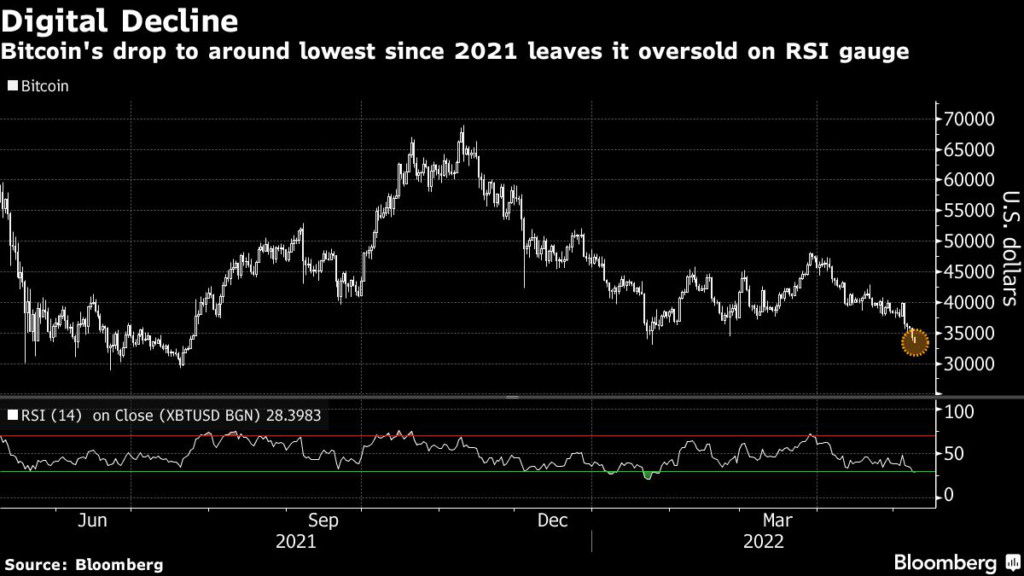
Bitcoin extended losses, dropping below $32,000 for the first time since July 2021, putting its decline from a November record high to more than 50% amid a global flight from riskier investments.

The world’s largest digital token fell as much as 7% on Monday and traded at around $31,924 as of 12:46 p.m in New York. Ether fell as much as 7.7%, while Solana dropped 12% and Avalanche dipped 13%.

Michael Novogratz, the billionaire cryptocurrency investor who leads Galaxy Digital Holdings Ltd., warned that he expects things to get worse before they get better. 

“Crypto probably trades correlated to the Nasdaq until we hit a new equilibrium,” Novogratz said on Galaxy’s first-quarter earnings call on Monday. “My instinct is there’s some more damage to be done, and that will trade in a very choppy, volatile and difficult market for at least the next few quarters before people are getting some sense that we’re at an equilibrium.” 

Tightening monetary policy to combat runaway inflation and ebbing liquidity are turning investors away from speculative assets across global markets. Adding to the caution around digital assets, the value of TerraUSD or UST, an algorithmic stablecoin that aims to maintain a one-to-one peg to the dollar, slid below $1 over the weekend.

“In light of fears of rising inflation, most investors have taken a risk-off approach — selling stocks and cryptos alike in order to cut down risk,” said Darshan Bathija, chief executive of Singapore-based crypto exchange Vauld.

Bitcoin Breaches Key Level; Do Kwon-Backed Stablecoin Slips

Rising interest rates are giving individual and institutional investors pause for thought about the crypto market outlook, according to Edul Patel, chief executive officer of Mudrex, an algorithm-based crypto investment platform. Bitcoin’s 30% decline in 2022 compares with a retreat of more than 10% in global bonds and shares, and a 2.5% advance in gold. 

“The downward trend is likely to continue for the next few days,” he said, adding Bitcoin could test the $30,000 level.

Bitcoin’s recent decline puts it at risk of firmly dropping out of the range where it’s been trading in 2022, completely reversing the most recent bull run that drove the token to a record of almost $69,000 in November. With its 40-day correlation with the S&P 500 stock benchmark at a record 0.82, according to data compiled by Bloomberg, any further hit to equities sentiment would risk dragging Bitcoin down as well. 

A correlation of 1 means two assets move in perfect lockstep; a reading of -1 means they move in opposite directions.  

More stories like this are available on bloomberg.com

©2022 Bloomberg L.P.

Wild Formula 1 Miami Parties Draw LeBron, Ivanka, and Beckham

(Bloomberg) — Formula One took over Miami for the first time this weekend, and its debut brought in stars as the city’s entire hospitality industry flexed its sizable muscles for several days of partying from the track to the beach.

Grand prix organizers projected that the race would bring about $400 million in economic impact to the area, and its famously wealthy fans indulged in a high-end spin on the city’s usual party fervor.  David Grutman, the man behind some of Miami’s trendiest restaurants and nightclubs, expects hospitality businesses to see a bump of up to 30% over what they normally do, aided by the rush of corporate sponsors looking for a piece of the action over the weekend.

“Any time you have an influx of corporate money and people activating events around, it’s the best for the city,” said Grutman. Or, as Miami native and baseball legend Alex Rodriguez told Bloomberg: “Nothing has rocked this city like F1. I’ve never seen anything like it.”

Mayor Francis X. Suarez said at a Bloomberg event on Friday the race tops off two years of work, since real-estate developer and Miami Dolphins owner Stephen Ross and his Hard Rock Stadium first came to the preliminary agreement with F1 in 2019. The local government has worked to attract asset management firms, venture capital funds, and the cryptocurrency industry in an effort to become a global technology hub. “It’s really the icing on the cake on 24 months of hypersonic growth that we’ve seen here,” said Suarez. 

On race week, much of the action and star power was centered in Miami Beach. New York restaurant Carbone, part of Major Food Group’s empire, opened a special beach location that had particular decadence. On the Thursday kickoff night, Ivanka Trump and Jared Kushner milled about the bar area as guests who paid $3,000 a seat plucked lobster and caviar from ice sculptures. Carbone flew in Italian opera singer Andrea Bocelli as the night’s surprise performer. Once most people had left after eating their pasta and steak, LeBron James (in full Miami-mode in a bucket hat) showed up to hang with friends. He came back the following night too, adding to a lineup that included Derek Jeter, Dwyane Wade, Gabrielle Union, Patrick Mahomes, David Beckham and Wyclef Jean.

Crypto platform FTX held a three-day festival on the sand in South Beach with food during the day and a EDM dance parties at night from DJs like Disclosure, Kaytranada, and Jamie XX. Poolside at the Fontainebleau hotel, where guests rented lawn pods for $10,000, suites for $20,000 and an island cabana for $60,000, Calvin Harris performed a DJ set that drew the influencer crowd. The guys from the Last 2 Leave creator house looked up to see an aerial light show, as drones buzzed around to make shapes before coalescing into the logo for Johnnie Walker whisky. Formula One Finally Found a Way to Get Americans to CareAustin Mahone, the singer and YouTuber who has more than 11 million followers on Instagram, told Bloomberg that being at Fontainebleau was “just a lifestyle that I love to live.” He’d be meeting up with Tony Parker, the former NBA star, for the race. “We’re team Ferrari. Go Ferrari,” he said. “This is exactly what Miami needed.” 

Unlike U.S. sports centered around primetime television, most Formula One races are held in daylight, aside from the night races in the Middle East and Singapore. That leaves plenty of time to prep for after-hours partying, a Miami specialty. The clubs brought in high-profile performers and were packed throughout the weekend. Grutman said the biggest difference is VIP over general admission, with a lot of sky-high minimums for anyone who wants a table.

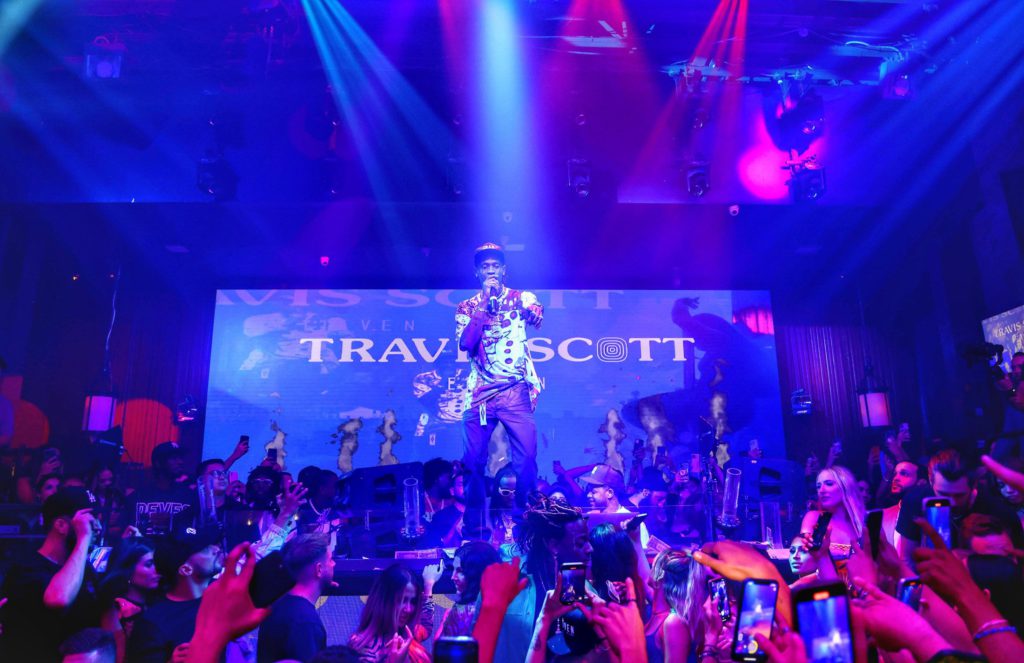
Snoop Dogg, Rick Ross, and Diplo each performed at downtown Miami club E11even, which on Saturday night saw the return of Travis Scott to the stage on for the first time since the tragedy at his Astroworld festival in November. He grabbed a mic at 3 a.m. and told everyone in the crowd to “lose their mother**** minds.” With the likes of influencer and boxer Logan Paul and Travis Kelce from the Kansas City Chiefs on hand, Scott consistently instructed the crowd to take shots while holding a bottle of Don Julio. At one point Quavo from Migos joined him on stage. 

Then there’s the actual track. The Miami International Autodrome that weaves its way around the arena is assembled just for this event, on private land that would normally be a parking lot when the Dolphins play on Sunday afternoons. U.S. sporting events have been adding more upscale hospitality than ever to their venues—just look at the five levels of suites at AT&T Stadium in Dallas—but the temporary nature of the grand prix setup allowed organizers to go all-in. At many races, like in Imola, Italy and Spielberg, Austria, the fans are fully focused on the track. Less so in Miami.

Right before the drivers took to the track to qualify, rapper Post Malone performed for a crowd at a pool party section, where people ordered food and bottle service to their cabanas. Restaurant Casa Tua set up a private trackside club at the exit of pit lane. Celebrities like Tom Brady, Michael Jordan, Bad Bunny, Shawn Mendes, and Pharrell watched from the paddock or the Palm Club.

But the talk of the weekend was the fake marina, a dry dock compete with fake water, made to replicate the vibe of the real yacht parties that go on during the race in Monaco.

After Red Bull’s Max Verstappen took home first place in the race and stood on the podium to receive his trophy—and a signed helmet from hall-of-fame Dolphins quarterback Dan Marino—Latin pop star Maluma and the Chainsmokers put on shows to close out the theatrics, just in case there weren’t enough.

More stories like this are available on bloomberg.com

©2022 Bloomberg L.P.

Wary of Crypto, Tanzania Shifts Closer to Own Digital Currency

(Bloomberg) — Tanzania is edging closer to introducing a central bank digital currency to help counter the rising popularity of cryptocurrencies in the nation.

“It’s important for us to provide a central bank digital currency as a safe alternative because many people are being affected by cryptocurrency speculators,” Bank of Tanzania Governor Florens Luoga said in an interview on Monday in Dar es Salaam, the commercial capital. The bank can’t ignore the technological advancement of money, he said.

Luoga spoke in reference to introducing a CBDC for payments similar to Nigeria, which was the first African country to start using the digital cash in October. China, the Bahamas, the Central African Republic, Kenya and Zambia are among the other nations that are issuing, piloting or studying consumer-facing digital currencies.

Nine in 10 central banks are exploring creating their own digital currencies, according to the bank of International Settlement. Governments are considering CBDCs as national currency — unlike their crypto counterparts, such as Bitcoin and Ethereum, which are not tied to fiat currency.

Tanzania has sent its officials to countries with more experience in CBDCs, including Nigeria, to learn from them, Luoga said. He declined to say when Tanzania’s may be introduced.

“We cannot ignore central bank digital currencies,” Luoga said. “Almost worldwide, central bank governors are in training right now and holding discussions on how to bring it about.”

More stories like this are available on bloomberg.com

©2022 Bloomberg L.P.
Prosecutor Who Took Down President Is Now Running South Korea

(Bloomberg) — South Korea’s Yoon Suk Yeol, a former prosecutor who made his name taking down a president, must now show he can govern as one.

Yoon took office when the clock ticked over to start Tuesday as South Korea’s eighth elected president since full democracy in 1987, facing daunting challenges from a Covid-ravaged economy to increasing weapons tests by North Korean leader Kim Jong Un. The conservative must overcome a hostile legislature, a lack of diplomatic experience and historically low popularity for an incoming elected leader in Asia’s fourth-largest economy.

Yoon, who in March squeaked out a victory in the closest presidential race in the country’s history, has called for greater private-sector-led growth, bolstering the nuclear power industry and a tougher approach toward China and North Korea. 

“The Yoon administration must revise and change pretty much all of the South Korean government’s strategic policies, including foreign policy and the policy for North Korea,” said Cheon Seong-whun, a former security strategy secretary for South Korea’s presidential office. 

The 61-year-old Yoon will be inaugurated at a ceremony in Seoul that starts Tuesday at about 11 a.m. He is set to share a stage at the ceremony with Park Geun-hye, a former president he helped send to prison when he was a lawman, and outgoing leader Moon Jae-in, whose progressive ruling party rammed through a prosecutorial reform law in his final days in office that could make it more difficult for the new government to probe possible wrongdoing by its predecessor.

U.S. second gentleman Douglas Emhoff, China’s Vice President Wang Qishan and Japanese Foreign Minister Yoshimasa Hayashi are expected to attend the inauguration ceremony, according to Yoon’s office. 

Conservative Election Win in South Korea Shows Hawkish Turn

While market players have been encouraged about the prospects of Yoon abolishing a capital gains tax planned for next year, surveys show the majority of the public is not sold on him as he embarks on the single-five year term for presidents. Yoon takes office with an approval rating of 41%, according to Gallup Korea, making him the first new elected leader not to hit 50% before taking over. The support rate is also below that of Moon, who leaves with a mark of 45%, it said.

Yoon will quickly be tested with President Joe Biden set to visit Seoul for talks about 10 days after he takes office. The U.S. leader may like what he hears from Yoon, who vowed the major semiconductor-producing country would take part in the Biden administration’s new supply chain initiative, strengthen military cooperation and back the Quad grouping of Australia, India, Japan and the U.S. that is seen as a counter to China’s assertiveness in the region.

“The incoming South Korean administration’s willingness to collaborate more with the United States as well as the Quad could have an impact on non-traditional security issues such as supply chain resilience,” said Naoko Aoki, a nonresident senior fellow at the Atlantic Council.

Aoki added coordination that involves the broader international community may be a challenge due to Russia’s invasion of Ukraine and U.S.-China competition. “It could also be difficult to steer the attention of the United States away from the Ukraine crisis, too, despite North Korea’s frequent missile tests,” she said.

Moon’s feud with Japan over contrition for its 1910-1945 colonial rule over the Korean Peninsula and efforts to court China frustrated U.S. efforts to stitch together a stronger coalition in Asia.  

But gridlock awaits Yoon, with Moon’s Democratic Party holding a supermajority in parliament until at least the next elections in 2024. 

Yoon squandered political capital before taking office with an unpopular decision to immediately move the presidential office from the long-used office and residence known as the Blue House. His government will take it to a part of Seoul where the Defense Ministry is located that also hosted a U.S. military base for decades.

South Korea President Yoon’s Blue House Move Will Reshape Seoul

North Korea’s official media has only mentioned Yoon once, delivering a one-sentence dispatch when Yoon won the March election. But Pyongyang has let him know that a rough ride awaits, after Moon for five years sought rapprochement and was often loathe to punish Pyongyang for its bad behavior. 

Since Yoon’s election, North Korea has been on a pace for its busiest year of missile tests, firing off in March its first intercontinental ballistic missile since 2017 and launching new missiles designed to strike South Korea with an atomic weapon. Meanwhile satellite imagery indicates North Korea is preparing for its first nuclear test in nearly five years.

The North Korean leader signaled he’s ready to use nuclear weapons against South Korea. Kim said at a military parade last month that his arsenal was not only to deter an invasion, but has a “second mission,” warning of a tactical strike “should there be an outbreak of an unwanted situation on this land.”

More stories like this are available on bloomberg.com

©2022 Bloomberg L.P.
Twitter Falls as Hindenburg Research Sees Risk of Deal Repricing

(Bloomberg) — Twitter Inc. shares fell as much as 4.1% on Monday after Hindenburg Research LLC, an investment research firm that focuses on activist short-selling, said it sees a “significant risk” that Elon Musk’s proposed offer to buy Twitter for $44 billion gets repriced lower.

The billionaire disclosed an offer on April 14 to buy Twitter for $54.20 a share and take it public. Initially there was some skepticism over where the world’s richest person would come up with the cash equity to fund the purchase. But about 10 days later, Musk outlined his financing plans and the board agreed to the offer. 

Hindenburg analysts said that “multiple developments have weakened the company’s position” since then, “threatening the current deal dynamic.” Hindenburg said it is short Twitter shares.

The researchers cited an ongoing meltdown in technology shares, Twitter’s own weak first-quarter results, including restating several years of user numbers, and the prospect that Musk will sell his 9% stake if the deal doesn’t come together.

“We are supportive of Musk’s efforts to take the company private, and believe he could get it done, but see no reason why he should at these levels,” Hindenburg wrote.

The Nasdaq composite index has plummeted about 17.6% since the last trading day prior to Musk’s disclosure of his stake on April 4th. Meanwhile Twitter has gained 23%.

“We believe if Elon Musk’s bid for Twitter disappeared tomorrow, Twitter’s equity would fall by 50% from current levels,” Hindenburg Research wrote. “Consequently, we see a significant risk that the deal gets repriced lower.”


More stories like this are available on bloomberg.com

©2022 Bloomberg L.P.
Shares Drop on Li Warning, Home Sales Tumble: Evergrande Update

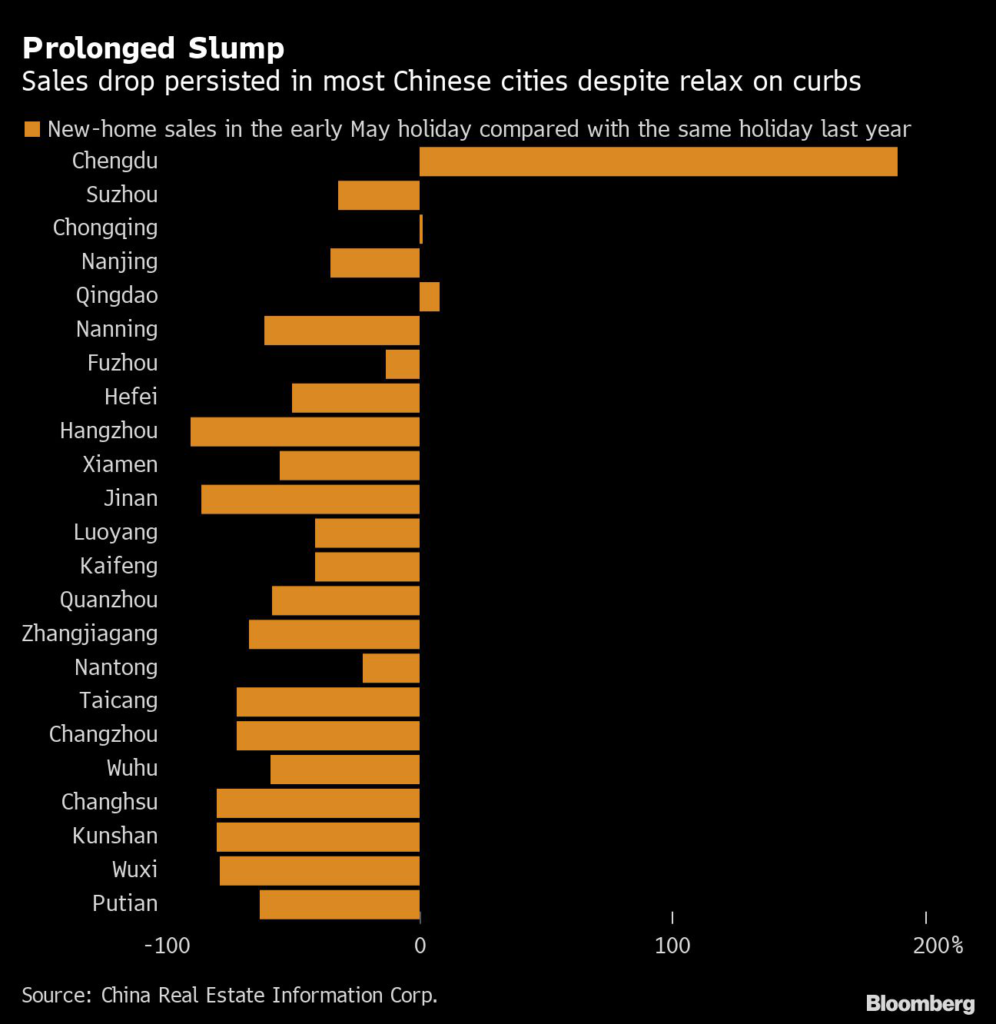
(Bloomberg) — New-home sales in 23 major Chinese cities plunged 33% by area during a five-day national holiday compared with a year earlier, despite policy makers’ pledges of support for the property market.

Chinese shares fell after Premier Li Keqiang warned that the nation’s employment situation was “grave,” as Beijing and Shanghai tighten virus curbs. A Bloomberg Intelligence gauge tracking junk dollar notes dropped last week for the third time in the past four five-day periods.

Exports from China grew at the slowest pace in April since June 2020. They are “unlikely to turn around anytime soon with the government appearing to be firmly committed to a Covid Zero policy for now,” Bloomberg economist Eric Zhu wrote.

Key Developments:

  • China Stocks Drop Again as Li’s Warning on Jobs Adds to Concerns
  • China Stimulus Fails to Ignite Housing Sales Over Key Holiday
  • China Premier Warns of ‘Grave’ Jobs Situation Amid Lockdowns (1)
  • China’s Oceanwide Loses $410 Million Manhattan Site to Lenders
  • China Property Sector Sees Slower Loan Growth by End March


Shimao Seeks Payment Extension on Public Bond (11:39 p.m. HK)

Shimao’s key onshore unit Shanghai Shimao is seeking to delay paying principal on a 500 million-yuan note due May 22 for a year, according to a Shanghai exchange filing late Monday. 

Shanghai Shimao will arrange a meeting with investors, the firm said, adding that the delay doesn’t amount to a default event. 

Li Keqiang Warning Hurts China Shares (2:23 p.m. HK)

Chinese shares fell after the premier warned that the employment situation was “complicated and grave,” deepening investor concern about economic damage from Covid outbreaks and strict curbs to contain them.

The CSI 300 Index slid as much as 1.4% as losses deepened in afternoon trading, although less than the 1.8% loss in the broader MSCI Asia Pacific Index. 

China’s exports grew at the slowest pace in April since June 2020, customs data showed Monday, as worsening virus outbreaks crimped demand, undermined production and disrupted logistics in the world’s second-largest economy.

Guangzhou R&F Gets Nod to Delay Payment (10:53 a.m. HK)

Guangzhou R&F Properties Co. obtained investor approval to effectively delay repaying the majority of a 6.48% 400 million yuan ($60 million) bond that’s puttable Monday, according to a filing to the Shanghai Stock Exchange dated Friday.

Under the new arrangement, the developer will still pay the coupon due for the past year on Monday but reschedule payments for the remainder of the bond originally due in 2024.

New Home Sales Drop Over Holidays (8:19 a.m. HK)

New-home sales in 23 major cities tracked by China Real Estate Information Corp. fell 33% by area, adding to the pain this year, after combined sales at the top 100 developers halved in the first four months. 

That’s despite the Politburo making sweeping vows to stimulate the economy and the top policy maker saying it would encourage “real housing demand,” in its clearest message condoning relaxation of property curbs. 

Oceanwide Loses Manhattan Site to Lenders (8:15 a.m. HK)

Lenders have seized control of the property where China Oceanwide planned to develop one of lower Manhattan’s tallest towers. 

Oceanwide defaulted on a $165 million loan on the project, at 80 South St., in January, leading to the transfer to a receiver as the property’s custodian, according to a filing by the developer’s Hong Kong affiliate. Oceanwide had invested $410 million in the project.

“The borrower has failed to pay all amounts demanded under the notice of default,” Oceanwide reported in the filing. “The company is continuously assessing the legal, financial and operational impacts of the actions to be taken by the initial lender.”

More stories like this are available on bloomberg.com

©2022 Bloomberg L.P.
Better Hires Ex-Goldman Marcus Head Talwar With Eyes on Listing

(Bloomberg) — Embattled online mortgage lender Better is turning to a former Goldman Sachs Group Inc. consumer-banking veteran to help it pursue a public listing just as rising interest rates pressure the business already reeling from a slew of personnel missteps.

The company appointed Harit Talwar as non-executive chairman, according to an internal memo from Chief Executive Officer Vishal Garg seen by Bloomberg News. He starts effective immediately and will “provide strategic direction to achieve Better’s long-term goals,” according to the memo.

Talwar’s appointment comes as Better grapples with hikes in interest rates that weighed on the company’s loan volume, leading it to make staff reductions over the past several months. The cuts sparked backlash after a December round of firings was carried out over Zoom, and Garg took a hiatus from the company for his handling of the situation. In Talwar, Better is getting a banking veteran with more than three decades of experience who built and led Goldman Sachs consumer-lending unit Marcus.

The non-executive chairman position was among leadership roles the company’s board said it would create and fill in the wake of an independent review carried out in the aftermath of the December firings. Talwar’s appointment follows the hiring of Richard Benson-Armer as chief people, performance, and culture officer in March. The company is still looking for a president.

“It is mission-centric, it is customer-centric, it has the track record, and it has challenges. And this is exactly the kind of situation in my career I’ve always jumped in,” Talwar said in a phone interview discussing his new appointment. “There will be challenges, both internal and external, but the goal is to build a business which we are proud of. The goal is to go public.”

More stories like this are available on bloomberg.com

©2022 Bloomberg L.P.
Truist Taps Credit Suisse’s Nemeroff for Software Dealmaking

(Bloomberg) — Truist Financial Corp. hired Credit Suisse Group AG managing director Michael Nemeroff, according to people with knowledge of the matter.

Nemeroff is set to join Truist in August as head of software investment banking, said one of the people, asking not to be identified discussing private information. He’ll report to Stellar Tucker, the firm’s head of technology investment banking. 

A Credit Suisse spokesman declined to comment, as did Nemeroff. A Truist representative didn’t immediately respond to a request for comment. 

Nemeroff, who’s based in New York, joined the Swiss bank in 2012, Finra records show. He transitioned to investment banking in 2018 from equities research, according to his LinkedIn profile. 

More stories like this are available on bloomberg.com

©2022 Bloomberg L.P.
Plunge in Crypto-Mining Stocks Deepens as Bitcoin Slumps

(Bloomberg) — The plunge in top crypto mining shares deepened Monday as Bitcoin tumbled along with the broader market on fears tightening monetary policy could throw the economy into a recession.

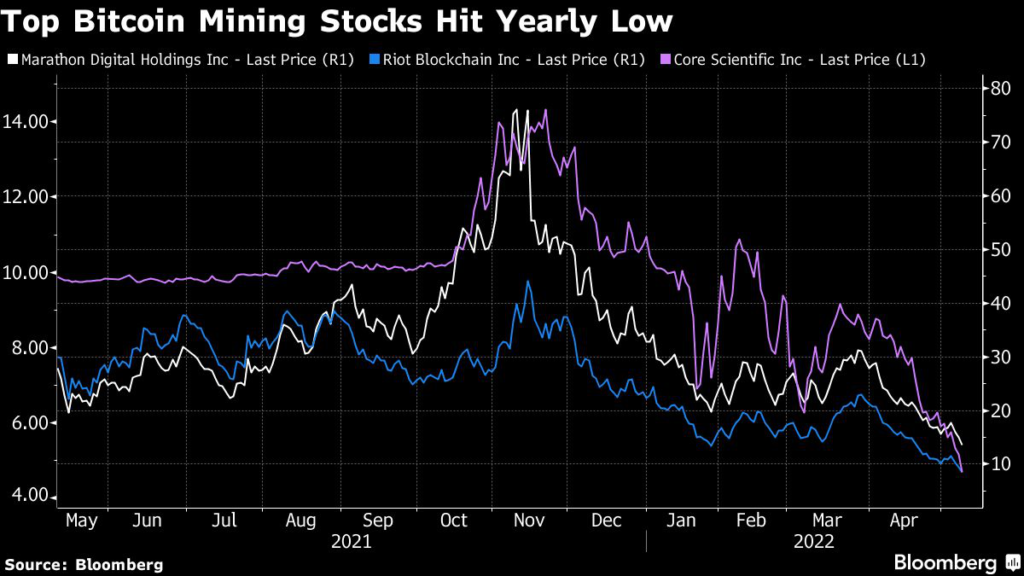
Marathon Digital Holdings, the largest public miner in the U.S. by market value, dropped 15% to $12.78, bringing its year-to-date losses to roughly 60%. Meanwhile, Core Scientific Inc. fell to a new low and Riot Blockchain Inc. declined to the lowest since 2020.

Crypto mining stocks have moved in tandem with the world’s largest cryptocurrency as such companies have large amounts of mined Bitcoin on their balance sheets. Investors, who do not want to directly hold Bitcoin in their portfolio, may choose such stocks as a proxy to bet on Bitcoin prices. 

“Crypto and equity markets are largely selling off in tandem due to a broad risk-off environment where many investors are moving to cash,” Steven McClurg, chief investment officer of Valkyrie Investments, said. “The correlation between the two asset classes has grown more pronounced in recent months because the number of publicly traded companies involved in blockchain and digital assets continues to grow, and is not likely to reverse course.”

Bitcoin fell below the key level of $33,000 over the weekend after a selloff in risker asset classes such as technology stocks followed moves by the Federal Reserve to boost interest rates in order to tame decades-high inflation. The tech-heavy Nasdaq 100 is suffering heavy losses, down 25% from a high in November, while the S&P 500 has shed about 14% over the same time period. 

Backers often champion Bitcoin as store of value similar to gold that’s uncorrelated with other financial markets. However, the digital currency has been among the most hard-hit asset classes by the risk-off environment. 

The losses come after shares of miners spiked late last year, along with Bitcoin, after a ban on crypto mining in China enabled the rest of the world to mine tokens with less competition. However, since then, shares have fallen along with the price of Bitcoin and as margins have deteriorated on higher energy prices stemming from sanctions on Russian energy imports. Shares of other crypto-exposed stocks such as MicroStrategy Inc. and Coinbase Global Inc. have also been in decline.

“In the short term, we believe the markets will continue to sell off through the summer, especially if rate hikes continue through the June and July FOMC meetings, before staging a potential rally through the end of the year in a pattern that has largely established itself over the past decade,” McClurg said. “One thing to watch is the yield curve, as an inversion would be a harbinger of further selloff. Recession is imminent.”

More stories like this are available on bloomberg.com

©2022 Bloomberg L.P.
Foreigners Make a Last Minute Dash for India’s Biggest IPO

(Bloomberg) — Foreign institutional investors stepped up their bids for India’s biggest share sale in the last hours before the close of subscription on Monday, shunning currency risks and global market uncertainties.   

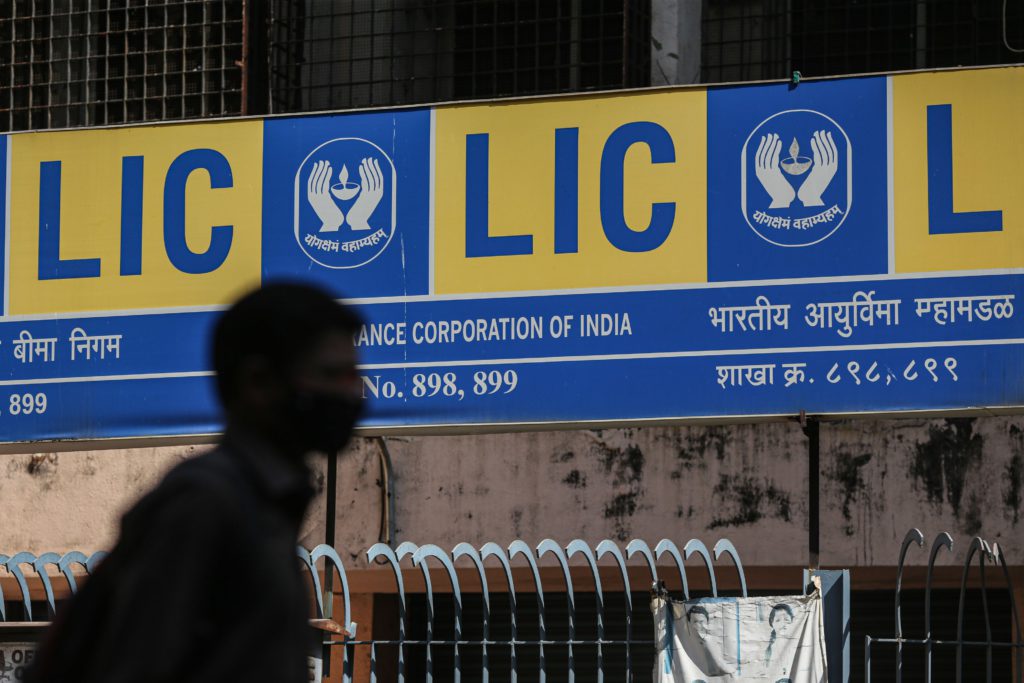
Overseas investors put in orders for 61% of the shares set aside for institutional buyers in the $2.7 billion initial public offering of Life Insurance Corporation of India, according to data from the exchanges. The portion was oversubscribed nearly three times by the end of the bidding. The issue opened on May 4 and received bids through the weekend.

While the anchor portion of the IPO also drew in sovereign funds from Norway and Singapore, most of the shares still went to domestic mutual funds.

“This shows that the capacity of our domestic investors and markets has gone up considerably,” Tuhin Kanta Pandey, secretary at the divestment department in the finance ministry, said at a briefing in New Delhi. “We can run our capital markets without being dependent on foreigners, though they are also welcome.” 

Dubbed India’s “Aramco moment” in reference to Gulf oil giant Saudi Arabian Oil Co.’s $29.4 billion listing in 2019 — the world’s largest — the float of LIC has ended up resembling the Aramco IPO not just in scale but in its reliance on domestic investors after some foreign buyers deemed it too expensive. 

LIC has been seeking to drum up interest with newspaper advertisements since the start of the year, seeking to take advantage of a retail investment boom in India.

India’s government had cut the fundraising of the IPO by about 60% as the war in Ukraine roiled markets, denting risk appetite, while rising U.S. interest rates are putting foreign investors off emerging market stocks. It also cut the valuation it is seeking for the country’s oldest insurer, which would be worth 6 trillion rupees ($77 billion) at the top of the price range.

“LIC is not only the largest insurance company but also the largest local investor in India. In a way its a proxy for the country’s growth,” said Jigar Shah, a Mumbai-based strategist with Kim Eng Securities Pvt. “The IPO was priced very wisely, making it attractive for investors, otherwise it would be difficult to get such response given market turbulence globally.”

Locals Pile In

While foreign investors picked up pace only on the last day, retail buyers have been piling in since the issue opened for subscription. Policyholders placed bids for over six times the shares reserved for them, while the employee portion received orders for four times the amount available, stock exchange data showed. Retail investors and policyholders will receive discounts on the offer price.

Overall, the IPO has received orders for nearly three times the shares on offer. The tranche for non-institutional investors, which includes corporates, was bid nearly three times.

Still, the international investor interest pales in comparison to some of last year’s Indian IPOs. One97 Communications Ltd., which operates digital payments firm Paytm, drew in the likes of BlackRock Inc., Canada Pension Plan Investment Board and Teacher Retirement System of Texas, among many others, for its 183 billion-rupee share sale last year. Food delivery platform Zomato Ltd. was similarly popular among foreign investors.

However, those buyers have been left nursing losses as enthusiasm over India’s tech boom waned after some flops. Paytm sank 27% on its debut and is now trading 74% below its offer price. Zomato had a strong debut last summer but has since lost 20% in value. 

Investors have also had concerns about LIC’s ability to keep market share as private insurers like HDFC Life Insurance Co. and SBI Life Insurance Co. expand. The private sector has been on an aggressive expansion spree during the pandemic, growing new individual policy premiums while LIC struggles. 

Read more: The Stunning Scale of India’s Biggest IPO Ever: QuickTake

(Updates throughout)

More stories like this are available on bloomberg.com

©2022 Bloomberg L.P.

Close Bitnami banner
Bitnami