

Bloomberg

Shaw Tumbles to Lowest Since 2021 as Rogers Takeover Looks Shaky

(Bloomberg) — Shaw Communications Inc. dropped to the lowest level in more than a year after saying that Canada’s antitrust agency is trying to block a takeover by Rogers Communications Inc. 

Shaw was down 9.4% to C$34.11 at 10:56 a.m. in Toronto, the lowest since April 2021. Rogers and Shaw will have to agree to changes or divestitures that satisfy the Competition Bureau or fight before the country’s Competition Tribunal, a process that could take months. 

The two companies received notice after markets closed on Friday that the antitrust agency plans to file an application to stop the merger. They said they remain committed to it and extended the closing deadline to July 31. Some analysts still believe the companies can complete their C$20 billion ($15.4 billion) transaction. 

“Sometimes the Competition Bureau just wants to slow things, put forward its arguments to be discussed with or without the Competition Tribunal, and possibly resolve issues,” National Bank Financial analyst Adam Shine said in a note to investors. 

Quebecor Negotiations

Rogers, which has offered C$40.50 a share for Shaw, wants to settle the matter out of court and has opened the door to selling assets to Montreal-based communications firm Quebecor Inc. to try to solve the antitrust concerns, according to a person familiar with the matter. 

The wireless business is a key sticking point for regulators: Shaw’s Freedom Mobile unit is Canada’s fourth-largest wireless provider, with a presence in several major markets including Toronto and Vancouver. Rogers has long been the largest wireless company in Canada, with more than 11 million subscribers. 

Rogers has drafted a deal to sell Freedom to Xplornet Communications Inc. But it’s possible that Quebecor ownership would be more acceptable to regulators because it already has 1.6 million wireless customers and has been a big spender on 5G spectrum. 

The company spent C$830 million on wireless licenses in an auction last year, and some are in Western Canada and could potentially be used to upgrade Freedom’s service, which isn’t a 5G network. Quebecor Chief Executive Officer Pierre Karl Peladeau has publicly expressed interest in buying Freedom under the right conditions. 

Rogers fell 6% to C$63.26. Quebecor fell 5.4%. 

“I think that what it means is the bureau is trying to put pressure on the parties, Rogers and Shaw, to conduct a fairer sale of Freedom wireless — to try to find a stronger competitor to offload it to” than Xplornet, according to Mark Warner, principal at MAAW Law in Toronto. 

“I’m not sure it really means we’ll actually see a contested merger. We might,” Warner said on BNN Bloomberg Television, referring to a merger that results in hearings at the Competition Tribunal. “But we do know that the commissioner of competition, Matthew Boswell, has talked about using the threat of litigation, if not litigation itself, to get better outcomes in negotiated settlements from parties.”  

(Updates share price, adds Warner comments and other updates)

More stories like this are available on bloomberg.com

©2022 Bloomberg L.P.

Lordstown Motors Sinks on Delay in Finalizing Foxconn Plant Deal

(Bloomberg) — Electric truck startup Lordstown Motors Corp.’s shares sank as much as 19% after it pushed back a deadline to complete the sale of its Ohio assembly plant to Taiwan’s Hon Hai Precision Industry Co Ltd., also known as Foxconn.

Lordstown postponed the closing of the Foxconn transaction for the former General Motors Co. plant by four days to May 18 and said Monday it will delay investment in tooling that would lower its production costs. Foxconn made $200 million in down payments on the $230 million purchase price for the Ohio plant. 

That marks the second delay of a deal that had originally been set to close last month. If it isn’t finalized by May 18 and the deadline isn’t extended, Lordstown would have to pay the money back — and has said it does not have the cash to do so.

“We’ve had constructive discussions with Foxconn,” Dan Ninivaggi , the company’s chief executive officer, said on a conference call with analysts. “It’s a complex deal. It’s taking a little bit longer than we expected. The fact that Foxconn agreed to extend the repayment deadline is a good sign.”

The stock pared an early drop to a record low of $1.55 and was trading down 11% to $1.69 as of 10:25 a.m. in New York. It is down about 50% so far this year.

The two companies are working to complete their agreement, which also includes a contract manufacturing arrangement with the Taiwanese maker of Apple Inc.’s iPhone and plans for joint development of future vehicles.

Lordstown will need to raise $150 million in cash this year, down from initial plans calling for $250 million, because of the deferred tooling investments, Chief Financial Officer Adam Kroll told analysts. But without that tooling, the cost to build the battery-powered Endurance truck will exceed its sale price. 

The startup, which has no revenue yet, also on Monday signaled delays in plans for mass production of the pickup. While production will start on time in the third quarter to build the first 500 trucks, it said some of those won’t be delivered until 2023. 

Lordstown, based in the northeastern Ohio village of the same name, lost 46 cents a share in its most recent quarter, which was a penny more than analysts had estimated.

More stories like this are available on bloomberg.com

©2022 Bloomberg L.P.

Rogers Looks to Longtime Foe to Help Rescue Shaw Deal

(Bloomberg) — To close one of Canada’s biggest-ever takeovers, Rogers Communications Inc. may need help from an unlikely ally: a rival telecommunications company led by an outspoken Quebec separatist with a penchant for lawsuits. 

Rogers is trying to acquire Shaw Communications Inc. for about C$20 billion ($15.5 billion), but the deal is in jeopardy because the country’s Competition Bureau is trying to block it. Rogers is trying to solve the most difficult antitrust issue by selling Shaw’s wireless division, which competes in major markets such as Toronto, Calgary and Vancouver under the name Freedom Mobile. 

That’s where Quebecor Inc. and its controlling shareholder, Pierre Karl Peladeau, enter the picture. 

Peladeau has suggested numerous times that he would be interested in buying Freedom, under the right conditions. But until recently, Rogers has been focused on cutting a deal with other parties, including New York-based investment fund Stonepeak Partners LP, which controls Canada’s Xplornet Communications Inc. 

Executives at Rogers have now opened the door to a deal with Quebecor, Bloomberg News reported Saturday, in the belief that they may have no other choice if they want to rescue the Shaw merger. 

Shares of all three Canadian telecom companies fell in Monday morning trading in Toronto. Shaw fell 9.5% and Rogers and Quebecor were each down 5.5% shortly before 10 a.m. in Toronto. 

Montreal-based Quebecor is a dominant force in media and communications in Quebec. It’s in newspapers, television, music, entertainment production, cable and internet service — and has 1.6 million wireless customers. Buying Freedom would add another 2 million users and represent a bold expansion outside its home province. 

“Quebecor has been the only operating entity that has consistently expressed an interest in acquiring Freedom,” BMO Capital Markets analyst Tim Casey said in a note Sunday. “Until now, we do not believe they have engaged in any meaningful discussion with Rogers on a potential transaction.”  

That may be because the two companies have a longstanding rivalry and an unpleasant history.

Partners and Combatants 

Peladeau got into the cable business, in fact, by beating Rogers in a bidding war for Quebec cable company Videotron in 2000. The firms have been occasional business partners and legal combatants since then. 

In 2017, Quebecor filed a complaint against Rogers with regulators that accused it of breaching a sports-broadcasting agreement. Last year, Peladeau’s company sued its larger rival over a network-sharing agreement that turned sour.

Peladeau, 60, one of Quebec’s most powerful entrepreneurs, took a brief detour out of business and into politics in 2014, running as a candidate for the separatist Parti Quebecois and declaring he wanted the province to seek independence from Canada. The election turned into a disaster for the party, and after a brief time as its leader, Peladeau quit politics and returned as Quebecor CEO. 

Since then, he has worked at making Quebecor one of the few companies that’s truly competitive with Canada’s three dominant wireless providers — Rogers, BCE Inc. and Telus Corp. — but only in Quebec. 

“I think it makes a ton of sense for them to bid for Freedom Mobile,” Morningstar analyst Matthew Dolgin said in an email. “Quebecor intends to expand its wireless business throughout much of the country anyway” and the move would immediately make them the fourth-largest player. A spokesperson for Quebecor declined to comment Sunday.

One reason a Quebecor bid for Freedom Mobile assets might be more palatable to regulators is that Peladeau’s company has been a big spender on 5G spectrum. It spent C$830 million on wireless licenses in an auction last year. Some of that spectrum is in Western Canada and could potentially be used to upgrade Freedom’s service, which isn’t a 5G network.  

“If Quebecor can jump into the Freedom data room quickly and be enticed to bid, as it wished to do all along, then the possibility exists that the Rogers-Shaw deal could close mid-summer,” National Bank Financial analyst Adam Shine said in a note to investors Sunday. “The two big factors are whether the cable merger is indeed palatable and is Quebecor the acceptable buyer of Freedom.”

The analyst added: “Is Quebecor truly the magical buyer being sought all along by the Competition Bureau? We’ll now wait and see because the company has apparently entered the process.”

(Updates with share price moves in sixth paragraph)

More stories like this are available on bloomberg.com

©2022 Bloomberg L.P.
Megacap Optimists Buckle Under Weight of Bear Market

(Bloomberg) — The brutal rout in tech stocks this year is shaking analysts’ confidence in once high-flying megcaps.

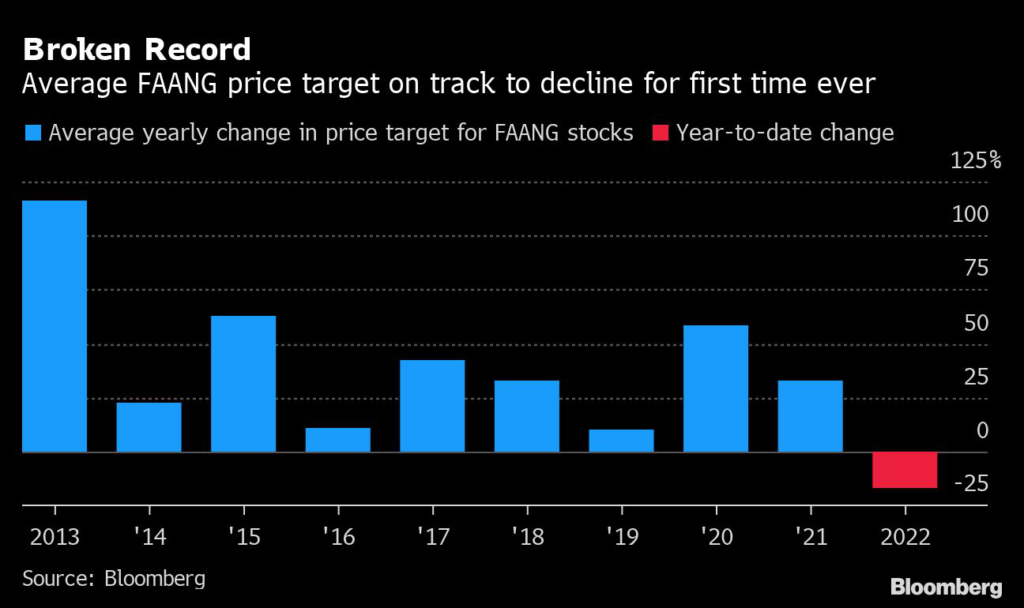
Brokerage firms expect shares of the so-called FAANG companies in aggregate to trade for less in the next 12 months than they had projected at the start of the year. The share-price targets for Facebook owner Meta Platforms Inc., Apple Inc., Amazon.com Inc., Netflix Inc. and Google parent Alphabet Inc. have fallen by more than 17% on average in 2022, putting that measure on track to decline over the year for the first time on record.

The turnabout in sentiment reflects the bear market that has hit the Nasdaq 100 Index this year, triggered by Federal Reserve interest rate increases, the impact of surging inflation on consumer demand, and supply-chain snags, all of which have fueled fears of an economic slowdown. 

“It’s analysts catching up to reality, and this is a massive change on how companies are being valued,” said Greg Taylor, chief investment officer at Purpose Investments. “We’re now going to get the reality that with interest rates at these levels and inflation at these levels, these high-growth companies are not going to be valued the way they were.” 

The headwinds also have shown up in weaker-than-expected quarterly results. Amazon experienced a historic rout amid slowing e-commerce growth and disappointing forecasts, while Apple warned that supply constraints would hurt sales. Netflix had a shockingly weak subscriber outlook and Alphabet released first-quarter revenue that fell short of analysts’ expectations. 

Steadily rising profit estimates — a hallmark of the group for years — are now hitting a wall. The average 2022 earnings per share estimate for Amazon has fallen more than 50% over the past month, according to data compiled by Bloomberg. Alphabet has seen its estimates drop 1.7% over the same period, while Apple, Microsoft and Meta Platforms projections are little changed. 

Even after a 22% drop for the Nasdaq 100 this year, some investors say tech stocks are still too pricey. Amazon sits at the top, trading at about 40 times estimated earnings, while Apple is at 25, Alphabet and Netflix are at 16 each and Meta at 14. The Nasdaq 100 Index is at 18 times projected profits. 

“While some technology stocks are facing earnings challenges, the key issue in this current market rout is not so much earnings, but valuations,” said David Bahnsen, chief investment officer at The Bahnsen Group, a $3.6 billion wealth management firm. “It is starting to feel very much like this is the moment when the market has had enough with stocks that were trading at excessive valuations.”

While analysts are dialing back their optimism, they haven’t completely capitulated — their forecasts still imply an average climb of 48% in the next year for the FAANG stocks. The Nasdaq 100 is projected to climb 33% over the same period and the S&P 500 is seen rising 25%. Apple is the only one of the five for which analysts have raised their average price target this year.  

“There are names like Facebook that are trading well under a market multiple and which have potential for growth,” said Dennis Dick, head of markets structure and a proprietary trader at Bright Trading.  “If you have 100% cash, it is probably time to put some of that to work.”


Tech Chart of the Day

Netflix Inc.’s stock-market value again surpassed Walt Disney Co.’s at the end of last year as the streaming race heated up. However, Netflix has since reported two consecutive disappointing quarters. The once high-flying stock has fallen 70% this year, the biggest drop in the S&P 500 index. Its market value now stands at $80.7 billion compared to Disney’s $200 billion.

Top Tech Stories

  • Infineon Technologies AG raised its revenue forecast for 2022 amid strong demand for its semiconductors, in particular those it makes for the automotive industry, but the company said it expects a global semiconductor supply crunch to persist
  • Democrats in the U.S. Congress should press ahead and rein in tech giants as the companies seek to stall antitrust laws by arguing Americans care more about privacy than competition, advocacy groups said
  • Zoom Video Communications Inc. is likely to be a prime beneficiary from a “rip and replace” cycle for the enterprise communications sector, Ark Investment Management’s Cathie Wood says in a tweet
  • Bitcoin is falling toward levels last seen in July 2021, part of a wider retreat in cryptocurrencies amid a global flight from riskier investments
  • Bill Gates said interest rates are likely to rise enough to cause a global economic slowdown, triggered by Russia’s invasion of Ukraine and fallout from the Covid-19 pandemic
  • Ford Motor Co. is selling 8 million of its shares in electric-pickup maker Rivian Automotive Inc. as an insider lockup expires Sunday, according to CNBC’s David Faber
  • Nippon Telegraph & Telephone Corp. is transferring its overseas business unit to networking and data subsidiary NTT Data Corp.
  • Shopify Inc. dodged privacy claims brought by an online shopper who alleged that the e-commerce platform collected his sensitive private information without his consent in violation of California law, after a federal judge threw out the proposed class action

(Updates market values in last paragraph.)

More stories like this are available on bloomberg.com

©2022 Bloomberg L.P.
Palantir Craters Most Since 2020 on Wider-Than-Expected Loss

(Bloomberg) — Palantir Technologies Inc. shares plummeted as much as 22% on Monday, the biggest intraday drop since September 2020, after the software maker reported mounting losses and a disappointing sales forecast.

The company lost $101 million in the first quarter, a sign it’s struggling to improve margins by offering more automated data analysis software. The net loss was an improvement over the same period a year ago but wider than analysts expected. The loss was 5 cents a share, the company said in a statement Monday.

Revenue in the second quarter will be at least $470 million, Palantir said. Analysts had been expecting $487 million on average, according to data compiled by Bloomberg.

The Denver-based company is known as much for its work supporting national defense and pandemic response for the U.S. and its allies as for its polarizing co-founders Peter Thiel and Alex Karp. Palantir has overhauled its software in recent years to make the product more customized to each customer, but growth from corporate users had historically been slow.

But in the quarter that ended in March, revenue growth from government customers slowed to 16% with sales totaling $241.7 million. Although that’s better than the 6% growth analysts expected, it’s the slowest quarterly growth for the segment since Palantir began reporting results as a public company in late 2020.

Palantir expects government revenue to increase through the rest of the year, driven by what executives painted as an increasingly violent and uncertain future where conflict is the norm, they said on a conference call with analysts Monday. Both Karp and Chief Financial Officer Dave Glazer warned of possible nuclear war.

“The threat of a nuclear event is so much higher than is being presented in the public,” Karp said. “It’s almost surreal to watch the coverage.”

Sales from U.S. companies were a bright spot in the first quarter. They more than doubled from a year earlier. Globally, commercial sales grew 54% to $204.5 million, blasting past analysts’ estimates, data compiled by Bloomberg shows.

Palantir hired Oracle Corp.’s Philippe Mathieu last fall to lead commercial sales efforts across Europe, the Middle East and Africa with the goal of signing new customers and expanding on existing relationships with the likes of Airbus SE, Merck & Co. and Ferrari. A Palantir customer since 2016, the Italian luxury sports car manufacturer expanded its use of the software in February for its Formula1 racing efforts. Palantir is now featured on both the cars and some drivers’ racing suits. It also struck a long-term deal with Hyundai Heavy Industries.

Government customer growth slowed during the quarter, despite new and expanded deals with agencies spurred by continuing fallout from the pandemic and rising geopolitical tensions, particularly the Russia-Ukraine conflict.

Palantir doesn’t work with China or other countries that are not aligned with U.S. national security interests, Karp vowed in a letter to shareholders preceding its 2020 public debut — a promise executives have often repeated since then.

In recent months, Palantir expanded deals with agencies including the U.S. Centers for Disease Control and Prevention and the National Institutes of Health to aggregate health data including wastewater to track Covid-19 infections and deliver therapeutic drugs.

Palantir is also seeking to strengthen its defense, intelligence and national security efforts. It said in March that a half-dozen former government officials had joined a federal advisory board. Former Acting Deputy Secretary of Homeland Security Jeh Johnson, now a counselor to Palantir, will also attend the meetings.

Glazer, the CFO, declined to forecast when Palantir would turn a net profit when asked by an analyst Monday. He said the company is making “significant progress” on its financial performance, referred to the operating margin and then abruptly shifted to geoplitics.

Adjusted earnings in the March quarter were 2 cents a share, falling short of the 3 cents analysts expected, according to estimates compiled by Bloomberg.

(Updates with executives comments throughout.)

More stories like this are available on bloomberg.com

©2022 Bloomberg L.P.
DeFi Platform Compound Prime Gets Junk Credit Rating From S&P

(Bloomberg) — Decentralized finance platform Compound Prime LLC received a junk credit rating from S&P Global Ratings, underscoring how crypto lending is making inroads among institutional investors — as well as the risks involved. 

S&P on Monday issued a B- long-term rating for Compound Prime, six levels below investment grade, with a stable outlook. It cited uncertainty around the regulation of cryptocurrencies as one of the risks to Compound Treasury’s rating. Stablecoins are tokens which are pegged to the value of an asset, typically the U.S. dollar. 

What Are Stablecoins? Why Are Regulators After Them?: QuickTake

Compound Prime, a subsidiary of Compound Labs Inc., oversees the company’s Treasury product which takes deposits in U.S. dollars and converts them into the USDC stablecoin. The tokens are then supplied to the broader DeFi lending project Compound to generate a promised 4% interest rate for accredited investors. 

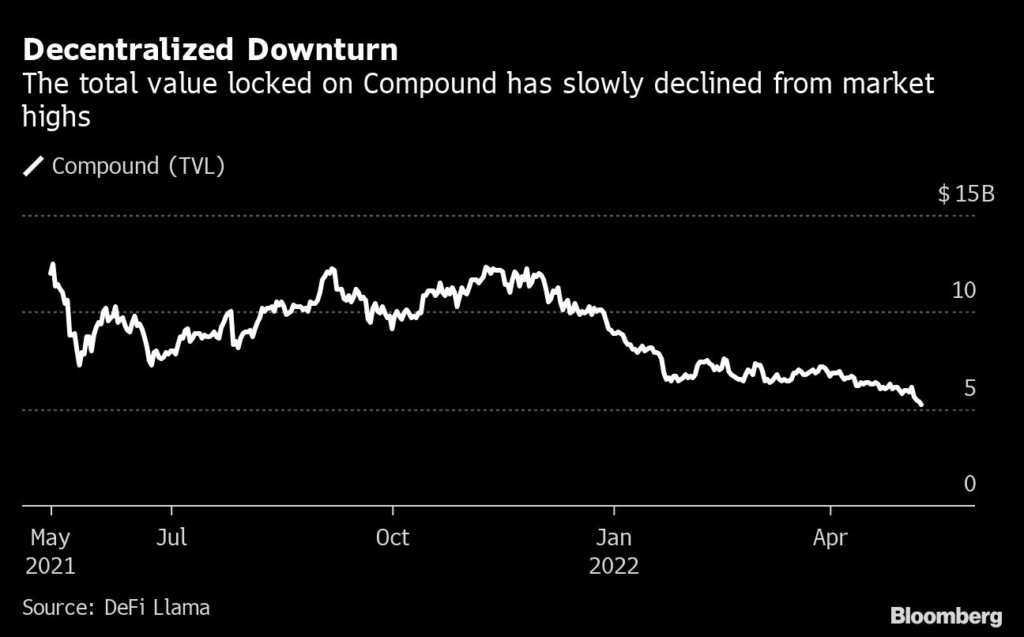
Compound Labs announced the Treasury offering in June last year. It has about $5.2 billion in total value locked to the Compound protocol, according to data from tracker DeFi Llama.

Among other risks S&P cited in its rating of Compound Prime was the convertibility of private stablecoins back into fiat currency, as well as the platform’s “very low” capital base, operational complexity and “the potential hurdles” to generate its 4% return.  

“The stable outlook reflects our expectation of limited loan losses on the platform but also of very low profitability and a fast-expanding balance sheet, which we believe will weigh on an already weak capital position,” the ratings agency said in its report.

Reid Cuming, general manager of Compound Treasury, said separately in a blog post that the rating from S&P signals “tremendous progress in the crypto industry’s maturity.” It is the first credit rating for an institutional DeFi offering from a major ratings firm, according to Compound Treasury. A spokesperson for S&P declined to comment.  

DeFi projects let investors trade, borrow and lend digital tokens without involving intermediaries like banks. Some also offer a strategy known as yield farming, where platforms advertise high interest rates for investors staking tokens on the underlying protocol. The industry has $133.5 billion in total value locked, DeFi Llama data show. 

Highlighting DeFi’s tentative steps into the financial mainstream, firms like Jane Street have recently started making use of such offerings. Fairfax County, Virginia, is considering putting pension fund money in two crypto funds that use yield farming to generate returns, an official said last week.

More stories like this are available on bloomberg.com

©2022 Bloomberg L.P.

India Shifts Stance, Berates Social Media for Censorship

(Bloomberg) — The Indian government reversed its stance, calling out Twitter Inc. and Meta Platforms Inc. for suspending accounts that violate the social media giants’ community guidelines.

Twitter’s decision to suspend lawyer Sanjay Hegde’s account about three years ago violates the Indian constitution and free speech rights, the Ministry of Information Technology said in a court filing last week, according to people with knowledge of the matter. 

This follows a filing last month, where the government said Meta and Twitter must follow Indian laws that require the firms to give users a reasonable chance to defend themselves before a post is removed or the account suspended, except in extreme cases such as content relating to rape threats or terrorism, the people said, asking not to be identified as the details are private.

The government’s current stance contrasts with a 2019 filing, when it said the matter was for Hegde and Twitter to resolve.

A ruling on this batch of cases with the Delhi High Court can decide tech companies’ powers of censorship in the country of more than 1.3 billion people, at a time when Elon Musk’s views on content moderation are in focus globally. It also adds a new dimension to the Indian government’s long-running feud with social media firms.

India Lawmakers Weigh New Regulator to Oversee Facebook, Twitter

Twitter declined to comment while Facebook and the Ministry of Electronics and Information Technology did not respond to requests for comments.

Public Duty

The two tech giants have been repeatedly at odds with Prime Minister Narendra Modi’s administration’s push to regulate big social media under the information technology rules of 2021. In a court case last year, Twitter agreed to comply with new rules while Meta has challenged in court the rules that can also force its messaging platform WhatsApp to break its encryption. 

Both Twitter and Meta have in separate filings defended their power to remove posts or user accounts saying they follow their community guidelines and terms of service agreed by users, according to the people familiar. Petitioners have argued that social media giants have practically gained a duopoly and they perform a public function.


More stories like this are available on bloomberg.com

©2022 Bloomberg L.P.
Dollar Dominance Rips Through Every Market on Fed, China Risks

(Bloomberg) —

The dollar is ruling global markets in the dash for safety. 

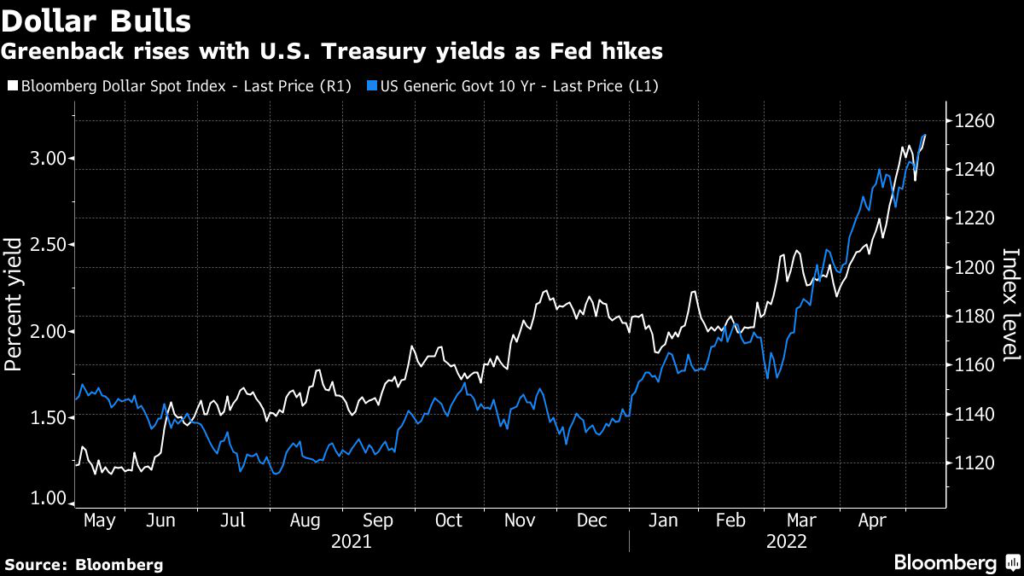
As stocks, bonds and commodities plummeted on Monday, an index of the dollar continued its relentless advance to a two-year high. The currency is an indisputable haven in a market that’s being thrashed by accelerating inflation, worries about a recession and China’s Covid lockdowns. 

Market positioning data shows the dollar is drawing in more adherents. Hedge funds boosted long bets to the highest this year, according to data from the Commodity Futures Trading Commission in the week to May 6. 

“It doesn’t look like this trend will turn any time soon,” said Chris Turner, head of currency strategy at ING Groep NV. “You’ve got the Fed, you’ve got the renmimbi and you’ve got Europe, and it’s hard to bet on any of those issues changing in the near term.” 

As a consequence, many of the dollar’s global counterparts are falling to levels that haven’t been seen in years. The pound slid to a fresh 2020 low, the yen dropped to the weakest since 2002, while India’s rupee slumped to a record low.

The Bloomberg Dollar Spot Index added 0.2 as of 8:20 a.m. in New York. U.S. Treasuries extended a slide, driving the yield on five-year notes to the highest since 2008. 

Many of the concerns about slowing global growth are being driven by China. The nation’s Premier Li Keqiang warned on the weekend of a “complicated and grave” employment situation as Beijing and Shanghai tightened curbs on residents in a bid to contain Covid outbreaks in the country’s most important cities. 


China’s weak export reading comes on the heels of a report last week showed manufacturing activity plunged to its worst level since February 2020. Currencies linked with Chinese growth struggled, with both the Australian and New Zealand dollars slumping around 1% on the day.

Developing-nation currencies are also being pummeled due to the threat of funds being pulled from their stock and bond markets as U.S. yields rise.

“Fragile” emerging economies with current-account deficits including Turkey and nations in Africa are particularly vulnerable, said Alvin Tan, a strategist at Royal Bank of Canada in Hong Kong. A stronger dollar “encourages capital outflows from emerging-markets and tightens EM financial conditions,” he said.  

Traders will next be looking to Wednesday’s monthly U.S. consumer-price data, given the pace of inflation in April is expected to slow in a Bloomberg survey. That could spark a re-think in the market about how aggressive the Fed’s tightening path will be, according to Simon Harvey, head of currency analysis at Monex Europe.

“All it takes a minor slip in the core CPI reading for markets to go back to the drawing board,” said Harvey. “Especially because of the aggressive positioning we’ve been seeing, it only needs one slip for markets to want to pullback in Treasuries, money market pricing and the dollar,” he said, adding a weak reading could spark a dollar retreat toward 130 versus the yen.

More stories like this are available on bloomberg.com

©2022 Bloomberg L.P.
BofA Hires JPMorgan’s Bhandari as EMEA Private Markets Co-Head

(Bloomberg) — Bank of America Corp. has hired Rahul Bhandari from JPMorgan Chase & Co. as managing director and co-head of its private capital markets business in Europe, the Middle East and Africa.

Bhandari will take up the new role in the early summer, according to an internal memo seen by Bloomberg News. Based in London, he’ll work alongside EMEA private markets co-head Aga Masud. Bhandari was previously head of EMEA private capital markets at JPMorgan. 

A representative for Bank of America confirmed the contents of the memo. 

Banks are dedicating ever more resources to their private capital teams, as startups continue to chase new money at elevated valuations. Cryptocurrency firm Blockchain.com and Turkish grocery-delivery company Getir were each valued at more than $10 billion in recent funding rounds, while Swedish payments firm Klarna Bank AB is weighing plans to raise capital at a valuation of roughly $50 billion to $60 billion.

To be sure, the pace of fundraising by startups has started to cool as pressures on valuations in the public markets ramp up. Venture capital transactions raised $148 billion globally in the first quarter, down nearly 25% from the last three months of 2021, according to data provided by analytics firm PitchBook.

More stories like this are available on bloomberg.com

©2022 Bloomberg L.P.

Novogratz’s Galaxy Digital Posts Quarterly Loss on Crypto Price Slide

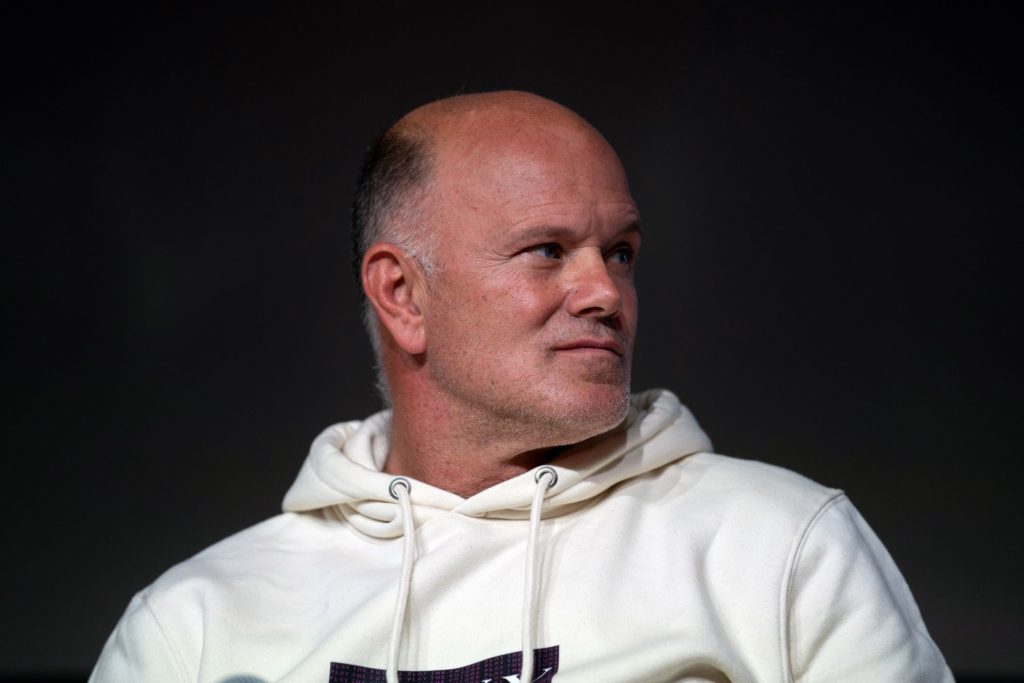
(Bloomberg) — Galaxy Digital Holdings Ltd., the cryptocurrency firm controlled by billionaire Michael Novogratz, posted a loss in the first quarter against a backdrop of large digital asset price declines. 

The net comprehensive loss was $111.7 million, compared to a gain of $858.2 million in the year-ago period, primarily due to unrealized losses on digital assets and investments in its trading and principal investment businesses. That was partially offset by profitability in investment banking and mining units. The company had warned of a loss of $110 million to $130 million in the first quarter through March 28, citing market volatility. 

Galaxy, which offers businesses ranging from crypto trading and asset management to mining, said it was managing $2.7 billion assets as of March 31, a 5% decline from end of last year.  

More stories like this are available on bloomberg.com

©2022 Bloomberg L.P.

Close Bitnami banner
Bitnami