Bloomberg

Crypto Exchange Bitstamp Names JB Graftieaux as CEO

(Bloomberg) — Bitstamp Ltd., the world’s fourth-largest cryptocurrency exchange, appointed JB Graftieaux as chief executive officer, replacing Julian Sawyer.

Graftieaux joined Bitstamp in May 2021 as CEO of its European business, the firm said in a statement on Monday. He started in his new role on May 7. Graftieaux previously worked as Bitstamp’s chief compliance officer between 2014 and 2016, before leaving for a senior role at eBay’s European unit.

Bitstamp, founded in 2011, is the fourth-largest cryptocurrency exchange by 24-hour trading volume, according to data from CryptoCompare. The Luxembourg-headquartered firm is also Europe’s largest exchange by the same metric. The company has more than 500 employees, according to the statement.

Sawyer, who joined Bitstamp as CEO in 2020 following an 11-month stint running rival crypto exchange Gemini’s European business, “has decided to pursue other opportunities,” the company said. Sawyer did not immediately respond to a request for comment.

Bitstamp recently launched a crypto-as-a-service product in North and South America, having operated the offering for institutional clients in Europe for the past five years. The platform makes it easier for banks and financial services firms to offer crypto trading services to their customers. 

Crypto Exchange Bitstamp USA Taps Wall Street to Boost Diversity

More stories like this are available on bloomberg.com

©2022 Bloomberg L.P.

New York Hospitals Battle Supply Shortages on Shanghai Lockdown

(Bloomberg) — Shanghai’s strict Covid-19 curbs are disrupting health care services halfway across the world, with hospitals in New York suffering a shortage of chemicals used in imaging tests — the latest example of how the Chinese city’s five-week-long lockdown is snarling global supply chains.

Health care facilities have seen shortages of an iodinated contrast medium known as Omnipaque that’s produced at a GE Healthcare factory in Shanghai, the Greater New York Hospital Association said in a May 4 statement. The chemical agent is widely used in X-rays, radiography and CT scans.

The hospital body also warned that supplies may be curtailed by as much as 80% for the next two months even though the factory has resumed production. It recommended health care providers ration existing stock for essential use only while seeking out other suppliers and considering alternative scanning tests for patients. 

A representative for GE Healthcare, the $17.7 billion unit of General Electric Co., said in an emailed response that the firm was “working around the clock to expand capacity” of the imaging chemical. “After having to close our Shanghai manufacturing facility for several weeks due to local Covid policies, we have been able to reopen and are utilizing our other global plants wherever we can,” GE Healthcare said in the email. “We are working to return to full capacity as soon as local authorities allow.”

China’s dogged pursuit of its Covid-zero strategy, exemplified in the stringent lockdown of its financial and trade hub since early April, has hobbled global supply chains and hurt companies from Tesla Inc. to Apple Inc. Critical components for everything from PCs to smartphones and automobiles are either being produced in insufficient quantities or are stuck in a logjam at the Shanghai port, the world’s biggest container terminal.

A slew of carmakers ranging from Volkswagen AG to Toyota Motor Corp. and Chinese EV maker Nio Inc. have only just started to resume production at factories in Shanghai and the industrial province Jilin, which has recently reopened after a lockdown. The Shanghai city government said last week that more than 70% of the 1,800 industrial companies it monitors had resumed production as of May 4. But the supply chain may take some time to ease up. 

As Shanghai emerges from its worst Covid outbreak as cases decline from a peak of over 27,000 new infections daily to fewer than 4,000 this week, officials continue to find cases outside of isolation facilities and sealed residential compounds in the city of 25 million people. The persistence of such community spread means authorities are unlikely to meaningfully ease movement restrictions for fear of reigniting the outbreak. 

More stories like this are available on bloomberg.com

©2022 Bloomberg L.P.

Distrust in South African State Puts Charity at Relief Forefront

(Bloomberg) — Some of South Africa’s biggest companies have pledged millions of rand to help fund a prominent charity’s response to deadly floods, highlighting the government’s shortcomings when it comes to managing and dispensing relief.  The Gift of the Givers stepped in to help those affected by the floods and landslides that washed away roads, …

Distrust in South African State Puts Charity at Relief Forefront Read More »

Bitcoin Flirts With Lowest Level Since 2021 as Equities Swoon

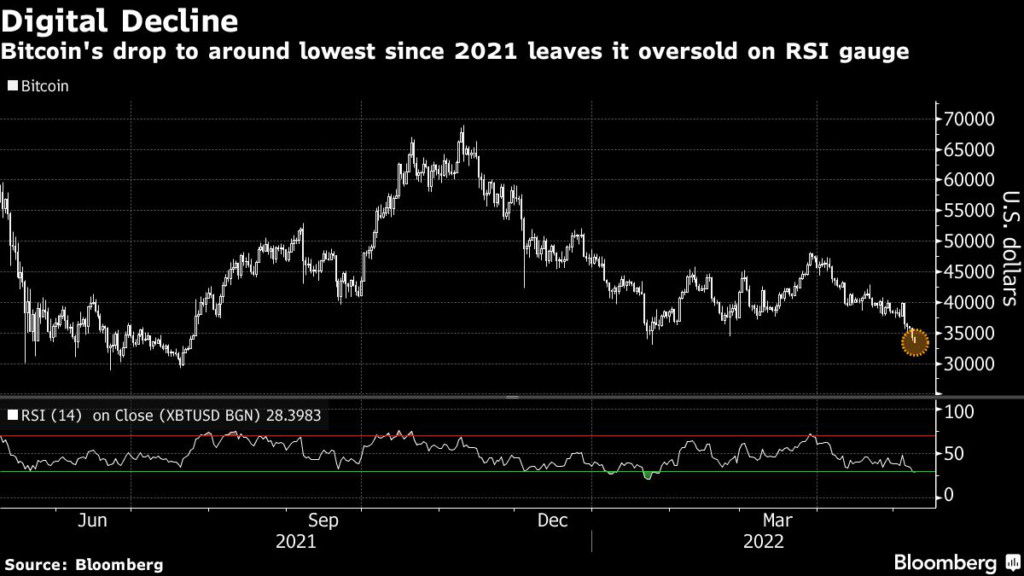
(Bloomberg) — Bitcoin is falling toward levels last seen in July 2021, part of a wider retreat in cryptocurrencies amid a global flight from riskier investments.

The world’s largest digital token dropped as much as 2.7% on Monday and was trading at $33,568 as of 8:44 a.m. in London. The second biggest, Ether, shed as much 4.6%. Most of the major virtual coins were under pressure over the weekend and the downbeat mood carried over into Monday. Equities in and Europe also dropped, with Hong Kong’s benchmark index slumping 3.8%. 

Tightening monetary policy to combat runaway inflation and ebbing liquidity are turning investors away from speculative assets across global markets. Adding to the caution around digital assets, the value of TerraUSD or UST, an algorithmic stablecoin that aims to maintain a one-to-one peg to the dollar, slid below $1 over the weekend before recovering.

“In light of fears of rising inflation, most investors have taken a risk-off approach — selling stocks and cryptos alike in order to cut down risk,” said Darshan Bathija, chief executive of Singapore-based crypto exchange Vauld.

Bitcoin Breaches Key Level; Do Kwon-Backed Stablecoin Slips

Rising interest rates are giving individual and institutional investors pause for thought about the crypto market outlook, according to Edul Patel, chief executive officer of Mudrex, an algorithm-based crypto investment platform.

“The downward trend is likely to continue for the next few days,” he said, adding Bitcoin could test the $30,000 level.

The token would hit its lowest level since July 2021 if it weakens below $32,970. Bitcoin’s 27% decline in 2022 compares with a retreat of more than 10% in global bonds and shares, and a 2.5% advance in gold.

Bitcoin’s recent decline puts it at risk of firmly dropping out of the range where it’s been trading in 2022, completely reversing the bull run that drove the token to a record of almost $69,000 in November. With its 40-day correlation with the S&P 500 stock benchmark at a record 0.82, according to data compiled by Bloomberg, any further hit to equities sentiment would risk dragging Bitcoin down as well. 

A correlation of 1 means two assets move in perfect lockstep; a reading of -1 means they move in opposite directions. 


(Updates with comment from exchange CEO in fourth paragraph.)

More stories like this are available on bloomberg.com

©2022 Bloomberg L.P.

Ukraine Latest: Japan to Phase Out Russian Oil; Crude Swings

(Bloomberg) —

Japanese Prime Minister Fumio Kishida plans to gradually phase out imports of Russian oil as he joined other Group of Seven leaders in stepping up pressure on President Vladimir Putin by pledging to halt crude imports from his country.

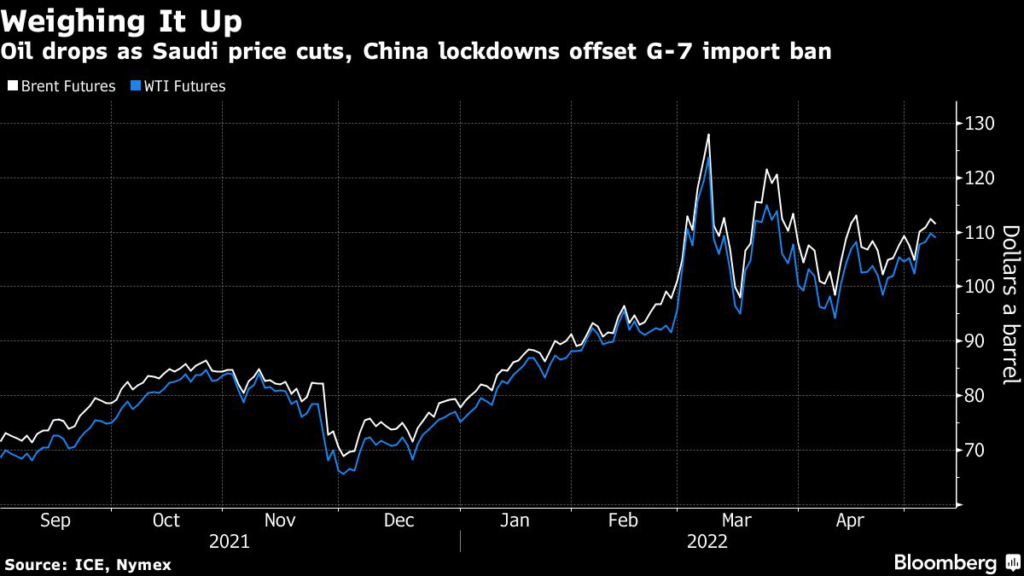
Oil fluctuated in trading to start the week with investors weighing the impact of the move by the bloc. Crude has had a tempestuous year as Russia’s invasion of Ukraine upends global commodity markets.

Ukrainian President Volodymyr Zelenskiy marked a day of remembrance for the defeat of Nazi Germany, with Putin set to address a military parade in Moscow Monday where he may lay out the next steps of his war. 

(See RSAN on the Bloomberg Terminal for the Russian Sanctions Dashboard.)

Key Developments

  • Mariupol Steel Plant’s ‘Dead Men’ Defenders Call for Rescue Plan
  • U.S. Bans Accounting Services to Russia in New Sanctions Package
  • Ukraine’s Tiny Neighbor Suffers Economic Fallout From the War
  • Hungary Continues to Block EU Oil Sanctions on Russia

All times CET:

Oil Swings as Traders Weigh G-7 Crude Ban (5:16 a.m.)

Oil fluctuated as investors weighed a pledge by the Group of Seven to ban imports of Russian crude against a cut in official prices by Saudi Arabia and the impact of China’s energy-sapping lockdowns.

West Texas Intermediate traded near $110 a barrel after earlier losing as much as 1.7%. The U.S. and the U.K. have already moved to ban imports of Russian fuel in response to the assault, but the weekend pledge by the G-7 will increase the pressure on Moscow further. 

Read more: Oil Swings as Traders Weigh Up G-7 Crude Ban, Saudi Price Cuts

Jill Biden to Meet President of Slovakia (2:32 a.m.)

Jill Biden finishes her trip to the region with a meeting Monday with Slovakian President Zuzana Caputova before returning to Washington, her office said in a statement.

The U.S. first lady earlier crossed into western Ukraine for an unannounced visit and met Ukrainian counterpart Olena Zelenska. Zelenska hasn’t appeared in public since Feb. 24, the day of Russia’s invasion, a U.S. official said. 

Read more: Jill Biden Meets Zelenskiy’s Wife in Unannounced Ukraine Visit

U.S. Bans Accounting Services to Russia (1:39 a.m.)

The U.S. banned American accounting and consulting firms from working with Russia and imposed its first sanctions on Gazprombank. 

The latest penalties include new export controls on industrial goods, limits on three of Russia’s top state-controlled television stations and additional visa restrictions, according to a White House statement. 

Read more: U.S. Bans Accounting Services to Russia in Added Sanctions

Japan Takes ‘Difficult’ Decision on Russia Oil (12:48 a.m.)

The impact of the ban is likely to be limited, as the world’s third-largest economy imported only 3.6% of its crude oil from Russia in March, compared to 10.8% of its coal and 8.8% of its gas in 2021. Still, the move threatens to add to surging gasoline costs that have stoked inflationary fears ahead of an upper house of parliament election two months away. 

Read more: Japan’s Kishida Says Phasing Out Russian Oil to Take Time


U.K. Sets Third Round of Russia Sanctions (11:30 p.m.) 

The U.K. announced a third round of trade sanctions against Russia and Belarus, taking to more than 4 billion pounds ($4.9 billion) the value of products subject to full or partial import and export bans.

New import tariffs will cover 1.4 billion pounds in goods, including platinum and palladium. Russia is a leading producer of both metals and is “highly dependent” on the U.K. as a buyer of its exports, the U.K. government said in a statement.

Zelenskiy Calls on G-7 to Keep Up Arms Supplies (10:45 p.m.)

President Volodymyr Zelenskiy thanked G-7 countries for supplying weapons and said they need to keep up supplies so Ukraine can defeat Russia, according to an account of his comments to Group of Seven leaders on Sunday provided by his office.

Deliveries of multiple-rocket launchers, for instance, would have saved many lives, he told the G-7.

Trudeau Pledges More Military Aid in Kyiv Visit (10:02 p.m.)

Prime Minister Justin Trudeau visited Kyiv and said Canada will provide an additional $50 million in military support, including drone cameras, satellite imagery, small arms and artillery ammunition, his office said in a statement. 

Canada will also continue to help with demining operations, Trudeau told reporters in the Ukrainian capital, where he also reopened the Canadian Embassy during his previously unannounced trip.

Mariupol Steel Plant Defenders Call for Rescue (9:19 p.m.)

If Russia’s President Vladimir Putin hoped to mark Victory Day by celebrating the capture or surrender of Mariupol’s last Ukrainian defenders, a Zoom appearance by their commanders suggests he’ll have to wait.

In an online press conference on Sunday, an intelligence officer of the Azov regiment holed up in the southeastern port city’s massive Azovstal steel factory said surrender would amount to suicide. He said they had enough food and weapons to hold out a while yet.

Describing their increasingly grim, and likely ultimately hopeless, circumstances, Illia Samoilenko also made clear his bitterness with the Ukrainian government in Kyiv. It had, he said, failed in its defense of southern Ukraine, where Russia made much faster progress than in the north, and had abandoned Mariupol’s garrison to its fate.

Lockheed Seeks to Double Javelin Missile Output (8:03 p.m.)

Lockheed Martin Corp. is working to almost double its production capacity for Javelin missiles to 4,000 a year and achieving that goal will require the supply chain to “crank up,” the defense contractor’s top executive said.

The Ukrainian army has used Lockheed’s missiles to great effect in destroying Russian tanks and armaments, and the company is ramping up production to ensure the U.S. military’s supplies aren’t depleted. Right now Lockheed can build about 2,100 Javelins a year, Chief Executive Officer Jim Taiclet said Sunday on CBS’s “Face the Nation.”

G-7 Leaders Commit to Russia Oil Import Ban (6:30 p.m.)

Leaders of the Group of Seven pledged to ban the import of Russian oil.  

The heads of the leading economies made the commitment after holding a video call with Ukraine President Volodymyr Zelenskiy on Sunday, the eve of Russia’s May 9 Victory Day, which commemorates Russia’s victory over Nazi Germany in World War II. The date has become a touchstone of the Kremlin’s campaign to whip up public support for the invasion. 

The leaders will “commit to phase out our dependency on Russian energy, including by phasing out or banning the import of Russian oil,” the G-7 said in the statement. 

Germany’s Scholz Sets Limits on Ukraine Policy (6:00 p.m.)

Chancellor Olaf Scholz outlined limits on Germany’s efforts to help Ukraine in a televised address. While Germany will continue to supply heavy weapons to help Ukraine defend against Russia, Europe’s biggest economy won’t sacrifice its security or affluence, he said.

U.S. Diplomats in Kyiv Ahead of Embassy Reopening (5:15 p.m.)

Charge d’Affaires Kristina Kvien led a team of U.S. diplomats that traveled to Kyiv for ceremonies to mark the anniversary of the Allied victory over Nazi Germany in World War II.

Secretary of State Antony Blinken told Ukrainian Foreign Minister Dmytro Kuleba the diplomats were there “to conduct diplomatic engagement in advance of the planned resumption of Embassy Kyiv operations,” State Department spokesman Ned Price said.  

The U.S. initially moved its diplomats to the western Ukrainian city of Lviv in the days leading up to Russia’s invasion, then operated from Poland. Diplomats last month started making day trips into Lviv. 

Russian Infrastructure Official Visits Mariupol (4:30 p.m.)

Russian Deputy Prime Minister Marat Khusnullin, whose portfolio includes construction, visited occupied areas of Ukraine including the recently captured city of Mariupol, according to a statement posted to his Telegram channel. 

Khusnullin, who was sanctioned by the European Union in February for his role in undermining Ukrainian sovereignty, said Russia would help the seized territories rebuild and provide humanitarian support. 

Vitol Says It’ll Get Harder to Trade Russian Oil From Mid-May (2:30 p.m.)

Commodity firms will find it much harder to buy and sell Russian oil from the middle of this month, according to the world’s biggest independent crude trader, as Europe tightens sanctions on Moscow. 

Russia’s exports of crude and oil products have probably dropped by about 1 million barrels a day from 7.5 million before the attack in late February, Mike Muller, head of Asia at Vitol Group, said Sunday. They could fall further after May 15, he said, because many trading houses interpret EU regulations as prohibiting them from dealing with Russian state energy companies beyond then. “There will be a “different reality.”

U2’s Bono, the Edge Perform in Kyiv Metro (2:26 p.m.)

Bono and the Edge, members of Irish rock band U2, performed in a Kyiv metro station on Sunday at the invitation of Ukrainian President Volodymyr Zelenskiy in a “show of solidarity with the Ukrainian people,” the band said on Twitter.  

In a video posted by Ukrainian politician Serhiy Leshchenko, the pair were seen with Taras Topolia, front man of the local band Antytila, performing the Ben E. King standard, “Stand by Me.”


More stories like this are available on bloomberg.com

©2022 Bloomberg L.P.

Home Sales Tumble, New York Property Seized: Evergrande Update

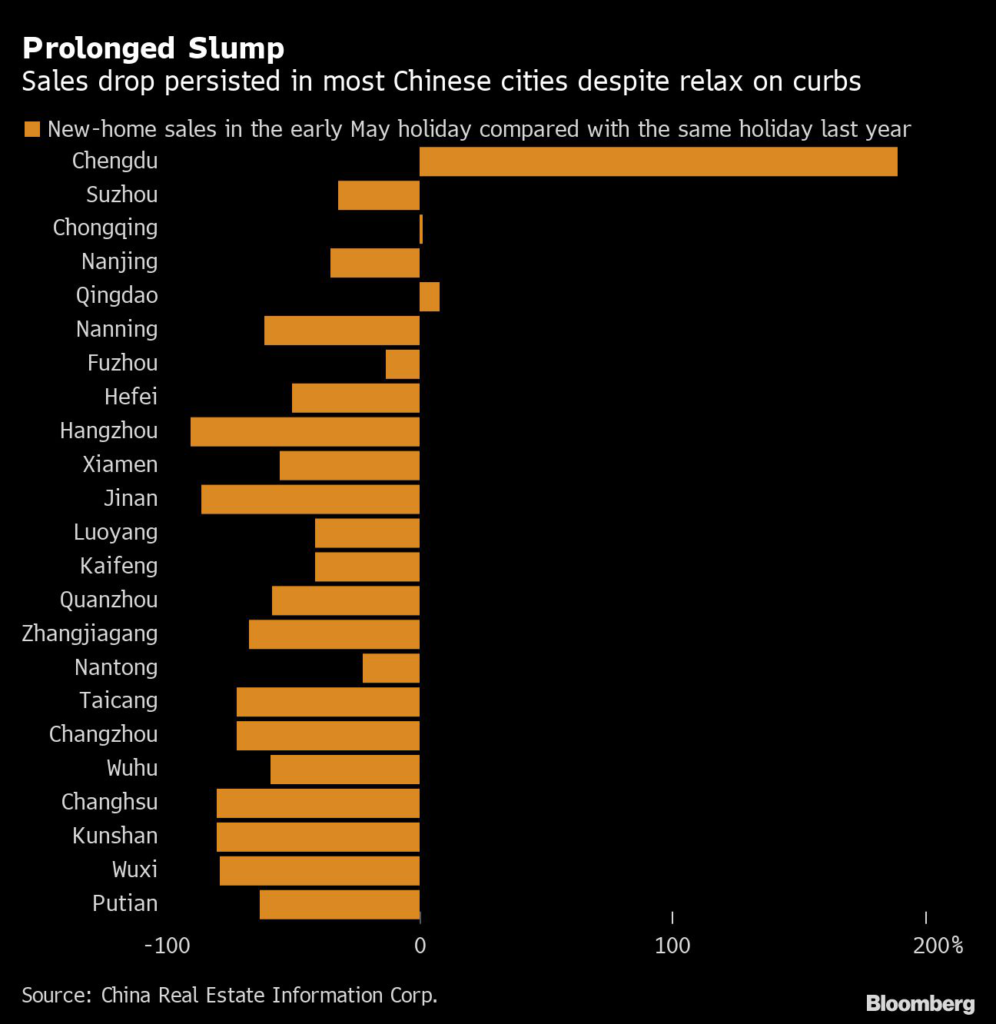
(Bloomberg) — New-home sales in 23 major Chinese cities plunged 33% by area during a five-day national holiday compared with a year earlier, despite policy makers’ pledges of support for the property market.

Lenders seized control of the property where China Oceanwide Holdings Ltd. planned to develop one of lower Manhattan’s tallest towers after the company failed to make mortgage payments. China-based developers have been struggling overseas as the government restricted international capital flows.

As China’s property sector faces continued stress, Premier Li Keqiang warned about the nation’s employment situation after Beijing and Shanghai tightened virus curbs. A Bloomberg Intelligence index of real-estate stocks fell as much as 4.4% Friday, amid broader market declines. A gauge tracking junk dollar notes fell for the third week in the past four.  

Key Developments:

  • China Stimulus Fails to Ignite Housing Sales Over Key Holiday
  • China Premier Warns of ‘Grave’ Jobs Situation Amid Lockdowns (1)
  • China’s Oceanwide Loses $410 Million Manhattan Site to Lenders
  • China Property Sector Sees Slower Loan Growth by End March

Guangzhou R&F Gets Nod to Delay Payment (10:53 a.m. HK)

Guangzhou R&F Properties Co. obtained investor approval to effectively delay repaying the majority of a 6.48% 400 million yuan ($60 million) bond that’s puttable Monday, according to a filing to the Shanghai Stock Exchange dated Friday.

Under the new arrangement, the developer will still pay the coupon due for the past year on Monday but reschedule payments for the remainder of the bond originally due in 2024.

New Home Sales Drop Over Holidays (8:19 a.m. HK)

New-home sales in 23 major cities tracked by China Real Estate Information Corp. fell 33% by area, adding to the pain this year, after combined sales at the top 100 developers halved in the first four months. 

That’s despite the Politburo making sweeping vows to stimulate the economy and the top policy maker saying it would encourage “real housing demand,” in its clearest message condoning relaxation of property curbs. 

Oceanwide Loses Manhattan Site to Lenders (8:15 a.m. HK)

Lenders have seized control of the property where China Oceanwide planned to develop one of lower Manhattan’s tallest towers. 

Oceanwide defaulted on a $165 million loan on the project, at 80 South St., in January, leading to the transfer to a receiver as the property’s custodian, according to a filing by the developer’s Hong Kong affiliate. Oceanwide had invested $410 million in the project.

“The borrower has failed to pay all amounts demanded under the notice of default,” Oceanwide reported in the filing. “The company is continuously assessing the legal, financial and operational impacts of the actions to be taken by the initial lender.”

More stories like this are available on bloomberg.com

©2022 Bloomberg L.P.

TPG Telecom Sells Mobile Towers to Omers for A$950 Million

(Bloomberg) — Australian phone company TPG Telecom Ltd. agreed to sell mobile-phone towers and rooftop infrastructure to Omers Infrastructure Management Inc. in a deal valued at A$950 million ($670 million) including debt.

The sale will generate net cash proceeds of about A$890 million, which will be used to repay debt, TPG said Monday. 

The 1,237 sites being sold include 428 towers and 809 rooftops, representing about 21% of TPG’s total mobile-network footprint, it said. The rest is already owned and operated by other tower companies.

More stories like this are available on bloomberg.com

©2022 Bloomberg L.P.

China Stimulus Fails to Ignite Housing Sales Over Key Holiday

(Bloomberg) — China’s embattled property market is struggling to generate a turnaround despite supportive pledges from the top decision-making body, underscoring Beijing’s challenge to revive one of the nation’s biggest growth drivers. 

New-home sales in 23 major cities tracked by China Real Estate Information Corp. fell 33% by area during a five-day national holiday compared with a year earlier. The plummet adds to the pain this year, after combined sales at the top 100 developers halved in the first four months. 

That’s despite the Politburo making sweeping vows to stimulate the economy and a U-turn in messaging — the top policy maker said it would encourage “real housing demand” — its clearest message condoning relaxation of property curbs. 

“Broader and stronger policy incentives haven’t restored buyer confidence,” said Meng Xinzeng, a real estate analyst at property data firm China Index Holdings. He added that transactions were not as strong as expected. 

The policies however might not be enough to revive sentiment that’s turned sour since July. Asset sales and an increase in loans for developers have failed to spur growth.

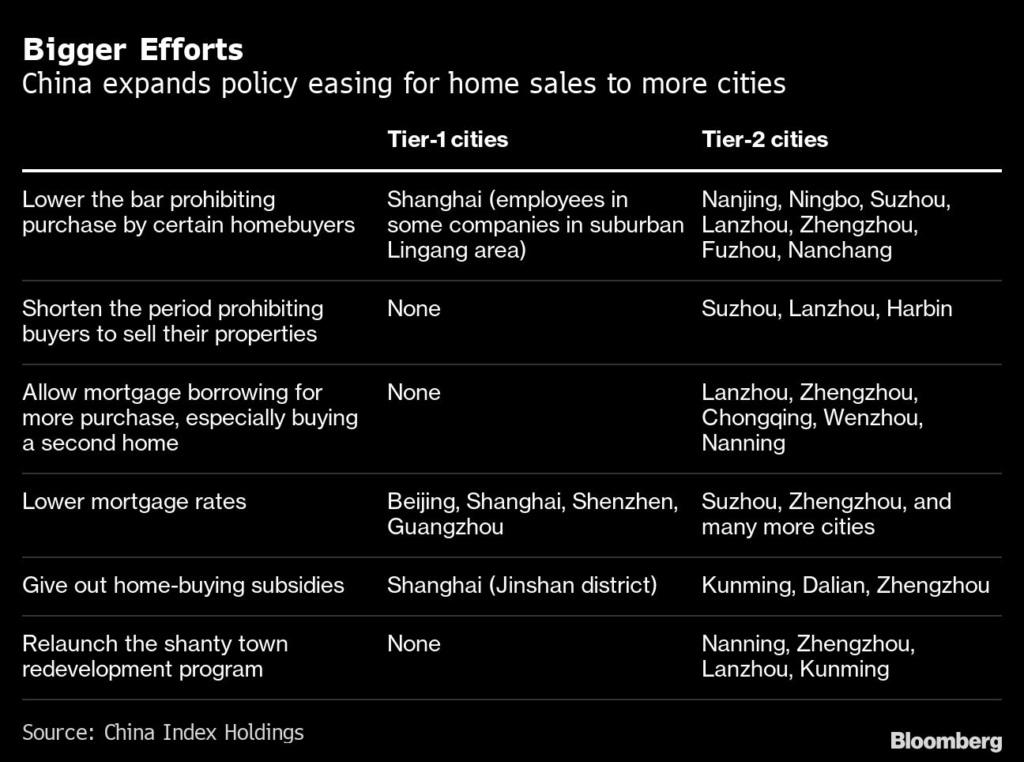
Easing started around April. The eastern city of Nanjing and manufacturing hub Suzhou are starting to allow residents not born in the city to buy property. The northern city of Harbin retracted a rule banning new homeowners from selling within three years. Not far away in Shenyang — where residential values declined for seven months straight — the government ushered in five measures before the holiday to boost home sales. 

It worked in some places like Chengdu, but most buyers are staying away. The country’s Covid Zero policy isn’t helping as further lockdowns could happen after top leaders struck a defensive tone on Thursday. 

Other sectors are suffering too. Tourist spending over the national Labour Day — a holiday that typically boosts consumption — was 64.7 billion yuan ($9.8 billion), down 43% from last year. Nomura Holdings Inc. estimates that 43 cities are under partial or full lockdown, or are facing some district-level restrictions, affecting about 328 million people. 

“If the coronavirus outbreak can be contained by June, the property market may still see a broad rebound,” CRIC analysts led by Yang Kewei wrote in a Thursday note. 

More stories like this are available on bloomberg.com

©2022 Bloomberg L.P.

Ukraine Latest: Mariupol Siege Dwindles to Plant’s ‘Dead Men’

(Bloomberg) —

Leaders of the Group of Seven countries pledged to ban the import of Russian oil. The U.S. announced new measures, including a ban on American accounting and consulting firms from working with Russia. Hungary continued to block the European Union’s latest package of sanctions against Russia. 

President Volodymyr Zelenskiy issued a video to mark Ukraine’s Day of Remembrance and Reconciliation, a day before Russian President Vladimir Putin is expected to a address a military parade in Moscow and may lay out the next steps of his war. Prime Minister Justin Trudeau of Canada met with Zelenskiy in Kyiv.

An intelligence officer of the Azov regiment holed up in Mariupol’s massive Azovstal steel factory said surrender would amount to suicide. All women, children and elderly have been evacuated. In the Luhansk area, as many as 60 people may have died in a Russian strike on a school. 

(See RSAN on the Bloomberg Terminal for the Russian Sanctions Dashboard.)

Key Developments

  • Mariupol Steel Plant’s ‘Dead Men’ Defenders Call for Rescue Plan
  • G-7 Leaders Will Commit to Ban Russian Oil Imports, Draft Says
  • U.S. Bans Accounting Services to Russia in New Sanctions Package
  • Ukraine’s Tiny Neighbor Suffers Economic Fallout From the War
  • Hungary Continues to Block EU Oil Sanctions on Russia
  • Boehly-Clearlake Group Lands $5.25 Billion Deal for Chelsea 

All times CET:

Trudeau Meets Zelenskiy in Ukraine’s Capital (9:33 p.m.)

Canada will continue to support Ukraine, supplying light anti-tank weapons, known as NLAWs, and other anti-tank weaponry as well as small arms and satellite imagery, Prime Minister Justin Trudeau told journalists after meeting with President Volodymyr Zelenskiy.

Canada will also continue to help with demining operations, Trudeau said, who also re-opened Canadian embassy in Kyiv during his unannounced Sunday trip.

Zelenskiy seeks Canada to lift import duties on Ukrainian goods and ease visa regime for Ukrainians.

Mariupol Steel Plant Defenders Call for Rescue (9:19 p.m.)

If Russia’s President Vladimir Putin hoped to mark Victory Day on Monday by celebrating the capture or surrender of Mariupol’s last Ukrainian defenders, a Zoom appearance by their commanders suggests he’ll have to wait.

Speaking in a lengthy online press conference on Sunday, an intelligence officer of the Azov regiment holed up in the southeastern port city’s massive Azovstal steel factory said surrender would amount to suicide. He said they had enough food and weapons to hold out a while yet.

Describing their increasingly grim, and likely ultimately hopeless, circumstances, Illia Samoilenko also made clear his bitterness with the Ukrainian government in Kyiv. It had, he said, failed in its defense of southern Ukraine, where Russia made much faster progress than in the north, and had abandoned Mariupol’s garrison to its fate.

Lockheed Seeks to Double Javelin Missile Production (8:03 p.m.)

Lockheed Martin Corp. is working to almost double its production capacity for Javelin missiles to 4,000 a year and achieving that goal will require the supply chain to “crank up,” the defense contractor’s top executive said.

The Ukrainian army has used Lockheed’s missiles to great effect in destroying Russian tanks and armaments, and the company is ramping up production to ensure the U.S. military’s supplies aren’t depleted. Right now Lockheed can build about 2,100 Javelins a year, Chief Executive Officer Jim Taiclet said Sunday on CBS’s “Face the Nation.”

Pelosi Cites Urgency of Passing $33 Billion U.S. Aid Package (7:38 p.m.)

House Speaker Nancy Pelosi said U.S. lawmakers are aware of the urgency of approving a proposed $33 billion aid package for Ukraine, though she stopped short of predicting when Congress might pass it.

“I think we will be able to do it as quickly as possible,” Pelosi said on CBS’s “Face the Nation” on Sunday. “We are very current on the needs and the urgency and, again, we will have bipartisanship as we go forward with it.”

G-7 Leaders Commit to Banning Imports Russian Oil (6:30 p.m.)

Leaders of the Group of Seven most industrialized countries pledged to ban the import of Russian oil in response to President Vladimir Putin’s war in Ukraine.  

The heads of the leading economies made the commitment after holding a video call with Ukraine President Volodymyr Zelenskiy on Sunday, the eve of Russia’s May 9 Victory Day, which commemorates Russia’s victory over Nazi Germany in World War II. The date has become a touchstone of the Kremlin’s campaign to whip up public support for the invasion. 

The leaders will “commit to phase out our dependency on Russian energy, including by phasing out or banning the import of Russian oil,” the G-7 said in the statement. 

U.S. Bans Accounting Services to Russia (6:05 p.m.)

The U.S. banned American accounting and consulting firms from working with Russia and imposed its first sanctions on Gazprombank as part of a package of new penalties.

The latest measures also include export controls on industrial goods, limits on three of Russia’s top state-controlled television stations, and additional visa restrictions, a U.S. official told reporters.  

Germany’s Scholz Sets Limits on Ukraine Policy (6:00 p.m.)

Chancellor Olaf Scholz used a rare televised address to the nation to outline limits on Germany’s efforts to help Ukraine, in a bid to reassure the country unsettled by the threat of war spilling over. 

While Europe’s largest economy will continue to send Kyiv heavy weapons to help it defend against Russia, Berlin wouldn’t sacrifice its own security in the process, Scholz said.

Scholz Defends Ukraine Stance as Voters Punish Muddled Policy

After warning in recent weeks that delivering tanks and other advanced weapons to Ukraine risks triggering nuclear war, Scholz was under pressure to justify the policy reversal to the German people.

U.S. Diplomats in Kyiv for Ceremonies (5:15 p.m.)

Charge d’Affaires Kristina Kvien led a team of U.S. diplomats that traveled to Kyiv for ceremonies to mark the anniversary of the Allied victory over Nazi Germany in World War II, a senior State Department official said. 

U.S. Secretary of State Antony Blinken told Ukrainian Foreign Minister Dmytro Kuleba that the return of the U.S. diplomats is a testament to Ukraine’s success in its war with Russia, according to the official. 

The move stops short of reopening the embassy in Kyiv. The U.S. initially moved its diplomats to the western Ukrainian city of Lviv in the days leading up to Russia’s invasion, and then operated from Poland. Diplomats last month started making day-trips into Lviv. 

Norway’s Gharahkhani Meets With Zelenskiy (5:03 p.m.)

Ukraine’s president met with Masud Gharahkhani, president of Norway’s parliament, thanking the Norwegian people for their support and for weapons donations. The pair discussed cooperation in energy security and ways to strengthen sanctions against Russia. Zelenskiy invited Norway to join the effort to restore Ukraine after the war.

Senior Russian Infrastructure Official Visits Mariupol (4:30 p.m.)

Russian Deputy Prime Minister Marat Khusnullin, whose portfolio includes construction, visited occupied areas of Ukraine including the recently captured city of Mariupol, according to a statement posted to his Telegram channel. 

Khusnullin, who was sanctioned by the European Union in February for his role in undermining Ukrainian sovereignty, said Russia would help the seized territories rebuild and provide humanitarian support. 

Jill Biden Crosses Into Ukraine From Slovakia, Meets Zelenska (3:30 p.m.)

U.S. first lady Jill Biden crossed into western Ukraine from Slovakia for an unannounced visit and met with Ukrainian counterpart Olena Zelenska. Biden’s motorcade drove through the town of Uzhorod to a public school now being used as temporary housing for displaced Ukrainians. 

Zelenska hasn’t appeared in public since Feb. 24, the day of Russia’s invasion, a U.S. official said. She and Biden exchanged hugs, and the U.S. first lady presented the Ukrainian with flowers. 

“I wanted to come in Mother’s Day. I thought it was important to show the Ukrainian people that this war has to stop and this war has been brutal and that the people of the United States stand with the people of Ukraine,” Biden said. Speaking in Ukrainian, Zelenska praised Biden for her courage.  

Vitol Says It’ll Get Harder to Trade Russian Oil From Mid-May (2:30 p.m.)

Commodity firms will find it much harder to buy and sell Russian oil from the middle of this month, according to the world’s biggest independent crude trader, as Europe tightens sanctions on Moscow. 

Russia’s exports of crude and oil products have probably dropped by about 1 million barrels a day from 7.5 million before the attack in late February, Mike Muller, head of Asia at Vitol Group, said Sunday. They could fall further after May 15, he said, because many trading houses interpret EU regulations as prohibiting them from dealing with Russian state energy companies beyond then. “There will be a “different reality.”

U2’s Bono, the Edge Perform in Kyiv Metro (2:26 p.m.)

Bono and the Edge, members of Irish rock band U2, performed in a Kyiv metro station on Sunday at the invitation of Ukrainian President Volodymyr Zelenskiy in a “show of solidarity with the Ukrainian people,” the band said on Twitter.  

In a video posted by Ukrainian politician Serhiy Leshchenko, the pair were seen with Taras Topolia, frontman of the local band Antytila, performing the Ben E. King standard, “Stand by Me.”

Hungary Continues to Block EU Oil Sanctions Against Russia (2:16 p.m.)

Hungary continued to block a European Union proposal that would ban Russian oil imports, holding up the bloc’s package of sanctions meant to target President Vladimir Putin over his war in Ukraine, according to people familiar with the talks. 

A meeting of the EU’s 27 ambassadors ended on Sunday without an agreement, with talks expected to resume in the coming days, said the people, who asked not to be identified because the discussions were private. 

The EU had been pushing to have the process concluded by Russia’s Victory Day military parade on Monday, at which Putin is expected to speak about the invasion of Ukraine. 

Zelenskiy Tells Fox Some Countries Trying to Buy Stolen Grain (10:15 a.m.)

President Volodymyr Zelenskiy says some countries are attempting to buy grain taken from Ukraine by Russia. His comments to Fox News came days after Ukraine’s Ministry of Agriculture said that farmers have reported Russians in occupied territory “stealing their grain en masse.” 

“I don’t want to name specific countries who behind our backs are making deals to buy our grain from Russia,” Zelenskiy told Fox News. “If they will do it, of course we’ll tell.” 

The United Nations World Food Program has called for the urgent reopening of Ukraine’s grain export seaports, which have been shut by Russian blockades.  

Zelenskiy Marks Ukraine’s Day of Remembrance in Video (8:44 a.m.) 

Volodymyr Zelenskiy released a 15-minute video to mark Ukraine’s Day of Remembrance and Reconciliation. The black and white footage shows the president speaking in front of a bombed-out apartment building in Borodyanka, northwest of Kyiv.

Ukraine’s president mused on the post-World War II vow of “never again,” saying that decades later, “darkness returned” to Ukraine “in a different uniform, under different slogans, but for the same purpose.”  

“All nations who have been branded ‘third-class,’ slaves without the right to their own state or to exist at all, hear statements that exalt one nation and erase others with ease,” he said. “They claim that you don’t really exist, you are artificially created, and therefore you have no rights.” 

Official Says Many Feared Dead in School Shelter Bombing (6:45 a.m)

As many as 60 people may have died in a Russian strike on a school in Bilohorivka, a village in the Luhansk area, according to regional head Serhiy Haiday on Telegram. 

Russian forces on Saturday bombed a school building where most residents of the village had been sheltering, he said earlier. About 30 people were rescued from within the rubble and two were found dead. The final number of victims will be known once the debris is cleared, Haiday said.

Ukraine’s Counteroffensive Said to Make Progress Near Kharkiv (7:30 a.m.)

Pushback from Kyiv’s forces northeast of Kharkiv “is making significant progress and will likely advance to the Russian border in the coming days or weeks,” according to the Institute for the Study of War. 

The U.S.-based think tank said the offensive “likely intends to push Russian artillery away from Kharkiv city and drive to the border” of Belgorad oblast in Russia. 

Moscow’s forces may be conducting a limited withdrawal in the face of successful Ukrainian attacks, and reportedly destroyed three bridges to slow Ukraine’s advance, ISW said, adding, “Armies generally only destroy bridges if they have largely decided they will not attempt to cross the river in the other direction anytime soon.”


More stories like this are available on bloomberg.com

©2022 Bloomberg L.P.

Lockheed CEO Says Supply Chain Must ‘Crank Up’ to Build Javelins

(Bloomberg) — Lockheed Martin Corp. is working to almost double its production capacity for Javelin missiles to 4,000 a year and achieving that goal will require the supply chain to “crank up,” the defense contractor’s top executive said.

The Ukrainian army has used Lockheed’s missiles to great effect in destroying Russian tanks and armaments, and the company is ramping up production to ensure the U.S. military’s supplies aren’t depleted. Right now Lockheed can build about 2,100 Javelins a year, Chief Executive Officer Jim Taiclet said Sunday on CBS’s “Face the Nation.”

“We’re endeavoring to take that up to 4,000 per year, and that will take a number of months, maybe even a couple of years to get there because we have to get our supply chain to- to also crank up,” Taiclet said. “We think we can almost double the capacity in a reasonable amount of time.”

One way to help the situation is for Congress to pass the Bipartisan Innovation Act that would propel domestic design and manufacturing of microprocessors, reducing the reliance on foreign supply, Taiclet said. Each Javelin requires about 250 microprocessors, he added. Lockheed is working with partners including Intel Corp. to support the defense industry’s needs. 

U.S. President Joe Biden visited the Javelin factory in Troy, Alabama, last week and urged Congress to authorize an additional $33 billion in aid for Ukraine — with lawmakers warning that stockpiles of the U.S. Army and Marine Corps’ premier anti-tank weapon are becoming depleted due to the war.

The self-guided portable missile system — which weighs just 49 pounds (22 kilograms) — has proved invaluable to Ukrainian fighters, who can fire on Russian vehicles from as far as 4,000 meters (2.5 miles) away and then quickly flee. The U.S. has already delivered about 5,000 of the 5,500 Javelins the White House has committed to provide to Ukraine, a senior defense official told reporters last week. 

More stories like this are available on bloomberg.com

©2022 Bloomberg L.P.

Close Bitnami banner
Bitnami