Bloomberg

Bitcoin Breaches Key Level; Do Kwon-Backed Stablecoin Slips

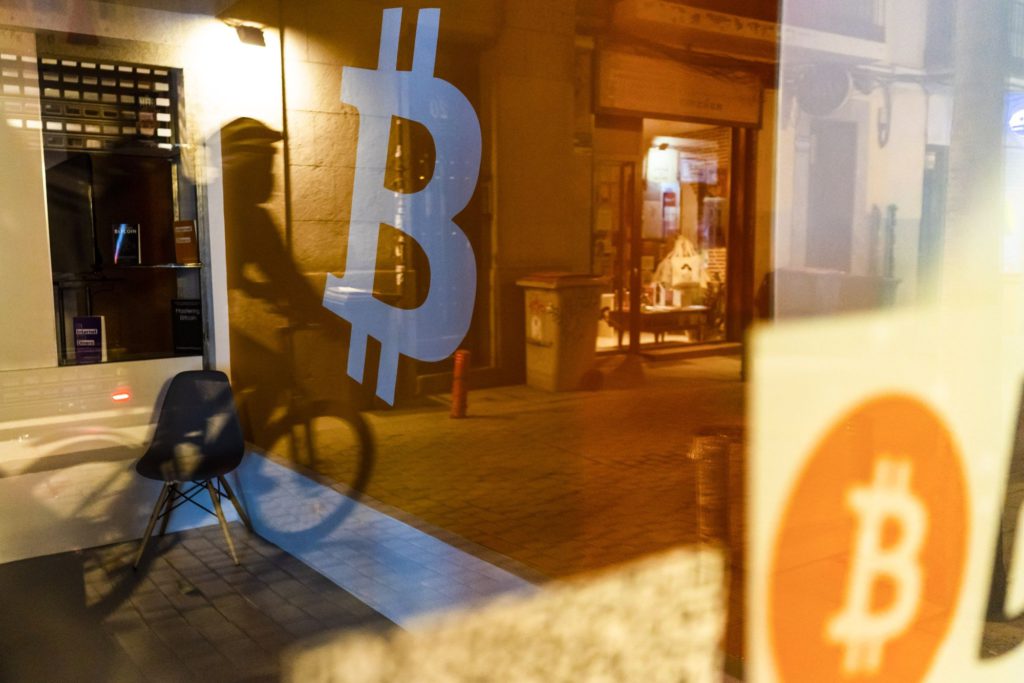
(Bloomberg) — A swift selloff over the weekend in two tokens associated with Do Kwon highlighted weakness in the broader crypto market, as Bitcoin slid through a key support level Sunday to almost a four-month low.

The value of TerraUSD or UST, an algorithmic stablecoin that aims to maintain a one-to-one peg to the dollar, dropped below $1 to its lowest level in almost a year, pricing from CoinMarketCap showed.

UST’s algorithmic stablecoin efforts are being closely watched by both skeptics and supporters, said Kunal Goel, research analyst at Messari. Its roughly 1% decline over the weekend might seem relatively restrained given overall crypto volatility, but the market appears to be bracing for another leg down, he said.

Kwon, who is currently based in Singapore, wrote on Twitter that he woke up to an “amusing morning” on Sunday. In a now deleted tweet seen by Bloomberg, Kwon seemed to hint that the selloff may have been an orchestrated effort to make UST lose its peg. He also retweeted from his verified handle a tweet by a user named Caetano Manfrini claiming that a single player dumped 285 million UST on platforms like Curve and Binance.

Trading volume in UST rose some 300% in the past 24 hours, according to CoinMarketCap data. On-chain data from Etherscan showed that a crypto whale swapped nearly 85 million UST for almost the same amount of USDC, a stablecoin issued by Circle. 

The Luna token, which is designed to help UST maintain that dollar peg, was trading down more than 14% at $62.64 on Sunday after falling more than 12% on Saturday.

Bitcoin Woes

Bitcoin, the biggest cryptocurrency by market value, broke through a key support level to trade around $34,450, its lowest since January and a decline of more than 25% year to date.  

“Bitcoin did not hold key support and now has upped chances for a large drop,” Rick Bensignor of Bensignor Investment Strategies wrote in a note. 

“Last week the weekly cloud’s Lagging Line did NOT hold above the bottom of its cloud at $36,870. I warned that that cloud breach could easily and quickly lead to a $10,000 drop. The bulk of crypto holders are “Hopers”, and they will sit on their longs regardless of what price action suggests,” he wrote.

Bitcoin has largely followed the negative trend in equity markets as investors across asset classes respond to signals of further interest rate rises. 

“Bitcoin has no counter-trend signals at this time, but the equity market does look poised to rebound next week, which we hope will carry over to cryptocurrencies,” Katie Stockton, managing partner at Fairlead Strategies, said in a note.

More stories like this are available on bloomberg.com

©2022 Bloomberg L.P.

Gangs Stealing Cables Miles Underground Torment South African Platinum Mines

(Bloomberg) — South African miners are battling a growing threat miles underground in the world’s deepest platinum shafts: Gangs stealing copper cables and disrupting operations. 

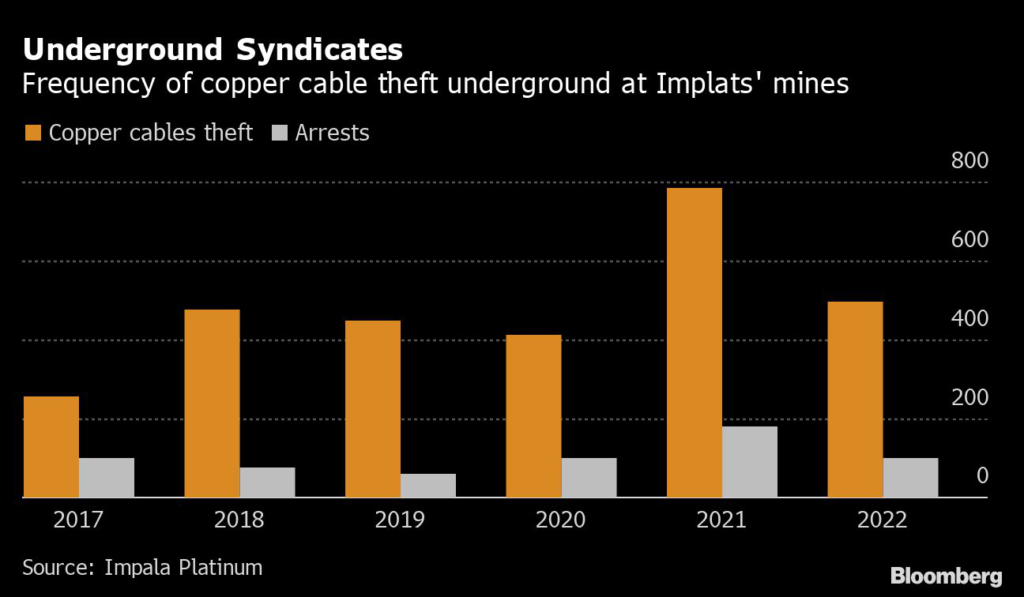
Enticed by high copper prices, thieves are sneaking in, descending deep underground and setting up camp among vast networks of tunnels to strip metal from power cables. The country’s platinum giants are struggling to contain the syndicates of trespassers known as “zama zamas” — a Zulu name that means “take a chance.”

Illegal mining has long been a problem in South Africa, though now thefts of equipment are becoming a major worry. The incidents — in some cases daily — can halt work for about a week at a time as cable cuts cripple systems such as locomotives that take ore to the surface.

The looting is part of a crime wave affecting vital infrastructure from railways to telecommunications to utilities, undermining President Cyril Ramaphosa’s efforts to revive the economy. The thefts have become increasingly lucrative with copper recently hitting a record high on expectations that supply will remain tight and mining companies finding it hard to keep the gangs out.

It’s a fresh headache for companies like  Impala Platinum Holdings Ltd.,  Sibanye Stillwater Ltd. and  Anglo American Platinum Ltd. They’re the largest producers in South Africa, the top miner of platinum-group metals and the location for the African Mining Indaba that starts Monday, a huge gathering for the industry.

Zama zamas, who have plagued gold deposits for many years, sell stolen metal for scrap or even export it.

“Every single day there is at least one place that’s not working because of cable theft,” said Mark Munroe, head of Implats’s Rustenburg complex. “At our most marginal shafts, if cable theft is not stopped, we may be forced to shut mining operations because these marginal shafts will not be able to sustain themselves under these conditions.”

The thefts are difficult to stop because it’s impossible to fully patrol all the tunnels that cover a vast distance. What started as informal ventures have become so organized that gangs now have their own supply chains to keep groups underground for longer. Workers have even smelled thieves’ food.

Gangs use ropes or handmade ladders to lower themselves down from holes dug on the surface. After the treacherous descent, stripped copper is then hidden in unused tunnels before being taken away at night using pre-arranged transport. Big cables are typically cut into smaller pieces to be carried out.

Roughly 500 people are illegally underground for as long as 60 days at any time at the sprawling Rustenburg site, Munroe said. It takes at least a week to reinstall some key copper cables and if the issue isn’t contained.

“These guys are well trained, they work with intelligence, they know where to go underground,” he said. 


The vandalism is dangerous too. When copper was stripped at Sibanye’s Thembelani shaft in March, it caused a fire that quickly spread and forced the evacuation of 140 workers. About 10 were treated for smoke inhalation.

The company had 120 theft incidents last year and recovered about 5.1 tons of stolen copper. So far this year, there have been 45 incidents and 3.2 tons recovered, with operations disrupted twice, according to Sibanye, which has stepped up security.

The interruptions threaten to crimp output of platinum metals that are mainly used in autocatalysts that cut vehicle emissions. While the platinum sector is reaping windfall profits again on the back of historically high palladium and rhodium prices, it had until a few years ago long suffered from rising costs and low metals prices that made running aging mines harder. 

Thefts aren’t the only problem. Record unemployment and the world’s most unequal society — the richest 10% of the population own more than 85% of household wealth — are fueling unrest around mines from people frustrated at government failures to provide basic services such as clean water.

Communities want producers making big profits to tackle social challenges, and every other week Implats’s operations face protests for jobs, water and education, Munroe said. Losses could reach 15 million rand ($958,000) a day at a shaft if protesters block roads and prevent worker access, he said.

Some unrest is also created by local contractors trying to win more work, by indicating to mining companies that they can ease protests if they’re hired, Sibanye spokesman James Wellsted said.

Tackling Theft

To discourage thefts, the government is trying to combat the illegal trade in cables through measures such as requiring metal traders to get licenses and preventing them from using cash. Some syndicates use bulk buyers to handle metal stripped from mines, according to Implats.

That shows just how complex the criminal ventures are.

“The tunnel workings and exit points also show you the levels of planning and sophistication is much higher than one guy making a hole to be in and out,” Implats’s Munroe said. “It takes a lot to maintain this system.”


More stories like this are available on bloomberg.com

©2022 Bloomberg L.P.

Cerebral Receives Grand Jury Subpoena From U.S. Attorney

(Bloomberg) — Cerebral Inc., the SoftBank-backed mental healthcare startup, is being investigated for possible violations of the Controlled Substances Act, a spokeswoman said in an emailed statement Saturday.

“To be clear, at this time, no regulatory or law enforcement authority has accused Cerebral of violating any law,” the spokeswoman said. “Cerebral intends to fully cooperate with the investigation.”

Cerebral received a grand jury subpoena from the U.S. Attorney’s Office for the Eastern District of New York on the evening of May 4, the spokeswoman said.

Earlier that day, Cerebral announced it would stop writing new prescriptions for drugs that treat attention deficit/hyperactivity disorder, such as Adderall and Ritalin. The company is among a handful of startups that began prescribing controlled substances online after a regulatory rollback in connection with the Covid-19 pandemic.

John Marzulli, a spokesman for Breon Peace, the U.S. Attorney for the Eastern District, declined to comment. 

In a March report in Bloomberg Businessweek, former nurse practitioners for the company described a fear that Cerebral was over-prescribing the medications. 

Then, in an April 27 lawsuit, a former executive alleged Cerebral’s chief medical officer had told employees the company’s goal was to prescribe stimulants to 100% of its ADHD patients as part of a plan to increase customer retention.

In a statement at the time, Cerebral said the allegations were not true, adding: “We plan to vigorously defend ourselves against these false and unfounded allegations.”

Earlier this week, the company announced that Margaret Miller, the chief financial officer, “will be leaving Cerebral later this month for other opportunities.” A statement said the decision was made “mutually” and “months ago.” She has removed references to Cerebral on her LinkedIn page.

(Adds no comment from U.S. Attorney in fourth paragraph and CFO departure in last.)

More stories like this are available on bloomberg.com

©2022 Bloomberg L.P.

Rogers’ $16 Billion Deal Hits Trouble With Antitrust Body

(Bloomberg) — Rogers Communications Inc. said Canada’s antitrust agency is opposed to its $16 billion takeover of rival Shaw Communications Inc., casting significant doubt on whether the companies will be able to close one of the country’s biggest-ever deals. 

The companies extended the deadline for the merger to July 31, from June 13, and said they remain committed to it. But the Canadian Competition Bureau’s attempt to stop the deal raises the prospect of a monthslong legal battle. 

Rogers wants to settle the matter out of court and has opened the door to selling assets to Montreal-based communications firm Quebecor Inc. to try to solve the antitrust concerns, according to a person familiar with the matter. 

Rogers, Canada’s no. 1 wireless and cable provider, agreed to buy Shaw for C$40.50 a share last year in the company’s biggest takeover to date. The wireless business is the key sticking point for regulators: Shaw’s Freedom Mobile unit is the fourth-largest wireless provider, with a presence in several major markets including Toronto and Vancouver. 

Rogers already has more than 11 million wireless customers — about 30% of Canada’s population. The company hired Barclays to run an auction for Freedom Mobile in the belief that selling it would solve the antitrust problem. 

In addition to Quebecor, Rogers has held talks about Freedom with Canadian internet provider Xplornet Communications Inc. and its controlling shareholder, New York-based Stonepeak Partners LP, according to a person familiar with the matter. 

But a statement from Rogers and Shaw early Saturday morning suggests the Competition Bureau isn’t satisfied with their proposals so far. Amy Butcher, a spokesperson for the bureau, declined to comment on the case. “We will release more information regarding our investigation in due course,” she said. 

‘Burned’ in Manitoba 

“The fact that the bureau is stepping up I think is both the right thing and I think sends a message — not just for this transaction but more broadly — there is a willingness to step up and challenge mergers,” said Michael Geist, a University of Ottawa law professor who specializes in tech and telecom law.

The bureau got “burned” when it allowed BCE Inc. to acquire Manitoba Telecom Services Inc. in 2017, he said in an interview. BCE divested assets to Xplornet but the buyer failed to become a major competitor in wireless in the Western Canadian province, he said, and implications of the Rogers-Shaw tie-up are even bigger.

The agency may want Rogers to divest to a more well-established company like Quebecor, Geist said. It’s a significant competitor in Quebec and has 1.6 million wireless subscribers, compared with 2.2 million for Shaw. 

A spokesperson for Quebecor couldn’t be immediately reached for comment.

The bureau’s action against Rogers “is a move informed by its past experience with the Bell-MTS deal, and more broadly with its knowledge of Xplornet and what it takes to create a viable fourth competitor here in Canada,” Dwayne Winseck, a professor at Carleton University, said by phone. 

If the matter isn’t settled, the bureau will have to argue its case before Canada’s Competition Tribunal, which is similar to a court and deals with mergers and other matters that affect competition.  

Rogers and Shaw said in the statement they’ll oppose the bureau’s attempts to stop the deal while still trying to negotiate a resolution, the companies said. They will also continue to seek approval from the Ministry of Innovation, Science and Economic Development.

“We could be headed to lengthy litigation,” Geist said.

Rogers shares have fallen about 7% in the past month and Shaw has dropped almost 4% amid a lack of information about the regulatory-approval process and a broad selloff in equity markets.  

Without the deal, Shaw shares are worth close to C$30, Morningstar analyst Matthew Dolgin said. They closed at C$37.56 on Friday. “A big selloff in response to news the deal won’t happen would be warranted in our view. Shaw’s business has struggled, and we’d prefer the businesses of its major peers,” Dolgin said. 

(Updates with additional information from the third paragraph)

More stories like this are available on bloomberg.com

©2022 Bloomberg L.P.

Insider-Trading Scourge Wooed to Be Crypto Ally in U.S. Senate

(Bloomberg) — Facing a crackdown from regulators in Washington, the crypto industry is turning to New York Senator Kirsten Gillibrand for help. 

At first blush, the Democratic lawmaker known on Wall Street for efforts to thwart insider trading in the stock market, isn’t an obvious choice to play crypto’s savior on Capitol Hill. But since she announced in March that she was working on legislation to overhaul rules for the market, her star has risen.

Industry executives sought to woo Gillibrand during a recent trip to San Francisco as she shuttled between a meeting with them at the St. Regis Hotel and breakfast with venture capitalists. Closer to home, a digital-asset lobbyist is planning a Manhattan fundraiser later this month for her re-election. 

The fixation on Gillibrand offers a glimpse into how the fast-growing sector is preparing to throw its weight — and money — around American politics. It also shows how lawmakers, including those who aren’t known for being staunchly pro-crypto, are poised to benefit from the industry’s largesse. 

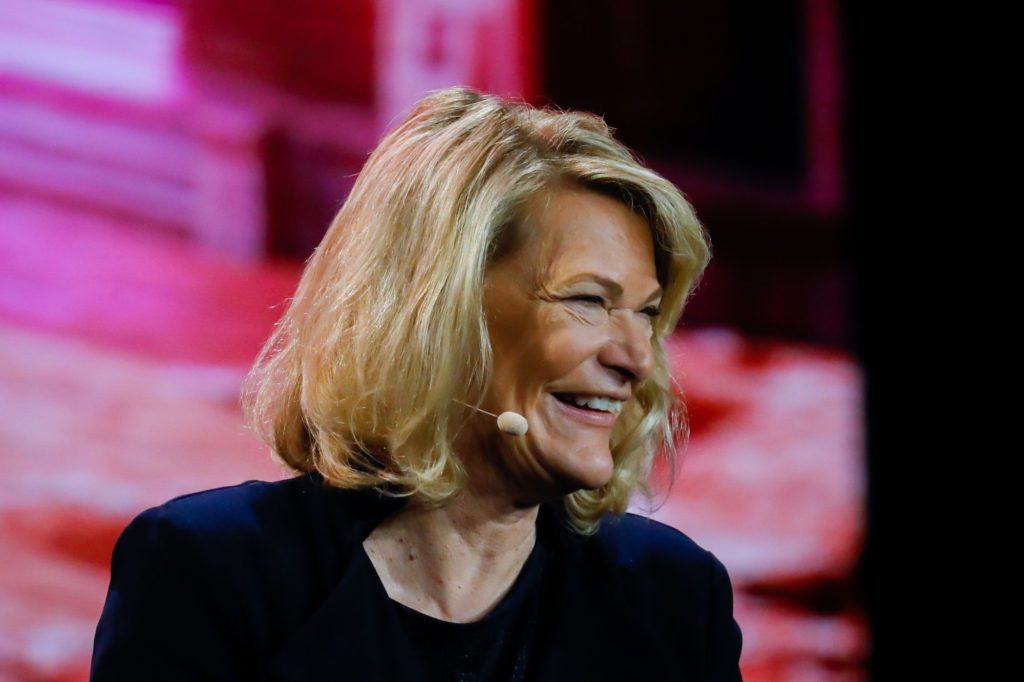
Gillibrand is crafting the bill with Cynthia Lummis — a Wyoming Republican who personally invests in Bitcoin. The duo’s legislation is seen as having a better chance of becoming law than many other crypto bills that have been introduced. 

Yet despite the involvement of the pro-crypto Lummis, the effort is making some coin enthusiasts nervous. 

Many worry that the legislation may be so broad it’ll cause unanticipated problems for firms down the road, according to people familiar with the matter. Others thought early drafts of the bill would give too much power to Securities and Exchange Commission Chair Gary Gensler, who says many digital assets are securities and subject to his agency’s tough investor protection standards.

The whole episode is emblematic of crypto’s growing pains in Washington where there’s no shortage of ideas for regulation. Progressive Democrats, including Elizabeth Warren are keen to crack down. The Senate Banking Committee’s top Republican Pat Toomey wants to rein in stablecoins. 

Lobbyists are waging a fierce campaign to make sure that small word choices by Lummis or Gillibrand don’t negatively impact the industry — even unintentionally. 

Gillibrand’s spokesman Evan Lukaske said that the New York senator has been holding meetings with crypto firms, regulators and consumer advocates as she works on the legislation. “Senator Gillibrand is interested in hearing from key stakeholders in order to best develop a framework that promotes innovation,” he said in a statement. 

A recent version of the legislation reviewed by Bloomberg News would give the Commodity Futures Trading Commission a bigger role in overseeing the asset class. Still, it’s unclear if the plan will assuage crypto die-hards, who want the CFTC to have more power than the SEC because they believe the derivatives regulator will take a lighter touch.

“If the industry doesn’t already realize it, it will come to understand that in legislation you don’t always get what you want,” said Ian Katz, a managing director at Capital Alpha Partners. “You have to be willing to compromise and sometimes that means accepting aspects of a bill you might not like.”

The measure would leave the SEC with some jurisdiction, said Abegail Cave, a spokeswoman for Lummis. “It is highly unlikely that a digital asset bill will pass Congress without the SEC having a role,” she added in a statement. “It is a broad bill because there are critical areas in many parts of the law that need to be addressed.”

Lummis and Gillibrand also aren’t the only two senators being courted. Cory Booker, a New Jersey Democrat, joined Gillibrand at one of the events last month in San Francisco, people familiar with the matter said. Meanwhile, Coinbase Global Inc., the U.S.’s biggest exchange, held a fundraiser for Chuck Schumer earlier this year. Representatives for Booker and Schumer didn’t respond to requests for comment. 

The uptick in events is a sign that lawmakers are poised to receive a windfall in donations from the crypto industry as their prep for re-election bids accelerates in the coming months and years. However, federal election filings are yet to paint a clear picture of their haul, in part because there’s a lag in reporting. 

Lummis is next up for re-election in 2026 and Gillibrand in 2024.

The Manhattan fundraiser being planned for Gillibrand is a May 31 cocktail party organized by Kristin Smith, executive director of the Blockchain Association. Guests will be notified of the location after they R.S.V.P., according to an invitation seen by Bloomberg.

More stories like this are available on bloomberg.com

©2022 Bloomberg L.P.

Social Media Buzz: Clarence Thomas, Roman Bust, Derby Day

(Bloomberg) — What’s buzzing on social media this morning:

BUZZING HEADLINES

Supreme Court Justice Clarence Thomas says the court is obligated to take a look at established precedent, and that government institutions should not be “bullied,” CNN reported. His comments on Friday came after the leak of a draft opinion that would overturn Roe v. Wade, which legalized abortions nationwide. Speaking to an audience of mostly judges and lawyers in Atlanta, Thomas said the Supreme Court is the “end of the line” and can’t be bound by “stare decisis,” or what has already been decided. The leak of the opinion has sparked a national debate about the future of reproductive rights. 

A 2,000-year-old Roman marble bust that had been bought for $34.99 at Goodwill store in Austin, Texas, went on display this week at the San Antonio Museum of Art. The bust was bought in 2018 by an Austin antiques collector, Laura Young, who tracked down the last owners, a museum in Germany, where it will return next year. It’s unclear how the 52-pound sculpture made it to Texas, though it’s speculated that a U.S. service member brought it after World War II.

The 148th running of the Kentucky Derby takes place on Saturday. The derby, held at Churchill Downs in Louisville, is the oldest continuously held sporting event in the U.S, dating back to 1875. Bill Carstanjen, Chief Executive Officer of Churchill Downs, told Bloomberg’s Business of Sports that he expects attendance to reach 150,000 people at this year’s race if the weather is fair. The race is held rain or shine.

Chelsea Football Club has confirmed that it has reached an agreement to be purchased by a group led by Los Angeles Dodgers part-owner, Todd Boehly, and Clearlake Capital. The 4.25 billion pound ($5.25 billion) transaction includes a 2.5 billion-pound purchase of shares in Chelsea plus 1.75 billion pounds for further investments in the club, Bloomberg previously reported.

If the deal goes through, the club would be the 10th in the Premier League backed by U.S. investors. The sale still requires approval from the British government, which sanctioned the club’s current owner, Russian billionaire Roman Abramovich in March after Russia’s invasion of Ukraine. 


More stories like this are available on bloomberg.com

©2022 Bloomberg L.P.

Rogers’ $16 Billion Deal Hits Trouble as Antitrust Body Says No

(Bloomberg) — Rogers Communications Inc. said Canada’s antitrust agency is opposed to its C$20 billion ($16 billion) takeover of rival Shaw Communications Inc., casting significant doubt on whether the companies will be able to close one of the country’s biggest-ever deals. 

The companies extended the deadline for the transaction to July 31, from June 13, and said they remain committed to it. But the Canadian Competition Bureau’s move to file applications against the deal raises the prospect they’ll have to win a court battle to get it done. 

Rogers, Canada’s no. 1 wireless and cable provider, agreed to buy Shaw for C$40.50 a share last year in the company’s biggest takeover to date. The wireless business is the key sticking point for regulators. Shaw’s Freedom Mobile unit is the fourth-largest competitor with a presence in several major urban markets, including Toronto and Vancouver. Rogers already has more than 11 million wireless customers — about 30% of Canada’s population.

Rogers hired Barclays to run an auction for Freedom in the belief that selling it would solve the antitrust problem. But the companies’ statement early Saturday morning indicates the Competition Bureau isn’t satisfied with the plan. Rogers has been in talks about Freedom with Canadian internet provider Xplornet Communications Inc., according to a person familiar with the matter. 

Xplornet, which is controlled by New York-based Stonepeak Partners LP, has played a role in a Canadian telecommunications merger before. 

In 2017, BCE Inc. acquired Manitoba Telecom Services Inc. in a deal that faced major concerns from the Competition Bureau. BCE agreed to divest parts of the business, including stores, spectrum and some customer accounts, to Telus Corp. and Xplornet to win approval.

Dwayne Winseck, a professor at Carleton University who was consulted by the government on that deal, called it a “complete disaster” because Xplornet didn’t become a strong wireless competitor. With Manitoba Telecom no longer around, the wireless market in the Canadian province is now dominated by three companies instead of four.

The bureau’s action against Rogers “is a move informed by its past experience with the Bell-MTS deal, and more broadly with its knowledge of Xplornet and what it takes to create a viable fourth competitor here in Canada that will be in it for the long run,” Winseck said by phone. 

The bureau now has to take the case to Canada’s Competition Tribunal, an independent arm of the federal government that deals with mergers and other competition matters.  

Rogers and Shaw will oppose the bureau’s application to prevent the deal while engaging with it to find a resolution, the companies said. They will also continue to seek approval from the Ministry of Innovation, Science and Economic Development.

“Rogers and Shaw remain committed to the transaction, which is in the best interests of Canada and Canadians because of the significant long-term benefits it will bring for consumers, businesses and the economy,” the companies said in the statement.

In March, the Canadian broadcast regulator approved Rogers’ purchase of Shaw’s cable television assets, but it still needs the green light from the competition watchdog and the federal government.

Rogers shares have fallen 7% in the past month and Shaw has dropped nearly 4% amid a lack of information about the regulatory-approval process and a broad selloff in equity markets.  

(Updates with additional information on Xplornet beginning in the fourth paragraph)

More stories like this are available on bloomberg.com

©2022 Bloomberg L.P.

Crypto Bridge Heists Swiping $1 Billion Spur Race for Alternatives

(Bloomberg) — High-profile hacks on crypto “bridges” — which let users swap digital tokens across blockchains — are creating opportunities for exchanges and other businesses to offer more secure alternatives.

Crypto exchanges FTX and Coinbase Global Inc. are deepening their capabilities to provide bridge-like services on various blockchains, so users invested in Bitcoin or Ethereum can easily participate in other networks’ financial or gaming apps. FTX, for instance, launched a marketplace last year that allows customers to trade Solana-based nonfungible tokens, and to easily swap their Ethereum for the chain’s main Sol coin to buy them. Users can also deposit an Ethereum-based NFT and withdraw it on Solana via FTX — instead of a bridge. And more app developers, like institutional lending marketplace Maple Finance, are moving onto new blockchains, making bridges unnecessary for certain transactions. 

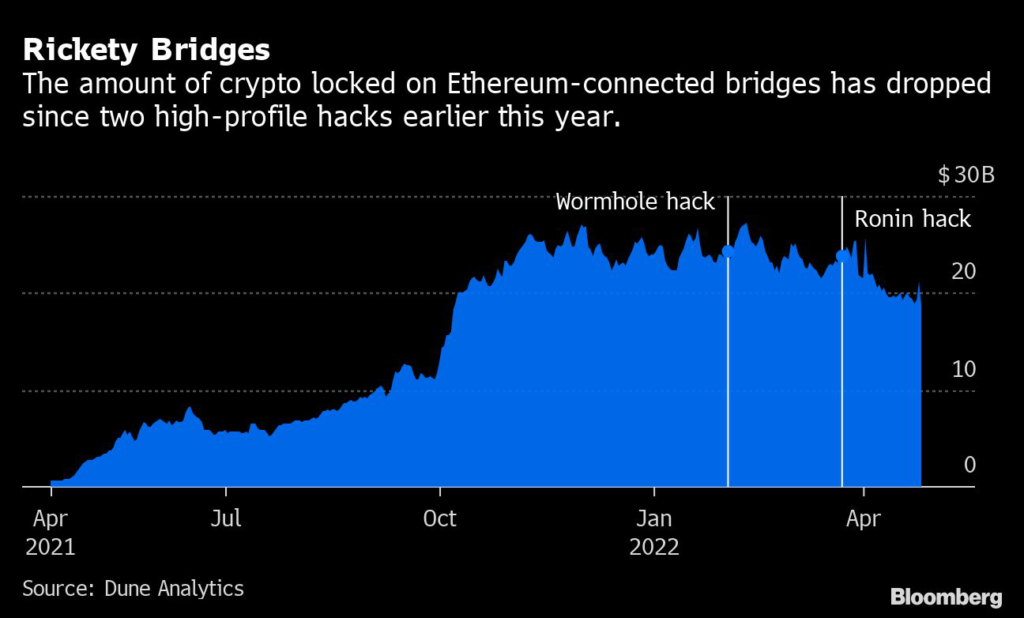
While some measures may have been in the works prior to the breaches, their urgency and attraction have increased after hackers siphoned more than $1 billion out of crypto bridges like Wormhole and Ronin — most of it in February and March. An April survey of 500 U.S. adults by OnePulse showed 80% of respondents don’t trust crypto networks to protect their funds. While Ethereum-connected bridges still contain some $17.4 billion in value locked, that’s down about 17% in the past 30 days, according to tracker Dune Analytics.

“It wouldn’t shock me if more users wanted exchanges as bridges given their expertise and bankroll,” Sam Bankman-Fried, chief executive officer of FTX, said in an email. “We’re currently bridging some chains together and are thinking about potentially doing more.”

With decentralized bridges, which are operated via software, it’s often unclear who runs them, who can access their funds and how, and whether users will be reimbursed in case of a hack. On the other end of the spectrum, a more centralized alternative may be run by a company that is licensed and regulated, and can be held accountable for any problems.

On March 17, Coinbase Wallet introduced support for Solana, letting users send, receive and store Solana and SPL tokens, which are coins native to the Solana blockchain. For example, if investors had previously wanted to move a USDC coin — one of the top stablecoins — from Ethereum to Solana, they needed to deposit the USDC into Coinbase to buy Sol, then swap that token for USDC-SPL on market maker Raydium. Now, that can be done through Coinbase directly, according to Austin Federa, head of communications at Solana Labs. 

“The more exchanges do this, the easier it becomes to explore Solana’s offering without having to support a decentralized exchange or a bridge,” Federa said in an interview. 

In its blog, Coinbase said it plans to further integrate into the Solana ecosystem, letting users connect to its decentralized applications, or dapps, and manage their Solana NFTs directly within their Coinbase Wallet.

Meanwhile, a slew of non-exchange apps like Maple are building versions for other blockchains — partly to help customers avoid bridges.

Maple, which started on the Ethereum blockchain, launched on Solana in late April. Previously an investor with USDC-SPL stablecoin on Solana had to go through a bridge like Wormhole to deposit funds into Maple. Now they can make the deposit directly.

“The institutional and the corporate partners that we’ve dealt with really wanted this security,” said Sid Powell, CEO of Maple Finance. As security and performance of decentralized bridges get better, more people will likely begin to use them, he said, noting that Maple is considering expanding onto other networks, like Avalanche.

Going onto different blockchains can require extensive rewriting of code for an app, though it can offer a lot of benefits. Crypto apps can potentially grow faster if usage of the underlying blockchain balloons.

“The primary and most prevalent reason is to tap different consumer bases,” said Bodhi Pinkner, a portfolio manager at Arca, a digital-asset management firm. “You can increase your user base theoretically. It would reduce the needs for bridging if you assume every application is deployed cross chain on every chain.” 

Still, bridges won’t be disappearing anytime soon. With more than 18,800 tokens, and thousands of blockchains, they are necessary for heavy users like Arca.

“People are becoming more conscious of the bridges they use,” Pinkner said in an interview. “But the need to bridge is so large that avoiding them for someone like us is not an option.” 

More stories like this are available on bloomberg.com

©2022 Bloomberg L.P.

‘Please Pay Attention’: Scientist Flagged Heart-Pill Toxins Early On

(Bloomberg) — A scientist at a China-based company that makes crucial ingredients for generic drugs warned a year before the start of a global recall that some blood-pressure pills could become tainted with potentially cancer-causing chemicals, according to court documents.

Zhejiang Huahai Pharmaceutical Co. makes active ingredients for generic drugs including valsartan, which is taken by millions of people to treat hypertension. In July 2018, valsartan made with Huahai’s products was recalled for containing N-Nitrosodimethylamine, or NDMA, a chemical that can increase the risk of cancer after prolonged exposure at the levels detected in the drugs. 

People who are prescribed blood-pressure treatments often take them routinely for years. Generic valsartan, which is part of a class of drugs known as angiotensin II receptor blockers, has been sold in the U.S. for a decade. Since the first batches were recalled, there has been a global effort—and legal wrangling—aimed at figuring out how NDMA got into the drug, and whether pills should have been removed from pharmacies sooner.

When Novartis AG detected NDMA in valsartan ingredients it bought from Huahai during routine testing in June 2018, the potential for the drug to become contaminated during manufacturing wasn’t well-known. The Swiss drugmaker developed the brand-name version of valsartan, marketed as Diovan, and its Sandoz unit sells a generic.

While the discovery surprised Novartis and regulators, an internal Huahai email shows that some of its officials were told of the possibility as early as July 2017. The message was made public last month in multidistrict litigation in the U.S. District Court in New Jersey.

The email from scientist Jinsheng Lin, who worked in a special quality unit at Huahai, was written as the company was trying to alter its approach to production of another heart drug called irbesartan, a chemical cousin of valsartan. A proposed new way to make irbesartan, he wrote, was unlikely to work because of a potential contamination issue.

The process created an impurity that “is similar to the N-nitrosodimethylamine that occurs in valsartan when quenched with sodium nitrite, and its structure is very toxic,” Lin wrote.

Read more: Carcinogens have infiltrated the generic-drug supply in the U.S.

Plaintiffs’ lawyers in the U.S. have seized on the message, which was addressed to Lin’s supervisor and other company managers, as evidence that Huahai could have acted earlier to protect consumers.

“This is somebody, in 2017, clearly stating the root cause for the NDMA in the valsartan and recognizing that it is in the valsartan,” plaintiffs’ attorney Adam Slater, of the law firm Mazie Slater Katz Freeman, said in a hearing in September, according to a transcript unsealed April 18. “What is the explanation from counsel for why Dr. Lin, almost a year before the disclosure to the rest of the world, knew that there was NDMA and knew exactly how it was being caused?”

Since the recall, similar problems have surfaced in more medications. Digestive drug Zantac was pulled from the market in 2020 for containing NDMA. Some versions of the widely used generic diabetes drug metformin were recalled. Pfizer Inc. and Sandoz found nitrosamines—the chemical family that includes NDMA—in muscle relaxers, smoking-cessation drugs and other blood-pressure pills.

Allison Brown, a Skadden, Arps, Slate, Meagher & Flom lawyer representing Huahai in the U.S., said the company couldn’t have known based solely on the email that a carcinogen would be formed in its production of valsartan.

“This email involves complex scientific issues that will be addressed by scientific experts in the valsartan litigation,” Brown said in a statement. “This email was written in Chinese and highlights the difficulties associated with translating from the original language and culture.”

Lin didn’t respond to a request for comment sent to a personal email account. Huahai didn’t respond to a request for comment. 

Evidence Battle

Hundreds of people in the U.S. sued Huahai and other drugmakers in 2019, alleging they got cancer after taking valsartan. The claims were consolidated to streamline pretrial proceedings.

Lawyers have been haggling over evidence and testimony, a debate complicated by security laws in China. In one instance, the court ordered that Huahai official Baohua Chen be deposed, but defense lawyers say China’s government wouldn’t let him leave the country. As a result, the plaintiffs have sought a default judgment against Huahai; a ruling on the motion is pending.

Huahai wanted to keep the full text of Lin’s email confidential, but a retired judge overseeing pretrial disputes, Thomas Vanaskie, ruled against the company in January. The plaintiffs posted the email on the docket in March. 

“This literally is a smoking-gun document,” Slater, the plaintiffs’ lawyer, said at a June 2021 proceeding.

Seven Huahai managers who were addressees on Lin’s email had been asked to produce documents related to the recall, but it was only included in records from Min Li, Lin’s boss, according to Slater. At the hearing in September, Slater said that Huahai never meant to reveal the email, but it slipped through because Li transferred files to a new laptop in June 2018, causing the message to be re-dated to a time period after Novartis informed Huahai of the contamination. 

Jessica Priselac, an attorney at the law firm Duane Morris who represented Huahai until April, said in September that Huahai didn’t try to hide the email. The company doesn’t have a centralized server, so emails don’t get saved unless they’re saved on personal computers, she said. Priselac didn’t respond to an email seeking comment.

Vanaskie said the circumstances surrounding the discovery of the email were “troubling” but declined to force Huahai to do a new document search, saying there wasn’t any direct evidence that anyone at the company deliberately destroyed evidence. He said that he would require Huahai to produce documents about the project Lin was working on to improve irbesartan production.

Chemical Reaction

Global regulators have determined that NDMA was caused by chemical reactions that occur as valsartan is manufactured. In February 2019, the European Medicines Agency said in a 41-page report that the compound sodium nitrite and a solvent called dimethylformamide, or DMF, react with each other to form NDMA in the drug. The conclusion was largely based on analyses conducted at the request of the EMA by pharmaceutical companies that sold the recalled valsartan.

At the time of the first recall in 2018, the FDA said there was no way companies could have known to test products for NDMA. An agency inspector raised concerns in 2017 about Huahai’s quality testing after a visit to its factory in Linhai, but regulators took no immediate action. The FDA banned Huahai from sending product from the factory to the U.S. in 2018; it lifted the ban last year.

“Because it was not anticipated that NDMA would occur at unacceptable levels in the manufacturing of the valsartan API, manufacturers at that time would not have been expected to test for it as an impurity, said Audra Harrison, an FDA spokeswoman.

Since the valsartan recall, the industry now knows what processes may lead to nitrosamine contamination and has better analytical technology to detect the compounds, Harrison said.

Read more: New toxic impurities have been detected in some heart pills in the U.S.

Quenching, a part of the drugmaking process that was the focus of Lin’s email, is used to eliminate excess amounts of a chemical that may be toxic but that creates essential reactions in manufacturing. In valsartan, sodium azide helps form a critical “tetrazole ring” of four nitrogen atoms and one carbon atom, but it must be removed from finished pills. Sodium nitrite is one option for quenching sodium azide.

At the end of his message, Lin pointed to a 2013 valsartan patent from another Chinese company that discusses using an alternative to sodium nitrite in quenching. The patent doesn’t mention NDMA, but Lin wrote that it recommends the substitution because sodium nitrite produces the dangerous impurities.“This indicates that other companies have paid attention to the quality problem very early on,” Lin wrote. “So leaders please pay attention to this issue.”

More stories like this are available on bloomberg.com

©2022 Bloomberg L.P.

A Guide to U.S. Electric Car Tax Credits and Rebates

(Bloomberg) — As the average price of gas continues to surge, more U.S. consumers might be considering buying an electric car. According to auto club AAA, from May 2 to May 6 the national average for a gallon of regular gasoline increased by five cents to $4.24. Russia’s invasion of Ukraine also has pushed prices higher. 

The conventional wisdom has been that plugging in and charging up a battery-powered car will cost an owner less than filling up a gas tank. But EVs are more expensive —  many models on the market in the U.S. are beyond the means of the average consumer. The cheapest Tesla, a Model 3, starts at $47,000; the Ford Mach-E has a similar base price but actual sales have run above the Manufacturer’s Suggested Retail Price. Ford’s F-150 Lightning, the electric version of America’s best-selling vehicle of the past 40 years, has drawn a ton of interest — and deposits — given a somewhat more competitive starting point: just under $40,000.

Those are big numbers but not necessarily deterrents. Anecdotally, dealers report an increase in prospective buyers entering showrooms specifically to explore electric or hybrid models. Some are “just wanting to look,” says James Morrell, the owner of the Destination Kia dealership in Albany, New York. That curiosity has recently converted into more EV sales. Morrell’s dealership sold 16 Kia EV6s — a new, fully electric sport utility vehicle that hit showrooms in February with a starting price, for the “Light” model, of $40,900 — in the last two weeks of March. “That’s a lot of electric vehicle sales in a short period of time,” he says.

Federal tax deductions for qualifying purchases can meaningfully change a buyer’s math. Add to that any applicable state rebates or credits from a power utility and before you know it, you’ve reduced your cost, potentially by several to many thousands of dollars. Dealers have become more practiced in explaining the options available to help lower the cost. Prospective shoppers are catching on — they’re coming in having done their research, says Morrell.

What should you know about credits and rebates before you buy? Our guide below lays out the key points.1. Federal income tax credit up to $7,500*Currently, $7,500 is the maximum amount available to buyers of new fully electric or plug-in hybrid cars (leasing only qualifies for the leasing company). The credit is a deduction on your federal income tax return for the calendar year in which you purchased the car. Let your accountant know you bought a new EV and be sure she knows about the deduction.

As for the “up to” qualifier: You’ll get the deduction only if you owe taxes. Say your tax bill comes to $8,000. Depending on which car you buy, you can reduce that bill by up to $7500. If you owe taxes totaling less than the maximum credit allowed, say $3,000,  you can deduct what you owe, but not more.

2. Battery size matters

Credits also are based on the size of the most important part of your new EV — the battery. While most current plug-in models command the $7,500 maximum, hybrids typically earn a smaller credit. If, for example, you’ve decided on a Toyota Prius Prime Plug-In Hybrid, your maximum rebate will be about $4,500.

To see where a particular model stands, check the Internal Revenue Code Section 30D.

3. Not all EV models qualify

The federal credit is available until a company sells 200,000 of a particular model; then the credit is phased out. Tesla models are no longer eligible for a tax credit; General Motors also has reached the threshold. Always ask a dealer whether the federal tax credit is available for the model you’re considering. 

Toyota, as Bloomberg reported earlier this week, is almost there. Demand for Toyota’s plug-in hybrid vehicles has steadily grown, especially as gasoline prices surpassed $4 a gallon. Cumulative sales of Toyota’s eligible vehicles came to 183,000 as of the end of 2021, according to analysis by BloombergNEF. The company reported another 8,421 plug-in hybrid and electric car sales in the first quarter.

4. State awards / rebates add up

California, as the state with the largest number of electric cars on the road, not surprisingly has a wide range of electric car rebates, all detailed on the website of the California Air Resources Board (CARB). The heftier awards that are part of the California Clean Vehicle Rebate Project are income eligible, among other requirements.

Programs and offers vary from state to state. In New York, the “Drive Clean” rebate of up to $2000 is given for any new EV purchase or lease. There are two requirements: you must keep the vehicle for a minimum of three years and agree to do so; and you must be a resident of the state. 

5. Local utilities and/or energy departments want to help

Check with your utility provider about any incentive or rebate. It might offer a discount on an at-home charger, which on average costs about $700. The bigger expense for that is running a 220 volt line that will power your plug. In Utah, Rocky Mountain Power offers its residential customers a rebate of up to $200 for buying and installing a Level 2 charger. 

 6. Resources list

Bookmark these websites for answers to your questions — and check back here at Bloomberg Green and Hyperdrive for our coverage on the ways U.S. consumers are increasingly embracing battery-powered cars.

  • The Alternative Fuels Data Center has state-by-state breakdowns
  • The U.S. Department of Energy’s EV incentives website
  • BloombergNEF’s annual EV outlook provides an in-depth look at every aspect of alternative fuel vehicles.

*President Joe Biden has proposed increasing the federal credit to up to $12,500, for vehicles made by union shops. But he faces strong opposition to the measure. West Virginia Senator Joe Manchin, a primary antagonist of many of the president’s infrastructure and transportation plans, this week rejected Biden’s proposal, calling it ludicrous.

More stories like this are available on bloomberg.com

©2022 Bloomberg L.P.
Close Bitnami banner
Bitnami