
Bloomberg

Beijing District Shuts Gyms, Cinemas to Halt Covid Spread

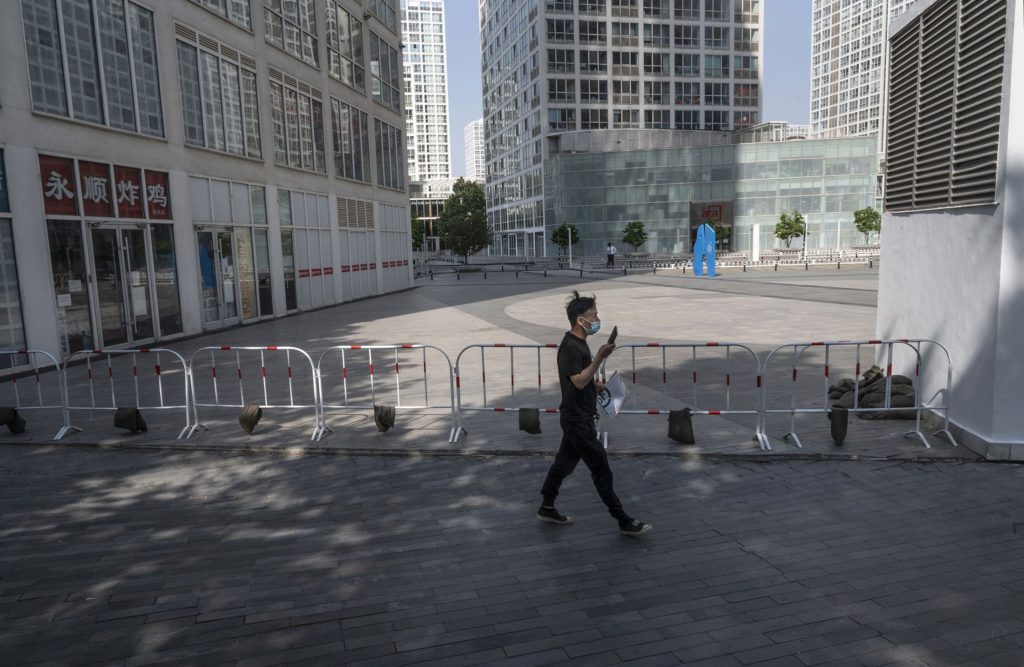
(Bloomberg) — A key district in China’s capital has ordered some businesses providing non-essential services such as gyms and movie theaters to close to prevent the spread of Covid infections after President Xi Jinping reaffirmed his stringent Covid Zero policy.

Beijing’s eastern Chaoyang district, home to embassies and offices of multinationals including Apple Inc. and Alibaba Group Holding Ltd., ordered companies “providing services other than those supporting residents’ livelihoods” to be closed until further notice, an official said at a briefing on Friday evening.

Businesses ordered closed include karaoke bars, internet cafes, museums and art galleries, said Yang Beibei, deputy director of Chaoyang district. New rounds of mass Covid tests were announced on Friday after the municipal government locked down some residential areas and subway stops in the city.

In the 24 hours ending 3 p.m. Saturday, Beijing added 78 new cases. Nationwide, 4,620 local infections were reported, most from Shanghai, the National Health Commission said, while 13 people died.

The city of Shanghai announced Saturday it would postpone entrance examinations for colleges and high schools until July, citing infection risk, while some of the city’s biggest manufacturers have said they are trying to restart plants.

Electric-vehicle battery maker Contemporary Amperex Technology Co. Ltd. said in a statement that capacity at its Shanghai factory has returned to pre-pandemic levels.

 “The plant is planning to increase production capacity if conditions allow,” according to the Tesla Inc. supplier.

China’s financial hub, also home to the country’s top automobile and semiconductor plants, said earlier that 70% of the city’s manufacturing facilities have resumed operation.

(Updates with number of Covid cases reported in Beijing in fourth paragraph.)

More stories like this are available on bloomberg.com

©2022 Bloomberg L.P.

India to Reassess Broadcast Pricing as Media Competition Hots Up

(Bloomberg) — India is proposing changes including on how cable TV fees are calculated, following concerns that free services from the state broadcaster and rising popularity of over-the-top platforms is eroding viewership. 

Direct-to-home active subscribers fell to 68.52 million in December from 70.99 million in March 2020. In such conditions, industry representatives say implementation of a new tariff order “will cause large scale disruptions,” the Telecom Regulatory Authority of India said in a consultation paper posted on its website Saturday. 

Asia’s Two Richest Men Prepare for Battle With Netflix, Amazon

The media and entertainment sector in India has become a hot-bed of competition in recent months. Global giants like Netflix and Amazon are battling Indian tycoons Gautam Adani and Mukesh Ambani in the only market which offers more than a billion customers and is open to foreign competition.

Trai’s key questions:

  • Should channels in a bouquet be priced homogenously?
  • What measures can ensure effective a-la-carte choice to customers?
  • Should prices be capped to ensure access/should discounts be offered?

Stakeholders can send their views by May 30 and counter comments by June 6.

More stories like this are available on bloomberg.com

©2022 Bloomberg L.P.

China Bans Younger Livestream Users From Sending Virtual Gifts

(Bloomberg) — Chinese regulators have further tightened their grip on the internet industry, banning younger users from sending virtual gifts on livestream platforms, which could affect companies including ByteDance Ltd. and Kuaishou Technology.

The announcement came after the central government hinted this week that it would wrap up a year-long crackdown on China’s internet industry, which is the world’s largest e-commerce market and has created technology giants such as Alibaba Group Holding Ltd. and Tencent Holdings. 

Livestream apps are banned from providing minors with facilities for online transfers or virtual gift-purchase services, under the new rules, according to a joint notice published by several government agencies including the National Radio and TV Administration and Cyberspace Administration of China.

Before the new guidance and despite rules aimed at curbing online spending by minor users, many young people were able to send virtual gifts or cash tokens to livestream performers, with some platforms claiming a commission fee from the contributions.

The government also asked platforms to stop providing livestream feeds to minors after 10 p.m., according to the notice.

“Platforms should deeply understand the extreme importance and urgency of regulating the livestream environment and protecting minor users,” said the notice.

Chinese authorities had already introduced stringent measures capping play time for minors and imposed requirements aimed at curbing addiction.

Late last month, China’s top leadership vowed to support the healthy growth of platform companies as Covid lockdowns countrywide threaten to dent the nation’s economy.

More stories like this are available on bloomberg.com

©2022 Bloomberg L.P.
Rogers, Shaw Say Canada Competition Bureau to Oppose Deal

(Bloomberg) — Rogers Communications Inc. and Shaw Communications Inc. said they were notified by Canada’s Competition Bureau that it intends to file applications against their C$20 billion ($16 billion) deal.

Rogers and Shaw will oppose the competition agency’s application to prevent the deal while engaging with it to find a resolution, the companies said in a statement. They will also still continue to seek approval from the Ministry of Innovation, Science and Economic Development.

Opposition by the antitrust agency could delay or derail one of Canada’s biggest-ever mergers, which the companies had been trying to close this quarter. In March, the Canadian broadcast regulator approved Rogers’ purchase of Shaw’s cable television assets, but it still needed the green light from the competition watchdog and the federal government.

“Rogers and Shaw remain committed to the transaction, which is in the best interests of Canada and Canadians because of the significant long-term benefits it will bring for consumers, businesses and the economy,” they said.

Shaw Deal Arbitrage Gap Is Widest Since November After Selloff

The antitrust review was expected to be the most difficult obstacle. Rogers, the country’s largest wireless and cable provider, has offered C$40.50 cash per Shaw share for an acquisition that would allow it to become a national cable player and bolster its wireless infrastructure in Western Canada. 

Rogers buying Shaw would eliminate the No. 4 wireless competitor in major cities like Toronto and Vancouver.

The companies said they have offered to address concerns regarding the impact of their merger on Canada’s wireless market, including the sale of Shaw’s Freedom Mobile business. The Globe and Mail earlier reported that Rogers presented Canada’s government a deal for Xplornet Communications Inc. to buy Freedom Mobile in April as part of the effort to get approval for the Shaw merger. 

Rogers Hits Record as Outlook Improves Ahead of Shaw Deal

(Updates with comments from companies from paragraph four)

More stories like this are available on bloomberg.com

©2022 Bloomberg L.P.
Rogers, Shaw Say Canada Competition Bureau to Oppose Merger

(Bloomberg) — Canada’s Competition Bureau notified Rogers Communications Inc. and Shaw Communications Inc. that it intends to file applications to oppose their merger, the companies said in a statement. 

Rogers and Shaw said they will oppose the competition agency’s application to prevent the deal while engaging with it to find a resolution. They will also still continue to seek approval from the Ministry of Innovation, Science and Economic Development.

“Rogers and Shaw remain committed to the transaction, which is in the best interests of Canada and Canadians because of the significant long-term benefits it will bring for consumers, businesses and the economy,” they said.

The companies said they have offered to address concerns regarding the impact of their merger on Canada’s wireless market, including the sale of Shaw’s Freedom Mobile business. The Globe and Mail earlier reported that Rogers presented Canada’s government a deal for Xplornet Communications Inc. to buy Freedom Mobile in April as part of the effort to get approval for the Shaw merger. 

Rogers Hits Record as Outlook Improves Ahead of Shaw Deal

More stories like this are available on bloomberg.com

©2022 Bloomberg L.P.

Trump’s Censorship Attack on Twitter Fails to Get Ban Lifted

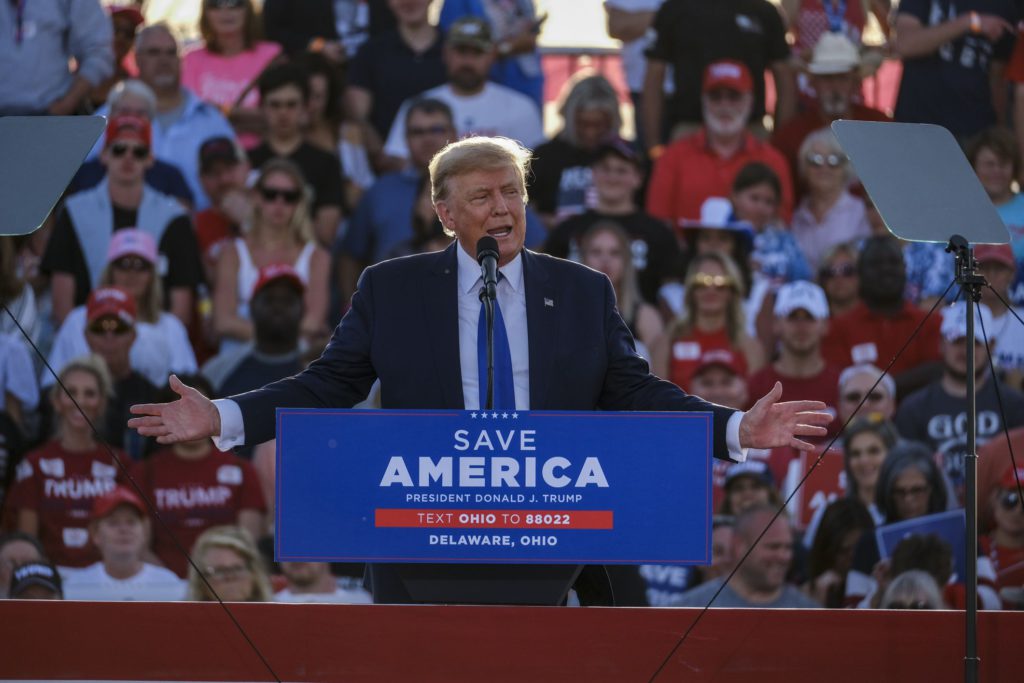
(Bloomberg) — Donald Trump’s claim that Twitter Inc. violated his free-speech rights by bumping him off its platform failed to win over a federal judge.

U.S. District Judge James Donato on Friday threw out the former president’s challenge to his permanent ban from Twitter for stoking the Jan. 6 Capitol riot. 

The San Francisco judge gave Trump’s lawyers a chance to revise the suit and try again, but warned they will have to show that Twitter was acting as a government censor.  

“This is not an easy claim to make, for good reasons,” Donato said.

Read More: Trump Tells Fox News He’ll Stay Off Twitter Even If Ban Lifted

Trump’s lawyers had argued that Twitter was acting at the behest of the government because it suspended his account under pressure from Democratic lawmakers.

Trump is considering whether to file an amended complaint or seek to overturn Donato’s decision at the 9th U.S. Circuit Court of Appeals, said his attorney, John Coale. 

“We’re going to go up to the 9th Circuit and are optimistic this will be decided in our favor at the Supreme Court level,” he said.

Trump vowed in recent media interviews not to return to tweeting even if he’s reinstated once Elon Musk, who has agreed to buy the platform, takes over. Musk claims Twitter has censored free speech.

If Trump does get reinstated on Twitter, he could potentially reconnect with more than 87 million followers as he weighs another run for the White House in 2024. 

The former president is not in the legal fight alone. He is joined by a handful of other Twitter users who were thrown off the platform, including the American Conservative Union, who filed the case as a class action on behalf of others who claim they were censored. 

Read More: Trump’s Truth Social Debut Kindles Retail Support for SPAC 

Trump’s Twitter-like platform — “Truth Social” — debuted Feb. 21 with a glitchy start as users complained of receiving error messages and being placed on waiting lists that had hundreds of thousands of people ahead of them. 

But Truth Social’s momentum picked up and Musk noted in an April tweet that the platform had risen to the top of the chart of Apple’s most-downloaded free apps, beating Twitter and video platform TikTok Inc.

A spokesperson for Twitter declined to comment on the ruling. 

Twitter’s defense to Trump’s suit is that the company, as a private actor, can decide who gets to use its platform and isn’t bound by the Constitution.

Donato said Trump’s suit was “a grab-bag of allegations” related to how lawmakers reacted to Trump’s tweets around Jan. 6.

“Legislators are perfectly free to express opinions without being deemed the official voice of ‘the State,’” the judge said. “Government in our republic of elected representatives would be impossible otherwise.”

Like Twitter, Meta Platforms Inc.’s Facebook and Alphabet Inc.’s YouTube permanently suspended Trump after a mob of his supporters raided the U.S. Capitol to prevent the certification of Joe Biden as winner of the 2020 presidential election. 

Trump is challenging the Facebook and YouTube bans before another federal judge in northern California and Friday’s ruling could influence decisions about whether those suits are allowed to proceed.

Trump frequently clashed with Big Tech companies while he was president, accusing them of liberal bias and exhorting lawmakers to take away their legal protection under a 1996 law that shields internet publishers from liability for users’ posts.

The case is Trump v. Twitter, 3:21-cv-08378, U.S. District Court, Northern District of California (San Francisco).

(Adds comment from Trump’s attorney)

More stories like this are available on bloomberg.com

©2022 Bloomberg L.P.
Tesla Sues Engineer Over ‘Dojo’ Supercomputer Technology Theft

(Bloomberg) — Tesla Inc. sued a former engineer claiming he illegally transferred confidential information on its supercomputer technology to his own computer and turned over a “dummy” laptop for inspection to cover up the theft.

Tesla is developing an in-house supercomputer, dubbed Project Dojo, to deal with massive amounts of data, including video from Tesla cars, and using it to create autonomous driving software. Alexander Yatskov was hired in January as a thermal engineer to help design cooling systems for the computer, which generates a lot of heat, Tesla said in the complaint.

“These thermal designs and data are confidential and tightly guarded within Tesla,” the electric-car maker said.

But Tesla said Yatskov admitted to downloading confidential information from his Tesla devices to his personal devices, after he was confronted. He turned over a “dummy” computer for inspection by Tesla to try and cover his tracks, the company said.

Yatskov quit on May 2 and has refused to return the information, Tesla said in the complaint.

When reached by phone, Yatskov said he wasn’t aware of the complaint and declined to immediately comment on it.

Tesla also accused Yatskov of lying in his resume about his expertise and work experience. He also breached a non-disclosure agreement that barred him from disclosing trade secrets, Tesla said.

“This is a case about illicit retention of trade secrets by an employee who, in his short time at Tesla, already demonstrated a track record of lying and then lying again by providing a ‘dummy’ device to try and cover his tracks,” Tesla said in its complaint.

Tesla is seeking compensatory and exemplary damages and an order that would stop Yatskov from disseminating its trade secrets and direct him to return all proprietary data.

The case is Tesla Inc. v. Yatskov, 5:22-cv-02725, U.S. District Court, Northern District of California (San Jose).

More stories like this are available on bloomberg.com

©2022 Bloomberg L.P.
Bitcoin’s Testing of Lows Has Traders Wary of a Break Below $32,000

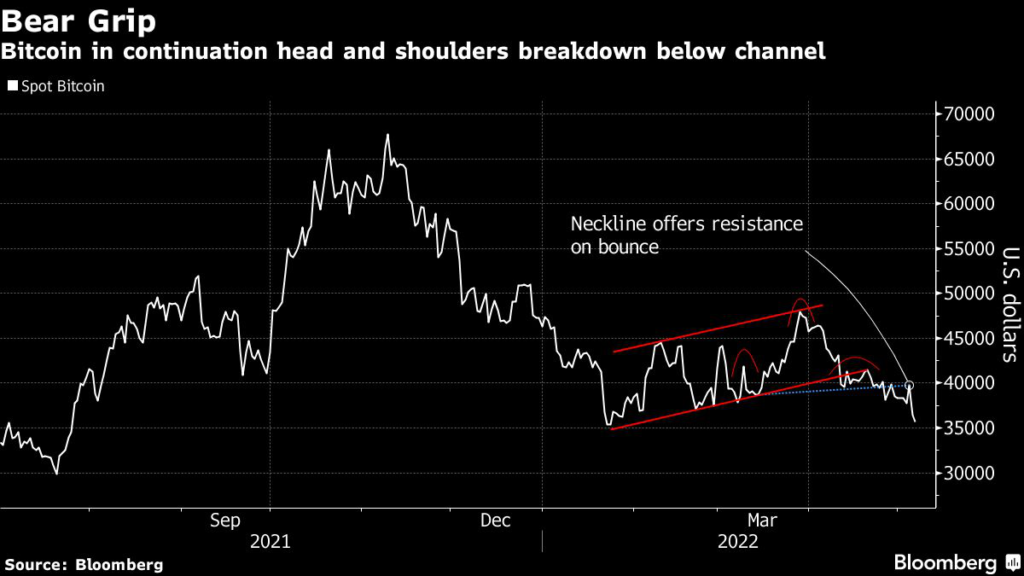
(Bloomberg) — Bitcoin slumped for the seventh time in eight days, raising concern that the slide risks pushing the largest cryptocurrency out of the range it has traded within much of the year. 

Cryptocurrencies have been weighed down by the overall risk aversion that has swept though global markets as central banks battle inflation while trying to temper the stimulus added during the Covid pandemic. Bitcoin is down more than 20% so far this year. 

“If risk sentiment continues plummeting, the chicken bones on the technical charts suggest Bitcoin could be on its way to $28,000 and then $20,000,” Jeffrey Halley, a senior market analyst at Oanda Asia Pacific, said in an email. “HODL on for dear life.”

Bitcoin fell about 1% to $36,077 as of 5 p.m. Eastern time Friday. It touched the lowest level since February and closed down around 6.3% since last Friday. The digital asset has been meandering between roughly $33,000 and the $48,000 it came into the year. It last traded below $32,000 in July. Ether, Avalanche and Solana also declined this week. 

About $475 million in long Bitcoin positions were liquidated over a 24-hours period, according to data from Coinglass. Bitcoin fell around 8% on Thursday, the biggest one-day drop since January. 

Bitcoin “is down by nearly 10%, breaking its support price, and there are chances that it may break below the current level,” said Edul Patel, CEO and co-founder of Mudrex, an algorithmic-based crypto investment platform. “BTC’s support now lies at $32,000.”     

Bitcoin has been largely trading in tandem with tech stocks — both the coin and the tech-centric Nasdaq 100 hit all-time highs in November and have been on a volatile downward path since. The Nasdaq 100 fell for a fifth consecutive week. 

The 90-day correlation coefficient of Bitcoin and the tech gauge now stands above 0.67, the highest such reading in Bloomberg data going back to 2010. A coefficient of 1 means the assets are moving in lockstep, while minus-1 would show they’re moving in opposite directions. 

David Duong, head of institutional research at Coinbase Global Inc., has been arguing that there are plenty of headwinds facing crypto — and other markets — this year, including more hawkish central-bank policies, as well as uncertainty over the path of global economies.

Duong attended the Milken Institute conference this past week, saying that a key takeaway was that many thought — despite turmoil seen in markets so far this year — that “there is still a good chance for further downside correction across risk assets.”

More stories like this are available on bloomberg.com

©2022 Bloomberg L.P.
Amazon Anti-Union Confabs Deemed Illegal By Labor Officials

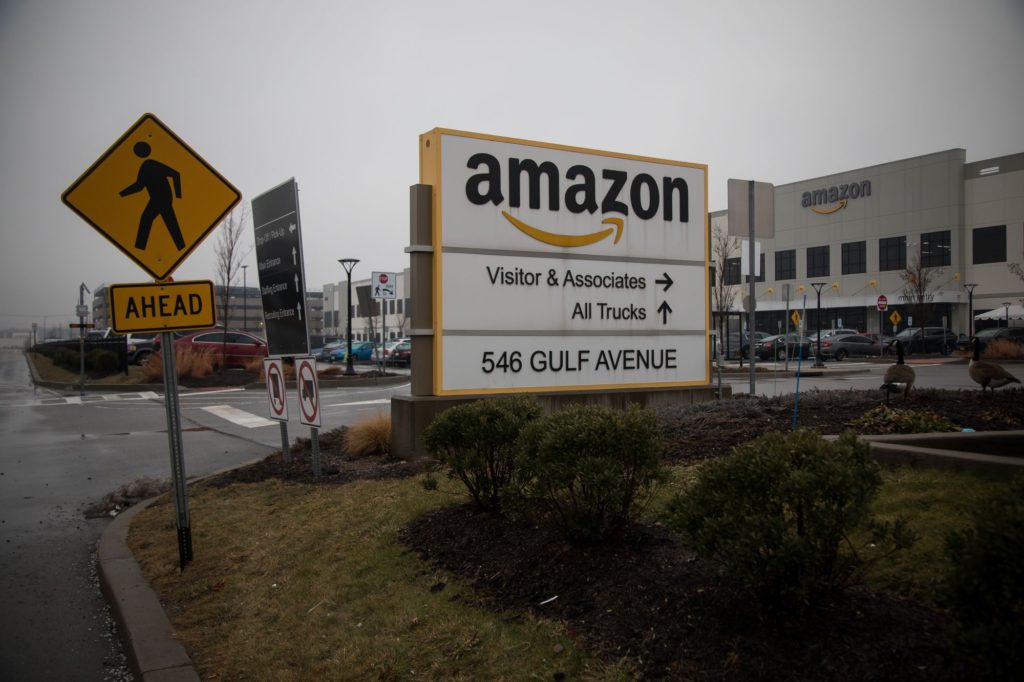
(Bloomberg) — U.S. labor board prosecutors have determined that anti-union meetings held by Amazon.com Inc. in Staten Island, New York, violated federal law, according to an agency spokesperson. 

The National Labor Relations Board’s Brooklyn regional director will issue a complaint if the company doesn’t settle, the agency’s press secretary Kayla Blado said in an email. The regional official has determined that the company held illegal mandatory meetings and made illegal threats in those sessions, she said.

Amazon said it holds the meetings to ensure employees understand the facts about unions and elections, and that for decades companies have been allowed to do so. “These allegations are false and we look forward to showing that through the process,” Kelly Nantel, an Amazon spokesperson, said in an email.

The upstart Amazon Labor Union last month decisively won an election to represent workers at an Amazon fulfillment center in Staten Island, the first time organized labor has gained a foothold at one of the e-commerce giant’s U.S. facilities. 

Amazon challenged the result, alleging the union broke election rules and that the NLRB violated its duty to be impartial by giving employees the appearance that the agency favored the union. Among its claims, Amazon said the union inappropriately tried “to interfere with and ‘shut down’” meetings with workers.

During the election, Amazon held mandatory “information sessions,” during which managers and consultants made the case that workers should vote to reject the union. 

The practice is standard operating procedure for the company, which also held the meetings during union campaigns in Alabama and at a second Staten Island warehouse, where the ALU lost an election earlier this week. 

“It’s a bit rich for Amazon to complain about interrupting captive-audience meetings” that are themselves “inherently coercive,” the union’s attorney Seth Goldstein said in an interview. “We hope that Amazon will agree to end this unlawful union-busting practice.”

The NLRB general counsel, Jennifer Abruzzo, said last month that she would seek to ban such meetings, declaring in a memo to the labor board’s regional chiefs that they constituted an unlawful threat to employees. The Amazon case could offer a vehicle for Abruzzo, an appointee of President Joe Biden, to get the issue before labor board members in Washington, where Democrats hold a majority due to other Biden appointments.

(Updates with Amazon comment in third paragraph)

More stories like this are available on bloomberg.com

©2022 Bloomberg L.P.

Shopify President Appeals for Patience as Stock Gets Crushed

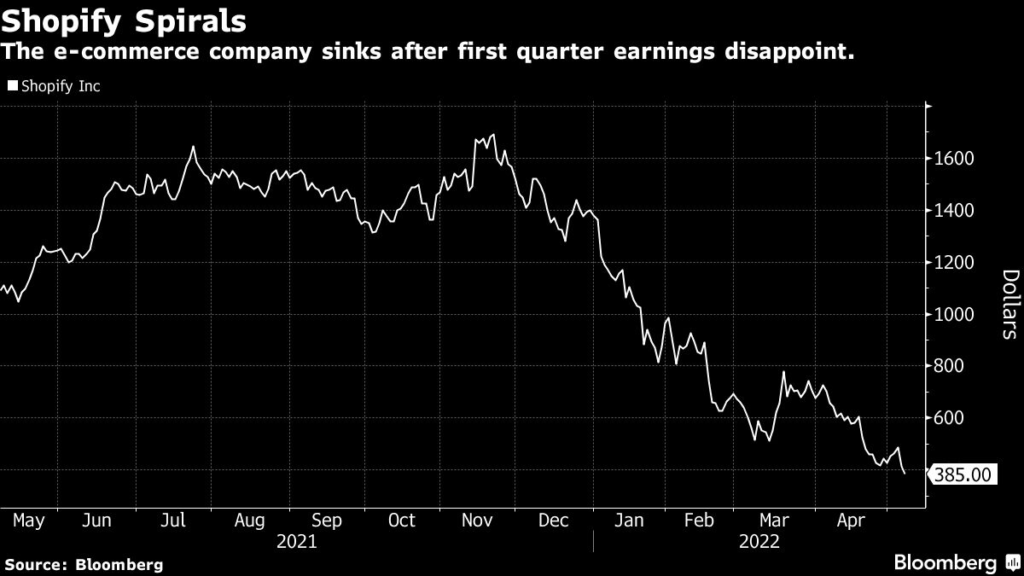
(Bloomberg) — Shopify Inc.’s president appealed to investors to focus on the company’s growing customer base as the stock dropped again Friday to a fresh two-year low. 

The Canadian company’s shares have plunged 22% since it disclosed first-quarter profit on Thursday morning that fell far short of analysts’ estimates. Shopify is navigating a “rebalancing” in retail that has seen shoppers head back to physical stores now that the Covid-19 crisis is easing, President Harley Finkelstein said. 

But Finkelstein said investors should pay more attention to its expanding roster of merchants and its longer-term growth opportunities. He stressed the unfavorable comparison with last year’s stimulus-fueled lockdown spending, adding that Shopify still expects “rapid” revenue growth at the end of the year. 

“We’re in an inflationary environment and consumer spending has changed dramatically,” Finkelstein said on BNN Bloomberg Television. “We’re looking at very difficult comps here. I think anyone that’s studied the stock and the market sees that. When you compare Q1 of 2022 to Q1 of 2021, we had lockdowns, we had government stimulus and it was a very different economy.”

The company doesn’t give a specific fiscal-year revenue outlook but analysts expect sales to grow 28% in 2022 to nearly $6 billion, according to data compiled by Bloomberg. 

E-commerce stocks including Amazon.com Inc., Wayfair Inc., Etsy Inc. and EBay Inc. have been battered on disappointing earnings and high volatility for tech stocks. More than a dozen analysts have slashed their price targets on Shopify since the first-quarter earnings release, and Barclays analyst Trevor Young wrote that investors are growing frustrated with the firm’s limited financial guidance and disclosure.

Shopify closed down 8.6% to $377.49 on Friday in New York. That’s the lowest level since April 2020. 

As retailers reopen physical stores, businesses that depended on Shopify’s e-commerce platform during pandemic lockdowns are adding its in-store point-of-sale services, Finkelstein said. 

Merchant solutions revenue — which includes services such as payments, lending and shipping — as a percentage of gross merchandise volume was the highest it has ever been at about 2%, he said.

That means that more merchants are joining Shopify’s platform and using more of its products, Finkelstein said. With its $2.1 billion acquisition of delivery technology company Deliverr to build out its fulfillment network, it is adding another service that will boost the company’s revenue, he said.

“It’ll be a reason why people not only come to Shopify, but stay at Shopify,” he said.

(Updates share price moves in second and seventh paragraphs, and the second deck.)

More stories like this are available on bloomberg.com

©2022 Bloomberg L.P.

Close Bitnami banner
Bitnami