Bloomberg

Cathie Wood’s Ark ETFs Dump Almost All Their Remaining Twitter Shares

(Bloomberg) — Cathie Wood’s famous faith in Elon Musk doesn’t appear to extend to his potential leadership of Twitter Inc.

Funds managed by Wood’s Ark Investment Management had already been selling the social-media platform this year even before the Tesla Inc. co-founder struck a deal to take Twitter private. On Thursday, when Twitter was one of the few stocks that gained amid a vicious rout, the funds sold a further 875,000 shares, nearly eliminating all of their remaining Twitter holdings.

The Ark Next Generation Internet ETF (ticker ARKW), which had about 5% in Twitter at the end of last year, cut its stake to about 2% by this week and then almost entirely disposed of it on Thursday, according to data compiled by Bloomberg.

The Fintech Innovation ETF (ARKF), which has maintained Twitter at about 1% this year, also trimmed its stake Thursday to 0.7%. The flagship Innovation ETF (ARKK) had already eliminated its Twitter holdings by mid-February.

Wood had expressed concerns about the platform that were similar to Musk’s, saying her firm’s confidence in Twitter “was nicked a bit as we saw some of the censorship issues and controversies.” After his deal was announced, she thanked Musk in a tweet.

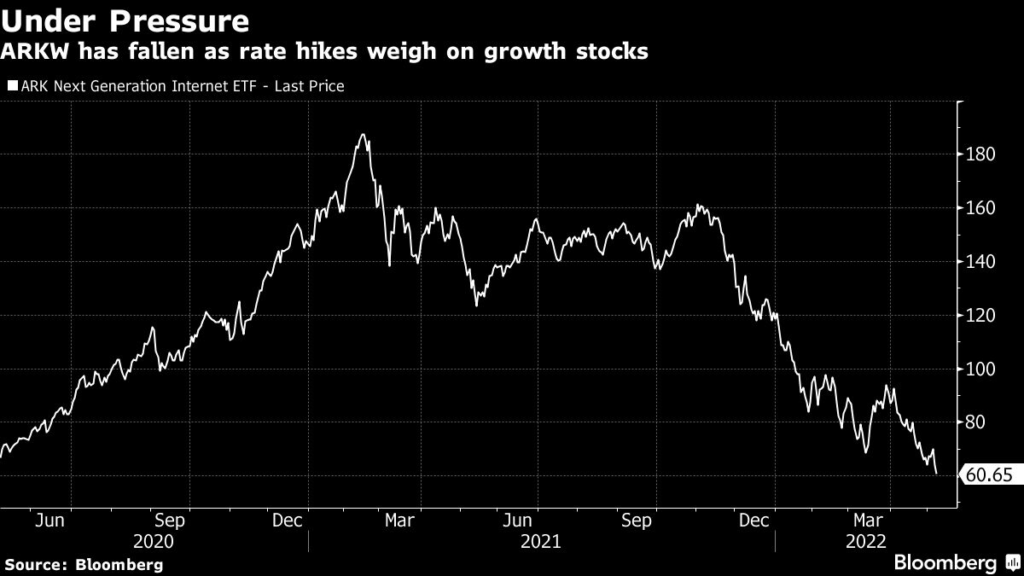
Ark’s exchange-traded funds have been under pressure from rising interest rates, which have weighed particularly hard on the valuations of growth stocks. Since the ETFs had been cutting their Twitter holdings this year, they also missed out on some of the gains in Twitter after Musk disclosed that he’d become Twitter’s biggest shareholder in April.

Meanwhile, Wood has stuck with Tesla, which is the biggest holding in ARKK and the second-biggest holding in ARKW. It’s also kept former lockdown-era favorites, like Zoom Video Communications Inc. and Teladoc Health Inc., which have tumbled 46% and 63%, respectively, this year.

ARKK experienced its worst month ever in April and its shares are down 51% in 2022, while ARKW has dropped 48% and ARKF has fallen 51%.

More stories like this are available on bloomberg.com

©2022 Bloomberg L.P.

Reliance Profit Misses as Tax, Input Costs Offset War Windfall

(Bloomberg) — Reliance Industries Ltd., India’s biggest company by market value, posted a lower-than-expected quarterly profit as higher tax liabilities and surging input costs offset gains made from fuel exports amid the Russia-Ukraine war.

Net income at the billionaire Mukesh Ambani-led conglomerate rose 22% to 162 billion rupees ($2.1 billion) in the three months ended March 31, according to an exchange filing Friday. But that still fell short of the average 168.2 billion rupee profit estimated by a Bloomberg survey of analysts. 

Revenue surged 37% to 2.12 trillion rupees compared to the same period last year, narrowly missing the analyst estimates. Total costs jumped 34% to 1.92 trillion rupees, lifted by a 69% rise in raw material prices. The company announced a dividend of 8 rupees per share, the filing said.

Key Insights

  • Reliance’s quarterly earnings missed expectations despite all its businesses doing reasonably well. Overall, its annual revenue rose past the $100 billion-mark, a first by an Indian corporate.
  • The single biggest headwind for Reliance in the local market is the threat from surging inflation. These could well eat into Indian consumers’ purchasing power besides crimping margins at its retail business. Global geopolitical uncertainty and the constant supply chain disruptions seen in the past few years will be another big risk for Ambani’s conglomerate.
  • The company made a deferred tax liability of 88.5 billion rupees as against 7.8 billion a year earlier.
  • Its refinery in Jamnagar — the world’s biggest refining complex — stepped up exports to benefit from the surging demand as Russia’s invasion of Ukraine spurred a global energy crunch that pushed up international prices.
    • Ambani will have to balance his fossil fuel-led businesses and his green energy ambitions for which he has committed $76 billion investment.
  • Self-sanctions by some European Union companies amid the Ukraine conflict is supporting high energy prices and pushing up fuel margins to multi-quarter highs, Joint Chief Financial Officer V. Srikanth told an earnings call
  • Reliance Jio Infocomm Ltd. saw improved average-revenue-per-user as the March quarter saw the full benefit of December’s tariff hikes flowing. ARPU jumped to 167.60 rupees, according to the company’s statement. The subscriber base has also shrunk amid an ongoing clean up of inactive users at Jio.
    • Investors are keenly watching Jio’s 5G rollout plans as well as how much spectrum India’s top operator is able to secure and at what price during the government auction this year.
  • The lifting of pandemic curbs and a full-scale reopening of the economy during the March quarter boosted Reliance’s consumer retail business. It transferred leases of hundreds of outlets under Future Retail Ltd. and Future Lifestyle Fashions Ltd. in a bloodless coup of sorts. Reliance also scrapped the transaction with the Future Group in April after the deal was rejected by the secured lenders.
  • Reliance is now also gearing up for an all-out face off with Amazon.com Inc., The Walt Disney Co. and Sony Group Corp as the media giants clash to win the broadcast rights of Indian Premier League — a coveted cricket tournament that’s expected to draw bids exceeding $5 billion.
  • After receiving almost $27 billion investment into Reliance’s Jio and retail units, investors are waiting for any management steer on a possible listing of these units, which a media report said may come as early as during Reliance’s shareholder meet this year.
    • Ambani had also spoken about a leadership succession in December, accelerating the process of his children — Isha, Akash and Anant — taking over various Reliance businesses.

Market Reaction

  • Shares of Reliance have surged 11% this year, touching a record high last month. Benchmark S&P BSE Sensex by comparison has slipped 6% in 2021.
  • Earnings were announced after the close of India market hours.

Get More

  • Reliance Jio reported a 24% jump in profit to 41.73 billion rupees. Subscriber base shrank to 410.2 million users as of end-March
  • Reliance Retail unit saw a quarterly profit of 21.4 billion rupees: filing
  • Total debt, as of March. 31, stood at 2.66 trillion rupees while cash equivalents were at 2.31 trillion rupees

(adds quote)

More stories like this are available on bloomberg.com

©2022 Bloomberg L.P.

News Corp. Falls Most Ever, Leading Steep Drop in Media Stocks

(Bloomberg) — News Corp., the publisher of the Wall Street Journal and New York Post, fell the most on record Friday, leading a steep decline in media stocks.

Shares of News Corp., controlled by media mogul Rupert Murdoch, slumped as much as 16% to $16.54 in New York, the biggest one-day decline since 2013, when the company began trading separately from the Murdoch family’s Fox Corp. entertainment interests.

Media stocks were in sharp decline Friday, with publishers, film and TV companies retreating more than broader indexes like the S&P 500. Major players including Netflix Inc. and Walt Disney Co. hit lows for the year.

Among the other big losers: Dish Network Corp., a pay-TV provider that slid as much as 14%, and Emmis Communications Corp., a broadcaster and publisher, which fell as much as 10%.

After markets closed on Thursday, New York-based News Corp. said revenue for the fiscal third quarter rose 6.7% to $2.49 billion, in line with the $2.5 billion average of estimates compiled by Bloomberg. The company said subscription-video-service revenue in the quarter decreased, due in part to a negative impact from foreign currency fluctuations. Adjusted earnings of 16 cents a share beat Wall Street estimates.

In a note to investors, Morgan Stanley observed that earnings growth had decelerated at News Corp. 

“Industry-wide, we expect revenue and earnings growth likely becomes more challenging in a rising interest rate environment,” analyst Andrew McLeod wrote, “making further steps on corporate simplification more important” to the company’s share performance.

More stories like this are available on bloomberg.com

©2022 Bloomberg L.P.

Nvidia Pays $5.5 Million U.S. Fine Over Crypto-Mining Disclosures

(Bloomberg) — Nvidia Corp. agreed to pay federal securities regulators a $5.5 million penalty over allegations that the chipmaker failed to adequately disclose revenue from crypto mining. 

During two consecutive quarters in 2018, the company didn’t make clear that demand from crypto miners was responsible for a significant part of the increase in sales of its graphics processing units that are also used for gaming, according to a Friday statement from the U.S. Securities and Exchange Commission. Crypto mining is the process of obtaining crypto rewards in exchange for verifying transactions on distributed ledgers.

“All issuers, including those that pursue opportunities involving emerging technology, must ensure that their disclosures are timely, complete, and accurate,” Kristina Littman, head of the SEC’s crypto enforcement team, said in the statement.

A Nvidia spokesman declined to comment. The company, which is based in Santa Clara, California, agreed to the penalty without admitting or denying the regulator’s findings. 

Nvidia increased 1.2% to $190.73 per share at 11:04 a.m. in New York.

According to the SEC, Nvidia omitted the information about surging demand from crypto miners while making statements about how digital assets were affecting other business lines. 

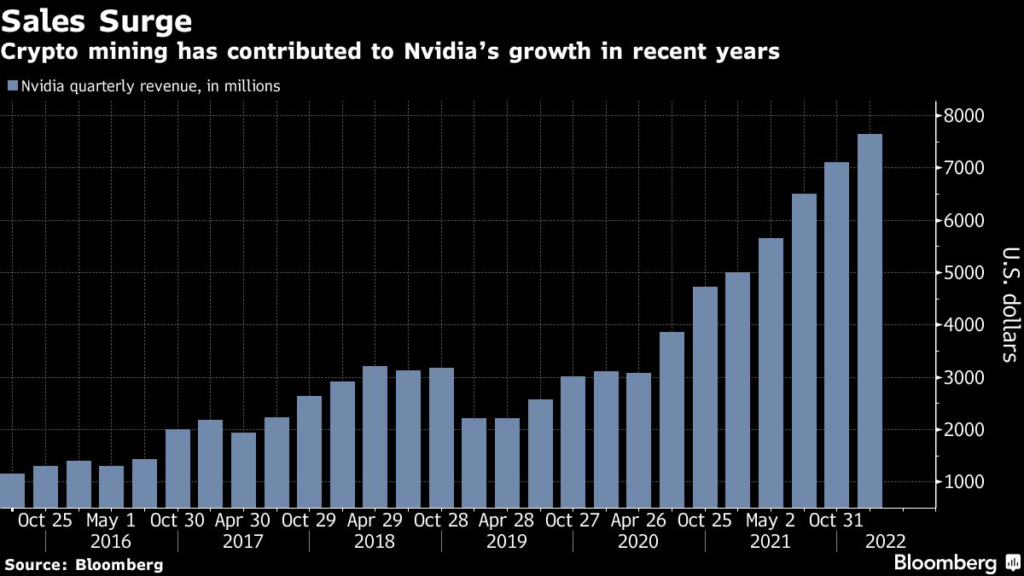
The growth of crypto mining has been a boon to Nvidia in recent years, but it’s also brought headaches. 

The firm’s powerful processors designed to handle video-game graphics are considered well-suited for mining cryptocurrencies like Ethereum and Bitcoin — and it’s been hard to tell what task customers are buying the products for. 

The situation has made Nvidia’s financial results less predictable. 

A surge in demand for graphics chips — fueled in part by the crypto craze — led to a run-up in 2017. But that windfall was short-lived, and the following year the company slashed annual sales forecasts to below analysts’ estimates. The disappointment caused investors to dump the stock, resulting in a 20% decline over two trading days.

To address the volatility, Nvidia is now offering chips designed specifically for crypto mining. And it adjusted its graphics cards so they’re harder to use for that task.

Investors will get a fresh peek at Nvidia’s efforts to navigate the crypto industry on May 25, when the company reports its quarterly results.  

(Adds SEC details starting in the fifth paragraph.)

More stories like this are available on bloomberg.com

©2022 Bloomberg L.P.

Tesla Confirms Vale Nickel Deal, Lifts Veil on U.S. Race Data

(Bloomberg) — Tesla Inc. confirmed a deal to buy nickel from mining giant Vale SA among other metal-supply contracts in an annual report on the company’s global impact, which also provided detailed data on the racial composition of its U.S. workforce. 

The electric-vehicle maker’s report issued Friday is the most comprehensive view Tesla has given of its metals-supplier relationships, a topic of increased interest as global auto industry demand for EV batteries has exceeded supplies. Unlike most other major carmakers, Tesla has sought to manufacture its own battery cells and buy raw materials directly from metals producers. 

Tesla listed Vale as a direct supplier of nickel for batteries, sourcing the metal from an integrated mine and refining site in Canada, which Bloomberg News first reported in March. The report also detailed agreements with producers such as Albemarle Corp., Livent Corp. and China’s Sichuan Yahua Industrial Group Co. for supplies of lithium. 

As the EV market leader’s battery supply chain continues to scale, Tesla expects the proportion of directly sourced minerals to grow. It already has deals with nine mining and chemicals companies to supply more than 95% of its lithium, greater than half its cobalt and over a third of its nickel, according to the report. 

The 144-page annual filing covers the Austin, Texas-based company’s environmental impact, supply chain, recycling and diversity and inclusion efforts.

Tesla confirmed its health insurance policies included travel and lodging for employees who had to seek health-care services out of state. That has become increasingly relevant because Texas has made it more difficult to get abortions and the state is prepared to outlaw the procedure entirely if the U.S. Supreme Court overturns its stance preventing such a move. 

The New York Times earlier reported on the health-care provision.

Tesla also provided previously undisclosed statistics on the racial breakdown of workers in the U.S. based on the private filings it submits each year to the Equal Employment Opportunity Commission. However, unlike competitors including General Motors Co. and Ford Motor Co., it only detailed percentages and not raw numbers for employees in each category, a practice that diversity experts say can obscure weaknesses depending on how jobs are categorized.

Read why Tesla is holding out against releasing full diversity data

Tesla selected a handful of companies to argue its racial representation compares favorably to the tech and automotive industries. Its Hispanic workforce at the end of 2021 was much higher than Ford’s and GM’s — the only two automakers it compared itself against — though the advantage was much smaller for professional and executive roles. On the flip side, Tesla was underrepresented for Black workers compared with the two competitors based in Detroit. 

The EEOC provides more comprehensive industry data each year that might put Tesla’s numbers in more perspective, but hasn’t yet provided the figures for 2021.

Tesla said its worldwide headcount grew 40% in 2021. Chief Executive Officer Elon Musk recently tweeted it has over 110,000 “direct jobs” globally.

More stories like this are available on bloomberg.com

©2022 Bloomberg L.P.

Havas CEO to Meet Union After Harassment Claims at Paris Agency

(Bloomberg) — Multiple harassment claims published on an Instagram account are shaking one of Paris biggest ad agencies, with two of its top executives stepping back and its union set to press for a separate investigation.

Havas Paris, part of the Havas SA ad group owned by French media giant Vivendi SE, has hired a law firm to launch an external probe after the anonymous harassment allegations were published, Havas wrote Wednesday in an internal email seen by Bloomberg.

A meeting between union representatives and Havas Chairman Yannick Bollore is now scheduled for May 9, according to people close to the matter. The union are set to ask for an investigation led by a law firm of its own choice, rather than Havas, one of the people added, who asked not to be named regarding private discussions. 

Havas Paris Chief Executive Officer Julien Carette and Chief Creative Officer Christophe Coffre have stepped back while the allegations were being investigated, an earlier internal memo said. 

A Havas spokesperson confirmed the two executives were stepping back but declined to comment while the probe is underway. A spokesman for Vivendi declined to comment.

Dozens of anonymous testimonies, ranging over the past 10 years, were posted to an Instagram account called “Balance Ton Agency.” The account, which says it reports “abuse in advertising,” gave alleged examples of moral and sexual harassment by several company managers.

Vivendi took over Havas in a 3.9 billion-euro ($4.2 billion) deal orchestrated by billionaire Vincent Bollore, who controlled both businesses. The company operates advertising firms such as Arnold Worldwide in Boston and public-relations businesses including Abernathy MacGregor, as well as several media-buying businesses.

More stories like this are available on bloomberg.com

©2022 Bloomberg L.P.

China Orders Government, State Firms to Dump Foreign PCs

(Bloomberg) — China has ordered central government agencies and state-backed corporations to replace foreign-branded personal computers with domestic alternatives within two years, marking one of Beijing’s most aggressive efforts so far to eradicate key overseas technology from within its most sensitive organs.

Staff were asked after the week-long May break to turn in foreign PCs for local alternatives that run on operating software developed domestically, people familiar with the plan said. The exercise, which was mandated by central government authorities, is likely to eventually replace at least 50 million PCs on a central-government level alone, they said, asking to remain anonymous discussing a sensitive matter.

The decision advances China’s decade-long campaign to replace imported technology with local alternatives, a sweeping effort to reduce its dependence on geopolitical rivals such as the U.S. for everything from semiconductors to servers and phones. It’s likely to directly affect sales by HP Inc. and Dell Technologies Inc., the country’s biggest PC brands after local champion Lenovo Group Ltd. Shares of HP and Dell were both down about 2.5% in New York Friday morning.   

Lenovo erased losses to climb as much as 5% on Friday in Hong Kong, while software developer Kingsoft Corp. also recouped its earlier decline to gain as much as 3.3%. On mainland Chinese exchanges, Inspur Electronic Information Industry Co., a server maker, gained 6% while peer Dawning Information Industry Co. jumped more than 4%. Inspur Software Co., an affiliate of the Inspur group, and China National Software & Service Co. both soared their daily 10% limits.

The push to replace foreign suppliers is part of a longstanding effort to wean China off its reliance on American technology — a vulnerability exposed after sanctions against companies like Huawei Technologies Co. hammered local firms and businesses. That initiative has accelerated since 2021, when the Chinese central government quietly empowered a secretive government-backed organization to vet and approve local suppliers in sensitive areas from cloud to semiconductors.

EXPLAINER: China’s Vast Blueprint for Tech Supremacy Over U.S.

The latest PC replacement project also reflects Beijing’s growing concerns around information security as well as a confidence in homegrown hardware: the world’s biggest laptop and server makers today include Lenovo, Huawei and Inspur Ltd., while local developers such as Kingsoft and Standard Software have made rapid strides in office software against the likes of Microsoft Corp. and Adobe Inc.

The campaign will be extended to provincial governments later and also abide by the two-year timeframe, the people said. The Ministry of Industry and Information Technology and State Council Information Office didn’t respond to faxed requests for comment.

What Bloomberg Intelligence Says

Lenovo could dramatically boost sales on Beijing’s order that central government agencies and state-backed companies replace foreign-branded computers, as reported by Bloomberg News. This would amount to more than 50 million PCs over the next two years. The nation’s No. 1 PC maker relies on U.S. chips, but has set up its own chip-making unit and invested in at least 15 semiconductor design firms.

– Nathan Naidu, analyst

Click here for the research.

Read more: Secretive Chinese Committee Draws Up List to Replace U.S. Tech

China has been encouraging use of home-made IT products in government agencies for at least a decade, regularly barring certain products from official procurement lists. In response, U.S. IT giants such as Hewlett Packard Enterprise Co. and Microsoft have set up joint ventures with firms backed by the Chinese government, to secure orders from the richest state-owned companies.

That process has long been dogged by inadequacies in Chinese-developed software and circuitry, forcing users to rely on imported equipment. That changed in recent years, as local champions such as Inspur and Lenovo gained global market share, though their products still rely on cutting-edge American components such as semiconductors from Intel Corp. or Advanced Micro Devices Inc. As of Friday, HP-branded machines were still available for purchase on a website used by central government procurement bodies, though it’s unclear if transactions would go through.

The latest government directive is likely to cover only PC brands and software, and exclude hard-to-replace components, including microprocessors, the people said. China will mostly encourage Linux-based operating systems to replace Microsoft’s Windows. Shanghai-based Standard Software is one of the top providers of such tools, one person said.

Certain agencies, including state-owned media and cybersecurity bodies, may continue to buy advanced foreign equipment under special permits as they always have, one of the people said. But that permit system could be tightened in future, the person said.

(Updates with shares of Dell, HP in third paragraph.)

More stories like this are available on bloomberg.com

©2022 Bloomberg L.P.

Bloomberg Retracts Story on Jefferies Seeking Crypto Donations

(Bloomberg) — Bloomberg retracted a story published today saying that Jefferies Financial Group Inc. was offering discounted shares to those who donated through a crypto wallet to support the people of Ukraine. The firm said the Instagram account of its chief executive officer had been hacked. Bloomberg regrets the error.

More stories like this are available on bloomberg.com

©2022 Bloomberg L.P.
Bilibili’s Listing Switch Shows Hunt for China Money 

(Bloomberg) — Faced with the risk of losing Wall Street investors, a growing number of Chinese tech companies are seeking an onerous way to tap money back home: a primary listing in Hong Kong. 

Bilibili Inc. said this week it will convert its Hong Kong listing to dual-primary status from secondary by early October. The change would enable the firm to be included in the exchange’s Stock Connect program, which gives mainland investors access to trade its shares. The video-streaming firm is joined by peers including online real estate broker KE Holdings Inc. and drugmaker Zai Lab Ltd. in pursuit of the shift.  

“The overall benefit is the access to the Southbound Connect,” said Vivian Lin Thurston, a portfolio manager at William Blair Investment Management. Mainland capital’s “investments to these names may offset the potential reduction of global investment as a result of ADR delisting to some extent.” 

A dual-primary listing on the Hong Kong Exchange is often more costly and requires stricter reporting rules than a secondary listing. Still, the recent actions highlight the urgency of Chinese companies seeking new investors ahead of possible delisting from American exchanges. 

The U.S. Securities and Exchange Commission has been expanding the list of Chinese firms that may face expulsion unless Beijing allows better access to the businesses’ financial audits. Bilibili, JD.com Inc. and Pinduoduo Inc. were among dozens of firms newly added this week. 

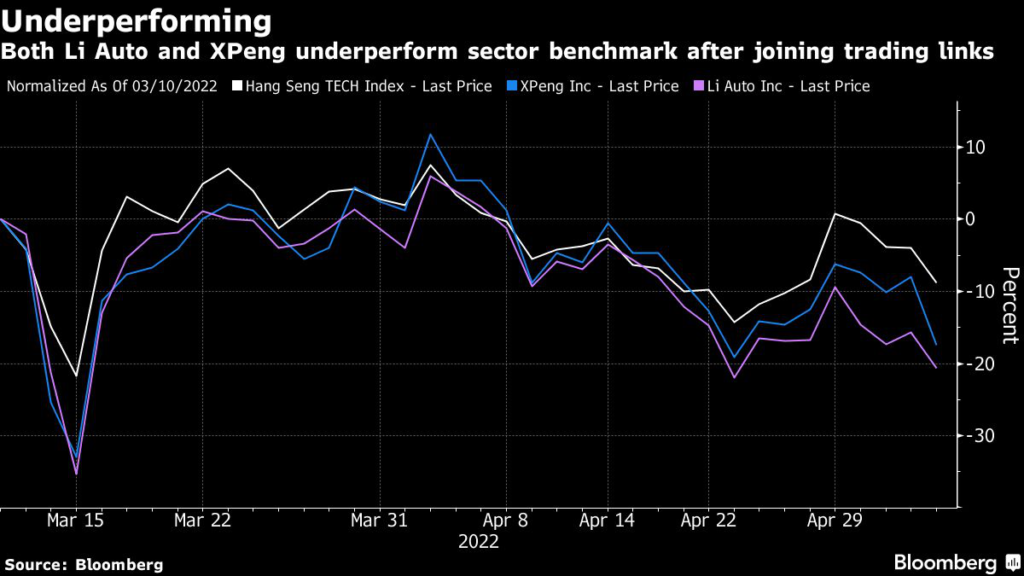
The few pioneers who have dual-primary listings have already attracted some inflows from China. In less than three months after electric vehicle makers XPeng Inc. and Li Auto Inc. joined the trading links, onshore investors added 1% stakes in each company, exchange data show. 

To be sure, any boost to share prices from mainland inflows is yet to be seen. XPeng and Li Auto have both underperformed the Hang Seng Tech Index after joining the trading links in February and March, respectively. 

Companies also need to meet certain criteria on their listing period and market capitalization to be included into the Stock Connect link with the mainland. Moreover, trading turnover in the U.S. is still much higher than in Hong Kong for most dual-listed companies. 

Still, the potential pressure on liquidity by losing American investors will at least be eased by attracting mainland capital, said Bruce Pang, head of macro and strategy research at China Renaissance Securities (HK). Pang expects about $42 billion to be raised by U.S.-listed Chinese companies in Hong Kong through 2023 by both secondary and primary listings.  

“Big tech companies with sensitive data will continue to schedule secondary listing or dual primary listing in Hong Kong as backup plans amid regulatory uncertainties,” Pang said. 

Tech Chart of the Day

The Nasdaq 100 Index performed one of its sharpest U-turns ever Thursday, swinging from a 3.4% rally the previous day to a 5.1% slump. The index extended losses on Friday falling 2.3%, while the S&P 500 also dropped 1.3% in early trading.

Top Tech Stories

  • China has ordered central government agencies and state-backed corporations to replace foreign-branded personal computers with domestic alternatives within two years, marking one of Beijing’s most aggressive efforts so far to eradicate overseas technology
  • Hundreds of workers at a technology factory in China clashed with authorities and flooded past isolation barriers after weeks under lockdown, a stunning breakdown in the Communist Party’s efforts to contain Covid-19 infections. The Shanghai factory is owned by Quanta Computer Inc. and makes devices for Apple Inc., among others
  • Data analytics company Palantir Technologies Inc. struck a 10 million-pound ($12.5 million) contract with the U.K. Ministry of Defence, the U.S. firm’s largest with the high-profile department
  • China’s technology stocks slumped Friday, tracking a tumble in the U.S., as growth worries from the nation’s Covid Zero policies and lack of concrete measures to support the sector triggered further selling
  • Tesla Inc. is making plans to resume double shifts at its factory in Shanghai as soon as mid-May as it expects staffing and parts shortages to ease, according to people familiar with the matter
  • Cryptocurrency trading platform Amber Group is in discussions to raise fresh funding at a valuation of $10 billion, according to people with knowledge of the matter

(Adds share moves in last paragraph.)

More stories like this are available on bloomberg.com

©2022 Bloomberg L.P.

DraftKings Boosts Full-Year Outlook Amid Online Gambling Boom

(Bloomberg) — DraftKings Inc. raised its revenue and earnings expectations for the year, while a planned launch in Canada is poised to give the online gambling company an additional boost.

Sales this year will be $1.93 billion to $2.03 billion, up from a prior expectation as low as $1.85 billion, according to a statement Friday detailing first-quarter results. The midpoint of the new range is above Wall Street’s expectation and implies as much as 56% growth over the prior year.

The revised forecast wasn’t enough to overcome broader market losses, as DraftKings’ shares erased premarket gains to fall 3.8% at 9:38 a.m. in New York.

DraftKings has grown revenue and attracted loyal bettors amid heightened competition from new online peers and legacy casinos. That has forced the company to spend millions on advertising and gambling incentives while still generating losses. DraftKings expects an adjusted loss before interest, taxes, depreciation and amortization of as much as $840 million in 2022, an improvement over its prior expectation.

“We are encouraged to see a reduced guided profit loss, but acknowledge losses remain significant, and does not include many new markets expected to open,” Benchmark analyst Mike Hickey wrote in a note.

The revised outlook doesn’t include its recently closed takeover of Golden Nugget Online Gaming or its planned launch in Ontario, Canada, in the second quarter. The combination is expected to drive an additional $130 million to $150 million in revenue for 2022, the company said.

Boston-based DraftKings posted first-quarter revenue of $417 million, narrowly topping Wall Street’s forecast for $414.9 million. Monthly unique players for the quarter were two million, matching estimates, while the average revenue per player was stronger than expected.

The company hasn’t seen “any impact from inflationary pressures on customer demand,” Chief Executive Officer Jason Robins said in the statement. 

(Updates share trading in third paragraph)

More stories like this are available on bloomberg.com

©2022 Bloomberg L.P.
Close Bitnami banner
Bitnami