
Bloomberg

Mother’s Day Can Be a Trigger, So More Brands Offer Opting Out

(Bloomberg) — The opt-out email is very much in.

After the pandemic’s emotional toll, brands are searching for different ways to connect with shoppers. That’s led companies spanning crafts marketplace Etsy to skincare maker Aesop to give customers the chance to not receive promotional messages for events like Mother’s Day that might rehash painful memories.

“The more choice you’re giving a customer, the more you’re treating them like a person of value,” said Amy Dunn, head of marketing and communications at fintech startup Bumped. “As opposed to someone whose inbox you’re just yelling into.”

The Portland, Oregon-based company rolled out a Mother’s Day opt-out initiative last year, and the feedback has been positive, Dunn said. The initiative also took place as the firm’s open rate on emails rose 11%.

Holidays tied to relationships, including Father’s Day and Valentine’s Day, can exacerbate feelings of anxiety and depression. And three out of five women find Mother’s Day emotionally triggering, according to a recent survey of users on the app Peanut, an online women’s community.

The opt-out strategy was designed for people like 22-year-old Arielle Wiedenbeck, whose mom died more than a decade ago. Mother’s Day emails have always been “harsh reminders,” and she’d prefer to avoid the annual deluge, she said.

“Grief is different for everyone,” said Wiedenbeck, a student in Lincoln, Nebraska. The opt-out email has “allowed me to make Mother’s Day more personal for me and not just this purely commercialized thing of: ‘Oh god, it’s Mother’s Day.’”

While it might seem like bad business to give potential customers the option to stop receiving marketing, doing so can actually boost a company’s bottom line since improving customer satisfaction often increases the chances they’ll make another purchase, according to Adobe Inc.

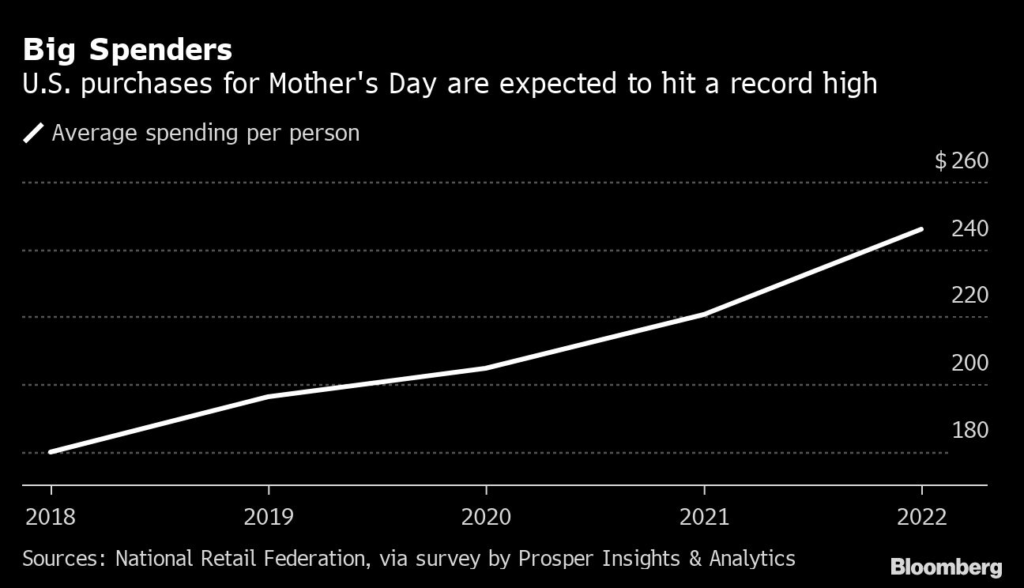
There’s a lot of stake this Mother’s Day with spending on everything from flowers to jewelry expected to reach $31.7 billion, up 13% from 2021, according to a survey conducted for the National Retail Federation.

Not everyone believes this is a good idea. When Nestlé-owned Blue Bottle Coffee sent its Mother’s Day opt-out email, the company received responses wondering whether it was necessary, according to Karl Strovink, the brand’s chief executive officer.

Critics worry opt-outs can come across as cash grabs masked as virtue signaling or even have the unwanted effect of reminding customers about the very holiday they were trying to avoid.

However, the opt-out email is likely here to stay, even as the pandemic recedes, because shoppers increasingly expect a more personalized experience like this, according to Kristin Dorsey, vice president of marketing at Linc, a customer experience consultant.

Of the firm’s more than 100 clients, at least half have moved toward implementing opt-out emails in the past year, Dorsey said. Only a small number of users choose this option, and feedback from the ones who do is largely positive.

The downsides are “pretty minimal,” she said.

More stories like this are available on bloomberg.com

©2022 Bloomberg L.P.
Elon Musk Turns to Billionaire Backers for Twitter Equity

(Bloomberg) — Elon Musk’s $7.1 billion of new financing commitments to help him buy Twitter Inc. for $44 billion come from the the highest rungs of global finance — and some familiar faces from his other ventures. 

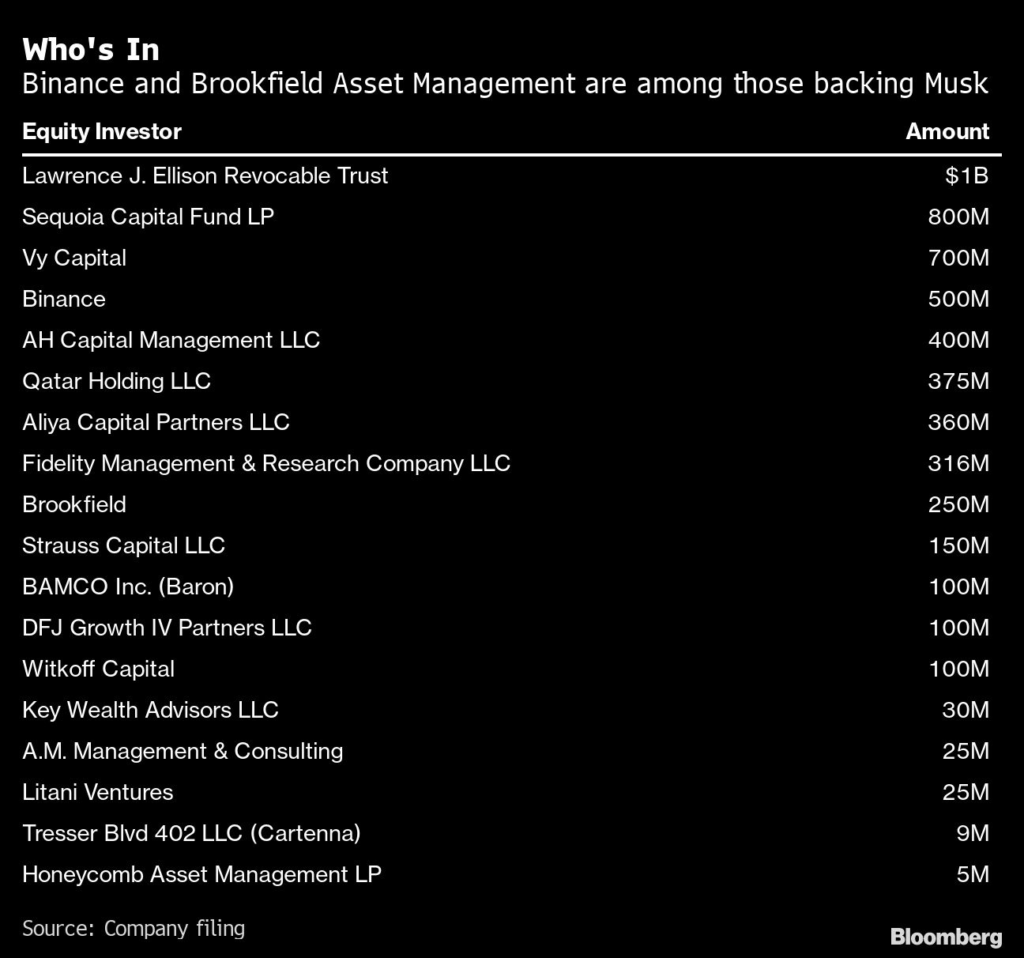
The Tesla Inc. co-founder won over the Saudi prince who initially balked at his offer and brought aboard Larry Ellison, the 11th richest person on the Bloomberg Billionaires Index. He also got a half-billion-dollar commitment from cryptocurrency exchange Binance.

Musk, 50, also got hundreds of millions of dollars from Sequoia Capital, a big backer of his Space Exploration Technologies Corp., and Vy Capital, which has previously invested in his Boring Co. and Neuralink.

There might be more money to come. Twitter founder Jack Dorsey, whose stake is worth about $1 billion, is continuing to have discussions about keeping his holdings in the company, according to a Thursday regulatory filing.

Here are the large investors throwing big money behind Musk’s Twitter bid.

Saudi Arabia Prince Alwaleed bin Talal: $1.9 Billion

Alwaleed has pledged to roll over his nearly 35 million Twitter shares, according to Thursday’s filing, which are worth about $1.9 billion at a price of $54.20 per share.

With a $16.4 billion fortune, he’s the richest individual in Saudi Arabia, according to the Bloomberg Billionaires Index. Most of his wealth is derived from his 95% ownership of Kingdom Holding Co.

He initially rejected Musk’s bid, saying the deal didn’t “come close to the intrinsic value” of the popular social-media platform. The move prompted a rapid retort from Musk, who asked how many shares the investor held in Twitter and the Kingdom’s view on freedom of speech for journalists.

Larry Ellison: $1 Billion

Ellison has made a fortune from Tesla. His stake in the electric carmaker is worth more than $14 billion. He was already one of the world’s richest people after founding Oracle Corp. He has a $95.6 billion fortune, as per the Bloomberg Billionaires Index.

Sequoia Capital: $800 Million

Sequoia Capital has been a major backer of Musk’s SpaceX and the links between the billionaire and some people at the firm go back a long time. Sequoia partner Roelof Botha was chief financial officer at PayPal Holdings Inc. when Musk was its CEO two decades ago.

Vy Capital: $700 Million

Vy Capital is a Dubai-based tech investment firm. Its website says it has “a focus on category-defining technology companies with the potential to meaningfully impact humanity.” It has previously invested in Musk’s ventures, including Neuralink and Boring Co.

Binance: $500 Million

This is the second high-profile investment in a media company for Binance, the world’s largest cryptocurrency exchange. The firm, founded by billionaire Changpeng Zhao, has also invested in Forbes.

AH Capital Management: $400 Million

AH Capital is the investment advisor of A16Z and was co-founded by prominent venture capitalist Marc Andreessen. Since Musk announced his plan to buy Twitter, Andreessen has encouraged the move, engaging with Musk on the social-media platform and even changing his biography to “shadow crew,” a jab at a Wall Street Journal article about those behind the scenes who encouraged the takeover.

Qatar Holding: $375 Million

Qatar, fittingly for Musk, is the world’s richest country per capita. It has a $450 billion sovereign-wealth fund that is seeking to diversify the country’s money by plowing into Asia and the U.S. after investing in Europe. The Qatar Investment Authority is the world’s ninth-largest sovereign-wealth fund, according to SWF Institute data.

Aliya Capital Partners: $360 Million

Miami-based Aliya has investments in companies it deems innovative and disruptive. Late last year, it was part of a $125 million Series B funding round for Kodiak Robotics, a self-driving truck startup. Led by CEO Ross Kestin the firm is the investment Manager of the Fortune Pre-IPO Fund and has also invested in SpaceX.

Fidelity Management & Research: $316.14 Million

Musk is also getting backing from some large U.S. institutional investors. Boston-based Fidelity Investments, led by Chief Executive Officer Abigail Johnson, ended 2021 with $4.5 trillion of discretionary assets.

Brookfield: $250 Million

Toronto-based Brookfield Asset Management oversees about $700 billion. CEO Bruce Flatt said recently in an interview with David Rubenstein that his key to success is to encourage employees to make small mistakes every day, “just don’t make any really large mistakes.”

Strauss Capital: $150 Million

Strauss is a New York-based investment banking firm founded by Tom Strauss, a former co-head of the mergers and acquisitions group at Barclays Plc’s U.S. investment-banking arm.

$100 Million or Less: BAMCO, DFJ Growth, Witkoff Capital, A.M. Management & Consulting, Honeycomb Asset Management, Key Wealth Advisers, Litani Ventures, Tresser Blvd 402

Musk secured investments from several other firms, in denominations of as little as $5 million. 

He’s still looking for more investors. He “will continue to have, discussions with certain existing holders of Common Stock (including Jack Dorsey) regarding the possibility of contributing such shares of Common Stock to Parent, at or immediately prior to the closing of the Merger, in order to retain an equity investment in Twitter following completion of the Merger,” according to Thursday’s filing.

(Updates with name of CEO of Aliya Capital. An earlier version incorrectly named the firm’s chief executive.)

More stories like this are available on bloomberg.com

©2022 Bloomberg L.P.

U.S. Sanctions Virtual Currency Mixer Tied to North Korea

(Bloomberg) — The U.S. Treasury Department on Friday sanctioned Blender.io, a virtual currency mixer it said was tied to North Korea’s hacking and money laundering activities. 

The action marks the first time Treasury has sanctioned a so-called “mixer,” which is used to hide the origin of illicit funds.

“Today, for the first time ever, Treasury is sanctioning a virtual currency mixer,” said Under Secretary of the Treasury for Terrorism and Financial Intelligence Brian E. Nelson. “Virtual currency mixers that assist illicit transactions pose a threat to U.S. national security interests. We are taking action against illicit financial activity by the DPRK and will not allow state-sponsored thievery and its money-laundering enablers to go unanswered.”

The sanctioning of Blender follows action Treasury took earlier this year to sanction an Ethereum wallet address tied to the North Korean hacking group Lazarus, which is accused of stealing more than $600 million in cryptocurrency from a software bridge used for the popular Axie Infinity play-to-earn game. Treasury said it has identified and blocked four additional wallets tied to the group.

The Lazarus Group, a broad designation for suspected state-sponsored North Korean hackers, has spent years carrying out data breaches that result in large financial thefts. Along with global financial institutions, attackers have specifically focused on cryptocurrency, stealing nearly $400 million worth of digital assets in breaches on seven crypto platforms in 2021, according to the blockchain analysis firm Chainalysis Inc.

A panel of United Nations experts reportedly blamed North Korean cyber-actors for stealing more than $50 million between 2020 and mid-2021, using phishing emails and malicious software as part of various efforts.

Suspected North Korean hackers also carried out the 2016 heist at the Bangladesh Bank in which thieves transferred more than $100 million into their own accounts.

(Updated to include paragraphs five, six and seven to include additional detail.)

More stories like this are available on bloomberg.com

©2022 Bloomberg L.P.
Carvana Father-Son Duo Down $25 Billion, Leading Wealth Rout

(Bloomberg) — Nine months ago, the father-son duo that runs used-car company Carvana Co. had a combined personal fortune of more than $32 billion. 

Ernie Garcia II and Ernie Garcia III have now shed almost 80% of that wealth, one of the biggest and fastest declines of any billionaire family or individual fortune, according to the Bloomberg Billionaires Index. 

The Garcias’ were further hammered Thursday by one of the worst days for the stock market in more than two years, sparked by concerns that the Federal Reserve will struggle to contain rising inflation. Phoenix-based Carvana’s losses exceeded those of the broader market, falling 18% and leaving the stock down 87% from its August peak.

The elder Garcia was a prolific seller of stock during the pandemic as Carvana’s shares soared. Starting in late October 2020 he sold shares almost every day for about 10 months, disposing of more than $3.5 billion worth — or more than a fifth of his stake — as Carvana shares reached a high of $376.83. The stock closed Thursday at $48.92.

The Garcias are emblematic of the pandemic economy, as pent-up savings spurred interest in car ownership and ultra-low rates boosted financing for purchases. Those forces are fast losing steam. Tech and online consumer firms that soared in value only months ago have been clobbered.

Those dragged down include Chase Coleman’s Tiger Global Management, which has lost $16 billion this year, and CAS Investment Partners, the hedge fund run by Clifford Sosin. It’s bet on Carvana, specifically, has backfired spectacularly.

The tech-heavy Nasdaq 100 Index fell 5% Thursday, its biggest one-day loss since Jun. 11, 2020. Elon Musk, the world’s richest person, lost more than $18 billion, according to the Bloomberg index, leaving him a fortune of $249.2 billion as shares of Tesla Inc. tumbled 8%. Amazon.com Inc. founder Jeff Bezos saw his net worth fall 7% to $140 billion, while Meta Platforms Inc.’s Mark Zuckerberg dropped $5.3 billion to $76.6 billion.

The world’s 500 richest people lost a collective $157 billion of wealth, the seventh-largest on record.

The only person among the world’s 15 richest to add to his fortune Thursday was India’s Gautam Adani, whose empire includes ports, mines and green energy.

(Adds share sales in fourth paragraph.)

More stories like this are available on bloomberg.com

©2022 Bloomberg L.P.
Stellantis Sees Car-Sharing Profits as BMW, Mercedes Retreat

(Bloomberg) —

In the car business, Carlos Tavares is seen as a turnaround whiz. 

The chief executive officer of Stellantis, a self-described “performance psychopath,” bought Opel, the money-losing European operation of General Motors, and made it profitable in one year. In 2021, Stellantis wowed Wall Street with an 11.8% adjusted operating margin, while integrating a global mega-merger and navigating the chip shortage.

Earlier this week, the French-Italian-American conglomerate announced it was buying Share Now, the car-sharing venture jointly owned by BMW and Mercedes-Benz, for an undisclosed sum. Auto analyst Juergen Pieper estimates the price tag was around 250 million euros ($265 million), based on estimated losses of 200 million euros a year, as Bloomberg reported.

Car manufacturers’ track record in building new business models in the buzzy, ill-defined world of mobility is pretty grim. And the austerity brought on by the pandemic as well as the cost of transitioning to electric vehicles has forced many to cut their losses.

GM pulled the plug on its car-sharing unit, Maven, in 2020. Ford ended its dalliance with electric scooter-sharing service Spin, selling it off in March. There’s a long list of car subscription pilots that bit the dust: Cadillac Book, BMW Access, Mercedes Benz Collection, Audi SilverCar, Nissan Switch. ( Porsche’s subscription service, starting at $1,700 a month, still is growing.)


So what is Tavares thinking? I spoke with Brigitte Courtehoux, a 21-year veteran of PSA who’s now the CEO of Free2Move, Stellantis’ mobility business, to better understand their strategy. Free2Move has been at this since 2016, and it’s learned from its mistakes along the way, Courtehoux said.

A key downfall for car-sharing and subscription services has been the cost of maintaining and servicing vehicles, and exposure to the car’s depreciation as an asset. For automakers used to booking revenue once a car leaves the factory, it’s been a painful lesson.

With Free2Move, Stellantis avoids those costs. “We don’t own the cars, we don’t want to own the cars,” Courtehoux said. The app gives users what she calls a “seamless experience” that allows Free2Move to have “more customers, more revenues, and reduce our risk in terms of assets.”

The Free2Move app connects users to cars they can rent for a few minutes, hours or days. Most transactions come from rental car companies, who pay a fee for the referral. Another business bucket is dealers operating a fleet rental business — the dealers service the cars and eat the depreciation.

Free2Move manages its own car-sharing service in select cities where there’s enough utilization to cover costs. Even then, it leases the vehicles from banks, who take on the depreciation risk, Courtehoux said.

So far, Free2Move has about 460,000 cars in operation in Europe and the U.S.; once the acquisition of Share Now is complete, it should have 5.4 million users. And Free2Move turned a profit last year on revenue of 40 million euros, Courtehoux said.

There are about 13.7 million users of car-sharing apps in the U.S. and Europe, excluding peer-to-peer platforms like Turo or Getaround, according to Shwetha Surender, an analyst at Frost & Sullivan. If Courtehoux succeeds, she could deliver on a piece of the automaker’s ambitious strategic plan for 2030: A new, 2.8 billion-euro revenue stream separate from the low-margin, capital-intensive manufacturing business that Wall Street pooh-poohs.

It could also provide the company with a network to deploy autonomous vehicles, something it’s already talking about with its self-driving partner, Waymo, Courtehoux said.

Like getting this newsletter? Subscribe to  Bloomberg.com for unlimited access to trusted, data-driven journalism and subscriber-only insights.

More stories like this are available on bloomberg.com

©2022 Bloomberg L.P.
Billions in Wrong-Way ETF Bets Placed Just Before Thursday Rout

(Bloomberg) — For a measure of just how brutal Thursday’s reversal was in U.S. equities, take a look at where cash was moving in the ETF market earlier in the week.

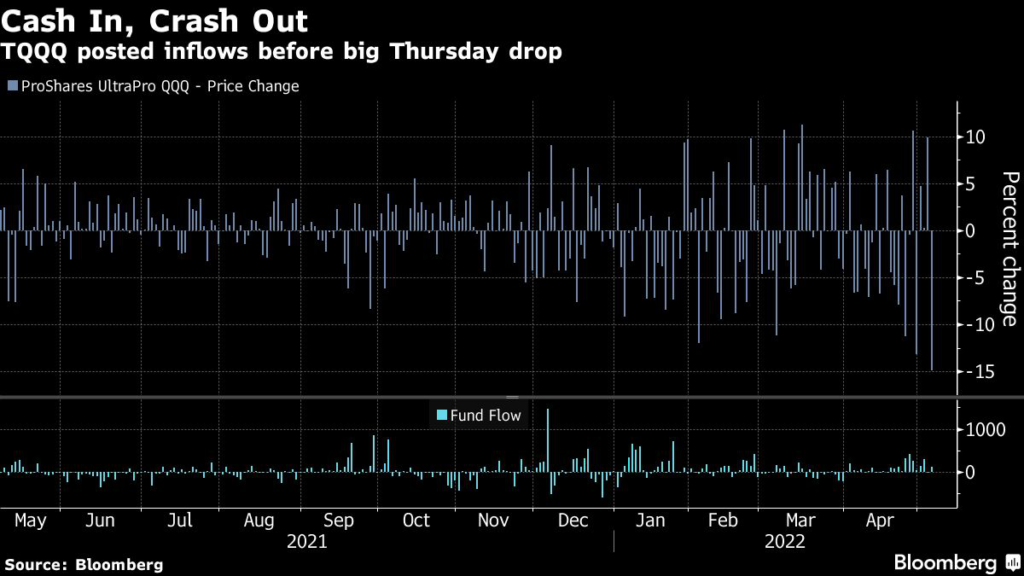
In the three days through Wednesday, investors added $426 million to the ProShares UltraPro QQQ ETF (ticker TQQQ), a leveraged product that delivers three-times the return of the Nasdaq 100 Index. Caught in the tech stock selloff, it tumbled 15% for both the biggest drop and lowest close since 2020. 

In the same time frame almost $1.8 billion poured into the iShares iBoxx High Yield Corporate Bond ETF (HYG), just in time for the fund’s worst day in nearly two years. Almost $600 million was plowed into the ARK Innovation ETF (ARKK), which slumped 8.9% for its biggest drop since the height of the Covid turmoil. 

It’s possible investors managed to exit before the worst of the declines — maybe even retaining some of their gains from a day earlier, when stocks enjoyed a broad post-Fed rally. TQQQ and ARKK report flows with a one-day lag, meaning Thursday activity isn’t visible yet. HYG recorded a tiny $23 million outflow.

But flows elsewhere suggest a broad pattern of bets on a change in market sentiment after months of rotation toward value and economically sensitive shares at the expense of growth stocks. Those moves also look ill-timed.

The three days through Wednesday saw some $372 million pulled from the ProShares UltraPro Short QQQ ETF (SQQQ), which offers an amplified bet against the Nasdaq 100. It surged 15% on Thursday. The ProShares Ultra VIX Short-Term Futures ETF (UVXY), the largest fund riding U.S. stock volatility, lost $124 million before rallying 26% for its best day in more than five months. 

Meanwhile, the bets on growth continued even during Thursday’s pummeling. Data overnight showed the Invesco QQQ Trust Series 1 ETF (QQQ) lured $1.2 billion amid the rout, its biggest influx since March.

More stories like this are available on bloomberg.com

©2022 Bloomberg L.P.
Microsoft Has $1.3 Billion at Stake as U.S. Tests Combat Goggles

(Bloomberg) — Microsoft Corp. has an initial $1.3 billion at stake in a test beginning later this month on whether its HaloLens augmented-reality goggles can be turned into an effective combat system for the U.S. Army.

The monthlong test from May 23 to June 17 will be evaluated by the Pentagon’s testing office to determine whether the headset is ready for full production and initial deployment.

The project by the Redmond, Washington-based company aims to develop a “heads-up display” for U.S. ground forces, similar to those for fighter pilots. The Integrated Visual Augmentation System would let commanders project information onto a visor in front of a soldier’s face and would include features such as night vision. 

So far, the Army and the testing office have indicated the goggles show promise but aren’t ready for combat deployment, and the service delayed putting them in the field in favor of this month’s evaluation.

“We’ll be looking carefully at those results to inform, ultimately, where we go” with the program, Army Secretary Christine Wormuth told the Senate Armed Services Committee on Wednesday. “I feel pretty comfortable where that program is,” she said. “We’ve been working very closely with Microsoft, and I think that that program is on track.”

It’s been called a potential $21.9 billion program over 10 years for as many as 121,500 goggles, spare parts, logistics and program management support. In fact, “less than half of this total is possible for the U.S. Army,” Major General Anthony Potts, the service’s program executive officer for soldier systems, told the Pentagon inspector general in the service’s rebuttal to a critical report released last month.

The $21.9 billion represents “a contract ceiling that includes all possible hardware, components, and services over a 10-year period at the worst possible pricing structure,” Potts wrote. He said the full estimate also includes “all possible sales to sister services, Foreign Military Sales and all maximized service contracts.” 

At the time a Microsoft official said in an email that the company continues to develop the goggles as a “transformational platform” that will enhance soldier safety and effectiveness, without addressing the questions about the contract’s potential size. Microsoft declined on Thursday to offer further comment.

This month’s crucial test will focus on whether a light infantry unit equipped with the goggles can accomplish its missions in a simulated combat environment, demonstrating “proficiency in soldier lethality tasks while maintaining situational awareness and enabling the commander’s decision-making,” test office spokeswoman Jessica Maxwell said.

Soldiers will be assessed while wearing the device in day and night as they share graphics, information on positions “and the ability to detect and engage targets,” according to the testers. The goggles will be evaluated on whether the field of view and comfort allows for good mobility so that soldiers can accomplish tasks.

Whatever the final program value over the next decade, a positive “Rapid Fielding Report” from the test office could free up at least $1.3 billion in spending that’s on hold or requested, starting with $167 million in unspent fiscal 2021 procurement money and $405 million this year.

There’s also $333 million of a $373 million order placed in March 2021 for the initial 5,000-goggle order; only $40 million has been paid to Microsoft. The Army won’t take delivery until the May test is successfully completed, according to service spokesman Jamal Beck. 

There’s an additional $400 million requested in fiscal 2023 procurement funds for a new order for as many as 6,898 sets of goggles.

More stories like this are available on bloomberg.com

©2022 Bloomberg L.P.

U.S. Brings Back Cyber Team to Combat Possible Election Meddling

(Bloomberg) — The U.S. has reassembled an election security team to safeguard the 2022 midterm vote, with officials citing fears that Russia could seek to conduct new influence operations aiming to undermine democracy.

“The band is already back together, it’s formed,” General Paul Nakasone, who leads the National Security Agency and U.S. Cyber Command, told a Vanderbilt University summit on modern conflict this week. 

The election security team is comprised of military and civil personnel from both of Nakasone’s agencies, who will liaise with the FBI, the Cybersecurity and Infrastructure Security Agency and U.S. National Guard units at the local and state level, among others.

“We’re less than 200 days before our nation goes to vote for midterm elections, and I assure you that we are ready and we will be ready going forward,” he said.

The effort comes amid warnings from U.S. officials that Russia could seek to sway voters during the midterms, which are viewed as a critical referendum on the Biden administration. Pollsters predict the Democratic Party stands to lose seats in both the House, where it has a slim majority, and potentially in the Senate, where it is already neck-and-neck with the Republican Party.

An ongoing war in Ukraine has also fueled concerns of Russia waging retaliatory cyberattacks against the U.S. for imposing sanctions.

The U.S. first set up a Russia small group to protect the 2018 midterms in the wake of interference in the 2016 election, which included hacking and leaking Democratic Party emails and a social media campaign that favored then candidate Donald Trump’s election. The team was renamed the election security group in a bid to counter an expanded array of nation-state threats in time for the 2020 presidential vote. 

A U.S. intelligence community report that was declassified last year concluded Russia and Iran stopped short of tampering with election infrastructure in the 2020 presidential vote. Instead, the two countries conducted influence operations intended to undermine their least desired candidate and widen existing domestic social divisions, the report said. 

China decided against influence operations in pursuit of stable relations with the U.S., according to the report.

The new election security group, which convened at the end of 2021, is jointly led by Brigadier General Victor Macias and NSA senior executive Anna Horrigan, a 20-year veteran of the intelligence community, according to Claudia Borovina, a spokesperson for the group. 

The mission of the team, which reports directly to Nakasone, is to scour for insights, defend against foreign adversaries and “when necessary impose costs,” Borovina added.

In 2018, U.S. Cyber Command took offline Russia’s Internet Research Agency, which the U.S. intelligence community describes as a Kremlin-linked troll farm, in one of the few offensive cyberattacks the U.S. government has admitted to carrying out.

Major General William J. Hartman, who leads the national cyber mission force responsible for protecting the U.S. from foreign threats and who is Macias’s commander, told Bloomberg in a roundtable interview that he expects to see Russian influence operations “increase” at the 2022 midterms given its invasion of Ukraine.

“I expect that there will be a fair amount of domestically generated information that the Russians will freely amplify,” he said.

The U.S. intelligence community said in the same 2021 declassified report that the Internet Research Agency reformed after 2018 as Lakhta Internet Research and ran short-lived troll farms in Mexico, Ghana and Nigeria to influence subsets of U.S. voters in the 2020 election. Hartman said he now expects that group to generate and spread information operations to undermine the midterms. 

“We see them active in different places right now,” Hartman said of the group, adding the aim of Russian troll farms and disinformation platforms linked to Moscow’s intelligence services was to create “churn” in the U.S. domestic system.

“It’s good for Russia and it’s bad for us if the Russians create doubt in our democratic process,” Hartman said. “Ultimately, that’s what I think the Russians will be focused on.”

Hartman said any attempt to physically tamper with U.S. election infrastructure – rather than seek to sway voter opinions – would likely cross a red line for the U.S., without explaining what those consequences might be.

A report from the U.S. intelligence community earlier this year predicted Russia would pursue tactics including trying to strengthen ties to U.S. individuals in the media and politics “in hopes of developing vectors for future influence operations” and look for new ways to circumvent efforts by major technology companies to curb disinformation. 

Nakasone told the summit the U.S. has previously warned adversaries in advance that it would take action if they sought to influence elections. 

More stories like this are available on bloomberg.com

©2022 Bloomberg L.P.

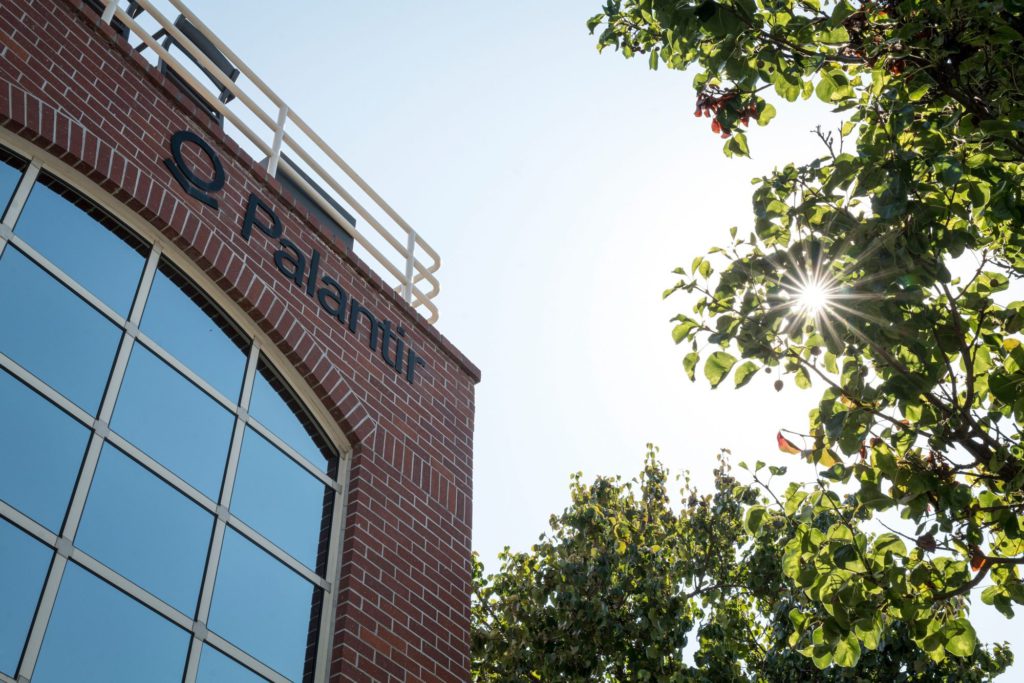
Palantir Deepens Relationship With U.K. Ministry of Defence

(Bloomberg) — Data analytics company Palantir Technologies Inc. struck a 10 million-pound ($12.5 million) contract with the U.K. Ministry of Defence, the U.S. firm’s largest with the high-profile department. 

While much of the 12-month contract is redacted, Palantir will offer support for its Foundry platform, which lets users cut costs by automating work and reducing data-processing time.

The company, co-founded by billionaire Peter Thiel and Alex Karp almost two decades ago, initially focused on selling software to U.S. government agencies and their allies. In the U.S., it works with the military’s Space Systems Command, among other Pentagon agencies, while in the U.K. it built a sizable relationship with the National Health Service during the pandemic. 

The latest contract, awarded in March, is among a number of previous contracts with the MoD, which includes data integration services and an analytics deal with the Royal Navy.

A Palantir spokesperson said the company has been a partner to the Ministry of Defence for over a decade and “is committed to supporting the values of the U.K. Armed Forces.” 

Palantir also recently hired Indra Joshi, the former head of artificial intelligence at the digital wing of Britain’s NHS.

The company’s relationship with vital government agencies has sometimes attracted criticism from privacy groups about the lack of transparency on how contracts are awarded. After lobbying from privacy campaigners, the U.K. government said it would consult with the public before extending contracts between the NHS and Palantir.  

In an April interview on Bloomberg Television, Palantir Chief Operating Officer Shyam Sankar said European governments and groups are using its software to organize the distribution of materials such as food and beds to Ukrainian refugees who fled during the war. Palantir’s software is also being used to power military responses to Russia’s invasion of Ukraine, he said.

(Updated with Palantir statement)

More stories like this are available on bloomberg.com

©2022 Bloomberg L.P.

Larsen’s Software Units to Merge in $18 Billion Stock Deal

(Bloomberg) — Mindtree Ltd. and Larsen & Toubro Infotech Ltd., two software units controlled by a Mumbai-based engineering conglomerate, have agreed to merge as they seek scale to compete with global digital giants.

Shareholders of Mindtree will be issued 73 L&T Infotech shares for every 100 shares held, according to an exchange filing by the companies on Friday evening. Larsen & Toubro Ltd., the parent company, will hold 68.7% of the combined entity after the merger. The announcement confirms an earlier Bloomberg News report.

The proposed merger comes as software companies see surging demand from businesses embracing the digitization that accelerated during Covid-19. Large IT outsourcing firms are also expanding into areas including cybersecurity, automation, and machine-learning support, moving beyond lower-margin traditional back-room services.

The combined entity named LTIMindtree Ltd. will be headed by Debashis Chatterjee, chief executive officer of Mindtree, according to the filing. L&T Infotech’s chief executive officer resigned from the company citing personal reasons, the company said in a statement that followed the merger announcement. 

Shares of Mindtree fell 3.9% in Mumbai trading on Friday, while L&T Infotech dropped 3.61%. The combined entity will have a market capitalization of about $18 billion, according to Friday’s share prices.

KPMG advised Mindtree on the deal, while L&T Infotech worked with Citigroup Inc. 

(Updates with details from second paragraph.)

More stories like this are available on bloomberg.com

©2022 Bloomberg L.P.

Close Bitnami banner
Bitnami