Bloomberg

China Tech Stocks Face Renewed Selling as Growth Worries Mount

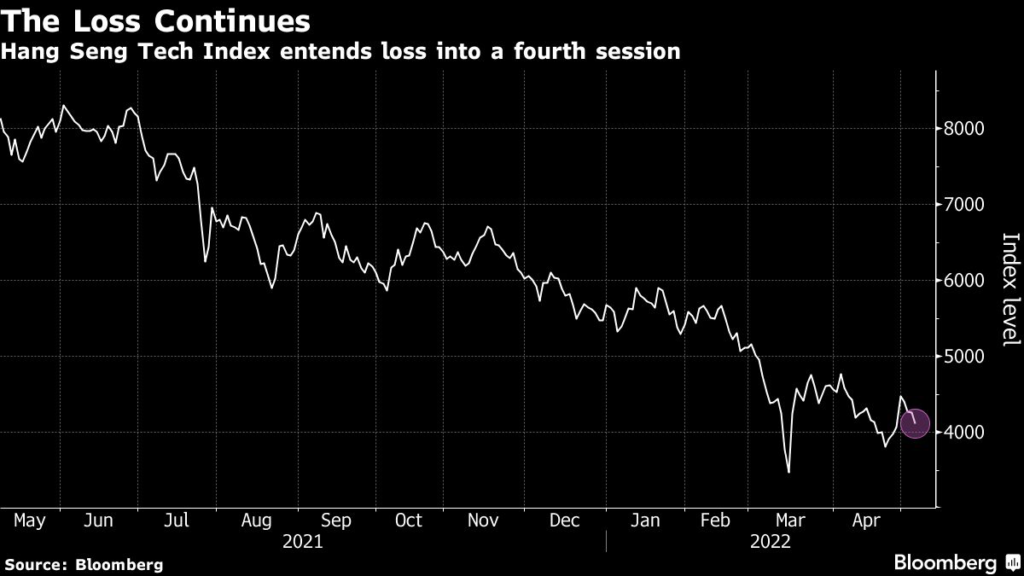
(Bloomberg) — China’s technology stocks slumped, tracking a tumble in its U.S.-listed peers, as growth worries from the nation’s Covid Zero policies and lack of concrete measures to support the sector triggered further selling. 

The Hang Seng Tech Index slid as much as 4.5% early Friday, declining for the fourth straight session. The losing streak threatens to erase last week’s rally spurred by the nation’s top leaders promising to loosen a regulatory crackdown on the sector.  

Friday’s slide follows a 7.7% drop in the Nasdaq Golden Dragon China Index, as overseas investors reassessed the Federal Reserve’s tightening path. The move also suggests that a barrage of pledges by Chinese authorities since mid-March — most recently on Thursday — to go soft on the sector has failed to convince investors that the regulatory environment will improve.

China’s Leaders Warn Against Questioning Covid Zero Policies 

Also weighing heavily on traders’ minds is the latest warning from Chinese leaders not to question President Xi Jinping’s Covid Zero policy. A slew of disappointing economic data from China has highlighted the growing toll of the lockdowns, and market watchers say the outlook will stay dim unless that stance shifts. 

“Although the valuation for Chinese tech giants have been largely beaten down over the past one year, we may have to see a clear control of China’s virus situation or more follow through in support measures in order to lift market confidence,” said Jun Rong Yeap, a strategist at IG Asia Pte. “With relief catalysts such as earnings seasons and Fed meeting largely behind us now, markets are in need of a new relief catalyst.” 

The Hang Seng Index was down as much as 3.3%, while on the mainland, the benchmark CSI 300 Index slid more than 2%.

Staying Power

Thursday’s statement from the Politburo’s Standing Committee sent a clear message that Covid restrictions and broad lockdowns are here to stay. That means policy makers will likely use other measures to prop up growth.

“No one who has been trading in the China market for any period of time has realistically expected a relaxation to Covid policies in the short term,” said Chen Yicong, managing director at Beijing Chengyang Asset Management. He added that Friday’s moves are more likely from the impact of U.S. declines.

Regional tech stocks also fell Friday, with the the MSCI Asia Pacific Information Technology Index down as much as 2.3%. A gauge of chipmakers in the region slumped 3.3%. 

More stories like this are available on bloomberg.com

©2022 Bloomberg L.P.

Globe Telecom Sees Lending as New Growth Platform, CEO Says

(Bloomberg) — Globe Telecom Inc. expects its fintech business to be a major contributor to growth, offering loans to millions of users of its mobile wallet GCash as well as a platform for cryptocurrency and stock investments, President Ernest Cu said.

“Crypto is one angle that we’re exploring but the biggest and most optimistic for us is on lending,” Cu said in an interview with Bloomberg Television’s David Ingles and Shery Ahn. It’s offering loans including a buy now, pay later product which is “very much ingrained” in the spending habits of Filipinos, he said.

Other Details

  • The Ayala Corp. unit has developed platforms for equity and mutual funds trading as well as savings
  • It will slow down its capital spending as it has built the infrastructure it needs, particularly in broadband and mobile
  • Economic reopening has expanded Globe’s mobile business “very nicely” in the month of March. Growth is likely to be “healthy” this year, with school reopening to further boost demand

More stories like this are available on bloomberg.com

©2022 Bloomberg L.P.

Binance Backs Musk Bid With Eye on Bringing Twitter to Web3

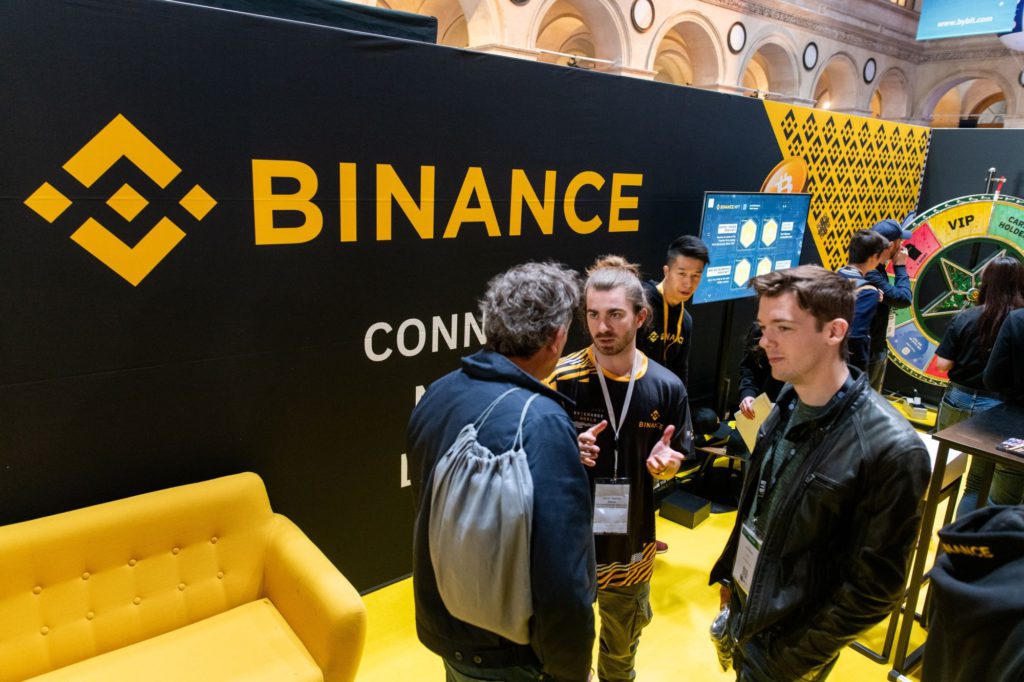
(Bloomberg) — Binance Holdings Ltd. has committed $500 million for Elon Musk’s proposed takeover of Twitter Inc. as part of its strategy to bring social media and news sites into the world of web3. 

“We’re excited to be able to help Elon realize a new vision for Twitter,” Changpeng Zhao, chief executive officer of Binance, said in a statement. “We hope to be able to play a role in bringing social media and web3 together and broadening the use and adoption of crypto and blockchain technology.” 

The deal was part of the $7.1 billion of new financing that Musk has secured for his proposed $44 billion takeover of Twitter. Sequoia Capital Fund, Qatar Holding LLC, and Brookfield Asset Management are among other backers in the package. 

Twitter is a main platform for online discourse by the crypto community. Yesterday, Musk briefly changed his Twitter avatar to a collage of Bored Ape NFTs, one of the most popular collections on the market. This resulted in a surge in the price of the ApeCoin token during European hours. 

Binance is creating an internal team to focus on how blockchain could be helpful to Twitter and other social platforms, and has brought up BNB Chain — a distributed ledger Binance helped to build — to Musk and his team, Patrick Hillmann, chief communications officer for Binance, said in an interview. 

‘Once in a Lifetime’

“This is probably one of the greatest laboratories that web3 has ever had access to,” Hillmann said. “It’s a once in a lifetime opportunity.”

BNB Chain is already used for decentralized finance and other applications and supports a token called BNB, which has a market capitalization of about $61.8 billion.


‘Web3’ is a catchall term referring to a vision of the world wide web as a decentralized environment that uses blockchain technology and digital tokens to wrest control of the internet from giant technology companies.

Prior to the funding announcement, Zhao told Bloomberg TV that Binance is ready to invest in any “strong business with existing users, existing models” that can be helped with additional monetization models using Web3, blockchain and cryptocurrencies. 

Gaming, e-commerce, logistics and real estate are also sectors that the company is interested in investing. In these industries, “we’ll be pretty passive and pretty silent,” he said. 

Binance announced in February that it is making a strategic investment of $200 million into the more than 100 year-old news publisher Forbes and will advise its digital assets strategy. 

A Binance spokesperson declined to share further details on the deal, when asked if the company will pay for funding in crypto. 

(Updates with Binance comments from the fifth paragraph.)

More stories like this are available on bloomberg.com

©2022 Bloomberg L.P.

Amazon Customers Sue Over Automatic Renewals for Services

(Bloomberg) — Amazon Inc. makes it too hard and unnecessarily confusing to cancel subscriptions for services, some customers claimed in a lawsuit alleging the internet retailer is violating California’s rules on automatic renewal programs.

The lawsuit was filed in San Francisco federal court by three California residents who say they signed up for free trials of Amazon services only to have the company convert them into paid subscriptions without their consent.

Amazon offers subscriptions for numerous services including Amazon Prime, which provides free shipping, Prime Video, Amazon Music and Kindle Unlimited.

California’s automatic renewal law, like those in other states, requires companies to make sure customers know what they are getting into before they click the subscribe button.

The customers claim Amazon is violating California’s law by failing to present automatic renewal terms in “a clear and conspicuous manner,” charging credit cards without “first obtaining affirmative consent,” and failing to send subscribers notices that explain renewal terms and how to cancel subscription.

Amazon didn’t reply to a request for comment.

The three plaintiffs seek to represent all those in the state who paid for Amazon renewals. They are asking the court to declare Amazon’s practices illegal and to order the company to pay class members actual, compensatory and punitive damages.

The case is Nacarino v. Amazon.com, Inc, 22-cv-02713, U.S. District Court, Northern District of California (San Francisco).

More stories like this are available on bloomberg.com

©2022 Bloomberg L.P.

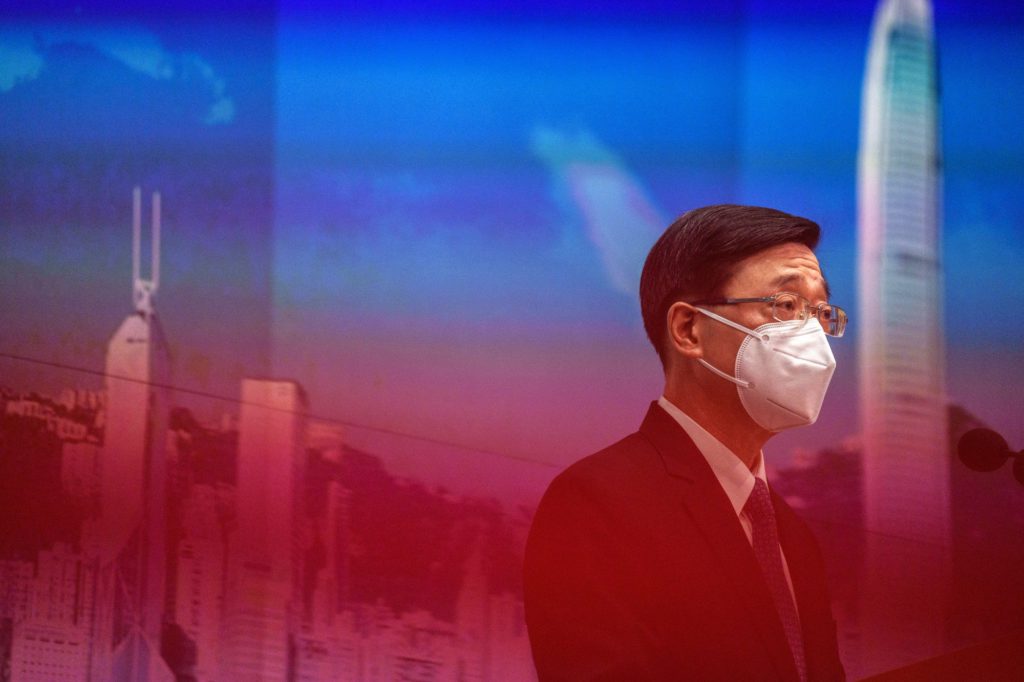
Hong Kong’s Hardline Next Leader Shows Flexibility Behind Scenes

(Bloomberg) — John Lee became the only candidate for Hong Kong’s top post by proving his willingness to loyally execute Beijing’s demands despite an international outcry. The question now is whether he can convince China that re-opening the Asian financial center to the world won’t jeopardize its control. 

Lee, a former cop and security minister, emerged as a leading advocate for cracking down on Hong Kong’s pro-democracy opposition over the past three years, defending the police’s use of force against protesters and warning that those who supported the now-shuttered Apple Daily newspaper would “pay a hefty price.” Such hard-line positions were central to Beijing’s decision to anoint him as the sole candidate in the chief executive’s election Sunday, according to interviews with 10 members of the committee appointed to ratify the choice.

At the same time, bankers, diplomats, politicians and others who’ve met privately with Lee say he’s been even-handed and receptive to the concerns of the business community in the beleaguered former British colony. While most expect him to hold fast to China’s sweeping view of national security, they say he appears more responsive to suggestions than outgoing Chief Executive Carrie Lam, who is deeply unpopular after a single five-year term. 

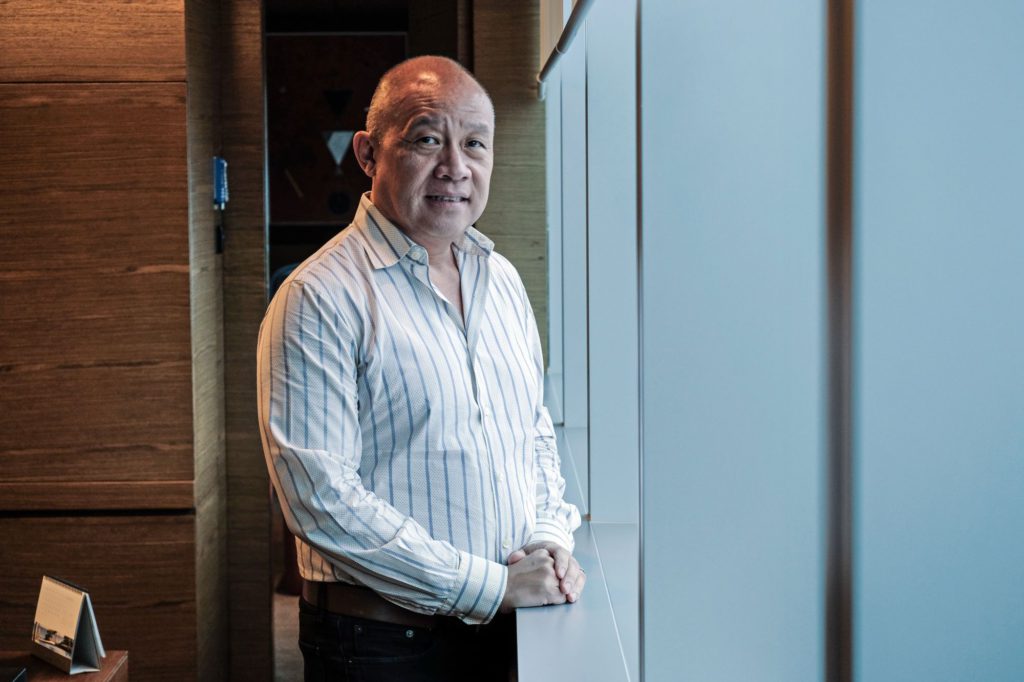
One Hong Kong-based diplomat said Lee, 64, has come off during several meetings as a “gentleman” and appears to know how to balance his views. A member of Hong Kong’s international business community said he was open to meeting up and hearing concerns. Hendrick Sin, a former HSBC Holdings Plc banker and co-founder of locally listed CMGE Technology Group, said Lee was a “good listener and able to analyze quickly.”

“Without strong ties or entangled relationships with business circles and real estate tycoons, he is seen as impartial — and that is a plus,” said Sin, who nominated Lee for the Election Committee’s innovation and technology sector. “Hong Kong needs to be united, working toward different goals to face its tremendous challenges.”

Most of those interviewed, including several others who worked with Lee at various stages of his rise through government but aren’t members of the Election Committee, asked not to be identified by name because they weren’t authorized to speak on his behalf.  

The tasks awaiting Lee when he takes office July 1 are monumental, with President Xi Jinping looking to use the 25th anniversary of Hong Kong’s return to Chinese rule to demonstrate his success in rolling back foreign influence in the city. Beijing’s increasing willingness to dictate local policies — imposing a national security law and its Covid Zero virus strategy — has shaken confidence in the city’s future as a global finance hub. 

Lee pledged in his campaign platform last week to enhance Hong Kong’s status as international business center, while cautiously charting a path forward towards managing Covid in a city still without quarantine-free travel to either the mainland or the rest of the world. On Thursday, he said reopening the border was “the first task on my mind” and he would seek to “remove the obstacles to satisfy the requirements” for doing so, without elaborating.

“I know that the current measures are causing some inconvenience,” he said, according to the South China Morning Post. “The current government is taking action to balance the measures against the need for economic development.”

Even before Hong Kong came under greater scrutiny during a wave of sometimes-violent democracy protests in 2019, its leaders struggled to balance the political desires of its 7.4 million people with China’s demands for control. No chief executive has managed to serve two five-year terms. Some 24% of the public has confidence in Lee, compared with 12% for Lam, according to a survey in March by the Public Opinion Research Institute.

Beijing settled on Lee “very late” in the process, in a decision that was likely influenced by the West’s criticism of China’s position on Ukraine, said three pro-establishment politicians familiar with the situation. Lee — who, like Lam, is already facing U.S. sanctions over his role cracking down on the democratic opposition — was seen as more firm than other contenders such as Finance Secretary Paul Chan, one of the politicians said. 

A former opposition lawmaker now living overseas described Lee as an “executioner” who was prepared to do whatever was asked, and said his selection showed Beijing’s desire to move away from career administrative officers like Lam. Choosing Chan or another similar candidate might have been misinterpreted as a sign that the security drive was winding down, said the ex-lawmaker.

Similarly, Hong Kong can’t completely abandon Covid Zero, which Chinese officials attribute directly to Xi and cite as an example of the advantages of their authoritarian model over fractious Western democracies. While the city has loosened some restrictions compared to China, including allowing non-residents to enter as of May 1, it continues to require quarantines of seven days. 

“It seems doubtful he’ll be able to fully satisfy Beijing’s anxieties about national security and, at the same time, address the concerns of companies and professionals who operate globally,” said Michael Davis, a law and international affairs professor at O.P. Jindal Global University in India and a former law professor at the University of Hong Kong. “Beijing has seemed willing to put Hong Kong’s financial, human rights, public health, rule of law and reputational concerns in second place behind what it perceives as national security threats.”

Lee this week revealed that he’s Catholic, similar to Lam, which is notable given the Communist Party’s restrictions on religion. He grew up in public housing before joining the police force as a probationary inspector in 1977, and earned a master’s degree in public policy and administration from Charles Sturt University in Australia. 

As chief superintendent of the criminal investigation unit, Lee helped Guangdong police investigate the kidnapping of billionaire Li Ka-shing’s eldest son, Victor, in the late 1990s, according to a person who worked under Lee as a police officer on the case.

The case foreshadowed future battles over Hong Kong’s legal autonomy, after Chinese authorities decided to try, and ultimately execute, the defendant on the mainland. Victor Li, who’s now chairman of CK Hutchison Holdings Ltd., was among the first tycoons to voice support for Lee’s candidacy as chief executive last month.

In 2012, then-Chief Executive Leung Chun-ying, whose father had been a police officer, brought Lee into the government as undersecretary for security. Lam promoted him into her cabinet as security secretary five years later, where he was central to advocating extradition legislation that prompted anti-government rallies of more than a million people in 2019. Early on in the protests, he joined Lam in apologizing for the bill and the “controversies and rifts it has caused in society.”

As Xi’s government lost patience with the increasingly violent demonstrations, Lee followed Lam in taking a harsher tone against the protests and defending police efforts to sweep activists from the streets. Lee became a chief proponent of the Beijing-drafted national security law that has resulted in the arrests of some 182 people, the closure of at least a dozen news organizations and the dissolution of some of the city’s largest labor unions.

The Chinese government fueled speculation that Lee would succeed Lam last June when it approved his promotion as chief secretary for administration, the city’s No. 2 position. An overhaul of the local election system ensured that Beijing would face even less opposition from the committee of some 1,460 insiders who must sign off on candidates. 

Soon after Lam’s April 4 announcement that she wouldn’t seek a second term, China’s Liaison Office circulated word that Lee would be the sole candidate and informed voters when they could pledge their support, according to two Election Committee members who asked not to be identified because they weren’t authorized to discuss internal deliberations. A third voter who asked not to nominate Lee to avoid making the process look illegitimate. 

Lee received 786 nominations from the panel, 35 more than the number of votes he needs to win in Sunday’s election. What remains to be seen is whether such support from Beijing gives Lee more freedom to seek compromise on thorny issues, such as Covid Zero and concerns about foreign influence. 

“John Lee has said he’s very concerned about ensuring Hong Kong’s reputation as a international center is maintained,” said George Cautherley, vice chairman of the International Chamber of Commerce – Hong Kong. “To do that, you’re going to have to take a much more pragmatic attitude towards how you handle the borders. Well, let’s see. It’s quite difficult.”

(Updates with Lee’s comments in SCMP)

More stories like this are available on bloomberg.com

©2022 Bloomberg L.P.

Andreessen’s Role in Musk-Twitter Bid Sets Up Meta Conflict

(Bloomberg) — A move by Andreessen Horowitz to join Elon Musk’s bid for Twitter Inc. threatens to create a conflict for firm co-founder Marc Andreessen, who sits on the board of social-networking rival Meta Platforms Inc.

Andreessen Horowitz agreed to invest $400 million in the Twitter takeover deal, part of $7.1 billion in new financing commitments announced Thursday. That put one of the biggest early backers of Facebook, which changed its name to Meta last year, in position to become a new owner of Twitter.

Firm co-founder Ben Horowitz said in a tweet that Musk was perhaps the only person in the world with the “courage, brilliance and skills” to fix Twitter’s problems and “build the public square that we all hoped for and deserve.”

Andreessen Horowitz’s involvement has raised questions about the VC firm’s links to Meta, where Marc Andreessen has served as a board member since 2008. Though it’s not uncommon for Silicon Valley investors to have a hand in competing startups, potential conflicts can be more serious with publicly traded businesses, said John Coates, a professor at Harvard Law School. 

“It’s safe to say that Silicon Valley norms about conflicts — where they are often tolerated or even encouraged, in a culture along the lines of ‘it all comes out in the wash’ — are dangerous to carry over to the world of public companies,” he said.

A representative for Andreessen Horowitz said it planned to seek legal advice to ensure compliance with any rules around the sharing of Twitter information with the firm. 

Andreessen, 50, has come under scrutiny for previous possible conflicts at Meta, such as investing in companies — including Oculus VR — that Facebook ended up buying. At one point he was sued by investors for advising Meta Chief Executive Officer Mark Zuckerberg on how to protect his majority voting control even if he sold his shares. 

On Twitter, Andreessen has been publicly supportive of Musk, and he’s railed against the content-moderation policies at social media companies. Musk has said he plans to loosen the rules if he takes charge of Twitter.

Since the investor doesn’t sit on Twitter’s board, his connection to Meta may not be an issue, said David Larcker, a professor at Stanford University. “Although I know of no way to figure this out from public data, I would guess that many executives and board members trade in the shares of their competitors,” he said.

Twitter, while far smaller than Facebook, is considered a Meta rival, competing for digital advertising dollars and users’ posts. When Twitter’s board was evaluating whether to take Musk’s bid, they looked at the recent decline in Meta’s valuation as part of their deliberations, according to a person familiar with the matter. They ultimately concluded that the billionaire’s offer was fair.

Andreessen isn’t the only partner at his venture firm whose existing relationships may get more complicated after Musk’s deal is completed. Vineeta Agarwala, a general partner at Andreessen Horowitz who invests in biotech and medical companies, is married to Twitter CEO Parag Agrawal. It’s unclear if Agrawal will remain as CEO under Twitter once Musk takes over, but Musk has previously said that he made his bid for Twitter in part because he didn’t have faith in the company’s current leadership. 

On Thursday, CNBC reported that Musk plans to take over as CEO for a short time after the deal closes.

(Adds Andreessen Horowitz comment in the sixth paragraph.)

More stories like this are available on bloomberg.com

©2022 Bloomberg L.P.
Argentina Slams Brake On Crypto, Banning Purchases Through Banks

(Bloomberg) — Argentina’s central bank dealt cryptocurrencies a blow Thursday, prohibiting financial institutions in the South American country from offering clients any operations involving unregulated digital assets.

The monetary authority banned operations that allow bank clients to purchase crypto, just days after two large institutions announced they would let clients buy Bitcoin and other digital currencies. The ban also includes assets whose returns are determined by the fluctuations of cryptocurrencies.

Argentines are embracing cryptocurrencies at a quick pace as recurring currency crises and inflation running above 50% annually erodes the value of their savings. The country is among the world’s top 10 with the highest adoption of crypto, according to specialized website Chainalysis.

Read More: Cryptocurrencies Prove a Lifeline in Argentina’s Chaotic Economy

Earlier this week, Banco Galicia, the country’s largest private bank by market value, and digital bank Brubank announced they would allow their customers to purchase crypto including Bitcoin, Ether and USDC.

With the measure published Thursday, the central bank banned such operations for the entire financial sector, saying it aims to “mitigate the risks” involved in transactions of digital assets.” Those include high volatility, cyberattacks and money laundering, according to a statement. 

Read More: Crypto Miners Threaten Frail Energy Grid at the End of the World

Financial institutions should focus on “financing investment, production and consumption of goods and services,” it added.

More stories like this are available on bloomberg.com

©2022 Bloomberg L.P.
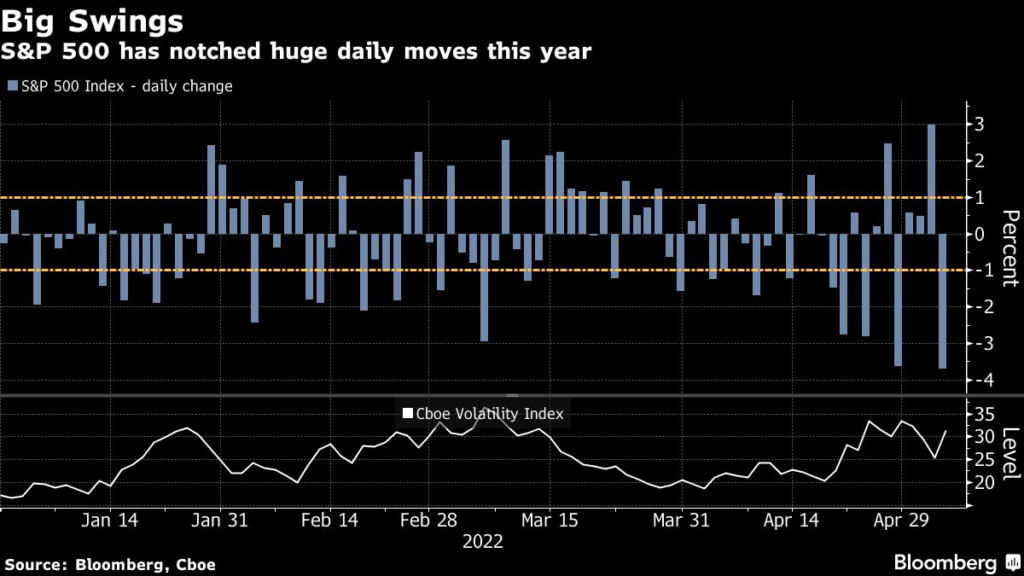
Wall Street Staggers With ‘Vicious’ $1.3 Trillion Stock Rout

(Bloomberg) — A day after celebrating the Federal Reserve’s signal that it wouldn’t be making any jumbo-sized moves, traders woke up on Thursday deciding that the central bank will struggle to fight high inflation amid the lingering threat of a recession.

In a sharp about-face, investors sold stocks, bonds and cryptocurrencies on Thursday. The S&P 500 Index lost 3.6%, erasing about $1.3 trillion of market value, and the tech-heavy Nasdaq 100 dropped 5.1%, the most since September 2020. 

“The great puking that’s happening? I didn’t expect that,” Kim Forrest, founder and chief investment officer at Bokeh Capital Partners said by phone. “We live for the days where we’ve made people money — that’s our job — and it’s cold comfort that I’m losing people less money.”

Speculative corners of the market were among the hardest hit, with an index of expensive software stocks sliding more than 10%, the most since mid-March 2020. An ETF tracking newly public companies lost 7.6%, while non-profitable tech firms lost roughly 11%, as Bitcoin — the largest cryptocurrency — dropped by the same amount to just above $36,000. 

“There’s still a lot of fear out there,” said Dennis Dick, head of markets structure and a proprietary trader at Bright Trading. “People thought yesterday was the green light, but now they’re getting caught again. Retail traders keep coming in and getting chopped up. The contrarians have been winning 2022.”

“The only thing that will lead to a sustained turnaround is if we see inflation start to not look so hot,” he added. “Any rally that isn’t on improving inflation is a sucker’s rally.”

Here’s what other market-watchers had to say:

Frank Davis, senior managing director at LEK Securities:

“It looks like some people might have viewed yesterday’s rally as a good exit, and then it just started feeding on itself this morning. The market did need to pull back and re-calibrate for value, but the viciousness of the move is really the story of the day.”

Fiona Cincotta, senior market analyst at City Index: 

“The S&P 500 seeing its strongest gains since 2020 on the day the Fed decides to hike interest rates is kind of extraordinary, so we are seeing a reprice today, which is expected. But at the end of the day, the risks remain. Inflation remains high. The Fed is keen to act.”

Chris Gaffney, president of world markets at TIAA Bank:

“When Powell said he wasn’t going to tighten 75, that’s what led to that relief rally. But they’re still tightening, and they’re still tightening at a more aggressive pace than most would have imagined just a short while ago. So it is difficult to buy into the rallies,” he said. “Overall financial conditions are going to be tighter moving forward and certainly the risk of a recession, the risk of tighter financial conditions leading to a recession is still there. So it’s very difficult to jump on any sort of rally under these conditions.”

Stephen Carl, head trader at Siebert Williams Shank & Co.:

“The scale of today’s move is a little surprising. We had been viewing 4,200 as a support for the S&P 500, and we’re below that now. Really, this seems like a knee-jerk reaction from yesterday, with some profit-taking. There could also be some portfolio managers out there recommending the buying of bonds and selling stocks, which could be contributing to the overall weakness.”

Randy Frederick, vice president of trading and derivatives for Charles Schwab & Co.: 

“People have been looking for a capitulation, where everyone just throws in the down. Perhaps today is that day. This is the first day that I would describe as a capitulatory day,” he said. “Even though some of these high-valuation, low-profitability names are down 60-70%, it doesn’t seem like there is any appetite to buy the dip.”

“We all knew something like this was going to happen eventually,” he added. “We’ve seen it before. We tried to warn the young traders, but they didn’t want to hear it. But I think this will result in a better market, because you actually have to look for quality.

Cliff Hodge, chief investment officer at Cornerstone Wealth: 

“Investors are getting spooked by the combination of soaring unit labor costs and a significant drop in productivity. Those are some stagflationary-like readings. The reports this morning are all from 1Q. They haven’t told us anything new, but investors are clearly extremely focused on inflation.”

Sam Stovall, chief investment strategist at CFRA:

“Usually you end up having a reversal move to digest whatever occurred the day before,” he said of stock moves around Fed days. “There’s a pop after a drop, and, in this case, there’s usually a drop after a pop. On the one hand, it’s because traders are looking to take profits because they questioned the sustainability of this advance.”

Quincy Krosby, chief equity strategist at LPL Financial:

“Chairman Powell was clear-ish — I say clear-ish because he said soft-ish landing. But when he took the 75 basis points off the table, inherent in that was a suggestion that perhaps they wouldn’t need it,” she said. “Why would you say that if you thought, for example, inflationary pressures were going to climb even higher?”

Sylvia Jablonski, CEO, CIO and co-founder of Defiance ETFs: 

“Day after day, the direction seems to change. This opens up good opportunism for companies which have fundamentals, strong earnings, strong outlook for the next three-to-five years. What is really interesting about these markets is that there are these every-other-day changes in either direction where investors are outrageously bullish or outrageously bearish the next day.”

(Updates with Randy Frederick quotes)

More stories like this are available on bloomberg.com

©2022 Bloomberg L.P.
Carvana Father-Son Duo Is Down $25 Billion, Leading Wealth Rout

(Bloomberg) — Nine months ago, the father-son duo that runs used-car company Carvana Co. had a combined personal fortune of more than $32 billion. 

Ernie Garcia II and Ernie Garcia III have now shed almost 80% of that wealth, one of the biggest and fastest declines of any billionaire family or individual fortune, according to the Bloomberg Billionaires Index. 

The Garcias’ were further hammered Thursday by one of the worst days for the stock market in more than two years, sparked by concerns that the Federal Reserve will struggle to contain rising inflation. Phoenix-based Carvana’s losses exceeded those of the broader market, falling 18% and leaving the stock down 87% from its August peak.

The Garcias are emblematic of the pandemic economy, as pent-up savings spurred interest in car ownership and ultra-low rates boosted financing for purchases. Those forces are fast losing steam. Tech and online consumer firms that soared in value only months ago have been clobbered.

Those dragged down include Chase Coleman’s Tiger Global Management, which has lost $16 billion this year, and CAS Investment Partners, the hedge fund run by Clifford Sosin. It’s bet on Carvana, specifically, has backfired spectacularly.

The tech-heavy Nasdaq 100 Index fell 5% Thursday, its biggest one-day loss since Jun. 11, 2020. Elon Musk, the world’s richest person, lost more than $18 billion, according to the Bloomberg index, leaving him a fortune of $249.2 billion as shares of Tesla Inc. tumbled 8%. Amazon.com Inc. founder Jeff Bezos saw his net worth fall 7% to $140 billion, while Meta Platforms Inc.’s Mark Zuckerberg dropped $5.3 billion to $76.6 billion.

The world’s 500 richest people lost a collective $157 billion of wealth, the seventh-largest on record.

The only person among the world’s 15 richest to add to his fortune Thursday was India’s Gautam Adani, whose empire includes ports, mines and green energy.

More stories like this are available on bloomberg.com

©2022 Bloomberg L.P.
U.K. Adopts New Tech Rules, But Without Power to Enforce Them

(Bloomberg) — The U.K. has set out sweeping new plans to regulate tech companies and impose massive fines, but has stopped short of saying how it will enforce the laws. 

The government will provide a new watchdog — the Digital Markets Unit — with the power to enforce competition rules, such as stopping firms from hurting rivals by preinstalling their own products, according to a statement from the Department for Digital, Culture, Media and Sport on Thursday.

The U.K. first laid out potential plans to create a tech-focused regulator in early 2019, at the time making the country a front-runner in the global push to regulate Big Tech. While Thursday’s statement provided fresh details about the DMU’s authorities, it remains unclear when it will get powers to enforce the rules. The U.K. said the government “will introduce legislation to put the Digital Markets Unit on a statutory footing in due course.” 

A government spokesman didn’t respond to a request for further detail.

The DMU, the U.K.’s first tech-focused regulatory agency, will have the power to:

  • Establish rules to allow people to switch between phone operating systems, such as Android and Apple Inc.’s iOS.
  • Ensure smaller technology companies won’t be surprised by Big Tech algorithm changes.
  • Plan for fines of as much as 10% of global revenue, with an additional penalty of 5% of daily sales for each day an offense continues.
  • Allow for publishers and content providers to get greater power to receive payments from large tech firms.
  • Potentially force firms to share data.
  • Make senior managers pay civil penalties if they fail to respond to requests for information.

While the future laws are hard-hitting, almost all of them have been enacted or are being enforced by the European Union and its member states. 

The landmark Digital Services Act from the European Union has the power to fine tech firms 6% of global annual sales when its rules go into effect, in 2023 or 2024 depending on the companies’ size. The related Digital Markets Act focuses on issues such as making messaging apps work together.

The DMA — first established in July of last year — will be part of the Competition and Markets Authority, and will be based in Manchester to boost the regulator’s presence outside London. It previously said it aims to have 200 employees based in the northwest English city by 2025.

Read more: Why Apple and Google face a U.K. clampdown

Countries such as France and Australia have also been forcing tech giants to renegotiate payments with content providers.

“We want to level the playing field and we are arming this new tech regulator with a range of powers to generate lower prices, better choice and more control for consumers,” said U.K. Digital Minister Chris Philp in the statement, “while backing content creators, innovators and publishers, including in our vital news industry.”

More stories like this are available on bloomberg.com

©2022 Bloomberg L.P.
Close Bitnami banner
Bitnami