

Bloomberg

Two Top VC Firms Bet on a Second Life for Twitter as a Startup

(Bloomberg) — Twitter Inc. is a strange target for venture capitalists. It’s 16 years old, growing slowly and publicly traded, all anathema to what VCs want. Yet, Elon Musk somehow persuaded two of the world’s most prominent VC firms, Andreessen Horowitz and Sequoia Capital, to invest in his effort to take Twitter private.

The deal may have been a nonstarter for these firms a few years ago, but recent changes to how they operate would allow more of these sorts of nontraditional investments in the future. Although each firm began as a pure VC outfit, they’re now both so-called registered investment advisers, allowing them to dabble in private equity transactions or public stocks and hold cryptocurrencies.

The changes were a reflection of a relatively new mindset in venture capital: Startup investing is no longer enough for many firms. VCs increasingly compete with and invest alongside growth-focused private equity firms and hedge funds in the same deals. The rise of crypto was a big factor, too, and now, leaving the confines of traditional venture capital lets Andreessen Horowitz and Sequoia take part in the most notable tech deal of the year.

For Andreessen Horowitz, the transformation from VC to diversified investment firm began in 2019. That’s when it revamped its structure, started loading up on crypto and pursued a range of early to late-stage startups. The $400 million check for Musk is among the largest recent deals and comes after weeks of supportive tweets by the founders saying the world’s richest man would improve the platform and bring about much-needed change.

“Elon is the one person we know and perhaps the only person in the world who has the courage, brilliance and skills to fix all of these and build the public square that we all hoped for and deserve,” Ben Horowitz, a founder of the firm, wrote Thursday. “While Twitter has great promise as a public square, it suffers from a myriad of difficult issues ranging from bots to abuse to censorship. Being a public company solely reliant on an advertising business model exacerbates all of these.”

Sequoia restructured as an investment adviser last fall. The Twitter investment, at $800 million, is one of the largest in its 50-year history. The firm will pull the cash from three separate funds: Sequoia Capital Global Equities, Sequoia Heritage Fund and Sequoia Capital, said a person familiar with the transaction who asked not to be identified because the details are private.

Musk and Sequoia’s just-appointed leader, Roelof Botha, have a long history. Both men are from South Africa, and Musk hired Botha at his dot-com startup, a precursor to PayPal.

”For over two decades, we’ve had a front row seat to Elon’s business and technical prowess, from X.com, which became PayPal, to SpaceX and the Boring Company,” a spokeswoman for Seqouia wrote in an emailed statement. “We see, as he does, the opportunity to drive meaningful product innovation that will help unlock Twitter’s full potential as a global platform that connects the world.”

Musk has sent mixed messages about his intentions for Twitter. He has said he doesn’t care about the economics of the business — generally something an investor doesn’t want to hear — but has also outlined ways he thinks could improve the service. Musk has suggested he could add a “slight cost” for corporate and government users and encrypt direct messages on the platform so they can’t be easily hacked.

Another possible future for Twitter could involve the decentralization of its infrastructure using blockchain technology. Crypto is a shared interest of Musk, Andreessen Horowitz and Sequoia, as well as for another investor in the deal, the cryptocurrency exchange Binance, which committed $500 million. “We hope to be able to play a role in bringing social media and web3 together,” Changpeng Zhao, the chief executive officer of Binance, said in a statement.

More stories like this are available on bloomberg.com

©2022 Bloomberg L.P.
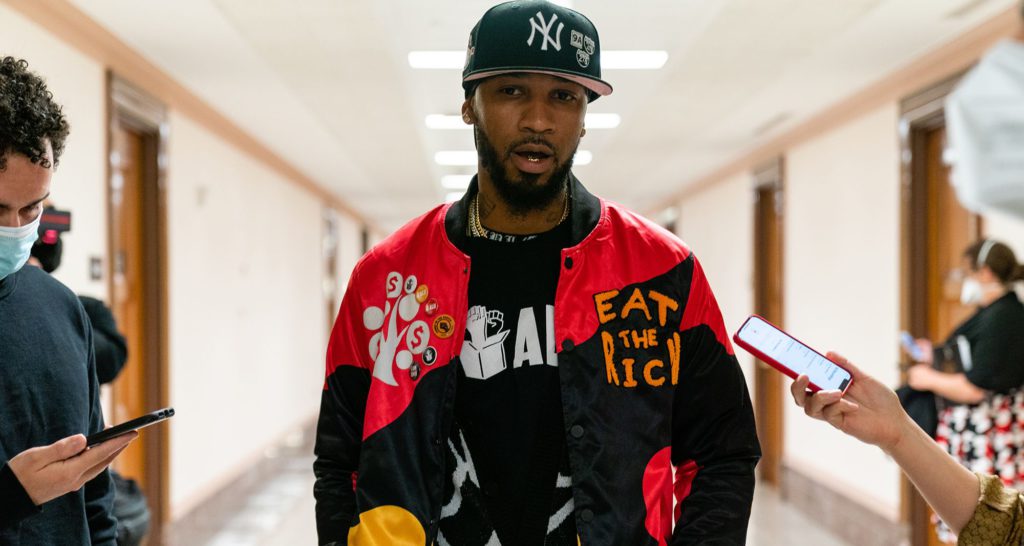
Biden Meets Amazon Union Organizer in Latest Jab at Retailer

(Bloomberg) — President Joe Biden met with a group of labor organizers Thursday at the White House, including a former Amazon.com Inc. worker who led a Staten Island union-organizing drive.

Christian Smalls, the Amazon organizer, took part in a roundtable session hosted by Vice President Kamala Harris and Labor Secretary Marty Walsh. The session included young organizers and workers at a range of companies. 

“Today I met with grassroots worker organizers to thank them for their leadership in organizing unions,” Biden tweeted Thursday, adding that Smalls and other union officials “are inspiring a movement of workers across the country to fight for the pay and benefits they deserve.”

Biden has regularly chided Amazon, and expressed support for the union push at the company last month. “By the way, Amazon, here we come,” he said at the time.

Smalls’s fledging Amazon Labor Union won an election in April to represent Amazon workers at a warehouse in New York’s Staten Island. Amazon has contested the result. The union this week lost an election at a second, smaller Amazon facility across the street. 

Smalls on Thursday also testified at a hearing presided over by Senator Bernie Sanders, who has proposed barring U.S. companies that violate labor laws from winning federal contracts. The Vermont independent said Amazon has “done everything possible — legal and illegal — to defeat union organizing efforts.”

The Sanders proposal faces long odds. Identifying federal contracts linked to Amazon would be difficult, owing to limited disclosure and the company’s choice of selling its cloud products through dozens of resellers and systems integrators.

A Bloomberg Government analysis of non-classified contracts and announcements of classified work reveals direct and indirect government sales could exceed $3 billion annually as recent contracts take effect over the next two years. In the government’s current fiscal year alone, Amazon bagged $367 million worth of contracts spread across 93 vendors and 33 agencies, according to publicly disclosed data.

The Bloomberg Government analysis excludes Amazon’s multi-billion-dollar, classified contracts with the Pentagon and the intelligence community, the value of which are not recorded in publicly released contracting data. The calculation also excludes the office supplies and other items that government agencies buy from Amazon’s web store.

Amazon didn’t respond to a request for comment on the hearing or Sanders’ allegations.

The company is grappling with an increasing number of unfair labor practice complaints from workers around the country. Employees have lodged 51 complaints so far this year, many of which came from Amazon locations in Staten Island and Bessemer, Alabama, where organizing efforts have been underway.

In his testimony, Smalls said federal contractors can break labor laws and get away with it and that the process workers can use to hold companies accountable is no longer working.

“It’s not a left or a right thing, it’s not a Democrat or Republican thing. It’s a worker thing,” Smalls said.

(Updates with Biden tweet in third paragraph, other details starting in sixth paragraph)

More stories like this are available on bloomberg.com

©2022 Bloomberg L.P.
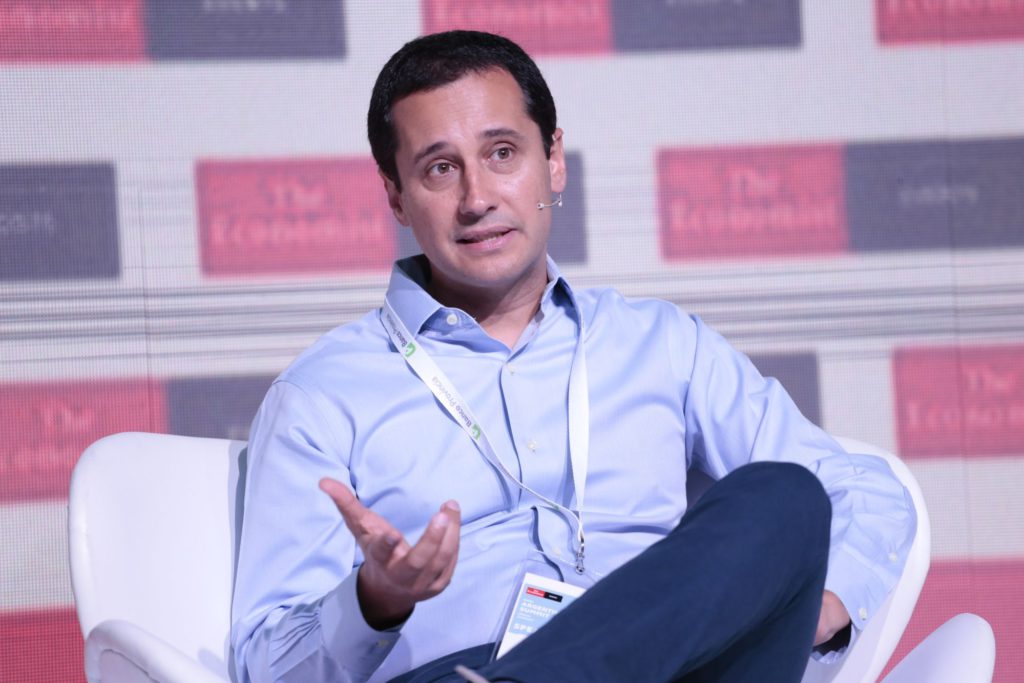
MercadoLibre Posts Record Revenue, Braces for Macro Jitters

(Bloomberg) — Latin American e-commerce retailer MercadoLibre Inc. grew its revenue more than forecast in the first quarter, boosting optimism that the company will continue to hold sway in a region where online competition is getting fiercer. 

Net revenue in the first three months of the year rose 63% from a year earlier to $2.2 billion, according to a statement Thursday, topping the $2 billion average estimate of analysts surveyed by Bloomberg. The Buenos Aires-based company reported gross merchandise volume of $7.7 billion, also beating expectations.

MercadoLibre saw a surge in user adoption during coronavirus lockdowns, and continues to grow even as most countries in the region reopen. That’s partly because the company also offers products such as in-store payment services that benefit from reopenings, said Chief Financial Officer Pedro Arnt. Still, he pointed to a challenging year ahead, with high volatility in global markets, rising commodity prices, and macro challenges across Latin America. 

“We’ve entered a period of increased uncertainty,” he said in an interview from Montevideo. “The business has always been very resilient. We continue to trust in that, but it’s a year with many global and local challenges.”

The company is looking to invest about $10 billion across the region this year in capital and operational expenditures, said Arnt. Previously the company had mentioned plans to spend $3.4 billion in Brazil and $1.5 billion in Mexico this year. Earlier in the week, it announced plans to boost direct employment by 46%, hiring 14,000 people across six countries in the region. 

“Because of the scale our business now has and the size it’s been able to achieve over the past two-year cycle, we’re at an attractive moment where we think we can sustain heavy investment but also consistent improvements in our profit generation,” he said.

MercadoLibre is expecting to use its cash to fund the investments, said Arnt, noting that the company continues to maintain its preference of growing organically rather than through acquisitions. 

“In this environment where cash is absolutely king, it’s even more likely that we will continue to stick to our preference to build,” he said. 

The company’s fastest-growing portion by revenue is its fintech arm, with 108% growth compared to the first quarter in 2021. Its credit portfolio rose to $2.4 billion, up from about $1.7 billion by the end of 2021, and Arnt said the company has “no intent to slow down” even as a more varied mix of credit offerings may lead to some deterioration in the credit business. 

“Periods of higher inflation and eco instability disimprove the environment for credit, no way around that,” he said. “But the level of data we have about our consumers and the short duration nature of our credit books make us well-equipped to navigate these macro turbulences.”

Shares in MercadoLibre rose 5.2% in postmarket trading in New York after the results. The stock is down 32% since the start of the year, punished by surging U.S. rates. MercadoLibre has 24 buy-equivalent recommendations from analysts, three holds and no sell, Bloomberg data show. 

Other key points from the interview:

  • Crypto transactions, which were launched in Brazil last year, are seen as a “central part” of the company’s expansion into products that promote savings
  • The company is in talks with regulators in various countries to get the green light to expand that offering

More stories like this are available on bloomberg.com

©2022 Bloomberg L.P.
Bitcoin Plunges the Most Since January; Altcoins Extend Losses

(Bloomberg) — Bitcoin tumbled the most since January as the rout in financial markets deepened in the wake of increasing concern of recession. 

The largest digital currency fell as much as 11% to $35,611, the biggest intraday drop since Jan. 21. It had gained 5.3% on Wednesday. Ether slumped as much as 8.7%. Avalanche and Solana, among some of the largest gainers after the U.S. central bank raised rates Wednesday, were down as much as 15% and 11%, respectively.  

“Investors are jittery about the Fed continuing to raise interest rates after yesterday’s 50 bps hike,” said Jason Lau, the San Francisco-based chief operating officer of the Okcoin exchange. “The potential of additional rate hikes makes the trajectory of the global economy uncertain.”

The U.S. central bank’s policy-making Federal Open Market Committee on Wednesday voted unanimously to increase the benchmark rate by a half percentage point and said it will begin allowing its holdings of Treasuries and mortgage-backed securities to roll off in June. Risky assets surged after Fed Chair Jerome Powell said a 75-basis point increase is “not something that the committee is actively considering.” 

Still, in this higher-rate environment, Bitcoin hasn’t been able to break out in any meaningful way beyond its highs at the start of the year. The coin has largely traded within a tight range over the past few months. 

“Bitcoin has become increasingly correlated with U.S. trading hours and U.S. traditional market indices, likely due to a combination of increasing U.S. institutional presence as well as the absence of China after the sweeping bans last year,” said Josh Olszewicz, head of research at digital asset fund manager Valkyrie Investments. 

Money has been flowing out of the sector amid the malaise. Investors yanked roughly $120 million from crypto products last week, bringing total outflows over the past four weeks to $339 million, according to data tracked by fund provider CoinShares. Bitcoin last week accounted for the majority of the flows in what was its largest single week of outflows since June 2021. 

“Since March this year, most of the large selloffs in Bitcoin have kicked off during U.S. market open, potentially suggesting a market participant continues to sell every bullish rally,” Olszewicz said.

(Updates prices. An earlier message corrected the percentage move in the second paragraph.)

More stories like this are available on bloomberg.com

©2022 Bloomberg L.P.
Shopify Tumbles Below Pre-Pandemic Levels After Huge Profit Miss

(Bloomberg) — Shopify Inc. shares plunged below their pre-pandemic level after the company missed revenue and profit estimates, prompting some analysts to dramatically change their outlook on the Canadian e-commerce company. 

Shopify fell 14.7% to $413.64 in New York, bringing this year’s decline to 70%. The stock is now 2% below where it closed on the day in March 2020 that the World Health Organization called Covid-19 a global pandemic. 

Covid lockdowns triggered a rally in e-commerce shares as businesses moved to sell goods online, pushing Shopify’s market capitalization as high as $212 billion and making it Canada’s most valuable company. 

E-commerce stocks have been pummeled this earnings season on concerns that online shopping is slowing as the Covid-19 pandemic fades. Amazon.com Inc. suffered the biggest one-day drop since July 2006 after it reported a weaker-than-expected revenue forecast. Wayfair, Etsy and EBay all dropped on Thursday. 

Ottawa-based Shopify earned 20 cents per share on an adjusted basis in the first quarter, far short of analyst calls for 64 cents. The company gave a weaker outlook for adding new business customers in 2022, saying growth in merchants on its platform would be “comparable” to 2021. 

Shopify also announced the largest acquisition in its history, a $2.1 billion deal for delivery startup Deliverr Inc. But it gave few financial specifics about the year ahead. 

“Investors we speak with are increasingly frustrated with limited/cryptic guidance, reduced disclosure and, in the current environment, ramping spend ahead of a possible recession,” said Barclays analyst Trevor Young, who lowered his share-price target to $460 from $900. “We don’t disagree, and although credit is due for everything they’ve built thus far, SHOP is now a ‘show me’ story.”

Revenue rose 22% to $1.2 billion from a year earlier, but couldn’t match analyst expectations of $1.25 billion, according to data compiled by Bloomberg.

Gross merchandise volume, the value of merchant sales flowing through Shopify’s platform, grew 16% in the first quarter from a year earlier to $43.2 billion. Analysts, on average, expected $46.5 billion in GMV. 

Shopify is contending with consumers returning to physical stores and rising inflation, as well as labor shortages, Chief Financial Officer Amy Shapero said.

“We saw lower merchant adds than last year and we largely attribute that to a very tight and transitional labor market,” Shapero told analysts. “We expect that the labor market will start to ease.”

At least seven analysts ratcheted down their share price targets on Shopify by Thursday afternoon, adding to a series of target cuts in the weeks before the earnings release.

Deliverr Deal

Shopify reached a deal to acquire Deliverr to expand in fulfillment services, confirming an April 20 report by Bloomberg News. In January, Shopify canceled several fulfillment and warehouse contracts intended to create its own distribution network.

Shopify to Buy Deliverr for $2.1 Billion: M&A Snapshot

The purchase of Deliverr — which provides two-day delivery services for companies including Amazon, EBay, Etsy, and Walmart — more than doubles the size of Shopify’s fulfillment team. The transaction will be financed using 80% cash and 20% Shopify Class A shares.

The deal marks the beginning of one of Shopify’s most important long-term initiatives, according to KeyBanc Capital Markets analyst Josh Beck. To build its own fulfillment network, Shopify needs an experienced team with established technology, which it gains with Deliverr. But the process is expensive and takes up time and resources, he added

“With the way the stock is trading, investors are focused on the extra dilution associated with the Deliverr deal,” Beck said in an interview. “In this market environment, that message of less near-term profitability and more investment is not well-received, particularly by short-term investors.”

In a bid to draw retail investors, Shopify announced in April plans to split its stock 10-for-1. The company is also seeking to make governance changes that would give Chief Executive Officer Tobi Lutke a “founder share” that will preserve his voting power as long as he’s at the company, under certain conditions.

When asked why shareholders should vote in favor of the plan, Lutke pointed out that his voting power will be capped at 40% and he’ll be forbidden from passing on the special share to his family. 

“Shareholders can get some assurance that this is a structure that supports the founder-led-ness of the company,” Lutke said. 

On the conference call, the CEO was asked about the company’s ability to attract and retain talent, given the collapse in the share price. Lutke said employees and investors want to be associated with companies based on their values, adding that stock performance plays a small part.

“The stock price is something that factors into this, but it’s one input of many,” Lutke said. “Most people tend to understand that the stock price is a snapshot in time.”

(Updates with analyst commentary from Barclays, share price, price target cuts and other changes)

More stories like this are available on bloomberg.com

©2022 Bloomberg L.P.

Musk Cuts His Margin Risk With Equity Partners for Twitter

(Bloomberg) — Elon Musk may be the world’s richest person, but that doesn’t mean he wants to put his massive fortune at risk to buy Twitter Inc.

The Tesla Inc. co-founder restructured his complex bid for the social-media giant by getting $7.1 billion in equity commitments from investors. He also cut in half the size of a record margin loan arranged last month with an array of investment banks.

Read more: Musk Gets Extra $7.1 Billion From Ellison, Qatar for Twitter Bid

As a result, Musk is significantly less exposed to any potential market volatility. Before, he needed Tesla to remain above about $837 a share for him to have the $62.5 billion to collateralize the $12.5 billion margin loan when it’s first funded. Now Tesla needs to trade above $419 for his available shares to be enough to secure the smaller, $6.25 billion loan.

The shift in the financing bolstered optimism that Musk can complete the transaction, for which he’s offering $54.20 a share. The stock climbed 2.7% to $50.36 in New York, even as U.S. equities tumbled. Tesla slid 8.3% to $873.28.

Musk’s $44 billion purchase of Twitter originally relied on $21 billion of equity that he has to come up with and $12.5 billion in margin loans secured by his Tesla stock. 

After selling $8.5 billion of shares in the electric carmaker to help raise cash, it wasn’t obvious that his remaining stake would be sufficient to secure the margin loan. Even if it were, he’d be left covering an enormous debt load with his Tesla holdings levered to the hilt. 

Musk already had more than half of his $134 billion Tesla position pledged to secure existing debt as of June, according to Tesla’s most recent proxy filing. The $12.5 billion margin loan would be secured by Tesla stock worth $62.5 billion — shares that could be sold by his lenders in the event that he defaulted.


‘Cash Poor’

Musk and his partners now have to come up with $27.25 billion in equity, according to a filing Thursday. He’s built his cash war chest by recently selling Tesla stock and has already amassed 9.6% of the social-media company.

Musk is worth about $250 billion, according to the Bloomberg Billionaires Index, but much of that fortune is illiquid and he has on occasion bemoaned being “cash poor.” 

Along with the new commitments from investors including Larry Ellison, Sequoia Capital and Qatar, Saudi Prince Alwaleed bin Talal is rolling his $1.9 billion of Twitter stock into the privatized company. Musk is also trying to persuade Twitter founder Jack Dorsey to do the same with his stake. 

Musk can continue seeking additional investors to close any potential financing gap.

One immediate benefit: Owning Twitter could now be significantly cheaper for him. The original margin loan was set to cost Musk about $500 million a year, depending on interest rates. That number now drops to about $250 million. 

(Updates with stock prices in fourth paragraph.)

More stories like this are available on bloomberg.com

©2022 Bloomberg L.P.
E-Commerce Stocks Sink to Two-Year Lows on Earnings Malaise

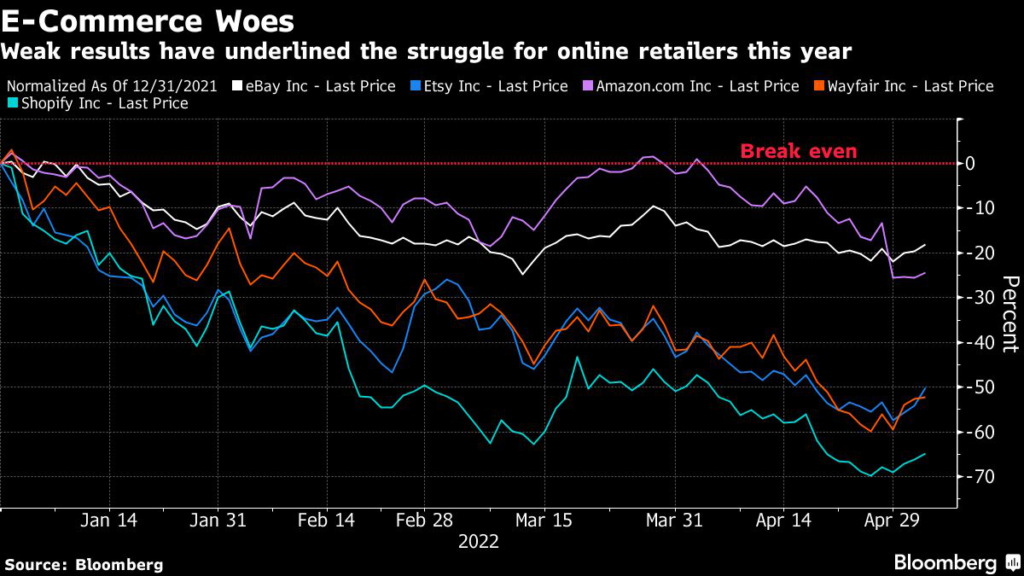
(Bloomberg) — Shares of e-commerce companies from Etsy Inc. to Shopify Inc. tumbled on Thursday after weaker-than-expected quarterly earnings and forecasts deepened concern that the pace of online shopping has slowed.

Etsy sank 17% after providing a second-quarter gross merchandise sales forecast that fell short of analyst expectations, while Canada’s Shopify dropped 15% in New York trading after merchandise volume and revenue for the first quarter failed to meet analyst expectations. Etsy closed at its lowest since June 2020 while Shopify ended at its lowest since April 2020.

The flurry of disappointing results and guidance follows Amazon Inc.’s historic rout last week after the tech giant reported a revenue forecast that came in below what Wall Street had projected. Amazon’s shares have slumped 38% from their peak in July, including a 7.6% drop on Thursday that took the stock to its lowest close since May 2020.

The selloff has highlighted how difficult the environment has become for the group after their pandemic-driven boom. The blazing rally in e-commerce stocks at the height of Covid-19 lockdowns in 2020 has reversed as consumers returned to their pre-pandemic habits and inflation cooled their spending. Amazon executives said last week they were watching for whether shoppers will trim their purchases to offset rising prices as fuel and labor costs bite.

“The whole e-commerce group has been terrible, with growth slowing and stocks getting hurt,“ said Wayne Kaufman, chief market analyst at Phoenix Financial Services. “They’re obviously struggling post-pandemic, and there’s a question about how long it will be until growth trends reassert themselves. In the meanwhile, there’s still a tremendous amount of over-valuation in the sector.”

Among other e-commerce stocks, EBay Inc. fell 12% after giving lackluster sales and profit outlooks for the second quarter with analysts pointing to macro headwinds, including the Ukraine war, surging inflating and weakening consumer confidence. The stock closed at its lowest since November 2020.

Wayfair Inc. plummeted 26%, closing at its lowest since April 2020 after its first-quarter adjusted loss per share was wider than analysts’ projections. Its chief executive officer Michael Fleisher also announced his retirement.

The Amplify Online Retail ETF fell 6.5% on Thursday, bringing its year-to-date decline to 41%. To compare, the broader SPDR S&P Retail ETF is down about 21% this year.

(Updates to market close.)

More stories like this are available on bloomberg.com

©2022 Bloomberg L.P.
DoorDash Beats Sales Estimates as Demand for Takeout Holds

(Bloomberg) — DoorDash Inc. reported revenue that beat analysts’ estimates, a sign that customers’ craving for the convenience of ordering online hasn’t abated even as indoor dining resumes.

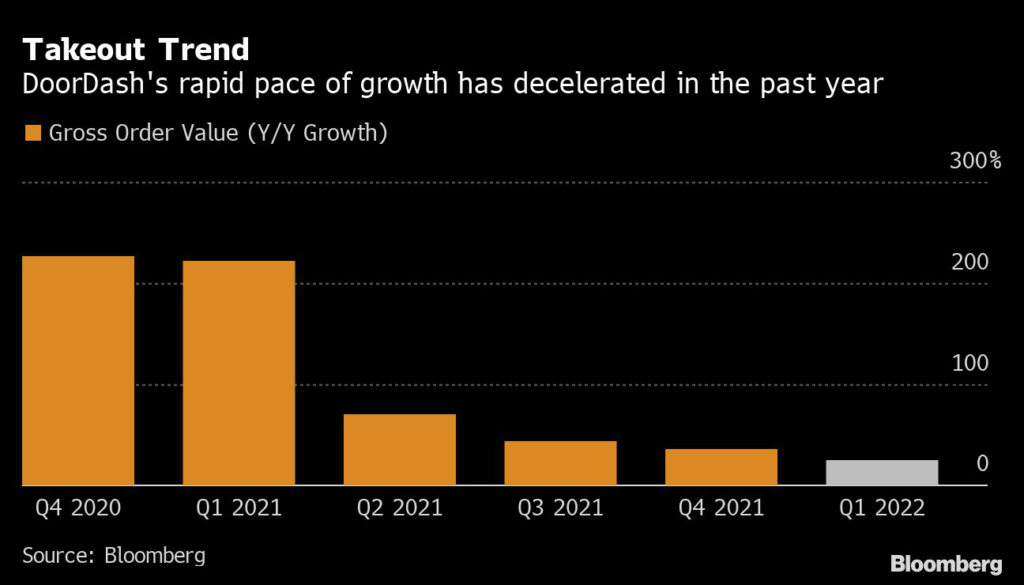
Revenue rose 35% in the first quarter to $1.46 billion, the San Francisco-based company said Wednesday in a statement. That was ahead of analysts’ average projection of $1.38 billion, according to data compiled by Bloomberg. The shares jumped 14% in extended trading.

“Our results speak to the resilience of the platform we’ve built,” Chief Financial Officer Prabir Adarkar said in an interview. “This is despite the headwinds over the course of the past year, whether it’s inflation or people getting more comfortable living with Covid and going back out into restaurants.”

Consumers’ affinity for takeout was supercharged when coronavirus lockdowns shifted the dining experience from restaurants to the couch. It was a boon for DoorDash, which was one of the first meal delivery services to conquer suburban markets, and set the stage for its initial public offering at the end of 2020. Since then DoorDash has only increased its market share, commanding 59% of all food delivery sales in the U.S. as of March, according to Bloomberg Second Measure. 

DoorDash said it added more new consumers in the first three months of the year than at any time since the first quarter of 2021, helping push members of its DashPass subscription service to new highs. More people on DashPass also helped push up order frequency to a new high. Membership services have gained traction as a way to boost customer retention and increase basket sizes. The company had more than 10 million subscribers at the end of 2021.

Customers placed 404 million orders in the three months ending March 31, representing a 23% increase from a year earlier. People were also ordering more often and the value of those orders increased 25% to $12.4 billion. Wall Street expected $11.7 billion. The company projected gross order value of $12.1 billion to $12.5 billion in the current quarter and earnings before interest, tax, depreciation and amortization of $0 to $100 million.

DoorDash has expanded its services into grocery, alcohol and pet supplies to capitalize on a shift in consumer behavior and hedge against a deceleration in its pandemic-level pace. While the company didn’t disclose figures for non-restaurant segments, the convenience category in particular has seen higher order frequency and growth in monthly users from last quarter, Adarkar said. 

In November, DoorDash acquired Finnish food-delivery company Wolt Enterprises Oy for about $8.1 billion, its biggest purchase ever, in a bid to increase its footprint outside the U.S. 

At the end of last year, DoorDash launched a 15-minute delivery pilot service in New York, joining rivals like Instacart Inc. and Uber Technologies Inc. as well as a crop of startups led by Gorillas Technologies GmbH, Getir and Jokr, that are vying to ferry items to customers in record time. 

San Francisco-based DoorDash reported a net loss of $167 million, wider than the $110 million loss a year earlier. The loss per share was 48 cents, while analysts were expecting a loss of 42 cents.

Investors have grown more sensitive to the prospects for profitability of once-hot startups like DoorDash. The shares have fallen more than 50% this year and are down more than 70% from a record high last November.  

“Growth companies like DoorDash have gotten a pass in the past and investors are very focused on the ability to deliver on the bottom line,” said CFRA analyst Angelo Zino. “The tension here is whether they can expand into new verticals and internationally without sacrificing profit.”

More stories like this are available on bloomberg.com

©2022 Bloomberg L.P.
Software Stocks Take the Harshest Blows in Brutal Tech Selloff

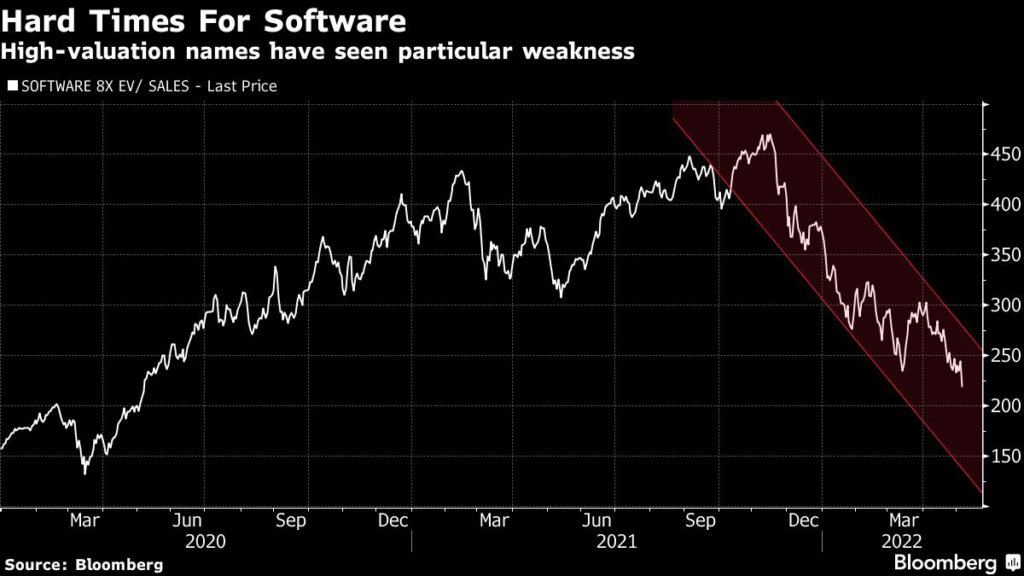
(Bloomberg) — Software shares took their hardest hit since March 2020 as investors shunned the priciest corner of the U.S. technology group that’s particularly vulnerable to higher interest-rates and slower economic growth. 

Tech losses were huge on Thursday with the Nasdaq 100 Stock Index sinking more than 5%. But for software makers such CrowdStrike Holdings Inc., ZScaler Inc. and DocuSign Inc. it was brutal — with each falling more than 10% at one point on Thursday.

That was also the magnitude of the drop for a Goldman Sachs basket of expensive software stocks, in their worst day since the depths of the pandemic-induced selloff more than two years ago. The iShares Expanded Tech-Software Sector ETF sank to its worst session since September 2020. 

Software providers are being particularly punished as they trade at a premium to the tech-heavy Nasdaq 100 and many are unprofitable. The group of companies priced at 8 times sales or higher has fallen more than 50% from a November peak.

“A lot of these companies don’t have a lot of profit, which makes it more challenging to find a bottom,” said Daniel Morgan, senior portfolio manager at Synovus Trust. “If a stock is trading at 10 times earnings, I can say, it can’t get much worse than this.”


To put that into perspective, the S&P North American Expanded Technology Software Index is trading on 35 times projected profits over the next 12 months. That compares with the S&P 500 at 18 times and the Nasdaq 100 at 21.

Some software providers were also hit by quarterly earnings results and forecasts that fell short of analyst expectations, deepening the selloff Thursday. DigitalOcean Holdings Inc. cratered 18% after providing a forecast that came in below analysts’ expectations, while Rapid7 Inc. shed 17% following an “anemic” forecast boost. 

Among other stocks, Snowflake Inc. dropped 11% to an all-time low, Cloudflare Inc. sank 14% to its lowest since May 2021, and Atlassian Corp. closed 9.4% lower. Trade Desk Inc., Hubspot Inc. and Unity Software Inc. all closed down more than 10%.

Even though some of these high-valuation, low-profitability names are down 60% to 70%, it doesn’t seem like there is any appetite to buy the dip. 

“We’ve seen very little of that this year, which is very different than 2021,” said Randy Frederick, vice president of trading and derivatives for Charles Schwab. “They’re just absolutely getting crushed.”


More stories like this are available on bloomberg.com

©2022 Bloomberg L.P.
Wall Street Staggers With ‘Vicious’ $1.3 Trillion Stock Selloff

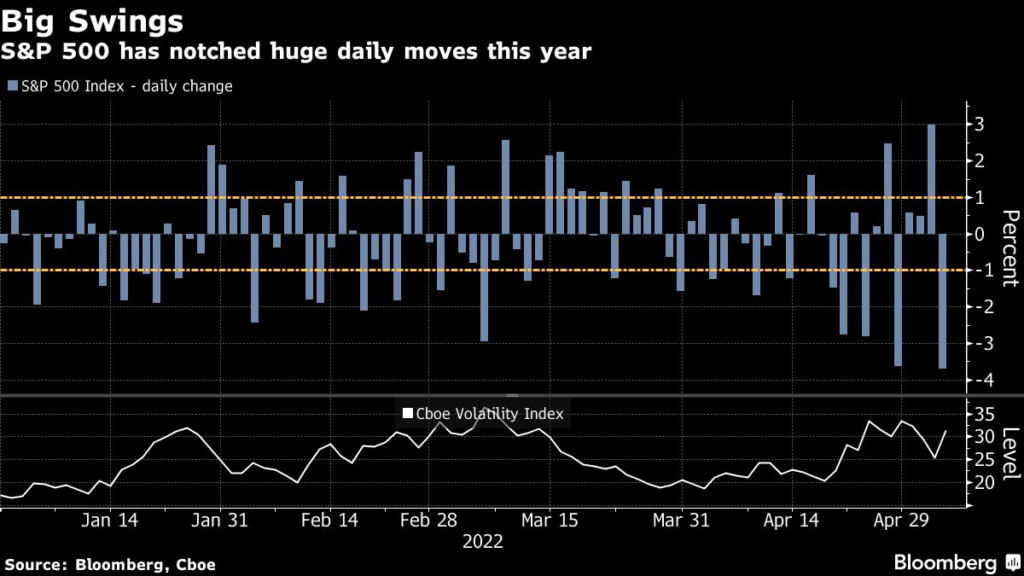
(Bloomberg) — A day after celebrating the Federal Reserve’s signal that it wouldn’t be making any jumbo-sized moves, traders woke up on Thursday deciding that the central bank will struggle to fight high inflation amid the lingering threat of a recession.

In a sharp about-face, investors sold stocks, bonds and cryptocurrencies on Thursday. At one point, the S&P 500 Index lost 4.2%, the most since June 2020, and the tech-heavy Nasdaq 100 dropped 5.7%, the most since March of that year. 

“The great puking that’s happening? I didn’t expect that,” Kim Forrest, founder and chief investment officer at Bokeh Capital Partners said by phone. “We live for the days where we’ve made people money — that’s our job — and it’s cold comfort that I’m losing people less money.”

Speculative corners of the market were among the hardest hit, with an index of expensive software stocks sliding more than 10%, the most since mid-March 2020. An ETF tracking newly public companies lost 9% at one point, while non-profitable tech firms lost roughly 11%, as Bitcoin — the largest cryptocurrency — dropped by the same amount to below $36,000. 

“There’s still a lot of fear out there,” said Dennis Dick, head of markets structure and a proprietary trader at Bright Trading. “People thought yesterday was the green light, but now they’re getting caught again. Retail traders keep coming in and getting chopped up. The contrarians have been winning 2022.”

“The only thing that will lead to a sustained turnaround is if we see inflation start to not look so hot,” he added. “Any rally that isn’t on improving inflation is a sucker’s rally.”

Here’s what other market-watchers had to say:

Frank Davis, senior managing director at LEK Securities:

“It looks like some people might have viewed yesterday’s rally as a good exit, and then it just started feeding on itself this morning. The market did need to pull back and re-calibrate for value, but the viciousness of the move is really the story of the day.”

Fiona Cincotta, senior market analyst at City Index: 

“The S&P 500 seeing its strongest gains since 2020 on the day the Fed decides to hike interest rates is kind of extraordinary, so we are seeing a reprice today, which is expected. But at the end of the day, the risks remain. Inflation remains high. The Fed is keen to act.”

Chris Gaffney, president of world markets at TIAA Bank:

“When Powell said he wasn’t going to tighten 75, that’s what led to that relief rally. But they’re still tightening, and they’re still tightening at a more aggressive pace than most would have imagined just a short while ago. So it is difficult to buy into the rallies,” he said. “Overall financial conditions are going to be tighter moving forward and certainly the risk of a recession, the risk of tighter financial conditions leading to a recession is still there. So it’s very difficult to jump on any sort of rally under these conditions.”

Stephen Carl, head trader at Siebert Williams Shank & Co.:

“The scale of today’s move is a little surprising. We had been viewing 4,200 as a support for the S&P 500, and we’re below that now. Really, this seems like a knee-jerk reaction from yesterday, with some profit-taking. There could also be some portfolio managers out there recommending the buying of bonds and selling stocks, which could be contributing to the overall weakness.”

Randy Frederick, vice president of trading and derivatives for Charles Schwab & Co.: 

“People have been looking for a capitulation, where everyone just throws in the down. Perhaps today is that day. This is the first day that I would describe as a capitulatory day,” he said. “Even though some of these high-valuation, low-profitability names are down 60-70%, it doesn’t seem like there is any appetite to buy the dip.”

“We all knew something like this was going to happen eventually,” he added. “We’ve seen it before. We tried to warn the young traders, but they didn’t want to hear it. But I think this will result in a better market, because you actually have to look for quality.

Cliff Hodge, chief investment officer at Cornerstone Wealth: 

“Investors are getting spooked by the combination of soaring unit labor costs and a significant drop in productivity. Those are some stagflationary-like readings. The reports this morning are all from 1Q. They haven’t told us anything new, but investors are clearly extremely focused on inflation.”

Sam Stovall, chief investment strategist at CFRA:

“Usually you end up having a reversal move to digest whatever occurred the day before,” he said of stock moves around Fed days. “There’s a pop after a drop, and, in this case, there’s usually a drop after a pop. On the one hand, it’s because traders are looking to take profits because they questioned the sustainability of this advance.”

Quincy Krosby, chief equity strategist at LPL Financial:

“Chairman Powell was clear-ish — I say clear-ish because he said soft-ish landing. But when he took the 75 basis points off the table, inherent in that was a suggestion that perhaps they wouldn’t need it,” she said. “Why would you say that if you thought, for example, inflationary pressures were going to climb even higher?”

Sylvia Jablonski, CEO, CIO and co-founder of Defiance ETFs: 

“Day after day, the direction seems to change. This opens up good opportunism for companies which have fundamentals, strong earnings, strong outlook for the next three-to-five years. What is really interesting about these markets is that there are these every-other-day changes in either direction where investors are outrageously bullish or outrageously bearish the next day.”

(Updates with Randy Frederick quotes)

More stories like this are available on bloomberg.com

©2022 Bloomberg L.P.

Close Bitnami banner
Bitnami
