Bloomberg

European Companies in China Cut Revenue Forecasts on Covid Zero

(Bloomberg) — European companies say China’s zero-tolerance approach to containing Covid-19 is battering their supply chains and spurring them to cut staff and revenue forecasts, underscoring the costs of President Xi Jinping’s signature policy for handling the pandemic. 

Nearly 60% of respondents in a recent survey said they are lowering revenue projections for 2022, most of them by 6% to 15%, the European Union Chamber of Commerce said in a report released Thursday. 

Almost a third of the firms said they have reduced staffing levels, mostly in the education industry, followed by legal, retail and cosmetics. Some 92% of the 372 respondents in the April 21–27 survey said Covid Zero measures have hurt supply chains, with 85% saying they struggled to get raw materials or parts for manufacturing.

“To restore confidence in the China market, European businesses need more predictability,” the chamber said in its report. “One of the best ways to provide this would be to introduce measures that will allow China to open further, while maintaining a robust response to minimizing health risks posed by Covid-19.”

The chamber said it had urged Chinese authorities in letters to vaccinate people over aged 60 who are most vulnerable to sickness, allow positive cases with little to no symptoms to quarantine at home and to use a bigger cocktail of vaccines, including mRNA shots.

Six Indicators That Will Signal China Is Abandoning Covid Zero

Representatives of foreign firms in the world’s No. 2 economy met Commerce Minister Wang Wentao last month to discuss the impact of measures such as locking down cities, mass testing and largely closed borders. China has shown no sign of letting up — a lockdown in Shanghai has entered its second month and the capital Beijing is stepping up efforts to prevent a similar ordeal — though officials did pledge measures to ease supply-chain woes.

China has inoculated most of its people with domestically made coronavirus vaccines based on older inactivated virus technology, but has not approved any using mRNA outside Hong Kong and Macau. CSPC Pharmaceutical Group Ltd. and Shanghai-based Stemirna Therapeutics have domestically made mRNA shots moving toward clinical trials.

The survey by the EU Chamber found that most firms said they wouldn’t make any changes to their China operations yet, or that it was too early to do so.  

“This demonstrates that, despite the challenges now being faced, European companies seemingly remain committed to China in the long term and are prepared to weather the storm for now,” the report said. “The question is, for how long?”

More stories like this are available on bloomberg.com

©2022 Bloomberg L.P.

Digital Therapeutic App Maker Sidekick Health Raises $55 Million

(Bloomberg) — Icelandic digital therapeutics company Sidekick Health has raised $55 million in Series B funding to expand the range of chronic conditions it can help treat as well as to grow its commercial footprint in the U.S.

The investment was led by London-based venture capital firm Novator Ventures with Wellington Partners, Asabys Partners, and Frumtak Ventures also taking part, the company said in a statement on Thursday. It plans to disclose the identity of a further U.S.-based investor at a later stage.

Sidekick runs an artificial intelligence-based smartphone app, which offers personalized treatment plans for patients, including medication reminders and tools to help manage multiple chronic illnesses, in a game-like interface.

“I believe that within three to five years, it will become unacceptable for a patient with a chronic condition to leave a doctor’s office without a digital therapeutic as a core part of the treatment,” Chief Executive Officer Tryggvi Thorgeirsson said in an interview. 

Thorgeirsson is one of two co-founders, both doctors, who started the company in 2014 in response to what he calls a “tsunami of often lifestyle-related chronic diseases.” Empowering the patient to manage their condition helps “prevent fires instead of putting them out,” he said.

Sidekick Health, previously known as GoodlifeMe, raised $20 million in a Series A round in October 2020. It currently has commercial partnerships in place to help treat 14 conditions, ranging from diabetes to ulcerative colitis. The funds it’s raising will go toward expanding that total to more than 40 by 2026, according to Thorgeirsson. Its partners include Bayer AG, Pfizer Inc. and Anthem Inc., and three new partnerships are in the works, including a collaboration to support patients with breast cancer, he said.

The company also plans to double its headcount to 240 this year across four locations: Iceland, Germany, Sweden and the U.S., and declined to disclose its valuation.

More stories like this are available on bloomberg.com

©2022 Bloomberg L.P.

Ukraine Latest: U.K., Japan to Help Asia Shift From Russian Oil

(Bloomberg) — U.K. Prime Minister Boris Johnson will meet his Japanese counterpart Fumio Kishida in London where they are expected to discuss a plan to support Asian nations in diversifying away from Russian oil and gas. 

Russian forces have been slowed by supply line and morale problems in the southern and eastern parts of Ukraine, the Pentagon’s chief spokesman said. 

More than 300 civilians have been evacuated from war-blasted Mariupol in a new “safe passage operation,” according to Osnat Lubrani, the United Nations humanitarian coordinator for Ukraine.

(See RSAN on the Bloomberg Terminal for the Russian Sanctions Dashboard.)

Key Developments

  • Oil Steadies Before OPEC+ Meet After Surging on EU Russian Ban
  • U.S. Sent Cyber Team to Lithuania Over Russia Hacking Threat (1)
  • ‘I Don’t Want to Sell to an Oligarch’: A CEO on Exiting Russia

All times CET:

Oil Advances Before OPEC+ Meet After Surging on EU Russian Ban (6:12 a.m.)

Oil steadied ahead of an OPEC+ meeting on supply after surging on the European Union’s plan for a phased ban on Russian crude. 

The EU plans to ban Russian oil over the next six months and refined fuels by the end of the year, to increase pressure on Vladimir Putin over his invasion of Ukraine. The bloc is also targeting insurers in a move that could dramatically impair Moscow’s ability to ship oil around the world.

U.S. Sent Cyber Team to Lithuania Over Threat of Russian Hacking (4:15 a.m.)

The U.S. rushed cyber forces to Lithuania to help defend against online threats that have risen since Russia’s invasion of Ukraine, an Army general said Wednesday.

“Our deployment in Lithuania was directly related to the ongoing crisis in the Ukraine,” Major General Joe Hartman, who commands the U.S. Cyber National Mission Force, told reporters at a roundtable interview in Nashville.

U.K. to Provide Aid for ‘Most Vulnerable’ (1:55 a.m.)

The U.K. will provide 45 million pounds to help Ukrainians most in need because of the war, the British government announced Thursday. Foreign Secretary Liz Truss said in a statement that the assistance would support “the most vulnerable in Ukraine, particularly women and children, who are facing increased risk of sexual violence and exploitation.”

The money will be directed to United Nations agencies and other relief organizations working in Ukraine.    

Blinken Reaffirms NATO’s Open Door Policy in Meeting With Sweden (1:37 a.m.)

Secretary of State Antony Blinken said the U.S. was committed to the North Atlantic Treaty Organization’s open door policy in a meeting with Swedish Foreign Minister Ann Linde in Washington. They also discussed additional ways to support Ukraine against “the Kremlin’s unprovoked and brutal war,” the U.S. State Department said. 

Sweden along with Finland, have been deliberating NATO membership after Russia’s invasion of Ukraine. Sweden’s Prime Minister Magdalena Andersson has said that joining the alliance will help to improve safety in the Baltic region. 

U.K., Japan to Discuss Plans to Help Asia Diversify From Russian Oil (1:15 a.m.)

U.K. Prime Minister Boris Johnson will meet his Japanese counterpart Fumio Kishida in London here they are expected to discuss a plan to support Asian nations to find energy supplies to diversify away from Russian oil and gas. Both leaders will also agree in principle to a new military pact for joint cooperation in the Indo-Pacific. 

“Bilateral meetings are expected to focus on Russia’s illegal invasion of Ukraine, and how international alliances can continue to exert maximum pressure on President Putin’s regime while supporting Ukraine and other European countries affected by the barbaric invasion,” the U.K. government said in a statement.

300 More Civilians Evacuated From Mariupol (12:15 a.m.)

More than 300 civilians have been evacuated from war-blasted Mariupol in a new “safe passage operation,” according to Osnat Lubrani, the United Nations humanitarian coordinator for Ukraine.

“Many came with nothing but the clothes they were wearing, and we will now support them during this difficult time, including with much-needed psychological support,” Lubrani said in a statement on Wednesday.

The civilians in this latest evacuation came from Mariupol and other cities and towns and are “receiving assistance in Zaporizhzhia,” Lubrani added.  

Russian Troops Bogged Down in Ukraine, Pentagon Says (10:09 p.m.)

Russian troops have not made the kind of progress in the eastern and southern regions of Ukraine “that they have wanted to make,” Pentagon spokesman John Kirby told reporters Wednesday, citing problems with supply lines and morale.

“We don’t believe they have solved their logistics and sustainment issues” he said, adding that Russian troops are “wary” of getting out too far ahead of their supply lines. Kirby also said that their missile strikes have been off target but that the U.S. does not know whether that’s related to technical problems, Ukrainian defenses, or “incompetence” on the part of the Russians.

Russia Announces Humanitarian Corridors From Mariupol (8:47 p.m.)

Russia’s Defense Ministry said it will offer safe passage for civilians still trapped in the Azovstal steel plant in Mariupol on May 5 to 7, Tass reported.

The humanitarian corridors will be open from 8 a.m to 6 p.m over the three days, the ministry said. The civilians can choose whether to go to Russia or Ukrainian-controlled areas, according to Interfax.

Russia has seized control of almost all of the port city of Mariupol after a brutal weeks-long siege. The remaining defenders are holding out in the giant industrial facility, where hundreds of civilians have taken refuge.

U.S. Military Spells Out Weapons Training for Ukrainians (6:23 p.m.)

The U.S. is training Ukrainians on new weapons systems, including artillery and drones, in Grafenwoer, Germany, according to Brigadier General Joseph Hilbert, head of the 7th Army Training Command in Europe. He told reporters that a first group of Ukrainian trainees is back in the fight in Ukraine, and a second group of about 50 to 60 is now being instructed.

“They understand how to operate it and employ it as effectively as they can on their own and in accordance with their own tactics and their own doctrine,” Hilbert said of the new equipment. “The soldiers that we are receiving here are absolutely motivated, incredibly professional.”

The U.S. hasn’t had any problems getting the small groups of Ukrainians into Germany and back again, according to Hilbert and Lieutenant Colonel Todd Hopkins, who is also overseeing training. The officials acknowledged challenges, including providing instruction through translators.

Biden Wants to Talk to G-7 About More Russia Sanctions (6:10 p.m.)

President Joe Biden said he would consult with Group of Seven allies this week about more potential sanctions on Russia. After the EU proposed a ban on Russian oil imports by year’s end, Biden told reporters the U.S. is “always open to additional sanctions” and that he would discuss with G-7 members “what we’re going to do or not do.” Senior Biden administration officials have said they are looking at ways to tighten existing sanctions in order to prevent Moscow from evading them.

Russian Billionaire Challenges EU Sanctions (4:45 p.m.)

Russian metals billionaire Alisher Usmanov is appealing the European Union’s decision to impose strict sanctions on him in response to Russia’s invasion of Ukraine. He filed his appeal at the EU’s General Court on April 29, asking judges also to suspend the sanctions until there’s a final ruling, according to a court filing. A spokesperson for Usmanov declined to comment. Usmanov’s case is part of an increasing number of challenges at the Luxembourg-based court since the bloc started issuing sanctions on Feb. 28.

The EU, along with the U.S. and U.K., has targeted Russia’s ultra-wealthy and Usmanov has had his 156-meter (512-foot) yacht detained. 

EU Tussles With Holdouts Over Latest Sanctions (3:10 p.m)

EU diplomats discussed the sixth package of sanctions Wednesday, with Hungary objecting to the oil phase-out timing. Greece, Malta and Cyprus raised questions about banning transport of oil between third countries, saying the move will just help Europe’s competitors, according to two diplomats. The diplomats aim to conclude the package by the end of the week, or by May 9 at the latest, the diplomats said.

Greece and Cyprus have large shipping industries while Malta is a so-called flag state, where companies can register their vessels for ownership purposes.

U.K. Bars Russia From Using Consultants (2:45 p.m.)

The U.K. cut Russia off from using management consultants, accountants and public relations firms, part of a further tranche of sanctions.

The government in London also announced additional measures against 63 Russian individuals and organizations, many of them targeting people connected to news outlets in an effort to punish what it called “the spread of lies.”

Portuguese Premier to Visit Kyiv Soon (2:30 p.m.)

Portuguese Prime Minister Antonio Costa announced he will travel to Kyiv in the near future to sign a “significant” financing agreement, part of the International Monetary Fund’s support for Ukraine.

“Regardless of the dynamics of the EU accession process, we have to provide immediate answers to the emergency needs of the Ukrainian state and the Ukrainian people,” Costa said.

More stories like this are available on bloomberg.com

©2022 Bloomberg L.P.

JD.com, Pinduoduo Added to Chinese Companies Facing Delisting in U.S.

(Bloomberg) — U.S. regulators added more than 80 companies, including JD.com Inc., Pinduoduo Inc. and Bilibili Inc., to an expanding list of firms that face possible expulsion from American exchanges because of Beijing’s refusal to allow access to the businesses’ financial audits.

The Securities and Exchange Commission on Wednesday put the corporations on a provisional lineup of U.S.-listed Chinese entities that face delisting under a 2020 law, starting a three-year clock to comply with inspection requirements. Some of the largest Chinese companies traded on U.S. exchanges, including China Petroleum & Chemical Corp., JinkoSolar Holding Co., NetEase Inc., and NIO Inc. were also added.

Wall Street’s main watchdog has long been expected to crack down on about 200 New York-traded firms with parent companies based in China and Hong Kong because the jurisdictions refuse to allow the inspections by American officials. The SEC’s publication of companies over the past several weeks had jarred investors who’d been hoping for a deal between regulators in Beijing and Washington. 

Traders largely shrugged off the latest round of additions though as the overall market rallied. Bilibili rose as much as 7.1% in Hong Kong, while JD.com climbed as much as 4.1%.

“The addition of these names to SEC’s list is within expectation and part of the process that was announced previously. With so many names on the list the market should no longer view it as a material event,” said Vey-sern Ling, senior analyst at Union Bancaire Privee.

How U.S. Is Targeting Chinese Firms for Delisting: QuickTake

Chinese authorities are preparing to give U.S. regulators full access to the auditing reports of the majority of companies listed in New York as soon as the middle of this year, people familiar with the process have said. That would mark a rare concession to prevent a further decoupling between the world’s two largest economies. 

The U.S. and China have been at odds for two decades over the mandate that all companies that trade publicly in America grant access to audit work papers. Since Congress passed the law in 2020, the Public Company Accounting Oversight Board, which oversees auditors, and the SEC have been laying the groundwork for identifying companies that don’t comply. 

Firms face removal if they shirk requirements for three straight years, meaning they could be kicked off the New York Stock Exchange and Nasdaq as soon as 2024.

Critics say Chinese companies enjoy the trading privileges of a market economy — including access to U.S. stock exchanges — while receiving government support and operating in an opaque system. But regulators in Beijing argue that Chinese national security law prohibits them from turning over audit papers to U.S. regulators. 

On Thursday, JD.com said it will examine its options but try to keep its U.S. listing. “JD.com has been actively exploring possible solutions,” it said in a filing. “The Company will continue to comply with applicable laws and regulations in both China and the United States, and strive to maintain its listing status on both Nasdaq and the Hong Kong Stock Exchange.”

Read more: China and U.S. Negotiate On-Site Audit Checks as Delistings Loom

(Updates with JD’s statement in the final two paragraphs)

More stories like this are available on bloomberg.com

©2022 Bloomberg L.P.

China Stocks Waver as Lockdowns Weighed Against Stimulus Vows

(Bloomberg) — Chinese stocks fluctuated after returning from a three-day break, as investors weighed Beijing’s vow to boost growth against strict Covid lockdowns and gloomy economic data.

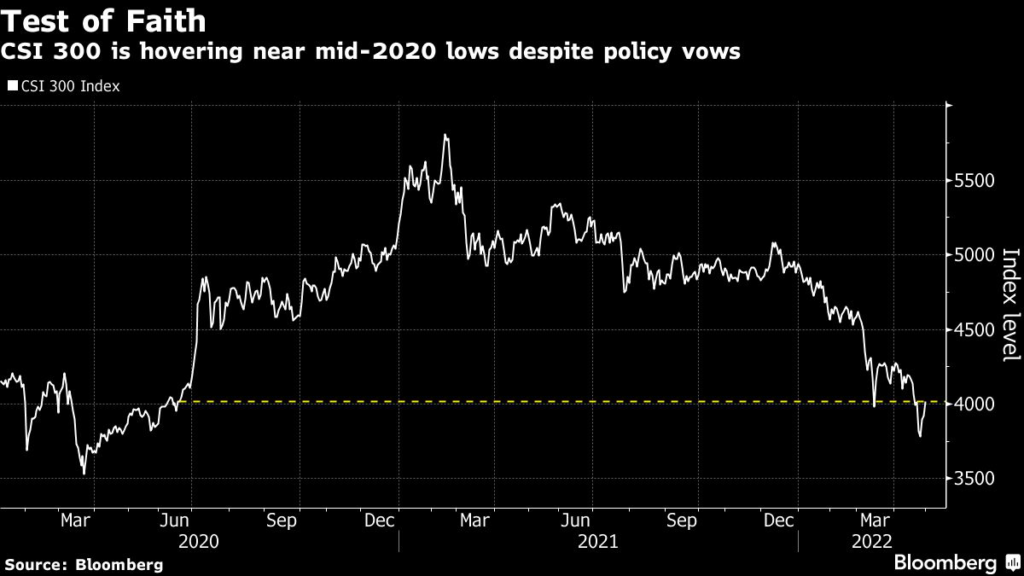
The benchmark CSI 300 Index advanced 0.5% at the midday break Thursday, led by consumer shares, erasing earlier losses of as much as 0.7%. Capping gains was a 14% plunge in battery giant Contemporary Amperex Technology Co. on disappointing earnings, as well as Hangzhou Hikvision Digital Technology Co. that tumbled 10% on the risk of fresh U.S. sanctions.

The market’s late-morning rebound came after Shanghai authorities said more than 70% of the city’s industrial firms have resumed production as of Wednesday, an encouraging development for the regional economic powerhouse following a five-week lockdown. In April, China’s services activity slumped to a two-year low.

The overnight rally on Wall Street failed to have a meaningful impact on Chinese shares, in a sign that the Fed’s latest rate hike and signaling of more to come this year continue to raise concerns about the allure of local assets.   

“The focus currently is on daily cases and restrictions which is quite short term, where it is hard to have an edge,” said Joshua Crabb, a fund manager at Robeco Hong Kong Ltd. “If we think a little longer term, we do know that sooner or later, the lockdown will abate and we know that a lot of stocks are starting to look cheap – so it’s time to start looking where to add.”

China’s top leaders last week issued sweeping pledges to boost economic stimulus to spur growth, vowing to meet growth targets by deploying more policy tools and ramping up infrastructure construction. 

Beijing also took pains to ease fears of an extended crackdown on private enterprise, especially on its once high-flying technology firms. In the latest of such efforts, China’s central bank said it will implement “normalized” supervision on the financial activities of online platform companies, adding that support for technology innovation companies should be strengthened. 

Elsewhere, the onshore yuan slipped 0.1% to 6.6059, while its offshore counterpart fell by as much as 0.3% to 6.6422. Yields on China’s benchmark 10-year government bond shed one basis point to 2.83%.

In credit markets, Chinese onshore corporate bonds were generally higher, alongside gains in high-yield dollar notes. Developers were some of the best performers.

(Updates prices and with analyst comments)

More stories like this are available on bloomberg.com

©2022 Bloomberg L.P.

U.S. Sent Cyber Team to Lithuania Over Russia Hacking Threat

(Bloomberg) — The U.S. rushed cyber forces to Lithuania to help defend against online threats that have risen since Russia’s invasion of Ukraine, an Army general said Wednesday.

“Our deployment in Lithuania was directly related to the ongoing crisis in the Ukraine,” Major General Joe Hartman, who commands the U.S. Cyber National Mission Force, told reporters at a roundtable interview in Nashville. 

The so-called hunt forward missions involve cyber teams going to nations where they’ve been invited by partner countries, where they scan networks with the goal of building the host countries’ resilience and share any new information about threats with government and private industry circles back in the U.S. 

Hartman said the now-concluded Lithuanian operation, which the U.S. and Lithuania revealed in an unusual disclosure earlier this week, was “moved up in the queue” because of the threat posed by Russia to Baltic states and other organizations in the region. 

Margiris Abukevicius, Lithuania’s vice minister of national defense, said in a statement on Tuesday that the three-month operation had “offered a wealth of intelligence and skills” to participants.  

The U.S. initiated the hunt forward missions in 2018 and has now carried out 28 in 16 countries, on more than 50 networks, Hartman said. Estonia, Montenegro, North Macedonia and Ukraine have been among the nations publicly identified as having participated. 

A mission to Ukraine in December was extended amid growing fears that war could soon break out. The team withdrew in February when the Defense Department pulled back personnel as Russia’s invasion plans became clearer. But Hartman said members of his command still talk to Ukrainian officials on a “daily” basis. 

He insisted that the U.S. operations in Ukraine and Lithuania were limited to friendly networks and should not trigger an escalatory response from Russia. “We’re not attacking Russia,” he said. 

General Paul Nakasone, who leads U.S. Cyber Command, told Congress last month that U.S. support to Ukraine and NATO allies and partners since Moscow began the invasion on Feb. 24 had helped bolster efforts to repel Russian cyberattacks. 

Some experts have been surprised that cyber weapons are playing a relatively limited role in Russia’s war on Ukraine, but Nakasone has urged caution.

“This idea that nothing has happened is not right,” Nakasone told a Vanderbilt University summit on modern conflict on Wednesday. “We don’t necessarily believe that by any means this is done.”

Nakasone said there had been a series of destructive attacks targeting Ukraine, including satellite communications. He added the Ukrainians have done “a tremendous job” defending their networks.

Ukrainian authorities have reported a more than threefold increase in cyberattacks since the war started compared with the same period last year. Microsoft. Corp. issued a report late last month saying Russian cyberattacks against Ukraine have been “relentless and destructive.” 

But Hartman said that while the Russians had undertaken “a fairly competent operation,” citing an attack that took down part of Viasat’s satellite network at the onset of the invasion, Russian cyber operations against Ukraine since then have not been “well synchronized.” Viasat Inc. said on March 1 that it suffered a cyberattack, after the invasion, that affected thousands of residential and business internet customers in Ukraine. 

“There doesn’t appear to me that there was a coordinated plan, which surprised us,” he said. 

The Biden administration has warned Russia may carry out cyberattacks against U.S. critical infrastructure in retaliation for punitive financial sanctions. 

American officials have said that a cyberattack against a NATO country could trigger Article 5, the transatlantic alliance’s mutual defense clause. Lithuania is a NATO member.

(Adds comment in 12th pargraph. An earlier version of this story correct wording of negative in 11th paragraph.)

More stories like this are available on bloomberg.com

©2022 Bloomberg L.P.

China Plans Policies to Rescue Growth, Support Tech Platforms

(Bloomberg) — China may soon reveal more policies intended to rescue the economy after top leaders vowed to meet growth targets without compromising on the country’s stringent Covid Zero strategy. 

Actions to promote investment, shore up exports and support technology platform companies are all on the table, state media outlets reported Thursday. The People’s Bank of China also said late Wednesday it would conduct “normalized financial supervision” over online platforms, echoing language used last week by the Communist Party’s Politburo, the top decision-making body. 

The media reports and PBOC statement come days after the Politburo issued its sweeping pledge to support the economy, which is in the throes of the country’s worst coronavirus outbreak since 2020. Authorities deployed strict lockdowns in places like Shanghai and Jilin province to contain infections, measures that have pummeled factory activity and consumer spending, imperiling the government’s growth target of about 5.5% for the year.

Read More: China Lockdowns Wreak Havoc on Economy as Xi Pledges Support

The state media reports don’t contain much detail about specific actions, which are likely to come from various government departments and agencies over coming weeks. However, some of the highlights from the reports include support for technology platform businesses, possible easing of real estate curbs and a boost in fiscal spending.

  • Beijing can’t rule out the possibility of increasing this year’s fiscal deficit to boost infrastructure spending, according to one report in the China Securities Journal citing Wang Qing, an analyst at Golden Credit Rating
  • The government could use special government bonds and policy bank bonds to promote infrastructure projects, or ease more curbs on the property sector to spur demand, the newspaper — which is owned by China’s official Xinhua News Agency — cited analysts as saying
  • In a separate front-page report, the China Securities Journal said the economy may have bottomed out in April and should start to recover this month
  • Authorities are expected to roll out measures to support the technological innovation of internet platform companies, according to a report in the official Economic Daily newspaper
  • Tech platform businesses are key in stabilizing growth and ensuring employment, the newspaper said, reiterating comments made by the Politburo last week that urged for regulation supporting the “healthy” development of the sector. The report also parallels the PBOC’s Wednesday remarks

More stories like this are available on bloomberg.com

©2022 Bloomberg L.P.

BitMEX Ex-CEO Hayes Asks for No Jail Time, Freedom to Travel

(Bloomberg) — BitMEX co-founder and former CEO Arthur Hayes, who was prosecuted for failing to police criminal activity on the crypto exchange, is asking for no jail time and permission to live abroad and travel freely.

Hayes, who pleaded guilty in February to violating the Bank Secrecy Act, included a letter from his mother in a bid for leniency from the Manhattan federal judge who will sentence him this month.

His lawyers filed a request for probation, with no home detention or community confinement, after he struck a plea deal that would result in a prison sentence of six to 12 months under federal guidelines.

The 65-page submission by his lawyers included photographs and letters from supporters. The government hasn’t filed a sentencing recommendation yet. 

Hayes, BitMEX co-founder Benjamin Delo and former chief technology officer Samuel Reed all admitted they failed to establish an anti-money-laundering program at the exchange. They each agreed to pay a fine of $10 million.

Hayes’s lawyers said his conviction in the emerging area of finance and markets is a precedent the U.S. can use in the prosecution of financial crimes at cryptocurrency trading platforms around the world. Hayes is unlikely to be a repeat offender, the attorneys said.

“This is a landmark case that has already had an extraordinary and well-publicized impact on Mr. Hayes’s personal life and on the BitMEX business that he co-founded,” according to the letter.

The case is U.S. v. Hayes, 20-cr-500, U.S. District Court, Southern District of New York (Manhattan).

More stories like this are available on bloomberg.com

©2022 Bloomberg L.P.
BofA Hires Back Software Banker David Larsen From Goldman Sachs

(Bloomberg) — Bank of America Corp. has re-hired Goldman Sachs Group Inc.’s David Larsen as a managing director, according to people with knowledge of the matter.

Larsen previously worked as a director at Bank of America before leaving in 2018 for Goldman Sachs, where he was a vice president, according to his LinkedIn profile. He will be focusing on application software in his new role, the people said.

Representatives of Bank of America and Goldman Sachs declined to comment. Larsen didn’t immediately respond to requests for comment.

More stories like this are available on bloomberg.com

©2022 Bloomberg L.P.

Bitcoin Miner Marathon Posts Loss After Impairment Charge

(Bloomberg) — Marathon Digital Holdings Inc. posted a first-quarter loss after taking an impairment change related to self-mined Bitcoin. 

The net loss for the three months ended March 31 was $13 million, or 13 cents a share, compared with net income of $83.4 million, or 87 cents, in the 2021 quarter, the company said in a statement. While revenue jumped to $51.7 million from $9.2 million, the amount was below the average estimate of analysts surveyed by Bloomberg. Bitcoin’s price fell 1.2% in the first quarter, and it traded about 20% lower than at the end of year-earlier period. 

While the company has secured large quantities of mining machines from manufacturers and raised capacity, it is among the miners who are struggling to find a home for their machines or the so-called data centers. 

Marathon cited regulatory bottlenecks for delaying the deployment of mining rigs in its new site in Texas for 45 days. The Las Vegas-based company doesn’t plan to concentrate operations in Texas, Chief Executive Fred Thiel, chief executive said on a conference call.  

“In Texas while it’s very open to mining, there comes a point where enough is enough and the load on the grid just becomes too much and we don’t want to be in a position where we have everything in Texas,” Thiel said.

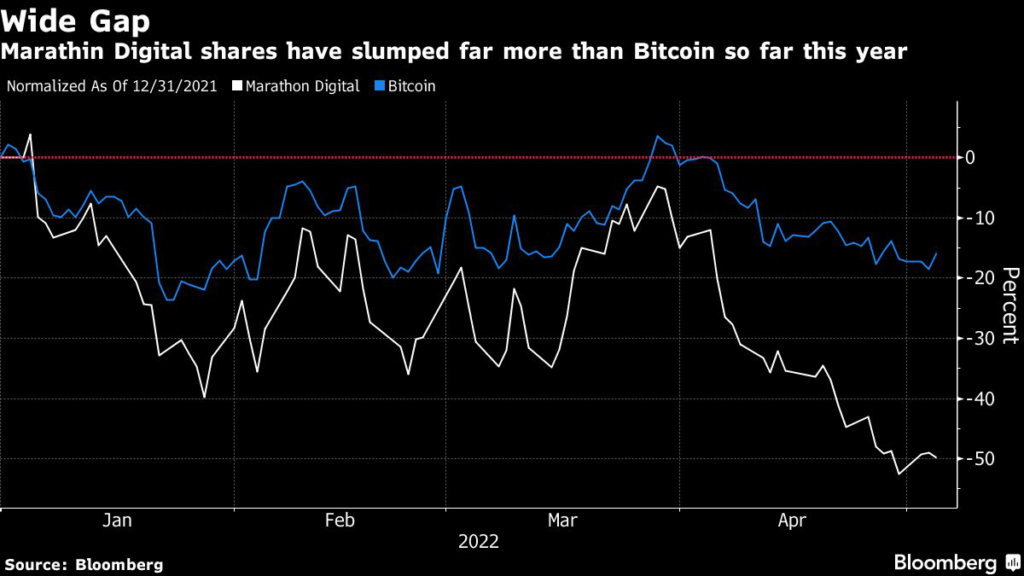
Shares have been cut almost in half since the start of the year, underperforming the world’s largest digital asset. 

The Bitcoin mining industry is facing a persistent lack of infrastructure that can host mining machines since China banned crypto mining last May. The U.S. has become one of the major destinations for millions of mining rigs migrating from China. Both exiled Chinese miners and local mining companies in the U.S. are scrambling to build out data centers and upgrade power transmission systems to plug in their machines. However, lead time for such construction has been significantly extended by supply chain issues due to the coronavirus pandemic. 

“The company has over 60,000 rigs on hand that are not connected to infrastructure,” Lucas Pipes, a B. Riley analyst with a “buy” rating on the company said in an interview prior to the earnings report. “Marathon would be the first to say things aren’t going as quickly as they’d like.” 

Read More: Texas Bitcoin Miners Seek Cheap Power, Land and a Place to Stay 

COMMENTARY AND CONTEXT

  • The current-year quarter also includes a $5.5 million charge for the decrease in the fair market value of the company’s investment fund
  • Adjusted EBITDA for the quarter totaled $39.4 million, an increase of $33.3 million from the prior-year period
  • As of March 31, 2022, cash on hand was $118.5 million
  • Total liquidity available to the company, defined as cash on hand plus available revolving credit facilities, was $218.5 million
  • Additionally, Marathon held approximately 9,374 Bitcoin with an approximate fair market value of $427.7 million at March 31
  • Produced a record 1,259 Bitcoin, a 556% increase from 192 Bitcoin in the first quarter of 2021 and a 15% sequential increase from 1,098 Bitcoin in the prior quarter

(Adds company comment in the fourth paragraph.)

More stories like this are available on bloomberg.com

©2022 Bloomberg L.P.

Close Bitnami banner
Bitnami