
Bloomberg

Nasdaq’s Friedman Sees IPO Revival Led by Digital Innovators

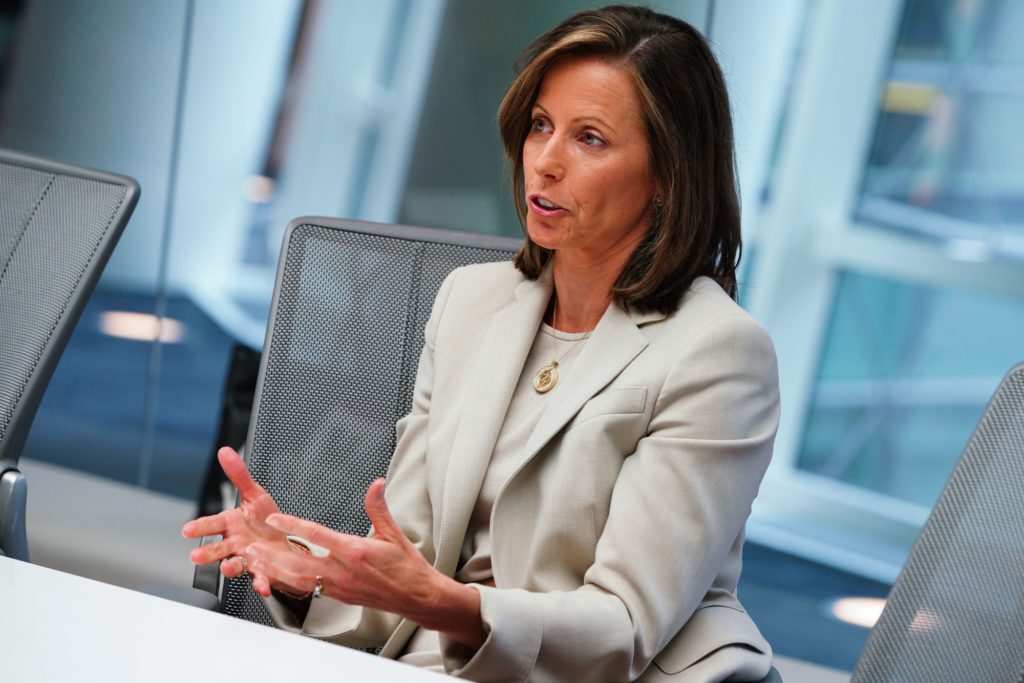
(Bloomberg) — Even with falling equity prices and delayed initial public offerings, some companies are still looking to make their stock-market debuts, Nasdaq Inc. Chief Executive Officer Adena Friedman said.

After more than 750 IPOs last year, Nasdaq’s exchange had just 70 such offerings in the first quarter, with closely held companies “staying on the sidelines” this quarter, Friedman said in a Bloomberg Television interview Wednesday. There’s a pipeline of more than 250 companies with S-1 filings looking to go public on the Nasdaq in coming months and quarters, she said.

“There are some companies that hope to tap the public markets this quarter,” though volatility is likely to delay those IPOs, Friedman said. “The companies that have been really eager to tap the public markets are those that are really leaning into the digitization of the economy, those that are leaning into providing new technologies to help get to a net-zero environment — those type of innovators that we see coming to Nasdaq every year.”

Nasdaq, the second-largest stock exchange in the U.S., bills itself as a technology company. Beyond running the exchange, the New York-based firm offers data, analytics, software and other surveillance services to clients including publicly traded and closely held companies and investors.

Amid a booming stock market and pandemic-driven volatility that increased trading volumes, Nasdaq’s revenue grew to $3.42 billion last year, up 18% from 2020. But with soaring inflation, rising interest rates and a fraught geopolitical environment, investor concerns are growing, and the tech-focused Nasdaq Composite Index is down more than 20% this year, compared with a 13% decline for the S&P 500.

Friedman, who has been CEO of Nasdaq since 2017, has focused on diversifying the company’s revenue stream to make it less reliant on the market for growth. The firm has invested in technology, data and other offerings beyond the exchange where shares in public companies trade.

The company has leveraged its technology to support companies in other industries, including crypto. Nasdaq is interested in partnerships with other firms in the field, but is taking a cautious approach because of questions around regulation. 

“As we evaluate the regulatory environment and how many institutions want to get into the space, we are actively evaluating how we can play a role,” Friedman said in an additional interview with Bloomberg. “More and more institutional investment is coming into the general digital-asset space, including crypto, but the level of inefficiency is incredible. That is where we will play a role.” 

(Updates with comments on crypto in last two paragraphs.)

More stories like this are available on bloomberg.com

©2022 Bloomberg L.P.
Verizon Mulls Price Increase in Response to Rising Cost Pressure

(Bloomberg) — Verizon Communications Inc. is considering raising prices for wireless service — one of several possible options to pass along inflation-related costs to consumers following AT&T Inc.’s decision this week to increase rates on older calling plans by $6 or more.

An increase like AT&T’s isn’t likely for Verizon, but alternatives such as the introduction of a higher-priced unlimited plan or added fees are among the possibilities, according to a person with knowledge of the company’s deliberations. Either way, if costs keep rising, Verizon customers will see higher monthly bills.

A Verizon representative declined to comment.

Like many companies, wireless carriers are seeing wages rise. AT&T said in April that pay increases would add a $1 billion or more to its costs. Both Verizon and T-Mobile US Inc. raised employees’ starting pay to $20 an hour in the past few months in response to a tight job market.

Hans Vestberg, Verizon’s chief executive officer, raised the prospect of boosting prices on an April call with investors, citing what he said was a 40-year high in inflation.

“We have plans to be prepared for what it takes,” Vestberg said. “So that will, of course, include different type of cost adjustments, but also looking into what you can do with pricing.”

Read more: AT&T raises prices on wireless plans to address higher costs

Not everyone is buying the higher-costs-made-me-do-it rationale. Some are saying ‘I told you so’ after the industry shrank from a four-player field to three when T-Mobile acquired Sprint Corp. in 2020. That left customers with fewer options and made them more captive to their current providers, opponents of that deal say.

“We are skeptical of claims that carriers are raising wireless prices because of inflation,” said Diana Moss, president of the American Antitrust Institute. “It is too easy to blame price increases on such an obvious factor.”

While AT&T broke from past practices and raised prices for the first time in three years, T-Mobile has been holding firm and offering a range of price plans to attract customers from rivals. The company recently introduced new prepaid plans starting at $20 a month. 

“Of course AT&T did what it did,” T-Mobile Chief Executive Officer Mike Sievert said during a presentation Wednesday. “This gives us the opportunity to stand up for the customer.”  

AT&T’s price increase isn’t evidence of a concentrated market, according to Makan Delrahim, who led the U.S. Justice Department’s antitrust division when the agency approved T-Mobile’s purchase of Sprint.

‘Real Competitor’

The combined company emerged as a “real competitor” to AT&T and Verizon, Delrahim said in an interview. It also empowered Dish Network Corp. as a potential fourth player, he said, with the combining companies selling assets to the new rival.

“The overall deal was much better for the consumer,” Delrahim said.

But even T-Mobile isn’t exactly a hero on the price front. The company used to boast that its unlimited plans included all fees and taxes in the advertised price. Today, only the two upper-tier Magenta plans include the extra charges in the posted price, while such items are added on top of the lower-tier plans.

“One big issue that the carriers need to be careful about is doing anything that would appear to increase the digital divide,” said Tammy Parker, an analyst with GlobalData. “They must balance price increases with the need to provide options that allow budget-constrained customers to remain connected.”

The wireless industry this week also saw hints of fresh competition. On Wednesday, Dish launched its 5G service in Las Vegas, a milepost in that company’s nearly two-year journey to become a new wireless competitor after the Sprint/T-Mobile deal.

But it will be years before Dish becomes a major competitor, giving the incumbents a “raise-your-prices-while-you-can” moment, according to Harold Feld, senior vice president of the Washington-based policy group Public Knowledge.

More stories like this are available on bloomberg.com

©2022 Bloomberg L.P.
Coinbase’s NFT Marketplace Opens to All, But Users Don’t Show Up

(Bloomberg) — Coinbase Global Inc.’s new marketplace for nonfungible tokens is now officially open to all — and it’s getting off to a very slow start.

After letting in a select number of users from its waiting list in the last few weeks, the U.S.’s biggest crypto exchange opened the marketplace to everyone as of noon Wednesday New York time. The site — which Coinbase says is still in testing — recorded fewer than 110 transactions as of about 5:15 pm, representing less than $60,000 in sales, according to tracker Dune Analytics. That compares with $124 million in transaction volume for No. 1 NFT marketplace OpenSea on May 3, the most recent day available, per Dune.

The result is hardly the mad rush expected by some on Wall Street after Coinbase’s NFT project attracted several million signups to its waiting list when it first announced the marketplace last fall. The new site is part of efforts by Coinbase to diversify its revenue and fuel growth, which is expected to turn negative this year.

“I think the expectations were ratcheted higher by other people,” Sasha Fleyshman, portfolio manager at digital-asset manager Arca, said in an interview. “I’ve spoken with their team, they are very understanding that they are entering a new space, there are going to be iterations. But it’s going to be slow. OpenSea is going to be the leader for quite a long time.”

Coinbase declined to share any of its own activity numbers or comment further.

More stories like this are available on bloomberg.com

©2022 Bloomberg L.P.
Facebook Parent Meta Slows Hiring in Cost-Cutting Push

(Bloomberg) — Facebook parent company Meta Platforms Inc. is slowing or pausing hiring for some mid- to senior-level positions, part of a broader plan to cut costs and cope with the challenges facing the social media giant.

“We regularly re-evaluate our talent pipeline according to our business needs and in light of the expense guidance given for this earnings period, we are slowing its growth accordingly,” Meta said in a statement Wednesday. “However, we will continue to grow our workforce to ensure we focus on long-term impact.” 

The move follows a generally upbeat earnings report last week — with the Facebook platform returning to user growth — but the company warned that the Ukraine war was weighing on sales. Meta said at the time that it would be reining in its spending plans for the year in light of a weaker revenue outlook.

That marks a reversal from rapid staffing growth in recent years. Meta Chief Financial Officer Dave Wehner had said in February that the company expected “accelerated headcount” to be the biggest contributor to expense growth in 2022, and the company added more than 5,800 new hires in the first quarter. But last week’s revision to its spending budget is now affecting hiring plans.

Meta, based in Menlo Park, California, had more than 77,800 employees at the end of March. That was up more than 28% from a year earlier. 

Insider first reported on Meta’s plans to slow hiring.

More stories like this are available on bloomberg.com

©2022 Bloomberg L.P.

EBay Drops After Weak Outlook on Fading Pandemic Sales Bump

(Bloomberg) — EBay Inc. gave a lackluster sales and profit outlook for the current quarter, accelerating its decline from the peaks reached when shoppers were stuck at home during the pandemic. The shares fell as much as 8% in extended trading.

Sales will be $2.35 billion to $2.4 billion in the period ending in June, the San Jose, California-based company said Wednesday in a statement. Analysts, on average, projected $2.53 billion, according to data compiled by Bloomberg. Earnings, excluding some items, will be 87 cents to 91 cents a share, falling short of the average estimates of $1.02.

The momentum the online shopping site gained during the pandemic when people abandoned stores for websites has been fading as shoppers return to in-person browsing and buying. Chief Executive Officer Jamie Iannone maintains that EBay’s advertising and payments businesses can boost profits even if total spending on the site falls. He has pledged to focus on the highest-priced items requiring authentication like brand-name sneakers, watches and other collectibles, and spend less money on promotions that lure random customers who don’t stick around.

Amazon.com Inc. also has seen e-commerce business plateau from its pandemic highs. Last week, the company said revenue at its online stores declined 3% in the first quarter from the period a year earlier.

EBay sales decreased 5.9% to $2.48 billion in the period ended March 31, the company said Wednesday in a statement. Analysts, on average, estimated $2.46 billion, according to data compiled by Bloomberg. Earnings, excluding some items, were $1.05 per share, beating estimates of $1.04.  

The shares fell to a low of $49.50 in extended trading after closing at $54.42 in New York. The stock has fallen about 18% so far this year, in line with a broader market drop.

EBay ended the quarter with 142 million active buyers, down 13% from a year earlier. Gross merchandise volume, which is the value of all goods sold on the site, fell 20% to $19.4 billion.

More stories like this are available on bloomberg.com

©2022 Bloomberg L.P.

ICE to Buy Mortgage-Software Firm Black Knight for $13.1 Billion

(Bloomberg) — Intercontinental Exchange Inc. has agreed to buy Black Knight Inc. in a deal valuing the mortgage software provider at about $13.1 billion, as the owner of the New York Stock Exchanges makes a huge bet on the future of the U.S. housing market. 

ICE has agreed to pay $85 per share in cash and stock for the Jacksonville, Florida-based company, according to a statement Wednesday. Bloomberg News reported on the potential takeover earlier. 

ICE and other exchange operators have been branching into data and other areas of fintech in recent years as growth stalled in the traditional exchange business. Black Knight would complement Ellie Mae Inc., the mortgage-software provider that ICE agreed to buy for $11 billion in 2020.

The deal marks the latest aggressive move by ICE Chief Executive Officer Jeffrey Sprecher, a serial dealmaker who has been eager to expand the company into new markets via acquisitions. ICE even flirted with buying EBay Inc. in 2020. With Black Knight, he is essentially doubling down on the future of the U.S. mortgage market. 

Black Knight’s software was used to service about 63% of the active first-lien mortgages in the U.S. in 2021, according to its most recent annual report. The company’s products also help originate loans and evaluate how much properties are worth, among other things. 

“With our expertise in operating networks and marketplaces, our planned acquisition will bring to life a true end-to-end solution for the mortgage manufacturing and servicing ecosystem, benefitting aspiring and current homeowners across the United States,” Sprecher said in a statement. 

Foley Win

The deal also marks a win for billionaire Bill Foley, founder of title insurance giant Fidelity National Financial Inc. Black Knight spun out from Fidelity National in 2017 and Foley remained chairman of Black Knight until last year. The deal values his 2.2% stake in Black Knight at about $288 million, according to data compiled by Bloomberg. 

Black Knight rose 15% to close at $72.84 in New York trading Wednesday, giving the company a market value of about $11.4 billion. ICE fell 4% to $109.86, for a market value of about $62 billion. 

Black Knight had been exploring a sale after receiving takeover interest from private equity firms, Bloomberg News reported last month. Based in Jacksonville, Florida, the company provides software, data and analytics to the mortgage and home equity lending and servicing and real estate industries. 

The deal is expected to close in the first half of 2023. Goldman Sachs Group Inc. and Wells Fargo & Co. advised ICE on the deal while JPMorgan Chase & Co. advised Black Knight. 

(Updates with additional details throughout.)

More stories like this are available on bloomberg.com

©2022 Bloomberg L.P.
Booking Beats Estimates, Sees ‘Busy Summer Travel Season Ahead’

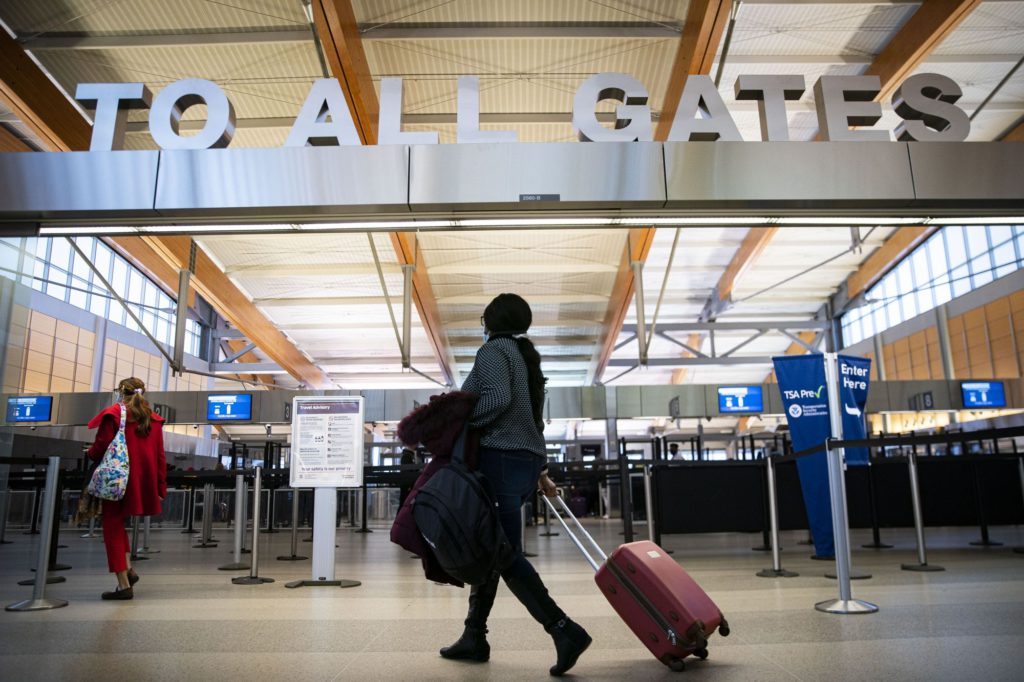
(Bloomberg) — Booking Holdings Inc. reported revenue in the first quarter that was better than analysts’ estimates, benefiting from pent-up demand for leisure travel.

The U.S.’s biggest online travel company reported revenue rose 136% to $2.7 billion in the three months ended March 31, while analysts projected $2.54 billion. Gross bookings, which represent all travel services excluding cancellations, were $27.3 billion, the highest quarterly amount ever for the company. That beat the average analyst estimate of $25.39 billion, according to data compiled by Bloomberg. The shares jumped about 8% in extended trading.

“Despite an uncertain macroeconomic environment, we have seen continued strengthening of global travel trends so far in the second quarter of 2022, and we are preparing for a busy summer travel season ahead,” Chief Executive Officer Glenn Fogel said in a statement.

After more than two years of limited travel options due to Covid-19 restrictions, travel executives are expecting a surge in bookings this summer as consumers splurge on vacations. Airbnb Inc., which reported strong results on Tuesday, said it sees “substantial demand” for travel heading into the busiest time of the year. And Chief Executive Officer Brian Chesky said Airbnb is seeing “higher than historical demand” for the fourth quarter, “which indicates that consumer confidence to travel remains strong beyond the summer months.”

But the market punished Expedia Group Inc., which earlier this week reported an 80% jump in revenue in the first quarter, signaling investors’ rising concern about inflation and the risk for recession. Travel companies from hotels to airlines have been saying consumers are willing to pay the rising prices so far, but there appears to be a limit. Hilton Worldwide Holdings Inc. also gave a profit forecast that fell short of analysts’ expectations.

Still, there are positive signs that people are itching to take a trip. For example, United Airlines Holdings Inc. is boosting capacity for transatlantic flights and Southwest Airlines Co. said it expects to be profitable for the remaining three quarters of the year, even with oil prices well over $100 a barrel.  

Booking also owns flight aggregator Kayak and travel booking site Priceline, as well as an alternative accommodations platform. The Norwalk, Connecticut-based company has a strong global presence, with close to 90% of 2020 revenue coming from its international segments, which made it more exposed to the war in Ukraine than its rivals. But positive signs for cross-border travel in Europe are emerging, with Covid-19 restrictions easing and greater demand on low-cost carriers EasyJet Plc and Ryanair Holdings Plc, according to Cowen Inc. analyst Kevin Kopelman. 

While Airbnb has attracted guests seeking to rent full homes in more rural areas where they can work remotely, Booking, which is more dependent on hotels, flights and car rentals, is anxiously awaiting tourists to return to large cities and international vacation hotspots. 

Investors were initially rattled by the war, but Booking disclosed in a March securities filing that despite a drop in room nights driven by the Eastern European region, Western Europe levels remained above 2019 levels. The slowdown in room nights is likely improving, Kopelman wrote in a note last week. Despite Americans’ feelings about the war, Fogel said in March that he didn’t think it would change their summer travel plans. 

Booking reported a net loss of $700 million. Adjusted earnings per share were $3.90, far better than expected than analysts’ estimates of 71 cents.  Despite the executives’ optimism over summer demand, all three online travel companies have seen their shares suffer this year. Booking is down about 12% while Airbnb is down about 6% and Expedia tumbled 17%.  


More stories like this are available on bloomberg.com

©2022 Bloomberg L.P.
Bitcoin Pierces $40,000 After Fed Quells Talk of Jumbo Hikes

(Bloomberg) —

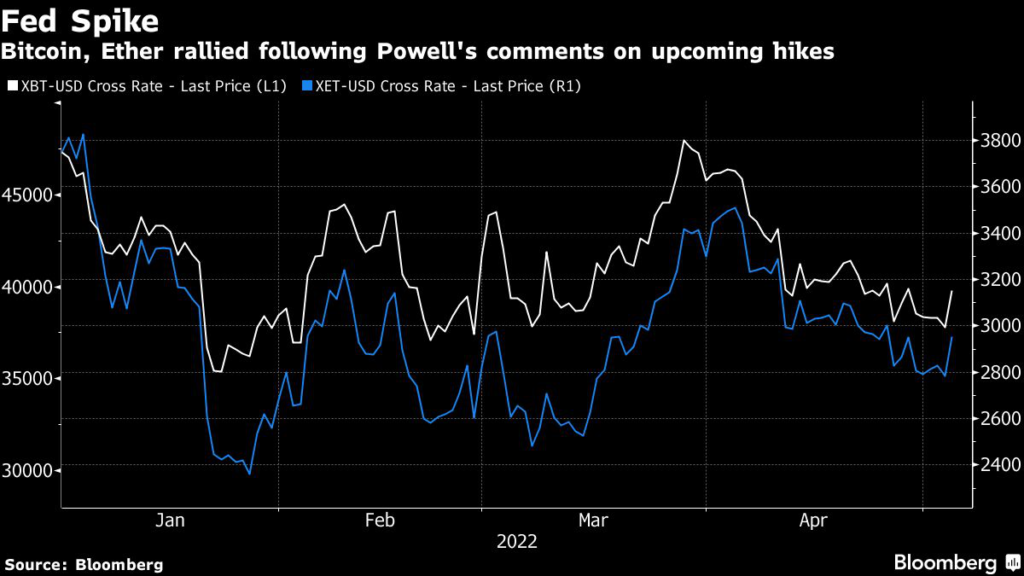
Bitcoin staged its biggest rally in nearly two months after the Federal Reserve quashed fears it will make jumbo-sized moves on interest-rate policy. 

The world’s largest cryptocurrency rose as much as 5.9% to $40,007 in New York trading, while other digital assets including Ether and Litecoin also rallied. The move follows comments from Fed Chair Jerome Powell, who said the central bank wasn’t looking to increase rates by 75 basis points at its upcoming meetings, quelling fears it would move super-aggressively to tamp down inflation. 

The relatively less-hawkish tone of the comments “contributes to speculative appetite, which is likely to be bullish for crypto,” said Stephane Ouellette, chief executive of FRNT Financial Inc.

The U.S. central bank’s policy-making Federal Open Market Committee on Wednesday voted unanimously to increase the benchmark rate by a half percentage point and said it will begin allowing its holdings of Treasuries and mortgage-backed securities to roll off in June. Risky assets surged after Powell said a 75-basis point increase is “not something that the committee is actively considering.” 

Still, in this higher-rate environment, Bitcoin hasn’t been able to break out in any meaningful way beyond its highs at the start of the year. The coin has largely traded within a tight range over the past few months. 

“The market is basically stuck in a range,” Dan Gunsberg, co-founder of Hxro Network, said by phone. 

Money has been flowing out of the sector amid the malaise. Investors yanked roughly $120 million from crypto products last week, bringing total outflows over the past four weeks to $339 million, according to data tracked by fund provider CoinShares. Bitcoin last week accounted for the majority of the flows in what was its largest single week of outflows since June 2021. 

Elsewhere, data from CoinGecko shows that the price of ApeCoin, the native crypto token of Yuga Labs’ APE ecosystem, was up 10% as of 4:10 p.m. in New York Wednesday after Elon Musk changed his Twitter display picture to that of a collage of Bored Apes. 

Yuga Labs, creators of the Bored Ape Yacht Club collection of NFTs, recently led a sale of virtual land on “Otherside,” its metaverse project. The sale raised $320 million but also led to huge congestion and high transaction fees on the Ethereum network.

The token price of ApeCoin fell from its Sunday highs of $22 to $14.50 per token on Wednesday before jumping to $17.16 after the Tesla CEO  — and Twitter acquirer — changed his profile picture.

More stories like this are available on bloomberg.com

©2022 Bloomberg L.P.
Powell Gives Tech a Lift by Taking Larger Hikes off the Table

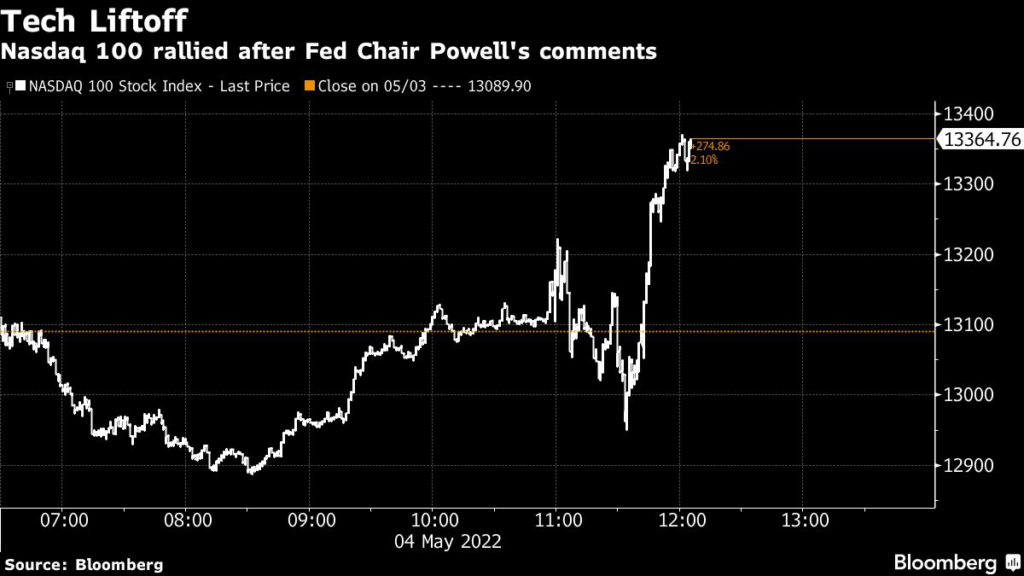
(Bloomberg) — The Federal Reserve gave a much needed shot in the arm of technology stocks on Wednesday by ruling out an more aggressive rate hike path and reassuring the U.S. economy remains strong.  

The megacap tech complex — which includes Apple Inc., Microsoft Corp. and Amazon.com Inc — rallied after Fed Chairman Jerome Powell said a 75 basis point hike is “not something that the committee is actively considering,” sending the Nasdaq 100 Index up 3.4%, its biggest one-day jump in about a week. Both Apple and Alphabet gained more than 4%, while Microsoft gained 2.9% and Nvidia advanced 3.7%. Meta Platforms rose 5.4%.

“Stocks were excited about Powell refuting talk of 75 basis points-increases and his optimism” about recent consumer prices trends, writes Vital Knowledge founder Adam Crisafulli

The U.S. central bank raised the benchmark rate by a half percentage point, the steepest increment since 2000, as it moves to combat inflation, which Powell said was “much too high.”

“There’s some optimism that we can get a soft landing, and that the Fed isn’t going to drive the economy into a ditch and create a recession,” said Kim Forrest, chief investment officer at Bokeh Capital Partners. 

A Goldman Sachs basket of software stocks staged a major reversal on Wednesday afternoon and jumped 4% after earlier touching its lowest since May 2020. Software companies are are among the most richly-valued within the technology sector, and the most under pressure from higher interest rates, which in turn hurt the value of its future profits. 

Software companies including Datadog Inc., Zscaler Inc., Snowflake Inc., and Cloudflare Inc., which have dropped between 40% and 60% off their November peaks, rallied in afternoon trading, with Snowflake closing up more than 5%.

Still, with inflation running high, technology stocks aren’t out of the woods yet, according to Michael Mullaney, director of global market research at Boston Partners. 

“There are no major surprises from the Fed, and the market seems to be relieved about that,” he said. “But this is only one of many steps that will be needed to quell inflation.”

(Updates to market close.)

More stories like this are available on bloomberg.com

©2022 Bloomberg L.P.
Shaw Deal Arbitrage Gap Is Widest Since November After Selloff

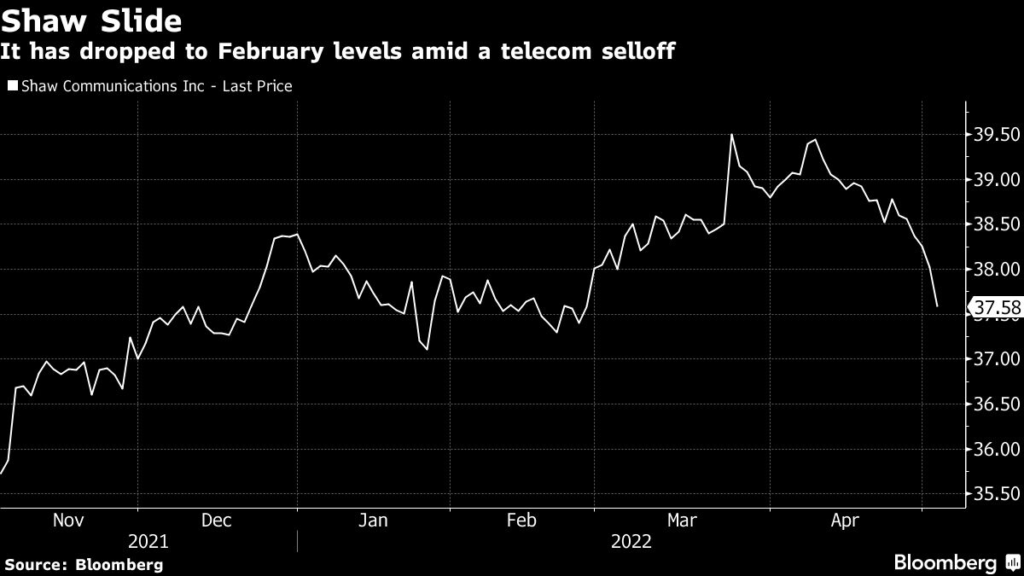
(Bloomberg) — Shares of Shaw Communications Inc. fell to the lowest level since November, closing 8.8% below the takeover price offered by Rogers Communications Inc., as Canadian regulators prepare to issue their rulings on the deal.

Shaw has declined seven consecutive days in a period of broad weakness in equity markets and ended Wednesday at C$36.92. Rogers, the country’s largest wireless and cable provider, has offered C$40.50 cash per Shaw share for an acquisition that would allow it to become a national cable player and bolster its wireless infrastructure in Western Canada. 

Shares of Rogers have fallen nearly 10% in the past two weeks and Canada’s other major telecommunications firms, BCE Inc. and Telus Corp., have dropped more than 5% as investors reprice stocks in an environment of higher interest rates and stubborn inflation. 

Rogers and Shaw have set June 13 as the deadline for closing the transaction, though they could extend it if regulators need more time. 

The deal has already cleared one regulatory hurdle: Canada’s broadcast regulator signed off the transfer of Shaw’s broadcast systems to Rogers. But the deal still requires approval from the Competition Bureau and a key federal ministry.

Most analysts have said they expect deal the deal to be completed at that price, but with divestitures. Rogers buying Shaw would eliminate the No. 4 wireless competitor in major cities like Toronto and Vancouver. Rogers executives believe the government won’t allow that, so the company has already solicited bidders for Shaw’s wireless division, Freedom Mobile. 

(Updates share performance)

More stories like this are available on bloomberg.com

©2022 Bloomberg L.P.

Close Bitnami banner
Bitnami
