Bloomberg

Lyft Plunge Wipes Off Nearly a Third of Market Valuation

(Bloomberg) — Lyft Inc. lost nearly one-third of its market value on Wednesday after the ride-hailing company’s second-quarter outlook and plan to increase spending on driver incentives disappointed Wall Street, highlighting investors’ willingness to dump growth stocks at the first hint of trouble. 

The San Francisco-based company’s shares closed down 30% at $21.56 in New York. The decline is the stock’s steepest-ever drop in a single session, and marks a descent of 72% from the record-high of $78.29 touched in March 2019.

“There’s no room for error in this environment, but still, this selloff seems overdone,” Piper Sandler analyst Alexander Potter wrote in a note.

The gloom from Lyft’s results also spread to its larger and more diversified peer, Uber Technologies Inc., which was lower premarket despite reporting strong revenue for the first quarter and delivering an upbeat outlook on Wednesday morning. Uber closed down 4.7%.

Uber was initially due to report postmarket on Wednesday, but the company in a statement released Tuesday evening said it was rescheduling the release of the results and its quarterly conference in order to provide a “more timely update” to its performance and guidance.

Lyft said it expects revenue of as much as $1 billion in the second quarter, and sees earnings before interest, tax, depreciation and amortization of $10 million to $20 million in the period. Both were lower than analysts expected. At the same time, the company plans to increase its spending on driver incentives. 

“This investment phase was not calibrated into our initial expectations for 2022 and likely caught many off guard,” Northcoast Research analyst John Healy wrote in a note. Healy lowered his price target on Lyft to $35 from $65.

Both Lyft and Uber were hard hit during the pandemic as shutdowns slammed the brakes on demand. But now, even with riders returning, the stocks are getting punished as investors grow increasingly wary of expensive and riskier growth assets amid concerns about inflation and a possible economic slowdown. 

(Updates stock moves in second and fourth paragraphs, updates chart.)

More stories like this are available on bloomberg.com

©2022 Bloomberg L.P.

Ukraine Latest: U.S. Spells Out Its Weapons Training in Germany

(Bloomberg) — The European Union proposed a ban on Russian crude oil phased in over the next six months, part of the bloc’s sixth package of sanctions as President Vladimir Putin seeks to cement military gains in Ukraine.

Germany threw its weight behind the EU plan, though Hungary said it won’t back the proposal as it stands and other nations asked for more flexibility. The Kremlin called the measure a “double-edged sword” as it will impact households. The EU is also proposing to cut off Sberbank and other lenders from the international SWIFT messaging network used by financial institutions.

Russia’s war in Ukraine is nearing the 10-week mark. Having failed to achieve a quick victory, Moscow is focused on reinforcing both military and political control over territory taken so far, according to people familiar with the Kremlin’s thinking. U.S. military officials provided details of the training on weapons that they’re providing for Ukrainian troops in Germany.

(See RSAN on the Bloomberg Terminal for the Russian Sanctions Dashboard.)

Key Developments

  • Russia Seeks to Annex Occupied Ukraine as Invasion Goals Shift
  • EU Squeezes Harder on Russia, Sweeping in Oil, Bank and Business
  • EU Aims to Target Russia’s Global Oil Sales With Insurance Ban
  • Russian Oil Embargo Risks More Inflation Trouble for Europe
  • Germany, Netherlands Push North Sea Drilling to Shun Russian Gas

All times CET:

Russia Announces Humanitarian Corridors From Mariupol (8:47 p.m.)

Russia’s Defense Ministry said it will offer safe passage for civilians still trapped in the Azovstal steel plant in Mariupol on May 5 to 7, Tass reported.

The humanitarian corridors will be open from 8 a.m to 6 p.m over the three days, the ministry said. The civilians can choose whether to go to Russia or Ukrainian-controlled areas, according to Interfax.

Russia has seized control of almost all of the port city of Mariupol after a brutal weeks-long siege. The remaining defenders are holding out in the giant industrial facility, where hundreds of civilians have taken refuge.

U.S. Military Spells Out Weapons Training for Ukrainians (6:23 p.m.)

The U.S. is training Ukrainians on new weapons systems, including artillery and drones, in Grafenwoer, Germany, according to Brigadier General Joseph Hilbert, head of the 7th Army Training Command in Europe. He told reporters that a first group of Ukrainian trainees is back in the fight in Ukraine, and a second group of about 50 to 60 is now being instructed.

“They understand how to operate it and employ it as effectively as they can on their own and in accordance with their own tactics and their own doctrine,” Hilbert said of the new equipment. “The soldiers that we are receiving here are absolutely motivated, incredibly professional.”

The U.S. hasn’t had any problems getting the small groups of Ukrainians into Germany and back again, according to Hilbert and Lieutenant Colonel Todd Hopkins, who is also overseeing training. The officials acknowledged challenges, including providing instruction through translators.

Biden Wants to Talk to G-7 About More Russia Sanctions (6:10 p.m.)

President Joe Biden said he would consult with Group of Seven allies this week about more potential sanctions on Russia. After the EU proposed a ban on Russian oil imports by year’s end, Biden told reporters the U.S. is “always open to additional sanctions” and that he would discuss with G-7 members “what we’re going to do or not do.” Senior Biden administration officials have said they are looking at ways to tighten existing sanctions in order to prevent Moscow from evading them.

Russian Billionaire Challenges EU Sanctions (4:45 p.m.)

Russian metals billionaire Alisher Usmanov is appealing the European Union’s decision to impose strict sanctions on him in response to Russia’s invasion of Ukraine. He filed his appeal at the EU’s General Court on April 29, asking judges also to suspend the sanctions until there’s a final ruling, according to a court filing. A spokesperson for Usmanov declined to comment. Usmanov’s case is part of an increasing number of challenges at the Luxembourg-based court since the bloc started issuing sanctions on Feb. 28.

The EU, along with the U.S. and U.K., has targeted Russia’s ultra-wealthy and Usmanov has had his 156-meter (512-foot) yacht detained. 

EU Tussles With Holdouts Over Latest Sanctions (3:10 p.m)

EU diplomats discussed the sixth package of sanctions Wednesday, with Hungary objecting to the oil phase-out timing. Greece, Malta and Cyprus raised questions about banning transport of oil between third countries, saying the move will just help Europe’s competitors, according to two diplomats. The diplomats aim to conclude the package by the end of the week, or by May 9 at the latest, the diplomats said.

Greece and Cyprus have large shipping industries while Malta is a so-called flag state, where companies can register their vessels for ownership purposes.

U.K. Bars Russia From Using Consultants (2:45 p.m.)

The U.K. cut Russia off from using management consultants, accountants and public relations firms, part of a further tranche of sanctions.

The government in London also announced additional measures against 63 Russian individuals and organizations, many of them targeting people connected to news outlets in an effort to punish what it called “the spread of lies.”

Portuguese Premier to Visit Kyiv Soon (2:30 p.m.)

Portuguese Prime Minister Antonio Costa announced he will travel to Kyiv in the near future to sign a “significant” financing agreement, part of the International Monetary Fund’s support for Ukraine.

“Regardless of the dynamics of the EU accession process, we have to provide immediate answers to the emergency needs of the Ukrainian state and the Ukrainian people,” Costa said.

EU Plans to Block Russians From Buying Real Estate (1:50 p.m.)

The EU added a ban on property transactions with Russian nationals to its latest sanctions. The European Commission’s proposal would halt property deals with Russian citizens, residents and entities — prohibiting the sale or transfer, directly or indirectly, of “ownership rights in immovable property located within the territory of the Union or units in collective investment undertakings providing exposure to such immovable property,” according to the legal text seen by Bloomberg.

EU Suggests Sanctioning Russian Patriarch Kirill (1:20 p.m.)

The EU is also proposing to sanction Patriarch Kirill, the head of Russia’s Orthodox Church, according to documents seen by Bloomberg and people familiar with the matter.

The list, which still needs to be approved by European governments and could change, also includes family members of President Putin’s spokesperson, Dmitry Peskov, as well a number of senior military personnel. Kirill is a long-time Putin ally and has become one of the most vocal supporters of Russia’s war. Sanctions need the approval of all member states and some Orthodox nations are reluctant to target a senior religious figure, one of the people said.

Kremlin Calls Oil Embargo ‘Double-Edged Sword’ (12:40 p.m.)

The EU’s plans to ban the import of Russian crude oil are a “double-edged sword,” the Kremlin said.

“In seeking to cause us harm, they also pay a high price,” Peskov told reporters on a conference call. “The price of these sanctions for EU citizens will increase every day.”

India Wants Russia to Discount Its Oil (11:39 a.m.)

India is trying to get deeper discounts on Russian oil to compensate for the risk of dealing with the OPEC+ producer as other buyers turn away, according to people with knowledge of the matter.

The South Asian nation is seeking Russian cargoes at less than $70 a barrel on a delivered basis to compensate for additional hurdles, such as securing financing for purchases, in high-level talks between the two countries, said the people.

EU Targets Russia’s Global Oil Sales (11:35 a.m.)

The EU is seeking to go beyond its proposed ban on Russian oil by also targeting Moscow’s ability to sell crude and refined products anywhere in the world.

The bloc is looking at banning European vessels and companies from providing services, including insurance, linked to the transportation of Russian oil globally, according to officials and a draft document seen by Bloomberg.

Oil Rallies on EU Proposal to Phase Out Russian Supply (11:25 a.m.) 

Brent futures rose as much as 3.8% to trade near $109 a barrel. The EU’s plan is the most significant energy response from the bloc to the war in Ukraine as it seeks to cut reliance on Moscow. Traders have been keenly focused on just how much the war will affect output from Russia, one of the biggest producers.

Hungary Skeptical of EU Oil Ban (10:45 a.m.)

The EU has yet to resolve Hungary’s concerns over the oil plan, according to Zoltan Kovacs, a spokesman for the Hungarian government. Hungary and Slovakia, which are heavily reliant on Russian energy, will be given until the end of 2023 to comply with sanctions, a year later than other member states, according to people familiar with the matter.

“We see no plan or guarantees in the current proposal to manage even a transition period nor what would guarantee Hungary’s energy security,” Kovacs said by phone on Wednesday.

Hungarian Energy Refiner Prepares for Russian Oil Curb (9:49 a.m.)

Mol, Hungary’s largest refiner, has already taken steps to prepare for EU sanctions on Russian oil, including by stocking up on supplies, its chairman and CEO, Zsolt Hernadi, told Telex news website.

Without access to Russian crude, output would drop by 20% at Mol’s refinery in Hungary and by 30% at its Slovak unit, due to the technological issues in processing other oil types, according to the CEO. Prime Minister Viktor Orban has threatened to block EU sanctions on Russian oil if they hindered Hungarian procurements from Russia.

Ukraine Says Russian Missiles Hit Transport Targets (9:40 a.m.)

Russian missiles targeted transportation infrastructure in eight regions of Ukraine late Tuesday, the General Staff of the Armed Forces said. Missiles hit railway electric grid equipment across the country, wounding several people. Russia is trying to use missiles to stop “new and powerful” weapons arriving to Ukraine from the West, President Volodymyr Zelenskiy’s chief of staff Andriy Yermak said Tuesday on Telegram.

Russia’s defense ministry appeared to acknowledge the strikes, saying its forces destroyed six power sub-stations near railway stations in Podbortsy, Lviv, Volonets, Timkovo and Piatikhatka, Tass news agency reported.

EU Proposes Phasing Out Russian Oil by the Year End (8:54 a..m.)

Hungary and Slovakia, which had been opposed to a swift cut-off of Russian oil, will be granted a longer timeframe — until the end of 2023 — to cut off Russian oil, according to people familiar with the matter. 

The move increases the stakes with Moscow as the EU, the single largest consumer of crude and fuel from Russia, seeks to pressure President Vladimir Putin. In 2019, almost two-thirds of the bloc’s crude oil imports came from Russia.

EU Proposes Sanctions on Main Belarus Potash Companies (7:58 a.m)

The move would see the bloc targeting Belaruskali OAO and its export arm, Belarusian Potash Co., according to a person familiar with the matter. The EU is also proposing sanctions on oil refinery Naftan.


All three companies provide significant revenue to President Alexander Lukashenko’s regime and have been previously sanctioned by the U.S. The EU and the U.S. have accused Belarus of aiding Putin in his invasion of Ukraine.

Belarus Calls Unexpected Drills After Lukashenko-Putin Talk (7:28 a.m.)

Belarus announced a “sudden check” of its military forces, the day after President Alexander Lukashenko had a phone call with Russian President Vladimir Putin where they also discussed Ukraine, according to RIA Novosti.

The country’s defense ministry doesn’t say how many troops will take part in the training, only that their size will “grow over time” and will involve moving “significant” amounts of military equipment. The statement doesn’t mention any involvement of Russian forces while claiming the drills threaten neither neighboring countries nor Europe.

Europe Stuck Pursuing Long-Term Gas Contracts (7:04 a.m.)

Europe is finding it next to impossible to put an end to the decades-long natural gas supply contracts it has opposed for years. The war in Ukraine is driving Europe’s energy firms to sign long-term deals to secure alternatives to Russian gas. The continent needs such agreements to fill the gap of losing supplies from Russia, its biggest provider of the fuel.

Europe’s Jobs Market Slows Amid War (6:30 a.m.)

There were fewer help-wanted advertisements in Europe on jobs-search website Indeed in the week to April 22 than there would have been had the pre-war growth trend continued. The survey adds to evidence that the war is weighing on the region’s economic recovery.

Australia Imposes Sanctions on Separatists in Ukraine, Russian Lawmakers (3:22 a.m.)

Australia expanded targeted financial sanctions and travel bans on a further 110 people, including Ukrainian separatists and Russian members of parliament. The measures target 34 senior members of the Russian-backed movements in Donetsk and Luhansk and 76 lawmakers of the state Duma. 

Zelenskiy Reports on Mariupol Evacuation (1:01 a.m.)

In his nightly video address, Zelenskiy discussed the evacuation from the besieged steel works in Mariupol. “We finally have the result, the first result, of our evacuation operation,” he said. “It took a lot of effort, long negotiations and various mediations. Today 156 people arrived in Zaporizhzhia.”

More stories like this are available on bloomberg.com

©2022 Bloomberg L.P.

Twitter Works to Soothe Anxious Staffers Wondering ‘Why Bother?’

(Bloomberg) — At a Twitter Inc. staff meeting Wednesday morning, the first slide of a presentation asked a question on the minds of many employees: “Why Bother?” 

Why show up and build stuff for an app that’s about to be in the hands of a new owner, Elon Musk, who has said he plans to make serious changes? Why keep earning stock options at a company that’s about to go private? The presenter, product vice president Jay Sullivan, tried to appeal to workers’ sense of community, according to two people familiar with the matter.

Sullivan told employees that they have a responsibility to each other, and to a product used by hundreds of millions of people, which hosts the world’s most urgent and important public conversations. They’re all in this together, he added, according to the people, who asked not to be named sharing internal discussions.

Twitter, which employs more than 7,500 people, warned about a possible staff exodus in a regulatory filing this week. Musk told bankers that he was considering cost cuts, including layoffs, as part of his plan to grow Twitter.

The company is unlikely to maintain the same management after Musk takes over, which won’t happen for several months if the deal closes. In the meantime, Twitter says it won’t make major hires or major changes to its product, decreasing incentive to stay. Musk has also made clear he has a different philosophy on Twitter’s content moderation, which is already affecting employees who work on advertising and policy.

Twitter declined to comment.

More stories like this are available on bloomberg.com

©2022 Bloomberg L.P.

Lyft Craters, Dragging Down Uber as Driver Supply Stirs Profit Concern

(Bloomberg) — More people may be once again hailing a ride from Uber Technologies Inc. and Lyft Inc., but investors remain wary that efforts to woo back more drivers could derail profitability goals. 

Lyft plunged as much as 35%, the most ever, dragging Uber down more than 12% after both companies reported quarterly results that pointed to strong demand for rides, but failed to reassure Wall Street that a driver shortage that’s cost the companies hundreds of millions of dollars in bonuses was abating.  

“We want to make sure Uber and Lyft don’t have to keep incentivizing drivers every time there’s a shock to the system,” said Robert Mollins, an analyst at Gordon Haskett Research Advisors 

The driver shortage underscores the challenge of grappling with pandemic-induced swings in demand and reveals the fragility of a labor model ill-equipped to address them. By hiring drivers as independent contractors, ride-hailing companies were historically able to offer lower prices than traditional taxis. But the pandemic destabilized this workforce after demand for rides cratered and many found other jobs, were better off collecting unemployment benefits, or were more concerned about the risk of infection from being in close quarters with passengers. 

While riders have flocked back as they resume office commutes and trips to the airport, luring back drivers and onboarding new ones is taking more time and money than investors expected. A spike in gas prices when the war in Ukraine broke out has dealt a blow to recruitment efforts, just as companies were scaling back bonuses. Both Uber and Lyft have added fuel surcharges to rides in a bid to help ease drivers’ gas bills.

Read more about Lyft’s earnings results that sent shares plunging the most ever 

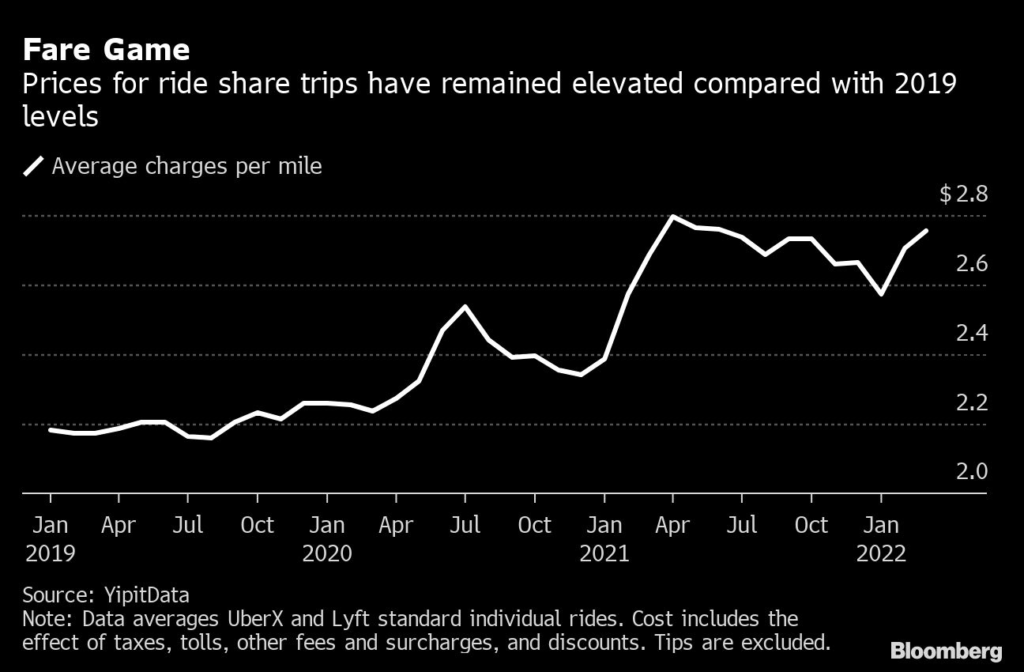
Solving the riddle of balancing riders with drivers is key to ensure the apps are still cheap enough and fast enough to not turn customers away. The average rideshare trip in the U.S. cost about $20 in the first quarter, up some 45% compared with the same period in 2019, according to market research firm YipitData. Meanwhile, average wait times during the week ending April 29 were roughly six and a half minutes, reverting back to December levels when shortages were more pronounced, a Gordon Haskett analysis analysis of 30 cities showed.

Once considered among the flagship Silicon Valley startups, disrupting the transportation model as we knew it and ushering in a new era of mobility, Uber and Lyft have seen their favor fade as they’ve had to reckon with city regulations and a pandemic that forced people into lockdowns. Lyft is down more than 70% from its 2019 initial public offering price of $72. Uber is off almost 40%.

The two companies laid out divergent strategies for their plans to boost drivers and meet an expected surge in ridership as Covid-19 wanes. 

Lyft said it would ramp up spending on incentives in the second quarter and said it expects the imbalance of supply and demand to dissipate when the pandemic fully subsides. Meanwhile, Uber touted the benefits of its multi-vertical business, which includes food-delivery unit, Uber Eats. The delivery service has served as a unique pipeline for drivers for Uber to tap after many shifted to ferrying meals when rideshare demand tanked and now it gives them the unique opportunity to make money on both services. 

Uber also said it has been making tweaks to the driver app, like unlocking the ability to see upfront fares before accepting a ride, improving maps and removing bugs. Rather than increase incentives, Uber plans to instead focus on its “holistic product experience as a way to attract, engage and retain earners,” Chief Executive Officer Dara Khosrowshahi said. 

Still, Uber may not be able to fully escape incentives and analysts were concerned about a potential subsidy-war. 

“If Lyft gets really aggressive with incentives, Uber might have to respond,” D.A. Davidson analyst Tom White said, noting this could have knock-on effects on profit margins. 

The threat of eroding profits in the course of spending more on driver incentives looms large over Lyft and Uber, which reached profitability for the first time as public companies last year, though Uber seems to be seeing stronger demand, helping it pull ahead of its smaller rival. Lyft gave a forecast for earnings before interest, tax, depreciation and amortization of $10 million to $20 million in the current quarter, substantially missing the $81 million Wall Street projected. Uber said it sees adjusted Ebitda of $240 million to $270 million, with the top end of that range beating the average analyst’s estimate.

Read more about how Uber managed to sidestep Lyft’s earnings debacle  

Lyft’s disappointing outlook underscores the San Francisco-based company’s struggle to claw its way out of the pandemic. 

Its forecast for adjusted Ebitda in the current quarter would be the second sequential quarterly decline. Chief Financial Officer Elaine Paul said the company feels like the worst is behind it, after omicron, and this coming quarter is “an opportunity to invest in kick-starting the next year of growth. We will do so with a focus on drivers, the overall marketplace and some additional brand marketing.” She said some of the costs related to driver incentives would be passed on to consumers through higher prices but others will weigh on profitability.

Though Lyft recorded a 40% increase in the number of drivers in the first quarter from the previous year, the company plans to invest more to boost driver supply in the second quarter, Paul said.

Meanwhile, Uber’s Khosrowshahi said the company’s first-quarter results “make clear that we are emerging on a strong path out of the pandemic.” Khosrowshahi said Uber’s driver base is at a “post-pandemic high” and that it expects engagement to continue “without significant incremental incentive investments.” 

Unlike Lyft, Uber was able to rely on its food-delivery business Uber Eats, which boomed during the pandemic just as ride share demand plunged. The delivery segment, which includes orders across restaurant, grocery and alcohol, has continued to grow despite indoor dining resuming, with bookings up 12% from a year ago to an all-time high of $13.9 billion.

Growth at Uber Eats has also helped funnel more drivers into its ride-hailing business. The ability to toggle between ferrying meals and people to make money has enticed drivers, many of whom shifted to food-delivery during the pandemic. “The success there has been very very significant,” Khosrowshahi said. 

(Updates to add information about fuel surchage and historcial stock information.)

More stories like this are available on bloomberg.com

©2022 Bloomberg L.P.

T-Mobile Ups the Battle for Internet Customers With $500 Rebates

(Bloomberg) — If the cable industry wasn’t already feeling the pressure of a slowing business, T-Mobile US Inc. is adding to their worries by sweetening its wireless home internet offer, dangling as much as $500 to new customers who want to pay off their contracts with other providers.

The second-largest U.S. wireless carrier is also offering to bundle its wireless home internet service with its high-end mobile phone plan for a combined $200 a month for a four-member account. 

“High-speed broadband service is still a monopoly in this country,” T-Mobile Chief Executive Officer Mike Sievert said during a presentation to investors Wednesday.

The discounts come the same week that AT&T Inc. broke ranks with other wireless providers and raised prices on older mobile plans by $6 a month. After spending more than $100 billion on their 5G networks, T-Mobile, AT&T and Verizon Communications Inc. are in a race to find payback from that investment.

T-Mobile is using 5G signals to beam internet connections directly into homes, a relatively new service that has chipped away at traditional landline broadband market share and the potential expansion areas cable and phone companies have mapped out. 

Last week, both Charter Communications Inc. and Comcast Corp., the two largest U.S. cable companies, posted first quarter broadband subscriber gains that were roughly half the growth of a year ago. 

The friction rubs in both directions. Charter and Comcast together added nearly 700,000 new wireless phone customers in the first three months of the year, cutting into a business the telecom companies dominate. 

More stories like this are available on bloomberg.com

©2022 Bloomberg L.P.

Bitcoin Tests $39,000 in First Increase in Six Trading Sessions

(Bloomberg) —

Bitcoin gained for the first time in almost a week even with the Federal Reserve raising interest rates, helping to push the coin toward the higher end of the range it’s been trading in for much of the year. 

The world’s largest cryptocurrency rose as much as 4.4% to $39,439 in New York trading, a percentage move that passes for excitement for the token these days. The digital currency has swung within a 5% band for eight trading sessions in a prolonged calm not seen since the start of the year.

“Everything in crypto, I think, is more muted right now,” said Antonio Juliano, founder and chief executive of dYdX, a decentralized trading platform that focuses on perpetual swaps.

Crypto assets, just like other riskier areas of the market, have all been weighed down as the Fed and other global central banks raise interest rates to fight red-hot inflation. The U.S. central bank’s policy-making Federal Open Market Committee on Wednesday voted unanimously to increase the benchmark rate by a half percentage point and will begin allowing its holdings of Treasuries and mortgage-backed securities to roll off in June.

In this environment, Bitcoin hasn’t been able to break out in any meaningful way beyond the highs it came into the year with. 

“Right now, the market is basically stuck in a range for the most part,” Dan Gunsberg, co-founder of Hxro Network, said by phone. 

Money has been flowing out of the sector amid the malaise. Investors yanked roughly $120 million from crypto products last week, bringing total outflows over the past four weeks to $339 million, according to data tracked by fund provider CoinShares. Bitcoin last week accounted for the majority of the flows in what was its largest single week of outflows since June 2021. 

Elsewhere, data from CoinGecko shows that the price of ApeCoin, the native crypto token of Yuga Labs’ APE ecosystem, rallied 17% intraday Wednesday after Elon Musk changed his Twitter display picture to that of a collage of Bored Apes. 

Yuga Labs, creators of the Bored Ape Yacht Club collection of NFTs, had recently auctioned virtual land on ‘Otherside’, its metaverse project. The sale raised netted Yuga $320 million but also led to huge congestion and high transaction fee on the Ethereum network over the past weekend.

The token price of ApeCoin fell from its Sunday highs of $22 to $14.50 per token on Wednesday before jumping to $17.16 after the Tesla CEO changed his profile picture.

More stories like this are available on bloomberg.com

©2022 Bloomberg L.P.
Bitcoin Adoption by Central African Republic a Concern, IMF Says

(Bloomberg) — The Central African Republic’s adoption of Bitcoin as legal tender presents a series of challenges for the country and the region, the International Monetary Fund said.

The government announced last week that the nation, one of the world’s poorest, would become the second to adopt the cryptocurrency after El Salvador. The decision drew criticism from opposition parties and was made without consulting the regional central bank, which manages a common currency used by six countries including the Central African Republic.

Read: Central Bank Caught Unaware as African Nation Endorses Bitcoin

“The adoption of Bitcoin as legal tender in C.A.R. raises major legal, transparency, and economic policy challenges,” the fund said in an emailed response to questions. “IMF staff are assisting the regional and Central African Republic’s authorities in addressing the concerns posed by the new law.”

The government said that adopting Bitcoin as a legal tender will spur CAR’s economic recovery and growth, while also helping stabilize the country, which has been wracked by a decade-long civil war.

The $2.3 billion economy, which the African Development Bank forecasts will expand 5.1% this year, ranks 188 out of 189 in the United Nations Development Programme’s Human Development Index. The nation has low life expectancy and extreme poverty, with just 557,000 of its 4.8 million people having access to the Internet.

More stories like this are available on bloomberg.com

©2022 Bloomberg L.P.

Dish Launches Its First 5G Wireless Service for $30 in Las Vegas

(Bloomberg) — After months of technical delays, Dish Network Corp. introduced the nation’s first cloud-based 5G wireless service, an initial step in a long-range plan to change the satellite TV provider into a mobile broadband company.

Dish is calling it Project Genesis and starting Wednesday, customers in Las Vegas can sign on for an unlimited data, text and calling plan for $30 a month. The company is also offering a $900 Motorola Edge+ phone to use on the new network. Dish plans to have the service in 120 cities in June.

The launch is a major milestone for co-founder Charlie Ergen, who has spent decades acquiring a trove of airwaves to cover the U.S. with an advanced network to challenge the incumbent carriers — AT&T Inc., Verizon Communications Inc. and T-Mobile US Inc.

Dish has formed several partnerships with big tech companies, including Amazon.com Inc., Microsoft Corp. and Dell Technologies Inc., in an effort to build a software-run, cloud-based network. The so-called open, greenfield buildout promises to bypass the traditional reliance on proprietary hardware that rivals use in today’s networks.

Dish is showcasing the Project Genesis network May 10 as part of the company’s analyst day in Las Vegas.  

More stories like this are available on bloomberg.com

©2022 Bloomberg L.P.

Teachers’ Union Urges Action on Meta’s ‘Clear Threats’ to Kids

(Bloomberg) — A national teachers’ union is urging its members’ pension funds to push for an outside review of Meta Platforms Inc.’s governance, saying the potential for its social media services to harm children warrants closer scrutiny of its inner workings. 

Randi Weingarten, president of the American Federation of Teachers, is seeking support for a proposal to be presented at Meta’s May 25 annual shareholder meeting that would compel Facebook’s parent to hire an outside law firm to assess its audit committee and risk management. The AFT has 1.7 million members who participate in pension funds that together hold 30 million shares of Meta, valued around $6 billion, according to the union.

“AFT members, whose deferred wages may be invested in Meta, have seen the harms perpetuated by Meta’s Facebook platform firsthand,” Weingarten wrote in a letter Wednesday. “Meta has not taken sufficient action to mitigate the clear threats its business management choices pose to children and teenagers.”

She highlighted the impact on members from harmful content, including nurses dealing with illness due to Covid misinformation, and school staff supporting children with depression or self-esteem issues. She also noted the drop in the company’s shares — Meta is down 34% over the past year — and regulatory risks stemming from concerns about its internal controls.

Weingarten, who heads the U.S.’s second-largest teacher’s union, wrote to trustees a day after Facebook whistleblower Frances Haugen appeared at an AFT town hall to discuss social media. In October 2021, Haugen, a former Facebook product manager, shared thousands of pages of internal documents with journalists that suggested Facebook knew about the harms it was causing teenagers but chose to do little in terms of addressing the problems. Huagen accused Meta of prioritizing profit over the safety of the platform’s active users. 

In its 2022 proxy statement, Meta’s board opposed the shareholder proposal. “The audit & risk oversight committee takes its responsibilities, including risk oversight, seriously,” the company wrote. Meta said that “robust efforts already in place” show the committee’s “commitment to providing appropriate oversight” and thus the proposal was “unnecessary and not beneficial to our shareholders.”

“Meta’s board must take seriously its obligation to police the company’s risk management practices and its internal controls,” and “part of that obligation includes addressing Meta’s role in harming children and the public at large,” Weingarten wrote. “The proposal makes clear that the failure, so far, to do so requires the involvement of independent outside expertise, much as other kinds of misconduct by corporate insiders would.”

She also singled out Chief Executive Officer Mark Zuckerberg, saying his role as founder and board chair seems to give him power to prevent the board from fulfilling its responsibility to internally audit the company’s management and products, while Meta’s dual-class share structure insulates him from public accountability.

More stories like this are available on bloomberg.com

©2022 Bloomberg L.P.

Bored Ape Thefts on Instagram Are Crypto’s Latest Hack Headaches

(Bloomberg) — When it comes to crypto hacks, the story is often the same: Scammers take advantage of a vulnerability in a blockchain’s design and make off with millions, like in the $600 million-plus heist involving the play-to-earn NFT game Axie Infinity and the $77 million theft that took place Saturday on decentralized finance projects Rari Capital and Fei Protocol.

But a $3 million hack last week involving nonfungible tokens from the popular Bored Ape Yacht Club universe exploited a different kind of weakness that isn’t unique to blockchain. 

Scammers infiltrated the NFT collection’s official Instagram account and posted a link to a fake website where users connected their crypto wallets for what they thought was an NFT launch. In reality, they had unwittingly opened themselves up to theft. When the actual launch happened on Saturday, users were again targeted when scammers posted links to fake websites that ended up cleaning users out of NFTs worth a collective $6.2 million.

The incidents exemplify a growing trend in which social media is being used as a tool for amplifying and executing crypto and NFT scams. These thefts aren’t just hitting Instagram: Twitter, Facebook, and the chat platforms Discord and Telegram are also fertile ground for these maneuvers, according to Ronghui Gu, chief executive officer of blockchain security firm CertiK.

“We have seen more and more attacks and hacks in web3 and the blockchain industry and many of them have new forms of attack, which we haven’t seen before,” Gu said in an interview.

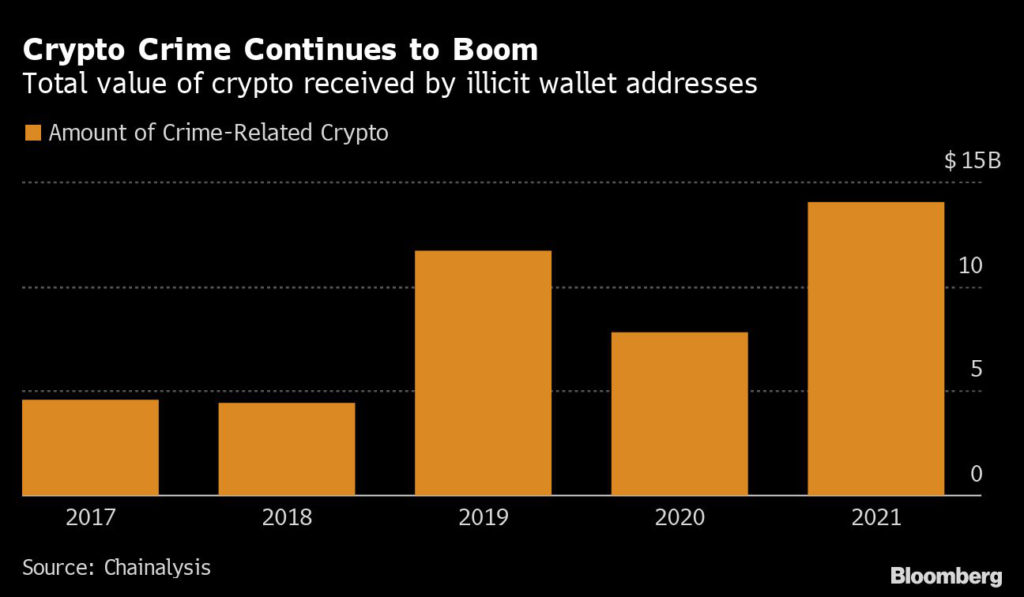
The escalating social-media cyber threat combines with crypto-based crime hitting an all-time high last year, according to blockchain security firm Chainalysis’ 2022 Crypto Crime Report. Illicit crypto wallets worldwide received $14 billion, an 80% increase from 2020. That’s a cost crypto firms and tech giants can’t afford to ignore, and it ratchets up the pressure on them to shore up security and tighten safeguards.

Crypto Copycats

Spam bots and account impersonation are already well-known problems on Twitter. About $2 million was stolen from customers over a seven-month period in 2020 and 2021 through crypto scams advertised by fake Elon Musk accounts, according to the Federal Trade Commission. These tactics are also rife on Crypto Twitter and other platforms upon which crypto users depend. 

“They heavily rely on this social media to get information about all kinds of different crypto projects like NFTs,” Gu said, adding that he’s even seen fake Telegram accounts that claim to belong to his company, CertiK.

Malicious accounts posing as real crypto companies, projects and entrepreneurs often tout fake giveaways of cryptocurrencies or NFTs. They can also disseminate through spam bots, which are automated social media accounts that can make posts and tag users, just like profiles run by humans. Twitter maintains that less than 5% of profiles are fake or spam, according its first-quarter earnings report — but that doesn’t make them any less of a potential threat. 

When Musk announced last week that he was acquiring Twitter Inc. in a $44 billion deal, he said he wanted to improve the social media platform by “enhancing the product with new features, making the algorithms open source to increase trust, defeating the spam bots, and authenticating all humans.” 

Identity Theft

It doesn’t have to be a false account disseminating crypto fraud — real accounts belonging to companies can be compromised too. The official BAYC Instagram account used two-factor authentication, according to a statement from Yuga Labs, the developer of the NFT collection. But that didn’t keep the account from being hacked.

The breach of this extra security measure indicates that hackers likely gained access to the account by tricking an administrator through social engineering, according to Gu. This practice involves using personal or professional information to gain someone’s trust, enabling a scammer to then elicit additional data or credentials for a sensitive or valuable account. Both an employee at a social media company and an individual user contacted by a scammer can fall victim to social engineering.

This kind of tactic has been used in hacks of Twitter accounts, with the most notable one being a 2020 incident in which profiles belonging to verified users like then-presidential candidate Joe Biden were used to post a fake Bitcoin giveaway. Twitter employees had been manipulated to provide the access needed for hackers to take over these accounts.

The breach of official crypto accounts has happened on Discord too. Prior to its official launch, NFT marketplace Fractal had its Discord channel infiltrated and used to spread a link to a fake token launch that stole about $150,000 from users.

What to Do?

Crypto scams put more pressure on social media companies to boost security measures and hash out clearer policies on how they plan to better protect users.

When asked about these issues, Twitter, Discord and Telegram told Bloomberg that they all take action to mitigate fraud on their platforms and allow users to report suspicious activity. Meta Platforms Inc., the parent company of Facebook and Instagram, declined to comment on crypto scams on these social media networks and the recent BAYC hack.

Even though cutting out scams is difficult, it’s not impossible, according to Curt Dukes, an executive vice president at the Center for Internet Security, a cybersecurity nonprofit. Requiring users to employ multi-factor authentication to protect their accounts and introducing a patch management system that helps identify and fix security flaws can help decrease vulnerability.

Companies can also provide better education to both employees and users on social engineering and make greater use of tools to verify that a user is human, such as adding a “CAPTCHA” challenge requiring users to solve a puzzle or type in hard-to-read text in order to use the platform.

Musk’s plan to open-source Twitter’s algorithms “definitely gives credibility to the platform,” according to Dukes. Allowing anyone to view Twitter’s code would increase the chances of a security issue being spotted, he said.

As for cleaning out bots, there are machine-learning tools available that could be a big help for social-media companies, but there are tradeoffs invoved, according to Adam Meyers, senior vice president of intelligence at cybersecurity firm Crowdstrike Holdings, Inc. Algorithms can identify posting patterns indicative of a malicious bot account, Meyers said in an interview. Doing so, though, could sharply cut overall user counts, which wouldn’t be ideal for a social-media platform.

“If you’re too good at stopping bots, then that’s going to drive that number down,” Meyers said.

Steps for Startups

Crypto startups can also take concrete steps to improve their security as scams increase, according to Kim Grauer, director of research at Chainalysis. While it’s common for early-stage firms in the sector to prioritize other areas over cybersecurity, “the industry cannot grow so long as it has this kind of ubiquitous hacking happening,” she said in an interview. In addition to hiring security specialists, crypto platforms can also undergo code audits that can help identify potential risks for users, she said. 

For some crypto adherents, the ultimate solution lies in web3 —  a decentralized, blockchain-based internet that proponents see as a step up from the current state of affiars, where tech companies control the biggest online platforms.

Web3 platforms are owned and managed by users, and developers can build tools that can help with issues like eliminating spam and verifying the identity of users. But a mass migration to a web3 social-media network isn’t realistic for the crypto industry, according to CertiK’s Gu.

Online communities like Crypto Twitter have helped boost mainstream adoption of NFTs and digital currencies. In addition to providing an easy way to promote projects and share information, these social media networks have earned some crypto companies millions of followers. 

For crypto startups, walking away from this kind of exposure is too big of a cost. But not taking steps to address security concerns can also take a heavy toll.  

More stories like this are available on bloomberg.com

©2022 Bloomberg L.P.
Close Bitnami banner
Bitnami