
Bloomberg

Mexico Inks Deal With Top Companies to Tame Rising Inflation

(Bloomberg) — Sign up for the New Economy Daily newsletter, follow us @economics and subscribe to our podcast.

Mexico’s government has struck a deal with leading companies to temporarily cap prices on 24 food and other basic products in an effort to temper inflation that has surged to two-decade highs.

The plan, which was first reported by Bloomberg News last week, will initially last six months and includes the reduction of tariffs of some food products to zero to ensure ease of imports, Finance Minister Rogelio Ramirez de la O said during a press conference at the National Palace on Wednesday. 

The price pact with companies includes items such as rice, onions, eggs, chicken, milk and potatoes. It will affect about a third of the country’s inflation components when combined with Mexico’s ongoing fuel subsidies and other energy price-reduction policies, Ramirez said. 

“This is not a price control. It is an agreement, an alliance, to guarantee that the basic basket of food items has a fair price,” President Andres Manuel Lopez Obrador said at the event, standing on stage in front of company executives participating in the deal.

Lopez Obrador said retailers such as Grupo Comercial Chedraui SA and Organizacion Soriana SAB will participate in the agreement together with telecommunications giant Telefonos de Mexico SAB, while executives from Wal-Mart de Mexico SAB and Grupo Bimbo SAB pledged their support. The government also plans to boost grain production by 2 million tons and to use its tree-planting program to increase the supply of food by 800,000 tons, the finance minister said.

The deal echoes pacts made by the government in the 1980s and 1990s that were seen as having helped slow double-digit inflation in a much more closed economy. Mexico’s inflation accelerated to 7.72% in early April, driven by food, gasoline and vacation costs. 

These measures are “positive developments” but have their limits, Alberto Ramos, chief Latin America economist at Goldman Sachs Group Inc., said in a note Wednesday. Voluntary price agreements tend to be ineffective beyond the short term to keep inflation at bay as they create distortions and lead to larger increases later on, he said.

“The announced measures are no substitute for a conservative calibration of monetary and interest rate policy to deal with the challenges of high and disseminated inflation,” Ramos wrote. 

The price pressure is becoming a political headache for the Mexican government given its impact on consumers and has led the central bank to boost interest rates in each of its meetings since June.

Read More: Banxico Board Member Warns Price Controls Only Work Short Term

After announcing the deal, Lopez Obrador said that the government needs to do what it can in order to create conditions that would limit interest rate hikes. The fewer rate increases the better, he said, as lower rates help promote investment and economic growth in the country. 

(Updates with food items in third paragraph, comments in seventh, eighth and tenth paragraphs.)

More stories like this are available on bloomberg.com

©2022 Bloomberg L.P.

Nasdaq’s Friedman Sees IPO Comeback Led by Digital Innovators

(Bloomberg) — Even with falling equity prices and delayed initial public offerings, some companies are still looking to make their stock-market debuts, Nasdaq Inc. Chief Executive Officer Adena Friedman said.

After more than 750 IPOs last year, Nasdaq’s exchange had just 70 such offerings in the first quarter, with closely held companies “staying on the sidelines” this quarter, Friedman said in a Bloomberg Television interview Wednesday. There’s a pipeline of more than 250 companies with S-1 filings looking to go public on the Nasdaq in coming months and quarters, she said.

“There are some companies that hope to tap the public markets this quarter,” though volatility is likely to delay those IPOs, Friedman said. “The companies that have been really eager to tap the public markets are those that are really leaning into the digitization of the economy, those that are leaning into providing new technologies to help get to a net-zero environment — those type of innovators that we see coming to Nasdaq every year.”

Nasdaq, the second-largest stock exchange in the U.S., bills itself as a technology company. Beyond running the exchange, the New York-based firm offers data, analytics, software and other surveillance services to clients including publicly traded and closely held companies and investors.

Amid a booming stock market and pandemic-driven volatility that increased trading volumes, Nasdaq’s revenue grew to $3.42 billion last year, up 18% from 2020. But with soaring inflation, rising interest rates and a fraught geopolitical environment, investor concerns are growing, and the tech-focused Nasdaq Composite Index is down more than 20% this year, compared with a 13% decline for the S&P 500.

Friedman, who has been CEO of Nasdaq since 2017, has focused on diversifying the company’s revenue stream to make it less reliant on the market for growth. The firm has invested in technology, data and other offerings beyond the exchange where shares in public companies trade.

More stories like this are available on bloomberg.com

©2022 Bloomberg L.P.
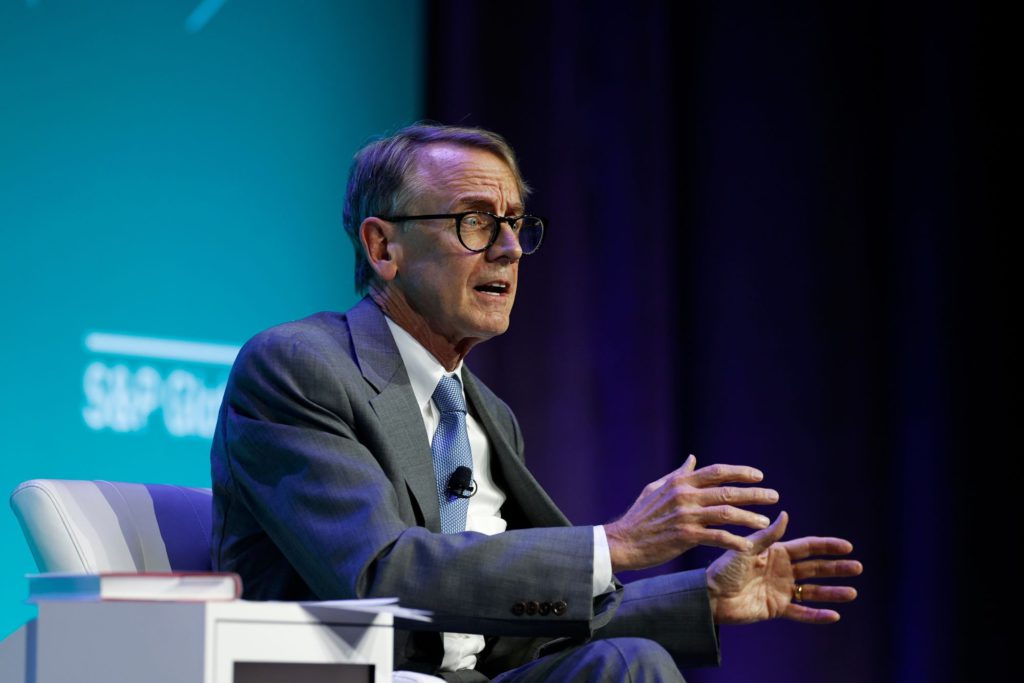
John Doerr Donates $1.1 Billion for Stanford Climate School

(Bloomberg) — Venture capitalist John Doerr is giving Stanford University $1.1 billion to create a school focused on climate change and sustainability, the largest donation in its history.

The gift from Doerr, and his wife Ann will create the Stanford Doerr School of Sustainability, according to a statement Wednesday. Doerr is chairman of venture firm Kleiner Perkins, which has backed tech giants including Amazon.com Inc., Google and Twitter Inc.

The school will house academic departments that advance the understanding of climate change and an accelerator focused on developing near-term policy and technology solutions, according to the statement.

“Stanford is making a bold, actionable, and enduring commitment to tackle humanity’s greatest challenge, and we have deep conviction in its ambition and abilities,” John and Ann Doerr said in the statement.

Doerr, 70, has a $6.1 billion fortune, according to the Bloomberg Billionaires Index.

The New York Times reported on the donation earlier.

More stories like this are available on bloomberg.com

©2022 Bloomberg L.P.
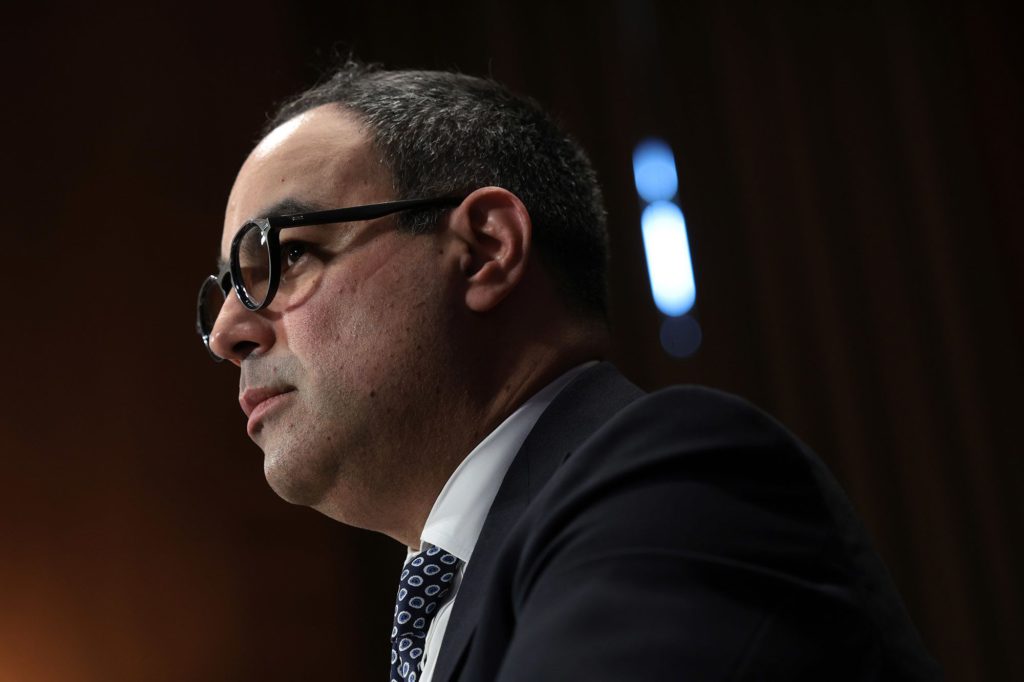
DOJ Antitrust Chief Warns S&P Global Over Insurer Ratings Tweak

(Bloomberg) — S&P Global Inc. should “carefully consider” a proposed tweak to how it assesses the creditworthiness of bonds owned by insurance companies, the Justice Department said, warning that such a change “could raise significant concerns” under U.S. antitrust law.

The Justice Department’s antitrust division said in a letter dated last Friday that a proposed methodology change by S&P — the world’s largest credit ratings company — could raise barriers for its rivals. The changes could end up hurting the credit grades of insurance companies that invest in bonds that aren’t rated by S&P.

The firm should “carefully consider whether penalizing insurers that purchase securities rated by S&P’s competitors has the potential to raise barriers to entry and expansion by competitors, insulate S&P from competition, or otherwise suppress competition from rival rating agencies,” said antitrust chief Jonathan Kanter in the letter. “Such actions could raise significant concerns that the Sherman Act has been — or will be — violated and warrant additional scrutiny.”

S&P is the No. 1 player in the U.S. market for credit ratings, which financial firms and investors use to measure the risk of products, companies or other entities. S&P controlled about 50 percent of the market as of December 2020, according to the Securities and Exchange Commission. 

Late last year, S&P proposed changing for the first time in more than a decade how it measures the creditworthiness of insurance companies. The new method would put more weight on the bonds within a firm’s investment portfolio and rank bonds rated exclusively by its competitors as less creditworthy. In some cases, that would demote the bonds to junk status — or beneath investment grade.

Critics have said the proposed change would pressure bond issuers to do more business with S&P and possibly devalue the assets already held by insurers. The National Association of Insurance Commissioners — a standards group for commissioners of U.S. states and territories — raised its own concerns about the S&P methodology change in March, urging S&P to reconsider.

S&P said in a statement Wednesday it would carefully review and consider the DOJ’s comment in its criteria development process, which it said is focused on “analytical quality.” S&P said its “policies and procedures provide a framework that supports our analysts in operating independently of commercial considerations and influence.”

More stories like this are available on bloomberg.com

©2022 Bloomberg L.P.
Just Eat COO Under Investigation for Misconduct at Company Event

(Bloomberg) — Just Eat Takeaway.com NV is facing a full-scale crisis after the company launched an internal investigation into its chief operating officer, and its chairman stepped down after an investor revolt. 

The company said Jorg Gerbig would no longer be up for reappointment as COO at its annual general meeting on Wednesday, after a complaint over personal misconduct at a company event, according to a statement on Wednesday. No further details were provided. 

Chairman Adriaan Nuhn also did not seek re-election, after major shareholder proxy services criticized the board’s lack of gender diversity and governance. Both Gerbig and Nuhn will leave the board immediately. Corinne Vigreux will take over as chair on an interim basis.

Nuhn said at the AGM that the supervisory board was informed about the complaint regarding Gerbig on Sunday. 

“It is clear that shareholders have concerns about the challenges the company is facing,” Nuhn said in the statement. “Not seeking re-election is, I believe, the best decision I can take with regard to serving the interests of the company.”

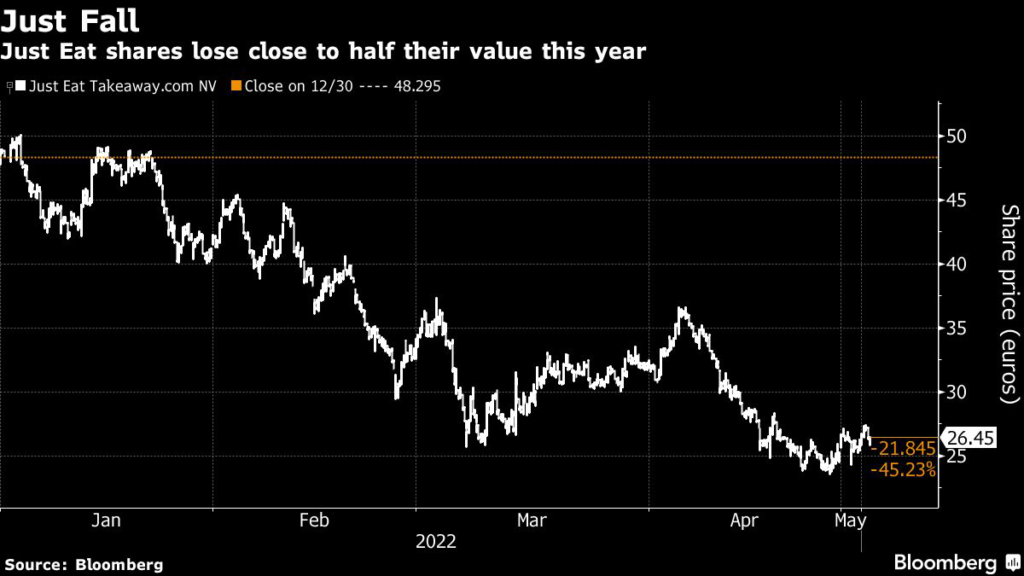
Just Eat shares have fallen 49% year-to-date, dropping as much as 8.8% in Amsterdam on Wednesday, and the announcements plunge the food delivery company into further chaos. 

The company recently faced criticism for holding a company-wide annual skiing trip. Some 5,400 staffers arrived at the village of Arosa, Switzerland, for four-day shifts on the slopes at the event last month, at a time when investors were publicly attacking the company’s strategy.  

Cat Rock Capital Management LP, which owns about 6.9% of Just Eat, has urged shareholders to vote against the delivery company’s Chief Financial Officer Brent Wissink and supervisory board at the AGM citing a “complete loss of trust” in management. Other investors such as Lucerne Capital Management have also said they planned to vote similarly.

However, Wissink was re-elected alongside Chief Executive Officer Jitse Groen and the remaining members of the supervisory board at the meeting on Wednesday. 

The share-price collapse is a dramatic reversal for Groen, who founded his company in 2000 as a college student before dropping out. Previously worth just over 17 billion euros ($17.9 billion) in 2021 due to a boost from the pandemic, its market value has fallen to just 5.5 billion euros. 

Just Eat said in April that it’s exploring a sale for Grubhub, less than a year after completing an acquisition for it worth $7.3 billion. The company also pared its projections for growth this year in a late April report, and said orders on its platform rose less than expected at the start of 2022.


Shareholder proxy services Institutional Shareholder Services Inc. and Glass Lewis had also recommended voting against the re-election of supervisory board chairman Nuhn over the board’s lack of gender diversity, and environmental and social governance, respectively. 

Just Eat announced in January that board member Gwyn Burr will step down after the shareholder meeting, leaving a board that is 17% female, according to ISS. 

A Bloomberg Data analysis of companies that have disclosed gender per board member found that about 38% of directorships for Europe’s Stoxx 600 companies are held by women. In the IT sector, that rises to about 40%.

(Updates throughout with shares and context from AGM. A previous version corrected timing of AGM in last paragraph.)

More stories like this are available on bloomberg.com

©2022 Bloomberg L.P.

MTA Short $1 Billion to Expand NYC Transit-System Cameras

(Bloomberg) — New York City’s transit network, the largest in the U.S., needs $1 billion to expand and update camera systems throughout its subways, buses and commuter rail lines, the head of the Metropolitan Transportation Authority wrote in a letter to Congress.

The MTA calculates it will cost $1.3 billion for the surveillance upgrades across its transit system, but it’s short $1 billion, Janno Lieber, the agency’s chief executive officer, wrote in a May 2 letter to U.S. House members. The lawmakers had asked for information last month on how the MTA uses federal funds for safety programs.

The MTA’s 2020-2024 capital plan, which finances repairs, infrastructure upgrades, expansion projects and accessibility initiatives, includes $250 million for cameras throughout the subway and $120 million to enhance the fiber optic network, Lieber wrote.

Lieber didn’t specifically ask Congress to cover the $1 billion shortfall, but highlighted the benefits of better surveillance.

Related: N.Y. MTA Watchdog Starts Inquiry Into Cameras After Shooting 

“This significant investment will allow us to upgrade our systems so all cameras stream live to a command center,” Lieber wrote. “It also will introduce cameras in additional areas of subway stations and at commuter rail stations.”

House members requested more information about the MTA’s surveillance system after cameras at three subway stations failed to transmit feed on April 12 to the agency’s command center and the New York Police Department, the day a man opened fire on a Manhattan-bound N train, injuring at least 23 people.

A problem with the fan unit was preventing video from transmitting, Lieber wrote. The MTA had been working on the issue since April 8, days before the shooting. Video from other subway cameras helped identify the suspected shooter.

The MTA has added 4,000 cameras in the subways in the past four years, and now has more than 10,000 in all of its 472 subway stations.

More stories like this are available on bloomberg.com

©2022 Bloomberg L.P.
Bitcoin Tests $39,000 in Push Toward High End of Trading Range

(Bloomberg) —

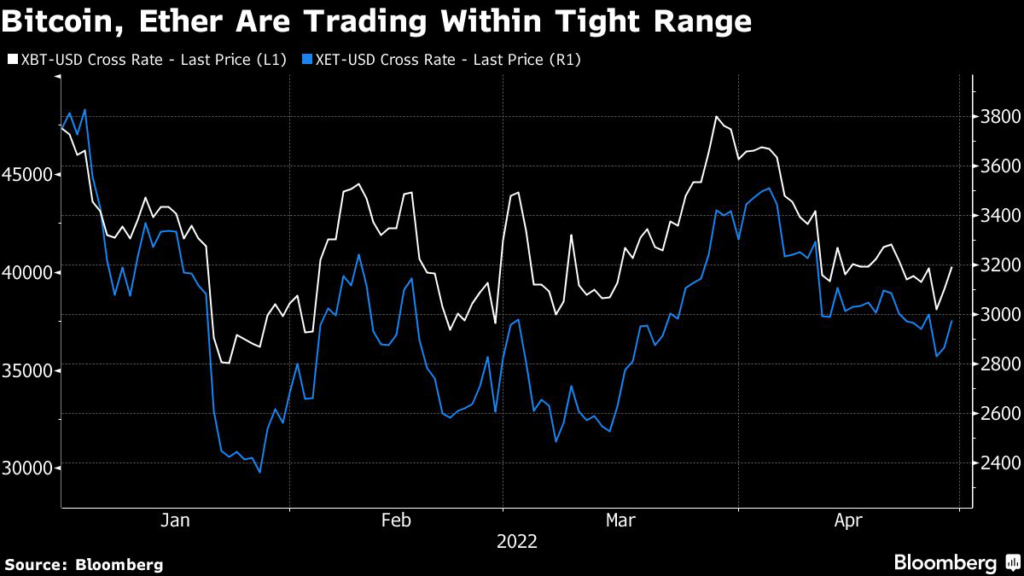
Bitcoin rose ahead of a highly anticipated interest-rate decision by the Federal Reserve, helping to push the coin toward the higher end of the range it’s been trading in for much of the year. 

The world’s largest cryptocurrency rose as much as 3.6% to $39,151 in early New York trading, a percentage move that passes for excitement for the token these days. The digital currency has swung within a 5% band for eight trading sessions in a prolonged calm not seen since the start of the year.

“Everything in crypto, I think, is more muted right now,” said Antonio Juliano, founder and chief executive of dYdX, a decentralized trading platform that focuses on perpetual swaps.

Crypto assets, just like other riskier areas of the market, have all been weighed down as the Fed and other global central banks raise interest rates to fight red-hot inflation. Market-watchers on Wednesday were bracing for the biggest Fed rate hike since 2000 and were awaiting more clues on how aggressively the central bank will try to tackle inflation.

In this environment, Bitcoin hasn’t been able to break out in any meaningful way beyond the highs it came into the year with. 

“Right now, the market is basically stuck in a range for the most part,” Dan Gunsberg, co-founder of Hxro Network, said by phone. 

Money has been flowing out of the sector amid the malaise. Investors yanked roughly $120 million from crypto products last week, bringing total outflows over the past four weeks to $339 million, according to data tracked by fund provider CoinShares. Bitcoin last week accounted for the majority of the flows in what was its largest single week of outflows since June 2021. 

Elsewhere, data from CoinGecko shows that the price of ApeCoin, the native crypto token of Yuga Labs’ APE ecosystem, rallied 17% intraday Wednesday after Elon Musk changed his Twitter display picture to that of a collage of Bored Apes. 

Yuga Labs, creators of the Bored Ape Yacht Club collection of NFTs, had recently auctioned virtual land on ‘Otherside’, its metaverse project. The sale raised netted Yuga $320 million but also led to huge congestion and high transaction fee on the Ethereum network over the past weekend.

The token price of ApeCoin fell from its Sunday highs of $22 to $14.50 per token on Wednesday before jumping to $17.16 after the Tesla CEO changed his profile picture.

(Updates with prices throughout; adds Juliano comment; adds CoinShares data.)

More stories like this are available on bloomberg.com

©2022 Bloomberg L.P.

Match Slumps to Record Low as CEO Leaves and Results Disappoint

(Bloomberg) — Shares of Match Group Inc. fell to a record low after Chief Executive Officer Shar Dubey announced she is stepping down from her role at the end of the month and the company reported results that disappointed analyst forecasts.

Dubey spent 16 years in various roles at Match, though her tenure as CEO has been short. She took up the role in March 2020 when Mandy Ginsberg stepped down just months before Match was spun off from IAC/InterActive Corp. Match said Dubey’s decision was “entirely personal.” Zynga Inc. President Bernard Kim will succeed her. 

“At the time it made sense for me to step up and provide the continuity and help guide the company through that process,” Dubey said on a call with analysts Wednesday morning. “I had told the board then that I couldn’t commit to being a long-term CEO because where I was at my life and the things I wanted to do.”

Shares of Match declined as much as 12.3% Wednesday to $69.28 in early New York trading, their lowest levels since being spun out of IAC in July 2020. The announcement of Dubey’s resignation comes as Match gave a forecast for revenue that missed analysts’ estimates and announced a share buyback. Dubey will continue to serve as a director on the board and as an advisor, Match said in a statement. 

Kim will be charged with turning around the prospects at Match, whose shares are down more than 40% this year, outpacing the 12% decline in the S&P 500. Kim is joining after more than five years as president at mobile gaming publisher Zynga, the maker of FarmVille, where he helped the company expand into new markets such as blockchain and hyper-casual gaming, as well as into new devices like the Nintendo Switch and Snapchat. 

As a result of some of those initiatives, Zynga’s market value quadrupled between the end of 2015 and the end of 2020, leading to its pending acquisition by Take-Two Interactive Software Inc. for $11 billion, which was announced in January. Kim earlier worked for 10 years at Electronic Arts Inc. as a senior vice president of mobile publishing, Match said in the statement.

Challenging Environment

The Dallas-based company, which owns apps such as Tinder, Hinge and OKCupid, said in a letter to shareholders that it expects revenue of $800 million to $810 million in the second quarter, well below analysts’ estimates for revenue of $835.2 million. Match said the 13% to 14% increase reflects “the impact of the challenging current macroeconomic environment.”

The company said it is expecting adjusted operating income of $285 million to $290 million, including an estimated $6 million of negative impact from Google’s data privacy changes effective June 1. Match estimates it may face an additional $42 million in charges this year if Google forces apps to use its payment system.

Full-year revenue growth will be toward the bottom of the 15-20% range previously guided, taking into account a strong dollar and the war in Ukraine, Match Chief Financial Officer Gary Swidler said on the call.  

“There is a lot of uncertainty – the macro negatives but also potential positives, particularly around post-Covid reopening around the globe – that make forward visibility challenging,” the company said.

In the first quarter, Match said the total number of payers on the site grew 13% to 16.3 million, in line with analysts’ estimates. The company reported revenue of $799 million, up 20% and beating the average analyst estimate of $791.2 million. Earnings per share were 60 cents, better than projections for 54 cents. The company also announced the board has authorized a buyback of as many as 12.5 million outstanding shares.

Match and its competitor Bumble Inc. have struggled with the ups and downs of Covid-19 infections, especially in Central Europe and Asia, where many countries still have onerous restrictions in place. Dating apps have seen activity decrease as people stay away from public interactions and also increase when people sought out connections online. The pandemic forced dating apps to experiment with new ways for users to connect, such as video dates and audio prompts that substituted for in-person meetings. Early in 2021, Match acquired South Korean video technology company Hyperconnect, which the company is integrating in to its apps.  

Match also experimented with an in-app virtual currency in a dozen countries, saying earlier in the year that it planned to roll the coins out globally by the third quarter. 


(Updates with quote from Dubey in third paragraph and full-year outlook in ninth-10th paragraphs)

More stories like this are available on bloomberg.com

©2022 Bloomberg L.P.

Didi Leads Slump in U.S.-Listed Chinese Shares Amid SEC Probe

(Bloomberg) — Didi Global Inc. led a drop in U.S.-listed Chinese internet stocks after news of a U.S. Securities and Exchange Commission investigation into the ride-hailing company’s 2021 debut in New York added to investor concerns around the sector.

Didi shares dropped as much as 6% on Wednesday, extending a decline of more than 60% this year with $59 billion market value wiped out since its initial public offering last summer. Among other large-cap Chinese tech stocks, Alibaba Group Holding Ltd. fell 2.2% and JD.com slid 3.2%. The Nasdaq Golden Dragon China index is down as much as 3.1%, ending a recent rally fueled by Beijing’s pledge to boost economic growth and support tech firms. 

Read more: Didi Faces SEC Probe Into Turbulent $4.4 Billion U.S. IPO (1)

A May 2 filing showed that Didi is facing a SEC probe into its controversial IPO, which has already been under scrutiny by Beijing regulators. Didi’s future is in limbo, as senior Chinese officials are said to regard a proposed cybersecurity penalty as too lenient, leading the company to suspend its plan for a Hong Kong listing when it prepares to depart New York bourses.

The news dealt a fresh blow to Chinese tech, a sector that investors are increasingly avoiding amid delisting risks and concern over an economic slowdown.

(Updates with share moves at open and adds Golden Dragon China Index)

More stories like this are available on bloomberg.com

©2022 Bloomberg L.P.
At 78, Investor Preps for ‘Biggest Bear Market in My Life’ 

(Bloomberg) — David Wright knows a thing or two about bear markets.

His Sierra Tactical All Asset Fund barely lost anything in 2008 as the global financial crisis caused the worst market panic since the Great Depression. Its loss during the Covid rout of 2020 was also relatively small. Wright, who is based in Santa Monica, California, says another private fund he runs didn’t lose a penny when the dot-com bubble burst two decades ago.

But none of those periods compare with what’s ahead, according to Wright. Stocks and bonds have already fallen hard in 2022. Much more is coming, the 78-year-old said in an interview.

“I believe we are in the biggest bear market in my life,” said Wright, co-founder of Sierra Investment Management, which oversees about $10 billion. “This is just the second inning. A lot more to come.”

There are no shortage of bears making similar claims these days. Between the Russia-Ukraine war, the aggressive tightening by the Federal Reserve, soaring inflation and Covid lockdowns in China, there are plenty things to worry about. The S&P 500 has already lost 12% this year, while the Nasdaq Composite cratered into a bear market after sliding more than 20% from its peak in November. Key bond benchmarks are down more than 10%. 

Mostly Cash

But what’s unique about Sierra is its aggressive approach to shed risk. The $869 million Sierra Tactical All Asset Fund — a so-called fund of funds that invests in mutual funds and exchange-traded funds, held less than 3% in U.S. stocks at the end of April. More than half of the fund is in cash. Fixed-rated bonds accounted for only 1% of its holdings, while commodities made up more than 9%. The rest of the portfolio is spread across assets including floating-rate bonds, foreign stocks and master limited partnerships.

It’s paying off this year. The fund has lost 2.3% in 2022, beating 91% of its peers tracked by Bloomberg. 

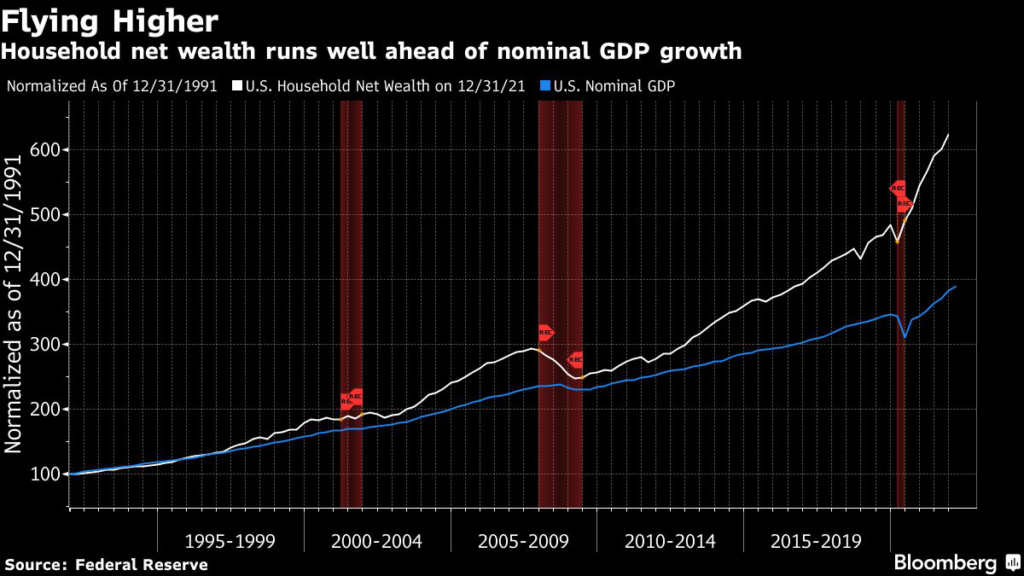
What’s underpinning Wright’s bearishness isn’t the Fed, inflation or the war. It’s the zealous behavior of investors during the past few years that sent everything from meme stocks to cryptocurrencies soaring. The stock market gains helped U.S. household wealth balloon to a record $150 trillion, or more than six times the size of the American economy, according to data compiled by the Fed.

“There’s no other country on earth that has staked so much of their net wealth in stocks,” said Wright, who co-founded Sierra Investment with Kenneth Sleeper in 1987. “But we are at a very big peak of complacency.”

Using computer models, the Sierra fund, which Wright manages with Sleeper and Douglas Loeffler, sets trailing stop losses for its holdings. Once prices fall to those preset levels, the fund liquidates the holdings and moves to cash or other assets that are trending up. It targets retirees and other investors who want to minimize risk.

Such a conservative approach helps it limit losses in a market downturn. But it also hurts performance when the market goes straight up — which it mostly has since the 2008 crisis. The fund returned 2.4% annually over the past five years, compared with an average gain of 5% among its peers, according to data compiled by Bloomberg. A portfolio made of 60% stocks and 40% bonds has returned 9% a year during the same period. 

Wright didn’t specify the amount of losses he thinks are ahead, but pointed out that significant retreats in the 1970s and 1980s didn’t end until the market’s price-to-earnings ratio dropped below 10. Currently, while the S&P 500’s 12-month trailing P/E ratio has dropped to 21, from 32 in March 2021, it is still above the average of 19 over the past two decades.

“Young people have no clue what the downside might be, what causes drawdowns and how far it can go,” said Wright, one of the top 100 independent financial advisers, according to Barron’s.

(Adds Wright’s location in 2nd paragraph, updates the fund’s size in 6th paragraph and the performance of its peers in 11th paragraph.)

More stories like this are available on bloomberg.com

©2022 Bloomberg L.P.

Close Bitnami banner
Bitnami
