Bloomberg

Crypto Wunderkinds Secure $85 Million to Start Own Hedge Fund

(Bloomberg) — A couple of up-and-coming crypto market participants are starting a hedge fund that will focus on a “long-only” strategy after receiving $85 million in funding from some of the sector’s most prominent proponents. 

Ryan Watkins, a 25-year-old former analyst at Messari Inc., and 26-year-old Daniel Cheung, who worked at Jennison Associates LLC, said they’ve formed Pangea Fund Management. They said they’re being backed by investors that include Bain Capital and ParaFi. Other participants in the funding round include Brad Burnham, co-founder of Union Square Ventures, Apollo Global Management co-founder Josh Harris, as well as “crypto natives” such as Do Kwon from Terraform Labs, Alameda Research and Multicoin Capital’s Kyle Samani.   

“Our thesis is that in the long run, there’ll be very few winners in each category” within crypto, Watkins said in an interview. “So for us, we’d much rather bet on some of the early winners we’re seeing.”         

According to Watkins, who joined market intelligence provider Messari in 2019, existing funds in crypto are divided into two buckets: hedge funds who trade mostly Bitcoin and Ethereum and venture funds who focus on early-stage projects. 

Pangea’s strategy is focused on taking long positions in three to seven established tokens, Watkins said, which makes the fund unique in the current market when a vast amount of interest from crypto venture capitalists is concentrated in investing in new projects.

“On the early-stage side, every other week, there’s another billion-dollar-plus funding raised,” Watkins said. “They all are investing in private markets with inflating valuations.”

Watkins is an advocate for crypto decentralization. He said the fund’s concentration in just a few tokens will also allow it to focus on supporting an important element of decentralization: projects’ governance.

“As these projects start to mature over time, in order for founders to credibly claim that their products are decentralized, they need to give power to community,” Watkins said. “But the only way that works is if you have members of the community to step up and take leadership roles.”  

More stories like this are available on bloomberg.com

©2022 Bloomberg L.P.

Lockdown Winners From Peloton to Zoom at Risk Even After $218 Billion Rout 

(Bloomberg) — The brutal selloff in Covid-19 lockdown winners may not be over yet.

After losing more than $218 billion in combined market value since their pandemic-driven boom, shares of Peloton Interactive Inc., Zoom Video Communications Inc. and DocuSign Inc. are at risk of even more losses, if this earnings season is any guide. 

First-quarter results for stay-at-home stocks kicked off with an alarm bell when Netflix Inc. plunged 35% after saying it had lost customers for the first time in a decade. And last week, shares in telemedicine company Teladoc Health Inc. had their worst day ever, tanking 40% after the company slashed its forecast amid a slowdown in sales.

“If you were to take a basket of pandemic winners, it would certainly include names that got overvalued and deserved to be hit,” said Michael Scanlon, who manages the John Hancock Balanced Fund.

Analysts have cut estimates for stay-at-home winners, with full-year earnings forecasts slashed by nearly 40% for home fitness equipment maker Peloton over the past quarter. Estimates for video conference provider Zoom have been cut by 20% while those for electronic-signature company DocuSign have been reduced by 7.6%, according to data compiled by Bloomberg. 

After meteoric rallies in 2020 as lockdowns kept consumers at home, shares in pandemic darlings have suffered amid vaccine rollouts, return to office mandates and people going back to brick-and mortar stores.

“Many of the names are recognized as the winners during the pandemic but frothy expectations are being priced out completely in these stocks,” said Peter Garnry, head of equity strategy at Saxo Bank.

Still, with estimates coming down, an earnings beat or positive commentary from any of the stay-at-home group could support shares. Paypal Holdings Inc. rallied after reporting a better-than-expected first quarter, despite cutting its full-year outlook, with analysts saying that the guidance reset makes the path to future outperformance clearer.

And analysts’ price targets suggest they haven’t given up on the pandemic winners-turned-losers yet. Peloton’s shares are expected to more than double in the next 12 months, while Zoom has a return potential of 56% and DocuSign is expected to climb 25%, according to data compiled by Bloomberg.

For Wedbush Securities analyst Dan Ives, there’s a difference between the “have and have nots” in the tech sector in the current environment of tightening monetary policy and a possible recession. He prefers product-driven companies like Apple Inc., software providers like Microsoft Corp. and cybersecurity stocks. 

“The work-from-home poster children such as Netflix, Zoom, DocuSign, etc. will continue to see multiples compress as results soften off pandemic highs,” he said in a May 3 report. Ives downgraded DocuSign to a sell-equivalent rating.

Tech Chart of the Day

Treasury yields have been rising throughout 2022, putting pressure on the most expensive names within tech, which are often priced on growth expected in the distant future. A Goldman Sachs basket of software stocks with enterprise values of at least 8 times sales fell 2.2% on Tuesday, with the index losing half of its value since a November peak.

Meanwhile, the U.S. 10-year yield has gone from a low of about 1.3% in December to nearly 3% today, around its highest level since 2018. This comes amid what is expected to be a series of Federal Reserve rate hikes. The central bank is widely expected to deliver a 50 basis-point increase today.

Top Tech Stories

  • Didi Global Inc. led a drop in U.S.-listed Chinese internet stocks after news of a U.S. Securities and Exchange Commission investigation into the ride-hailing company’s 2021 debut in New York added to investor concerns around the sector
  • Lyft Inc. shares plunged after a weaker-than-expected outlook sparked investor concerns that a planned increase in spend on driver incentives could weigh on profits
  • Airbnb Inc. gave a forecast for revenue in the current quarter that easily surpassed Wall Street’s estimates as the company sees “substantial demand” for travel heading into the busy summer season after more than two years of Covid-19 restrictions
  • Just Eat Takeaway.com NV is facing a full-scale crisis after the company launched an internal investigation into its chief operating officer, and its chairman stepped down after an investor revolt
  • Advanced Micro Devices Inc. gave a strong sales forecast for the current quarter, indicating that the chipmaker continues to make strides in its most lucrative market: data-center processors

(Updates potential return values in the ninth paragraph.)

More stories like this are available on bloomberg.com

©2022 Bloomberg L.P.

New York Times Credits Wordle for Record Growth of Game Subscribers

(Bloomberg) — The New York Times Co. added a record number of subscribers for its games product in the first quarter thanks to its recent acquisition of Wordle.

The Times bought the popular daily word game in January. While Wordle remains free, it “brought an unprecedented tens of millions of new users to the Times,” Chief Executive Officer Meredith Kopit Levien said Wednesday. Many of the new users stayed and signed up for games subscriptions, which include crossword puzzles.

The growth in games helped drive the addition of 387,000 digital subscribers in the quarter. That number also included customers for The Athletic, a sports media website that the Times bought in February. The media company said Wednesday that it will begin selling subscriptions to The Athletic as part of a bundle with its other standalone products in the second half of this year. The Times views bundling — or selling multiple products at a discounted price — as a key part of its strategy for adding more subscribers.

“That’s the opportunity we’re most excited about,” Levien said on an earnings call with analysts.

The Times has used games and other non-news subscriptions such as recipes and shopping advice to diversify its business. That allows the company to rely less on the constant fluctuations of the news cycle. Readership has been strong lately due to heightened interest about the war in Ukraine, which also helped bolster subscriptions, the Times said. 

Total revenue grew 14% in the quarter to $537 million, falling short of analysts’ estimates of $543 million. Adjusted earnings per share of 19 cents topped Wall Street’s expectations of 18 cents.

The Times now has 9.1 million subscribers. The company is targeting 15 million subscribers by 2027.

More stories like this are available on bloomberg.com

©2022 Bloomberg L.P.

Wordle Brought ‘Tens of Millions’ of New Users to the New York Times

(Bloomberg) — The New York Times Co. added a record number of subscribers for its games product in the first quarter thanks to its recent acquisition of Wordle.

The Times bought the popular daily word game in January. While Wordle remains free, it “brought an unprecedented tens of millions of new users to the Times,” Chief Executive Officer Meredith Kopit Levien said Wednesday. Many of the new users stayed and signed up for games subscriptions, which include crossword puzzles.

The growth in games helped drive the addition of 387,000 digital subscribers in the quarter. That number also included customers for The Athletic, a sports media website that the Times bought in February. The media company said Wednesday that it will begin selling subscriptions to The Athletic as part of a bundle with its other standalone products in the second half of this year. The Times views bundling — or selling multiple products at a discounted price — as a key part of its strategy for adding more subscribers.

“That’s the opportunity we’re most excited about,” Levien said on an earnings call with analysts.

The Times has used games and other non-news subscriptions such as recipes and shopping advice to diversify its business. That allows the company to rely less on the constant fluctuations of the news cycle. Readership has been strong lately due to heightened interest about the war in Ukraine, which also helped bolster subscriptions, the Times said. 

Total revenue grew 14% in the quarter to $537 million, falling short of analysts’ estimates of $543 million. Adjusted earnings per share of 19 cents topped Wall Street’s expectations of 18 cents.

The Times now has 9.1 million subscribers. The company is targeting 15 million subscribers by 2027.

More stories like this are available on bloomberg.com

©2022 Bloomberg L.P.

Lyft Plunges on Disappointing Outlook, Weighs on Uber

(Bloomberg) — Lyft Inc. is poised to lose more than a quarter of its market value on Wednesday after the ride-hailing company’s second-quarter outlook disappointed Wall Street, highlighting investors’ willingness to dump growth stocks at the first hint of trouble. 

The San Francisco-based company’s shares fall as much as 29% to $21.90 in New York. The decline is the stock’s steepest-ever drop in a single session, and marks a descent of 72% from the record-high of $78.29 touched in March 2019.

“There’s no room for error in this environment, but still, this selloff seems overdone,” Piper Sandler analyst Alexander Potter wrote in a note.


The gloom from Lyft’s results also spread to its larger and more diversified peer, Uber Technologies Inc., which was lower premarket despite reporting strong revenue for the first quarter and delivering an upbeat outlook on Wednesday morning. Uber resumed declines at the open, falling as much as 10%. 

Uber was initially due to report postmarket on Wednesday, but the company in a statement released Tuesday evening said it was rescheduling the release of the results and its quarterly conference in order to provide a “more timely update” to its performance and guidance.

Lyft said it expects revenue of as much as $1 billion in the second quarter, and sees earnings before interest, tax, depreciation and amortization of $10 million to $20 million in the period. Both were lower than analysts expected. At the same time, the company plans to increase its spending on driver incentives. 

“This investment phase was not calibrated into our initial expectations for 2022 and likely caught many off guard,” Northcoast Research analyst John Healy wrote in a note. Healy lowered his price target on Lyft to $35 from $65.

Both Lyft and Uber were hard hit during the pandemic as shutdowns slammed the brakes on demand. But now, even with riders returning, the stocks are getting punished as investors grow increasingly wary of expensive and riskier growth assets amid concerns about inflation and a possible economic slowdown. 

(Updates stock moves in second and fourth paragraphs, updates chart, adds Northcoast comment in seventh.)

More stories like this are available on bloomberg.com

©2022 Bloomberg L.P.

Rio Hedge Fund Adam Stung by Selloff in Worst Month Since Launch

(Bloomberg) — One of Brazil’s best-known hedge funds saw an unprecedented rout last month, bucking gains for peers amid the selloff in U.S. stocks.

Adam Capital’s flagship fund Adam Macro II FIC fund slumped 7.3% in April, the biggest monthly decline since it was launched by veteran investor Marcio Appel in 2016. That compares to a 1.4% gain for a basket of local peers and a 0.8% increase for the CDI benchmark rated used by the industry, according to data compiled by Bloomberg. 

“Our portfolio suffered with the magnitude of the correction, as well as the loss of correlation between some asset classes,” the fund wrote in a monthly note this week. “A reduction in some positions was needed.” 

Adam, which is based in Rio de Janeiro, didn’t say which trades contributed most to losses, but a note published in early April mentioned it had wagers both in the U.S. and Brazil stocks. Appel recently said in a podcast that he owned a basket of U.S. stocks, including cloud computing firms. The position was partly hedged by a short in the S&P 500 Index.

Adam declined to comment beyond the monthly note. 

Read More: Downfall of Star Hedge Fund Reveals Brazil at Tipping Point

The S&P 500 saw its biggest monthly drop since the onset of the pandemic in April, hurt by underwhelming guidance from large tech firms and with the Federal Reserve on track to deliver its biggest rate hike since 2000. The tech-heavy Nasdaq 100 Index was also hammered, falling the most since 2008. 

The asset manager oversees over 8 billion reais ($1.6 billion) and was founded in 2016 by Appel and Andre Salgado, industry veterans from Banco Safra SA and Banco Santander’s Brazilian unit. The firm quickly became one of the country’s largest independent hedge-fund managers, but struggled with redemptions last year amid waning appetite for riskier products. 

More stories like this are available on bloomberg.com

©2022 Bloomberg L.P.

Ukraine Latest: EU Plans Oil Ban as Putin Seeks to Cement Gains

(Bloomberg) — The European Union proposed a ban on Russian crude oil phased in over the next six months, part of the bloc’s sixth package of sanctions as President Vladimir Putin seeks to cement military gains in Ukraine.

Germany threw its weight behind the EU plan, though Hungary said it won’t back the proposal as it stands and other nations asked for more flexibility. The Kremlin called the measure a “double-edged sword” as it will impact households. The EU is also proposing to cut off Sberbank and other lenders from the international SWIFT messaging network used by financial institutions.

Russia’s war in Ukraine is nearing the 10-week mark. Having failed to achieve a quick victory, Moscow is focused on reinforcing both military and political control over territory taken so far, according to people familiar with the Kremlin’s thinking.

(See RSAN on the Bloomberg Terminal for the Russian Sanctions Dashboard.)

Key Developments

  • Russia Seeks to Annex Occupied Ukraine as Invasion Goals Shift
  • EU Squeezes Harder on Russia, Sweeping in Oil, Bank and Business
  • EU Aims to Target Russia’s Global Oil Sales With Insurance Ban
  • Russian Oil Embargo Risks More Inflation Trouble for Europe
  • Germany, Netherlands Push North Sea Drilling to Shun Russian Gas

All times CET:

EU Tussles With Holdouts Over Latest Sanctions (3:10 p.m)

EU diplomats discussed the sixth package of sanctions Wednesday, with Hungary objecting to the oil phase-out timing. Greece, Malta and Cyprus raised questions about banning transport of oil between third countries, saying the move will just help Europe’s competitors, according to two diplomats. The diplomats aim to conclude the package by the end of the week, or by May 9 at the latest, the diplomats said.

Greece and Cyprus have large shipping industries while Malta is a so-called flag state, where companies can register their vessels for ownership purposes.

U.K. Bars Russia From Using Consultants (2:45 p.m.)

The U.K. cut Russia off from using management consultants, accountants and public relations firms, part of a further tranche of sanctions.

The government in London also announced additional measures against 63 Russian individuals and organizations, many of them targeting people connected to news outlets in an effort to punish what it called “the spread of lies.”

Portuguese Premier to Visit Kyiv Soon (2:30 p.m.)

Portuguese Prime Minister Antonio Costa announced he will travel to Kyiv in the near future to sign a “significant” financing agreement, part of the International Monetary Fund’s support for Ukraine.

“Regardless of the dynamics of the EU accession process, we have to provide immediate answers to the emergency needs of the Ukrainian state and the Ukrainian people,” Costa said.

EU Plans to Block Russians From Buying Real Estate (1:50 p.m.)

The EU added a ban on property transactions with Russian nationals to its latest sanctions. The European Commission’s proposal would halt property deals with Russian citizens, residents and entities — prohibiting the sale or transfer, directly or indirectly, of “ownership rights in immovable property located within the territory of the Union or units in collective investment undertakings providing exposure to such immovable property,” according to the legal text seen by Bloomberg.

EU Suggests Sanctioning Russian Patriarch Kirill (1:20 p.m.)

The EU is also proposing to sanction Patriarch Kirill, the head of Russia’s Orthodox Church, according to documents seen by Bloomberg and people familiar with the matter.

The list, which still needs to be approved by European governments and could change, also includes family members of President Putin’s spokesperson, Dmitry Peskov, as well a number of senior military personnel. Kirill is a long-time Putin ally and has become one of the most vocal supporters of Russia’s war. Sanctions need the approval of all member states and some Orthodox nations are reluctant to target a senior religious figure, one of the people said.

Kremlin Calls Oil Embargo ‘Double-Edged Sword’ (12:40 p.m.)

The EU’s plans to ban the import of Russian crude oil are a “double-edged sword,” the Kremlin said.

“In seeking to cause us harm, they also pay a high price,” Peskov told reporters on a conference call. “The price of these sanctions for EU citizens will increase every day.”

India Wants Russia to Discount Its Oil (11:39 a.m.)

India is trying to get deeper discounts on Russian oil to compensate for the risk of dealing with the OPEC+ producer as other buyers turn away, according to people with knowledge of the matter.

The South Asian nation is seeking Russian cargoes at less than $70 a barrel on a delivered basis to compensate for additional hurdles, such as securing financing for purchases, in high-level talks between the two countries, said the people.

EU Targets Russia’s Global Oil Sales (11:35 a.m.)

The EU is seeking to go beyond its proposed ban on Russian oil by also targeting Moscow’s ability to sell crude and refined products anywhere in the world.

The bloc is looking at banning European vessels and companies from providing services, including insurance, linked to the transportation of Russian oil globally, according to officials and a draft document seen by Bloomberg.

Oil Rallies on EU Proposal to Phase Out Russian Supply (11:25 a.m.) 

Brent futures rose as much as 3.8% to trade near $109 a barrel. The EU’s plan is the most significant energy response from the bloc to the war in Ukraine as it seeks to cut reliance on Moscow. Traders have been keenly focused on just how much the war will affect output from Russia, one of the biggest producers.

Hungary Skeptical of EU Oil Ban (10:45 a.m.)

The EU has yet to resolve Hungary’s concerns over the oil plan, according to Zoltan Kovacs, a spokesman for the Hungarian government. Hungary and Slovakia, which are heavily reliant on Russian energy, will be given until the end of 2023 to comply with sanctions, a year later than other member states, according to people familiar with the matter.

“We see no plan or guarantees in the current proposal to manage even a transition period nor what would guarantee Hungary’s energy security,” Kovacs said by phone on Wednesday.

Hungarian Energy Refiner Prepares for Russian Oil Curb (9:49 a.m.)

Mol, Hungary’s largest refiner, has already taken steps to prepare for EU sanctions on Russian oil, including by stocking up on supplies, its chairman and CEO, Zsolt Hernadi, told Telex news website.

Without access to Russian crude, output would drop by 20% at Mol’s refinery in Hungary and by 30% at its Slovak unit, due to the technological issues in processing other oil types, according to the CEO. Prime Minister Viktor Orban has threatened to block EU sanctions on Russian oil if they hindered Hungarian procurements from Russia.

Ukraine Says Russian Missiles Hit Transport Targets (9:40 a.m.)

Russian missiles targeted transportation infrastructure in eight regions of Ukraine late Tuesday, the General Staff of the Armed Forces said. Missiles hit railway electric grid equipment across the country, wounding several people. Russia is trying to use missiles to stop “new and powerful” weapons arriving to Ukraine from the West, President Volodymyr Zelenskiy’s chief of staff Andriy Yermak said Tuesday on Telegram.

Russia’s defense ministry appeared to acknowledge the strikes, saying its forces destroyed six power sub-stations near railway stations in Podbortsy, Lviv, Volonets, Timkovo and Piatikhatka, Tass news agency reported.

EU Proposes Phasing Out Russian Oil by the Year End (8:54 a..m.)

Hungary and Slovakia, which had been opposed to a swift cut-off of Russian oil, will be granted a longer timeframe — until the end of 2023 — to cut off Russian oil, according to people familiar with the matter. 

The move increases the stakes with Moscow as the EU, the single largest consumer of crude and fuel from Russia, seeks to pressure President Vladimir Putin. In 2019, almost two-thirds of the bloc’s crude oil imports came from Russia.

EU Proposes Sanctions on Main Belarus Potash Companies (7:58 a.m)

The move would see the bloc targeting Belaruskali OAO and its export arm, Belarusian Potash Co., according to a person familiar with the matter. The EU is also proposing sanctions on oil refinery Naftan.


All three companies provide significant revenue to President Alexander Lukashenko’s regime and have been previously sanctioned by the U.S. The EU and the U.S. have accused Belarus of aiding Putin in his invasion of Ukraine.

Belarus Calls Unexpected Drills After Lukashenko-Putin Talk (7:28 a.m.)

Belarus announced a “sudden check” of its military forces, the day after President Alexander Lukashenko had a phone call with Russian President Vladimir Putin where they also discussed Ukraine, according to RIA Novosti.

The country’s defense ministry doesn’t say how many troops will take part in the training, only that their size will “grow over time” and will involve moving “significant” amounts of military equipment. The statement doesn’t mention any involvement of Russian forces while claiming the drills threaten neither neighboring countries nor Europe.

Europe Stuck Pursuing Long-Term Gas Contracts (7:04 a.m.)

Europe is finding it next to impossible to put an end to the decades-long natural gas supply contracts it has opposed for years. The war in Ukraine is driving Europe’s energy firms to sign long-term deals to secure alternatives to Russian gas. The continent needs such agreements to fill the gap of losing supplies from Russia, its biggest provider of the fuel.

Europe’s Jobs Market Slows Amid War (6:30 a.m.)

There were fewer help-wanted advertisements in Europe on jobs-search website Indeed in the week to April 22 than there would have been had the pre-war growth trend continued. The survey adds to evidence that the war is weighing on the region’s economic recovery.

Australia Imposes Sanctions on Separatists in Ukraine, Russian Lawmakers (3:22 a.m.)

Australia expanded targeted financial sanctions and travel bans on a further 110 people, including Ukrainian separatists and Russian members of parliament. The measures target 34 senior members of the Russian-backed movements in Donetsk and Luhansk and 76 lawmakers of the state Duma. 

Zelenskiy Reports on Mariupol Evacuation (1:01 a.m.)

In his nightly video address, Zelenskiy discussed the evacuation from the besieged steel works in Mariupol. “We finally have the result, the first result, of our evacuation operation,” he said. “It took a lot of effort, long negotiations and various mediations. Today 156 people arrived in Zaporizhzhia.”

More stories like this are available on bloomberg.com

©2022 Bloomberg L.P.

Elon Musk, Twitter and the Attention Economy

(Bloomberg) —

Elon Musk wants to buy Twitter for $44 billion and Twitter’s board is going along with it.

It’s a remarkable move for the 50-year-old Musk, the rare CEO who already has his hands full running both Tesla Inc. and SpaceX, as well as the Boring Company and Neuralink.

Musk is a bona fide cultural icon, one who spent two decades steeped in Los Angeles celebrity culture before moving to Texas, where his empire is ever expanding. He is seemingly everywhere: guest hosting Saturday Night Live, speaking at the TED conference in Vancouver, rubbing shoulders with world leaders.

His favorite platform, of course, is Twitter, where he’s amassed roughly 90 million followers. Several employees at his companies have told me they follow him on the platform as it’s the quickest way to find out about business decisions or where his private plane is headed. Musk’s Twitter account is part of how Tesla disseminates information, a point the electric automaker regularly makes in regulatory filings.

Twitter has about 229 million monetizable daily active users, the vast majority of whom live outside of the United States. Twitter said that its first quarter growth and increased usage was largely “due to the war in Ukraine as people turned to Twitter to organize, share news, find sources of support and stay connected.”

In an attention economy, much of our value as consumers is measured by the time we spend on the site — liking memes, signal boosting information, clicking on links. During times of crisis and fast-moving world events, it’s an invaluable resource.Over 90% of Twitter’s revenue comes from advertising. Tesla doesn’t spend any money on traditional advertising. The Austin, Texas-based company does spend on marketing — lavish parties for customers and fans, like the recent Cyber Rodeo, do an enormous amount to spread the brand. User generated content — photos from the parties, fan videos on YouTube, a constant stream of Tesla chatter on Twitter — does the rest.

Assuming Musk can complete the ‘funding secured’ part of the deal, he’s poised to buy the platform where he’s a Super User. Musk says that Twitter will always be free for casual users, but there might be a “slight cost” for commercial and government users. So will Tesla have to start paying for its corporate tweets?

Musk also wants to grow Twitter’s user base. If he gets his wish, then more of us will be paying attention to him and his companies.

“Right now, it’s sort of niche,” Musk said of Twitter on Monday night at the Met Gala. “I want a much bigger percentage of the country to be on it, engaging in dialogue.”

There was a period when President Donald Trump was the loudest voice on Twitter. News organizations hung on his every word, and his tweets had the ability to move markets. Journalists struggled over what was actual news and what was just Trump being Trump. If the President tweets, is it automatically worthy of coverage? If Elon Musk makes a joke about buying Coca-Cola and cocaine, does that merit a news story? (Alas, several news organizations, including Bloomberg, wrote about it).

In Trump’s absence, Musk is the one that we all seem to be paying attention to. The richest man on the planet, the guy who builds electric cars and lands reusable rockets and flies astronauts to the International Space Station, is now planning to buy a social media platform. And nearly everyone who uses Twitter has feelings about him getting the keys to the kingdom.

I love Twitter, mostly for the climate scientists, activists, epidemiologists and scholars who have expertise. I’ll leave you with one thought from Ruth Ben-Ghiat, a professor of history at New York University who is an expert on fascism, authoritarianism, war, propaganda and Donald Trump.

“Advice from a historian of propaganda: Don’t fall for it! Musk is filling a space Trump used to occupy,” tweeted Ben-Ghiat. “His role/job is diff, but creation of more strife/garbage & swirling attention around himself, getting you to waste your time reacting to his ignorant opinions, is the same.”

Like getting this newsletter? Subscribe to  Bloomberg.com for unlimited access to trusted, data-driven journalism and subscriber-only insights.

More stories like this are available on bloomberg.com

©2022 Bloomberg L.P.

Biden Orders Quantum Computing Push as China Challenge Grows

(Bloomberg) — President Joe Biden will sign directives on Wednesday aimed at preparing the U.S for a new era of quantum computing, as Chinese agencies and companies pour billions of dollars into the next-generation technology.

The Biden administration wants America’s most vulnerable IT systems to adopt new cryptographic standards that can resist the potential threat of code-cracking posed by quantum computing, a nascent technology that does not yet exist at viable scale. 

Federal agencies will have to develop comprehensive plans to safeguard American intellectual property, research and other sensitive technology from acquisition by America’s adversaries, plus educate industry and academia on the threats they face, the White House said, without naming specific countries.

“America must start the lengthy process of updating our IT infrastructure today to protect against this quantum computing threat tomorrow,” according to a fact sheet the White House issued on the directives. A new national security memorandum “provides a roadmap for agencies to inventory their IT systems, with a requirement to set and meet specific milestones.”

Read more: Pentagon’s Outgoing Data Boss Warns of Quantum Cyber Threats

Washington and Beijing are locked in a race to develop the underpinnings of future technologies, from semiconductors and ultra-fast networking to quantum computers, which promise to exponentially multiply the power and speed of today’s processors. China is spending billions of dollars on quantum research and experts worry that the theft of encrypted data — some of which is intended to stay private for decades — could one day be cracked at scale.

In January, the Biden administration mandated national security systems to develop new algorithms to protect vital information, but much of the private sector and wider federal government has yet to explore the issue closely. The National Security Agency has predicted that shifting to new quantum-resistant cryptography could take 20 years.

The National Institute of Standards and Technology, or NIST, is shortly due to announce the winning quantum-resistant algorithms from a multiyear search, which is now down to seven finalists. 

In-Q-Tel, the CIA’s venture capital arm, is among those funneling capital into the arena. It’s invested in Google-spinoff Sandbox AQ, which is developing quantum-resistant software architecture that can accommodate the winning NIST algorithms. The company’s first round of fundraising reached “well into the nine figures”, Sandbox AQ Chief Executive Officer Jack Hidary told Bloomberg.

Read more: Sandbox AQ Gets Backing From CIA’s Venture Capital Arm

But scientists differ over when computationally relevant quantum computing will arrive, however, with estimates varying between five and 50 years, if at all. 

“I really believe that ‘never’ is highly unlikely,” Rob Joyce, director of cybersecurity at the National Security Agency, told Bloomberg in an interview. “We know it’s coming. It’s an engineering problem today. And the question is when, not if, a quantum computer emerges?” 

Joyce said it was important to start the transition to quantum-resistant algorithms early. “One of the challenges is we need to be secure against quantum-computing challenges of the future so that if one shows up in 20, 30 years, our information today is protected across that same lifetime,” he said.

Under Wednesday’s changes, NIST will establish a project to support the widespread migration in the U.S. to post-quantum cryptography, and work with industry to encourage broad adoption of the new standards.

The National Quantum Initiative Advisory Committee, an independent body of experts formed in 2020 to advise the federal government, will also now report directly to the White House rather than jointly to the Department of Energy.

A senior administration official said that effort was intended to foster promising applications in quantum information science, or QIS, saying recent developments in the field have “shown the potential to drive innovation across the American economy,” citing energy, medicine, computing, networking and sensing.

“Much like the earlier technological revolutions brought about by the Internet, GPS, and even the combustion engine, advances in QIS are poised to generate entirely new industries, well-paying jobs, and economic opportunities for all Americans,” the official added.

(Updated to include additional context from a senior administration official in final paragraph.)

More stories like this are available on bloomberg.com

©2022 Bloomberg L.P.

Texas Bitcoin Miners Seek Cheap Power, Land and a Place to Stay

(Bloomberg) — Bitcoin mining company Argo Blockchain Plc posted an unusual job opening a few months back: It needed a housekeeper in rural Texas to clean and maintain a five-bedroom home.

Companies like Argo, which mine coins by building giant computer arrays to solve complex math puzzles, are more used to staffing up with technicians and electrical engineers. But like other cryptocurrency miners that have descended on remote parts of Texas to feast on cheap electricity and inexpensive land, it found itself surrounded by dusty fields with hardly any residential housing. 

So Argo is building the facility at its data center 300 miles (500 kilometers) west of Dallas that will be office and living quarters for employees who come from out of town. The alternative in Dickens County, which is three-fourths the size of Rhode Island but has only 1,700 residents, are the modest hotels 20 miles away in Spur.

The challenges for industries operating in rural Texas is nothing new, of course, with oil and gas producers struggling for decades with how to accommodate workers in remote parts of the Permian and Eagle Ford basins. But learning how to operate in areas lacking basic services like restaurants, gas stations and hotels is a new endeavor for the crypto companies that have set up shop in Texas at a rapid pace since China last year banned miners from operating there.

“You can bring all these jobs to rural Texas, but then you have to be able to lodge these people,” said Collin McLelland, the chief executive officer of Digital Wildcatters, which hosts events to bring together energy industry executives with crypto miners. “It’s all the same issues of where do people live and having to invest in infrastructure.”

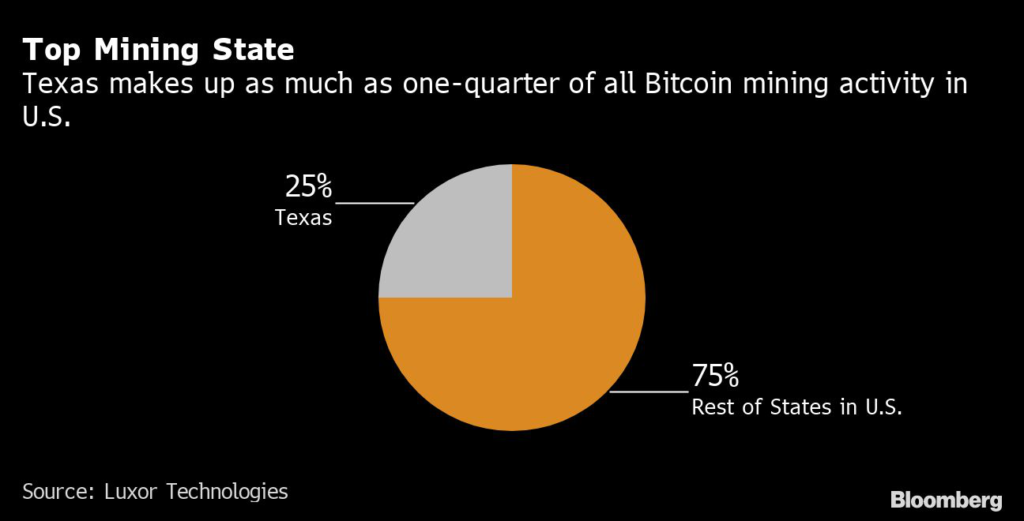
Crypto-mining companies are flocking to Texas to tap into cheap, plentiful electricity, generally their single biggest cost. But instead of honing in on big cities, they’ve preferred to set up near underutilized circuits flush with excess energy. Usually that means sites amid sparsely populated farm or ranchland, near towns with no more than a few hundred residents, a grocery store and a greasy cafe. Texas has the highest amount of mining activity among all states, making up as much as 25% of the U.S. total, according to estimates by Luxor Technologies, a mining platform.

The Mining Store, a Grundy Center, Iowa-based mining company, has plans to open a 33,000-square-foot facility in dry prairie about 100 miles north of Amarillo. With so little housing available, CEO J.P. Baric said the company will be buying or leasing houses for workers. Right now, whenever Baric visits he stays in a hotel that is a 45-minute drive away. He’s also looking at setting up trailers that technicians can use as living quarters.

Cormint Data Systems, based in New York, operates a 22-megawatt facility outside of Fort Stockton, some 200 miles east of El Paso. It signed a long-term lease on a four-bedroom house, paying $2,500 a month to have somewhere for workers to live. The company is also looking for residences to purchase. 

“The housing situation out there is tricky,” CEO Jamie McAvity said.

There are other obstacles beyond housing. Oftentimes, miners must upgrade local roads to accommodate the trucks they need to deliver industrial equipment. Matt Lohstroh, the owner of Giga Energy, which uses natural gas at well heads to mine Bitcoin, says his company has had to repair several county roads by a site about 30 miles outside Texarkana. 

Giga Energy operates seven shipping containers that contain more than 2,000 computers on its property. Out there, the closest business is a single gas station about 30 minutes away that also serves decent grub, according to Lohstroh. He and his colleagues often make a lunch stop to pick up burgers when they’re on site.

“All those ladies that work at the gas station recognize us,” Lohstroh said. “They know some of our guys by name.”

But that single gas station closes at 2 p.m. and you better bring cash — it charges 6% fees for using a credit card and there’s no way to pay at the pump.

Back in Dickens County, Argo is getting ready to begin operations in May after months of construction. The massive project has been a boon for local barbecue joint TC’s Ponderosa. Owner Nancy Hale said she’s bringing in an extra $200 a day in sales from the construction workers who pick up smoked meat sandwiches for lunch or dinner. She has also catered a couple events for Argo.  

Unfortunately for her, the miners enjoyed the restaurant so much that Argo poached its manager to fill the housekeeper job and do some cooking. Argo also hired two more people from TC’s — one as an administrative assistant and the other as a security guard. 

While Hale said she was sad to see her employees go, she was happy for them. Argo offered around $40,000 to $50,000 in salary, more than she could pay. 

“I was really proud they got a good paying job with benefits,” Hale said.

This might just be the beginning for Dickens County, where the per-capita income is just above $25,000 a year. County Judge Kevin Brendle — the chief administrator — said he’s been fielding inquiries from miners who are interested in tapping into the local grid.

“I’m getting calls from Bitcoin miners every time I turn around,” Brendle said.

More stories like this are available on bloomberg.com

©2022 Bloomberg L.P.

Close Bitnami banner
Bitnami