Bloomberg

Goldman Sachs Investment Manager Calls Out ‘Lazy’ ESG Tech Bets

(Bloomberg) — Relying on a specific sector such as tech to build an ESG portfolio has exposed investors to unnecessary losses, according to Luke Barrs of Goldman Sachs Asset Management.

The focus on tech has been a “kind of lazy approach” in environmental, social and governance investing, said Barrs, GSAM’s head of fundamental equity client portfolio management in EMEA and Asia ex-Japan, in an interview.

“It just became an easy trade where you got exposure to these high growth businesses that were doing very well and you can mask them as kind of ESG,” he said. “Where actually, when we think about ESG, ESG should not be a sector specific determination.” 

Instead, Barrs said GSAM is looking for “solution providers to environmental issues,” which includes areas like supply chains of electric vehicle makers, environmentally friendly farming and power usage for buildings. “Those are areas that I think are incredibly attractive long-term,” he said, declining to name specific stocks.

Read More: Amazon Defeats Drive to Unionize Second New York Facility 

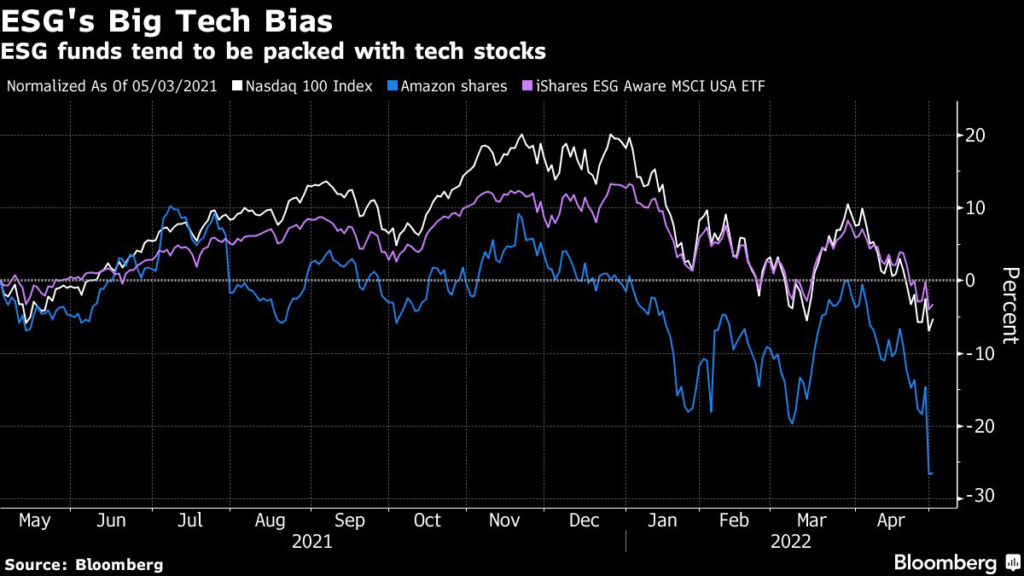
ESG investors who are overweight technology stocks have had a sobering start to the year, thanks in large part to a more hawkish Federal Reserve. The Nasdaq 100 Index is down by roughly a fifth of its value, with heavyweights like Amazon.com Inc. losing even more than that.


And yet, a lot of ESG funds continue to rely heavily on tech. BlackRock Inc.’s iShares ESG Aware MSCI USA ETF, the world’s biggest ESG exchange-traded fund, counts Amazon among its three biggest holdings, along with Apple Inc. and Microsoft Corp. It’s down about 15% this year.

Much of the appeal of tech has been tied to its “quite limited carbon intensity profile,” Barrs said. And despite obvious social concerns associated with some tech giants, “for the most part these are technologies and businesses that can help solve some social issues,” he said. “And so there’s an easy way of framing that.”

Meanwhile, there are signs that ESG investing clients may be growing dissatisfied with some of the poor returns they’re seeing. Jean-Xavier Hecker, JPMorgan Chase & Co.’s co-head of ESG equity research, said in March that some ESG investors have started to worry about a “potential missed opportunity.” That’s as non-ESG assets such as defense stocks and commodity prices have soared.

At the same time, there are indications of a broader sense of indifference to ESG among regular savers. A recent survey by Charles Schwab found that 66% of U.K. retail investors don’t care whether their allocations are sustainable, and instead only focus on maximizing returns. 

“Part of the reason you’ve seen material underperformance of some passive ESG solutions is they put deliberate screens and exclusionary frameworks in place to reduce exposure to, especially, carbon assets,” Barrs said. “There’s more flexibility or discretion an active manager can have to try and still build balance in a portfolio against the changing backdrop.”

Many investors are “very fee conscious and sensitive,” Barrs said, which favors passive strategies. But at some point, “people recognize the opportunity cost,” because a passive strategy may overlook risks, he said. 

More stories like this are available on bloomberg.com

©2022 Bloomberg L.P.

Crypto Crowd’s Secret Gala Convenes Outside Milken’s Gates

(Bloomberg) — No name tags and by invitation only, an exclusive cryptocurrency crowd gathered behind closed doors at the Waldorf Astoria’s Jean-Georges restaurant in Beverly Hills.

It was Medici LA 22, an event set up to connect crypto entrepreneurs and institutional investors amid the ballooning popularity of digital assets. The who’s who of crypto attended, with Mike Novogratz, chief executive officer of Galaxy Digital, Anatoly Yakovenko, co-founder of Solana and Rostin Behnam, chairman of the Commodity Futures Trading Commission, among the 130 or so at the two-day meeting. The goal was to generate “actionable investment ideas” in the digital asset world, according to a copy of the conference’s program seen by Bloomberg News.

And by some accounts, tickets for the event were hard to come by. A few hundred meters away, a separate confab was in full swing but some participants at the Milken Global Institute Conference — a mainstay event for the U.S. investing world — were wondering how they could get access to the parallel cryptocurrency gig. 

That’s even as Milken hosted its own digital asset offering — perhaps its most expanded yet — with several crypto-related panels, including two on the metaverse and one on digital nationalism. Crypto executives, investors and developers such as Brian Armstrong, CEO of Coinbase Global Inc. attended at the Beverly Hilton.

At the Medici event, Wall Street financiers in buttoned-up shirts and suits mingled with crypto developers in sneakers and T-shirts. The CFTC’s Behnam shared views from Washington, saying partnerships are being formed in the Senate and the House of Representatives over the industry’s future. Attendees came from companies such as BlackRock Inc., Goldman Sachs Group Inc., and Jane Street.

Other participants at the event, which began on Monday at a separate hotel, included Kanav Kariya, president of Jump Crypto, Mary-Catherine Lader, chief operating officer of Uniswap Labs, Adam Jackson, CEO of Braintrust and Mihailo Bjelic, co-founder of Polygon. Attendees, who didn’t have to wear name tags, discussed scaling and infrastructure, markets and DeFi, web3 and regulation and policy. Medici events are free for invited guests, according to the program. 

The Medici Network was set up about five years ago by Adam Winnick, founding partner of Finality Capital Partners and an early entrant into the crypto world. Winnick started his career on Wall Street at CIBC working on high-yield financing, according to his profile on LinkedIn. Michael Milken, the Milken Institute’s founder and billionaire “Junk Bond King” helped turn high-yield debt from a backwater of risky corporate debt into a trillion-dollar market. High-yield bonds had inspired Winnick, he said.

“At the time, high-yield bonds were a novel asset class that institutions could not buy. They were, however, an invaluable financial instrument for founders building new networks cable, mobile, fiber optics,” he said in the conference’s program. “Today, tokens are the novel instrument that are bootstrapping a whole new group of networks and we are proud to support that effort.”

The group’s optimism contrasts with the performance of crypto markets this year. Digital assets, just like other riskier areas of the market, have all been weighed down as the Federal Reserve and other global central banks raise interest rates to fight red-hot inflation. In this environment, Bitcoin hasn’t been able to break out in any meaningful way beyond its highs at the start of the year.

(Updates with details from meeting, market context from fifth paragraph.)

More stories like this are available on bloomberg.com

©2022 Bloomberg L.P.

Uber Sidesteps Lyft’s Debacle With Optimism Over Riders, Profit

(Bloomberg) — Uber Technologies Inc. delivered a positive outlook for earnings in the current period, signaling the company plans to capitalize on robust ride demand without compromising profits by focusing on product changes, rather than incentives, to address the driver shortage.

The ride-sharing and delivery company projected gross bookings of $28.5 billion to $29.5 billion in the second quarter and adjusted earnings before interest, tax, depreciation and amortization of $240 million to $270 million. The top end of both ranges beat the average analyst estimate. 

Uber’s rosy results contrasted with rival Lyft Inc., which delivered a disappointing outlook on Tuesday and signaled the shortage of drivers that has plagued both ride-hailing companies for the past year would spill over into the second quarter. Shares plummeted as much as 27% in extended trading after Lyft said it would ramp up spending on driver incentives to bring the number of drivers on its marketplace back into balance with resurgent rider demand. Uber shares were dragged lower by Lyft’s report, tumbling 3.8% in premarket trading after the results.

Uber’s guidance comes after revenue rose 136% to $6.9 billion in the first quarter, the company said Wednesday in a statement. That beat the $6.1 billion analysts had projected, according to data compiled by Bloomberg. Adjusted Ebitda earnings were $168 million in the quarter, surpassing the $135 million analysts expected. 

“After more than two years of persistent and sometimes unpredictable impacts to our business, our Q1 results make clear that we are emerging on a strong path out of the pandemic,” Chief Executive Officer Dara Khosrowshahi said in the statement.

Khosrowshahi said Uber’s driver base is at a “post-pandemic high” and that it expects engagement to continue “without significant incremental incentive investments.” 

Read more: Lyft Craters on Plans to Boost Spend for Driver Incentives

The driver shortage underscores the challenge of grappling with pandemic-induced swings in demand and reveals the fragility of a labor model ill-equipped to address them. By hiring drivers as independent contractors, ride-hailing companies were historically able to offer lower prices than traditional taxis. But the pandemic destabilized this workforce after demand for ride-share cratered and many found other jobs, were better off collecting unemployment benefits, or were more concerned about the risk of infection from being in close quarters with passengers. 

Unlike the speed at which customer demand has rebounded, luring back drivers and onboarding new ones to meet demand is taking more time and money than investors expected. After spending hundreds of millions last year to entice drivers back to the platform, a spike in gas prices when the war in Ukraine broke out dealt a blow to efforts, just as companies were scaling back bonuses.

Uber and Lyft, which reached profitability for the first time as public companies last year, are faced with balancing a post-pandemic recovery and profits after years of losses. 

The intensifying competition for labor is also revealing the different ways in which ride-hailing giants are tackling the issue. Uber said it has been making tweaks to the driver app, like unlocking the ability to see upfront fares before accepting a ride, improving maps and removing bugs. Rather than increase incentives, Uber plans to instead focus on its “holistic product experience as a way to attract, engage and retain earners,” Khosrowshahi said. 

Unlike Lyft, Uber was able to rely on its food-delivery business Uber Eats, which boomed during the pandemic just as ride share demand plunged. The delivery segment, which includes orders across restaurant, grocery and alcohol, has continued to grow despite indoor dining resuming, with bookings up 12% from a year ago to an all-time high of $13.9 billion.

Growth at Uber Eats has also helped funnel more drivers into its ride-hailing business. The ability to toggle between ferrying meals and people to make money has enticed drivers, many of whom shifted to food-delivery during the pandemic. “The success there has been very very significant,” Khosrowshahi said on a call with analysts on Wednesday. Active drivers in the U.S. and Canada increased 70% in April compared with last year, with new drivers jumping 121%, Khosrowshahi added.

“Having a multi-product marketplace really does provide tangible benefits in terms of driver retention, engagement and overall better marketplace liquidity,” said D.A. Davidson analyst Tom White.

In the three months ended Mar. 31, Uber reported $26.4 billion in gross bookings, which encompass ride-hailing, food delivery and freight, a 35% increase from the same period last year. Monthly active platform users reached 115 million, just below the 116.6 million analysts expected. 

Uber recorded a net loss of $5.9 billion due to unrealized losses from stakes in Didi Global Inc., Grab Holdings Ltd. and Aurora Innovation Inc. 

More stories like this are available on bloomberg.com

©2022 Bloomberg L.P.

Shaw Deal Arbitrage Gap Is Widest Since February After Selloff

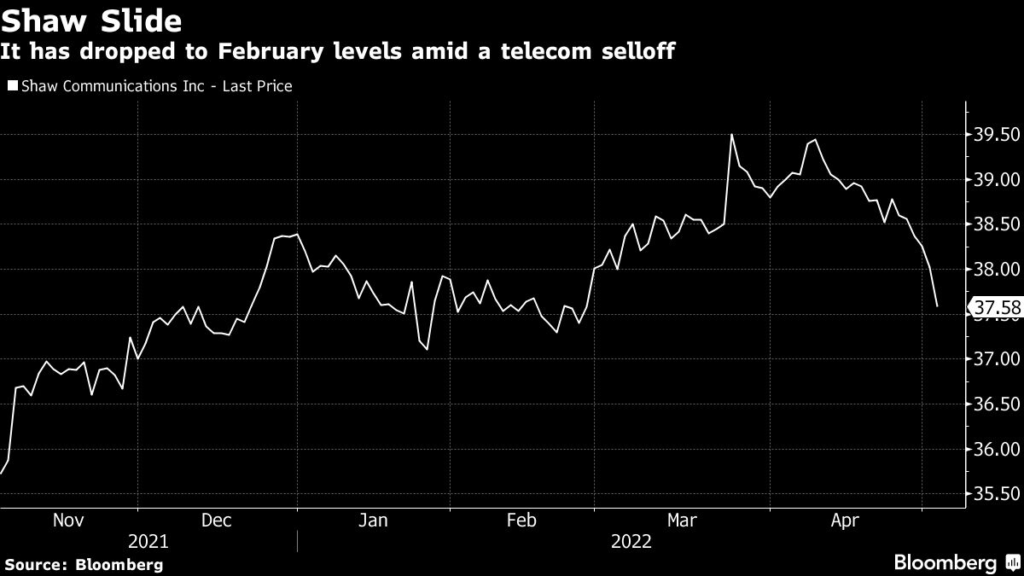
(Bloomberg) — Shares of Shaw Communications Inc. are trading 7% below the takeover price offered by Rogers Communications Inc., the biggest gap since February, as Canadian regulators prepare rulings on the deal.

Shaw has fallen six consecutive days in Toronto in a period of broad weakness in equity markets, closing at C$37.58 on Tuesday. Shares of Rogers and Canada’s other major telecommunications firms, BCE Inc. and Telus Corp., have also dropped in the past two weeks as investors reprice dividend stocks in an environment of higher interest rates and stubborn inflation.

Rogers, the country’s largest wireless and cable provider, offered C$40.50 per share for Shaw more than a year ago in a takeover that would allow it to become a national cable player and bolster its wireless infrastructure in Western Canada. 

The companies have set June 13 as the deadline for closing the deal, though they could extend it if regulators need more time. 

The deal has already cleared one regulatory hurdle: Canada’s broadcast regulator signed off the transfer of Shaw’s broadcast systems to Rogers. But the deal still requires approval from the Competition Bureau and a key federal ministry.

Most analysts have said they expect deal the deal to be completed at that price, but with divestitures. Rogers buying Shaw would eliminate the No. 4 wireless competitor in major cities like Toronto and Vancouver. Rogers executives believe the government won’t allow that, so the company has already solicited bidders for Shaw’s wireless division, Freedom Mobile. 

More stories like this are available on bloomberg.com

©2022 Bloomberg L.P.

Graft-Hit South Africa Firm Weighs Sale After Turning a Profit

(Bloomberg) — EOH Holdings Ltd. Chief Executive Officer Stephen Van Coller is considering a sale of the graft-tainted South African IT firm after returning the group to profitability, according to people familiar with the matter. 

The former Absa Group Ltd. and MTN Group Ltd. executive is seeking advice on how to price the company, said the people, who asked not to be identified as the plan isn’t public. No final decisions have been made, and options other than a disposal could still be considered, they said. 

“We are exploring all opportunities to maximize value for shareholders,” Van Coller said in an emailed response to questions on the matter. “Now that we are turning a profit this has opened up many opportunities for shareholders.”

The shares reversed declines to trade 0.4% higher as of 2:20 p.m. in Johannesburg on Wednesday.

The deliberations come almost four years after the CEO was appointed to try and turn around Johannesburg-based EOH, which later emerged to have been previously involved in a series of government-related corruption scandals that came to light after Microsoft Corp. severed ties in early 2019. 

The turbulence has put pressure on the stock, which has tumbled 86% since 2018, valuing EOH at 952 million rand. That’s even after reporting a return to positive earnings per share in the six months through January. 

Suing Directors 

Van Coller has overseen a mass departure of executives, including the founders, and the company said last year it would look to sue former directors for more than 6 billion rand.

EOH has also sold more than 80 entities over the past 30 months, reducing gross debt from 4.1 billion rand to 1.65 billion rand, Van Coller said Wednesday. A further 500 million rand is expected to flow into company coffers over the next six months from disposals, he said. 

The meager market valuation of the company is pushing Van Coller and the board to look at options including the potential sale, said the people. The CEO may see the company perform better as a private entity, they said. 

Shareholders “need to guide the board as to what they want us to do in the next growth phase,” the CEO said. 


(Updates with share price in fourth paragraph)

More stories like this are available on bloomberg.com

©2022 Bloomberg L.P.

Payments Startup Affirm Teams Up With Fiserv in Latest Expansion

(Bloomberg) — Affirm Holdings Inc., the “buy now, pay later” startup led by former PayPal Holdings Inc. co-founder Max Levchin, will be offering its services to Fiserv Inc.’s merchant clients as part of an agreement announced Wednesday.

Merchants will be able to add an Affirm option to their checkout process later this year, the companies said in a statement. Fiserv helps almost 6 million merchant locations globally.

Affirm is expanding its reach with merchants and the tech companies that power their payment offerings. The company struck an agreement with Verifone earlier this year to put its payment offerings on the company’s devices and online checkout systems. Amazon.com Inc., American Airlines Group Inc. and Walmart Inc. are among companies using Affirm’s checkout options. 

Fiserv already has partnerships with “buy now, pay later” providers including Synchrony Financial and Zip. San Francisco-based Affirm’s offering will be the first option that’s fully integrated with Fiserv’s Carat operating system, Fiserv said in a separate press release. 

“These deals are certainly very important to us,” Geoff Kott, Affirm’s chief revenue officer, said in a phone interview. “Our integrating into Carat will provide what we believe will be an even more seamless onboarding experience for their wide range of merchants and, importantly for us, further expand our omnichannel reach.” 

Affirm shares have plunged 70% this year. They declined almost 1% to $30.10 Tuesday in regular New York trading. The lender went public in early 2021 at $49 a share. 

More stories like this are available on bloomberg.com

©2022 Bloomberg L.P.

Uganda Warns Against Facilitation of Cryptocurrency Transactions

(Bloomberg) — Bank of Uganda warned payments intermediaries including banks and fintech companies against facilitating cryptocurrency transactions, saying it has not licensed any institution in the East African nation to carry out such trades.

Following press adverts advising investors that they can convert cryptocurrency into mobile money or vice versa, the central bank said such transactions can’t happen without the participation of service providers and system operators, which is illegal, according to a circular verified by Bloomberg News.

Uganda’s payments law allows for the revocation or suspension of licenses for entities that fail to adhere to central bank directives, or those participating in activities likely to endanger the stability of the country’s financial system.


More stories like this are available on bloomberg.com

©2022 Bloomberg L.P.

Titans Talking Crises at Milken Conference Hit Afresh With Flash Crash News

(Bloomberg) — As the billionaires and mere multimillionaires flocked this week to Beverly Hills, California, there was no shortage of concerns to discuss: Russia’s invasion of Ukraine, surging inflation, recession risks, supply-chain woes, the lingering pandemic.

Then, as the Milken Institute’s Global Conference was barely underway, European stocks experienced a rare flash crash when a trader on Citigroup Inc.’s London desk made an error inputting a transaction. Executives at the event cited the incident as a symptom of fragility in financial markets, with bank balance sheets stretched in the wake of post-2008 regulations.

“There is more trading going on and markets are bigger, yet banks have less balance sheet,” Jason Brady, president and chief executive officer of Thornburg Investment Management Inc., said on the sidelines of the conference. “You’re going to see more and more crazy things. What you’re seeing is an increasing number of flash crashes across markets.”

The trading shock was followed later in the day by more surprising news: Abortion rights in the U.S., in place for almost a half a century, were poised to be struck down. Already the topic had been a point of discussion at the conference, with Citigroup CEO Jane Fraser asked about divisive cultural issues including the bank’s coverage for out-of-state abortion travel. “We have 220,000 employees — we listen to them, what are their concerns, what are their needs, and the same with our customers,” she said in a Bloomberg Television interview Monday afternoon. 

A few hours later, during a conversation, one financier stopped mid-sentence, not sure the breaking Roe v. Wade story his son had just texted him was even real. On Tuesday, a biotech investor said she skipped several morning panels because friends and colleagues were contacting her about the Supreme Court’s plans. 

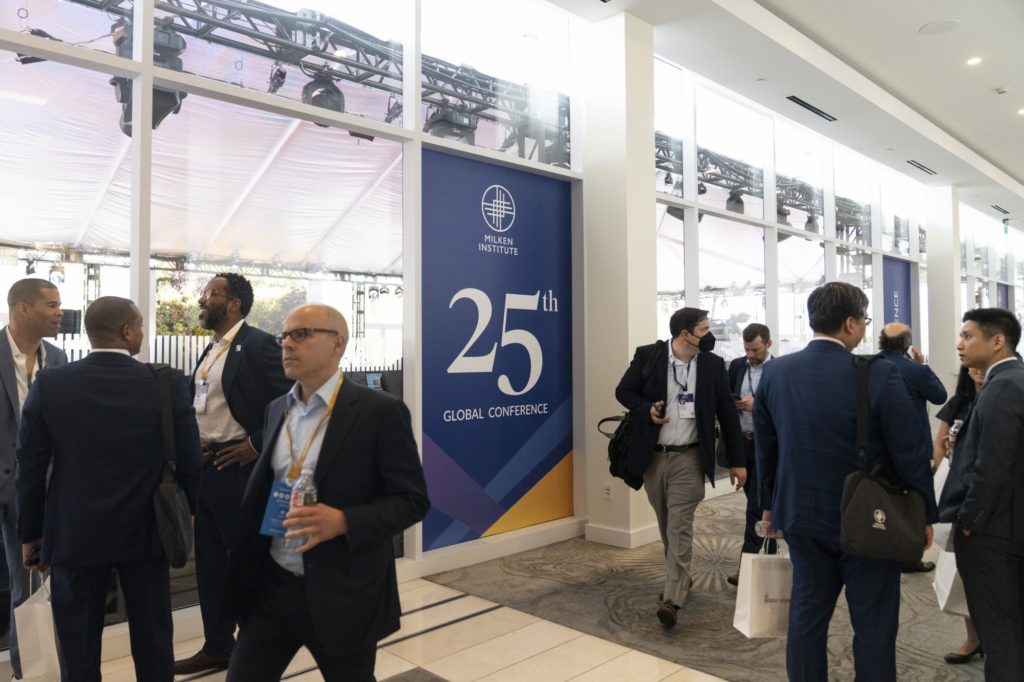
Even with the myriad concerns both domestic and global — concerns that were discussed, questioned, fretted over and even, at times, joked about during speeches, panel discussions and meals — the investors, dealmakers, politicians and power brokers in attendance found time for levity too. It was, after all, the first time that the confab, now in its 25th year, has returned to its standard spring schedule since the pandemic began. After being grounded for much of the Covid-19 crisis, the titans were ready to cut loose.

The Milken Institute’s founder, Michael Milken, and wife Lori were in the front row of the Beverly Hilton’s ballroom Monday night as David Foster, Katharine McPhee, Vonzell Solomon, the Tenors and other performers sang tunes including Whitney Houston’s “I Have Nothing” and Neil Diamond’s “Sweet Caroline,” while Tiffany Haddish offered a surprise rendition of “Proud Mary.”

Before Haddish’s number, Chris Tucker took a turn on stage.

“I’ve never seen so many rich people in my life,” the comedian said. “I’ve never heard people talk money all day long,” he added. “Look at y’all making money right now — he just crossed his legs, he made a million dollars,” he said, pointing out hedge fund manager Jeffrey Feinberg, seated in the front row.

Michael Milken, who founded the Milken Institute in the early 1990s, worked at Drexel Burnham Lambert in the 1980s before he was convicted for securities fraud, sent to prison and banned from the securities industry for life. Former President Donald Trump pardoned him in 2020. 

Goldman, Apollo

Elsewhere Monday night, the on-again couple Jennifer Lopez and Ben Affleck were expected at a Goldman Sachs Group Inc. party, Apollo Global Management Inc. had an event on the rooftop of the Waldorf Astoria Beverly Hills and Ares Management Corp.’s Tony Ressler and controversial German financier Lars Windhorst hosted gatherings at their respective homes.

And the flash crash didn’t stop Citigroup from partying as well. On Monday evening, former Vice Chairman Ray McGuire mingled with bank clients on a nearby rooftop terrace, with sushi and chicken sliders available for snacking. Guests departing the Citigroup-hosted event were given water with electrolytes to fight potential hangovers.

Over the weekend, Napster co-founder Sean Parker threw a dinner attended by Carlyle Group Inc.’s David Rubenstein and executives from General Motors Co., Kroger Co. and other companies. Other weekend events included a gathering at the art-filled home of one-time Walt Disney Co. President Michael Ovitz — attended by Jim Messina, deputy chief of staff under President Barack Obama, and about 40 others — and a dinner at Point 72 Asset Management founder Steve Cohen’s house co-hosted by former U.S. Treasury Secretary Steve Mnuchin.

Even with all the partying, global concerns were inescapable. One London-based mezzanine-debt investor who’s been to several Milken conferences said the mood seemed notably more somber this year, given market volatility and recession expectations, and that it felt harder to revel in the excess than in past years.

Cyber Threats

One senior Wall Street executive, during a conversation in the hallways of the Beverly Hilton, said industry leaders have been receiving regular classified security briefings and are fielding warnings about escalating cyber threats against the financial system. Even poolside — a site for relaxation much of the year, but a place for Apollo co-founder Leon Black to meet with Trian Partners’ Nelson Peltz and Ed Garden during Milken — talk turned to Ukraine.

At the cabanas, one financier who’s been in the industry for decades and has attended several past Milken events said he’d just come from a meeting where former oil tycoon Mikhail Khodorkovsky talked about the decade he spent jailed, the steps Russian President Vladimir Putin would need to take to implement a nuclear attack and the likelihood of defection among his deputies. The financier called it one of the most interesting conversations he’s ever had.

As in past years, activists descended on the Milken conference as well to seek attention for their causes. Speakers at a social-impact panel Tuesday morning, entitled “Where Values Meet Value: Doing Well by Doing Good,” had to contend with the sound of United Steelworkers protesters outside. “Hey, Chevron, you’re no good, treat your workers like you should,” they chanted, demanding better contracts. Separately, cryptocurrency entrepreneurs and investors gathered for their own exclusive event nearby.

And the Covid-19 pandemic and its attendant infection risks lingered as well. Still, attendees largely went maskless, with only a few people in one room of 50 using face coverings. The Milken Institute did provide masks to those wanting them. And Michael Milken himself wore one as he walked around the conference — one of the few people to do so.

(Updates with nearby cryptocurrency event in penultimate paragraph.)

More stories like this are available on bloomberg.com

©2022 Bloomberg L.P.

Developer Software Maker Sentry Triples Valuation to $3 Billion

(Bloomberg) — Developer tool startup Sentry said it raised $90 million in a new funding round, valuing the company at more than $3 billion.

The fundraising brings the total gathered to date to $217 million, it said, and triples Sentry’s valuation from $1 billion last year, at a time when valuations in the broader private market are cooling. The round was co-led by BOND and Accel, with participation from existing investor NEA as well as new investor K5 Global. 

Sentry helps software developers with performance monitoring for their applications. Its platform helps resolve code-related issues in software, such as errors and slow database queries. Its customers include Peloton Interactive Inc., Eventbrite Inc. and Slack. Sentry said it is used by 3.5 million developers across 85,000 organizations.

The company was able to increase its valuation in this difficult environment because of its strong growth, said Dan Levine, a partner at Accel, one of the company’s early investors. Now “everyone seems to use this thing” in the developer industry, he said, comparing its growth trajectory to Slack’s. Levine said that he expects the company to continue to grow both organically and through acquisitions. 

Jay Simons, a general partner at BOND, said he’s optimistic that Sentry could someday be a public company, like Atlassian Corp., where he was president during its initial public offering. His experience at Atlassian helped him learn more about the developer ecosystem and how large the potential market is, he explained, adding that companies are shifting toward a “digital-first mindset.”

Sentry Chief Executive Officer Milin Desai said that whether a company is building thermostats or ride-sharing, “everything is software-driven” these days, which is why there is a need for application-related developer tools. He said that the company will be investing in expansion in locations including Europe.

More stories like this are available on bloomberg.com

©2022 Bloomberg L.P.
Russia Barred From Using U.K. Consultants, Accountants, PR

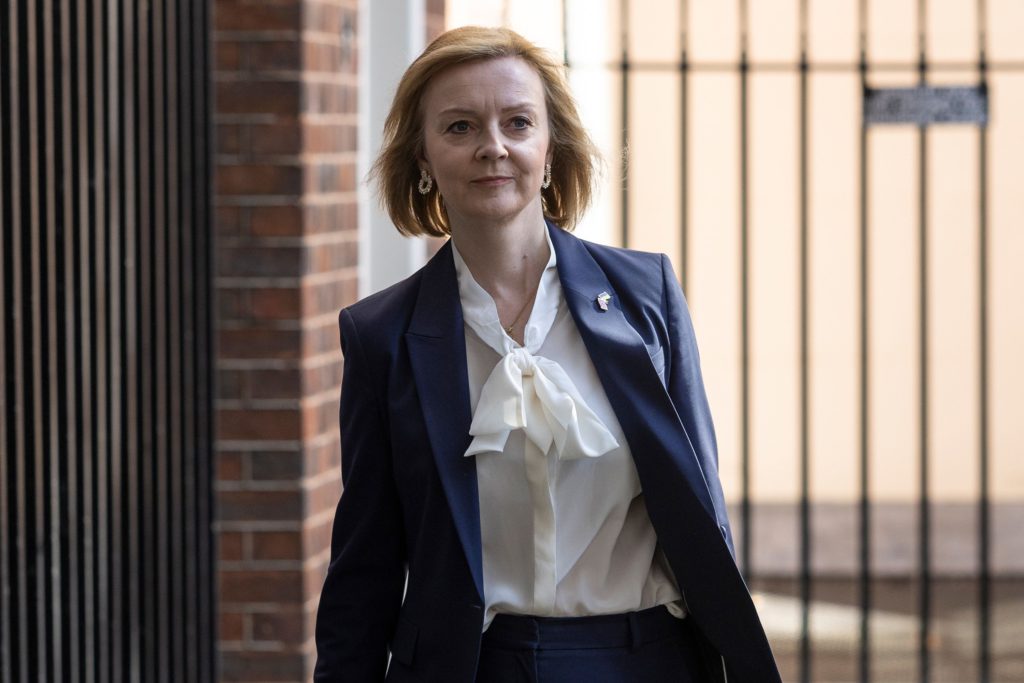
(Bloomberg) — Foreign Secretary Liz Truss cut Russia off from accessing U.K. management consultants, accountants and public relations firms as she announced a further tranche of sanctions aimed at putting more international pressure on Vladimir Putin in the wake of the Russian invasion of Ukraine.

The new measures will mean Russia’s businesses can no longer benefit from the expertise of British firms, which currently provide about 10% of Russian imports in those sectors, the Foreign and Commonwealth Office said in a statement Wednesday. 

“Doing business with Putin’s regime is morally bankrupt and helps fund a war machine that is causing untold suffering across Ukraine,” Truss said. “Cutting Russia’s access to British services will put more pressure on the Kremlin and ultimately help ensure Putin fails in Ukraine.”

Russia Seeks to Annex Occupied Ukraine as Invasion Goals Shift 

The move continues the British and western approach of ratcheting up sanctions on Russia to tighten the squeeze on its economy. European Commission President Ursula von der Leyen on Wednesday said the bloc plans to ban Russian crude oil over the next six months. Britain has already said it plans to phase out imports of Russian oil by year-end.

The U.K. also announced fresh sanctions on 63 individuals and organizations, many of them targeting people connected to Russian news organizations in an effort to punish what it called “the spread of lies,” according to the statement.

The sanctions include the websites, social media accounts and apps of RT, Channel One and Sputnik. The nation has already banned RT from broadcasting its TV channel in the U.K. Russian war correspondents from All-Russia State Television and Radio Broadcasting Company and the newspaper Komsomolskaya Pravda were also sanctioned as the U.K. accused them of spreading propaganda and disinformation.

More stories like this are available on bloomberg.com

©2022 Bloomberg L.P.

Close Bitnami banner
Bitnami