Bloomberg

China’s Central Bank Pledges ‘Normalized’ Supervision for Tech Platforms

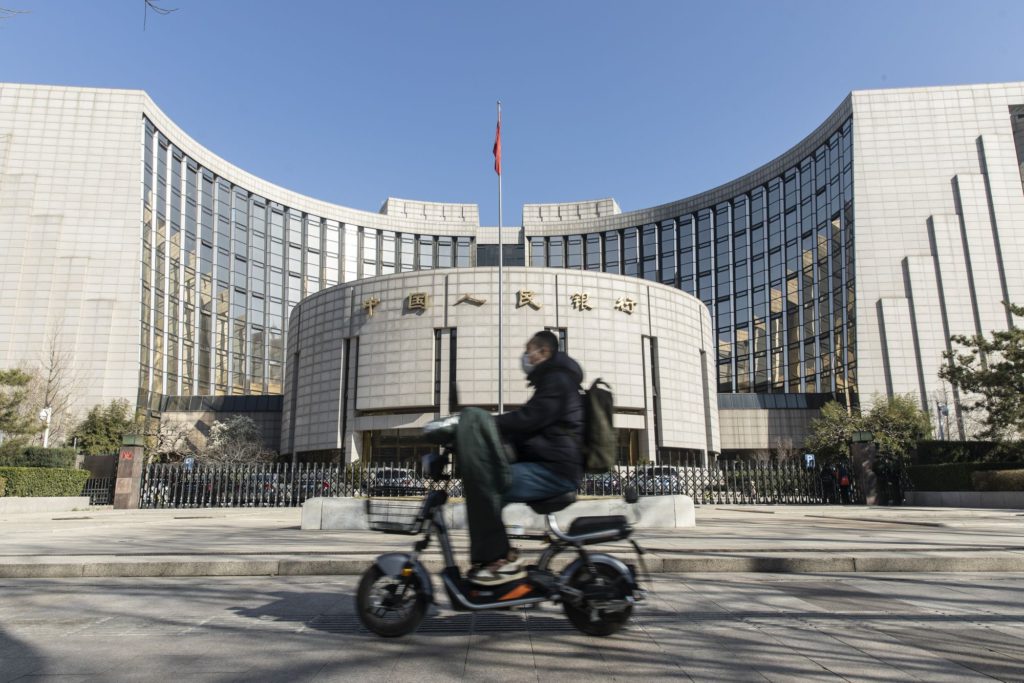
(Bloomberg) — China’s central bank said it will implement “normalized” supervision on the financial activities of online platform companies, reiterating comments from top leaders last week.

The People’s Bank of China held a meeting on April 29 to discuss implementing financial support for the economy and policies to boost the healthy development of technology platform companies, it said in a statement on Wednesday.

The comments mirrored those from a statement by the Communist Party’s Politburo, the top decision-making body, which also met on April 29, suggesting authorities may ease up on a regulatory crackdown on the industry. The Politburo’s statement sparked a rally in tech stocks on the day. 

The PBOC added that financial support for technology innovation companies should be strengthened and the stable operation of capital markets must be supported. It said policies that have been confirmed need to implemented faster.

More stories like this are available on bloomberg.com

©2022 Bloomberg L.P.

U.K. Warehouse Stocks Sink After Amazon Bemoans ‘Too Much Space’

(Bloomberg) — Shares of U.K. warehouse companies are among the latest pandemic-era winners to head south. Analysts are blaming Amazon.com Inc. 

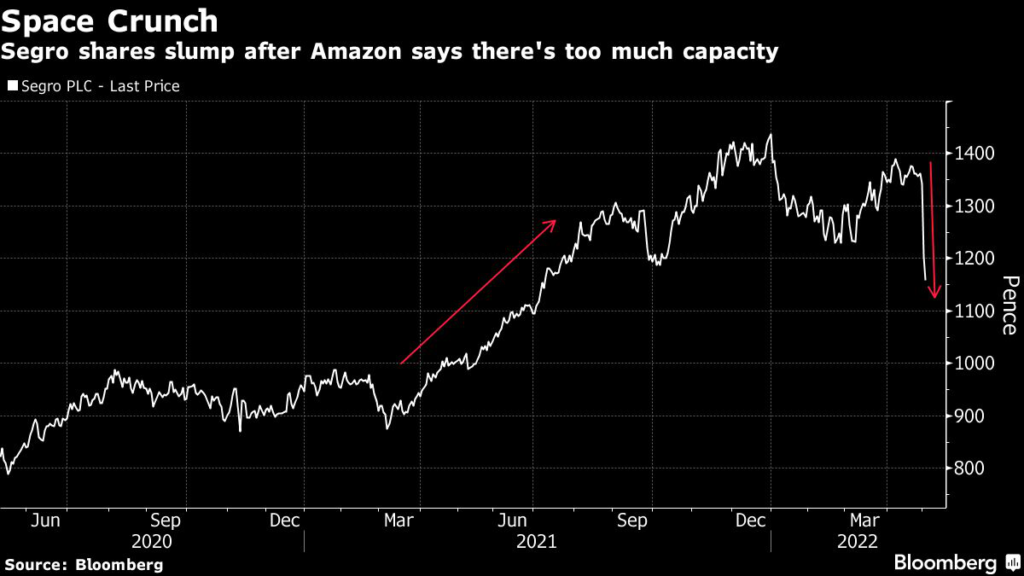
Segro Plc, Europe’s biggest warehouse landlord, has fallen 14% in the last two sessions after Amazon flagged last week that there was “too much space right now.” That view from the U.S. e-commerce giant was a blow to Segro and its peers, who added warehouse capacity as the pandemic fueled online shopping.

“This kind of comment may add some jitters to the logistics market,” wrote Kepler Cheuvreux analyst Frederic Renard, adding that Amazon was Segro’s largest tenant, accounting for 7% of headline rent. Renard downgraded his rating on the stock to reduce from hold on Tuesday.

Shares in Tritax Big Box Plc, LondonMetric Property Plc and Urban Logistics REIT Plc have all been sliding this week.

Roughly 20% of the U.K.’s logistics space was taken up by Amazon in the past two years, according to Bloomberg Intelligence analyst Susan Munden. 

Segro owns or manages 9.6 million square metres of space valued at 21.3 billion pounds ($26.7 billion), according to its website. It has properties in the U.K. and seven European countries.

“At a time when speculative developments are rising and with a pile of money being deployed at aggressive yields to bet on future rental growth, we argue that only one domino has to fall to put the whole chain at risk,” said Renard.

More stories like this are available on bloomberg.com

©2022 Bloomberg L.P.

African Union Slams Somalia Raid as Group Claims Scores Dead

(Bloomberg) — The African Union condemned an attack on peacekeeping forces in Somalia by al-Shabaab, an al-Qaeda-linked militant group, which claimed dozens of Burundian soldiers were killed.

The continental body didn’t provide a death toll for the attack, while the African Union Transition Mission in Somalia that was targeted in the raid on Tuesday didn’t immediately respond to requests for comment. Radio Andalus, a pro-al-Shabaab broadcaster, said in a report monitored in the capital, Mogadishu, on Wednesday that 173 Burundian soldiers died in the assault.

If confirmed, the death toll would be the biggest since at least January 2016, when an attack on Kenyan forces at the El Adde military camp in southwestern Somalia left dozens of soldiers dead. Tuesday’s raid came after an African Union peacekeeping force that’s been active in Somalia since 2007 restructured and was renamed ATMIS last month.

“The chairperson pays tribute to the Burundian peacekeepers who lost their lives helping to bring peace and stability to Somalia,” African Union Commission Chairman Moussa Faki Mahamat said in a statement. “This heinous attack will not lessen the determination of ATMIS forces.”

The attack, which was planned weeks in advance, was among the most serious to be staged since the AU troops arrived in Somalia, according to Hussein Moalim, the director of the Hiraal Institute, a Mogadishu-based security think-tank. 

“Al Shabaab mobilized hundreds of fighters in the Shabelle Middle Region, but no one knew what base would be attacked,” he said by phone. The militants closed all the supply routes to the base and by the time helicopter gunships arrived to support the AU forces it had been overrun and dozens of soldiers had been killed, while others who fled on foot were captured, he said. 

Dini Roble Ahmed, a police spokesman in the Hirshabelle state, said six civilians died and 25 others were injured in the attack.

“There are no words strong enough to condemn the terrorist attack against the Burundian contingent of ATMIS,” Burundian President Evariste Ndayishimiye said on Twitter.

(Updates with analyst comment starting in fifth paragraph.)

More stories like this are available on bloomberg.com

©2022 Bloomberg L.P.

U.K. Plans to Set Security, Privacy Requirements for App Stores

(Bloomberg) — The U.K. government has published proposals under which app stores could be asked to commit to a code of practice setting security and privacy requirements.  

The proposed code would require stores to have a “vulnerability reporting process for each app so flaws can be found and fixed quicker,” the Department for Digital, Culture, Media and Sport said in an emailed statement Wednesday. 

The guidelines would affect developers and store operators, including Apple Inc., Google parent Alphabet Inc., Amazon.com Inc., Huawei Technologies Co., Microsoft Corp. and Samsung Electronics Co. 

No app “should put our money and data at risk. That’s why the Government is taking action to ensure app stores and developers raise their security standards and better protect U.K. consumers,” Cyber Security Minister Julia Lopez said. 

The government is now seeking opinions from companies and experts until June 29. 

Read more: Why Apple and Google Face a U.K. Regulatory Clampdown: Quicktake

More stories like this are available on bloomberg.com

©2022 Bloomberg L.P.

Lyft Plunges on Disappointing Outlook, Taking Uber Down With It

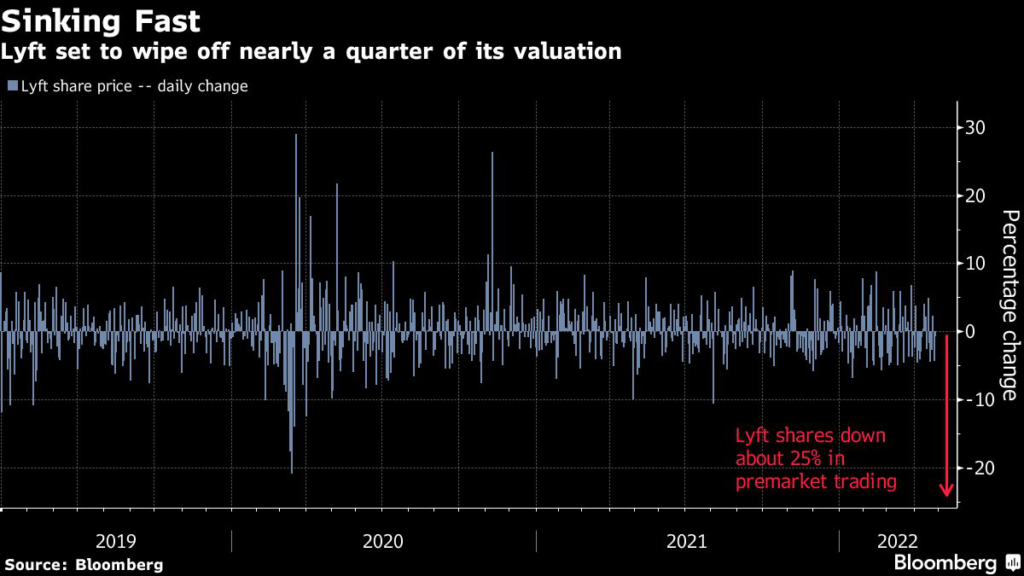
(Bloomberg) — Lyft Inc. is poised to lose more than a quarter of its market value on Wednesday after the ride-hailing company’s second-quarter outlook disappointed Wall Street, highlighting investors’ willingness to dump growth stocks at the first hint of trouble. 

The San Francisco-based company’s shares were down 27% to $22.60 in premarket trading. If the decline continues into the regular session, it would represent the stock’s steepest ever drop in a single session, and put it down 71% from the record-high of $78.29 touched in March 2019.

“There’s no room for error in this environment, but still, this selloff seems overdone,” Piper Sandler analyst Alexander Potter wrote in a note.

The gloom from Lyft’s results also spread to its larger and more diversified peer, Uber Technologies Inc., which fell 5.1% premarket. 

In a statement released Tuesday evening, Uber said it rescheduled the release of its first-quarter financial results and its quarterly conference to Wednesday morning from the afternoon in order to provide a “more timely update” to its performance and guidance.

Lyft said it expects revenue of as much as $1 billion in the second quarter, and sees earnings before interest, tax, depreciation and amortization of $10 million to $20 million in the period. Both were lower than analysts expected.

Both Lyft and Uber were hard hit during the pandemic as shutdowns slammed the brakes on demand. But now, even with riders returning, the stocks are getting punished as investors grow increasingly wary of expensive and riskier growth assets amid concerns about inflation and a possible economic slowdown. 

(Updates to add that Uber rescheduled its quarterly earnings release in the fifth paragraph.)

More stories like this are available on bloomberg.com

©2022 Bloomberg L.P.

N.J. Grocery Trips Get Pricier With Ban on Paper, Plastic Bags

(Bloomberg) — New Jersey will become the first state to ban both plastic and paper bags on Wednesday, leaving companies and shoppers to find creative workarounds to get their groceries home.

ShopRite, with more than 100 New Jersey stores, will charge a flat $1.50 per order for reusable bags. Instacart Inc., which fulfills shoppers’ lists for Aldi Inc., Lidl Ltd., CVS Health Corp. and others, said it will charge a flat bag fee, but didn’t specify the cost. 

Amazon.com Inc.’s Whole Foods Markets Inc. — which dropped plastic bags nationally more than a decade ago — will pack those orders in reusable bags, for which it is “not currently charging any additional fees,” the company said in an email. The Wawa Inc. convenience-store chain will give away 1,000 reusable bags at each of its 272 New Jersey locations starting on Wednesday.

Governor Phil Murphy, a Democrat who took office in 2018, pledged to make an environmental leader of New Jersey, the most densely populated U.S. state and the nation’s top location for toxic Superfund sites, with 113. The law he signed in November 2020 restricts most grocery and other stores from giving away or even selling paper or plastic single-use bags. No other U.S. state has banned paper bags, though some require recycled content or per-bag consumer fees of a few cents, at times channeled to pollution-control programs.

New Jersey may not be alone for long: Some studies have shown that paper, though easily recycled, can sap more energy and raw materials than plastic. Reusable bags, too, have drawbacks, as cotton versions are soil-, fertilizer-, and manufacturing-intensive, and synthetic types often rely on fossil fuels. 

The 100 billion plastic bags used in the U.S each year require 12 million gallons of oil to manufacture, according to EarthDay.org, a Washington-based non-profit environmental group. 

Places that outlawed plastic have seen use drop dramatically. California, the first state to ban single-use bags in 2016, cut plastic carryout bag use by 20,000 tons (18 million kilograms) a year, according to research by University of Sydney economist Rebecca Taylor. But that figure was offset by a 120% increase in sales of small trash-bin liners as consumers who had re-purposed single-use bags filled the void.

‘Bring a Receptacle’

Days before the ban, some New Jersey grocery stores had empty plastic-bag holders at checkout lines and signs warning customers of the upcoming change. “Please bring a receptacle for your vehicle if you would like your items contained,” one sign read.

Target Inc. is “transitioning to a bag-free experience” in its 48 New Jersey stores, encouraging shoppers to bring their own or buy reusables, said spokeswoman Liz Hancock in an email. “Target gives guests a five-cent discount for each reusable bag used at all of our stores.”

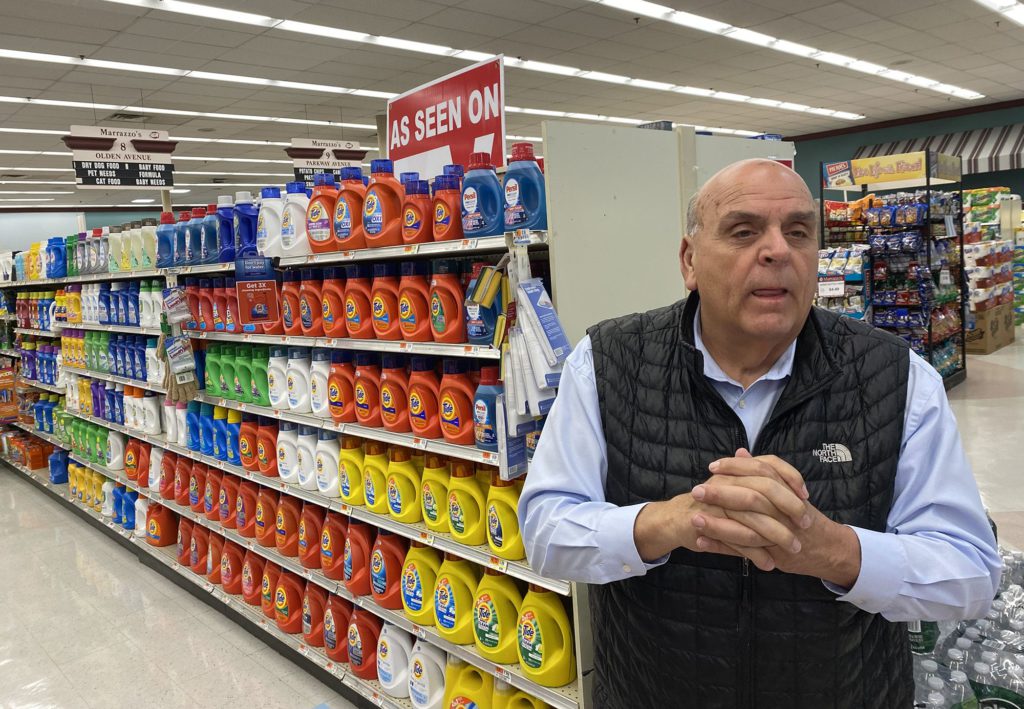
Sam Marrazzo, making an example of plastic- and cardboard-packaged laundry detergent in aisle 7 of his Marrazzo’s Market grocery store in Ewing, New Jersey, questioned the bag policy: “Banning bags is saving the environment how, exactly?”

Marrazzo customers like Kay Trainor, a 79-year-old retired artist from Titusville said she’d switch to garbage bags. “I’m going to have to buy Hefty,” said Trainor, who reuses the free shopping bags to dispose of her cats’ waste. 

At the end of New Jersey’s “Paper or plastic?” retail era, Marrazzo says he’s taking a 25-cent hit on each reusable bag he sells.

It’s a favor, he says, to customers who are seeing an 8.8% one-year increase nationally in food prices. And no, he said, he won’t realize big savings with paper and plastic bags off his supplies list, after U.S. inflation in February hit a 40-year high of 7.9%.

“The guy who collects the trash just started charging $1,000 more a month,” Marrazzo said. “Then I got the light bill to pay.”

More stories like this are available on bloomberg.com

©2022 Bloomberg L.P.

The First Commercial Brain Computer Interface Is Entering Human Trials

(Bloomberg) — Synchron Inc., which develops a so-called brain-computer interface and competes with Elon Musk’s Neuralink Corp., enrolled the first patient in its U.S. clinical trial, putting the company’s implant on a path toward possible regulatory approval for wider use in people with paralysis.

The early feasibility study is funded by the National Institutes of Health and will evaluate the safety of the device, known as the Stentrode, the New York-based company said. It will also assess how effective the Stentrode is in helping patients control digital devices hands-free.

The trial represents a landmark for Synchron, the first startup working on brain-machine interfaces to begin a clinical trial seeking approval to sell its product. It also puts Synchron ahead of Neuralink, which is better funded but is still recruiting a trial director. Neuralink raised $205 million last year. Synchron has raised $70 million total.

Brain-computer interfaces, or BCI, could empower millions of disabled people to more easily communicate and engage in modern life. Paralysis affects more than 5 million people in the U.S. alone, according to researchers at the Centers for Disease Control. Farther in the future, Musk and other technologists talk of a world where anyone could receive implants to achieve a sort of superintelligence.

Synchron’s device, once implanted, travels to the brain through blood vessels. (Neuralink’s is implanted directly into the skull.) After it reaches the brain, the Stentrode translates brain activity into signals designed to allow texting, emailing, online shopping or other activities using an external device, Synchron said.

In the past, other BCIs have received regulatory approval to treat patients on a temporary basis. Synchron’s trial, if successful, would secure approval from the U.S. Food and Drug Administration for long-term use, not just for experiments like those in a lab.

The Synchron study will eventually involve six U.S. patients, split between New York and Pittsburgh. The first patient enrolled this week at Mt. Sinai Hospital in New York. Tom Oxley, Synchron’s founder and chief executive officer, declined to identify the patient or provide demographic details.

The next step on the path toward approval would be a wider trial to test for efficacy. If the trials succeed, it will likely be several years before the Stentrode is available for sale.

More stories like this are available on bloomberg.com

©2022 Bloomberg L.P.

Twitter Plans Aggressive Pitch to Calm Advertisers Amid Musk Deal

(Bloomberg) — Twitter Inc. is planning an aggressive pitch to advertisers during a media buying event this week, attempting to assuage fears over how much the service will change if Elon Musk’s $44 billion takeover is finalized.

The network’s pitch at the IAB Digital NewFronts, the annual event for digital companies to sell ad space to marketers, will be a “spectacle,” according to a person familiar with the matter, who declined to be named because the details aren’t public. 

Sarah Personette, Twitter’s chief customer officer, will lead the presentation and announce a variety of new and renewed partnership deals. Twitter is also likely to address advertisers’ concerns about their promotions running alongside undesirable content, as Musk has made clear he wants to limit enforcement of the company’s content rules.

However aggressively Twitter wants to sell advertisers on its potential, it’ll be hard for the company to make credible promises about what the future holds. Twitter on Monday warned in a regulatory filing that it won’t be able to predict what Musk will do with the business. The Tesla Inc. chief executive officer’s deal for Twitter, announced April 25, won’t close for months, and in the meantime uncertainty could cause “adverse changes in our relationships with employees, advertisers and other business partners,” the filing said.

The company also faces a series of issues specifically related to Musk’s stated plans. A self-described free-speech absolutist, Musk has promised to take a minimalist approach to content restrictions. Musk has said he would be “very reluctant to delete things” and “very cautious with permanent bans” on Twitter, according to his comments at a TED conference in April. The impulsive billionaire has also talked about limiting advertising on Twitter. “I don’t care about the economics at all,” Musk said.

That could cost Twitter. “I don’t think brands can afford to turn up in environments that are not safe,” said Arun Kumar, chief data and marketing technology officer at IPG.“I really hope he knows what he’s doing, because if they relax the content rules and they open up the algorithm, I just don’t see how they’re going to control bad actors.”

EXPLAINER: Twitter, Musk and Why Online Speech Gets Moderated

At the NewFronts, beyond its presentation, Twitter employees will mingle with ad-buyers, content creators and others who use the conference to decide how much time and money to dedicate to Twitter’s platform.

Musk’s vision to ease content-moderation policies may be welcomed by those who believe Twitter disproportionately silences conservative political speech, but it has alarmed Black, LGBTQ+, Muslim and other groups who are worried about increased harassment on the platform. Meanwhile, advertisers have expressed concern that their ads will show up next to controversial posts if content moderation rules are loosened.

On Tuesday, a group of 26 organizations, including Media Matters for America, GLAAD and Black Lives Matter Global Network Foundation, issued a statement calling on Twitter’s top advertisers to demand that Musk commit to upholding “standards of community trust and safety, and to pull their advertising spending from Twitter if he does not.”

“Under the guise of ‘free speech,’ [Musk’s] vision will silence and endanger marginalized communities, and tear at the fraying fabric of democracy,” the group said in its statement.

The advocacy group coalition is demanding, among other things, that Twitter commits to keeping public figures and politicians that were removed for violating Twitter’s rules, like former President Donald Trump, off the platform. Many have speculated that upon taking control of the company, Musk would move to reinstate controversial accounts that have been suspended. 

That’s not something Twitter can promise, because employees do not know Musk’s plans. Prior to Musk’s takeover, Twitter doesn’t intend to change its commitment to running a network that’s appealing to brands, according to a person familiar with the matter.

Not everyone is convinced that Musk’s hopes for loosening content moderation will negatively impact Twitter’s bottom line. 

Michael Cohen, executive vice president of Performance Media at Horizon Media, pointed to the #StopHateForProfit boycott that was organized by several civil rights groups in July 2020, mostly on Meta Platforms Inc. apps. The organizers urged companies to stop paying for ads on Facebook and Instagram to protest the platform’s handling of hate speech and misinformation. Of more than 9 million advertisers who bought ad space on Facebook, only about 1,000 publicly joined the boycott and the resulting impact on the company’s revenue was negligible. 

“With the Meta boycott, we saw some advertisers come off the platform for a couple of months before moving right back on,” said Cohen. 

Although Twitter’s advertising business is dwarfed by that of other major digital players, advertising dollars accounted for over 92% of its first-quarter revenue.

“Will advertisers move away from Twitter if Elon Musk owns it?” Mark DiMassimo, founder and creative chief of agency DiGo, asked rhetorically. “Not if they can still get good reach and frequency and a good audience.” 

Twitter will try to make that case at the NewFronts, at least.

More stories like this are available on bloomberg.com

©2022 Bloomberg L.P.

U.K. Lawmakers Request Elon Musk Give Evidence Over Twitter Deal

(Bloomberg) — British lawmakers wrote to Elon Musk asking the billionaire to address concerns over his view on free speech, following the Tesla Inc.’s chief’s proposed acquisition of Twitter Inc.

“At a time when social media companies face the prospect of tighter regulations around the world, we’re keen to learn more about how Mr Musk will balance his clear commitment to free speech with new obligations to protect Twitter’s users from online harms,” Conservative party lawmaker Julian Knight wrote in a statement published Wednesday. 

The request from the influential Digital, Culture, Media and Sport Committee comes as questions remain over how Musk will run Twitter following his $44 billion deal to take the social media company private. 

“I want to make it as inclusive and interesting and entertaining as possible, and broaden the audience,” Musk said on Monday, at a benefit for the Costume Institute at the Metropolitan Museum of Art.

Requests to give evidence to a U.K. parliamentary select committee are neither legally binding nor mandatory, but companies routinely answer the calls and provide executives to speak. Evidence gathered is used by committee members to write reports, which are passed to the government to inform lawmaking and legislative changes.

Sometimes requests are repeatedly refused, however, notably in the case of Meta Platforms Inc. Chief Executive Officer Mark Zuckerberg. The social-networking giant declined to send the CEO to appear before an earlier incarnation of the committee, following threats of a formal summons.

The U.K. is currently introducing long-awaited and sweeping legal proposals to force internet companies to remove illegal content from their platforms, giving regulator Ofcom power to impose massive fines and prosecute executives personally for failures to comply.

More stories like this are available on bloomberg.com

©2022 Bloomberg L.P.
VW Sees Better Chip Supplies in Second Half Boosting Output

(Bloomberg) — Volkswagen AG expects the protracted shortage of semiconductors to ease during the second half of the year and contribute to a surge in output, offsetting months of curtailments.

VW confirmed a projection that deliveries will rise by as much as 10% this year, it said Wednesday, even after production slumped by 12% during the first three months. Strong prices and demand for high-end premium cars helped to offset lower production, it said. 

“The overall situation of the world — with Covid in China, the war in the Ukraine, semiconductors still in short supply — this is quite a challenging environment,” Chief Executive Officer Herbert Diess said in an interview with Bloomberg TV. “I’m happy we could show resilience in the first quarter.” 


The company warned its upbeat forecast hinged on further developments from the war in Ukraine and China’s strict coronavirus policies weighing on the global economy. The company has managed to navigate the shortages of chips and wire harnesses from suppliers in Ukraine by reallocating resources between its main markets in Europe, China and North and South America, it said.

The shares were almost unchanged in Frankfurt trading and have declined 16% since the start of the year. 

So far, carmakers like Mercedes-Benz AG and BMW AG have come through the supply-chain crisis by raising sticker prices for new and used vehicles to offset the drop in production. Still, while demand remains strong, record price swings in commodity markets and the ongoing war in Ukraine are clouding the outlook.

While Volkswagen has halted its operations in Russia, it also had to temporarily shut some sites in Europe after suppliers of wire harnesses in Ukraine were unable to deliver components. As Europe weighs reducing its dependence on Russia for oil and natural gas, Diess acknowledged that Volkswagen was concerned with threats to the energy supply at its factories.

“We cannot really fully judge what’s going to happen in our supply chain, if there would be a cut off of gas, but we try to be as resilient as possible,” the CEO said on a call with reporters.

Europe’s geopolitical crisis is reaffirming the carmaker’s push to expand its business in the U.S., Diess said. Production of the electric ID.4 crossover is on course to start later this year at the company’s plant in Chattanooga, Tennessee, and VW’s purchasing chief said last month the carmaker was scouting possible locations for battery factories. 

“We see the American region as a continuously growing market,” Diess said. “America will be untouched by what’s happening in Europe, and it should be strategically a region where we invest more.”

Nickel Hedging

VW already announced preliminary first-quarter earnings last month of 8.5 billion euros ($8.9 billion), almost double that of year ago. The jump was due to a surge in value of the company’s nickel hedging position following an historic short squeeze.

On Wednesday, VW said price increases for its volume brands and customers choosing “well-equipped” premium vehicles had helped to offset a drop in production. 

Strong demand in VW’s sport and luxury brand group, in particular for Porsche’s 911, Panamera and Cayenne models, helped boost operating profit to 1.4 billion euros with an operating margin of 18.6%, the company said. The Porsche brand remains on track for a potential initial public offering in the fourth quarter of this year, Chief Financial Officer Arno Antlitz said on a call with reporters.

“If you look at the first-quarter results, it shows that the electric-car business model works well at Porsche,” Antlitz said. “It’s the right time to pursue this project.”

Volkswagen also revealed financial figures for its Cariad software unit for the first time with net sales rising to 110 million euros in the first quarter. Upfront investment in software stacks contributed to an operating loss, though Diess told reporters he anticipated the unit to become profitable in 2026 at the earliest. 

(Updates with comments from CEO, CFO)

More stories like this are available on bloomberg.com

©2022 Bloomberg L.P.
Close Bitnami banner
Bitnami