
Bloomberg

India’s Sitharaman Sees Strong Growth, Low Inflation in 2023

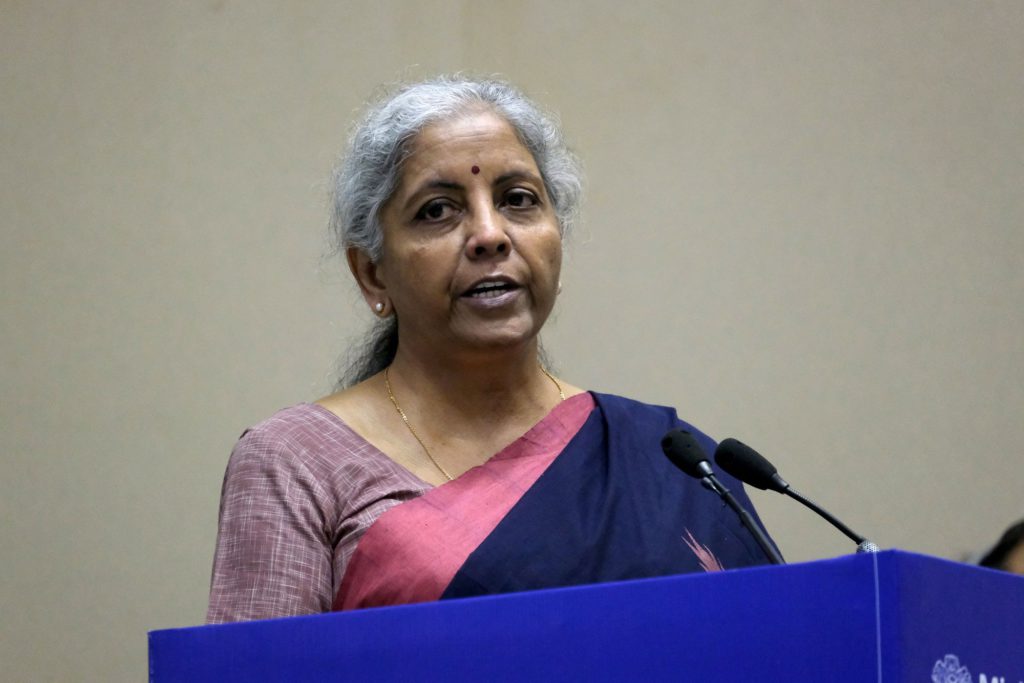
(Bloomberg) — India’s Finance Minister Nirmala Sitharaman expects strong growth and lower inflation next year, as central bank authorities seek to stabilize Asia’s third-largest economy amid tough global headwinds.

“External factors were very strong in the inflation-targeting exercise,” Sitharaman said Wednesday at a Reuters event, noting that they were beyond the control of the government and the Reserve Bank of India. “We expect currency volatility to settle on its own.”

India’s consumer price gains fell below 7% for the first time in three months in October. The RBI, which has raised its benchmark rate by 190 basis point this year, is expected to remain hawkish at a monetary policy review next week. Rate setters penned a letter this month to the government explaining their failure to contain inflation between 2% and 6% and outlined a road map for returning prices to target. 

Sitharaman declined to describe specifics from the letter, but added that the government’s top three priorities for 2023 will be “growth, health and education.”

The finance minister’s comments come as authorities prepare the annual budget for February. That will be the final full-year budget before citizens elect a new prime minister in the summer of 2024, a time when Indian governments typically loosen their purse strings.

Sitharaman said capital expenditure is a key way to drive growth. The government is offering incentives to firms that scale up manufacturing in India, hoping to capitalize on appetite to diversify operations away from China, she added. 

“We are well on the course of meeting the capex target for this year,” Sitharaman said. “States have shown exceptional absorption capacity for taking the monies and spending them on capital assets. That is the only way we think we can sustain our growth because that is the sure-shot way of achieving the multiplier that the economy requires.”

Sitharaman also defended the use of foreign exchange reserves to address the volatility in the currency that touched record lows about a month ago. “All of us are confident that what has happened in terms of using reserves to contain the volatility was the right thing to do,” she said. 

Here’s more from Sitharaman:

  • “India needs to take care of its own interest on oil and needs to have affordable and sustainable oil,” Sitharaman said when asked whether the nation will join others in putting a price cap on Russian oil
  • The government remains very open-minded on expanding the scope of production-linked incentives
  • Will focus reforms for multilateral banks, climate finance, regulation of crypto assets during India’s G-20 presidency
  • “Crypto assets that are coming like mushrooms will have to be regulated and that cannot be regulated effectively unless countries come together”

–With assistance from Adrija Chatterjee.

(Updates throughout.)

More stories like this are available on bloomberg.com

©2022 Bloomberg L.P.

China Adjusts Covid Restrictions in City With IPhone Plant

(Bloomberg) — The Chinese city of Zhengzhou shuttered hundreds of buildings and apartment blocks hours after lifting broader lockdown measures, as officials strive to make their Covid controls more targeted in line with Beijing’s directives. 

The city, home to Apple Inc.’s largest manufacturing site in China, said late Tuesday that it was lifting a lockdown of its main urban areas put in place five days ago as Covid cases climbed. Authorities then issued a lengthy list of buildings that would be declared high risk spanning the greater Zhengzhou region, which means they will continue to be subject to lockdown-style curbs. 

The shift comes after China’s top health officials in Beijing reinforced an order for local cadres to avoid excessive curbs in containing the virus, following weekend protests where demonstrators took to the streets in several major cities in opposition to the stringent Covid Zero policy. 

As of Nov. 30, Zhengzhou will remove so-called mobility controls — a euphemism for lockdown — and replace them with “normal Covid-combating measures,” according to a post on the local government’s official WeChat account. Businesses will be allowed to resume operations in an orderly manner, and people outside of the high-risk areas won’t be subject to regular mandatory Covid tests as long as they don’t leave home. 

Beijing is urging local authorities to adhere to a 20-point playbook for virus control issued just over two weeks ago after a meeting of the Politburo Standing Committee, China’s top leadership body. While the guidelines caution against broader lockdowns and excessive mass testing, officials on the ground have struggled to control outbreaks in a more targeted way — instead reverting to the cruder, wider measures of old. 

Read more: China’s Lockdowns Surge in Week Since Covid Policy Adjusted

Tough Task

Zhengzhou has adjusted its restrictions a number of times over the past few weeks, with tensions at the vast Foxconn Technology Group factory known as “iPhone City” putting its response in the global spotlight. 

A lockdown of the district around the plant was lifted Nov. 9, and replaced with a web of high-risk areas that included the factory, which is currently in a so-called closed loop to keep operating. There have been no statements from authorities in the three weeks since to indicate the situation around Foxconn’s plant has changed. On Wednesday, the district said it was adjusting restrictions to bring them into line with wider Zhengzhou’s move, but it was unclear whether that would affect the factory.

The city’s experience shows the difficulty officials have meeting Beijing’s twin priorities of wiping out Covid outbreaks, while being less disruptive to people’s lives and the economy. Anger at restrictions and their possible role in stymieing the response to an apartment block fire in Xinjiang, northwest China, sparked the weekend’s demonstrations, unprecedented during President Xi Jinping’s tenure. 

Goldman Sachs Group Inc. said on Monday that it saw a 30% chance of China exiting its tough Covid approach before April, earlier than widely anticipated, because of the public pushback.

Zhengzhou’s iPhone plant has also seen unrest, including a rare violent protest last week after almost a month under tough restrictions intended to contain an outbreak within the factory and enable employees to continue production.

Foxconn has been struggling to secure enough workers to crank out the latest iPhone 14 Pro devices, the most sought-after of Apple’s latest handset models, as many left outbreaks on the campus. The Taiwanese company is offering various incentives to retain existing workers while luring former employees back. 

Zhengzhou’s move to lift blanket lockdowns may help with staffing shortages at the Foxconn plant, a person familiar with the matter said, adding that the situation remains fluid.

Turmoil at the plant is likely to result in a output shortfall of close to 6 million iPhone Pro units this year, Bloomberg News has reported. 

Analyst Ming-Chi Kuo of TF International Securities warned the labor protests in China could mean iPhone Pro shipments will be 15 million to 20 million less than expected. That projection is too extreme and the shortfall is likely to be much less, the person said.

–With assistance from Jacob Gu, Lin Cheng and Li Liu.

(Updates with latest statement from district where iPhone plant located in seventh paragraph.)

More stories like this are available on bloomberg.com

©2022 Bloomberg L.P.

Tesla Has California to Thank for Its First Semi Truck Delivery

(Bloomberg) —

When Tesla moved its headquarters to Texas a year ago, the former head of the powerful California Air Resources Board said Elon Musk lacked gratitude for the role the state played in the carmaker’s rise. California’s zero-emission vehicle mandate required automakers that didn’t sell enough electric vehicles to buy credits from Musk’s company before it was making any money.

Tesla has grown to where it can now stand on its own two feet, but it still has reasons to be thankful for its former home state. This week’s Semi delivery event is a perfect example: Five years after Musk rode on stage in a prototype during an unveiling event, some of his first production trucks will go to a project CARB supported with $15.4 million in funding.

CARB awarded the grant in September 2018 to an air district in California’s Central Valley that partnered with PepsiCo’s Frito-Lay to transform its manufacturing site in Modesto, California. The company wanted to replace all of its diesel-powered freight equipment with zero-emission trucks and install solar panels and energy-storage systems.

The $30.8 million project — half of which CARB paid for — includes 15 Tesla Semi trucks, six Peterbilt electric trucks, three BYD electric yard trucks, 12 electric forklifts and 38 low-emission Volvo tractors. Tesla’s Semis were the last piece of the project.

PepsiCo will host an event to showcase the Modesto facility’s transformation on Jan. 18. But rather than hold court where its customer will be the first to operate a commercial fleet of Semis, Tesla will stage its event Thursday at its massive factory near Reno, Nevada.

Tesla may now be headquartered in Austin, but it still has a formidable presence in California, where public policy and funding has paved the way for electric passenger cars, and now, electric big rigs. The company bills the Semi as nothing less than the future of trucking, but that may prove to be as overly optimistic as its initial plan to start production in 2019. For one, truck stops aren’t ready to deliver the huge amounts of power big rigs and their giant batteries will require. One recent study found the projected power needs for a big truck stop will equal that of a small town by 2035.

Musk said during Tesla’s last earnings call that the company is tentatively aiming to produce 50,000 Semis for North America in 2024. He appears to have taken the product off the back burner after the passing of the Inflation Reduction Act, which makes up to $40,000 tax credits available to commercial vehicles.

For all the help truck manufacturers and their customers are getting from governments, the transition to cleaner commercial vehicles also will be dictated by tougher emissions rules forcing the issue.

“Trucking will always be driven by cost per mile and total cost of ownership,” said Mike Roeth, executive director of the North American Council for Freight Efficiency. “But we’re moving into a world where diesel is no longer an option because of changing regulations. The game has changed, and fleets are leaning into zero-emission options, whether its electric or hydrogen.”

–With assistance from Brett Pulley.

More stories like this are available on bloomberg.com

©2022 Bloomberg L.P.

China Home Sales Slump Persists Even as Rescue Efforts Mount

(Bloomberg) — China’s home sales slump persisted in November, underscoring the challenge for policy makers as they seek to revive the embattled industry. 

The 100 biggest real estate developers saw new-home sales drop 25.5% from a year earlier to 559 billion yuan ($78.9 billion) in November, according to preliminary data from China Real Estate Information Corp. That narrowed from a 28% decline in October. 

A rebound in home sales is seen as crucial to repairing China’s property market, which has been dragging on economic growth for more than a year. Authorities are trying to address a debt crisis among developers by boosting financing on three fronts: stock sales, bond issuance and bank loans. 

Regulators issued a 16-point plan earlier this month to spur the real estate market, while several state-owned lenders pledged at least 1.28 trillion yuan ($180 billion) in funding for builders. Officials have also lifted a ban on local stock offerings by developers and widened a program allowing them to issue state-guaranteed bonds. 

Yet it remains to be seen whether home buyers will become more willing to splash out on properties as strict Covid restrictions weigh on wages and push up unemployment. 

Falling home values are also deterring purchases. Real estate prices fell the most in seven years in October, the latest official data showed. 

China’s Covid controls sparked social unrest following a deadly fire in Xinjiang last week. Economic activity contracted further in November amid a record outbreak, and will likely continue to weaken until at least the first quarter of next year, according to some market watchers. 

–With assistance from April Ma.

More stories like this are available on bloomberg.com

©2022 Bloomberg L.P.
Google Sued by 130,000 Small Rivals in UK for Abusing Dominance

(Bloomberg) — Google and its parent Alphabet Inc. were sued in a UK court over alleged antitrust abuses in a group claim by 130,000 businesses that argues the tech giant’s approach to advertising that may have cost companies billions in lost revenue.

The claim, filed at London’s UK Competition Appeal Tribunal on Wednesday, accuses Google and its parent of abusing their dominant position in online advertising and “earning super-profits for itself at the expense of the tens of thousands of publishers of websites and mobile apps in the UK.” 

Google earlier this year lost a court fight in France to topple a €150 million ($155.5 million) French fine for mistreating companies using its online advertising platform.

That fine and other investigations around the globe are not enough to stop Google, says, Toby Starr, a partner at City law firm Humphries Kerstetter, who represents some of the claimants. The UK suit is being run alongside a European Union claim expected next year in the Netherlands. 

“None of these regulatory actions will do anything to compensate the UK publishers of thousands of websites and mobile apps who have lost billions in advertising revenue because of Google’s actions,” Starr said in a statement. “The only way to recoup these losses is through a competition class action.”

Britain’s opt-out class-action regime finally sparked into life last year after new laws allowed US-style claims under competition law. Potential UK damages, which are based on estimates from possible losses could run into the low tens of billions, according to the claimants.

Opt-out class-action style lawsuits mean someone impacted doesn’t have to be involved in the case to be included or to get a share in any eventual award.

The UK challenge would add pressure to the scrutiny Google already  faces in the EU. While Google’s antitrust run-ins in Europe have cost the tech giant billion of euros, the 2019 decision by the Autorite de la concurrence was its first such fine in France. 

A spokesperson for Google didn’t immediately respond to a request for a comment.

More stories like this are available on bloomberg.com

©2022 Bloomberg L.P.

Unicorn Zetwerk Buys US Startup in Bet on Renewable-Energy Gear

(Bloomberg) — India’s Zetwerk Pvt, which connects companies with manufacturing partners and suppliers, is acquiring US startup Unimacts to expand in renewable-energy products.

Unimacts helps solar and wind energy businesses source components from countries such as India, Vietnam and Mexico. The acquisition values Unimacts at $39 million, Bangalore-based Zetwerk said in a statement Wednesday.

The acquisition is Zetwerk’s fourth in recent months, adding to purchases in the oil and gas, aerospace and defense industries. The deal gives Zetwerk access to Unimacts’s supplier base and expertise in renewables product design and logistics, and allows customers to reach suppliers beyond China.

“The world order is changing in renewables,” Amrit Acharya, Zetwerk’s co-founder and chief executive officer, said in a video interview. “Manufacturing of products like solar modules and trackers was 100% concentrated in China, and this supply chain will move away to India and other countries, mimicking the trend in electronics manufacturing.”

Washington’s trade restrictions on China is prompting companies to source components from other countries, a potential boon to Unimacts. Meanwhile, the recent US bipartisan infrastructure bill will boost growth in solar and wind energy sectors, Unimacts CEO Matthew Arnold said in the statement.

Zetwerk, backed by Sequoia Capital and Lightspeed Venture Partners, was valued at $2.7 billion in a funding round last year. Its software matches companies with manufacturing partners and suppliers, allowing project managers to monitor the process from purchase order to delivery.

The company is in a select club of profitable startups among the hundred-plus unicorns in India. It said its revenue is set to top $1 billion in the year through March after jumping to $670 million from $110 million during the previous fiscal year. About 15% of the revenue comes from outside India, a proportion that is growing steadily, Acharya said.

More stories like this are available on bloomberg.com

©2022 Bloomberg L.P.

These Crypto Players Are Struggling After FTX’s Collapse (Podcast)

(Bloomberg) — Listen to Bloomberg Crypto on the iHeartRadio App, Apple Podcasts or  Spotify.

We’re going to keep saying this: news moves fast in crypto. To help us stay on top of it, the show considers some of the pivotal but perhaps less well-known players in crypto, whose names all begin with G.

Bloomberg reporter Yueqi Yang joins to discuss Genesis, Galaxy, Gemini and more.

Subscribe to the Bloomberg Crypto Newsletter at https://bloom.bg/cryptonewsletter 

More stories like this are available on bloomberg.com

©2022 Bloomberg L.P.

US Tech Battle With China Is Supported by Allies and Foreign Firms, Raimondo Says

(Bloomberg) — US allies and companies support Washington’s efforts to keep China bereft of advanced technologies needed to modernize its military, and they’re willing to accept lower revenue for the sake of national security, according to US Commerce Secretary Gina Raimondo.

Raimondo, previewing remarks she plans to give at the Massachusetts Institute of Technology on Wednesday about competing with China, pushed back against criticism from companies in the US, as well as from allies with key technology firms in the Netherlands and Japan, that US policies to restrict exports and expertise to China damage their bottom lines. 

The chief executives of US and foreign firms “share the concern as it relates to the national security threat,” she said. “Are they happy about losing revenue? Probably not. But do they fully intend to comply, because they know it’s in the security interest? I think so.”

Read more: Biden’s Chip Curbs Beat Trump in Forcing World to Align on China 

Raimondo’s Commerce Department is at the forefront of the White House efforts to limit China’s access to advanced technologies, particularly those that have military or surveillance capabilities. At the same time, the department is spearheading efforts to boost domestic development and output of next-generation semiconductors, most notably through distribution of more than $50 billion in investment incentives authorized through the Chips and Science Act signed into law earlier this year.

“Semiconductors are ground zero in this technological competition and core to our investment strategy,” she said. “We have to ensure the US builds the talent, technologies and manufacturing capacity necessary to be at the forefront of innovation and lead the global economy.” 

The Biden administration has been trying to persuade the Netherlands and Japan to follow suit and impose the same or similar restrictions on its chip equipment manufacturers, but progress stalled after the US went ahead with its curbs. US officials are traveling to The Hague to continue negotiations and are confident they can reach an agreement, even if it takes a few more months.

Raimondo told companies earlier this month that it would take another six to nine months before she could get allies on board, leading American firms to complain about their decreasing market share while Dutch and Japanese competitors are able to keep supplying China.

‘China Challenge’

“I’m confident that our like-minded partners — by the way, who have the same national security interests — will ultimately determine to act in concert with us in a way that enhances our shared national security,” she said. “I’m really quite confident, based upon our consultations with these countries, that they will come to a similar conclusion that we did.”

Raimondo intends to highlight in her speech — titled “US Competitiveness and the China Challenge” — the key points of the US policy, including “transformational” investments in innovation and manufacturing; bolstering efforts to prevent Beijing from undermining national security, including more strategic use of US export controls; and how the US can partner with allies.

QuickTake: Why Making Computer Chips Has Become a New Arms Race 

She also plans to advocate for the advantages of US trade and investment, including the exchange of “benign” technologies and goods with China.

“We’re not seeking the decoupling from China,” Raimondo said. “We want to promote trade and investment in areas that don’t threaten our core economic and national security interests, or compromise human rights values.”

More stories like this are available on bloomberg.com

©2022 Bloomberg L.P.

JPMorgan’s Top Korean Banker Kim to Join Tech Giant Naver

(Bloomberg) — JPMorgan Chase & Co.’s head of investment banking in South Korea Young-ki Kim is leaving the US bank to join internet giant Naver Corp.

Kim, a managing director based in Seoul who was named to his current role in April, is set to become chief financial officer for two of Naver’s units, a Naver spokesperson said in response to a Bloomberg News query. The businesses include Naver Z, which houses metaverse platform Zepeto, and resale and trading platform KREAM, the spokesperson said.

The banker is expected to start at Naver in February, the spokesperson said. A representative for JPMorgan declined to comment on the matter.

Naver provides South Korea’s top search portal as well as services including its Snow camera app, digital comics platform Webtoon and social media app Band, as well as Zepeto, according to its website. Zepeto has more than 300 million registered users as of March 4, a press release shows.

The tech company’s shares have dropped nearly 51% this year, valuing it at about $23.3 billion. In October, Naver agreed to buy online secondhand-fashion marketplace Poshmark Inc. in a deal valued at about $1.2 billion.

Last year, Naver Z raised 223.6 billion won ($170 million) from SoftBank Group Corp., Hybe Co., JYP Entertainment Corp., YG Plus, Mirae Asset Capital and others. Zepeto formed a partnership with Thailand’s True Corp. earlier this year to bring the emerging technology to users in one of the region’s fastest growing digital economies.

More stories like this are available on bloomberg.com

©2022 Bloomberg L.P.

German Police Launch Nationwide Raids Targeting Web Hate Speech

(Bloomberg) — German police launched multiple raids across the country Wednesday in the latest crackdown on hate speech posted on the Internet and spread in social networks.

Although the number of such postings recorded by the authorities declined by about 8% last year to 2,411, Germany’s federal crime office said that was “no reason to sound the all-clear” as many incidents are not reported.

“Hate and incitement on the Internet endanger our democracy and provide a breeding ground for extremist violence,” Interior Minister Nancy Faeser said in an emailed statement. “We must set clear limits here and force perpetrators out of their supposed anonymity.”

More stories like this are available on bloomberg.com

©2022 Bloomberg L.P.

Close Bitnami banner
Bitnami