Bloomberg

African Union Condemns Somalia Raid as Group Claims Dozens Dead

(Bloomberg) — The African Union condemned an attack on peacekeeping forces in Somalia by an al-Qaeda-linked militant group, which claimed dozens of Burundian soldiers were killed.

The continental body didn’t provide a death toll for the attack, while the African Union Transition Mission in Somalia that was targeted in the raid on Tuesday didn’t immediately respond to requests for comment. Radio Andulus, a pro-al-Shabaab broadcaster, said in a report monitored in the capital, Mogadishu, on Wednesday that 173 Burundian soldiers died in the assault.

If confirmed, the death toll would be the biggest since at least January 2016, when an attack on Kenyan forces at the El Adde military camp in southwestern Somalia left dozens of soldiers dead. Tuesday’s raid came after an African Union peacekeeping force that’s been active in Somalia since 2007 restructured and was renamed ATMIS last month.

“The chairperson pays tribute to the Burundian peacekeepers who lost their lives helping to bring peace and stability to Somalia,” African Union Commission Chairman Moussa Faki Mahamat said in a statement. “This heinous attack will not lessen the determination of ATMIS forces.”

Dini Roble Ahmed, a police spokesman in the Hirshabelle state, said six civilians died and 25 others were injured in the attack.

“There are no words strong enough to condemn the terrorist attack against the Burundian contingent of ATMIS,” Burundian President Evariste Ndayishimiye said on Twitter.

More stories like this are available on bloomberg.com

©2022 Bloomberg L.P.

Boohoo Plunges as Online Clothing Retailer’s Growth Wilts

(Bloomberg) — Boohoo Group Plc shares plunged after the U.K. online clothing retailer warned that revenue growth may grind to a halt in the first half as cash-strapped consumers return more garments.

The company also said Wednesday it expects full-year sales growth in the low single digits, which would be the smallest increase since its initial stock sale in 2014. Boohoo also predicted profitability will be much lower than its historical average. The stock fell as much as 16%, having lost more than four-fifths of its value since a peak in 2020.

Selling clothes online is getting tougher as retailers worldwide piled into e-commerce during the pandemic as shoppers were stuck at home. Cut-rate discount upstart SheIn has been enjoying exponential growth, while Inditex SA is trying to keep its sourcing advantages against other retailers. Hennes & Mauritz AB is also attempting to double its revenue by 2030.

“We view Boohoo as vulnerable to further market share loss,” wrote Sherri Malek, an analyst at RBC Europe.

The fast-fashion company slashed its sales projections twice last year as customers coming out of lockdown returned more clothes and the nascent U.S. business was hit by supply chain disruption and freight costs. Boohoo, whose brands include PrettyLittleThing and Nasty Gal, is also recovering from a labor supply scandal in 2020 which sparked governance changes at the e-commerce retailer. 

Read more: Boohoo Defends Standards After Report of Labor Abuse at Supplier

Over the last two years, revenue has grown 77% in the U.K., 71% in the U.S. and 16% in Europe, according to Chief Executive Officer John Lyttle.

“This year is about consolidation of the market share we’ve gained over the pandemic,” Lyttle said in a phone interview. “We are holding onto all of that market share growth.”

The adjusted Ebitda margin will probably be 4% to 7% in the full year, Boohoo also said. Last year’s level was 6.3%. 

The retailer said it has started a cost-cutting program and is operating with lower levels of inventory. To help tackle the problem of freight costs and delays, the company is looking to buy its garments more closely to the point of sale.

About 60% of sourcing will come from territories including the U.K., Italy, Turkey and northern Africa, reducing the focus on China, Lyttle said. Moving products out of China even using air freight is slow and very costly, adding weeks rather than days, the CEO said.

Amid surging inflation, Boohoo will raise prices on garments when competitors increase but “we want to remain competitive,” the CEO said. The company will announce an increase in employee wages in the coming weeks to recognize the burden of rising costs, he said. 

Boohoo expects higher return rates to continue in the first half as customers buying outfits for special occasions are more likely to send them back than than those shopping for casual clothing during Covid lockdowns. The retailer said Wednesday that sales growth should pick up in the second half of the year with return rates easing and consumer demand normalizing.

(Updates with CEO comments from 10th paragraph.)

More stories like this are available on bloomberg.com

©2022 Bloomberg L.P.

North Korea Keeps Missile Flurry Coming Ahead of Biden’s Visit

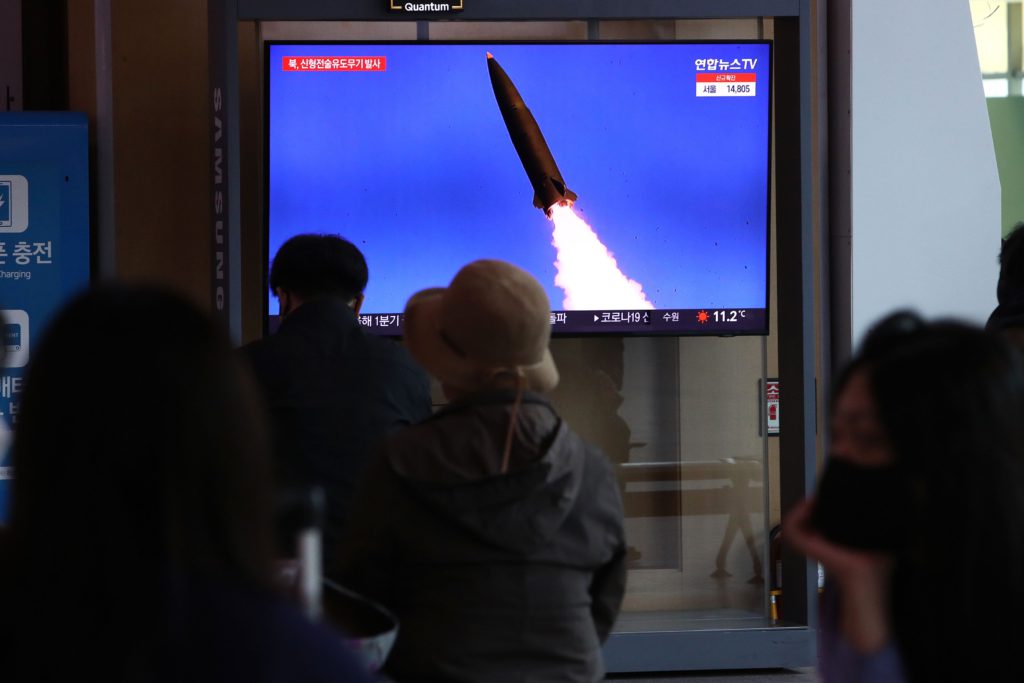
(Bloomberg) — North Korea launched what appeared to be a medium-range ballistic missile Wednesday, as Kim Jong Un ramps up his nuclear program ahead of U.S. President Joe Biden’s first visit to Seoul. 

The regime fired off a ballistic missile just after noon local time Wednesday from an area near Pyongyang Sunan International Airport, according to the South Korean Joint Chiefs of Staff. The missile flew about 780 kilometers (480 miles) into space and fell into the sea about 470 kilometers away, giving it a possible reach consistent with an MRBM.

South Korea said it was still analyzing details of the launch and North Korean state media often don’t reveal details of such exercises until at least the next day. Kim’s regime is on pace for its busiest testing year ever, after launching at least 14 ballistic missiles since Jan. 1, including its first intercontinental ballistic missile test since 2017. 

South Korean President-elect Yoon Suk Yeol’s transition team denounced the latest launch as an “outright violation” of United Nations resolutions banning ballistic missile tests. The act “threatens the peace and security of the international community and is absolutely unacceptable,” Japanese Prime Minister Fumio Kishida told a group of reporters while visiting Rome, according to Kyodo News.

Biden is expected to make his first visit to Seoul as president on May 20, even as North Korea continues to rebuff his overtures to restart talks. During a military parade in Pyongyang last week, Kim showed off the full range range of new missiles developed during his decade-long reign and vowed to further accelerate the program.

Satellite imagery indicates North Korea is preparing a key site for the country’s first test of a nuclear bomb in almost five years. Any such display would serve as a reminder of the pressing security problems posed by Pyongyang that have simmered as the Biden administrations focuses on Russia’s invasion of Ukraine.

“North Korea seems to have resumed its martial protests before Biden’s visit to South Korea later this month and as U.S. deploys its strategic assets around the Korean Peninsula,” said Cheon Seong-whun, a former security strategy secretary for South Korea’s presidential office. 

Asked by lawmakers during parliamentary hearings Wednesday what sort of weapon Kim launched, Defense Minister nominee Lee Jong-sup told lawmakers that it could’ve been an ICBM or a missile with a shorter range. That fed speculation that he could’ve tested his most advanced Hwasong-17 rocket at a reduced thrust to ensure success. 

North Korea appeared to doctor a video of an ICBM launch in March to cover up a failed test of the Hwasong-17, which experts believe is designed to carry multiple warheads to the entire U.S. mainland. Another possibility was a new submarine-launched ballistic missile that state TV called “the world’s strongest weapon” during the parade last week. 

Cha Du-hyeogn, who served as a security adviser to former South Korean President Lee Myung-bak, said the latest test was likely a short-range ballistic missile or MRBM, dismissing the idea that Kim would’ve spent resources launching a more powerful weapon without demonstrating its full capabilities. 

“Kim Jong Un’s nuclear strategy was becoming more offensive and hostile,” Cha said. “There’s less incentive for him to conduct such a costly test with reduced range.” 

More stories like this are available on bloomberg.com

©2022 Bloomberg L.P.

Chinese Tech Stocks Slide as SEC’s Didi Probe Hurts Sentiment

(Bloomberg) — Chinese technology shares slumped as the U.S. regulator’s probe into Didi Global Inc.’s 2021 debut in New York dampened investor appetite for the sector.  

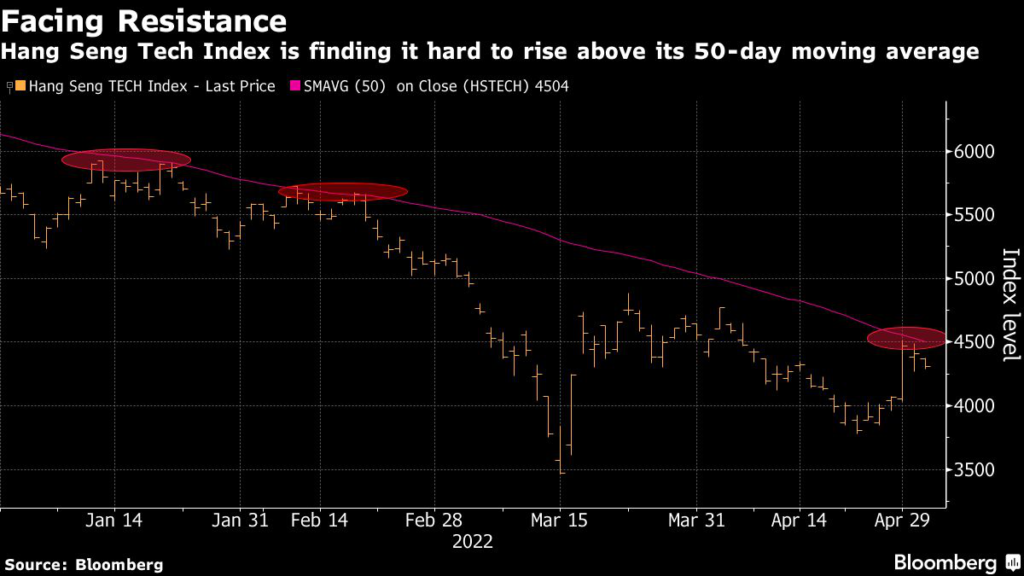
The Hang Seng Tech Index closed 3.3% lower on Wednesday, dropping for a second day. The losses put to test a recent rebound in the battered sector. The gauge of Chinese tech firms rallied last week on the back of the Politburo’s vows to support a healthy development of the industry.  

The U.S. Securities and Exchange Commission’s probe adds uncertainty to the ride-hailing giant as it prepares to depart New York bourses under pressure from Beijing. The troubles underscore the risk of investing in China’s tech sector, which still faces regulatory uncertainties despite Beijing’s repeated pledges to put an end to harsh crackdowns. 

The SEC’s probe is hurting “sentiment” even as the investigation is unlikely to impact other stocks in the sector, said Steven Leung, an executive director at UOB Kay Hian (Hong Kong) Ltd. “Diminishing regulatory risk from China should help further rebound on Chinese tech stocks.” 

Also weighing on the tech sector are holding cuts by some investors. JD Health International tanked 13% as an exchange filing showed its chairman sold shares. Meituan slumped 4.6% following news that Sequoia funds reduced stakes in the delivery giant. Both were among the worst performers on the tech gauge.

JD.com fell as restrictions on sale of the stock by Tencent holders who received the shares as a dividend were lifted.  

Hong Kong’s benchmark Hang Seng Index was also down more than 1%. The mainland markets reopen Thursday after the Labor Day holiday. 

More stories like this are available on bloomberg.com

©2022 Bloomberg L.P.

Didi Global Says It Faces SEC Probe Related to U.S. IPO

(Bloomberg) — The U.S. Securities and Exchange Commission is investigating Didi Global Inc.’s chaotic 2021 debut in New York, when the ride-hailing giant raised $4.4 billion days before revelations of a Chinese probe into data security tanked the stock.

Didi’s shares were down 7% in U.S. pre-market trading, deepening an 85% loss since its initial public offering in the summer of last year. The Chinese company said it’s cooperating with the probe, without providing further details. 

U.S. lawmakers had called last year for an investigation into Didi’s controversial IPO — the biggest by a Chinese firm since Alibaba Group Holding Ltd. China’s cybersecurity watchdog stunned investors by announcing its investigation into Didi two days after the listing, suspending the internet giant’s main apps from domestic stores. 

That precipitated a flurry of regulatory action against gig-economy and internet companies, culminating in a decision to force Didi to delist from New York and float in Hong Kong instead. That process is now suspended because regulators are pressing for more severe penalties, Bloomberg News has reported.

It’s unclear when the SEC launched its own probe into the matter. Didi devoted just a few lines on the U.S. investigation well into a 170-plus-page regular filing on May 2. Spokespeople for Didi and the SEC declined to comment. 

“After our initial public offering in the United States, the SEC contacted us and made inquiries in relation to the offering,” the filing read. “We are cooperating with the investigation, subject to strict compliance with applicable PRC laws and regulations. We cannot predict the timing, outcome or consequences of such an investigation.”

The SEC probe adds to the uncertainty surrounding Didi, once the most celebrated startup in China, as it prepares to depart New York bourses under orders from Beijing. The company, once worth about $80 billion, is grappling with the broader fallout after proceeding with its IPO despite regulators’ objections. It will now likely see its stock traded over the counter on the so-called pink-sheets market, home to penny stocks and other riskier businesses. Didi said last month it hadn’t applied to move to another exchange, surprising investors who anticipated a smoother transition. 

The company has been in talks with the Cyberspace Administration of China about a fine and other penalties, Bloomberg News has reported. But central government officials told the CAC they’re not satisfied with the proposed punishments and asked for revisions, people familiar with the matter have said.

Didi shareholders will vote on its delisting at a special meeting on May 23.

Beijing Has Put Didi in a Difficult Position: Fully Charged

(Updates with pre-market trading in second paragraph)

More stories like this are available on bloomberg.com

©2022 Bloomberg L.P.

Lyft Craters on Plans to Spend More on Driver Incentives

(Bloomberg) — Lyft Inc. shares plunged after a weaker-than-expected outlook sparked investor concerns that a planned increase in spend on driver incentives could weigh on profits. 

The San Francisco-based company sees earnings before interest, tax, depreciation and amortization of $10 million to $20 million in the current period, substantially missing the $81 million Wall Street projected. The shares were down 26% in pre-market trading.

The disappointing outlook underscores Lyft’s struggle to claw its way out of the pandemic without eroding profitability. Though the ride-hailing giant and its rival Uber Technologies Inc. have found resurgent customer demand, attracting drivers has been a persistent challenge and companies have spent millions in bonuses and other incentives to lure drivers back. The imbalance has led to longer wait times and high fares for riders.  

Meanwhile, a dramatic spike in gas prices in March squeezed workers’ take-home earnings, further casting doubt on rideshare platforms’ ability to retain them. Lyft and Uber have already introduced a gas surcharge to rides in a bid to help drivers. Though Lyft recorded a 40% increase in the number of drivers in the first quarter from the previous year, the company plans to invest more to boost driver supply in the second quarter, Chief Financial Officer Elaine Paul said on an analyst call the company. Paul said Lyft “remains committed” to being profitable on an adjusted basis for the year. 

The outlook suggests “that the company’s investments to boost driver supply coupled with higher gas prices may keep dragging on ride frequency through the year,” Bloomberg Intelligence analyst Mandeep Singh wrote. The decline in both active riders and revenue per active rider was “unexpected,” Singh said. “This could be a signal that Lyft is ceding market share to Uber.”

Wait Times

The average rideshare trip in the U.S. cost approximately $20 in the first quarter, up approximately 45% versus the same period in 2019, according to market research firm YipitData. Lyft President John Zimmer said in an interview the company “has room to improve” service levels, or wait times, which came down by about 30% in the first quarter. 

Lyft reported first-quarter revenue of $875.6 million on Tuesday, up 44% from a year earlier. That was more than the $844.5 million analysts were expecting, according to data compiled by Bloomberg. Lyft’s adjusted earnings before interest, tax, depreciation and amortization were $54.8 million in the quarter, far surpassing the $14.4 million analysts were expecting. 

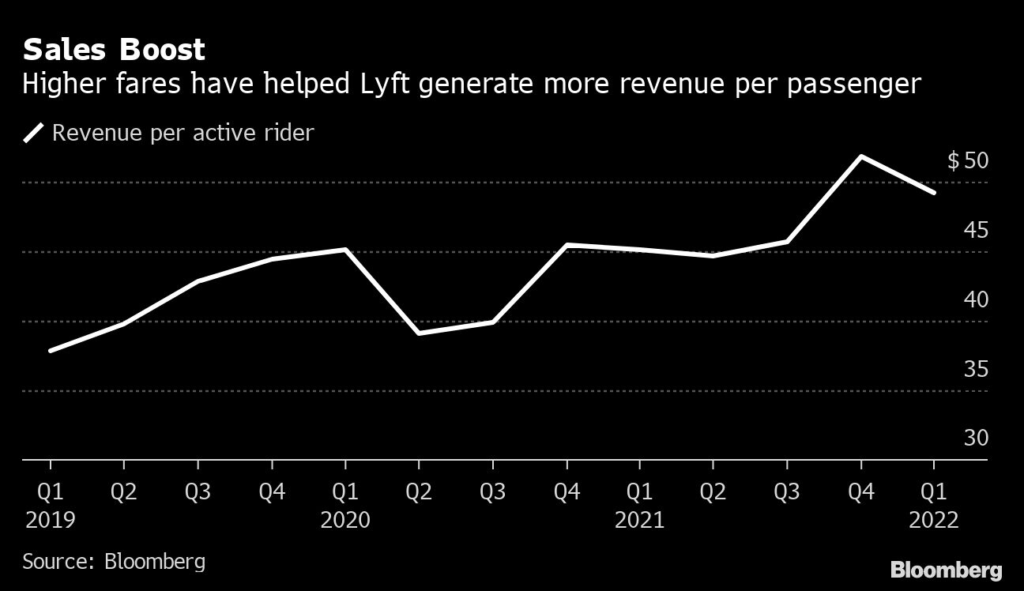
The boost in profits is attributed to strong ride volumes but also from the increase in revenue Lyft extracted from each passenger. Lyft generated $49.18 per active rider in the first quarter, the second-highest on record and 9% higher than the same period last year, partly due to higher fares. 

“The first quarter had a lot of disruptive factors,” CFRA Research analyst Angelo Zino said before the numbers were released. “While a high revenue per rider helps profitability, longer-term we want to see that figure come down to reflect a sustainable rideshare pricing model. Maintaining a growing rider base is key.”

Unlike Uber, which pivoted into food delivery during the pandemic with Uber Eats, Lyft’s core business is ride sharing. The company has expanded into other forms of transportation like bikes and scooters in some of its biggest markets such as New York City, San Francisco and Chicago. Still, Lyft’s ability to grow its rider base could be challenged by Uber’s partnerships with New York City and San Francisco taxi-hailing apps that would migrate cabbies to Uber’s platform. Lyft has no plans to pursue a similar deal, Chief Executive Officer Logan Green said on Tuesday. 

Lyft projected revenue of as much as $1 billion in the second quarter. Green said bringing back shared rides, which are only in effect in Miami and Philadelphia, will accelerate Lyft’s recovery and expects a broader rollout by the end of the year.

Lyft reported a net loss of $196.9 million, or 57 cents a share, narrower than the loss of $198.4 million, or 60 cents a share, analysts forecast. 

(Adds pre-market trading in the second paragraph, TOUT on Street Wrap)

More stories like this are available on bloomberg.com

©2022 Bloomberg L.P.

Africa’s Top Insurer Partners With Allianz on $2.1 Billion Deal

(Bloomberg) — Sanlam Ltd., Africa’s largest insurer, agreed to form a joint venture with Germany’s Allianz SE that will combine their assets on the continent valued at 2 billion euros ($2.1 billion) and help the partnership expand.

Sanlam and Allianz will fold their respective African operations — excluding those operating in South Africa — into a new unit majority controlled by the Cape Town-based group, according to a statement on Wednesday. They agreed to remain invested for at least 10 years. 

The deal “will enable Sanlam to enhance its capabilities in existing markets and expand its footprint,” the company said, while utilizing Allianz’s scale and expertise as one of the world’s largest financial services groups. 

Africa’s finance industry is facing a major shake up, with mobile-phone giants and fintech startups challenging the traditional banking and insurance providers. That’s left established operators to urgently strive to adapt, introducing products and services to take advantage of rapidly growing digitization and smartphone payments. 

Sanlam shares gained 0.5% as of 9:41 a.m. in Johannesburg, while Allianz, the parent company of insurance giant Pimco, fell 0.8% in Frankfurt.  


More stories like this are available on bloomberg.com

©2022 Bloomberg L.P.

Microsoft Faces Dutch Fines in Bankruptcy of Russia-Linked Bank

(Bloomberg) — A Dutch court ruled that Microsoft Corp. must allow bankruptcy trustees appointed to the Russia-linked Amsterdam Trade Bank to access to its data or face fines.

The technology giant risks daily fines of 10 million euros ($10.5 million), with a maximum penalty of 100 million euros, if it doesn’t comply with the ruling, court-appointed trustee Job van Hooff said by phone late Tuesday. ATB, a lender linked to Russia’s Alfa Group, was declared bankrupt last month in the Netherlands after U.S. and U.K. sanctions paralyzed its payment systems. 

“We don’t have access to email boxes because they have been shut down” by Microsoft, van Hooff said. “They contain important information for us trustees to be able to conduct the investigation into the causes of the bankruptcy,” he said. “There are also all kinds of documents, excel files, internal committee reports, minutes from management board meetings that were also to a large part stored in Microsoft’s environment.” 

The trustees and Microsoft are currently discussing the issue, said van Hooff. “We’re evaluating potential solutions that would enable us to comply with both the court’s decision and sanctions imposed by the U.S., EU, and U.K.,” said Sarah O’Hare O’Neal, associate general counsel of global trade at Microsoft by email.

Read More: Russia-Linked Amsterdam Trade Bank Declared Bankrupt

Van Hooff said some data was also stored via Amazon.com Inc. but they did not file proceedings against the company after it cooperated with the trustees. Dutch financial daily Het Financieele Dagblad was first to report the trustees’ dispute with Microsoft.

ATB had 23,000 private account holders, most of whom are resident in the Netherlands, and about 6,000 customers in Germany, according to the Dutch central bank. The lender, in which sanctioned billionaire Mikhail Fridman held an interest via Alfa Group, has been operating in the Netherlands since 1994 and had over 1.2 billion euros in assets, according to a 2020 report.

The trustees “will first look into possibilities to liquidate assets of the bank,” van Hooff said. After that they will start looking into the causes of the bankruptcy, he said. 

The central bank said it will pay eligible ATB account holders a maximum of 100,000 euros per person.

“The bank was quite solvent and liquid” but the U.S. and U.K. sanctions made it impossible for the bank to transfer funds, according to van Hooff. A number of banks also refused incoming payments from ATB bank accounts, he said.

(Updates with further trustee details)

More stories like this are available on bloomberg.com

©2022 Bloomberg L.P.
Luxury Fashion Maker Kering Backs Lab-Grown Leather Startup

(Bloomberg) — A California-based startup making cell-cultivated leather has raised $46 million in funding from investors including Kering SA, the maker of brands such as Gucci and Saint Laurent.

VitroLabs Inc. makes cellular-cultivated leather that replicates the structure of animal hides. It will use the funding to scale-up its operations and expects to start pilot manufacturing this spring, the company said in a statement on Wednesday.

The startup is the latest company to tap investor funding to develop alternative materials that replicate animal products. The sector is experiencing a growth spurt this year as brands demand more sustainable options. The 95 firms in the space raised an estimated $980 million last year, double the amount in 2020, according to the nonprofit Material Innovation Initiative. 

More than half of the firms have launched since 2014 and a majority of them are focused on creating leather-like material from mushroom roots, known as mycelium, as well as pineapples, cactus, other organic ingredients or from stem-cell technology, such as VitroLabs. Others are looking at fabrics including silk and wool.

While brands have sold products marketed as “vegan” leather for years, some of those products are simply a version of pleather, made from plastic. The new wave of biotech startups are trying to avoid plastic altogether or cut the amount used to bind the organic materials.

Companies are also working on making cheese and milk substitutes using a technology called precision fermentation, but lab-grown leather may face fewer regulatory hurdles to come to market than cultivated foods.  

VitroLabs said it’s the first alternative materials company that a major luxury group like Kering has invested in. Agronomics Ltd. and actor Leonardo DiCaprio also took part in the funding round. 

More stories like this are available on bloomberg.com

©2022 Bloomberg L.P.
VW Sees Better Chip Supplies in Second Half, Boosting Output

(Bloomberg) — Volkswagen AG expects the protracted shortage of semiconductors to ease during the second half of the year and contribute to a surge in output, offsetting months of curtailments.

VW confirmed a projection that deliveries will rise by as much as 10% this year, it said Wednesday, even after production slumped by 12% during the first three months. Strong prices and demand for high-end premium cars helped to offset lower production, it said. 

“Volkswagen’s global set up helped us mitigate many of the adverse effects we are currently seeing,” Chief Executive Officer Herbert Diess said in a statement. “Even in a more polarized world, Volkswagen is firmly committed to expanding its global footprint.”

The company warned its upbeat forecast hinged on further developments from the war in Ukraine and China’s strict coronavirus policies weighing on the global economy. The company has managed to navigate the shortages of chips and wire harnesses from suppliers in Ukraine by reallocating resources between its main markets in Europe, China and North and South America, it said.

The shares rose 2.3% in early trading in Frankfurt, paring losses of nearly 14% since the start of the year. 

So far, carmakers like Mercedes-Benz AG and BMW AG have come through the supply-chain crisis by raising sticker prices for new and used vehicles to offset the drop in production. Still, while demand remains strong, record price swings in commodity markets and the ongoing war in Ukraine are clouding the outlook.

While Volkswagen has halted its operations in Russia, it also had to temporarily shut some sites in Europe after suppliers of wire harnesses in Ukraine were unable to deliver components. 

VW already announced preliminary first-quarter earnings last month of 8.5 billion euros ($8.9 billion), almost double that of year ago. The jump was due to a surge in value of the company’s nickel hedging position following an historic short squeeze.

On Wednesday, VW said price increases for its volume brands and customers choosing “well-equipped” premium vehicles had helped to offset a drop in production. 

Strong demand in VW’s sport and luxury brand group, in particular for Porsche’s 911, Panamera and Cayenne models, helped boost operating profit to 1.4 billion euros and deliver an operating margin of 18.6%, the company said. The Porsche brand remains on track for a potential initial public offering this year, it said previously. 

Volkswagen provided financial figures for its Cariad software unit for the first time with net sales rising to 110 million euros in the first quarter. Upfront investment in software stacks contributed to an operating loss.

(Updates with shares in fifth, comment on Porsche returns in 10th paragraph)

More stories like this are available on bloomberg.com

©2022 Bloomberg L.P.
Close Bitnami banner
Bitnami