Bloomberg

Jefferies Weighs Sale of Oak Hill Capital Partners Stake

(Bloomberg) — Jefferies Financial Group Inc. is exploring the sale of its minority stake in private equity firm Oak Hill Capital Partners, according to people with knowledge of the matter.

Jefferies bought a 10% to 15% stake in Oak Hill Capital in 2019, when the firm planned to make it the anchor investment in a fund managed by Stonyrock Partners. Stonyrock planned to raise as much as $1 billion to buy stakes in private equity, real estate, infrastructure and other asset classes. 

Jefferies has since wound down the fund, dubbed Stonyrock Alt Fund I LP, Reuters reported earlier this year. The New York-based firm has sought interest in the Oak Hill Capital stake from potential buyers, one of the people said, requesting anonymity because the talks are private.

A Jefferies spokesman declined to comment. An Oak Hill Capital spokeswoman didn’t immediately respond to a request for comment.

Oak Hill Capital traces its roots to Texas billionaire Robert M. Bass’s family office, and is led by managing partners Tyler Wolfram, Brian Cherry and Steve Puccinelli, its website shows. The firm has had more than $19 billion in capital commitments since its inception, it said last month. The portfolio includes Checkers Drive-In Restaurants, American Veterinary Group and fiber-optic provider MetroNet.

Stakes in asset managers, known as GP stakes, have proliferated as a business on Wall Street as a means for firm founders and executives to obtain liquidity. Investors in the sector value firms at a multiple of management fees, which are predictable, and potential carried interest. 

More stories like this are available on bloomberg.com

©2022 Bloomberg L.P.

South African Inflation Edges Toward Top of Central Bank Range

(Bloomberg) — South Africa’s inflation rate moved closer to the ceiling of the central bank’s target range in March, highlighting the tough choice it faces in striking a balance between taming price growth and supporting the nation’s sluggish economy.  Annual inflation accelerated to 5.9% from 5.7% in February, Statistics South Africa said Wednesday in a …

South African Inflation Edges Toward Top of Central Bank Range Read More »

Netflix Craters After Shock Subscriber Drop, ‘About-Face’ on Ads

(Bloomberg) — Netflix Inc. investors punished the company for its shock loss in subscribers and abrupt turnabout to embrace advertising after years of shunning it.

Shares of the streaming leader plunged as much as 39%, erasing years of gains in the biggest intraday drop since 2004. The swoon made Netflix the worst-performing stock of the year on both the benchmark S&P 500 and Nasdaq 100 indexes and sent shock waves across the media universe, sinking Warner Bros. Discovery Inc., Roku Inc. and others.

Netflix is seeking ways to stop a loss of subscribers and combat investor fears that its best days are over. Co-founder Reed Hastings had said for years that he doesn’t want to offer advertising and had no problems with password sharing.

But the company is changing course after losing 200,000 customers in the first quarter, the first time it has shed subscribers since 2011. Netflix also projected it will shrink by another 2 million customers in the current quarter, a huge setback for a company that regularly grew by 25 million subscribers or more a year. Netflix also will curb its spending on films and TV shows in response to the customer losses.

“It’s just shocking,” said analyst Michael Nathanson of MoffettNathanson LLC. “Everything they’ve tried to convince me of over the last five years was given up in one quarter. It’s such an about face.”

Investors, analysts and Hollywood executives had been bracing for the company to report a sluggish start to the year, but Wall Street still expected Netflix to add 2.5 million customers in the first quarter. The shares were already down more than 40% this year.

Hastings and co-Chief Executive Officer Ted Sarandos had previously dismissed the company’s slowing subscriber sign-ups as a speed bump related to the pandemic, which had accelerated Netflix’s growth in 2020. But the company’s growth hasn’t returned to pre-pandemic levels.

Four Causes

Management pointed to four causes, including the prevalence of password sharing and growing competition. The company said there are more than 100 million households that use its service and don’t pay for it, on top of its 221.6 million subscribers. The Los Gatos, California-based company is experimenting with ways to sign up those viewers, such as asking people who are sharing someone else’s account to pay.

“It allows us to bring in revenue for everyone who is viewing and who gets value from entertainment we’re offering,” Chief Operating Officer Greg Peters said during an interview with analyst Doug Anmuth of JPMorgan Chase & Co.

Netflix’s troubles are a warning sign for its peers and competitors. After watching millions of customers abandon pay TV for streaming, U.S. entertainment giants merged and restructured to compete with Netflix. Investors encouraged this strategic shift, boosting shares of companies like Walt Disney Co. that demonstrated a commitment to streaming.

Investors have begun to question whether some of these media companies will sign up enough customers to justify all the money they are spending on fresh programming. Disney fell as much as 5.5%, while Warner Bros. Discovery, the owner of HBO Max, declined as much as 7.3%. Roku, the maker of set-top boxes for streaming, dropped as much as 8.9%.

All of these competitors offer advertising-supported services, or are planning to do so in the near future. Analysts and competitors have speculated for years that Netflix would offer advertising, only to be rejected by Hastings. Netflix always said its viewers preferred its service over cable TV because there were no ads. Hastings also didn’t want to compete with Google and Facebook in selling ads online. Yet he has finally relented.

‘Makes Sense’

“Allowing consumers who would like to have lower price and are ad tolerant makes a lot of sense,” Hastings said Tuesday. Netflix will explore the best way to offer advertising over the next couple of years.

Cracking down on password sharing is a risk for a company that started by giving customers a cheaper, more convenient alternative to cable. By nudging customers to pay — and inserting advertising — Netflix begins to resemble what it replaced.

But the company needs help after losing customers in three of its four regions in the first quarter, including more than 600,000 in the U.S. and Canada. Netflix blamed most of that on a price increase, and said the decline was expected. Russia’s invasion of Ukraine cost the company another 700,000 customers when it had to pull its service in Russia, resulting in a loss of 300,000 customers in Europe, the Middle East and Africa.

Overall, Netflix had forecast subscribers would grow by 2.5 million in the first quarter, roughly in line with Wall Street estimates. For the current period, analysts were predicting gains of 2.43 million. First-quarter revenue grew 9.8% to $7.87 billion, missing analysts’ estimates. Profit, at $3.53 a share, easily topped projections of $2.91.

“They were never able to explain why or how growth was slowing,” Nathanson said. “Now they’ve decided growth is slowing. How did this change in two quarters?”

Asia was the lone bright spot. Netflix added more than 1 million customers in the region, buoyed by popular new titles such as the South Korean drama “All of Us Are Dead.”

Read more: ‘Squid Game’ Helps Makes Asia Lone Bright Spot for Netflix

Netflix remains well ahead of most of its competitors outside the U.S., and is the largest streaming service in the world. The company believes it can execute its way out of the current predicament by luring new customers with better programs and finding more ways to charge its existing user base. The company still expects to add customers this year, and will have a stronger slate of new shows in the back half of the year.

Whether Wall Street believes that is up for debate.

More stories like this are available on bloomberg.com

©2022 Bloomberg L.P.

ASML Sees Rising Demand After Earnings Hit by Supply Snags

(Bloomberg) — ASML Holding NV signaled plans to raise its forecast later this year as demand for its chip-making machines outstrips supply.

“In light of the demand and our plans to increase capacity, we expect to revisit our scenarios for 2025 and growth opportunities beyond,” Chief Executive Officer Peter Wennink said. “We plan to communicate updates in the second half of the year.”

ASML shares gained as much as 8% on Wednesday in Amsterdam. 

Analysts asked ASML executives on an earnings call about whether demand for chips is falling due to weakening global macroeconomic conditions, but Wennink said he hasn’t seen any sign that demand for his company’s equipment is tapering off. The Dutch company is only able to fulfill about 60% of the orders for its mature deep ultraviolet lithography systems this year, he said.

“The demand we are currently seeing comes from so many places in the industry,” Wennink said. “It’s so widespread. We have significantly underestimated the width of the demand. That, I don’t think, is going to go away.”

Wennink said a large industrial conglomerate told him last week that it was buying washing machines to tear out chips and use those components to build its modules, and incidents like this are happening “everywhere.” He added that a major Chinese customer also told ASML that it has sold out all of its capacity throughout 2023.

The optimism for ASML, the world’s largest semiconductor equipment maker, was tempered after sales forecasts for the second quarter fell short of analysts’ expectations as the company’s decision to delay testing its machines to speed up deliveries once again hit earnings.

In the second quarter, 800 million euros of net delayed revenue was excluded from the company’s guidance, according to Chief Financial Officer Roger Dassen. “That is the result of the fact that we expect more fast shipments at the end of Q2 than we had at the end of Q1.”

Dassen also cited the increase in labor, component, freight and energy prices. “If I were to quantify that, I think all in all we might be looking this year about a 1% incremental impact on the gross margin,” he said.

Inflationary pressures are growing amid a rise in service fees to secure parts that are in short supply and very high demand, a jump in freight costs on changing shipping corridors and fuel prices and “very strong” competition in labor markets in Asia and Silicon Valley, according to Dassen. 

Last week, ASML’s major customer, Taiwan Semiconductor Manufacturing Co., said its suppliers are facing challenges including a constraint in labor and chips, which has led to a longer delivery time for tools. The Taiwanese chipmaker said it’s working closely with suppliers to resolve the issues. 

ASML has cornered the market for the latest advanced extreme ultraviolet lithography equipment needed to make cutting-edge chips that are faster and more efficient. 

However, the company began skipping some final testing in its factories last year to speed up delivery. This meant clients get their machines more quickly, but ASML had to delay about 2 billion euros worth of sales that were expected to ship in the first quarter.

ASML’s customers include Samsung Electronics Co. and TSMC, which have been investing heavily to keep up with rebounding demand as lockdowns ended. It competes with Japan’s Nikon Corp. in deep ultraviolet machines used to produce more mature chips.  

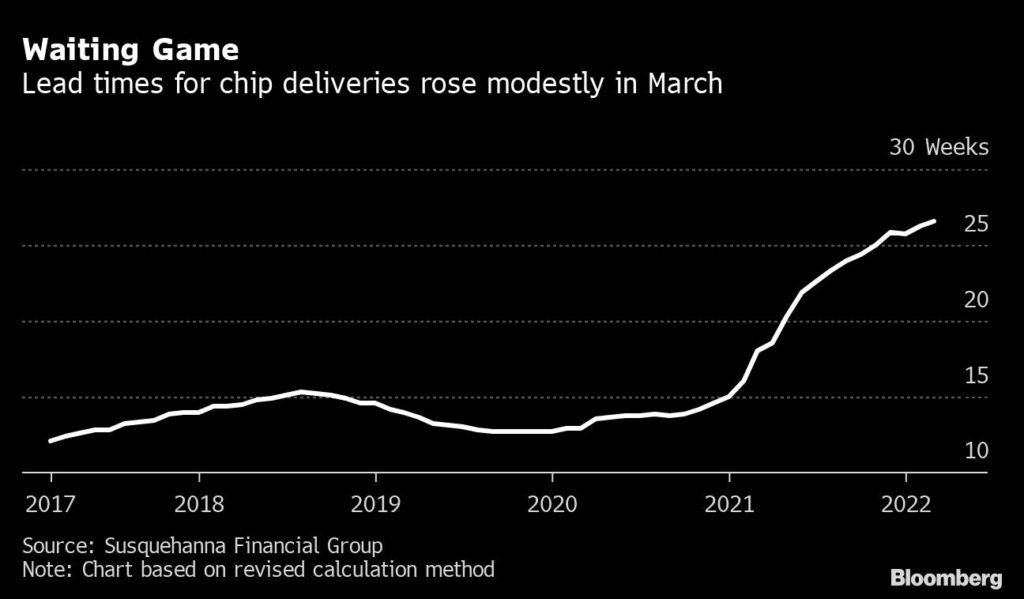
The wait times for semiconductor deliveries rose to a new high in March, after lockdowns in China and an earthquake in Japan further hampered supply. Lead times — the lag between when a chip is ordered and delivered — increased by two days to 26.6 weeks last month, according to research by Susquehanna Financial Group.

Key Insights

  • In the first quarter, ASML shipped 9 of its newest EUV machines, which print smaller circuits while increasing capacity and speed.
  • ASML said Wednesday it predicts sales of 5.1 billion euros ($5.52 billion) to 5.3 billion euros for the second quarter compared with an estimate of 5.86 billion euros in a Bloomberg analyst survey.
  • ASML kept its guidance for 20% sales growth and a capacity for 55 EUV units this year
  • Dassen says the company is investigating whether it is feasible “to get to a capacity for EUV by 2025 – low-NA EUV – of 90 units and DUV 600 units.” “That’s what we’re looking at for 2025. For the medium term we’re also looking at 20 units for High-NA.”
  • “Backed by a very well filled orderbook and a ramp in production capacity 2023 is shaping up well already,” said Marc Hesselink, an Amsterdam-based analyst ING. Hesselink said he sees an unchanged picture overall with “high demand for years to come.”
  • ASML stock dropped about 16% since the start of the year, compared with about a 21% retreat in the Stoxx Europe technology index.

(Updates with detail from conference call from fourth paragraph. A previous version corrected to clarify ASML as a machine-maker.)

More stories like this are available on bloomberg.com

©2022 Bloomberg L.P.
Elon Musk Goes Looking for Financing for His $43 Billion Twitter Bid

(Bloomberg) — Elon Musk has started reaching out to potential financing partners across Wall Street as he seeks to shore up funds for his $43 billion bid to buy Twitter Inc.

Musk and his advisers have held conversations about debt financing with several possible partners, according to a person familiar with the matter. The prospect of raising equity to back the offer hasn’t yet been discussed with other firms, said the person, who asked not to be identified as the detail are private. 

While Musk is the world’s richest person with a fortune of about $261 billion, according to the Bloomberg Billionaires Index, much of that wealth is tied up in the stock of Tesla Inc., the electric-car company he co-founded. He has multiple options available to fund the bid, including selling some of those shares, taking out loans against them, raising debt financing or bringing in an investment partner.

Wall Street’s biggest banks and buyout shops are divided on whether they’d step in to help Musk. 

Among the parties that would almost certainly help back a bid is Morgan Stanley, the bank that’s advising Musk on his unsolicited offer. Apollo Global Management Inc. is also interested in helping finance the potential takeover, a separate person familiar with the matter said this week. Meanwhile, private equity firms including Blackstone Inc., Brookfield Asset Management and Vista Equity Partners have ruled out getting involved, people familiar with their thinking said. 

The New York Post and the New York Times previously reported some aspects of the financing plans.

Aside from assembling the financing, to succeed with a bid Musk still has to win over the company’s board. Though Twitter hasn’t yet rejected his offer, the company has launched a poison pill defense to thwart Musk’s bid to take it private at $54.20 a share. 

Twitter shares were trading below the offer, up 0.5% on Wednesday at $46.34 apiece. 


(Updates with Twitter’s share price in final paragraph.)

More stories like this are available on bloomberg.com

©2022 Bloomberg L.P.

JD, Alibaba Stock Exodus From New York Intensifies

(Bloomberg) — Investors are shifting more of their shares in Chinese e-commerce giants to the Hong Kong market, as Beijing’s efforts have yet to dispel concerns over the companies’ eligibility to remain listed on Wall Street. 

About 77% of JD.com Inc.’s shares are circulating in Hong Kong’s clearing and settling system as of Tuesday, versus 44% at the beginning of this year, according to Bloomberg calculations based on stock exchange data. Alibaba Group Holding Ltd.’s Hong Kong-listed share portion rose to 56% from 53% during the same period, the data show. 

Most of this year’s conversions at Alibaba and JD.com took place this month, even as China modified a decade-old rule that potentially removed a key hurdle for U.S. regulators to gain full access to auditing reports. 

While other companies that are listed in both Hong Kong and New York haven’t seen a similar scale of share conversion this year, the moves by shareholders at Alibaba and JD.com highlight that the U.S. delisting risk remains a concern. By slashing exposure to American depositary shares, investors avoid direct regulatory shocks that may force trading suspensions and liquidation of their stock in the U.S. 

“We are buying incrementally through the Hong Kong shares instead of U.S. shares,” said Louis Lau, fund manager at Brandes Investment Partners, who said Beijing’s efforts lowered the possibility of delisting, but the odds still stand at 50%. “The attention is now shifting onto implementation — how will China grant U.S. audit access and to what companies.”

The U.S. and China have been at odds for two decades over the mandate that all companies that trade publicly in America grant access to audit work papers. Firms face removal if they shirk requirements for three straight years, meaning they could be kicked off the New York Stock Exchange and Nasdaq as soon as 2024.

The U.S. Securities and Exchange Commission has named at least 23 Chinese companies on a list of those who are running afoul of the auditing requirements. 

There are more than 200 Chinese firms that are listed in the U.S., of which about 20 companies also have a listing status in Hong Kong, and that group is expected to increase. Holders of depositary receipts can hand their U.S. shares back to the depositary bank to register a conversion, which then swaps them into Hong Kong-listed shares at a set ratio. The portion of Hong Kong-listed shares at JD.com and Alibaba almost doubled last year. 

To be sure, a conversion doesn’t offset all of the risks introduced by U.S. delisting. Investors will need to deal with a less liquid market and potentially lower valuation when shares are shifted back to Hong Kong. 

“There are more discussions in the market on the differences in liquidity and investor structures between the Hong Kong and U.S. stock markets,” said Jamie Chen, an analyst at Third Bridge Group Ltd. “It is inevitable that there will be some discounts in valuations and the turnover rate will also be reduced. This is the main risk of listing in Hong Kong.” 

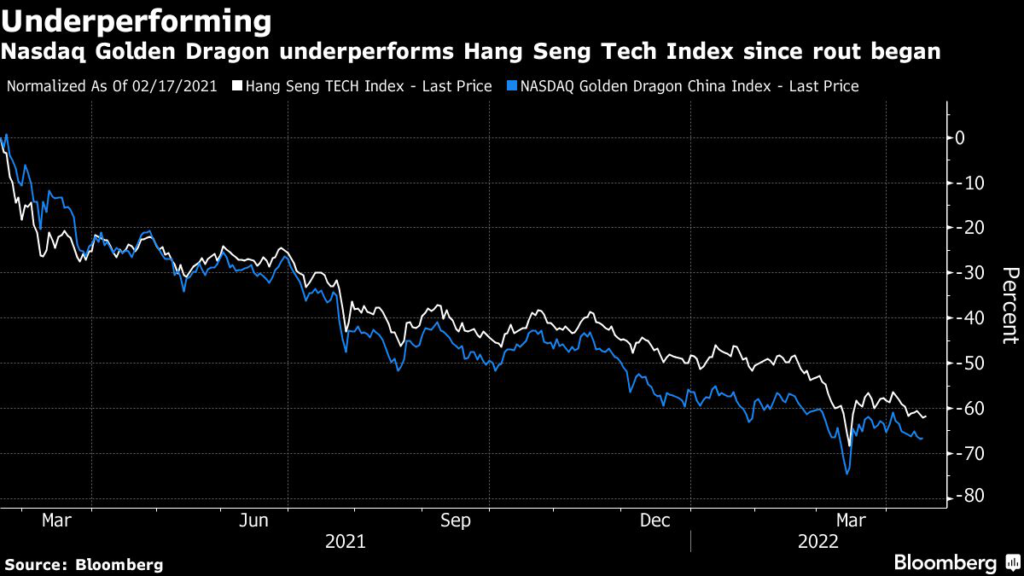
The Hang Seng Tech Index has dropped 27% in Hong Kong this year, and the risk of abandoned U.S. listings remains a key overhang for the sector. Didi Global Inc. tumbled Monday after the Chinese ride-hailing giant said it’s planning to delist its U.S.-traded shares before it finds a new venue for the stock.

On Wednesday, DiDi shares fell 2.7%, Alibaba Group Holding dropped 2.1%, and JD.com fell 4.3%. Baidu slid 1.1%.

Tech Chart of the Day

Netflix shares fell as much as 39% on Wednesday, their biggest intraday percentage loss since 2004. The selloff, spurred by weak subscriber trends, took the stock to its lowest since 2018. With the drop, Netflix is now down more than 60% for 2022, making it the worst-performing component of both the Nasdaq 100 Index and the S&P 500 Index.

Top Tech Stories

  • Netflix shares are on course to lose about $40 billion in value Wednesday after the company reported its first customer decline in more than a decade
  • Elon Musk has given fresh fuel to speculation he would launch a tender offer for Twitter Inc. shares in the event that the board resists his proposal to acquire the company
  • ASML Holding NV, the world’s largest maker of semiconductor-manufacturing equipment, said demand for its machines outstripped supply in the second quarter, prompting it to lift its longer-term sales forecasts
  • Smartphone shipments fell 11% in the first quarter, the biggest drop since the coronavirus outbreak, after inflation fears, Russia’s invasion of Ukraine and the Omicron variant derailed an unsteady recovery for the sector
  • International Business Machines Corp. reported sales that topped analysts’ estimates on strong demand for its hybrid-cloud offerings, signaling continued momentum for its transition to a business fueled by cloud-based software and consulting


(Updates with market open.)

More stories like this are available on bloomberg.com

©2022 Bloomberg L.P.
Netflix Shares Plunge 30% After Massive Subscriber Loss

(Bloomberg) — Netflix Inc. tumbled 39% on Wednesday, extending a selloff that has set it on course for a $60 billion wipeout in market value, after it reported a sharp decline in its subscriber base.  

Netflix traded as low as $212.51 in New York, extending its plunge this year to 64% — making the worst performing stock in the broad S&P 500 and the tech-heavy Nasdaq 100 indexes. Netflix has a 0.7% weighting on the Nasdaq 100 and 0.3% on the S&P 500. The shares are on pace for their biggest drop since October 2004 and are now worth less than $100 billion in market value.

The streaming service shocked Wall Street by losing 200,000 customers in the first quarter, the first time it has shed subscribers since 2011. It also projected it will shrink by another 2 million customers in the second quarter.

“A big problem with Netflix is that it’s too easy to leave the service,” said Russ Mould, investment director at AJ Bell. Consumers feeling the pinch from inflation will be looking hard at their expenses and streaming services are a quick way to save money, he said.

The drop in customers has led Netflix to break some of its long-standing rules: it will introduce a cheaper, advertising-supported option for subscribers in the next couple years and will start to crack down on people sharing their passwords even before that. 

Netflix’s stock has suffered this year as the pandemic-era surge in user sign-ups faded and investors have turned away from high-value technology and growth stocks due to rising bond yields. 

Fellow stay-at-home stocks, including Etsy Inc., Zoom Video Communications Inc. and DocuSign Inc. have also been hit by deep losses, down by 38% to 51% in 2022, as these businesses struggle to leverage the inroads they made during lockdowns.

Long-Time Bulls Cool 

Netflix’s stock has been a Wall Street darling in recent years, with three out of every four analysts covering the stock recommending a buy at the start of the year. 

Now, even Wall Street bulls are flipping sides after Netflix missed even the most-bearish forecasts, not just once, but twice in a row. Analysts across Wall Street reduced their price targets for the streaming-video company, while at least nine brokerages downgraded the stock. 

JPMorgan’s Douglas Anmuth, who cut his buy recommendation that he had maintained since 2013, said he was encouraged by the company’s intentions of creating an ad business — a model that has worked for Hulu and Disney+ — but noted that it was still in early stages.

With the downgrades, the streaming-video company now has the lowest number of buy ratings since 2015, according to data compiled by Bloomberg. 

(Updates share price move.)

More stories like this are available on bloomberg.com

©2022 Bloomberg L.P.
Telecom Italia Is Said to Seek $3.3 Billion State-Backed Loan

(Bloomberg) — Telecom Italia SpA is in talks to get a guarantee on a new credit line from Italy’s trade insurer as it seeks to bolster its balance sheet after reporting a record loss, according to people familiar with the matter.

The former phone monopolist is in negotiations with a pool of banks for a facility totaling around 3 billion euros ($3.3 billion), the people said, asking not to be named because they aren’t authorized to speak about it. 

Discussions with state-owned credit insurer Sace SpA are ongoing for a guarantee over at least part of the amount, and there’s no certainty the parties will reach an agreement on the financing, they said.

A Rome-based spokesman for Telecom Italia declined to comment. A spokesman for Sace wasn’t immediately available for comment.

A new loan backed by Sace would help Telecom Italia boost its reserves after it booked an 8.6 billion-euro fourth-quarter loss because of impairments and avoid possible future downgrades. The company has been struggling for years from high indebtedness amid fierce competition in Italy’s telecoms sector. 

Debt Pile

Sace traditionally provides loans to Italian exporters, but has stepped in to prop some of the country’s largest companies throughout the pandemic. The new loan could be one of the biggest credit guarantees provided by the credit insurer since it backed a 6.3 billion-euro loan for the Italian unit of Fiat Chrysler Automobiles NV in 2020. 

Telecom Italia has 33 billion euros of debt in total, with 8.2 billion euros coming due before the end of 2023. A change in ownership and structure of the company — currently under discussion after KKR & CO. walked away from a full takeover bid — could also have an impact on the debt quantity and ratings.

Telecom Italia’s new Chief Executive Officer Pietro Labriola, a 54-year-old industry veteran, has drawn up a new business plan in a bid to shake up the company by separating the landline network. The plan would also see all commercial services spun off into a separate unit called ServCo. 

In March, Fitch Ratings and Moody’s Investors Services downgraded Telecom Italia’s debt deeper into non-investment grade territory, threatening to further lower the rating as they expect leverage to increase. 

“We remain cautious on Telecom Italia, as it’s uncertain how the company will look a year from now,” wrote Jan Frederik Slijkerman, an analyst at ING Bank NV, in a note. “A potential partial sale of the network would be negative for bondholders.”

More stories like this are available on bloomberg.com

©2022 Bloomberg L.P.

Is Coinbase’s New NFT Marketplace the Answer to Its Growth Problems?

(Bloomberg) — Coinbase Global Inc.’s marketplace for nonfungible tokens is finally here in what could be key to reviving the crypto exchange’s growth prospects a year after its fizzling public debut. 

A trial version of its long-awaited platform — designed to sell ownership of digital art and possibly other items — was unveiled Wednesday in the company’s latest attempt to diversify its revenue and bring more predictability to the business.

When Coinbase went public a year ago, investors had high hopes for a growth story. But with sales growth expected to go from triple digits in 2021 to negative this year, shares have tanked to a record low recently. 

The social NFT marketplace — which will allow users to trade, “like” and comment on images, similar to Instagram — will be entering a crowded field six months after it was originally announced. A slew of other crypto exchanges and platforms, such as Binance and FTX, have already launched similar marketplaces. Plus, the NFT hype itself is cooling down. Sales on OpenSea, the world’s biggest NFT marketplace, are down 67% over the past 30 days, per tracker DappRadar.

Coinbase will need the platform to be a hit as it seeks to reduce its reliance on trading fees, which are subject to the whims of retail traders who more recently have been on the sidelines after crypto prices fell from last year’s highs. At the end of last year, about 86% of Coinbase’s revenue came from trading fees. It has about 89 million registered users to whom it could promote the service.

Many believe Coinbase will be able to expand into NFTs — but perhaps not as quickly as they expected last fall. The platform may be “too little, too late,” according to Dan Dolev, managing director at Mizuho Securities. “I don’t think this is the big, promising thing,” he said.

One-Year Anniversary

Sentiment toward Coinbase stock has greatly changed from when the company made its debut almost exactly a year ago. As the biggest U.S. crypto exchange, its net revenue grew more than 500% in 2021. But it’s been a bumpy ride since then as Coinbase’s challenges have piled up.

The company is facing increasing competition from not just crypto exchanges, but also online brokerages like Robinhood. Its grand India expansion plan — touted by Chief Executive Officer Brian Armstrong in a recent trip to Bengaluru — was blemished by an obstacle in payment. And analysts now forecast a drop in adjusted revenue this year, according to data complied by Bloomberg.

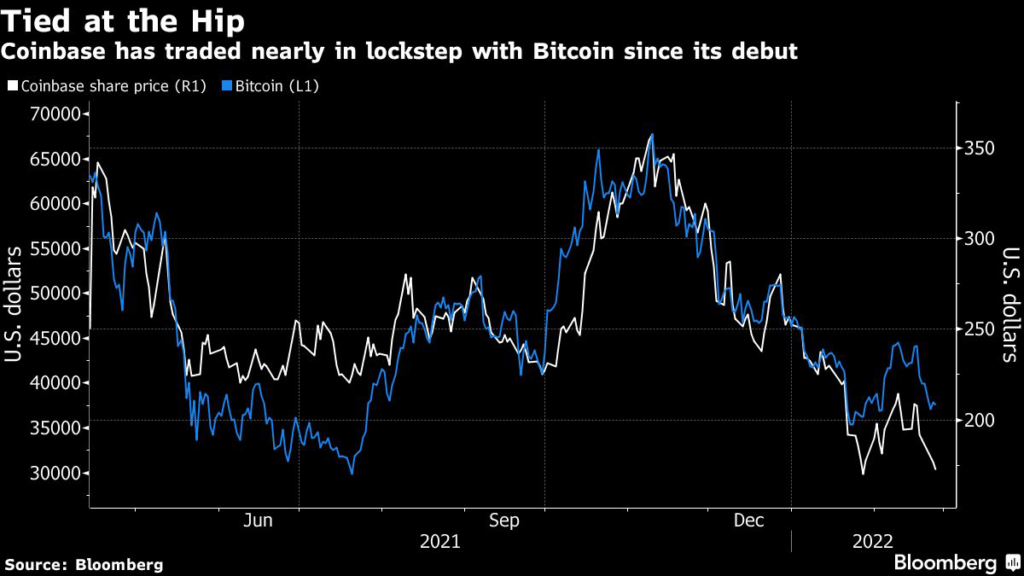
The stock has shed about 50% from the end of its first day of trading, and while it has mostly moved in tandem with Bitcoin prices, investors would have been better off buying spot Bitcoin. Shares declined about 3.6% on Wednesday.

“Equity analysts just don’t believe Coinbase will be able to generate any revenues outside of trading in any meaningful way,” Jeff Dorman, chief investment officer at Arca, said in an interview. He believes they are wrong. “It obviously makes no sense where it’s being valued right now. Fundamentally, it’s just the cheapest stock in the world.”

The NFT market still has grown hugely over the past year, and many believe that everything — from house deeds to club memberships — will become an NFT, creating a massive market. But the expectations for Coinbase’s new NFT business have been tempered since it was first announced.

“I don’t think the waitlist is going to be as excited about NFTs as they were six months ago,” Chris Brendler, an analyst at D.A. Davidson, said in an interview. Coinbase has 2.5 million email addresses in its waiting list, though some of them could be duplicates.

Looking Ahead

Despite the challenges, Coinbase is investing heavily in search for growth. Its previous efforts to diversify revenue have included its so-called staking products, which allow users to earn yield on their coins. But in a recent investor letter, the company said it may slow its investments if there’s a material decline in sales so that losses won’t exceed $500 million this year. Its venture arm is one of the most prolific in the industry, making nearly 150 deals last year.

“We’re not always going to be the first to market with a product,” said Alesia Haas, chief financial officer, during its earnings call in February. “But once we see customer demand, we’re going to fast follow and make sure that we can leverage the strength of our platform.”

(Adds share move.)

More stories like this are available on bloomberg.com

©2022 Bloomberg L.P.
Reed Hastings, Hedge Funds Dealt Another Blow After Netflix Miss

(Bloomberg) — Reed Hastings’s fortune was already on the decline before Netflix Inc., the streaming giant he co-founded, reported its surprising first-quarter earnings.

Now with Netflix shares plunging 31% after it lost subscribers for the first time in a decade and the firm forecasting that 2 million more will soon leave, his wealth wipeout ranks among the biggest in the world, according to the Bloomberg Billionaires Index.

Read more: Netflix Craters After Shock Subscriber Drop, ‘About-Face’ on Ads

Hastings, 61, has a net worth of $3.6 billion, down 46% from the start of the year. That’s the second-steepest drop among U.S. billionaires tracked by the Bloomberg index, exceeded only by Ernest Garcia III, the chief executive officer of Carvana Co., which has tumbled 58% this year.

His wealth is still mostly tied to the performance of Netflix. In 2020, he cashed in on pandemic-fueled subscriber growth with a stock sale worth $616 million.

While Hastings has said for years that he doesn’t want advertising and is fine with password sharing, the company is changing course after losing 200,000 subscribers in the first quarter. It said it would introduce a cheaper, ad-supported option in coming years and will start cracking down on people circulating their login information.

Some mega hedge funds may also be feeling the pain. 

Hedge fund Pershing Square Capital Management made a big bet on Netflix in January, when Bill Ackman tweeted that he’d bought 3.1 million shares of the company.  

Chase Coleman’s Tiger Global Management owned more than 1 million shares of Netflix as of year-end, while Philippe Laffont’s Coatue Management had about 931,000 shares. Netflix was Maverick Capital’s fourth-biggest U.S. stock position as of Dec. 31, holding more than 420,000 shares.

Other hedge funds, including Viking Global Investors and D1 Capital, ditched their Netflix stakes entirely at the end of last year. It was a particularly interesting move for D1, as founder Dan Sundheim said in 2019 that Netflix could trade above $1,000 a share by 2024. It was trading at $240.49 at 9:35 a.m. in New York.

More stories like this are available on bloomberg.com

©2022 Bloomberg L.P.
Close Bitnami banner
Bitnami