Bloomberg

JPMorgan Loses Lead Role in IPO After Note Branded China Tech ‘Uninvestable’

(Bloomberg) — JPMorgan Chase & Co. was removed as the most senior underwriter for Kingsoft Cloud Holdings Ltd.’s Hong Kong stock offering after one of the bank’s analysts cut the share-price target for the Chinese technology company by half, people familiar with the matter said.

The New York-based bank lost the so-called lead-left role in arranging Kingsoft Cloud’s listing, the people said, asking not to be identified discussing private information. JPMorgan is still a sponsor of the offering, but is now ranked behind UBS Group AG and China International Capital Corp., the people said.

The demotion could cut fees for JPMorgan and underscores the tricky path banks must sometimes navigate when their research departments issue downbeat calls on investment-banking clients. JPMorgan is among a slew of global banks seeking to expand in China at a time when the nation’s stock market is tumbling on worries about slowing economic growth, strict Covid Zero policies and a government crackdown on tech companies.

There’s no indication that JPMorgan has lost any other investment-banking roles after analysts at the firm cut ratings on 28 tech companies including Kingsoft Cloud in widely circulated research last month, calling the China internet sector “uninvestable” in the near term. Research analysts at global banks including JPMorgan are supposed to operate independently of the firms’ investment bankers.

Read more: JPMorgan Started Damage Control as Soon as Dimon Made China Joke

Kingsoft Cloud, which is already listed in the U.S., has a market capitalization of about $1 billion. The size of the offering in Hong Kong may be relatively small, amounting to about $100 million, one of the people said.

A spokesman at JPMorgan declined to comment, as did media representatives from UBS and CICC.

In a statement, Kingsoft Cloud said it couldn’t comment on anything related to the proposed listing. “We highly respect research independence,” it said. Investment bank appointments and rankings will not be finalized until prior to the listing, and each of the joint sponsors, if hired, take the same responsibility, the firm said. 

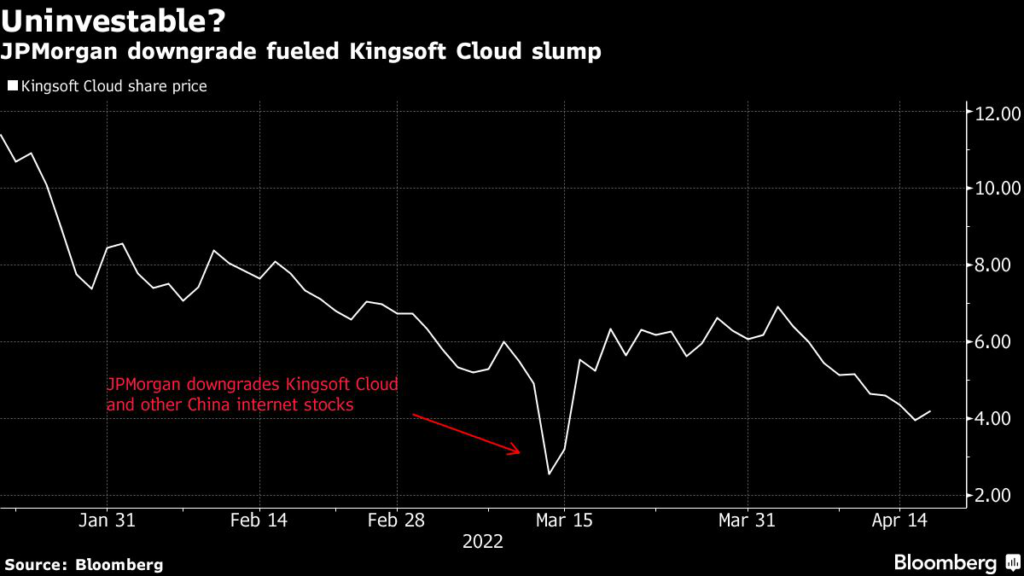
JPMorgan analyst Alex Yao on March 14 downgraded Kingsoft Cloud to underweight, slashing its price target to $3.50 from $8. The stock plunged 48% that day. It rebounded the following day after Kingsoft Cloud announced it was exploring the Hong Kong listing.

Read more: China Markets Are Only ‘Uninvestable’ for Slackers: Shuli Ren

JPMorgan bankers have explained to Kingsoft Cloud’s management that the downgrade was triggered by general market conditions rather than fundamentals, the people said. Kingsoft Cloud’s decision on the deal isn’t final, the people added. 

More stories like this are available on bloomberg.com

©2022 Bloomberg L.P.

JPMorgan Loses Lead Role on China Deal After ‘Uninvestable’ Call

(Bloomberg) — JPMorgan Chase & Co. was removed as the most senior underwriter for Kingsoft Cloud Holdings Ltd.’s Hong Kong stock offering after one of the bank’s analysts cut the share-price target for the Chinese technology company by half, people familiar with the matter said.

The New York-based bank lost the so-called lead-left role in arranging Kingsoft Cloud’s listing, the people said, asking not to be identified discussing private information. JPMorgan is still a sponsor of the offering, but is now ranked behind UBS Group AG and China International Capital Corp., the people said.

The demotion could cut fees for JPMorgan and underscores the tricky path banks must sometimes navigate when their research departments issue downbeat calls on investment-banking clients. JPMorgan is among a slew of global banks seeking to expand in China at a time when the nation’s stock market is tumbling on worries about slowing economic growth, strict Covid Zero policies and a government crackdown on tech companies.

There’s no indication that JPMorgan has lost any other investment-banking roles after analysts at the firm cut ratings on 28 tech companies including Kingsoft Cloud in widely circulated research last month, calling the China internet sector “uninvestable” in the near term. Research analysts at global banks including JPMorgan are supposed to operate independently of the firms’ investment bankers.

Read more: JPMorgan Started Damage Control as Soon as Dimon Made China Joke

Kingsoft Cloud, which is already listed in the U.S., has a market capitalization of about $1 billion. The size of the offering in Hong Kong may be relatively small, amounting to about $100 million, one of the people said.

A spokesman at JPMorgan declined to comment, as did media representatives from UBS and CICC.

In a statement, Kingsoft Cloud said it couldn’t comment on anything related to the proposed listing. “We highly respect research independence,” it said. Investment bank appointments and rankings will not be finalized until prior to the listing, and each of the joint sponsors, if hired, take the same responsibility, the firm said. 

JPMorgan analyst Alex Yao on March 14 downgraded Kingsoft Cloud to underweight, slashing its price target to $3.50 from $8. The stock plunged 48% that day. It rebounded the following day after Kingsoft Cloud announced it was exploring the Hong Kong listing.

Read more: China Markets Are Only ‘Uninvestable’ for Slackers: Shuli Ren

JPMorgan bankers have explained to Kingsoft Cloud’s management that the downgrade was triggered by general market conditions rather than fundamentals, the people said. Kingsoft Cloud’s decision on the deal isn’t final, the people added. 

More stories like this are available on bloomberg.com

©2022 Bloomberg L.P.

Global Smartphone Market Had Worst Drop Since Virus Outbreak

(Bloomberg) — Smartphone shipments fell 11% in the first quarter, the worst drop since the coronavirus outbreak, after inflation fears, Russia’s invasion of Ukraine and the Omicron variant derailed an unsteady recovery for the sector.

Samsung Electronics Co. reclaimed the lead from Apple Inc. with a 24% share, according to Canalys market data, with Chinese vendors Xiaomi Corp., Oppo and Vivo filling out the top five in roughly the same proportion as they did a year ago. The major slowdown was due in part to China’s pursuit of a Covid Zero policy that’s impacted both demand and supply in the world’s biggest smartphone market, with domestic manufacturers struggling to secure components for their entry-level devices, the researchers found.

“Markets saw a spike in Covid-19 cases due to the Omicron variant,” said Canalys Vice President Nicole Peng. “Vendors face major uncertainty due to the Russia-Ukraine war, China’s rolling lockdowns and the threat of inflation. All this added to traditionally slow seasonal demand.”

China’s quarterly production of semiconductors shrank for the first time since early 2019 as consumer electronics demand softened and Covid-triggered lockdowns in regions including Shanghai disrupted output, official figures showed this week.

Component shortages may improve sooner than expected, however, and provide cost relief to manufacturers, Peng said.

Global smartphone demand is likely to be curbed by an inflationary environment, according to Bloomberg Intelligence analyst Woo Jin Ho, who expects 2022 sales of roughly $527 billion, little changed from last year and 4% below IDC’s target.

More stories like this are available on bloomberg.com

©2022 Bloomberg L.P.

Ex-PBOC Official Urges Easing Property Crackdown During Outbreak

(Bloomberg) — China’s finance regulators should ease up on their efforts to rein in developers’ debt to help them ride out the latest Covid wave, a former central bank official said.  

The outbreak may “severely” hit home sales and impede a recovery, Sheng Songcheng, a former director of the People’s Bank of China’s statistics and analysis department, said in an interview Tuesday. 

Lockdowns in key cities are worsening the housing slowdown that emerged last year when a cash crunch among developers shattered confidence among homebuyers. Authorities last month pledged to support the industry, which has been battered by a crackdown on excessive leverage.

“We should be on high alert for a vicious cycle led by developers’ liquidity crisis,” said Sheng, now a professor at the China Europe International Business School in Shanghai. “The deleveraging can be appropriately slowed considering the current home market situation.”

Sheng said regulators should allow banks to keep providing loans to developers that breach debt metrics known as the “three red lines,” at least temporarily, as long as builders refrain from piling up borrowings in the next six months, he said. 

Authorities introduced the limits in late 2020 to curtail excessive borrowing and speculation in the industry. Developers face restrictions on fresh borrowing if they breach them, according to state media reports. 

Sheng also called for allowing banks more time to comply with a separate rule that caps their real estate lending. A requirement imposed at the start of 2021 gives lenders four years to meet the limit. Sheng suggests banks to be given another six to 12 months. 

In addition, Sheng urged local governments to continue to relax restrictions on purchasing homes to shore up demand. Banks in several cities have been lowering mortgage rates and cutting down-payment requirements to arrest the housing slump. 

“All local governments should strike a balance between local policies based on city specifics and the national guidelines in a flexible way, as long as they can keep the bottom line of controlling property risks,” he said. 

Read a Bloomberg Intelligence note on mortgage easing

New-home sales dropped in March at the fastest pace since the current slump began in July, government figures showed this week. Ten provinces either in full or partial lockdowns, including Shanghai and Guangdong, saw their steepest decline in transactions since at least 2013, according to Bloomberg calculations based on the data. 

The figures probably don’t capture the full impact on sales because the lockdowns intensified toward the end of the month. 

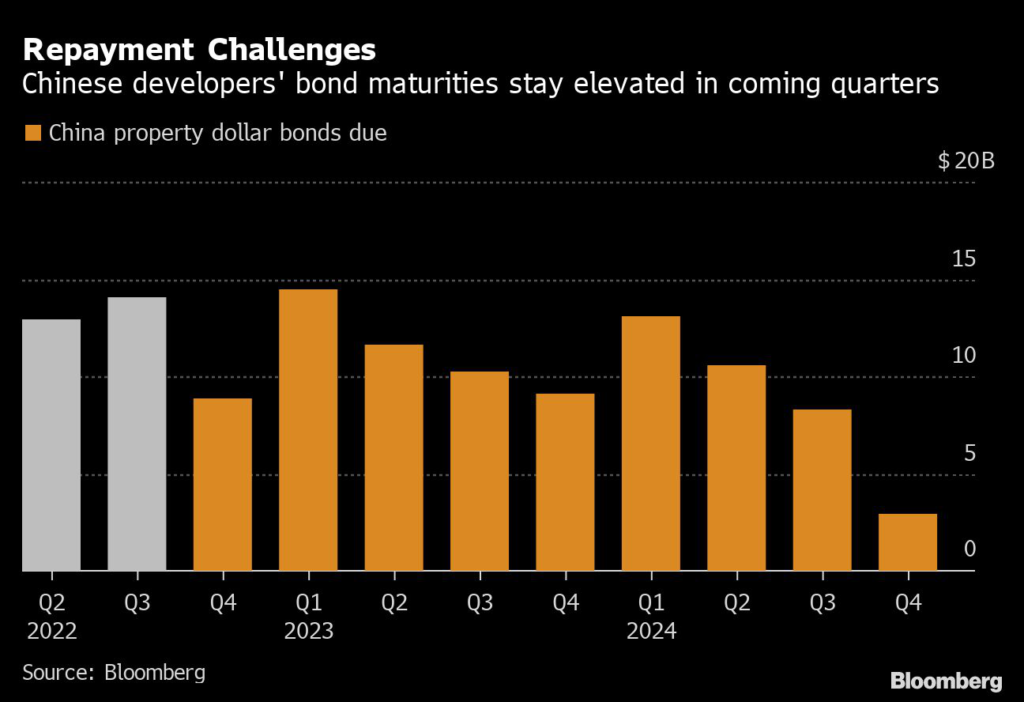
Sheng also warned that a wave of offshore debt maturing this quarter adds to liquidity risks. Chinese developers face $13 billion in payments on dollar bonds in the current quarter and $14 billion in the third, according to data compiled by Bloomberg.

Still, Sheng emphasized that the long-term policy target to reduce leverage in the property industry should remain. 

“It’s essential to establish a firewall between the real estate sector and financial markets, as well as avoid systemic risks tied to property,” Sheng said. “Both the caps on developers’ borrowings and banks’ lending to builders are effective tools for deleveraging, and they should be kept.” 

More stories like this are available on bloomberg.com

©2022 Bloomberg L.P.

Goldman Sachs Boosts Hiring of Dealmakers in Singapore

(Bloomberg) — Goldman Sachs Group Inc. is hiring senior investment bankers in Singapore, according to people with knowledge of the matter, as the U.S. lender looks to bolster its dealmaking capabilities in Southeast Asia.

The firm has hired Chua Hui Yin from JPMorgan Chase & Co. to cover corporate finance and execution, as well as Oversea-Chinese Banking Corp.’s Andrew Teo for Singapore investment banking, the people said, asking not to be identified as the information isn’t public. The bankers have resigned from their previous roles, the people said.

Chua, Teo and representatives for Goldman Sachs and JPMorgan declined to comment. An OCBC representative confirmed Teo’s resignation.

Goldman’s move to boost advisers in Singapore comes as dealmaking surges across the region. Southeast Asian companies have defied a global slump to raise $2.7 billion in initial public offerings this year, up 17.5% from the same period in 2021, according to data compiled by Bloomberg. The field was led by Indonesia’s Goto Group which raised $1.1 billion. Last year’s biggest IPO in Southeast Asia was also by an e-commerce firm, as PT Bukalapak.com raised $1.5 billion in a Jakarta listing.

Srijith Nair joined Goldman last year as head of Southeast Asia financial institutions group from Barclays Plc, according to his LinkedIn profile. Andy Tai, who has been with Goldman for about 15 years, moved to Singapore from Hong Kong as head of Southeast Asia investment banking.

Goldman is ranked third for mergers and acquisitions in Asia this year, advising on $80.9 billion worth of deals, according to data compiled by Bloomberg. It ranks fifth for equity offerings in Asia ex-Japan so far in 2022, the data show.

(Updates with league table rankings in last paragraph.)

More stories like this are available on bloomberg.com

©2022 Bloomberg L.P.

Netflix Tumbles as 200,000 Users Exit for First Drop in Decade

(Bloomberg) — Losing customers for the first time in a decade, Netflix Inc. is throwing out all of its old rules.

The streaming leader will introduce a cheaper, advertising-supported option for subscribers in the next couple years, and will start to crack down on people sharing their passwords even before that. Netflix also will curb its spending on films and TV shows in response to the customer losses.

Co-founder Reed Hastings has said for years that he doesn’t want to offer advertising and had no problems with password sharing. But the company is changing course after losing 200,000 customers in the first quarter, the first time it has shed subscribers since 2011. Netflix also projected it will shrink by another 2 million customers in the current second quarter, a huge setback for a company that regularly grew by 25 million subscribers or more a year.

“It’s just shocking,” said analyst Michael Nathanson of MoffettNathanson LLC. “Everything they’ve tried to convince me of over the last five years was given up in one quarter. It’s such an about face.”


Investors, analysts and Hollywood executives had been bracing for the company to report a sluggish start to the year, but Wall Street still expected Netflix to add 2.5 million customers in the first quarter. The shares, already down more than 40% this year, tumbled as much as 27% to $256 in after-hours trading. 

Hastings and co-Chief Executive Officer Ted Sarandos had previously dismissed the company’s slowing subscriber sign-ups as a speed bump related to the pandemic, which had accelerated Netflix’s growth in 2020. But the company’s growth hasn’t returned to pre-pandemic levels.

Four Causes

Management pointed to four causes, including the prevalence of password sharing and growing competition. The company said there are more than 100 million households that use its service and don’t pay for it, on top of its 221.6 million subscribers. The Los Gatos, California-based company is experimenting with ways to sign up those viewers, such as asking people who are sharing someone else’s account to pay more.

“It allows us to bring in revenue for everyone who is viewing for gets value from entertainment we’re offering,” Chief Operating Officer Greg Peters said during an interview with analyst Doug Anmuth of JPMorgan Chase & Co.

Netflix’s troubles are a warning sign for its peers and competitors. After watching millions of customers abandon pay TV for streaming, U.S. entertainment giants merged and restructured to compete with Netflix. Investors encouraged this strategic shift, boosting shares of companies like Walt Disney Co. that demonstrated a commitment to streaming.

Investors have begun to question whether some of these media companies will sign up enough customers to justify all the money they are spending on fresh programming. Disney fell as much as 5.2% in extended trading after Netflix reported its outlook, while Warner Bros. Discovery Inc., the owner of HBO Max, declined as much as 2.8%. Shares of Roku Inc., the maker of set-top boxes for streaming, dropped as much as 8.3%.

All of these competitors offer advertising-supported services, or are planning to do so in the near future. Analysts and competitors have speculated that Netflix would offer advertising for years, only to be rejected by Hastings. Netflix always said its viewers preferred its service over cable TV because there were no ads. Hastings also didn’t want to compete with Google and Facebook in selling ads online. Yet he has finally relented.

‘Makes Sense’

“Allowing consumers who would like to have lower price and are ad tolerant makes a lot of sense,” Hastings said Tuesday. Netflix will explore the best way to offer advertising over the next couple of years.

Cracking down on password sharing is a risk for a company that started by giving customers a cheaper, more convenient alternative to cable. By nudging customers to pay — and inserting advertising — Netflix begins to resemble what it replaced.

But the company needs help after losing customers in three of its four regions in the first quarter, including more than 600,000 in the U.S. and Canada. Netflix blamed most of that on a price increase, and said the decline was expected. Russia’s invasion of Ukraine cost the company another 700,000 customers when it had to pull its service in Russia, resulting in a loss of 300,000 customers in the Europe, Middle East and Africa.

Overall, Netflix had forecast subscribers would grow by 2.5 million in the first quarter, roughly in line with Wall Street estimates. For the current period, analysts were predicting gains of 2.43 million. First-quarter revenue grew 9.8% to $7.87 billion, missing analysts’ estimates. Profit, at $3.53 a share, easily topped projections of $2.91.

No Explanation

“They were never able to explain why or how growth was slowing,” Nathanson said. “Now they’ve decided growth is slowing. How did this change in two quarters?”

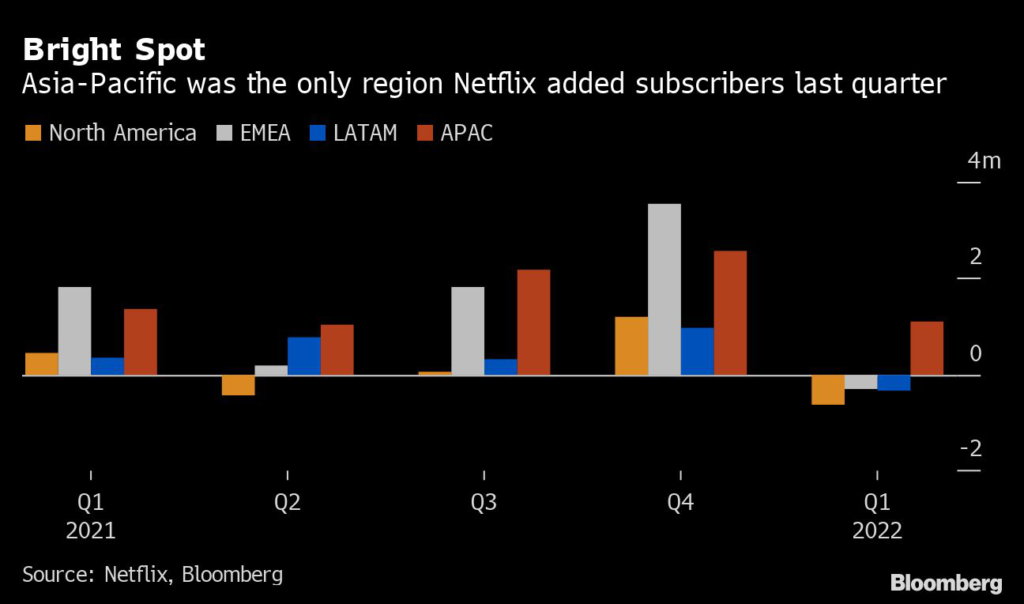
Asia was the lone bright spot. Netflix added more than 1 million customers in the region, buoyed by popular new titles such as the South Korean drama “All of Us Are Dead.”

Read more: ‘Squid Game’ Helps Makes Asia Lone Bright Spot for Netflix

Netflix remains well ahead of most of its competitors outside the U.S., and is the largest streaming service in the world. The company believes it can execute its way out of the current predicament by luring new customers with better programs and finding more ways to charge its existing user base. The company still expects to add customers this year, and will have a stronger slate of new shows in the back half of the year.

Whether Wall Street believes that is up for debate.

More stories like this are available on bloomberg.com

©2022 Bloomberg L.P.

SoftBank Robotics Invests in Hong Kong Startup Avalon SteriTech

(Bloomberg) — SoftBank Group Corp.’s robotics arm has agreed to buy a minority stake in cleaning technology startup Avalon SteriTech Ltd., marking the company’s first investment in Hong Kong.

SoftBank Robotics is buying a 5% stake in the Hong Kong-based company, Kent Yoshida, chief business officer at SoftBank Robotics Group and Lewis Ho, the chief executive officer of Avalon SteriTech, said in an interview. As part of the deal, Yoshida will join the company’s board of directors. They declined to provide the financial details of the transaction.

The investment follows an existing joint venture between the companies that develops products and technologies for cleaning and bio-decontamination with a focus on Whiz Gambit, an AI-powered robotic cleaning system.

Avalon SteriTech is considering conducting a series A funding round to help fund its growth plans, the executives said. It plans to grow in countries such as the U.S., Australia and the United Arab Emirates and has been in talks with prospective partners to enter into new markets, they added.

Avalon SteriTech revenues will reach $8 million to $10 million this year, from about $2 million last year, Ho said. The company, whose clients include Hong Kong’s railway operator MTR Corp. and the city’s flagship carrier Cathay Pacific Airways Ltd., could break even in 2023, he added. The company is a unit of Avalon Biomedical Management Ltd., whose businesses include diagnostics, medical devices, pharmaceuticals and infection control.

SoftBank Robotics has made investments in countries such as the U.S. and the U.K. In January, it announced a partnership with Infogrid, a London-based AI provider of smart building systems. Last year, SoftBank led a $200 million investment in Opentrons Labworks Inc., a robotics startup that helped spur New York City’s Covid testing process, boosting the company’s value to $1.8 billion. 

More stories like this are available on bloomberg.com

©2022 Bloomberg L.P.
‘Squid Game’ Helps Make Asia Lone Bright Spot for Netflix

(Bloomberg) — South Korean dystopian hit ‘Squid Game’ has helped make Asia a lone bright spot for Netflix Inc., which added more than 1 million subscribers in the region last quarter, even as the streaming service’s total audience declined for the first time in a decade. 

Read more: Netflix Loses 200,000 Customers, First Decline in a Decade

‘Squid Game,’ in which a group of indebted people compete in deadly versions of childhood games to win life-changing money while super-rich VIPs watch, became Netflix’s biggest launch ever. That success has spawned a deeper push into Asian content, including the Korean zombie series “All Of Us Are Dead” that took off this year.

Netflix shares plunged about 25% in extended trading after saying it lost 200,000 customers in the first quarter — the first time it has shed subscribers since 2011. The company also said it expects to shed 2 million more this quarter. 

The company lost customers in three of its four regions, including more than 600,000 in the U.S. and Canada. It blamed most of that attrition on a price increase, and said the decline was expected. Russia’s invasion of Ukraine cost the company another 700,000 customers when it had to pull its service in Russia, resulting in a loss of 300,000 customers in the Europe, Middle East and Africa region.

Read more: K-Drama Stocks Fall as Netflix to Curb Spending on Films, Shows

In contrast, Asia-Pacific subscribers rose 1.09 million to 33.7 million. 

“We’re making good progress in APAC where we are seeing nice growth in a variety of markets including Japan, India, Philippines, Thailand and Taiwan,” management wrote in a letter to shareholders.


More stories like this are available on bloomberg.com

©2022 Bloomberg L.P.

Blackstone, Vista, Brookfield Rule Out Financing Elon Musk’s Twitter Bid

(Bloomberg) — Private equity firms including Blackstone Inc. and Vista Equity Partners have ruled out financing Elon Musk’s takeover bid for Twitter Inc., according to people familiar with the matter. 

Brookfield Asset Management has also opted against backstopping Musk’s unsolicited, $43 billion offer, said the people, who asked to not be identified because the matter isn’t public. Vista and Blackstone aren’t interested in participating in any potential bid for Twitter from Musk or any other party at the moment, the people added.

To be sure, there’s plenty of other financing sources out there for Musk to tap, one person said.

Representatives for Blackstone, Vista Equity and Brookfield declined to comment. 

The reluctance from some of the biggest names in private equity to get involved in Musk’s Twitter adventure underscores the obstacles facing his bid for control of the social media company. Aside from assembling the financing, he has to win over the company’s board. Twitter already launched a poison pill defense to thwart Musk’s bid to take the company private at $54.20 a share. 

There are other variables. At $43 billion, the deal would be one of the largest leveraged buyouts on record, raising questions about whether it would be economical for any would-be backers. Plus there’s another wild card: Musk himself.

Still, he may not totally be on his own. Apollo Global Management Inc. is interested in participating in a bid for Twitter in the form of credit or preferred equity, Bloomberg News reported this week. Twitter has also been fielding takeover interest from other parties, including technology-focused private equity firm Thoma Bravo, Bloomberg has reported. 

The Financial Times reported earlier that Blackstone, Vista and Brookfield weren’t interested in helping Musk. 

More stories like this are available on bloomberg.com

©2022 Bloomberg L.P.
‘Squid Game’ Trade Alive in Korean Stocks Even as Netflix Slumps

(Bloomberg) — “Squid Game” may not be boosting Netflix Inc.’s lagging stock price any more but its impact continues to bolster the shares of Korea’s production studios.

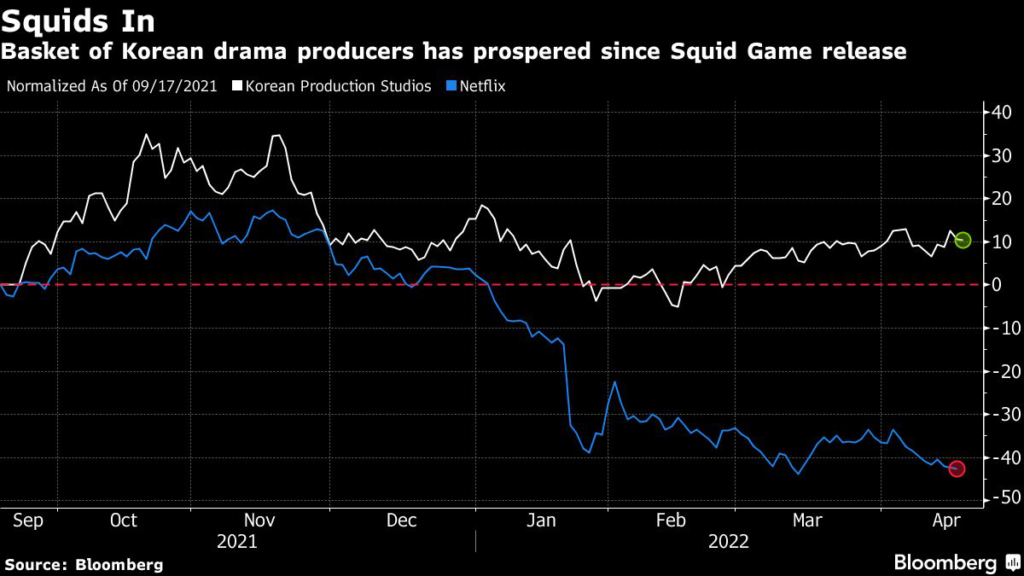
An equal-weighted basket of local drama producers remains more than 10% higher since the South Korean television phenomenon first aired in mid-September last year, versus a more than 40% slump in Netflix. Investors are betting demand for so-called K-Dramas will continue to grow on multiple platforms, after the global success of the U.S. streamer’s most popular series ever.

Walt Disney Co., Apple Inc. and Warner Media are among other big names seeking to offer Korean language titles and local originals, while domestic streaming services like TVing aim to increase their offerings to lure subscribers. Netflix announced its biggest lineup of Korean shows ever in January — more than 25 programs this year — after a six-fold global rise in viewing hours for Korean shows in 2021.

Netflix shares tumbled more than 20% in after-hours trading Tuesday, after announcing subscriber losses for the first time in a decade.

“So many people living overseas are watching Korean drama,” said Lee Kihoon, an analyst at Hana Financial Investment. “Netflix’s share price is irrelevant to drama production companies as long as Netflix continues to invest in South Korea.”

Netflix Hunts for Subscribers in Asia After ‘Squid Game’ Success

Competition to develop the next Korean blockbuster series has intensified since the resounding success of Squid Game — a show about heavily-indebted people playing a deadly childhood game to win huge prize money.

More than a dozen local production studios are listed in South Korea, many of them in the smaller Kosdaq index. Set to be flush with cash from global players like never before, Lee forecasts that almost all of them will post record-high profits this year. 

Investment from streaming services will help offset lower demand from local television broadcasters who have been the main source of income for the production studios in the past. 

Original Series

The leader of the pack is Samhwa Networks Co., a $200 million studio whose shares have skyrocketed almost 80% this year. It will release a remake of The Mentalist, a crime drama, which could be the first original series on HBO Max in South Korea later this year. 

The company — which was loss-making in 2020 — is forecast to post annual profit of as much as 20 billion won ($16.2 million) on just 90 billion won revenue, according to Hana’s Lee. 

Bigger production studios such as Studio Dragon Corp. and Jcontentree Corp. plan to create more than 30 titles this year, their biggest ever, while Next Entertainment World Co. struck a deal to produce at least one title for Disney+, which was launched in South Korea last year. 

Meanwhile, Korea accounts for about 5% of Netflix’s global content investment, and that might rise to about 10%, Lee forecast.

‘Squid Game’ Shakes Up Korean Stocks as Much as Netflix Viewers

More stories like this are available on bloomberg.com

©2022 Bloomberg L.P.

Close Bitnami banner
Bitnami