
Bloomberg

Google’s Corio Says Grid Connections Jammed Up: BNEF Update

(Bloomberg) — Energy executives, government officials and financiers are converging in New York on Tuesday and Wednesday for the BNEF Summit, one of the premier conferences focused on the energy transition.

The event is happening as Russia’s war in Ukraine disrupts global energy markets and raises critical questions about how the industry will respond. While some are seeking to return to the prewar status quo that’s dominated by fossil fuels, many people see the turmoil as an opportunity to accelerate the shift to clean energy.

Time stamps are New York.

Google’s Corio Says Grid Connections Jammed Up (4:55 p.m.)

Google’s global head of data center energy, Amanda Peterson Corio, said the traffic jam of clean power generators seeking to provide electricity to the U.S. grid is a big problem that’s slowing the growth of renewable energy.

Corio cited a recent study that said there are 1,300 gigawatts of solar and wind power and battery storage in “interconnection queues” seeking to connect to the U.S. grid. “That’s not scalable. We need to fix these problems,” she said. “In the meantime, we are going to see scaling on demand. So how do we fix that mismatch.”

Developer’s Market Is Slowing Decarbonization (4:22 p.m.)

Thanks in part to pricier supplies and geopolitical tensions, a developer’s market now exists for U.S. renewables. This means higher costs and slower growth — not an ideal situation in the drive to speed decarbonization, said Tara Narayanan, an analyst at BNEF.

Renewables became mainstream by the combination of falling costs and increasing capacity additions. But supplies are harder to obtain right now, making projects more expensive. Reasons include shipping constraints faced by other industries as well as the prospect of new solar tariffs.

Goldman’s Waldron Cautions Against Speedy Decarbonization (4:03 p.m.)

It is possible that the energy transition could move too quickly, warned Goldman Sachs Group Inc. President John Waldron.

“What’s going on in Europe is shining a light on that every day. We have to find that balance,” he said, adding that the world may not be able to move as fast as some would like.

“We unfortunately aren’t prepared as a world to do that,” Waldron said. “We have to keep the lights on and keep people safe and prosperous.”

Republicans Could Adopt Green-Friendly Agenda Like U.K. Tories (3:12 p.m.)

If the recent climate shift by the U.K.’s Conservative Party is any indication, there is potential in the U.S. for the Republican Party to adopt a more green-friendly agenda going forward.

“Don’t dismiss the possibility of a green elephant,” said Tom Rowlands-Rees, an analyst at BNEF. “The left doesn’t have a monopoly on climate.”

U.K. Tories have had greater electoral success this century after it adopted a greener agenda, he said. The Republicans, meanwhile, have mostly either championed oil and gas interests, or a so-called all-of-the-above approach.

Chevron Says Oil Needs Calorie Counts Just Like Food (1:55 p.m.)

Oil and gas products should have carbon footprint scores similar to the calorie counts you see next to meal choices at a fast-food chain, said Chevron’s Bruce Niemeyer.

“It affects your choices,” Niemeyer said. “As the world moves to a lower carbon future, it’ll prefer to consume oil and gas that comes from carbon efficient producers.” 

Chevron supports an industrywide plan to measure the carbon footprints of oil and gas products so consumers have the ability to make choices based on lower emissions due to better methane management or other measures. The oil major is currently in talks with industry groups about the idea, which would need third-party verification to be effective, Niemeyer said.

Guyana to Decide on National Oil Company by September (12:56 p.m.)

Guyana will decide on whether or not to create a national oil company within the next six months as the government deliberates the licensing process.

All of the 10 billion barrels of oil discovered in Guyana since 2015 have been in the Stabroek Block, operated by Exxon Mobil Corp. and co-owned by Hess Corp. and China’s CNOOC. Guyana is concerned about the “concentration” of the oil majors in its economy and wants to make sure new licenses are allocated on more favorable terms to the government, Vice President Bharrat Jagdeo said.

If Guyana decides to set up a national oil company, it would seek a “strategic investor” to partner with, and the government would largely take a “passive role,” Jagdeo said.

Exxon’s existing license will not be renegotiated even though it was signed on terms highly favorable to the oil giant, he said. “We believe that the future blocks, we can correct this inequity, this imbalance in future blocks.”

North America Hasn’t Yet Missed the Sustainable Finance Boat (12:36 p.m.)

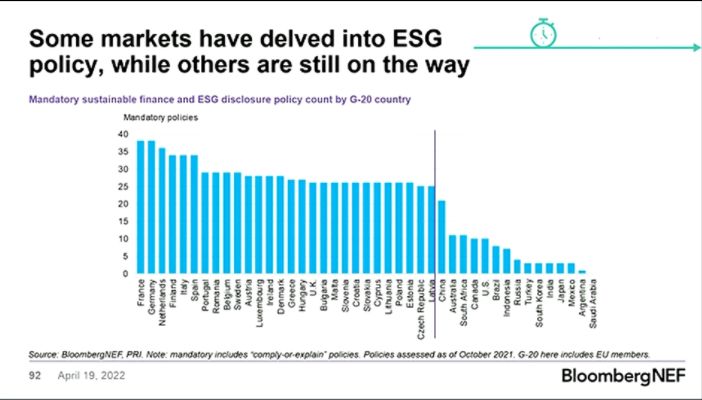
The U.S. and more broadly North America have been laggards when it comes to putting sustainable finance and ESG policies in place, said BNEF analyst Mallory Rutigliano said. Still, she said “it is very much not too late” to put together policies that are ambitious and robust and align with other global players that moved earlier.

Rutigliano compared sustainable finance efforts by countries to guests attending a dinner party — some are early, some bear gifts, some bring good conversation to the table and others make up for other failures by helping with cleanup.

The good dinner guests are European countries, with France and Germany leading when it comes to mandatory disclosure policies, she said. The U.S., China, Russia and Saudi Arabia are among the G-20 countries at the opposite end of the spectrum, with weak or no disclosure policies. 

The U.S. is an example of a country that hasn’t put in place policies yet, but can bring something to the table as the source of the most green bonds in the world, led by corporations to municipalities, she said.

Ultimately, Rutigliano said the message to countries that are late to the game is “you can still redeem yourself.”

U.S. Oil Likely Needed to Meet Global Energy Demand for Decades (11:32 a.m.)

Booming cash flows stemming from higher crude prices and capital discipline are leaving U.S. shale producers in a much better position to tap the nation’s oil reserves, according to Anastacia Davies, head of oil supply and U.S. oil at BloombergNEF.

New supplies from the U.S. will be likely needed to help fill up a potential supply gap left by Russia and to meet global energy demand for the decades to come, Davies said during a presentation.

“We do think the days of unchecked U.S. growth are likely behind us, but that doesn’t mean the shale’s role is gone,” Davies said. “There’s maybe a ‘new new normal’ yet to come.”

White House Is in Talks to Boost Energy Security in Spending Bill (11:18 a.m.)

The White House is in talks with members of Congress about a reconciliation spending package that would increase energy security as well as tackle consumers costs, said Ali Zaidi, the administration’s deputy national climate advisor.

“We are having conversations with members on the Hill, a number of them, about a reconciliation package that will help us tackle consumer costs and boost energy security,” Zaidi said. “We are having, I think, good dialogue on this topic.”

Senator Joe Manchin of West Virginia has said he is interested in restarting negotiations on a slimmed-down version of the stalled Build Back Better Act that would focus on climate change, prescription drug prices, and deficit reduction. A key element of the original proposal was $550 billion in energy and climate spending, including more than $300 billion in new and expanded tax credits for wind and solar power, nuclear plants, biofuels and advanced energy manufacturing.

Zaidi also said there’s some “appropriate short-term anxiety” on solar development in the face of potential additional tariffs on imports, though people are still “pretty bullish” about the direction the U.S. is going.

“There’s good reason for that because we know how to take that stuff on,” he said.

Stop ‘Villainizing’ Fossil Fuels: Motiva Executive (10:14 a.m.)

The energy industry has brought tremendous technological advances over the past 50 years, said Keo Lukefahr, head of energy derivatives and renewables trading at Motiva Enterprises LLC.

“Let’s stop villainizing the fossil fuel industry,” she said. We have to move to low-carbon generation but fossil fuels are part of that transition, she said.

Sunrise Project Says Energy Firms ‘Cynically’ Exploiting Europe Crisis (9:59 a.m)

Europe’s immediate push away from Russian natural gas amid the war in Ukraine and a long-term desire to limit gas overall is a “loud and powerful signal to economies around the world,” said Justin Guay, director of global climate strategy for the Sunrise Project.

Guay also said he believes some energy companies are “cynically” taking advantage of the current European energy crisis by planning new liquefied natural gas terminals.

He questioned the long-term value of rushing to build LNG terminals to help the European Union shift away from Russian gas.

“It takes three to five years to build a new LNG terminal” he said. “Europe needs a new gas supply by the end of the year”.

The crisis will moderately increase the energy transition, added Betrand Millot of Caisse de Depot et Placement du Quebec. While higher oil and gas prices amid the crisis magnifies energy-security concerns, he said, there are constraints in supply chains, including for electric vehicles that make that acceleration a moderate one.

Energy Industry Needs Focus on Cybersecurity: Dragos CEO (9:58 a.m.)

Energy companies are investing in cybersecurity for their information and neglecting protection for their physical infrastructure, Dragos Inc. Chief Executive Officer Robert Lee said.

“You’re spending more money on your website than your gas turbines,” Lee said, adding that right now everyone’s talking about infrastructure cybersecurity.

Companies used to “air gap” their industrial operations to protect them from cyberattacks. Those operations are increasingly connected via networks and so the focus needs to shift from preventing attacks to building resilience and the ability to withstand attacks.

Chevron VP Says the ‘Future of Energy Is Lower Carbon’ (9:41 a.m.)

A Chevron Corp. vice president said the company intends to be a leader in the energy transition by investing in new lower-carbon solutions.

“Energy companies of the world need to be at the table,” said Bruce Niemeyer, vice president of strategy and sustainability at Chevron. “We believe the future of energy is lower carbon.”

The challenge is unprecedented: energy demand and populations are growing, but the world is attempting to reduce emissions, Niemeyer said. Because the challenge is bigger than any one country, one industry or one company can solve, there’s a need to collaborate.

Shifting to Renewables is ‘Job to be Done’ (9:27 a.m.)

The war in Ukraine has focused a spotlight on the world’s reliance on fossil fuels, said Jon Moore, CEO of BloombergNEF, as he opened the two-day event. The conflict is also pointing to ways to get away from traditional sources of energy.

“When everything is in chaos, it’s good to think about the job to be done,” Moore said.

The planet has already warmed by 1 degree Celsius (1.8 degrees Fahrenheit) he said, getting closer to the 1.5 degree limit that most scientists agree is the upper limit to avoid the most catastrophic impact of climate change. And focusing only on cost, using just the lowest-cost sources of power generation, would put the world on track to warm by a disastrous 3.3 degrees.

“That is not the job to be done,” Moore said.

Earlier Tuesday, National Grid Plc said it plans to eliminate fossil fuel from its gas networks in Massachusetts and New York by relying instead on green hydrogen and so-called renewable gas produced from landfills, farm waste and other sources.

Other utilities including Southern Co. and Southern California Gas Co. have discussed using this approach to limit carbon emissions, though there are questions about cost and availability of both fuels.  

“Just as we are investing in renewables like wind and solar to decarbonize the energy running through our electric network, we are committing to decarbonize our gas network,” National Grid CEO John Pettigrew said in a statement.

More stories like this are available on bloomberg.com

©2022 Bloomberg L.P.

A Timeline of How Elon Musk Became Twitter’s Most Influential Investor

(Bloomberg) — Twitter users woke up April 4 and found the words “Elon” and “Elon Musk” trending on the site — not because the world’s richest, most-followed businessman had caused a stir with his futuristic companies, but because he’d disclosed a major stake in Twitter Inc.

Suddenly, Musk was Twitter’s largest individual shareholder, with more than 9% of the company, and speculation swirled about how he would influence the network’s future. He’d been frequently tweeting ideas for revamping the social media platform. Over the next week, Musk would accept an offer to join Twitter’s board of directors and, in a sudden reversal, reject that offer five days later, leaving the company’s management, employees, investors and interested observers guessing about his plans.

Will Musk continue buying Twitter shares at market prices, slowly building up his position until he—potentially with a sympathetic co-investor or another current shareholder — holds enough of the stock to control its destiny? Will Musk decide to buy shares from Twitter’s other investors? Will Musk ultimately decide to sell his shares and pocket his gains? As the news develops, here’s a look at what’s happened so far:

Jan. 31: Musk starts building his stake 

Musk started quietly buying Twitter shares on Jan. 31. By March 14, Musk had accumulated an over 5% stake, the point after which he was supposed to disclose the activity to the Securities and Exchange Commission, and by extension, the public. Musk missed the deadline to inform the SEC by 10 days. Because Twitter’s share price rose the second his stake was revealed, he was able to accumulate more on the cheap by not disclosing — a misstep that would later trigger a shareholder lawsuit. 

March 24: Musk starts critiquing Twitter, on Twitter

His stake still secret, Musk began tweeting criticisms of the company in late March.

“Worried about de facto bias in the Twitter algorithm having a major effect on public; Twitter algorithm should be open source,” Musk tweeted on March 24.

“Free speech is essential to a functioning democracy. Do you believe Twitter rigorously adheres to this principle?” Musk asked his Twitter followers in a poll posted on March 25.

“Is a new platform needed?” Musk asked in a tweet on March 26. “Am giving serious thought to this.”


Several users commenting on the Tesla Inc. chief executive officer’s tweet recommended he look into buying Twitter instead. Soon they would find out he was already acquiring shares.

April 4: Musk’s stake becomes public, and he’s invited to join Twitter’s board

Musk’s filing listed him as a passive investor, and yet, shortly after it became public, he started tweeting out business propositions for the social media company. Musk posted another poll on Twitter asking users to vote on whether they wanted the company to add an edit button that would allow people to change tweets after they’ve been published. Twitter CEO Parag Agrawal urged users to “vote carefully” on the poll. “The consequences of this poll will be important.”

By the end of the day, Twitter invited Musk to join the board. Musk signaled that he would sign an agreement stipulating that he could not own more than 14.9% of the company’s stock. 

April 5: Musk becomes an active investor

In the morning, several of Twitter’s board members took to the platform to congratulate Musk on his decision to join their ranks. Agrawal tweeted that the company and Musk had been chatting for weeks. Agrawal’s tweet led people to question why someone engaged in discussions to become a director would file as a passive investor. 


Later that day, Musk refiled the disclosure of his stake to classify himself as an active investor, making the change only after indicating that he would accept a seat on the social media company’s board.

April 9: Musk rejects the board seat

The day that Musk was set to officially join Twitter’s board, Musk informed the company that he would be rejecting its offer. But, Twitter sat on the news for roughly 36 hours while waiting to see whether Musk would change his mind. Twitter’s investor relations website listed Musk as a board member throughout the weekend.

During that time, while the public still thought Musk was set to join Twitter’s board, Musk tweeted several veiled criticisms and suggestions for the company. Musk asked his followers, “Is Twitter dying?”

Musk suggested that everyone who signs up for Twitter Blue, a subscription version for power users, should get an authentication checkmark. He suggested Twitter should convert its San Francisco headquarters into a homeless shelter “since no one shows up anyway.” And he made some crass jokes, suggesting removal of the “w” in Twitter.

April 10: Twitter makes the news public

On Sunday, Agrawal sends out a note to employees, and later tweets it publicly. Neither Agrawal or Musk give a reason for the reversal.


April 11: Speculation abounds

Musk files an amended disclosure with the SEC. He can now purchase as many shares as he wants. Without a board seat, he no longer has to act in the best interest of Twitter shareholders. At Twitter, which doesn’t have a founder with majority control like other tech giants, employees are “ super stressed,” concerned that this is only the beginning of the whiplash.

April 14: Musk offers to buy the whole company

In an SEC filing and accompanying tweet, Musk said he would buy out stockholders in a cash deal valued at $43 billion and  take Twitter private. The offer is $54.20 a share, a 54% premium over the price when he started building his stake in January. The number is also an apparent (and not-very-subtle) reference to Musk’s failed bid to take Tesla private in 2018 for $420 a share — and, of course, to a special number in pot culture. He described the Twitter offer as his “best and final” one.

April 15: Twitter adopts ‘poison pill’ to ward off Musk takeoverTo thwart Musk, Twitter launched a so-called poison pill, which is a rights plan that allows shareholders to purchase shares at a discount if any shareholder exceeds 15% ownership. This would effectively dilute the billionaire’s stake. The company said in a statement that the intention of the plan is to ensure that anyone taking control through open-market accumulation pay all shareholders an appropriate premium. Twitter has been fielding interest from other parties, including private equity firm Thoma Bravo, according to a person familiar. The company is being advised by Goldman Sachs Group Inc. and JPMorgan Chase & Co. Twitter founder Jack Dorsey, a friend of Musk, acknowledged in a tweet that as a public company Twitter has always been for sale.


April 16: ‘Twitter’s board owns almost no shares’

In a flurry of tweets about the potential deal, Musk said, “With Jack departing, the Twitter board collectively owns almost no shares,” so its economic interests are not aligned with shareholders. Dorsey replied, “It’s consistently been the dysfunction of the company.” Dorsey is scheduled to leave the board once his term expires at the next shareholder meeting on May 25.

Vanguard’s April 8 disclosure that it owns 82.4 million shares or 10.3% of the company fuels tweets that Musk is no longer the top Twitter shareholder. 

April 19:  Musk retains Morgan Stanley to consider leveraged buyout

The New York Post reports that Musk has brought in Morgan Stanley to help find backers for his bid and is willing to invest up to $15 billion of his own cash and borrow against his Twitter stake to push through a deal. 


(Updates with Twitter’s poison pill starting in 20th paragraph.)

More stories like this are available on bloomberg.com

©2022 Bloomberg L.P.
Bankrupt Black News Channel Gets $1.6 Million Infusion From Jaguars Owner Khan

(Bloomberg) — Black News Channel has won a federal judge’s permission to borrow desperately needed funds from its owner so the troubled media outlet can keep operating while it searches for a buyer.

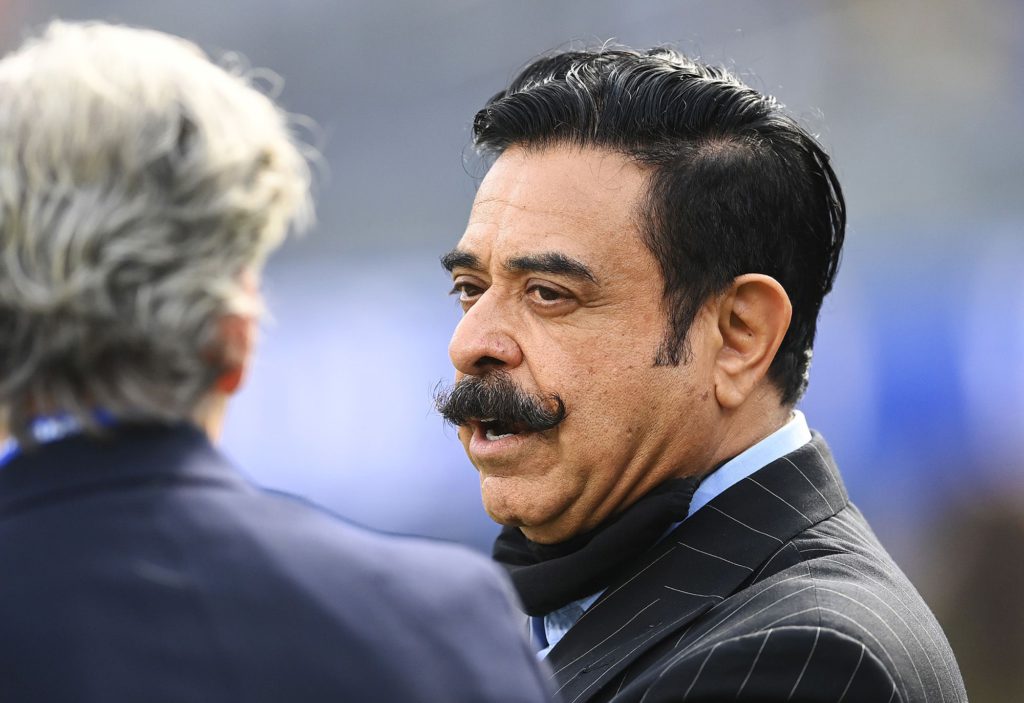
U.S. Bankruptcy Judge Karen Specie said in a hearing Tuesday she’d let the television network borrow about $1.6 million from an entity affiliated with Shahid Khan, the billionaire who has been financing BNC since 2018. The cash will let BNC keep paying vendors and its few remaining employees while it tries to quickly line up a buyer for the operations.  


BNC, a television outlet catering to people of color, was on the precipice of shutting down entirely and selling itself in pieces late last month after running desperately low on funds. The outfit shrank its operations and fired almost all of its employees, many of whom still haven’t been paid for work done just before the bankruptcy, court papers show.   

Instead of liquidating, the company filed for Chapter 11 bankruptcy and has since worked to keep operating on a much smaller scale. Just 17 employees remained when it filed for bankruptcy, a fraction of the more than 300 people working for the Tallahassee-based broadcaster six months ago, but BNC in the last week moved to rehire seven employees that’ll help the channel stay on the air, according to court papers. 

BNC had about $500,000 of cash on hand at the end of last month compared with debts of more than $25 million, court papers show. Despite valuable distribution deals with cable and Internet television providers, the company has struggled to turn a profit in light of higher-than-expected costs and disappointing revenues since it started broadcasting in 2020, Vice President of Finance Maureen Brown said in a sworn declaration.

Still, potential bidders have contacted the company in recent weeks about buying the operations and keeping it afloat, according to court papers. Lawyers for the company and its creditors agree that a sale of the whole business would best maximize value for everyone involved, attorney Gregory Werkheiser said on behalf of BNC in the bankruptcy hearing Tuesday. But its access to cash is limited and a deal would need to take place quickly. 

“We think this case is going to rise and fall within the next sixty days,” Christopher Schreiber, a lawyer for Khan’s investment entity, said in the hearing. “Hopefully within that time we’re going to have a sale.”

The case is Black News Channel LLC, 22-40087-KKS, U.S. Bankruptcy Court for the Northern District of Florida (Tallahassee).

More stories like this are available on bloomberg.com

©2022 Bloomberg L.P.

IBM Posts Sales That Top Estimates on Hybrid-Cloud Momentum

(Bloomberg) — International Business Machines Corp. reported sales that topped analysts’ estimates on strong demand for its hybrid-cloud offerings, signaling continued momentum for its transition to a business fueled by cloud-based software and consulting.

First-quarter revenue rose 7.7% to $14.2 billion, compared with analysts’ average projection of $13.8 billion, according to data compiled by Bloomberg. The sales results and comparison exclude much of IBM’s legacy infrastructure services unit, which was spun off in November into a new company called Kyndryl.

Chief Executive Officer Arvind Krishna is trying to spur revenue growth by steering IBM, which traditionally relied on infrastructure and information-technology services, into the fast-growing cloud-computing market. Last quarter, the company posted its biggest sales increase in a decade.

“Demand for hybrid cloud and AI drove growth in both Software and Consulting,” Krishna said Tuesday in a statement. “Today we’re a more focused business and our results reflect the execution of our strategy.”

The shares gained about 1.5% in extended trading after closing at $129.15 in New York. The stock has declined 3.4% this year.

Still, IBM faces a crowded field of cloud rivals, even as companies shift more of their operations to the internet. By 2025, for example, 51% of spending on information technology will be directed to the public cloud, up from 41% this year, according to research firm Gartner Inc. Krishna wants IBM to distinguish itself by targeting a hybrid model, which helps clients store and analyze data across on-premises infrastructure, private cloud services and servers run by major public providers such as Amazon.com Inc. and Microsoft Corp.

Hybrid-cloud sales increased 14% to $5 billion, led by an 18% increase for Red Hat, in the period ended March 31, the Armonk, New York-based company said in the statement. Software unit revenue jumped 12% to $5.77 billion and consulting sales gained 13% to $4.83 billion. Results from both units beat analysts’ average projections.

Sales in IBM’s infrastructure unit declined 2.3% to $3.22 billion. The company remains one of the biggest makers of mainframe computers, which have long-served as a foundation of a business’s most important applications, and earlier this month introduced its new z16 mainframe model. But even here IBM pitches the equipment as fitting into a hybrid-cloud environment.  

Profit, excluding some items, was $1.40 a share in the quarter, compared with the average estimate of $1.41 a share. Gross margin was 52.9%, falling short of the average estimate of 54.4%.

IBM said annual revenue growth would be at the “high-end of the mid-single digit range.” In January, the company projected 2022 sales would increase in the mid-single digits.

(Updates with extended trading in the fifth paragraph.)

More stories like this are available on bloomberg.com

©2022 Bloomberg L.P.
Crypto-Focused Silvergate Jumps on Blowout Earnings Report

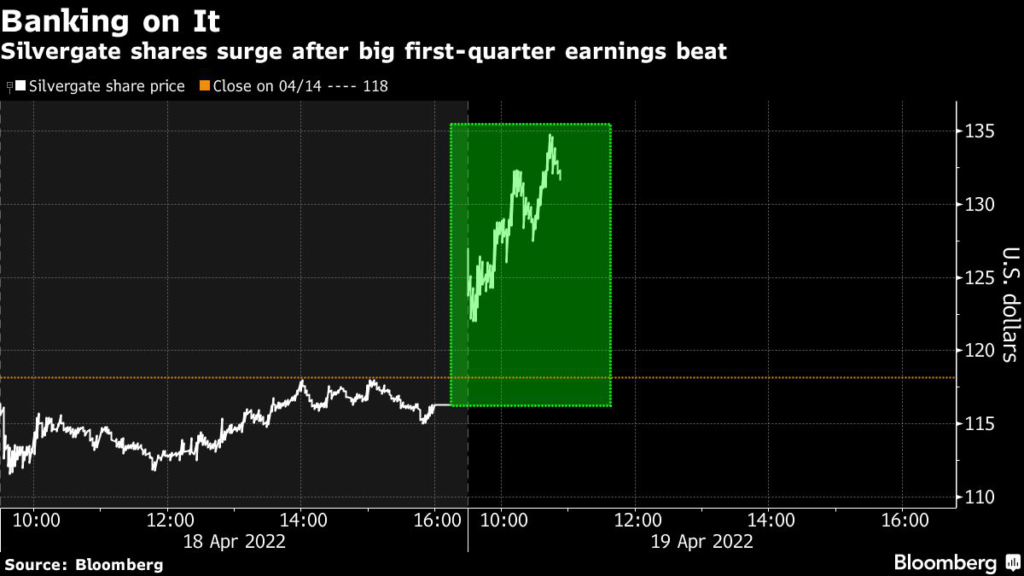
(Bloomberg) — Silvergate Capital Corp. surged by the most in more than a month on Tuesday after the cryptocurrency-focused bank reported first quarter earnings that came in ahead of consensus forecasts.

Shares of the firm jumped 13%, the biggest one-day leap since March 9, after revealing earnings-per-share of 79 cents for the first three months of the year, 75% higher than the average analyst estimate of 45 cents, according to data compiled by Bloomberg. The bank also reported that its number of digital currency customers had jumped to 1,503 from the year prior, an increase of about 36%.

“The combination of higher rates plus Silvergate’s ability to put cash to work in higher yielding assets should have a dramatic impact on the bank’s earnings power moving forward as shown in the first quarter,” KBW Michael Perito wrote in a note.

Despite a rocky start to the year for many digital tokens, average digital currency deposits at the bank continued to grow, reaching $14.7 billion. Meanwhile, Silvergate’s Exchange Network Leverage program — which helps provide access to capital through dollar loans collateralized by Bitcoin — saw commitments rise to roughly $1.1 billion, nearly doubling from the end of last year.

Earlier this year, MicroStrategy Inc. announced that it had received a $205 million loan from Silvergate, backed by about $820 million in Bitcoin using the SEN Leverage program.

Shares of Silvergate have been volatile this year, largely tracking the movement in Bitcoin prices. The stock has fallen about 18% since hitting a three-month high late last month and is down roughly 11% so far this year following a 99% surge in 2021.

Other crypto-linked stocks also pushed higher on Tuesday, aided by a second straight day of gains for Bitcoin. Shares of Coinbase Global Inc., Marathon Digital Holdings Inc. and MicroStrategy Inc. all gained by at least 2.5%. BitNile Holdings Inc., which surged 29% on Monday after reporting annual revenue growth of 120%, fell 14%. 

(Updates pricing throughout.)

More stories like this are available on bloomberg.com

©2022 Bloomberg L.P.
Police, Republicans, Even a Democrat Pile On Biden FCC Pick

(Bloomberg) — President Joe Biden’s nominee for the Federal Communications Commission is drawing opposition from an unusual array of foes, including a police group, a North Dakota Democrat and former Republican aides working to stymie the president’s agenda.

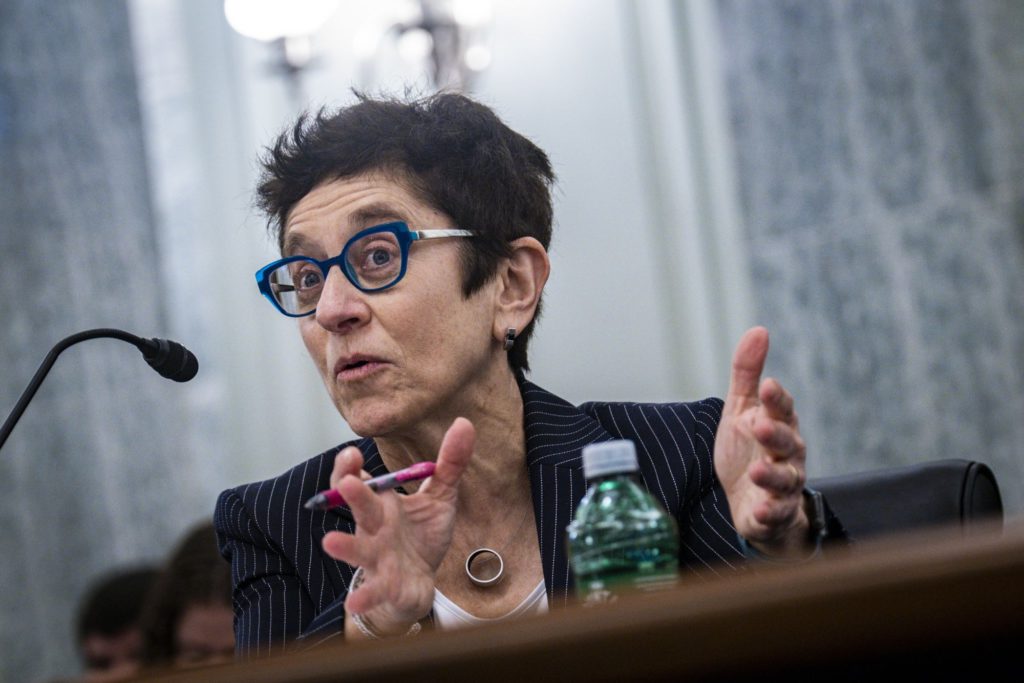
Gigi Sohn, who would give Democrats a majority on the five-member commission and potentially revive net neutrality policies she favors, has yet to get a vote of the full Senate, almost six months after her selection by Biden. 

The long fight over Sohn has delayed possible new regulations for voice and broadband providers because the FCC remains split 2-to-2 between Republicans and Democrats, said Andrew Jay Schwartzman, a communications lawyer. The delay also is a product of an evenly split Senate, he said.

“The new usual is that everything is incredibly partisan,” Schwartzman, senior counselor at the Benton Institute for Broadband & Society, said in an interview. “Getting a nominee through is ever more difficult.”

Selections for the FCC normally don’t receive wide attention. Sohn, 60, a communications lawyer, is well known in Washington after more than two decades of advocacy there, and serving as counselor to the last Democratic FCC majority. She has described herself as “an advocate for universal and affordable access to open and democratic communications networks.”

Critics have found fodder in her trail of public comments including tweets critical of Fox News, and her service on boards including that of the Electronic Frontier Foundation, which supports strong encryption.

Law enforcement groups support strong encryption but want technology companies to comply with subpoenas allowing investigators access to evidence, including the contents of communications. The Fraternal Order of Police said it discerned a “serious animus towards law enforcement officers and the rule of law” from Sohn’s retweets and likes on Twitter.

Sohn declined to comment on the criticism but a former FCC public safety chief in a Jan. 4 letter to the Senate panel considering her nomination said Sohn took “no position” on encryption policy while working at the FCC.

“On the contrary, she was extremely helpful in bringing tech-savvy professionals before the bureau to provide useful background on both sides of the issue,” Retired Navy Rear Admiral David Simpson said in the letter. “I believe her decisions will balance consumer, citizen and community interests with law enforcement and national security priorities.”

Two other former chiefs of public safety at the FCC also wrote to lawmakers in January backing Sohn.

The police group on March 11 wrote to nine Democratic senators asking them to oppose Sohn. Because the Senate is split 50-50, a nominee is expected to need all 50 Democratic votes to succeed. Any defection could kill Sohn’s nomination, leaving the White House to name a replacement — and the FCC to languish further without a working majority. 

Sohn’s nomination received a party-line tie vote in committee. To succeed, she needs a series of floor votes in the Senate that have yet to be scheduled. The body is in recess this week and is to convene next week.

Lawmakers receiving a letter from the police group included Nevada Senator Catherine Cortez Masto and Arizona Senator Mark Kelly, who each face re-election this year. State groups will settle on endorsements later this year, said Jim Pasco, executive director of the Fraternal Order of Police. The group also wrote to West Virginia Democratic Senator Joe Manchin, who has become known for resisting White House initiatives.

Cortez Masto declined to comment when asked if she supports Sohn. Kelly and Manchin each said they would consider her nomination later. 

Other groups, too, are focusing on Sohn.

The American Accountability Foundation, run by staffers for former President Donald Trump and Senate Republicans, has called on Sohn’s nomination to be withdrawn. The group says it’s “working to ensure that leaders within the federal government reflect the values and concerns of the American people, not the liberal coastal elites and their woke allies in corporate America.”

In a tweet the group said blocking Biden nominees and policy is “the reason we get up every morning.”

One Country Project, led by two former Democratic U.S. senators — Heidi Heitkamp, of North Dakota, and Joe Donnelly, of Indiana — said it’s launching a six-figure ad campaign opposing Sohn. The group argues Sohn “is the wrong choice for the FCC and rural America.” Ads are to run in states including Arizona, Nevada and West Virginia, the group said.

Heitkamp in a blog post said Sohn would “shift attention toward her preferred constituencies in urban areas” when considering broadband expansion.

Heitkamp drew a rebuttal from Christopher Mitchell, director of the Community Broadband Networks program at the Institute for Local Self-Reliance.

“Her group claims Gigi is anti rural while taking Gigi’s comments out of context!,” Mitchell said in a tweet. “Gigi wants to invest in rural America, has criticized programs that failed to do it.” 

(Adds when Senate convenes in 12th paragraph. An earlier version corrected the state in the first paragraph)

More stories like this are available on bloomberg.com

©2022 Bloomberg L.P.
Italy Is Ready to Halt Russian Gas Payments If EU Finds a Violation

(Bloomberg) — Italy will refuse to comply with new gas-payment terms demanded by Moscow if the European Union concludes that doing so would breach sanctions related to Russia’s invasion of Ukraine, according to people familiar with the matter.

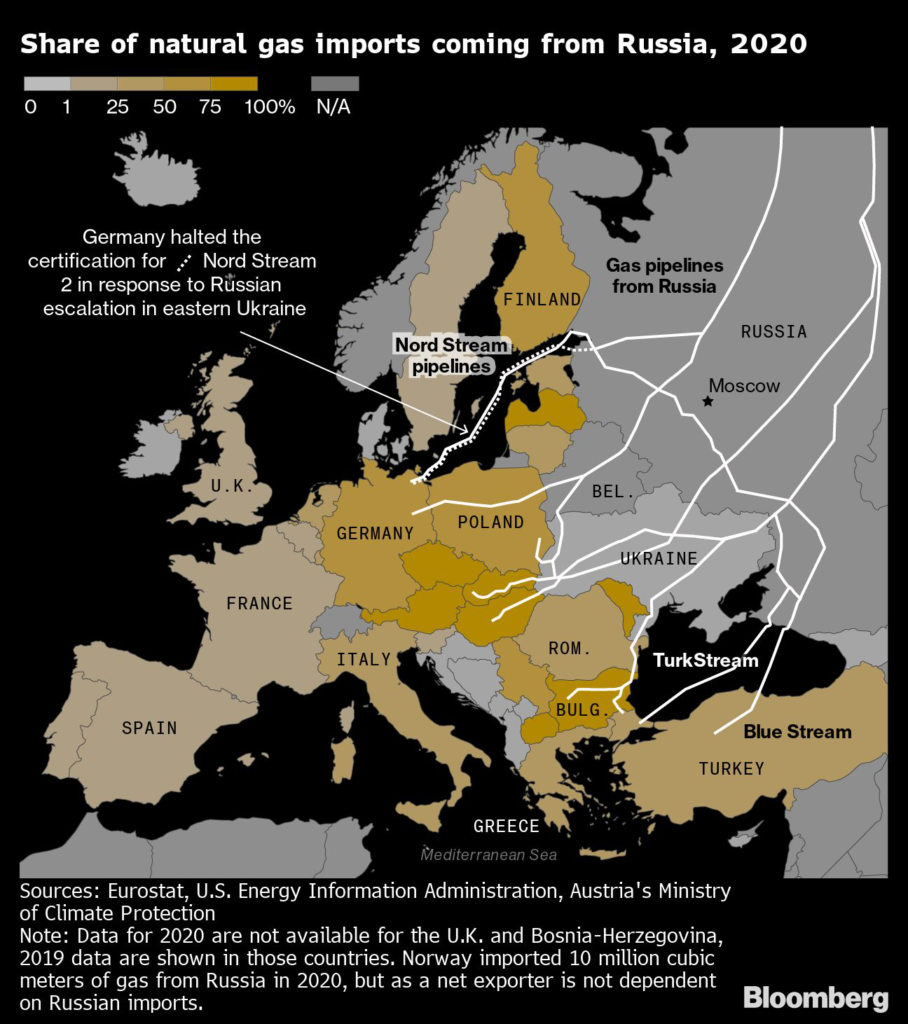
In a preliminary assessment, the EU found that the Kremlin’s payment terms were a clear violation of the bloc’s sanctions. The Italian government is waiting for Brussels to finalize its legal analysis before taking any action, said the people, who asked not to be identified because the process is private.   

President Vladimir Putin has threatened to halt gas supplies to buyers that don’t comply with the decree, which involves Russia’s Gazprom PJSC receiving payments in rubles. The loss of those energy supplies would pose a serious threat to the EU, which gets 40% of its gas from Russia.  

A spokesperson for the Italian government said they welcome the commission’s ongoing work on the matter but wouldn’t elaborate because the assessment is still preliminary. 

On March 31, Putin issued a decree stipulating that “unfriendly” buyers of its gas open two accounts, one in a foreign currency and one in rubles, with Gazprombank. The Russian bank would convert the foreign currency payments into rubles before transferring the payment to Gazprom, the state-owned gas company. 

A preliminary analysis by lawyers for the European Commission, the EU’s executive arm, found that payments using this system would violate the bloc’s sanctions, according to a person familiar with the matter. Lawyers for the European Council, the institution composed of the leaders of the 27 member states, concurred with the commission’s assessment, another person said.

Last week, the Dutch government told energy companies in the Netherlands to refuse the new Russian payment terms, citing the EU assessment. Member states including Italy are continuing to scrutinize the report, and Moscow could still provide clarifications or adjustments to the terms. 

The EU is racing to find alternative energy sources as it seeks to become less reliant on Moscow. During a Tuesday call with U.S., European and Asian allies, Italian Prime Minister Mario Draghi pushed the leaders to speed up the process of diversifying gas imports from Russia, one of the people said. 

Separately, Italy is set to announce new energy deals with the Republic of Congo and Angola this week which could bring Italy an additional 5 billion cubic meters and 1.5 billion cubic meters of natural gas a year, respectively, the people said. Together with the extra volume it secured from Algeria, that would replace more than half the amount it gets from Russia as early as next year. 

More stories like this are available on bloomberg.com

©2022 Bloomberg L.P.

Police, Republicans, Even a Democrat Pile On FCC Pick

(Bloomberg) — President Joe Biden’s nominee for the Federal Communications Commission is drawing opposition from an unusual array of foes, including a police group, a North Dakota Democrat and former Republican aides working to stymie the president’s agenda.

Gigi Sohn, who would give Democrats a majority on the five-member commission and potentially revive net neutrality policies she favors, has yet to get a vote of the full Senate, almost six months after her selection by Biden. 

The long fight over Sohn has delayed possible new regulations for voice and broadband providers because the FCC remains split 2-to-2 between Republicans and Democrats, said Andrew Jay Schwartzman, a communications lawyer. The delay also is a product of an evenly split Senate, he said.

“The new usual is that everything is incredibly partisan,” Schwartzman, senior counselor at the Benton Institute for Broadband & Society, said in an interview. “Getting a nominee through is ever more difficult.”

Selections for the FCC normally don’t receive wide attention. Sohn, 60, a communications lawyer, is well known in Washington after more than two decades of advocacy there, and serving as counselor to the last Democratic FCC majority. She has described herself as “an advocate for universal and affordable access to open and democratic communications networks.”

Critics have found fodder in her trail of public comments including tweets critical of Fox News, and her service on boards including that of the Electronic Frontier Foundation, which supports strong encryption.

Law enforcement groups support strong encryption but want technology companies to comply with subpoenas allowing investigators access to evidence, including the contents of communications. The Fraternal Order of Police said it discerned a “serious animus towards law enforcement officers and the rule of law” from Sohn’s retweets and likes on Twitter.

Sohn declined to comment on the criticism but a former FCC public safety chief in a Jan. 4 letter to the Senate panel considering her nomination said Sohn took “no position” on encryption policy while working at the FCC.

“On the contrary, she was extremely helpful in bringing tech-savvy professionals before the bureau to provide useful background on both sides of the issue,” Retired Navy Rear Admiral David Simpson said in the letter. “I believe her decisions will balance consumer, citizen and community interests with law enforcement and national security priorities.”

Two other former chiefs of public safety at the FCC also wrote to lawmakers in January backing Sohn.

The police group on March 11 wrote to nine Democratic senators asking them to oppose Sohn. Because the Senate is split 50-50, a nominee is expected to need all 50 Democratic votes to succeed. Any defection could kill Sohn’s nomination, leaving the White House to name a replacement — and the FCC to languish further without a working majority. 

Sohn’s nomination received a party-line tie vote in committee. To succeed, she needs a series of floor votes in the Senate that have yet to be scheduled. The body is in recess this week.

Lawmakers receiving a letter from the police group included Nevada Senator Catherine Cortez Masto and Arizona Senator Mark Kelly, who each face re-election this year. State groups will settle on endorsements later this year, said Jim Pasco, executive director of the Fraternal Order of Police. The group also wrote to West Virginia Democratic Senator Joe Manchin, who has become known for resisting White House initiatives.

Cortez Masto declined to comment when asked if she supports Sohn. Kelly and Manchin each said they would consider her nomination later. 

Other groups, too, are focusing on Sohn.

The American Accountability Foundation, run by staffers for former President Donald Trump and Senate Republicans, has called on Sohn’s nomination to be withdrawn. The group says it’s “working to ensure that leaders within the federal government reflect the values and concerns of the American people, not the liberal coastal elites and their woke allies in corporate America.”

In a tweet the group said blocking Biden nominees and policy is “the reason we get up every morning.”

One Country Project, led by two former Democratic U.S. senators — Heidi Heitkamp, of North Dakota, and Joe Donnelly, of Indiana — said it’s launching a six-figure ad campaign opposing Sohn. The group argues Sohn “is the wrong choice for the FCC and rural America.” Ads are to run in states including Arizona, Nevada and West Virginia, the group said.

Heitkamp in a blog post said Sohn would “shift attention toward her preferred constituencies in urban areas” when considering broadband expansion.

Heitkamp drew a rebuttal from Christopher Mitchell, director of the Community Broadband Networks program at the Institute for Local Self-Reliance.

“Her group claims Gigi is anti rural while taking Gigi’s comments out of context!,” Mitchell said in a tweet. “Gigi wants to invest in rural America, has criticized programs that failed to do it.” 

(Corrects state reference in first paragraph)

More stories like this are available on bloomberg.com

©2022 Bloomberg L.P.

Crypto Firm Blockchain.com Is Planning IPO as Soon as This Year

(Bloomberg) — Cryptocurrency startup Blockchain.com is interviewing banks for an initial public offering that could take place as soon as this year, according to people familiar with the matter.

An IPO might not happen until next year and the company’s plans could change, said the people, who asked not to be identified because the discussions were private.

A representative for the company declined to comment.

Blockchain.com, a rival to cryptocurrency exchange Coinbase Global Inc., said in March that it was valued at about $14 billion in a funding round. That financing was led by Lightspeed Venture Partners with major participation from Baillie Gifford & Co., Blockchain.com said.

The Bloomberg Galaxy Crypto Index has fallen 19% this year, compared with 6.5% for the S&P 500.

Coinbase continues to expand after going public through a direct listing last April, though its shares have lost about 60% of their value since their debut trades. Other crypto firms are angling for public markets, including Binance.US whose chief executive officer has said in September that he foresees an IPO in two or three years.

Founded in 2011, Blockchain.com allows users to buy and store digital tokens such as Bitcoin and is led by Chief Executive Officer Peter Smith.

This month it launched an asset-management service, called BCAM, that will cater to institutional investors, family offices and high-net worth individuals. It was created in partnership with Altis Partners, an investment firm that manages futures portfolios. While Blockchain.com powers BCAM, Altis provides investment management. 

BCAM, which will track the price of Bitcoin versus the U.S. dollar, will also focus on reducing the volatility that comes with investing in Bitcoin by offering “algorithm-based risk-managed exposure” to the currency.

(Updates with BCAM service in eighth paragraph.)

More stories like this are available on bloomberg.com

©2022 Bloomberg L.P.
Crypto Billionaire Sam Bankman-Fried Wants to Talk to Elon Musk About Twitter

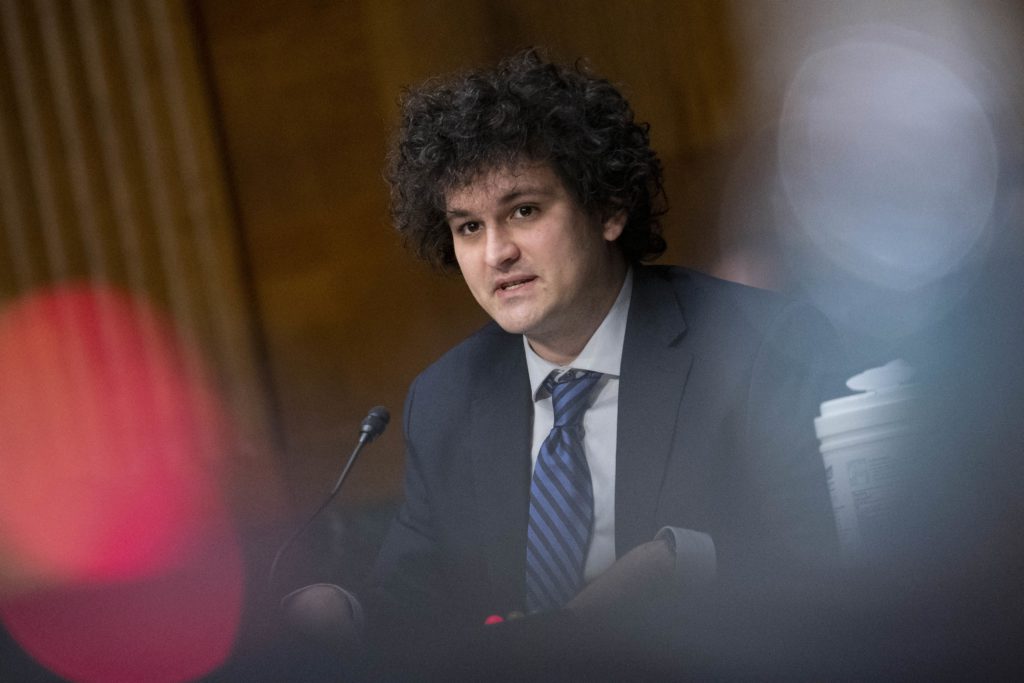
(Bloomberg) — It is well-known that cryptocurrency billionaire and FTX Chief Executive Officer Sam Bankman-Fried wants to give away his entire fortune. Next on his agenda is fixing social media’s “broken model” through blockchain technology. 

“What is the moderation policy for all of social media — it’s like three guys? It’s the people who run three companies who choose what does and doesn’t get censored. That’s a broken model,” Bankman-Fried said in an interview with Bloomberg TV. 

Much like Tesla CEO Elon Musk, Bankman-Fried thinks censorship is a major issue. Creating a system in which social media platforms could each draw from the same source for underlying data could help solve the problems that plague social media, from basic user experience to freedom of speech, he said. 

“It’s a really messy system where there is no interoperability between different platforms,” Bankman-Fried said. “There’s no ability to see a Tweet on Facebook. If you message someone on Facebook, Whatsapp can’t read it and that’s the same company.”

Asked whether he has spoken with Musk, Bankman-Fried said: “I have not directly talked to Elon about this, but I would be excited to.” 

Last week, Musk made an unsolicited bid to take Twitter Inc. private at $54.20 a share, valuing the company at about $43 billion. In turn, Twitter adopted a so-called poison pill defense to shield itself from hostile bids. The shareholder rights plan is exercisable if a party buys 15% of the stock without approval and seeks to ensure anyone taking control of Twitter through open market accumulation pays all shareholders an appropriate premium. Musk has already built a 9% stake in the social media company and been a vocal critic of its policies on free speech. 

Under Bankman-Fried’s proposed model, different interfaces can draw from the same data and make decisions independently about censorship. This would also spur competition because it would level the playing field between those platforms with a deep user base and those that are just starting out, he added. 

“This would be a really, really interesting, important innovation in social networks,” he said.

More stories like this are available on bloomberg.com

©2022 Bloomberg L.P.

Close Bitnami banner
Bitnami
