Bloomberg

DeSantis Weighs Action Against Twitter Board Over Musk Rebuff

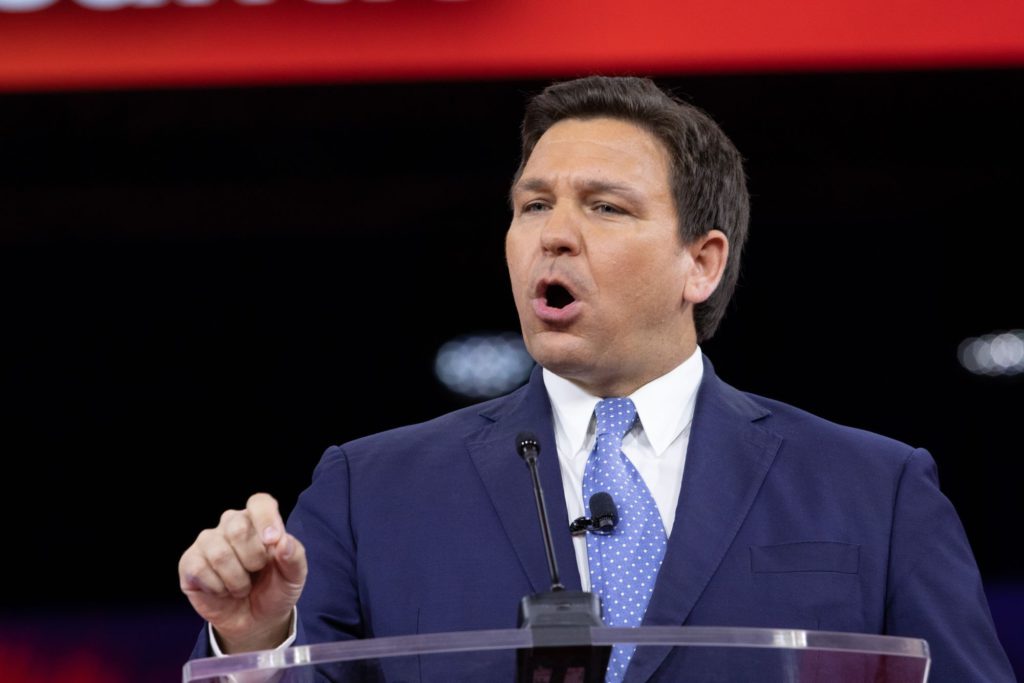
(Bloomberg) — Florida Governor Ron DeSantis said the state could take action against Twitter Inc. for launching a poison pill defense to thwart an unsolicited bid by Elon Musk.

“Why would you reject the 20% premium?” DeSantis said Tuesday at a press conference, accusing the company of censorship. “I don’t think that was a rejection based on financial concerns or business judgment. They rejected it because they know they can’t control Elon Musk. They know that he will not accept the narrative.”

DeSantis, a Republican and potential presidential candidate, said he would be looking at ways to hold the board “accountable for breaching their fiduciary duty.” His comments came minutes after he escalated a dispute with Walt Disney Co. by asking the state’s legislature to consider the termination of special privileges the company has in the state. 

DeSantis said Florida could have legal standing to try and take action against Twitter because the state pension owns shares. Florida’s State Board of Administration, which administers the state’s retirement system investment plan, held 949,690 Twitter shares as of Dec. 31, according to data compiled by Bloomberg. 

Twitter and the pension board didn’t immediately respond to a request for comment.

Read More: DeSantis Puts Disney Privileges in Florida on Chopping Block 

More stories like this are available on bloomberg.com

©2022 Bloomberg L.P.

Alphamin Resources Kicks Off Potential Sale of Miner as Tin Prices Surge

(Bloomberg) — Alphamin Resources Corp., one of the world’s largest tin miners, has kicked off a potential sale of the company as prices of the metal surge, people with knowledge of the matter said. 

Canadian-listed Alphamin, which is working with boutique advisory firm Cutfield Freeman & Co., has sent out marketing materials to prospective bidders, the people said. It has asked for initial offers by the end of the month, according to the people, who asked not to be identified because the information is private.

Alphamin jumped 16% to C$1.30 a share as of 2:45 p.m. in Toronto, giving the company a market value of C$1.65 billion ($1.3 billion). Investment firm Denham Capital is its biggest shareholder with a 57% stake, according to data compiled by Bloomberg. The company could attract interest from Chinese bidders as well as private equity funds, according to the people.

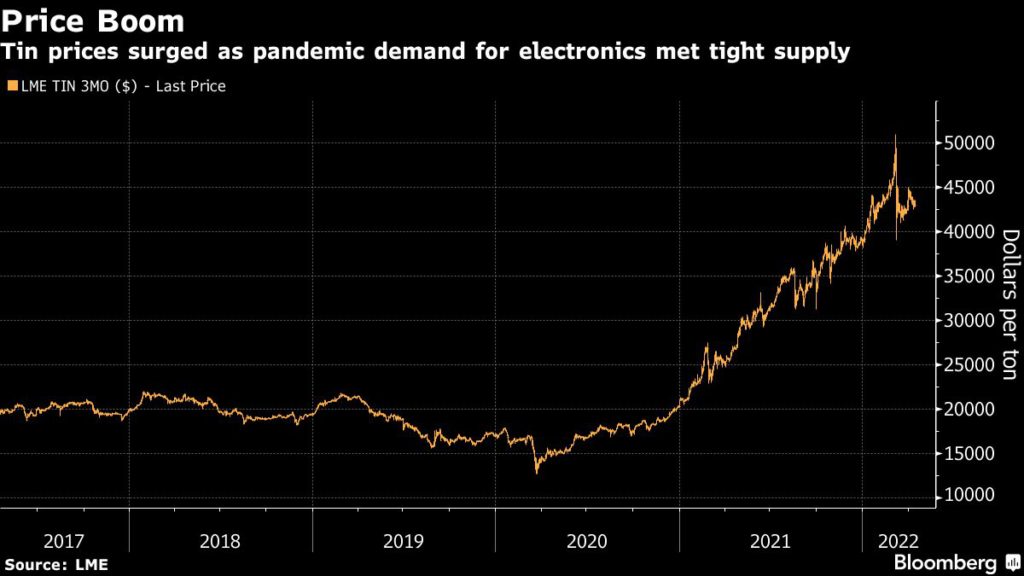
Tin is having a moment amid a new focus on the supply chains for technology products. Prices for the metal, used as solder in chips made by companies like Taiwan Semiconductor Manufacturing Co. and Intel Corp., hit an all-time high of $51,000 per metric ton in March. It was trading Tuesday at $43,090, still up about 150% since the start of 2020.

Alphamin announced in November it was seeking a strategic review to maximize shareholder value. It said at the time it would consider options including a potential sale, extension of its mine life, balance sheet restructuring or shareholder distributions. 

Deliberations are ongoing, and there’s no certainty they will lead to a transaction, the people said. Chief Executive Officer Maritz Smith declined to comment beyond Alphamin’s previous statements. A representative for Cutfield Freeman also declined to comment, while a spokesperson for Denham Capital didn’t immediately respond to a request for comment.

Alphamin’s Mpama North mine in the Democratic Republic of Congo is considered to be one of the world’s highest-grade tin mines. It accounts for around 3% of world usage of the metal, producing 10,969 tons of tin concentrate in 2021. That’s due to expand as the company starts output at the nearby Mpama South project in December 2023.

Trading house Gerald Metals currently holds an offtake agreement for the tin concentrates produced by Alphamin at its Mpama North asset.

(Updates with share price, market value in third paragraph.)

More stories like this are available on bloomberg.com

©2022 Bloomberg L.P.

Billionaire Trade Desk CEO Gets $830 Million in Pay to Fight Google

(Bloomberg) — It’s not a googol, but Trade Desk Inc.’s nine-figure compensation package for founder Jeff Green is the largest yet disclosed for any chief executive officer in 2021.

The Ventura, California-based ad-tech company awarded Green pay valued at more than $830 million, according to a recent filing. That’s more than the compensation for each of KKR & Co.’s new co-CEOs, Joseph Bae and Scott Nuttall, or Blackstone Inc.’s Stephen Schwarzman.

The compensation is largely tied to an options award granted by Trade Desk’s board in October that vests at eight successively higher share price targets. If the stock rises about five times above its current price and the company hits other goals, Green stands to collect more than $5 billion, according to Bloomberg calculations. 

The pay underscores a make-or-break moment for the internet and for Green’s firm, which is among the largest buyers of web-based ads. Alphabet Inc.’s Google absorbs as much as 42% of all online ad revenue, but faces lawsuits that threaten parts of its business. Meanwhile, advertisers and publishers of all sizes are navigating changes in privacy norms like cutting back on the digital trackers known as cookies. 

“We are not interested in controlling the internet,” Green, 45, said in an interview last month in New York. “We’re just interested in keeping it free.” 

‘Existential Threat’

Little known outside the ad-tech world, Trade Desk’s clients include Conde Nast, NBCUniversal Media and the world’s largest ad company, WPP. Green’s 10% economic interest in the firm comprises the majority of his $3.5 billion personal fortune, according to the Bloomberg Billionaires Index. 

Trade Desk has launched a new privacy-neutral feature aimed at replacing third-party cookies, which Google is phasing out, as well as another feature that bypasses Google’s lucrative role as a middleman in the online buying and selling of ads. It has also said it plans to stop buying ads on behalf of clients in a popular Google-run product called Open Bidding. 

It’s one of the few times in recent years that a major ad-buying company has attempted to break out of Google’s orbit, according to industry experts. 

“Smaller ad-tech firms need to adapt and expand because if they don’t they’re basically dead,” said Oliver Latham, a consultant at Charles River Associates. “It’s both an opportunity and an existential threat.” 

A spokesperson for Google didn’t immediately respond to a request for comment.

Green is old enough to remember the early days of online advertising, when there were no rules to structure the buying and selling of ads. After graduating from college, he worked at a Los Angeles agency called 411 Web Interactive, where his job was to buy ads on behalf of clients. Those that he’d place on websites like Yahoo would perform phenomenally on some days, but tank on others.

“You’re like, ‘Oh my God, what happened?’” Green said. 

Open Path

Intent on building a rules-based approach to online advertising, he started a firm in 2004 called AdECN, which he soon sold to Microsoft Inc. He stayed on for a couple of years, but eventually felt that Microsoft wasn’t giving his corner of the company the attention it deserved — even as Google was spending billions on acquisitions to cement its early advantage. 

“I still admittedly had a chip on my shoulder,” Green said.

With Microsoft colleague David Pickles, he started Trade Desk in 2009. It focused on a basic proposition: helping clients buy ads in online auctions more efficiently.

It worked. Trade Desk reported income of $138 million in 2021 on sales of $1.2 billion. The company’s stock has climbed more than 3,500% since its 2016 initial public offering.

One of the ways it’s trying to take on Google is by clearing a more direct route between buyers and sellers of ads with a portal called Open Path, largely bypassing Google as the middleman. Bloomberg LP, the parent of Bloomberg News, is testing a limited version of the product.

“This is consequential,” said Ratko Vidakovic, founder of the Toronto-based ad-tech consultant AdProfs. “Trade Desk did not just cut off one of Google’s products, it also told advertisers that there was a more efficient way to buy media from publishers – by cutting out the ad exchange altogether.”

Trade Desk has also launched Unified ID 2.0, which is its answer to the phase-out by Google and Apple Inc. of third-party cookies. Green says the loss of such trackers is the biggest challenge the industry faces. 

Moonshot Options

In October, Trade Desk’s board awarded Green options valued at about $830 million, giving him the right to buy millions of shares should the company’s stock hit successively higher price targets. If the stock achieves the top target of $340 and the company meets other goals, such as beating most firms on the Nasdaq 100, Green is eligible for a $5.2 billion payout.

The stock was up 7.5% to $66.69 at 2:33 p.m. in New York.

While the award may reflect the board’s confidence in Green as a leader, to shareholder advocates it’s another demonstration of the fallacy that only gobs of cash can sufficiently motivate leaders. It’s also part of a lawsuit from one of the firm’s shareholders, Miami’s pension fund for firefighters and police officers.

“To give somebody who owns 10% of the company such a massive stock grant in addition to very generous cash compensation is truly egregious,” said Rosanna Landis-Weaver, a manager at corporate social responsibility nonprofit As You Sow. 

A Trade Desk representative declined to comment on the suit, beyond saying the firm has sought to have it dismissed. 

About a month after being awarded the new stock, Green signed the Giving Pledge, vowing to give away more than 90% of his wealth.

More stories like this are available on bloomberg.com

©2022 Bloomberg L.P.

Former EBay Security Director to Plead Guilty to Cyberstalking

(Bloomberg) — Former eBay Inc. security director Jim Baugh will plead guilty to running a bizarre 2019 cyberstalking campaign against a couple who ran a website critical of the company, according to a person familiar with the matter.

Baugh had been scheduled to face trial in late May. In a court filing on Tuesday, his defense attorney, William Fick, asked a federal judge in Boston to allow Baugh to change his plea via videoconference.

Five other former eBay employees have already admitted to roles in a cross-country campaign designed to intimidate Ina and David Steiner of Natick, Mass. Several were expected to testify against Baugh. Another eBay employee, former global resiliency director David Harville is scheduled to face trial in May. 

Ina Steiner’s reporting about eBay on the couple’s site eCommerce Bytes upset the company’s then-Chief Executive Officer Devin Wenig, whose compensation package she revealed. 

“Take her down,” Wenig texted his then-communications chief Steve Wymer, according to prosecutors.

Neither Wenig nor Wymer have been charged. The Steiners filed suit against eBay and the former employees last year.

At Baugh’s direction, the couple received anonymous deliveries including a preserved fetal pig, a bloody pig mask, a funeral wreath and a book on surviving the loss of a spouse. Baugh also secretly visited the couple’s suburban home with plans to install a GPS tracking device on their car, according to federal prosecutors.

The case is U.S. v. Baugh, 20-cr-10263, U.S. District Court, District of Massachusetts.

More stories like this are available on bloomberg.com

©2022 Bloomberg L.P.
‘Zero-Day’ Hacks Hit Record in 2021, Google Researchers Say

(Bloomberg) — After a year dominated by high-profile ransomware attacks and supply chain compromises, researchers from Alphabet Inc.’s Google have identified another ignominious cyber milepost for 2021: a record number of “zero-day” exploits.

A zero-day exploit is a previously unknown bug which leaves software vendors exactly zero days to secure it. That makes the technology in question particularly valuable to hackers — and a nightmare for cybersecurity professionals.

Hackers exploited a total of 58 zero-day flaws impacting major software providers in 2021, according to a report published Tuesday by Google’s Project Zero, a team of elite bug hunters. That compares to 25 flaws in 2020 and 21 in 2019.

It’s the highest number of zero-days ever recorded by Project Zero since tracking began in 2014. The trend could be due to an improvement in detection from the likes of Microsoft Corp., Apple Inc. and Google, who now disclose their findings around zero-day issues, rather than a rise in hacks, Maddie Stone, a security researcher at Project zero, said in a blog post about the findings. 

In recent years, hackers have used the attack technique to install advanced spyware on smartphones that was then used to spy on journalists, politicians, human rights activists and others. Suspected Chinese state-sponsored hackers, meanwhile, exploited such flaws last year to compromise Microsoft Exchange servers.

Google’s Stone said there were some surprises among the data. Despite the recent focus on spyware being misused, cybersecurity researchers are still struggling to find zero-days that allow hackers to take control of targets’ phones. 

“We know that messaging applications like WhatsApp, Signal, Telegram, etc are targets of interest to attackers and yet there’s only one messaging app, in this case iMessage, zero-day found this past year,” she wrote. The team has uncovered two such flaws before that: one in WhatsApp in 2019 and another in iMessage in 2021.

Stone said the “majority of people on the planet” don’t have to fear being at risk of being targeted by a zero-day attack. Still, she said such attacks end up having a broad impact.

“These zero-days tend to have an outsized impact on society so we need to continue doing whatever we can to make it harder for attackers to be successful.”

More stories like this are available on bloomberg.com

©2022 Bloomberg L.P.
UBS Sees Some Cyclical Stocks Shining Despite Rising Risk Aversion

(Bloomberg) — The selloff in cyclical stocks this year has created opportunities in some economically sensitive sectors even as risk aversion continues to dominate investors’ decision making, according to UBS. 

Semiconductor stocks could benefit from fears about a combination of slow economic growth and high inflation while rising interest rates offer a counterbalance for the financial sector, strategists Alastair Pinder and Keith Parker wrote in note to clients on Tuesday.

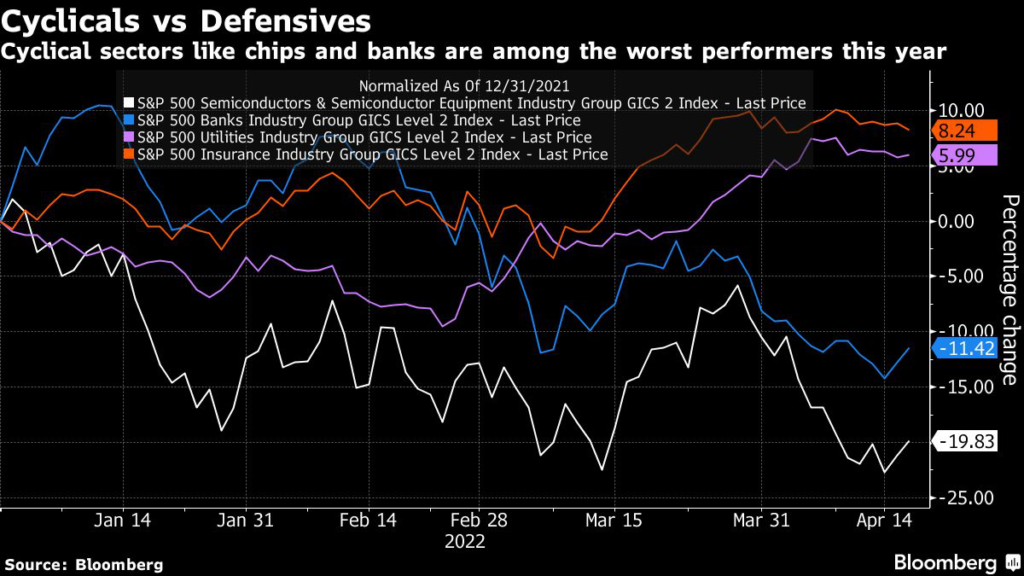
“Risk-reward increasingly favors taking a more neutral stance on cyclicals vs defensives and focusing on relative value industry group winners,” they said. “Analysis shows that risk aversion/VIX is driving performance much more so than macro factors.”

Cyclical stocks are among the worst performers this year as investors have rotated into defensive sectors amid fears that the Federal Reserve’s efforts to tame inflation, combined with high energy prices and the war in Ukraine could push the economy into a recession. Chip-related stocks in the S&P 500 Index have fallen 20% in 2022 while the insurance and utilities groups have each gained more than 6%. 

In addition to select cyclicals, the UBS strategists recommended investors have higher exposure to technology, real estate investment trusts and health care while cutting positions in materials and industrials. 

More stories like this are available on bloomberg.com

©2022 Bloomberg L.P.

IMF Slashes Growth Outlook on Russia Invasion, China Lockdowns

(Bloomberg) — The International Monetary Fund slashed its world growth forecast by the most since the early months of the Covid-19 pandemic, and projected even faster inflation, after Russia invaded Ukraine and China renewed virus lockdowns. Global expansion will slow to 3.6% in 2022, down from a forecast of 4.4% in January before the war, …

IMF Slashes Growth Outlook on Russia Invasion, China Lockdowns Read More »

Silvergate Shares Surge After Blowout First-Quarter Earnings

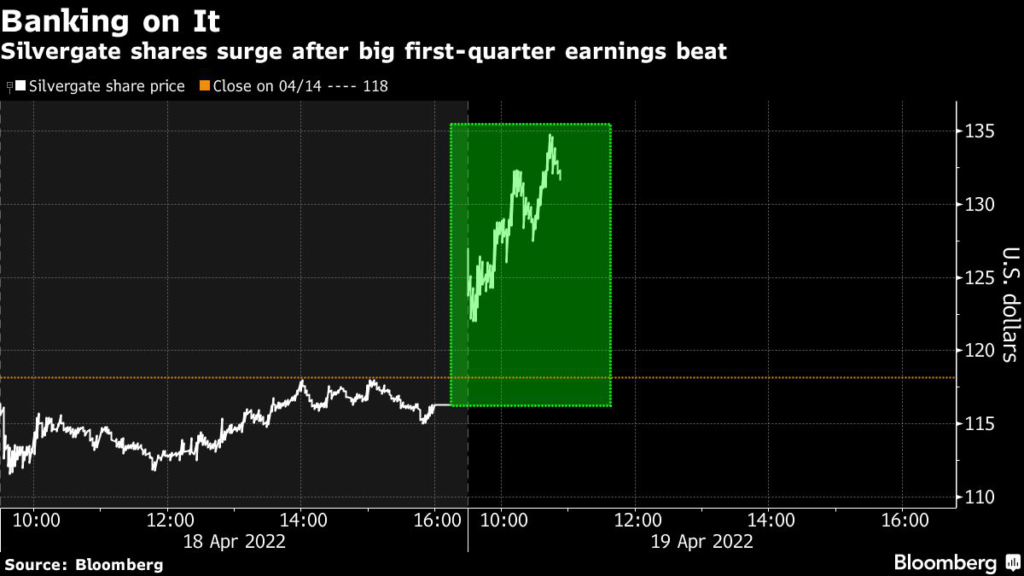
(Bloomberg) — Silvergate Capital Corp. surged by the most in more than a month on Tuesday after the cryptocurrency-focused bank reported first quarter earnings that came in ahead of consensus forecasts.

Shares of the firm jumped as much as 16%, the biggest intraday leap since March 9, after revealing earnings-per-share of 79 cents for the first three months of the year, 75% higher than the average analyst estimate of 45 cents, according to data compiled by Bloomberg. The bank also reported that its number of digital currency customers had jumped to 1,503 from the year prior, an increase of about 36%.

“The combination of higher rates plus Silvergate’s ability to put cash to work in higher yielding assets should have a dramatic impact on the bank’s earnings power moving forward as shown in the first quarter,” KBW Michael Perito wrote in a note.

Despite a rocky start to the year for many digital tokens, average digital currency deposits at the bank continued to grow, reaching $14.7 billion. Meanwhile, Silvergate’s Exchange Network Leverage program — which helps provide access to capital through dollar loans collateralized by Bitcoin — saw commitments rise to roughly $1.1 billion, nearly doubling from the end of last year.

Earlier this year, MicroStrategy Inc. announced that it had received a $205 million loan from Silvergate, backed by about $820 million in Bitcoin using the SEN Leverage program.

Shares of Silvergate have been volatile this year, largely tracking the movement in Bitcoin prices. The stock has fallen about 19% since hitting a three-month high late last month and is down roughly 12% so far this year following a 99% surge in 2021.

Other crypto-linked stocks also pushed higher on Tuesday, aided by a second straight day of gains for Bitcoin. Shares of Coinbase Global Inc., Marathon Digital Holdings Inc. and MicroStrategy Inc. all gained by at least 3.5%. BitNile Holdings Inc., which surged 29% on Monday after reporting annual revenue growth of 120%, fell as much as 15%. 

More stories like this are available on bloomberg.com

©2022 Bloomberg L.P.
Uber, Lyft Scrap Mask Requirement for U.S Riders and Drivers

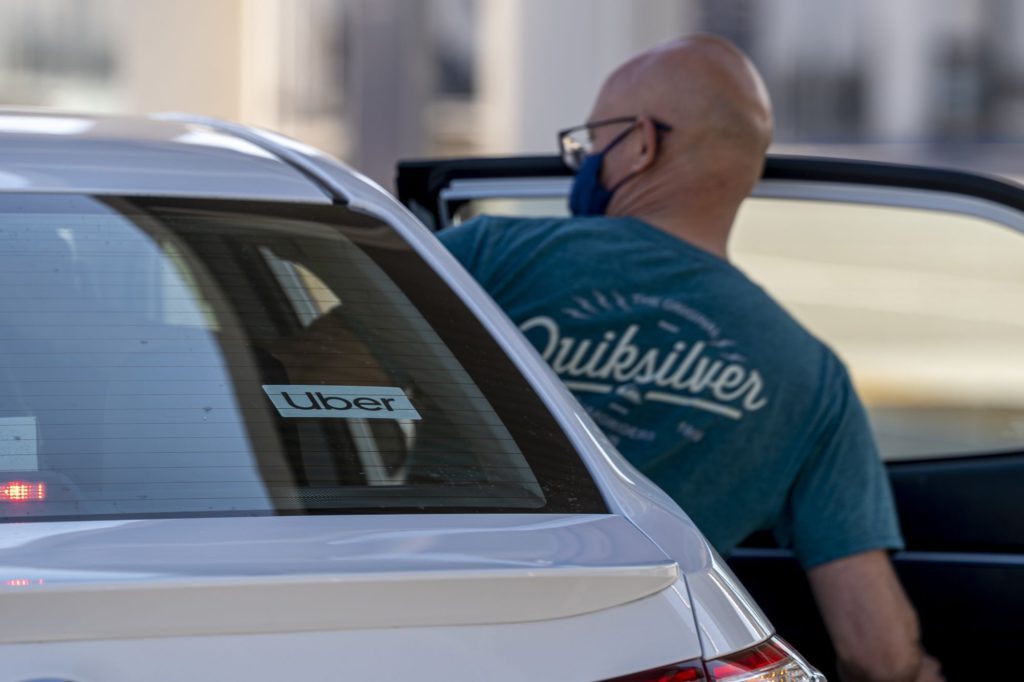
(Bloomberg) — Uber Technologies Inc. and Lyft Inc. will no longer ask riders and drivers in the U.S. to wear masks, joining a growing number of major transport providers shifting their policies. 

The ride-hailing giants’ relaxing of their rules comes after U.S. airlines said they would no longer require travelers or employees to wear face coverings on domestic and some international flights. A U.S. judge on Monday overturned a federal mandate for passengers to cover their faces. 

“Remember: many people still feel safer wearing a mask because of personal or family health situations, so please be respectful of their preferences,” Uber said in a statement.

Both companies also said they will allow riders to sit in the front passenger seat. “While riders and drivers can always cancel any ride they don’t wish to take, health safety reasons — like not wearing a mask — will no longer appear as cancellation options in the app,” Lyft said in a blog post.

In the U.K., Uber’s other major market, the company already relaxed its rules for mask-wearing in line with government advice. 

The U.S. Transportation Security Administration and the Centers for Disease Control and Prevention said on Monday that companies would no longer be able to order passengers to wear masks on public transportation, although both agencies recommended their continued use.

Covid restrictions in the U.S. have eased after a decline in case numbers from a January peak caused by the omicron variant. Almost 1 million Americans have died of Covid in the past two years, and hundreds more continue to die every day.

Read this next: King of the ‘Lunatics’ Becomes Bitcoin’s Most-Watched Whale

New York recently delayed plans to remove the mask mandate in city schools and day-care centers for children under age 5, saying cases of Covid-19 are rising again. 

(Updates to include Lyft from first paragraph.)

More stories like this are available on bloomberg.com

©2022 Bloomberg L.P.
Uber, Lyft Scrap Mask Requirement for U.S. Riders, Drivers

(Bloomberg) — Uber Technologies Inc. and Lyft Inc. will no longer ask riders and drivers in the U.S. to wear masks, joining a growing number of major transport providers shifting their policies. 

The ride-hailing giants’ relaxing of their rules comes after U.S. airlines said they would no longer require travelers or employees to wear face coverings on domestic and some international flights. A U.S. judge on Monday overturned a federal mandate for passengers to cover their faces. 

“Remember: many people still feel safer wearing a mask because of personal or family health situations, so please be respectful of their preferences,” Uber said in a statement.

Both companies also said they will allow riders to sit in the front passenger seat. “While riders and drivers can always cancel any ride they don’t wish to take, health safety reasons — like not wearing a mask — will no longer appear as cancellation options in the app,” Lyft said in a blog post.

In the U.K., Uber’s other major market, the company already relaxed its rules for mask-wearing in line with government advice. 

The U.S. Transportation Security Administration and the Centers for Disease Control and Prevention said on Monday that companies would no longer be able to order passengers to wear masks on public transportation, although both agencies recommended their continued use.

Covid restrictions in the U.S. have eased after a decline in case numbers from a January peak caused by the omicron variant. Almost 1 million Americans have died of Covid in the past two years, and hundreds more continue to die every day.

Read this next: King of the ‘Lunatics’ Becomes Bitcoin’s Most-Watched Whale

New York recently delayed plans to remove the mask mandate in city schools and day-care centers for children under age 5, saying cases of Covid-19 are rising again. 

(Updates to include Lyft from first paragraph.)

More stories like this are available on bloomberg.com

©2022 Bloomberg L.P.
Close Bitnami banner
Bitnami