Bloomberg

American Vanguard Rejects Cruiser Capital’s Director Nominees

(Bloomberg) — American Vanguard Corp. has rejected a slate of four directors put forth by activist investor Cruiser Capital Advisors, arguing the nominees wouldn’t add value to the board and lacked enthusiasm for joining. 

Cruiser, run by Keith Rosenbloom, told American Vanguard last month when it nominated the directors that it held a roughly 0.2% stake in the agricultural chemical producer, the company said in a regulatory filing Tuesday, confirming an earlier report by Bloomberg News. Cruiser now claims to own about 3% of the company, it said. 

American Vanguard believes that Cruiser, which said it was nominating the directors to help improve the company’s operations, didn’t offer enough details on how that would be achieved.

Rosenbloom said in an emailed statement that he believed American Vanguard has the potential to be a highly-profitable platform but is undermanaged. He said it’s failed to generate meaningful returns over the past decade, and a more focused management team could improve the company’s earnings before interest, tax, depreciation and amortization margin to “well north” of 15%, from 10% today. 

“We think the opportunity is substantial, but the company’s board has demonstrated poor capital allocation decisions over the past 10 years and we are deeply concerned about how free cash flow will be allocated,” Rosenbloom said.

In addition to Rosenbloom, Cruiser nominated its director of research, Charles Rose; former Union Carbide Corp. chairman and chief executive officer Patrick Gottschalk; and former Hemlock Semiconductor chairman and CEO Mark Bassett. All four were interviewed by the American Vanguard board, which decided to reject them because the nominees either wouldn’t add value to the board or expressed reservations about joining, the company said in the filing. 

The board considered, among other factors, the lack of relevant experience in agricultural chemicals, sustainable agriculture, precision applications, agribusiness, regulatory, or other relevant expertise, as well as the lack of diversity of any kind among the Cruiser nominees, it said in the filing. 

Rosenbloom said he didn’t believe the vetting of its nominees was made in good faith. 

“As for their review process of our board nominees, it was perfunctory at best — but it’s exactly what one would expect from a board who has been paid millions of dollars while its shareholders have seen virtually no historical return,” Rosenbloom said Tuesday. 

Shares of Newport Beach, California-based American Vanguard have climbed 39% this year through Monday’s close. They rose 2.2% to $22.85 in New York trading Monday, giving the company a market value of $707 million.

American Vanguard is benefiting from the fundamental strength in its sector that has been amplified by the war in Ukraine, which has created a fertilizer shortage and increased the value of North American crops. 

Cruiser previously agitated for changes in the sector in 2018, when it nominated four directors to Ashland Global Holdings Inc.’s board to help oversee its transition to a pure-play chemical company. Cruiser reached a settlement at the company the following year that saw one of its nominees appointed to the board. 

It also was also given two seats on the board of A. Schulman Inc. in a settlement in 2017. A. Schulman was later sold to LyondellBasell Industries N.V. 

More stories like this are available on bloomberg.com

©2022 Bloomberg L.P.

Decarbonizing Aviation Will Require Big Leaps From These Pioneers

(Bloomberg) — Stay on top of the electric car revolution by signing up to our Hyperdrive newsletter here.

We are seeing a big push happening this year in aviation, driven by calls on airlines to decarbonize and investor interest in new aviation technology startups.

I have spent the past six months researching a handful of new technologies being developed by startups to help decarbonize aviation. These include electric flight, hydrogen and biofueled flight, and new aircraft design. The work is part of BNEF’s annual climate-tech innovation competition, the BNEF Pioneers, whose objective is to identify companies with the potential to change the industry and those pushing forward with innovations that support a low-carbon economy.

Here are some of the more interesting trends we’ve identified recently:

Venture capital funding for climate-tech startups has surged in the past year

Low-carbon transport companies were the largest recipients. Investors are drawn to transport as an investment category because many offerings are cost competitive and have a good product-market fit. Also, there have been successes in the industry, particularly for companies involved in low-carbon road transport, such as battery-maker CATL and Chinese electric-vehicle startup Nio.

Aviation may be the next big market for climate-tech investors

As low-carbon road transport technologies mature, investors are looking for new opportunities and expanding into aviation and shipping. Venture capital and private equity (VCPE) investment in aviation technologies has surged 724% from 2017 to 2021, totaling almost $3 billion in 2021, according to BNEF.

Public markets also have demonstrated an interest in the sector. Urban air mobility companies such as Joby Aviation and Lilium raised billions of dollars through reverse mergers last year.

Urban air mobility doesn’t meaningfully contribute to broader sustainability targets

The majority of climate-tech investment to date has been in urban air mobility companies looking to transform private intracity travel. An electric vertical take-off and landing (eVTOL) aircraft could go from the city of London to Heathrow airport in six minutes, traveling at top speed, for example. But these urban flights — some of them electric — will at best displace cars with a more energy-intense form of travel. At worst, they will replace public transit.

While investors are excited by the promise of this type of travel, the contribution by such startups to broader sustainability goals will be limited. Over 50% of global flight departures fly under 1,111 kilometers (690 miles), but only account for 1% of total miles flown globally.

Innovations in long-haul commercial aviation

The innovations required include changes in drivetrain — to electric motors, fuel cells or modified turbines — and moves to zero-carbon fuel. This is technically possible, and many new aircraft have been tested and shown to work for short-haul flights, but none are commercially available yet. Of the 225 startups BNEF has identified as building sustainable aviation technologies, two in particular — Twelve and ZeroAvia — are BNEF Pioneers standouts.

Twelve has developed a process for converting CO­2 into jet fuel, and ZeroAvia has become a key player in the race to produce hydrogen aircraft. The two startups are working to improve the performance and efficiency of sustainable aviation technologies, but both face significant hurdles in commercializing their products. The cost involved and the time it takes to replenish traditional fleets with low-carbon aircraft, to replace existing infrastructure, and to certify safety standards, is substantial. Investors will play a role, but stronger policy and regulation will be needed ultimately to demonstrate that these technologies are safe.

Mark Daly is an analyst with BloombergNEF’s Climate Technology and Innovation team.

More stories like this are available on bloomberg.com

©2022 Bloomberg L.P.

Crypto Startups Bring In Billions Even With Lofty Valuations, For Now

(Bloomberg) — Investors drawn to cryptocurrency startups are doing a lot of double-takes these days.

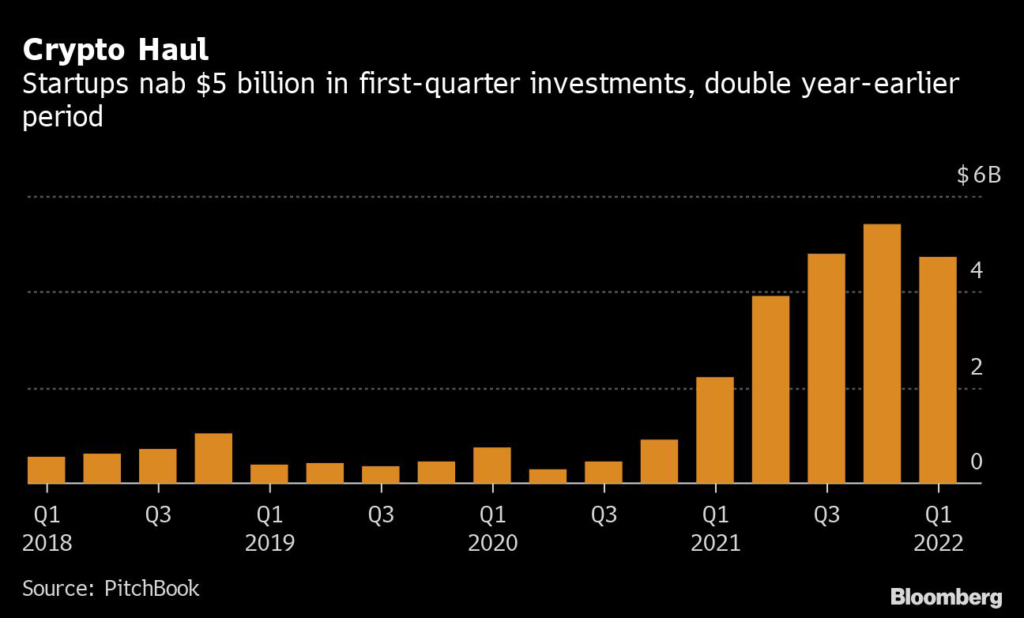
The industry continues to draw venture capital even amid broad market angst, luring roughly $5 billion in the first quarter, double the year-earlier period, according to data compiled by PitchBook Data Inc. But ever-lofty valuations of new companies, some less than a year old, are giving some potential backers pause.

Prominent investors, including at Sequoia Capital and SoftBank Group Corp., rang the alarm in January as prices of technology stocks and cryptocurrencies slumped. Blockchain Capital LLC, which has completed 130 deals since its founding in 2013, recently passed on a deal it was originally excited about after the startup’s asking price was five times the firm’s “walk-away” figure.

“Compared to just a year ago, there’s been financing events that we’re just shocked at by the amount they were able to raise,” said Spencer Bogart, general partner at Blockchain, which counts Coinbase, Uniswap and Kraken among its portfolio of companies. “We’re passing and letting the founders know we’re interested, but that valuations are in excess of what we’re comfortable with.”

A slowdown in deal activity into the summer is the norm, according to Multicoin Capital partner John Robert Reed, though he also acknowledges a shift in market dynamics. Multicoin has completed 36 deals since 2017 and its portfolio includes crypto marketplace operator Bakkt and analytics firm Dune Analytics.

“The market is swinging to neutral from a founder’s market,” Reed said. “Top operators are still commanding top valuations but investors are getting more disciplined, not trying to spray as much.”

‘Pendulum Swinging’

Pantera Capital, which has backed 90 blockchain companies since 2013, also sees a shift underway. 

“I am already starting to see the pendulum swinging in favor of investors and expect early-stage to dip later this year,” said Paul Veradittakit, a partner at Pantera Capital. As to his own firm’s strategy, he said that for companies “we don’t see with an obvious large total addressable market, we may pass due to price.” 

Some venture capitalists are more upbeat about future prospects and point to activity in the past few weeks alone. Blockchain developer Near Protocol raised $350 million, more than double what it received in January. The nonfungible token, or NFT, project Bored Ape Yacht Club, raised $450 million in a seed round investment that pushed its valuation to $4 billion. And the project is less than a year old.

Shan Aggarwal, head of corporate development and ventures at cryptocurrency exchange Coinbase, said the pace of investments into crypto “remains strong” and the firm’s investment decisions are market agnostic. 

“Some of the most successful projects of today were funded during the bear market of 2018 and 2019 and we’ll continue to invest in quality founders and projects moving forward regardless of crypto market conditions,” he said. 

Indeed, volatility in crypto lately hasn’t deterred investments to the extent seen in previous cycles, which venture capitalists say is indicative of a maturing market. Coinbase Ventures is among the most active investors in the industry, according to data compiled by PitchBook. The unit of the crypto exchange operator said in January it closed almost 150 deals just in 2021, accounting for 90% of its transactions since its inception four years ago.

“Funding is starting to dry up in some of the other areas of tech financing — some IPOs and term sheets are dwindling. Some companies are struggling to get backers. But in crypto, we’re not seeing that yet,” Noelle Acheson, head of market insights at Genesis Global, said in an April 12 interview. “Every day, in fact, so far this month, there have been notable $100 million-plus raises for funds, so there’s a lot of money waiting to deploy.”

More stories like this are available on bloomberg.com

©2022 Bloomberg L.P.

Uber Riders, Drivers No Longer Need to Wear Masks in U.S.

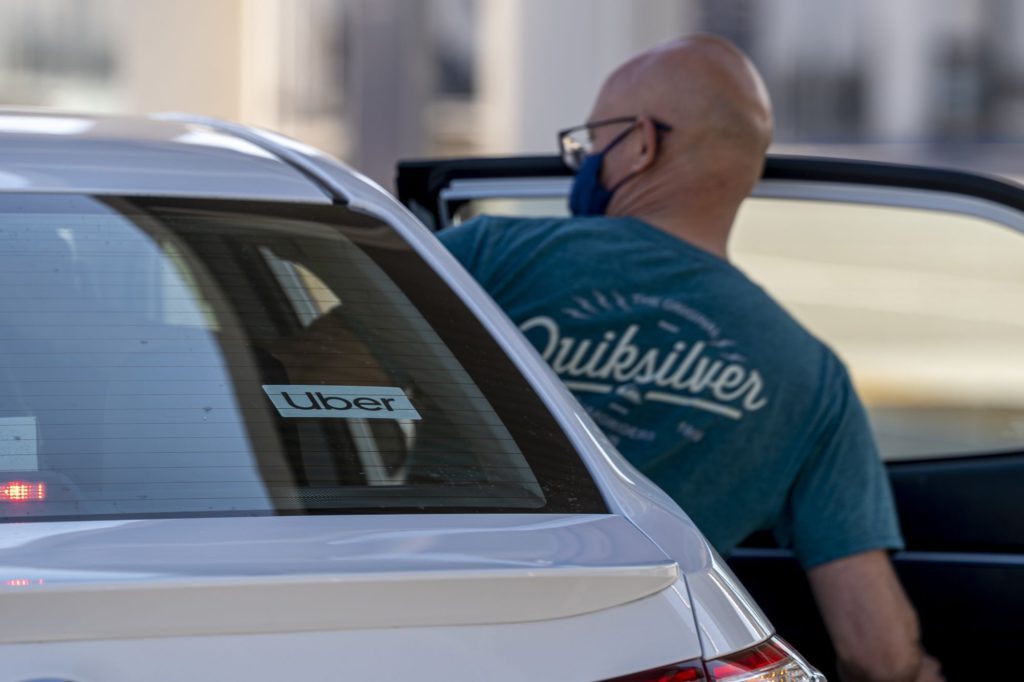
(Bloomberg) — Uber Technologies Inc. will no longer ask riders and drivers in the U.S. to wear masks, joining a growing number of major transport providers shifting their policies. 

Uber’s relaxing of its mask rules comes after U.S. airlines said they would no longer require travelers or employees to wear face coverings on domestic and some international flights. A U.S. judge on Monday overturned a federal mandate for passengers to cover their faces. 

“Remember: many people still feel safer wearing a mask because of personal or family health situations, so please be respectful of their preferences,” Uber said in a statement.

In the U.K., Uber’s other major market, the company already relaxed its rules for mask-wearing in line with government advice. 

The U.S. Transportation Security Administration and the Centers for Disease Control and Prevention said on Monday that companies would no longer be able to order passengers to wear masks on public transportation, although both agencies recommended their continued use.

Covid restrictions in the U.S. have eased after a decline in case numbers from a January peak caused by the omicron variant. Almost 1 million Americans have died of Covid in the past two years, and hundreds more continue to die every day.

New York recently delayed plans to remove the mask mandate in city schools and day-care centers for children under age 5, saying cases of Covid-19 are rising again. 

(additional context.)

More stories like this are available on bloomberg.com

©2022 Bloomberg L.P.

Power-Plant Breakdowns Force Eskom to Widen South Africa Outages

(Bloomberg) — South Africa’s state power utility doubled the intensity of nationwide outages because of faults at two of its plants. Eskom Holdings SOC Ltd. cut 4,000 megawatts from the national grid on Tuesday morning after the Majuba Unit 5 and Tutuka Unit 4 facilities tripped, the company said on Twitter. The utility had on …

Power-Plant Breakdowns Force Eskom to Widen South Africa Outages Read More »

Rising Freight Rates Put Heavy Burden on Grain-Importing Nations

(Bloomberg) — The war in Ukraine will put further pressure on grain-importing countries in Africa and Asia as a reduced number of vessels for delivering cargoes drives up shipping rates, according to the head of the International Chamber of Shipping.  About 80 to 100 ships, mostly bulk carriers, have been unable to leave Ukrainian waters …

Rising Freight Rates Put Heavy Burden on Grain-Importing Nations Read More »

PLDT Sells Towers for $1.47 Billion in Largest Foreign Purchase

(Bloomberg) — PLDT Inc. raised 77 billion pesos ($1.47 billion) selling half of its telecommunication towers, the largest ever acquisition of assets in the Philippines by international investors, it said.

Part of the proceeds will settle 27.5 billion pesos of debt and pay 9 billion pesos of special dividends, CFO Anabelle Chua said in a briefing. It will also fund cash requirements that would save PLDT from taking on 24.5 billion pesos of additional debt, she said.

PLDT units Smart Communications Inc. and Digitel Mobile Philippines Inc. sold 5,907 telecom towers at about 13 million pesos each, the highest for similar transactions in the region. Axiata Group’s edotco Group and EdgePoint, backed by DigitalBridge Group, paid more than three times the 23 billion peso book value of the towers, Chua said.

With the proceeds, PLDT is also plans to raise this year’s capital spending plan of up to 80 billion pesos, Chairman Manuel Pangilinan said.

Other Highlights

  • Smart to lease back the towers for about 7 billion pesos a year over a 10-year period, Chua said, adding this will save the group in operational costs and capital expenditures
  • As part of the sales agreement, edotco Group and EdgePoint will build 1,500 towers, two-thirds of which will be up by 2025
  • The tower sale will be earnings accretive for PLDT over the next 10 years at about 10% annually from last year’s 30 billion-peso core profit
  • PLDT will save 2.6 billion pesos in financing costs
  • PLDT will retain ownership of active infrastructure which include the antennas, remote radios, microwave dish and fiber backhaul; the tower companies will own the steel structures, cooling systems, power supply, land lease contracts
  • On April 5: PLDT Said to Pick Edgepoint, Edotco for $1.5 Billion Tower Deals

More stories like this are available on bloomberg.com

©2022 Bloomberg L.P.

SoftBank-Backed Sandbox Said to Seek Funds at $4 Billion Value

(Bloomberg) — The Sandbox, a platform that allows users to trade and monetize virtual assets in the Ethereum blockchain, is considering raising fresh funds at a valuation of more than $4 billion, according to people familiar with the matter.

The company is looking to raise about $400 million from both new and existing investors, the people said, who asked not to be identified as the information is confidential. Sandbox, which is majority-owned by blockchain gaming developer Animoca Brands Corp., is in talks with potential investors for the funding round, the people said.

Considerations are ongoing and details such as the size and valuation for the new round could still change depending on market sentiment and investor demand, the people said. A representative for The Sandbox didn’t immediately respond to requests for comment.

A new fundraising deal would follow the $93 million The Sandbox raised in a series B round led by SoftBank Vision Fund 2 in November. The transaction was the fund’s first investment into crypto assets and was earmarked to help speed up development of The Sandbox’s open metaverse.

The Sandbox rose to fame with its two namesake mobile games which garnered 40 million downloads in total. In 2018, it entered into blockchain by introducing user-generated content with a marketplace allowing users to upload, publish and sell their non-fungible tokens. The company has also expanded into virtual land sales, fashion and concerts with its own cryptocurrency SAND. 

Companies that bought a virtual plot in The Sandbox in recent months include Adidas AG, retailer Carrefour SA and Warner Music Group Corp., which plans to organize live concerts within the platform. Snoop Dogg released his first music video filmed in the metaverse for his song “House I Built,” which featured his digital double dancing.

The Sandbox could carry out a new funding round this year as it looks to expand “aggressively” in terms of hiring and acquisitions, Chief Operating Officer and Co-Founder Sebastien Borget said at a press conference in Lisbon earlier this month. Borget didn’t provide details of the potential fundraising size nor acquisition targets.

More stories like this are available on bloomberg.com

©2022 Bloomberg L.P.

Zilingo’s Board Is Said to Weigh Replacing CEO Amid Probe

(Bloomberg) — After suspending Ankiti Bose from her post as chief executive officer, the board of Zilingo Pte is discussing replacing her for good amid an investigation into the Singapore startup’s accounting practices, according to people familiar with the matter.

Directors have been talking regularly in recent days to consider the future of Bose and Zilingo itself, said the people, asking not to be identified because the discussions are private. Bose, whose current suspension runs through May 5, has pressed the board to clarify her status in part because she is concerned the company is growing directionless, the people said.

The board has not yet decided who will replace Bose, though one option discussed is to appoint interim leadership, possibly including senior executives and investors, the people said. The private investigative firm Kroll is conducting a probe of Zilingo’s bookkeeping and is aiming to finish soon. 

Bose has denied any wrongdoing and has hired an attorney to fight back against what they have described as a “witch hunt.” She has grown frustrated with the conflicts and has begun to realize she is unlikely to return as CEO, according to one of the people.

In her first statement since the probe began, Bose told Bloomberg that she is “fully committed to cooperating with the board in the investigations” and that “one thing we all agree on is that whenever there are credible complaints, as board members we are obligated to look into them and do what is best for the company.”

In its own statement, Zilingo’s board said it had received a complaint in March and the company is working closely with an independent firm to investigate the matter. “Any question of a change in management is speculative and premature at this stage,” the board said.

Zilingo, backed by Sequoia Capital India and Temasek Holdings Pte, had been one of the highest-profile startups to emerge from Singapore until revelations about its accounting probe and the CEO’s suspension emerged this month. Temasek, also based in Singapore and backed by its government, has expressed concern the meltdown is tainting its reputation and urged the company to fix the situation.

“We expect our portfolio companies to abide by sound corporate governance and codes of conduct and ethics. We are therefore supportive of the board’s investigation into the complaint as part of good governance, to safeguard the interests of the company,” Temasek said in a separate statement. 

Zilingo, which supplies technology to apparel merchants and factories, had been trying to raise as much as $200 million with help from Goldman Sachs Group Inc. when prospective investors began to question its financial practices. The concerns involve how the startup accounts for revenue on a platform used by thousands of small merchants, as well as the consolidation of its Indonesia operations, the people said. 

The company raised $226 million at a valuation of $970 million in 2019 when Bose was 27 years old. But the Covid-19 pandemic took a toll on its business: Revenue dropped by about a third in fiscal 2021 to roughly $40 million. Bose took a pay cut of about 30% as a result, while the company laid off staff.

The clash between Bose and the board has escalated in recent days as executives and directors sort through who is responsible for the startup’s financial state, the people said. Bose has argued that she is getting blamed for decisions and practices that were well known by senior managers and directors, they added. 

In particular, she has made the case that Sequoia and its Managing Director Shailendra Singh were intimately involved in Zilingo’s operations, the people said. She has said that she and co-founder Dhruv Kapoor were young founders who leaned on the expertise of investors like Sequoia, which owns about 25% of the startup and is considered one of the top venture firms in the world, they said. 

Singh participated in many discussions about daily operations, communicating with Bose frequently, the people said. He also joined discussions with Goldman about fundraising and helped bring in other investors.

Sequoia said a statement that its team routinely works with portfolio companies, but it “operates on information shared by the companies.” The firm, along with other investors, was “shocked and disappointed by the allegations that surfaced in March 2022.”

Singh and two other directors have resigned from Zilingo’s board in recent weeks. Sequoia India’s Sandeep Kher took over his director post at Zilingo.

Sequoia India posted an unusual mea culpa on its website on Sunday, following troubles at several of its startups including Zilingo.

“We usually stand shoulder to shoulder with our founders during hard times. But on some rare occasions, we wake up feeling disappointed. Our worst days are when we hear about breaches of integrity or ethics in the portfolio. This is the stuff that pains us deeply. And it’s time we speak about this,” said the post, which did not name any individual partners and was attributed only to “Team Sequoia.”

“Recently some portfolio founders have been under investigation for potential fraudulent practices or poor governance. These allegations are deeply disturbing,” it read. “We need some guardrails that we, as an ecosystem, sign up to, so that a few errant founders don’t create big setbacks for the wider ecosystem at large.”

Sequoia’s Singh had raised the idea of replacing Bose as far back as January of 2021 and had suggested Ananth Narayanan, the former CEO of Myntra, as a successor, the Morning Context reported earlier. Bose, who had worked at Sequoia before co-founding Zilingo, fought back against that idea. 

Bose has made the case that Sequoia and other investors are now using the pretext of accounting to oust her unfairly, the people familiar told Bloomberg. At least some of the bookkeeping practices at Zilingo are technical decisions that are typically considered judgment calls at startups.

One example is how a startup accounts for revenue when it provides substantial incentives to customers. If, for example, a customer gets a 50% discount on a $100 dress, the company may count that as $100 in revenue and $50 in expenses, effectively making its revenue look bigger. A more conservative approach would be to book only $50 in revenue.

Zilingo has made similar accounting decisions that make its revenue look larger, but Bose has argued the company’s finance department is primarily responsible for such moves, the person said. 

The board has argued that as Zilingo emerges from the Covid downturn it is better to press the reset button with a new CEO, one person said. While Bose feels loyalty to many employees at the company, she has grown disappointed that directors have not backed her with sufficient support, another person said.

“I’m committed to, above all, acting in the interests of all of our customers, our hundreds of employees, our shareholders and their LPs and together with the cooperation of the board, we will find the most constructive path forward,” Bose said in her statement. “I hope that the media and social media can give us some privacy as we resolve this in the best way possible for the company, its stakeholders and the entire ecosystem.”

(Updates with Zilingo board statement in sixth paragraph)

More stories like this are available on bloomberg.com

©2022 Bloomberg L.P.

Close Bitnami banner
Bitnami