

Bloomberg

Apple’s Cook Goes to Washington to Meet With Top GOP Lawmakers

(Bloomberg) — Apple Inc. Chief Executive Officer Tim Cook is in Washington to meet with top Republican lawmakers, according to people familiar with his visit, as the company seeks to forge ties with the GOP ahead of the party’s takeover of the House early next year. 

Cook has scheduled sessions with Republican Representatives Jim Jordan of Ohio, Darrell Issa of California and Cathy McMorris Rodgers of Washington, according to two of the people familiar with the meetings, who asked not to be identified discussing private travel plans. Jordan and McMorris Rodgers are likely to chair the top committees overseeing the tech industry when the GOP retakes the House next year. 

The meetings were likely scheduled weeks ago, far in advance of the diatrabe against the company launched by Twitter Inc. CEO Elon Musk. Still, Apple faces intensifying heat from conservatives. Some Republicans are rallying behind Musk, who on Monday attacked Apple and Cook in a series of tweets, claiming that the company threatened to remove Twitter from Apple’s app stores and paused its advertising on Twitter’s platform. 

Musk claimed Apple was antagonizing Twitter over Musk’s “free speech” approach to leading Twitter, which he bought for $44 billion earlier this year. Critics have said Musk’s plan to pare back the rules governing speech on Twitter is leading to a spike in abuse, harassment and threats on the platform. 

Jordan in particular has publicly aligned himself with Musk, periodically posting messages of support for Musk, who is also CEO of Tesla Inc. 

Apple and the offices of lawmakers that Cook is scheduled to meet with didn’t immediately respond to requests for comment.

Jordan will likely chair the House Judiciary Committee when the GOP takes control of the House, while McMorris Rodgers is set to helm the House Energy and Commerce Committee. The two are in charge of forming the GOP’s tech policy agenda next year.

Cook, who has been making the rounds in Washington for months, is also scheduled to meet with Texas Republican Senator John Cornyn, as well as Democratic Senators Martin Heinrich of New Mexico and Brian Schatz of Hawaii. 

Cornyn, one of the loudest China hawks in the Senate, has publicly criticized Apple’s ties to Beijing. Cornyn was one of several lawmakers who sent a letter earlier this year questioning Apple’s plans to use memory chips from a Chinese chipmaker. 

Cook’s meetings are a continuation of Apple’s broader outreach in Washington as the iPhone maker has faced increasing scrutiny from policymakers over its tight control of the app store and extensive ties to China. 

More stories like this are available on bloomberg.com

©2022 Bloomberg L.P.
Amazon’s Cloud Unit Plans to Add Staff in 2023, Keep Building Data Centers

(Bloomberg) — Amazon.com Inc.’s cloud unit plans to add employees next year and keep building new data centers, a sign that a hiring freeze elsewhere in the company hasn’t derailed investment plans for its most profitable business. 

Amazon earlier this month instituted hiring curbs across corporate groups, pausing recruiting except in certain areas or with executive approval. The company also plans to cut about 10,000 jobs, Bloomberg reported. But Matt Garman, a senior vice president who oversees Amazon Web Services’ sales and marketing teams, said he expected both his organization and the wider AWS business to add staff in 2023.  

“I anticipate that we actually will add some more headcount next year,” Garman said in an interview Tuesday on the sidelines of AWS’s re:Invent conference in Las Vegas. “Our business is still growing rapidly.”

Sales in Amazon’s cloud unit, the largest provider of rented data storage and computing power, totaled $20.5 billion during the three months ended in September, up 27%. That rate, though, is the slowest year-over-year growth since Amazon began breaking out the division’s performance in 2014, as some businesses sought to slow their technology spending or make cuts to weather an economic downturn.

Before Amazon’s executive team made the decision to freeze hiring, AWS executives had been debating implementing their own curbs, conversations that were going on regardless of the souring economic outlook, Garman said. Amazon historically has shifted from periods of investment to self-imposed frugality, an effort to ward off corporate bloat.

“We’d gone through a couple years where we just haven’t done it,” Garman said. “It was, frankly, time.”

“We have a pause and, and I actually think our teams all are embracing it,” he added. “We’ve grown so rapidly that a lot of times from an organizational point of view, it’s healthy to have a time of digestion.”  

The teams Garman leads did much of AWS’s hiring in recent years, as the company bulked up on the sales staff necessary to win contracts with large corporate and government entities. “We scaled really rapidly over the last couple years because we started from zero,” Garman said. “I think at this point we’ve done a pretty good job there. I think we’re still smaller than some of our competitors, but not that many of them.”

AWS has long been a profit engine, sometimes accounting for all of the parent company’s operating income. But as growth in that business moderates, some have questioned the pace of Amazon’s investment in the cloud. On an earnings call in October, after Amazon projected the slowest-ever growth for a holiday quarter, a financial analyst asked whether the company might curb its spending on new AWS data centers.

“We’ll moderate our data center growth when the demand moderates,” Garman said in the interview. “We have a lot of supply chain models that tell us to keep building data centers, so we’re gonna keep building them.”

More stories like this are available on bloomberg.com

©2022 Bloomberg L.P.

Genesis Creditors Seek Options to Keep Crypto Brokerage Out of Bankruptcy

(Bloomberg) — Creditors to embattled crypto brokerage Genesis are organizing with restructuring lawyers and seeking options that would keep the firm out of bankruptcy, according to people with knowledge of the situation.

One group of creditors is getting advice from law firm Proskauer Rose, while another group is working with Kirkland & Ellis, said the people, who asked not to be identified because the matter is private. Following FTX’s rapid bankruptcy, the groups are seeking to avoid a similarly chaotic and costly process for Genesis, the people added. 

“Our goal is to resolve the current situation in the lending business without the need for any bankruptcy filing,” according to a statement from a Genesis spokesperson. 

Representatives for Proskauer and K&E didn’t immediately respond to requests for comment.

The brokerage has $2.8 billion in outstanding loans on its balance sheet, with about 30% made to related parties including its parent company, Barry Silbert’s Digital Currency Group. The sudden collapse of FTX, one of the world’s largest crypto exchanges, roiled the crypto market and triggered a liquidity crunch at Genesis. A representative for DCG didn’t immediately respond to a request for comment. 

In a letter sent to clients last week and seen by Bloomberg, interim Chief Executive Officer Derar Islim said Genesis began talks with potential investors and its largest creditors and borrowers, including Gemini and DCG, on ways to boost liquidity for its lending business and address clients’ needs. The company said it hired Moelis & Co. to evaluate strategies and advance negotiations.

The company has been trying to raise at least $1 billion in fresh cash for its lending unit, but so far no deal has materialized. Some investors approached for the lifeline have balked at the interconnectedness between the entities. 

Genesis, which warned potential investors that it may need to file for bankruptcy if its efforts to raise cash fail, halted redemptions shortly after revealing on Nov. 10 that it had $175 million locked in an FTX trading account.

More stories like this are available on bloomberg.com

©2022 Bloomberg L.P.
Sam Bankman-Fried Set to Face a Public Still Seeking Answers on FTX’s Collapse

(Bloomberg) — The collapse of FTX was one of the crypto industry’s biggest and most stunning failures. It transformed Sam Bankman-Fried from a billionaire savant and industry savior to a corporate villain virtually overnight, even though major questions remain about what exactly happened. Some may be answered if the former chief executive officer goes through with a planned speaking engagement at the New York Times DealBook Summit on Wednesday. Here are key issues that have yet to be sufficiently explained: 

How did FTX end up with an $8 billion shortfall?

Bankman-Fried has offered convoluted explanations of what happened, both on Twitter and in media interviews. He ultimately blamed the company’s $8 billion hole on “poor internal labeling” of accounts, though that effectively raised as many questions as it answered. A live interview may force him to provide more clarity on what went on at a company that court records now portray as one rife with mismanagement, self-dealing and insufficient oversight over what happened to customers’ money. FTX acting CEO and Chief Restructuring Officer John J. Ray, the court appointed overseer who worked on the Enron case, said in a filing that “never in my career have I seen such a complete failure of corporate controls.” But Bankman-Fried’s record of dissembling and dishonesty could mean that straight answers are unlikely. 

Did FTX and Alameda Research misuse customer funds?

The Securities and Exchange Commission and the Commodity Futures Trading Commission are investigating whether FTX misused customer funds, and it’s been reported that the company lent clients’ money to Alameda Research, the crypto trading firm co-founded by Bankman-Fried. The two companies shared close ties and FTX received some customer deposits through bank accounts held by Alameda. If FTX did misappropriate customers’ money, the next question would focus on what the funds were used for. Options include covering Alameda’s liabilities, as well as fueling venture investments, Bankman-Fried’s $1 billion bailout spree over the summer or purchases like his acquisition of a 7.6% stake in Robinhood Markets Inc. Bankruptcy records show that Alameda is owed $4.1 billion for loans it extended to “related parties,” including $1 billion to Bankman-Fried.

Who are FTX’s biggest creditors?

FTX owes its top 50 unsecured creditors around $3.1 billion, but a bankruptcy judge ruled that they can remain anonymous for now. Not knowing who these creditors are helps obscure the full extent of FTX’s contagion, sowing uncertainty and questions about which others may be taken down by its collapse. Cryptocurrency lender BlockFi Inc. cited FTX’s debts in its own bankruptcy filing, and concerns about which firms have money tied up with the exchange has sapped investors’ confidence in the industry. FTX owes its largest unsecured creditor more than $226 million and 10 of the biggest creditors have claims of more than $100 million each, according to bankruptcy filings. Knowing who FTX’s top creditors are would also show whether major institutional investors were caught up in FTX’s web and could indicate that the ripple effect of the company’s collapse isn’t just contained to crypto.

How did $662 million of crypto disappear from FTX’s platform after its bankruptcy?

Shortly after FTX filed for bankruptcy on Nov. 11, a series of mysterious withdrawals drained $662 million worth of digital assets from the crypto exchange. While the identity of the account associated with the attack has been determined, there still are a lot of unknowns, including how this could have happened. Any updates from Bankman-Fried could provide greater clarity and mitigate speculation that this was an inside job perpetrated by either current or former FTX employees. 

What’s next for Bankman-Fried?

With his reputation in tatters and regulators descending on FTX, Bankman-Fried’s next move will be closely watched. Details on how he’s cooperating with investigators — or even just basic insights into where he’s currently located or his state of mind — could shed some light on what the troubled founder is facing now that his former empire lies in ruins.

More stories like this are available on bloomberg.com

©2022 Bloomberg L.P.
Amazon Seizes Sales Opportunity With $8.25 Billion of Bonds

(Bloomberg) — Amazon.com Inc., the world’s second-largest company by revenue, sold $8.25 billion of investment-grade bonds before any potential increase in inflation worries reduces investors’ craving for highly rated debt.

The online retailer was one of 11 companies in a busy bond market on Tuesday ahead of anticipated volatility. Federal Reserve Chairman Jerome Powell is scheduled to speak Wednesday, with key inflation data to follow Thursday and the monthly US employment report on Friday.

The company’s senior unsecured bonds sold in five parts, with the longest — a 10-year security — yielding 0.95 percentage points over Treasuries, according to a person with knowledge of the matter, who asked not to be identified as the details are private. Initial pricing talks called for a spread of 1.15 percentage points and an offering size of $7 billion, the person said, showing the bonds attracted big investor demand.

Proceeds may be used to repay debt as well as fund acquisitions and share buybacks, the person added. Amazon last sold bonds in April, raising $12.75 billion, which was the company’s first offering in about a year at the time. 

“Its five-tranche bond offering, with initial price talk ranging from 45-115 bps over Treasuries for maturities ranging from 2-10 years, is tight to peers for good reasons, we believe, including the company’s dominant cloud and retail businesses, $59 billion of cash and potential for its credit profile (A1/AA/AA-) to continue to improve,” Bloomberg Intelligence analyst Robert Schiffman wrote in a note Tuesday.

He added that “with that amount of cash, funding isn’t needed, but it enhances duration and provides incremental firepower for potential additional M&A and larger share buybacks.” Amazon’s total debt load now exceeds $70 billion, according to Schiffman.

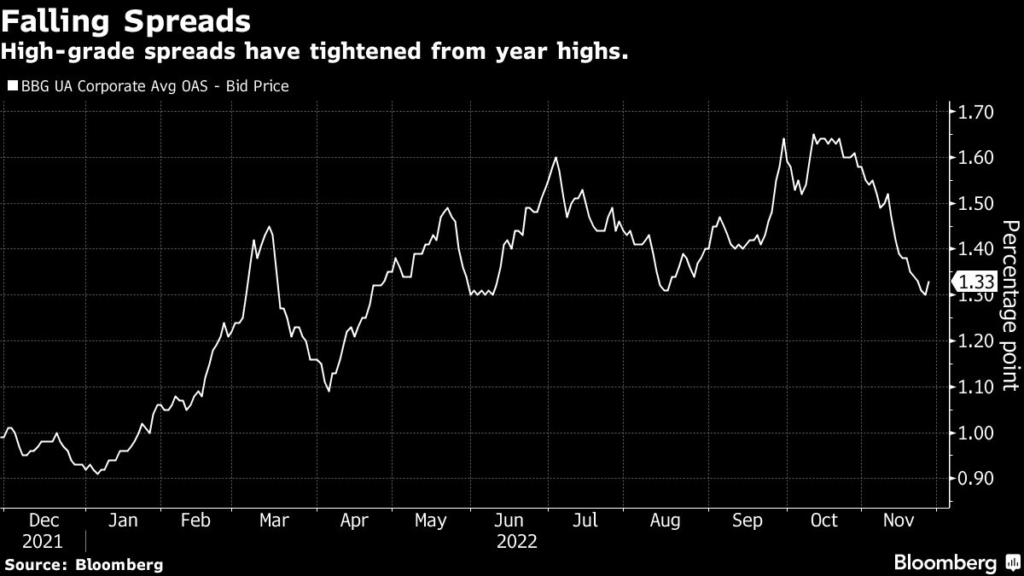
Investment-grade credit spreads are currently at 133 basis points, more than 30 basis points below the year’s peak of 165. The cost of issuing debt has also fallen since reaching a high in October, now sitting at 5.36%.


Barclays Plc, Bank of America Corp., JPMorgan Chase & Co. and Societe Generale are managing the bond sale, the person said.

(Updates to show the bonds have been sold)

More stories like this are available on bloomberg.com

©2022 Bloomberg L.P.
Cybersecurity Stocks Drop as CrowdStrike Warns Headwinds Are Growing

(Bloomberg) — A disappointing revenue forecast from CrowdStrike that the cybersecurity company blamed on “increased macroeconomic headwinds” sent the shares of peers lower in postmarket trading. 

Zscaler Inc. and SentinelOne Inc. fell more than 5% on Tuesday after US markets closed. Palo Alto Networks Inc., Fortinet Inc. and Cloudflare Inc. dropped more than 3%.

CrowdStrike expects fourth-quarter revenue to be $619.1 million to $628.2 million. That fell short of the average of analyst estimates at $634.8 million, according to data compiled by Bloomberg. That sent the stock down more than 18% in extended trading.

“Increased macroeconomic headwinds elongated sales cycles with smaller customers and caused some larger customers to pursue multi-phase subscription start dates,” CrowdStrike Chief Executive Officer George Kurtz said in a statement.

Okta, which is down 2.4% in postmarket trading, is scheduled to report earnings on Wednesday after markets close. 

More stories like this are available on bloomberg.com

©2022 Bloomberg L.P.

EV Startup Faraday Future Loses Product Head After CEO’s Ouster

(Bloomberg) — Faraday Future Intelligent Electric Inc.’s head of product execution, Robert Kruse, has resigned, the second top executive to depart from the troubled electric-vehicle maker in as many days.

Kruse, a veteran of General Motors Co. who joined Faraday in 2019, stepped down Tuesday morning, according to people familiar with the matter who asked not to be identified discussing non-public information. He was instrumental in Faraday’s 2021 merger with a blank-check firm and in developing the performance characteristics of the startup’s electric SUV, which is still not in production.

Kruse declined to comment.

The departure comes a day after Faraday said its board removed Chief Executive Officer Carsten Breitfeld. The Los Angeles-based company, which reported just $27 million in cash as of Oct. 25, is trying to cut costs with a round of furloughs this week across multiple teams, the people said. Earlier this month it announced an equity purchase agreement to sell as much as $350 million in stock to an affiliate of Yorkville Advisors Global LP.

Faraday previously announced a companywide salary cut of at least 25% in late October. 

The startup, which is being probed by the US Securities and Exchange Commission, recently agreed to a major shakeup of its board after a monthslong fight with a shareholder group associated with founder Jia Yueting.

More stories like this are available on bloomberg.com

©2022 Bloomberg L.P.
Chinese Stocks Listed in the US Are Having Their Best Month Ever

(Bloomberg) — US-listed Chinese stocks are on track for the best month ever as investors grow more encouraged about a potential shift away from the strict pandemic policies that have slowed the economy.

The Nasdaq Golden Dragon Index surged 5.1% on Tuesday after Beijing vowed to speed up Covid shots for the elderly, which is seen as a critical step toward allowing the nation to abandon its Covid Zero policy. The gain leaves the benchmark of US-listed Chinese shares up 30% this month, a dramatic turnaround from October’s 25% plunge and the biggest monthly advance since the data begin in 2001. 

Chinese stocks in Hong Kong also rose, pushing the Hang Seng China Enterprises Index up over 6% Tuesday and putting it on track for the best month since 2003.

Global investors have become more positive about Chinese equities as Beijing pares back some Covid restrictions and puts forward measures to support the economy and the housing sector. Better-than-expected earnings report from major Internet companies have also helped.

“We think the path towards reopening is set to be bumpy but not derailing,” Morgan Stanley strategist Laura Wang wrote in a note to clients. The direction was established by the Nov. 11 relaxation of Covid guidelines and reinforced by the latest statement detailing the plan for boosting vaccinations among the elderly, according to the note. 

On Tuesday, China said it will bolster vaccinations among senior citizens while stopping short of issuing mandates that helped raise inoculation rates in other countries. The country’s top health officials also warned against any excessive control measures during a briefing, while saying China is constantly adjusting its pandemic policies.

READ: China Pushes Elderly Vaccination as Reopening Pressure Grows

The statements came after protesters took to the streets across China over the weekend in a rare act of defiance against the government and its Covid Zero strategy. The demonstrations were muted on Monday after authorities deployed a heavy police presence in major cities and localities pared back some Covid restrictions, soothing concerns that a long-lasting protest may prompt a crackdown.

On Tuesday, the American-listed shares of e-commerce giants Alibaba Group Holding Ltd. and JD.com Inc. rose 5.3% and 6.7%, respectively. Stocks that are set to gain strongly from reopening, such as online travel agency Trip.com Group Ltd. and Yum China Holdings Inc., also climbed. 

Meanwhile, the stocks are getting an additional lift from earnings optimism. Bilibili Inc. was the latest to announce better-than-expecting results, pushing its shares up as much as 25% in the US. Pinduoduo Inc. topped analysts estimates on Monday.

To be sure, this group has endured intense price swings marked by fears of new Covid infections, with the standard deviation of daily changes over the past year at roughly 4.3%. 

The volatility is likely to continue “due to potential binary sentiment swings between overly simplified hope for a rapid opening-up and disappointment from a seemingly slow and zig-zagging move towards a Covid exit,” Morgan Stanley’s Wang said.

A separate quantitative strategy note from Morgan Stanley said that US institutional investors continued to trim positions in Chinese American Depositary Receipts, while Asia-based hedge fund managers were the dominant buyers amid this month’s rally. US-based mutual funds and hedge funds remained to be net sellers of Chinese ADRs in the fourth quarter, with total estimated outflow of $2.9 billion, according to the note.

Read more: Morgan Stanley Sees Tepid US Fund Sentiment on China Stocks

While China is firmly on a reopening path, it will take time and the pandemic will likely keep weighing on economic conditions through the winter, according to TS Lombard. 

“The six-12 month macro and market outlook is increasingly positive, however, we wait for stronger signals of health-care improvements before entering reopening trades,” Rory Green, TS Lombard’s head of Asia & China Research, said during a webinar. 

(Updates share moves at close, adds details about Morgan Stanley’s quantitative strategy note)

More stories like this are available on bloomberg.com

©2022 Bloomberg L.P.

HPE Projects Sales That Top Estimates on Office Upgrades

(Bloomberg) — Hewlett Packard Enterprise Co. projected revenue for the current quarter that beat analyst expectations, suggesting corporations are continuing to upgrade their technology infrastructure in an uncertain economy. 

Sales will be about $7.4 billion in the fiscal first quarter ending in January, compared with analysts’ average estimate of $7 billion, according to data compiled by Bloomberg. Profit, excluding some items, will be about 54 cents a share. Analysts projected 49 cents.

HPE’s pivot away from traditional hardware to services such as cloud computing and artificial intelligence is paying off, Chief Executive Officer Antonio Neri said in an interview. “We exited fiscal 2022 with steady demand,” he said.

In the fiscal fourth quarter, which ended Oct. 31, revenue increased 7% to $7.87 billion, the Spring, Texas-based company said Tuesday in a statement. Analysts, on average, projected $7.37 billion. Profit, excluding some items, was 57 cents a share, a penny higher than estimates.

Sales in the Intelligent Edge unit gained 18%. The division, which is a key part of HPE’s transformation plan, covers products that let companies gather and process data where it is generated instead of sending it to an external storage center. Revenue from the company’s largest division, Compute, which includes data centers and servers, jumped 16%. Both exceeded analysts’ expectations.

However, sales in the segment including high-performance computing and AI declined 14% in the quarter, while analysts expected a revenue gain. The decline was due to one large contract with the US Department of Energy for the Frontier supercomputer that was pushed back to the current quarter, Neri said.

The shares gained about 3% in extended trading after closing at $15.46 in New York. The stock has been a relative safe haven in technology this year, dropping only about 2% compared with a 26% decline for the S&P 500 Information Technology Sector Index.

HPE also affirmed its earlier full fiscal year guidance of adjusted earnings per share of as much as $2.04 and free cash flow as high as $2.1 billion. It also said it would spend at least $500 million on share buybacks in the fiscal year.

HPE’s decision to keep its previous guidance may be prudent, as peers such as NetApp Inc. have reduced their outlooks, said Bloomberg Intelligence analyst Woo Jin Ho. The results are also rosier than those of office infrastructure peer Dell Technologies Inc., he said.

Neri said it’s “a little too early” to think about updating the full-year guidance, as supply chains and currency fluctuations continue to provide headwinds. He added that the company doesn’t have any job cuts planned. “No restructures — we’re done with that.”

(Updates with additional comments from CEO in the final paragraph.)

More stories like this are available on bloomberg.com

©2022 Bloomberg L.P.
Stocks Close Off Lows in Run-Up to Powell’s Speech: Markets Wrap

(Bloomberg) — Stocks pared most of their losses, with traders unwilling to make big bets ahead of Jerome Powell’s speech Wednesday.

Gains in energy and financial firms tempered a slide in big tech. Amazon.com Inc., which is selling investment-grade debt, saw its shares slump. Trading volume was below the average of the past month. A gauge measuring the global yield curve inverted for the first time in at least two decades — signaling a recession. 

Powell is expected to cement expectations the Fed will slow its pace of hikes next month — while reminding Americans that its fight against inflation will run into 2023. Some policymakers stressed this week they will raise borrowing costs further, with one key official saying that he sees rates heading somewhat higher than he had forecast just a couple of months ago.

“The Fed has hiked enough — and quickly enough — to make recession a base-case scenario in our book,” said Lauren Goodwin, economist and portfolio strategist at New York Life Investments. “Volatility and risk premia are likely to remain elevated as long as the Fed is fighting inflation in a growth slowdown.”

Goodwin also noted that equity earnings don’t usually begin to drop until an economic recession starts. That means equity market fundamentals “may still deteriorate,” she added.

Corporate America’s bloated margins are likely to start coming down in 2023 as certain expenses start to normalize, according to Goldman Sachs Group Inc.’s David Kostin. The firm’s strategists, along those at other banks including Morgan Stanley have been saying they see a slowdown in earnings growth next year.

Alicia Levine at BNY Mellon Wealth Management says that even in a shallow recession, S&P 500 companies can still see earnings declines of 20%.

“There is still risk here in the end,” Levine told Bloomberg Television. “This is the transition year. Next year is, ‘OK, now your rates are higher, what does it mean for the real economy?’ And that I think we really have not priced in.”

Read: Barclays Delays Call for US Recession, Fed Cuts Amid Strong Data

Read: BofA Says the US Yield Curve Will Return to Normal on Fed Pivot

The Fed’s actions, stubborn inflation, the war in Ukraine and the outlook for corporate earnings “make for a tough tale to tell for the stock market over the next 12 months,” said Kevin Philip, partner at Bel Air Investment Advisors.

Last week, institutional clients and hedge funds poured money into stocks, while retail clients sold off for a fifth straight week — with selling likely to continue through next month, according to Bank of America Corp. strategists led by Jill Carey Hall.

Recent flow momentum along with lack of “capitulation-like outflows” signal that investors believe the market has already bottomed. But BofA strategists say they see further downside risk ahead of a first half of 2023 bottom.

Several widely followed DeMark indicators, which try to anticipate momentum and long-term trend reversals, suggest the Cboe Volatility Index may be poised for a reversal.

History shows that the appearance of a “countdown 13” pattern has led to turns in the past, with a cluster of such signals occurring at the more-recent lows. The so-called fear gauge last week fell to its lowest level since August as the S&P 500 advanced.

Meantime, former greenback bulls including JPMorgan Asset Management and Morgan Stanley say the era of dollar strength is ending as cooling prices spur markets to trim bets on further Fed tightening. That may spell buying opportunities for the currencies of Europe, Japan and emerging markets.

Key events this week:

  • EIA crude oil inventory report, Wednesday
  • China PMI, Wednesday
  • Fed Chair Jerome Powell speech, Wednesday
  • Fed releases its Beige Book, Wednesday
  • US wholesale inventories, GDP, Wednesday
  • S&P Global PMIs, Thursday
  • US construction spending, consumer income, initial jobless claims, ISM Manufacturing, Thursday
  • BOJ’s Haruhiko Kuroda speaks, Thursday
  • US unemployment, nonfarm payrolls, Friday
  • ECB’s Christine Lagarde speaks, Friday

Some of the main moves in markets:

Stocks

  • The S&P 500 fell 0.2% as of 4 p.m. New York time
  • The Nasdaq 100 fell 0.7%
  • The Dow Jones Industrial Average was little changed
  • The MSCI World index was unchanged

Currencies

  • The Bloomberg Dollar Spot Index fell 0.1%
  • The euro fell 0.1% to $1.0326
  • The British pound fell 0.1% to $1.1947
  • The Japanese yen rose 0.1% to 138.79 per dollar

Cryptocurrencies

  • Bitcoin rose 1.8% to $16,492.11
  • Ether rose 4.3% to $1,222.22

Bonds

  • The yield on 10-year Treasuries advanced seven basis points to 3.76%
  • Germany’s 10-year yield declined seven basis points to 1.92%
  • Britain’s 10-year yield declined three basis points to 3.10%

Commodities

  • West Texas Intermediate crude rose 1.7% to $78.54 a barrel
  • Gold futures rose 0.4% to $1,762.60 an ounce

This story was produced with the assistance of Bloomberg Automation.

–With assistance from Peyton Forte, Vildana Hajric and Garfield Reynolds.

More stories like this are available on bloomberg.com

©2022 Bloomberg L.P.

Close Bitnami banner
Bitnami
