Bloomberg

‘Fantastic Beasts’ Beats ‘Sonic’ to Lead Holiday Box Office

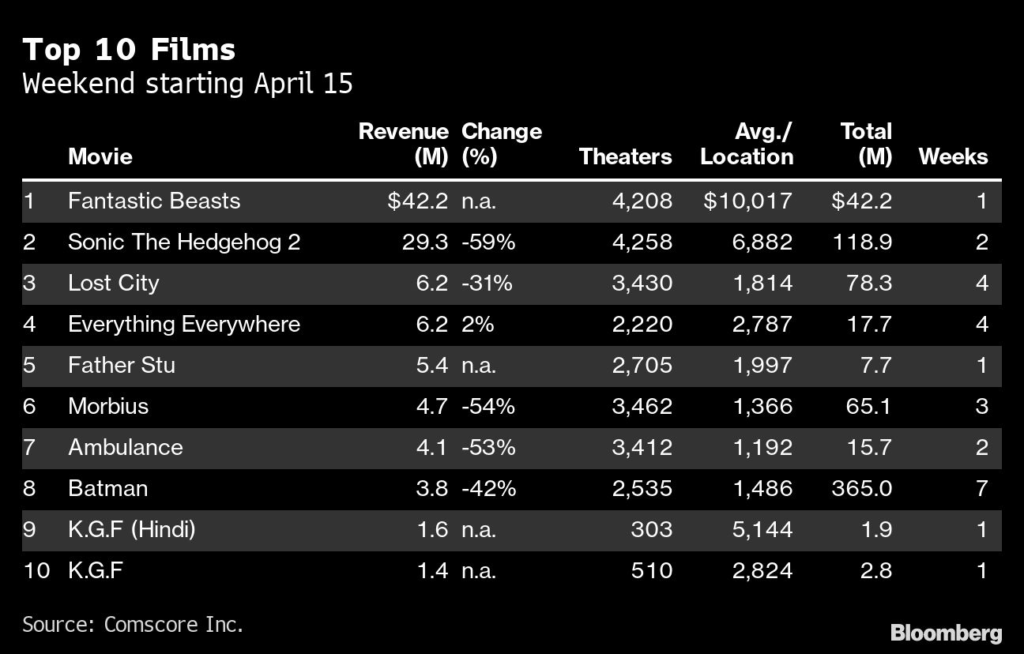
(Bloomberg) — “Fantastic Beasts: The Secrets of Dumbledore,” the latest spinoff of the Harry Potter movie franchise from Warner Bros., opened as the top film in North American theaters this weekend, toppling “Sonic the Hedgehog 2” after just one week atop the standings.

  • The third installment of the “Fantastic Beasts” series, brought in $42.2 million in weekend sales in the U.S. and Canada, industry researcher Comscore Inc. said Monday in an email. Boxoffice Pro was forecasting $44.1 million in sales for the extended Easter holiday weekend. The film follows zoologist Newt Scamander and his battle against a dark wizard.
  • “Sonic 2,” which became the highest-grossing kids movie of the pandemic era last weekend, took in $29.3 million to place second for theaters and its distributor, Paramount Pictures.
  • The quirky sci-fi release “Everything Everywhere All at Once” brought in $6.19 million to land in fourth place.

Key Insights

  • Just over half of critics recommended the latest “Fantastic Beasts,” according to review aggregator site RottenTomatoes.com, topping its predecessor, “Fantastic Beasts: The Crimes of Grindelwald.” The latest fantasy stars Eddie Redmayne as a wizard who studies magical creatures. Jude Law plays Albus Dumbledore.
  • “Fantastic Beasts” is the kind of attention-grabbing, family-friendly film that studios now deem worthy of theatrical release. But some outliers have managed to resonate with theatergoers. “Everything Everywhere All At Once,” an indie film with a modest budget, expanded to 2,200 theaters.
  • Each installment of the “Fantastic Beasts” franchise has generated less in its opening weekend than the film before it. In 2016, the original “Fantastic Beasts and Where to Find Them” took in more than $74 million in U.S. and Canadian theaters in its opening weekend, while the 2018’s “Crimes of Grindelwald” generated $62.1 million, according to Box Office Mojo.
  • Year-to-date box office sales have quintupled, to about $1.72 billion, from the year-earlier period, Comscore reported.

Get More

  • See Box Office Mojo’s release schedule here.

(Updates with final sales figures in first bullet.)

More stories like this are available on bloomberg.com

©2022 Bloomberg L.P.

Amazon Workers at New Jersey Facility to Hold Union Election

(Bloomberg) — Amazon.com Inc. workers at a facility in New Jersey have met the threshold to hold a union election just weeks after employees at a Staten Island, New York, warehouse became the first to unionize in the company’s U.S. history. 

Local 713 International Brotherhood of Trade Unions is hoping to unionize 200 workers at an Amazon facility in Bayonne, New Jersey, according to the National Labor Relations Board. Local 713 is based in Carle Place, New York, and was founded in 1995, according to its website.

The size of the workforce at the Bayonne facility is far smaller than the thousands of employees at the JFK8 warehouse on Staten Island who earlier this month backed the upstart Amazon Labor Union to represent them. The ALU is scheduled to have a second election later this month at another Staten Island facility that employs 1,500 workers. 

A date for the Bayonne election hasn’t been decided yet. Amazon didn’t immediately respond to a request for comment. 

Local 713 brought in revenue of $7.3 million, with $6.1 million in net assets in 2018, the last year non-profit filings were available for the union. Peter Hasho, the union’s president emeritus at the time, was paid more than $1 million a year, according to the filing. 

In order to meet the threshold to hold a union election, more than 30% of workers must be in favor. Before the ALU’s victory, efforts to unionize Amazon workers in the U.S. had ended in defeat. The Retail, Wholesale and Department Store Union lost an election last year to represent workers in Bessemer, Alabama. That election was ordered to be run again in a mail-in ballot that ended in March. The union is trailing with the results still contested. 

More stories like this are available on bloomberg.com

©2022 Bloomberg L.P.

Apollo Global Is Interested in Helping Finance a Bid for Twitter

(Bloomberg) — Apollo Global Management Inc. is interested in helping finance a bid for Twitter Inc. following Elon Musk’s $43 billion unsolicited offer to take the company private, according to people familiar with the matter.

Apollo is considering backing a potential deal for Twitter and could provide Musk or another bidder like private-equity firm Thoma Bravo LP with equity or debt to support an offer, the people said, declining to be named because the discussions are private. The participation could come in the form of credit or preferred equity, one of the people said.

The Wall Street Journal earlier reported Apollo’s interest. 

Twitter shares posted their biggest gain in two weeks on Monday after the social media company launched a poison pill defense to thwart Musk’s bid to take the company private at $54.20 a share.

Morgan Stanley is advising Musk, according to a filing Thursday, while Twitter has enlisted the help of Goldman Sachs Group Inc. and JPMorgan Chase & Co. as it considers how to respond to Musk’s hostile bid, Bloomberg reported.

(Updates with second source in first paragraph)

More stories like this are available on bloomberg.com

©2022 Bloomberg L.P.

Apollo Considers Backing Elon Musk, Other Suitors for Twitter Bid

(Bloomberg) — Apollo Global Management Inc. is interested in helping finance a bid for Twitter Inc. following Elon Musk’s $43 billion unsolicited offer to take the company private, according to people familiar with the matter.

Apollo is considering backing a potential deal for Twitter and could provide Musk or another bidder like private-equity firm Thoma Bravo LP with equity or debt to support an offer, the people said, declining to be named because the discussions are private. The participation could come in the form of credit or preferred equity, one of the people said.

The Wall Street Journal earlier reported Apollo’s interest. 

Twitter shares posted their biggest gain in two weeks on Monday after the social media company launched a poison pill defense to thwart Musk’s bid to take the company private at $54.20 a share.

Morgan Stanley is advising Musk, according to a filing Thursday, while Twitter has enlisted the help of Goldman Sachs Group Inc. and JPMorgan Chase & Co. as it considers how to respond to Musk’s hostile bid, Bloomberg reported.

(Updates with second source in first paragraph)

More stories like this are available on bloomberg.com

©2022 Bloomberg L.P.

Warren Wants Details From TurboTax on Its Free Filing Program

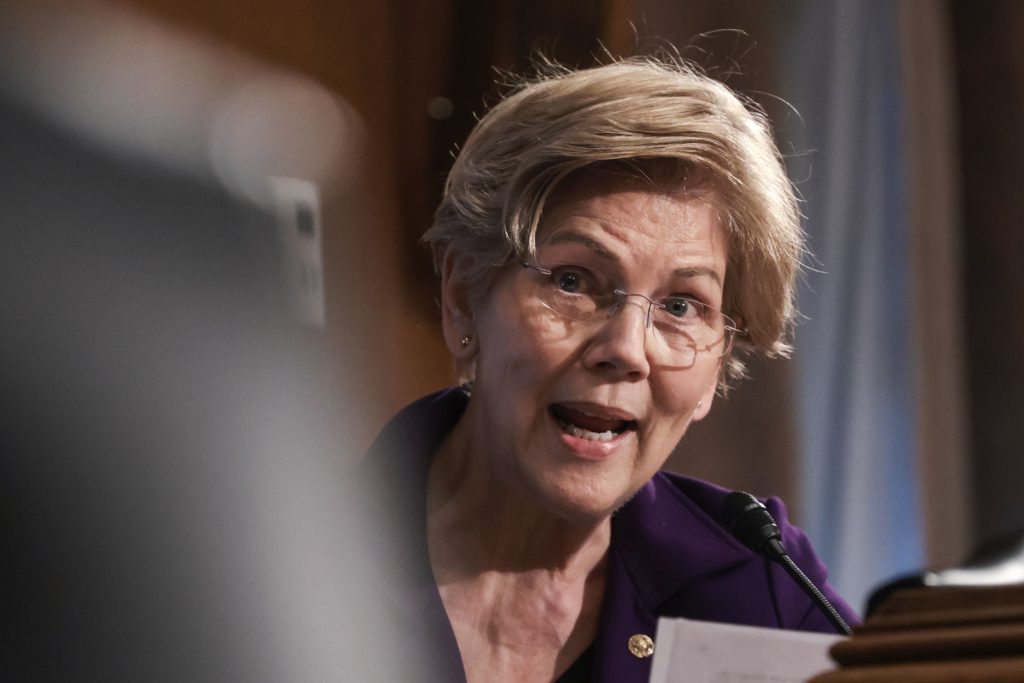
(Bloomberg Law) — Sen. Elizabeth Warren (D-Mass.) and Reps. Katie Porter (D-Calif.) and Brad Sherman (D-Calif.) want information from Intuit Inc, the maker of TurboTax tax preparation software, about how much money the company makes off of low- and middle-income filers, and information about how many Intuit employees previously worked for federal agencies.

In a public letter sent Monday addressed to Intuit CEO Sasan Goodarzi, the trio accuse the company of misleading consumers and using former government officials to shield it from government action. The Federal Trade Commission recently sued the company over its advertisements for free filing services, claiming deceptive practices.

The Democrats ask Intuit to provide information on the amount of money it makes from taxpayers who make $73,000 or below and would thus be eligible for free filing, and how many government officials it has employed since 1999.

“Intuit deliberately hid its IRS Free File program from Google results using ‘dark 9 patterns’—adding code into the website to suppress results, and instead pushing taxpayers into their in-house ‘freemium’ edition where they could be tricked into paying into services that should be free under Free File,” they wrote.

“We are clear and fair with our customers and open and transparent about our advertising practices, and our participation in the Free File program was done in compliance and with the oversight of the IRS,” Intuit spokesperson Derrick Plummer said in an emailed statement. “We are reviewing the letter from Sen. Warren and other policymakers and will respond.”

To contact the reporter on this story: Colin Wilhelm in Washington at cwilhelm@bloombergtax.com

To contact the editors responsible for this story: Patrick Ambrosio at PAmbrosio@bloombergindustry.com; Alex Clearfield at aclearfield@bloombergindustry.com

(Adds response from Intuit in fifth paragraph.)

More stories like this are available on bloomberg.com

©2022 Bloomberg L.P.

Altcoin Monero Surges as Owners Set Withdrawal From Exchanges

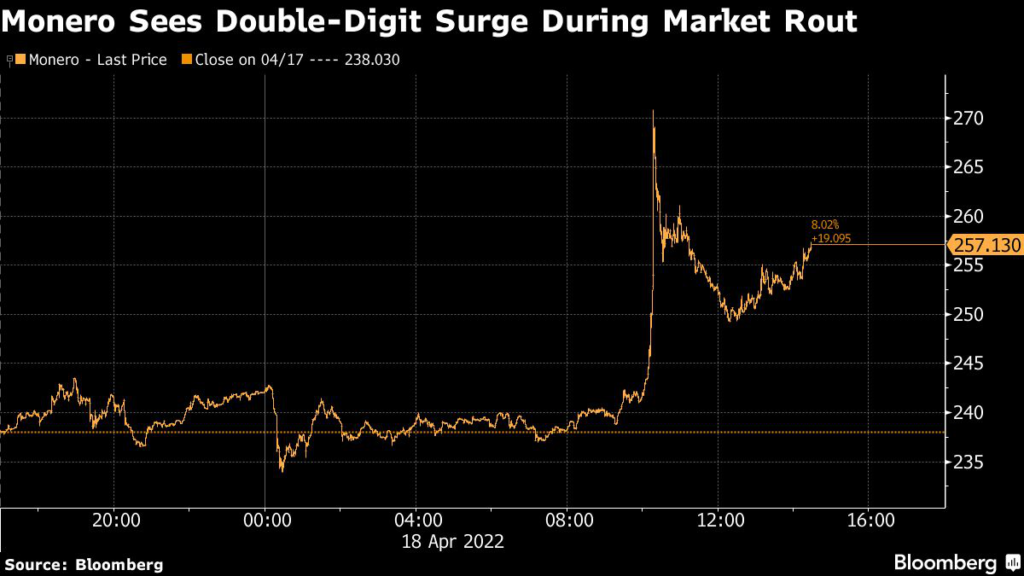
(Bloomberg) — Privacy-focused cryptocurrency Monero is staging a surprising surge on Monday, running counter to the declines shown by most other tokens. 

Monero rose as much as 14%, while Bitcoin, the largest cryptocurrency by market value, dropped 4% and Ether fell 5%. Other altcoins tumbled even more, with Ethereum Classic and EOS down more than 8%. 

The rally in Monero came as some of the token owners attempted to withdraw their holdings from major exchanges in a coordinated move dubbed the “Monerun.”

According to a post on the token’s dedicated subreddit, the move away from exchanges is designed to create an intentional short squeeze.

“The Monero community has come to a loose consensus that many exchanges don’t actually hold all of the Monero which customers have purchased,” according to the post by Reddit user “bawdyanarchist”.  

The withdrawal is intended to force those exchanges to purchase actual tokens, which would in turn send Monero’s price much higher, the Reddit user said in the post. 

Other commenters on the Reddit post alleged that some exchanges trade or invest their users’ crypto assets versus simply holding them. Typically, large exchange wallet addresses are known and visible on chain, making it relatively transparent to track or review trades. Because Monero, a so-called “privacy coin,” uses an obfuscated ledger, transactions are more difficult to verify.

Monero has been on a month-long rally since another Monero-focused blog made the case that token owners should withdraw from exchanges including Binance.

“Binance has a strict internal policy of not allowing any use of token holdings from users,” a spokesperson from Binance told Bloomberg by email. “We have an internal monitoring system to handle the reconciliation to ensure that the blockchain balance is the same as the system balance.”

Monero reached an all-time high of $518 per coin last May before tumbling to the record low of $132 in late February. It’s up almost 11% in 2022.

More stories like this are available on bloomberg.com

©2022 Bloomberg L.P.

Twitter Gains as Board Plots Defense Strategy Against Musk

(Bloomberg) — Twitter Inc. shares posted their biggest gain in two weeks on Monday after the social media company launched a poison pill defense to thwart an unsolicited bid by Elon Musk to take the company private at $54.20 a share.

A securities filing on Monday confirmed the defense strategy Twitter outlined last week, which would allow the company to issue new stock that all shareholders except Musk could buy at a discounted price. It imposes a “significant penalty” on any person or entity that would acquire more than 15% of the company without board approval, according to the filing. Musk currently owns just over 9% of Twitter shares.

“The board adopted the rights agreement to protect stockholders from coercive or otherwise unfair takeover tactics,” according to the filing. 

The stock rose 7.5% to $48.45 in New York, its biggest jump since April 4.

Twitter is using the poison pill defense in order to buy time to come up with a plan that would be in the best interests of its shareholders, according to a person familiar with the company. The shares are gaining amid speculation that Twitter will strike a deal that is more palatable to shareholders. 

The company has been fielding takeover interest from other parties, including technology-focused private equity firm Thoma Bravo LLC, according to a person familiar with the matter. Private equity firm Silver Lake, which already owns a significant stake in Twitter, also would make sense as a partner since it has an existing relationship with Musk as well, but it’s unclear if they’re interested. Meanwhile Musk may partner with Oracle Corp. and a private equity consortium that includes Thoma Bravo to thwart Twitter’s poison pill, according to Bloomberg Intelligence analysts, “while raising the bid 10-15% to about $50 billion.”

Musk, for his part, has said that any rejection of his bid, valuing Twitter at $43 billion, would cause him to re-evaluate his stake. Over the weekend, Musk said that the economic interests of Twitter’s board aren’t aligned with shareholders. He was responding to a tweet about board members’ stock holdings, saying that with the impending departure of co-founder Jack Dorsey, the board “collectively owns almost no shares.” In a tweet on Monday, Musk, who is also chief executive officer of Tesla Inc., said if his Twitter bid succeeds, board members would not be given a salary. 

Tesla has paid its own directors an annual cash retainer of about $20,000 plus certain additional fees in recent years, but they also each receive stock option grants every few years — meaning they stand to make tens of millions of dollars or more with Tesla’s stock price gains.

Since making the offer last week, Musk has been actively posting on his Twitter account in what appears to be a social media campaign to sway public opinion in favor of his bid.


The billionaire entrepreneur floated a cryptic tweet with the word “tender,” a likely wink-and-nod reference to a potential tender offer. 

If Musk is serious about pushing ahead with his takeover offer for Twitter, he should launch a tender offer to acquire the shares in the company he doesn’t already own despite the poison pill, said Andrew Freedman, co-chair of the shareholder activism practice at law firm Olshan Frome Wolosky.

“Even though Musk wouldn’t be able to close his tender offer, even with a majority of shares tendered, given the poison pill and other impediments, it’s a ‘put your money where your mouth is’ type move and shows he really wants to buy this company,” Freedman said.

Musk could simultaneously launch a proxy contest where he would ask shareholders to withhold their votes for the two directors who will stand for re-election at this year’s annual meeting, which is slated for May 25, Freedman said. That would serve as a referendum on his offer, and also allow him to solicit votes for an amendment to the company’s charter to declassify the board, meaning that all directors would stand for election each year rather than just a few, he added. Last year, a similar proposal almost achieved the 80% vote threshold required to change the company’s bylaws, he noted.

If Musk doesn’t act in the next few months, he won’t be able to do much at Twitter until next year’s annual general meeting because the company doesn’t allow for shareholders to call a special meeting or act by written consent. Freedman noted that both Twitter Chief Executive Officer Parag Agrawal and Chairman Bret Taylor will stand for re-election next year. Dorsey is scheduled to leave the board once his term expires at the next shareholder meeting.

If Musk “can get fairly widespread support this year, it also could force the company’s hand to negotiate with Musk earlier than they would like to or announce and run a sale process. All to avoid facing the music next year,” he said.

(Updates with closing shares in fourth paragraph.)

More stories like this are available on bloomberg.com

©2022 Bloomberg L.P.

Didi Global Sinks on Delisting Plans and Revenue Drop

(Bloomberg) — DiDi Global Inc. tumbled Monday, after the Chinese ride-hailing giant said it’s planning to delist its U.S.-traded shares before it finds a new venue for the stock.

DiDi’s American depositary receipts sank 18% to $2.01 after it set an extraordinary general meeting for May 23 to vote on delisting its shares from the New York Stock Exchange. While the company will continue to explore listing on another internationally recognized exchange, DiDi said it won’t apply until after the U.S. delisting is finished.

“Although investors were well aware that DiDi Global intended to delist, the manner of delisting has taken investors aback,” said Gary Dugan, chief executive officer at the Global CIO Office. 

Separately, DiDi reported that its fourth-quarter net loss narrowed by 95% from a year earlier to 383 million yuan despite a 13% decline in revenue to 40.78 billion yuan.

DiDi’s Move From NYSE to Hong Kong — What to Know: QuickTake

DiDi has plunged 86% since going public, wiping out $58 billion in market value. The company has been one of the biggest targets under Beijing’s private sector crackdown last year, as regulators launched a cybersecurity probe just days after its IPO and forced its services off domestic app stores. The agency in Beijing responsible for data security was later said to have asked DiDi’s top executives to devise a plan to delist because of concern sensitive data may leak. 

In March, the company suspended preparations for its planned Hong Kong listing after the Cyberspace Administration of China informed executives that their proposals to prevent security and data leaks had fallen short of requirements, Bloomberg News reported. 

The Chinese Securities and Regulatory Commission said in a Saturday statement that Didi’s case would not affect talks with the U.S. on audit access. Investors had remained optimistic after Beijing regulators modified a decade-long rule that restricted financial data sharing by offshore-listed companies. The move could help U.S. regulators gain full access to auditing reports of the majority of the 200-plus Chinese companies listed in New York. 

The lack of an immediate relisting plan dealt DiDi shareholders another blow had they hoped to convert their American-listed holdings to Hong Kong shares ahead of Didi’s NYSE withdrawal. It also added to investor jitters on the company’s path forward, with concerns surrounding further penalties from regulators. 

“The risk that the stock will be delisted for an extended period of time before being listing again is very negative,” said Jason Hsu, chief investment officer of Rayliant Global Advisors Ltd. “The assumed liquidity premium is clearly being reflected in the price now,” he said. 

The Nasdaq Golden Dragon China Index fell 2% Monday, extending a 2.3% decline from last week.

“The DiDi news only adds to poor news from China, undermining any hopes for a sustained rally,” Dugan said. “International investors will once again be put off rebuilding weighting in Chinese equities.”

(Updates with closing prices. A previous version of this story was corrected to show the company’s net loss narrowed)

More stories like this are available on bloomberg.com

©2022 Bloomberg L.P.
Amazon to Undergo Racial Audit, Led by Former AG Lynch

(Bloomberg) — Amazon.com Inc. said it agreed to undergo an independent racial equity audit, joining companies including Citigroup Inc. and Tyson Foods Inc. in performing such reviews.  

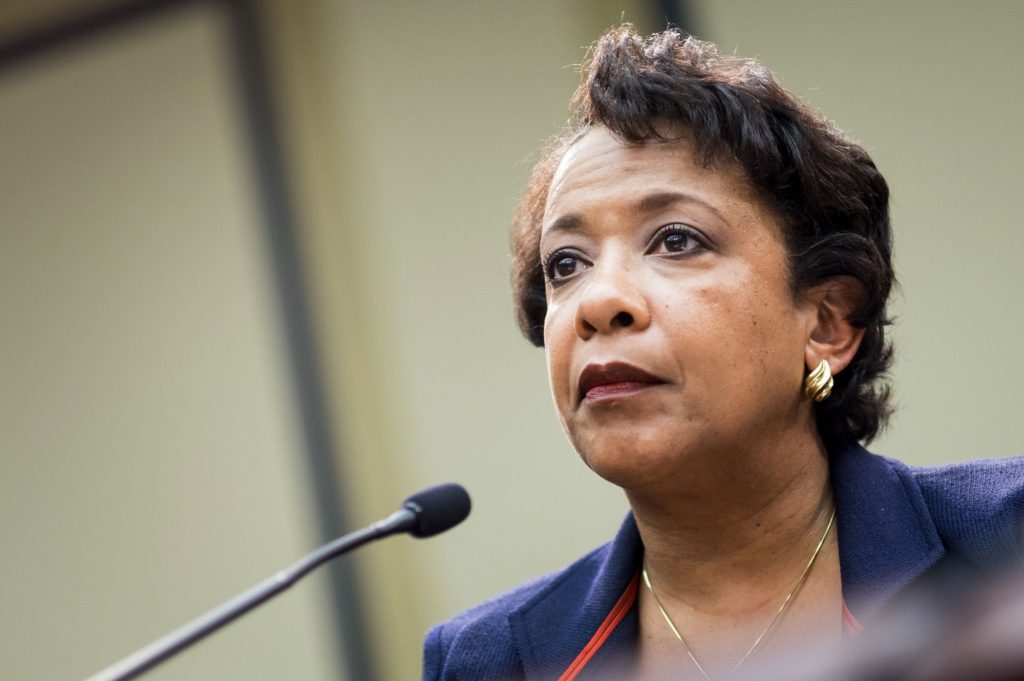
The audit — an analysis of companies to see whether their businesses cause and perpetuate discrimination — will be led by former U.S. Attorney General Loretta Lynch, now a partner at law firm Paul, Weiss, Rifkind, Wharton & Garrison LLP, Amazon said in a proxy statement filed Thursday. 

The review will measure any disparate racial impacts on Amazon’s U.S. hourly employees resulting from policies, programs and practices, the world’s largest online retailer said. The Seattle-based company said it will publish the audit’s results once completed.

New York State Common Retirement Fund and its Comptroller Thomas DiNapoli, which had pressed Amazon to conduct a racial audit, said they looked forward to learning more about Amazon’s plan for a review. But they said they “remain concerned that the company has provided few details and has made no assurances that the audit will be independent.”

The New York pension fund had filed a shareholder resolution with Amazon in 2021 asking for an audit, citing alleged discrimination of the company’s Black and Latinx workers, their low wages and exposure to dangerous working conditions, including Covid-19, as well as air pollution from distribution facilities located in minority neighborhoods. Amazon had also come under fire for its facial-recognition software.

While the proposal failed, it garnered 44.2% of shareholder support, according to Bloomberg Intelligence, the highest of all racial-audit resolutions that went to vote during last year’s annual shareholder meetings. The New York pension plan filed a similar proposal for Amazon’s May 25 annual meeting.

Amazon is advising shareholders to vote against the resolution because the company is now doing an audit. A company spokesman referred to the proxy statement filed last week.

Amazon joins other companies, including JPMorgan Chase & Co., that have agreed to perform racial audits after initially pushing back against doing them. They had cited their efforts such as funding historically Black colleges and universities, running leadership programs for underrepresented minorities and channeling tens of millions of dollars to help close the racial wealth divide.

Apple Inc. shareholders backed a call last month for the tech giant to undergo a civil-rights audit — the first time such a resolution passed. Airbnb Inc. was the first company to do a racial audit back in 2016. Starbucks Corp. and Facebook Inc., now called Meta Platforms Inc., followed later. 

(Updates with investor comment in the fourth paragraph)

More stories like this are available on bloomberg.com

©2022 Bloomberg L.P.
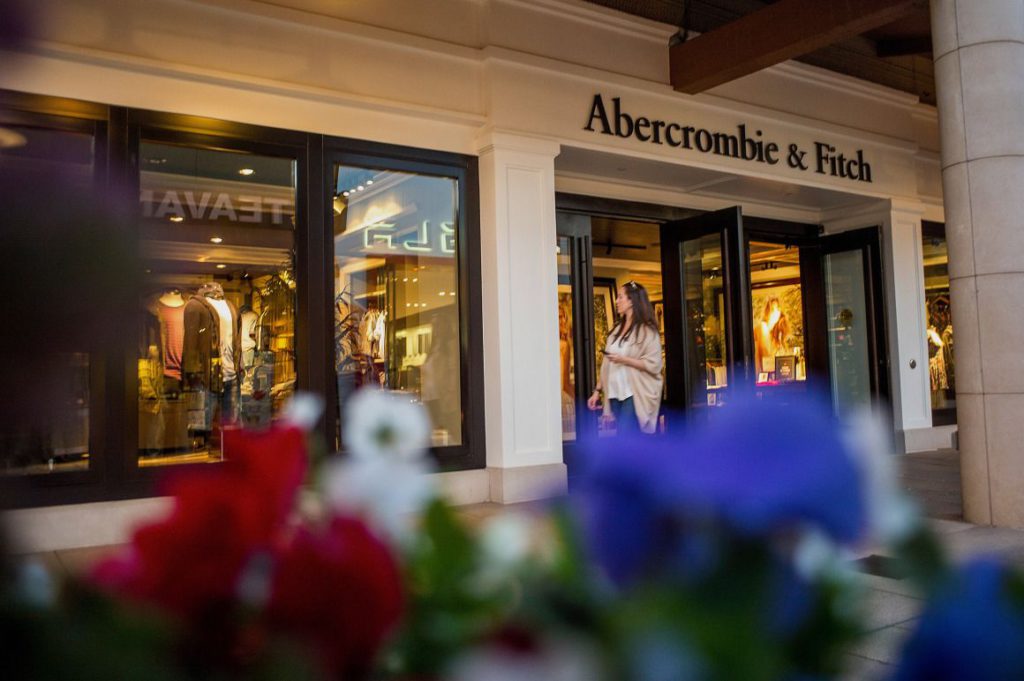
Abercrombie & Fitch Is Latest Corporate Villain in Netflix Film

(Bloomberg) — As office life resumes across the U.S., cautionary tales of corporate misdeeds have been topping the charts on streaming platforms. With “The Dropout” on Hulu, “Super Pumped” on Showtime and “WeCrashed” on Apple TV+, the shenanigans of rogue tech founders have made for compelling docudramas.

But Netflix’s “White Hot: The Rise & Fall of Abercrombie & Fitch” debuting Tuesday focuses on an industry seldom featured in cinema — the mall retailer — and how a trendy teen brand was able to leverage exclusionary practices to drive record profit.

At the center of the documentary is Mike Jeffries, who served as Abercrombie’s CEO for more than two decades, from 1992 to 2014. He was hired by Leslie Wexner, founder of the company’s onetime parent, Limited Brands, which also owned Victoria’s Secret. Jeffries leveraged a playbook of racy marketing to sell an aspirational aesthetic of the “cool kid” — one who plays rugby barechested and dons that “all-American” look — which Jeffries dictated as White, fratty and fit. Celebrities featured in ads included Taylor Swift, Channing Tatum and Jennifer Lawrence, and at the height of its popularity Abercrombie was worth more than $7 billion.

But the brand fell out of favor. Protests erupted over a line of T-shirts called out for being racially insensitive. Jeffries admitted to being exclusionary. And lawsuits started piling up, including a Supreme Court case that found it discriminated against a Muslim woman who wore a headscarf to a job interview. As Abercrombie struggled to respond to the decline of mall culture and rise of e-commerce and fast fashion, Jeffries stepped down.

Abercrombie, now under new leadership, boasts a more inclusive look and considers itself evolved from its prior iteration. Sales and profit rose last year. In a post on Instagram, it addressed the film’s release. “While the problematic elements of that era have already been subject to wide and valid criticism over the years, we want to be clear that they are actions, behaviors and decisions that would not be permitted or tolerated at the company now,” it said.

Filmmaker Alison Klayman, who also directed HBO’s Alanis Morissette documentary “Jagged,” said in an interview that she made the film to remind people that it wasn’t that long ago that this type of corporate behavior existed. “Not everything is fixed, there’s a lot more work to do,” she said, explaining that Abercrombie was a “flagrant example of discrimination” in an already discriminatory fashion industry.

Morningstar retail analyst David Swartz agreed that despite a changing marketing and product mix, many apparel brands still have far to go to reflect the diversity of their customers. “If you watch a fashion show for a luxury apparel brand, the models are still thinner than the average woman for the most part,” he said.

More stories like this are available on bloomberg.com

©2022 Bloomberg L.P.
Close Bitnami banner
Bitnami