Bloomberg

Amazon to Undergo Racial Audit, Led by Former AG Loretta Lynch

(Bloomberg) — Amazon.com Inc. said it agreed to undergo an independent racial equity audit, joining companies including Citigroup Inc. and Tyson Foods Inc. in performing such reviews.  

The audit — an analysis of companies to see whether their businesses cause and perpetuate discrimination — will be led by former U.S. Attorney General Loretta Lynch, a partner at law firm Paul, Weiss, Rifkind, Wharton & Garrison LLP, Amazon said in a proxy statement filed Thursday. 

The review will measure any disparate racial impacts on Amazon’s U.S. hourly employees resulting from policies, programs and practices, the world’s largest online retailer said. The Seattle-based company said it will publish the audit’s results once completed.

New York State Common Retirement Fund filed a shareholder resolution with Amazon in 2021, asking for a racial audit. The request cited alleged discrimination of the company’s Black and Latinx workers, their low wages and exposure to dangerous working conditions, including Covid-19, as well as air pollution from distribution facilities located in minority neighborhoods. 

While the proposal failed, it garnered 44.2% of votes, according to Bloomberg Intelligence, the highest of all racial-audit resolutions filed in last year’s shareholder meetings. The New York pension plan filed a similar proposal for Amazon’s May 25 annual meeting.

Amazon is advising shareholders to vote against the resolution because the company is now doing an audit. A company spokesman referred to the proxy statement filed last week.

Amazon joins other companies, including Citigroup, that have agreed to perform racial audits after initially pushing back against doing them. They had cited their efforts such as funding historically Black colleges and universities, running leadership programs for underrepresented minorities and channeling tens of millions of dollars to help close the racial wealth divide.

Apple Inc. shareholders backed a call last month for the tech giant to undergo a civil-rights audit — the first time such a resolution passed. Airbnb Inc. was the first company to do a racial audit back in 2016. Starbucks Corp. and Facebook Inc., now called Meta Platforms Inc., followed. 

More stories like this are available on bloomberg.com

©2022 Bloomberg L.P.

Cathie Wood’s Ark Now Sees Tesla Shares More Than Quadrupling

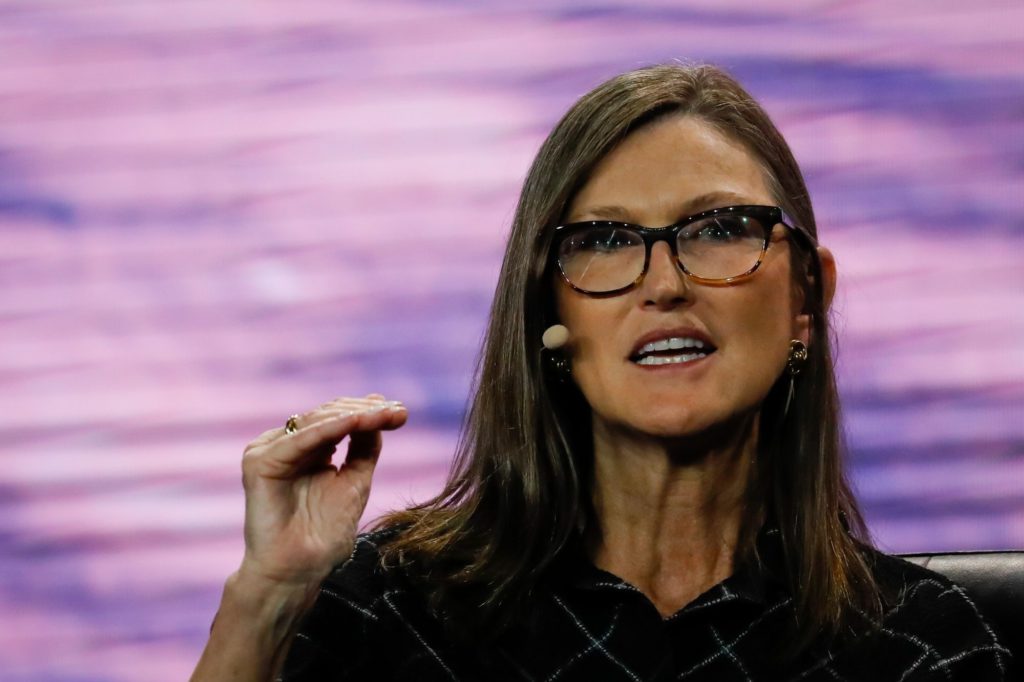
(Bloomberg) — Cathie Wood’s Ark Investment Management now expects Tesla Inc. shares to more than quadruple to $4,600 by 2026.

Ark last year said it saw shares of the electric-vehicle maker hitting $3,000 by 2025, but has since updated its price target amid new expectations around Tesla’s prospective robotaxi business and capital efficiency.

The firm’s bull case suggests the price could rise to around $5,800 by 2026 and the bear case suggests $2,900 — still around three times more than the current share price of $1,005.

“Although tuned to our expectations for 2026, we believe our Tesla model is methodologically conservative,” Tasha Keeney, an Ark analyst, wrote in a blog post last week. “We assume that Tesla’s stock will trade like a mature company rather than a high-growth one in 2026.”

Wood has long been an ardent supporter of Tesla and its chief executive officer Elon Musk. While the flagship Ark Innovation ETF (ticker ARKK) trimmed its position in Tesla last month, the electric-vehicle maker is still its largest holding, making up 10% of the fund. Tesla shares gained about 1.8% Monday.

Not everyone is as positive on the stock after a 40% rally over the past 12 months, however. In fact, David Trainer, CEO of investment research firm New Constructs, sees Tesla’s share price dropping to as low as $150 to $200.

“Tesla enjoyed a first-mover advantage for a short while, but they no longer have that and there are plenty of other EVs on the road that are competing very successfully,” he said. “This is, in my opinion, Cathie Wood dropping words out there that may be attractive or interesting, shiny, glittery things, to unsuspecting retail investors, when they are really missing the point of where Tesla is positioned competitively.”

A key driver of Ark’s new model is expectations of greater demand for autonomous ride-hailing, an estimated $11 trillion to $12 trillion market, according to Keeney. Ark has also increased its conviction in Tesla’s ability to achieve full self-driving, with the carmaker’s prospective robotaxi business contributing to a 60% chunk of its expected value in 2026.

Another factor is the expectation that Tesla will be more capital efficient, Keeney wrote, noting that Tesla’s capital expenditure per incremental unit of capacity has decreased to $7,700 from $84,000 in 2017.

Meanwhile, Tesla’s Bitcoin holdings are included in Ark’s model, but are not seen as a key component of the forecast, increasing the price target by less than 5%, Keeney wrote. Other business opportunities that Tesla could pursue that are not included in the model include an energy storage business, artificial intelligence-as-a-service and a humanoid robot.

Ark has open-sourced its model, allowing people to change inputs and simulate potential outcomes.

More stories like this are available on bloomberg.com

©2022 Bloomberg L.P.

Another Pentagon Official Exits, Saying U.S. Is at Risk of Losing Tech Edge

(Bloomberg) — A senior official responsible for driving technological innovation at the U.S. Department of Defense has resigned, saying the Pentagon needs “structural change” and should behave more like SpaceX, Elon Musk’s satellite company that has shaken up rocket launches.

“We’re falling behind the commercial base in key areas, so we’ve got to catch up,” Preston Dunlap, the first person in the U.S. Department of Defense to fulfill the role of chief architect officer, told Bloomberg News in an interview. As a result the U.S. risked losing its technological edge against potential adversaries, he said. 

Dunlap, who handed in his resignation on Monday after three years in the post at the U.S. Space Force and U.S. Air Force, was responsible for pushing more technology into a $70 billion budget for research, development and acquisition. He plans to start a space software company focused on the nexus with satellites, data and artificial intelligence. The Pentagon was behind the domestic commercial sector in data, distributed computer processing, software, AI and cybersecurity, he said.

“By the time the Government manages to produce something, it’s too often obsolete,” he said in a nine-page resignation statement he billed as a “playbook” to help guide the Pentagon, which he later made public on LinkedIn. “Much more must be done if DoD is going to regrow its thinning technological edge.” 

Dunlap said the Pentagon, which he dubbed “the world’s largest bureaucracy,” needed to stop focusing on internal turf wars and reinventing the wheel and instead work together to tap the private sector, defend the country and compete with China.

“Ironically as I’m writing this, I received notification that the phone lines are down at the Pentagon IT help desk. Phone lines are down? It’s 2022, folks,” he wrote.

In a statement, an Air Force spokesperson confirmed Dunlap’s resignation, and said the military was grateful for his public service. Dunlap had “worked tirelessly” for three years, said Ann Stefanek, chief of media operations at the Department of the Air Force.

Dunlap’s comments come after two other senior tech officials in the U.S. Department of Defense resigned, calling on the Pentagon to modernize its approach to technology on the way out the door. 

Earlier this month, David Spirk, the Defense Department’s outgoing chief data officer, told Bloomberg that the Pentagon needed to speed up efforts to counter adversaries who are developing military tools supported by advanced technologies such as artificial intelligence, machine learning and quantum science. Nicolas Chaillan, the U.S. Air Force’s first chief software officer, resigned last year, telling the Financial Times the U.S. was losing the AI race to China.

Such concerns are also shared by senior Pentagon officials. Michael Brown, director of the Defense Innovation Unit, the Pentagon’s tech hub, told the Senate Armed Services Committee this month that a slow pace of inventing and adopting new technology was a “glaring weakness,” adding the U.S. risked falling behind China. 

Deputy Defense Secretary Kathleen Hicks voiced concern last week over “real resistance” from Congress to taking technologically risky approaches that might fail.

In order to emulate SpaceX and other innovative companies, Dunlap said, the government must become braver about undertaking tests that might initially fail, spanning hypersonics to artificial intelligence algorithms. 

He added the consolidation of the defense-industrial base from dozens of companies during the Cold War to a handful today was bad for competition and the country. To fix that, he said the Pentagon should instead contract multiple companies at a time in far more flexible ways. 

Michele Flournoy, a former senior Pentagon official who has focused on the challenge to the U.S. military from China’s own military modernization, said Dunlap had managed to bring in more than 100 new commercial contractors to the U.S. Air Force, but that the Pentagon struggled to do that at scale.  

“It’s way too hard,” she said, describing Dunlap’s departure as “a loss” and saying the Pentagon should find a replacement who is similarly “entrepreneurial.” 

She said there was a strong strategic imperative for the Pentagon “to figure out how to bring these new technologies in rapidly and at scale if we’re going to successfully deter aggression by China in the future and/or defeat it if it happens.”

(Updated to move mention of Dunap’s next position to the third paragraph. Deleted mention of some artificial intelligence development in final paragraph. Other structural changes throughout.)

More stories like this are available on bloomberg.com

©2022 Bloomberg L.P.

Verizon Boosts Its Starting Wage to $20 an Hour in Tight Job Market

(Bloomberg) — Verizon Communications Inc. is the latest wireless carrier to raise its minimum wage to $20 an hour, reflecting the tighter job market and a push by labor organizers to unionize retail and customer service employees.

New staffers answering customer calls and working in stores at Verizon will start at that rate, and existing employees who make less will get raises, according to a release Monday. 

“These changes are the direct result of employee feedback and will help us remain an attractive employer in this competitive environment,” Krista Bourne, chief operating officer for Verizon Consumer Group, said in the release. 

Late last year, mobile phone competitor T-Mobile US Inc. bumped up its starting pay to $20 an hour from $15 in response to a challenging recruiting environment during the pandemic. AT&T Inc. hasn’t made any widespread wage increases but may do so now, said John Byrne, an analyst with GlobalData. 

“The Verizon announcement plus T-Mobile having done so a few months ago makes it inevitable that AT&T will follow suit,” Byrne said.

AT&T declined to comment on starting wages, but says its customer service employees make an average of $26 an hour in total pay.

The pressure of having fewer job candidates has shifted more of the power to prospective employees and fueled more unionizing efforts at companies from Amazon.com Inc. to Starbucks Corp. 

“I’m sure that’s in the back of the minds of the telcos,” Byrne said.

More stories like this are available on bloomberg.com

©2022 Bloomberg L.P.

Trend-Tracking Firm Riwi Looks for M&A to Expand Risk Data

(Bloomberg) — Riwi Corp., a survey technology firm whose client list includes Bank of America Corp., plans to push ahead with acquisitions to capitalize on demand for data about economic and geopolitical uncertainties.

The Toronto-based microcap plans to decide on its financing strategy during the second or third quarter of the year, Chief Executive Officer Greg Wong said. The company is currently is in talks with private lenders and bankers about financing alternatives, he said.

“We’re looking to grow both organically and through acquisitions,” Wong said in an interview. “We are definitely looking to do a raise, whether it’s going to be done through debt or through going back to the markets.”

Last month, the company announced a partnership with David Woo, a former Bank of America and Barclays strategist, to put in place a series of indexes tracking geopolitical risk. 

That deal includes a Military Conflict Risk Index that tracks the real-time views of citizens physically close to five major geopolitical hot zones, including Iran, Russia and Ukraine, to help test local support for each leader’s approach to the conflict.  

Riwi developed a technology called “random domain intercept” surveys. It captures web traffic from dormant and inactive web domains and delivers a survey to those users based on their location, without capturing any personal identifiable information. Riwi says it can place surveys in field in less than 24 hours and results can be updated hourly. 

“The data space right now is highly fragmented,” said Wong. “We’ve got a number of large financial services organizations that are customers, and those customers can benefit from additional data sets.” 

More stories like this are available on bloomberg.com

©2022 Bloomberg L.P.

Tokens From Manchester City to PSG Prove Disappointing

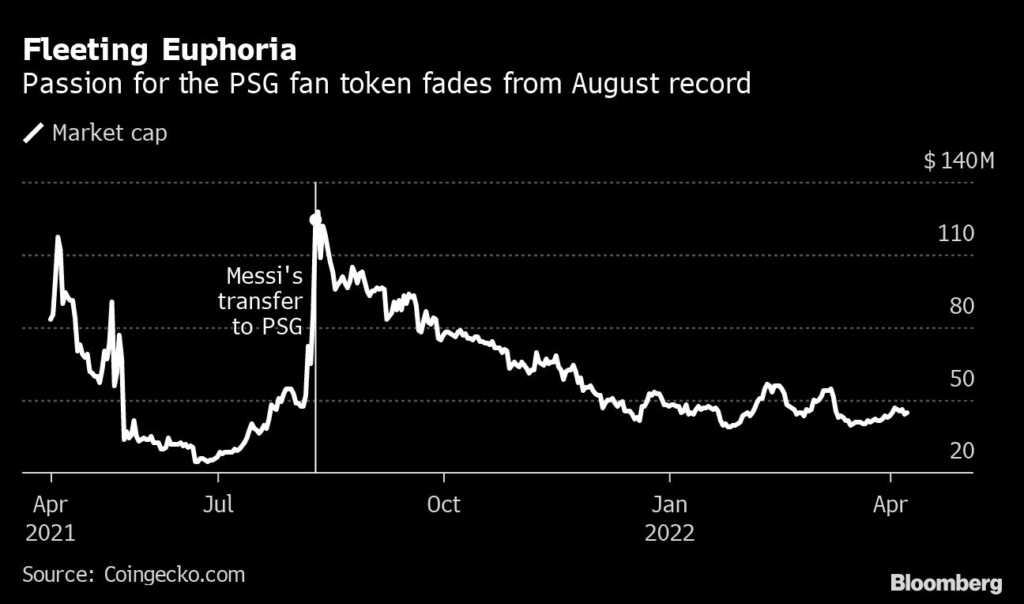
(Bloomberg) — As soon as rumors started buzzing that soccer star Lionel Messi would transfer from FC Barcelona to Paris Saint-Germain in August, Miguel Schweizer decided to buy the French club’s fan token, $PSG, on a hunch that prices would spike. They did – but he didn’t hold the tokens for long.

He sold them a few days later, betting the rally would be short-lived. His trade proved correct: prices were down 34% a week later, and 73% from when the tokens were issued after four months. 

“I would never keep them in my investment portfolio for the long term,” said Schweizer, 29, chief executive officer of Decrypto, a Buenos-Aires based exchange and wallet. “They’re trade opportunities.”

For many hopeful fans, soccer club tokens have proved a disappointment, with prices quickly losing steam within days. It’s now three years since fan tokens started trading on the main crypto exchanges, promising an alternative for clubs to gain financing and for fans to be closer to their favorite teams. 

Both these options have yet to live up to expectation. Clubs that have issued tokens include the likes of Manchester City, SS Lazio, FC Porto, Santos FC, FC Barcelona, AC Milan and Trabzonspor. Some, like FC Arsenal have raised as much as $5.5 million in first-day sales of fan tokens, dubbed “initial fan token offerings,” though most have raised closer to $2 million in these sales. That’s a fraction of these clubs’ expenses. 

Clubs can potentially generate additional revenue from future token sales. According to Socios, these first-day offerings typically only make available between 5% and 10% of the total supply of the fan tokens. 

Club may also derive revenue from the fees they charge for volumes traded on Binance or other exchanges where these are listed. Binance is currently the most active exchange for these tokens, according to Coingecko data. 

Analysts caution that demand for fan tokens quickly goes from euphoria to indifference. The main criticism they make is that these have few tangible benefits for the fans. The Juventus token, for example, allows fans to use the tokens to obtain VIP tickets with loyalty points they earn as token holders, while the PSG token was used to allow holders to vote on the design for the new team bus and club slogan. 

“The problem with current fan tokens is the clubs do not actively promote them or the utility the tokens have”, said Oliver Bell, CEO and co-founder of XCAD Network, a company that makes tokens for content creators. “The people that are buying them are not necessarily fans of the clubs at all; the only buyers are crypto enthusiasts.”

Meanwhile, the market remains small. The market value of the sports fan tokens is as high as $491 million and its daily traded volume is $241 million. The biggest 10 fan tokens have an average daily volume of $13 million, which is only 28% of the daily volume traded on average for the 364 coins listed on Binance, according to CoinMarketCap and Coingecko data.

The largest fan token by market value is Manchester City’s at $56 million, with daily traded volume under $15 million, according to data from CoinMarketCap and Coingecko. The token is trading at a price less than half of what it was issued for, the data show. A spokesperson for Socios said fans who had access to pre-launch pricing, available to people who staked a different token in exchange for the right to buy Manchester City’s, were able to buy $CITY tokens at the equivalent of 50 cents.

Room for Growth

Proponents of fan tokens say it’s too early to assess their success. These coins are not intended to be investment assets, but rather to provide a service, said Alexandre Dreyfus, founder and CEO of Socios.com, a company that partners with clubs to develop the tokens. 

Socios.com has 57 fan token partners, according to the company, ranging from soccer to Formula 1. That’s up from 20 a year ago, which Dreyfus says indicates growing interest. 

“We’re seeing an uptick in interest from clubs in issuing fan tokens,” he said. “Fans will be able enjoy exclusive games and content and score points that they can redeem for official signed products, free tickets or VIP experiences.”

To promote their use, on April 7, Binance began offering Lazio fan token holders the opportunity to stake, a process that allows owners to earn passive income on the coins without having to sell them. The tokens are used to help validate transactions on the blockchain, with the rewards and fees divided among the participants and the exchange. Binance offered holders 8% annualized returns when they keep the Lazio tokens locked for 30 days, or 15% if they keep them for 90 days.

Some say they still see a good investment opportunity, even amid low volumes that reflect the wider mood on crypto on high volatility. They point to certain tokens, like PSG’s or Barca’s, which have seen spikes of interest when there’s big news. 

“When the market becomes more bullish, there we will see how the volumes traded in all tokens increase”, said Maximiliano Hinz, Latin America general director of Binance, the world’s largest crypto exchange by traded volume, which has issued four fan tokens. “It’s the free market that governs their prices.” 

(Corrects reference in the sixth paragraph to “volumes traded on Binance” to specify that tokens can also be traded on other exchanges and adds detail about pre-launch staking.)

More stories like this are available on bloomberg.com

©2022 Bloomberg L.P.

Uala Founder Raises $30 Million for LatAm Venture Capital Fund

(Bloomberg) — The founder of Argentine fintech Ualá, Pierpaolo Barbieri, is launching a venture capital firm that has raised $30 million from a roster of investors, including General Catalyst, Brevan Howard founder Alan Howard and others. 

Through his new firm 17Sigma, Barbieri will focus on betting on early-stage startups in Latin America. Backers also include former SoftBank executives Marcelo Claure and Paulo Passoni, Adam Neumann’s 166 2nd, MongoDB founder Kevin Ryan, Rappi co-founder Sebastian Mejia, Greenmantle LLC’s managing director Niall Ferguson and former Key Square senior managing director Diego Dayenoff.  

The launch comes after a record year for startup funding in Latin America in 2021, with about $15 billion raised, helping to mint 17 new companies worth $1 billion or more, according to data from the Association for Private Capital Investments in Latin America. 

Barbieri, 34, is the founder of one of those new unicorns, Buenos Aires-based financial services startup Ualá, which operates in Mexico and Colombia in addition to its home country. The company was valued at $2.5 billion in its latest funding round. 

17Sigma will focus on pre-seed and seed rounds in Latin America, given that there’s less interest in that phase of funding from larger global funds, according to Barbieri. 

Read More: Startup Funding Triples to Record $15 Billion in Latin America

“When we thought about this project, we thought the most effective way to help the community and to disrupt markets is to bet at the earlier stage,” Barbieri said. “That’s when founders need the most help, they need ideas, they’re building teams.”

Ualá’s management team is also investing in the company, Barbieri added. 

While Barbieri is the lead investor and sits in the investment committee, the fund will be run by managing partner Bianca Sassoon, formerly at venture capital firm Kaszek Ventures, making it the first fund in Spanish-speaking Latin America to be led by a woman, Barbieri said. 

The team has three members and will be hiring actively, Barbieri said. 17Sigma has already invested in 10 companies from countries including Argentina, Brazil, Chile, Colombia and Mexico. The venture capital firm is looking to invest in 15 to 20 more targets across sectors, beyond fintech. 

“We look for companies with a goal of developing digitization in Latin America and increasing competition in markets that are usually monopolistic,” Barbieri said. He pointed to the fund’s name, a statistical term that refers to highly unlikely events, to explain his vision. “We want to help these founders create these 17 sigma events, so rare that they rarely happen, but when they happen they change the nature of the economy.”

More stories like this are available on bloomberg.com

©2022 Bloomberg L.P.

Video Game Junkie Quietly Builds $3 Billion Payments Powerhouse

(Bloomberg) — Aleksandr Agapitov is little known inside video gaming circles, let alone the business world. 

Yet his company is one of the leading players in the $135 billion video game payments industry, in which gamers spend real money to acquire virtual items. 

Xsolla, which Agapitov founded in 2005, allows video game producers to sell in-game digital items — such as “skins” that change a character’s appearance or virtual pets — in exchange for about a 5% cut of the sales. Its clients include some of the hottest companies in the industry, including Epic Games, Valve and Roblox Corp., whose platform is a hit with children. He owns 100% of the company, which brought in nearly $100 million last year. 

Two investment banks estimated last year that Xsolla could seek a valuation of as much as $3 billion if it were to go public, according to documents seen by Bloomberg. 

Even so, he’s in no rush to do so. Agapitov, 38, who was born in Russia and moved to Los Angeles at age 25, said he enjoys the freedom that comes with not having to answer to shareholders. His goal is to return the company to 40% annual sales growth, up from 25% now.

“I just like to help game developers make more money,” he said in an interview. “Wonderful innovations come from video games.”

Digital in-game revenues comprised more than three-quarters of all revenue generated by the $180 billion global video game market last year, according to data provider Newzoo.  

“There’s a desire to monetize beyond that initial purchase price,” especially for free-to-play games, said Julianne Harty, a gaming analyst at Newzoo.

Metaverse Project

In February, Agapitov launched a metaverse-based project called X.LA. It seeks to do for those who build things in the metaverse what Xsolla does for video game developers: give them a monetary incentive to create. 

The work requires hardwiring the codes and blockchain technology that underpin the metaverse, and Agaptiov brought a team of Xsolla employees with him to do it. If successful, a person who develops a part of the metaverse could get a “reward” in the form of virtual currency whenever other users visit that location.

“As in any other industry, it’s about how to get funded, how you get paid, how to find new customers, and how to engage with your customers,” Agapitov said.

Agapitov grew up in the city of Perm, about 700 miles (1,127 kilometers) east of Moscow. He studied math and computer science at a local university, but dropped out to spend more time with his girlfriend and to make money doing odd jobs. Around the same time, he combined his interest in early online payment systems with his love of video games. The result was Xsolla, which he moved to California in 2009 after attracting the interest of some big clients.

Xsolla has over 700 ways gamers can make in-game purchases, from using Visa and PayPal to regional options such as China’s WeChat Pay and India’s Paytm. 

“What I’m trying to do is like Shopify for video games,” he said.

More stories like this are available on bloomberg.com

©2022 Bloomberg L.P.

Bitcoin Falls to Lowest in a Month as Risk Aversion Takes Toll

(Bloomberg) — Bitcoin dropped to its lowest level in more than a month and other digital assets tumbled as investors’ tendency toward risk aversion, combined with the lack of a clear catalyst for buying, drove the market lower. 

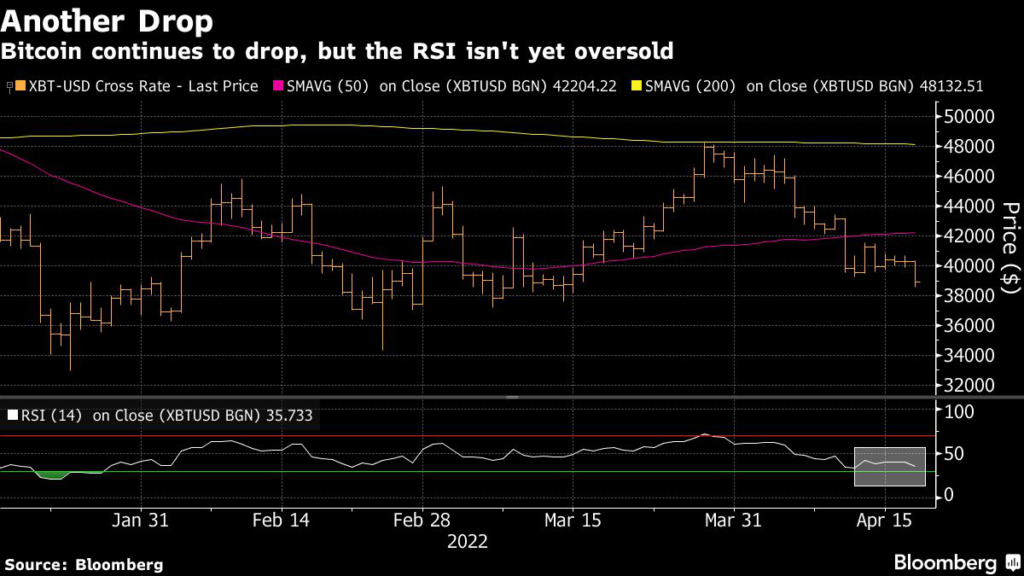
The largest cryptocurrency fell as much as 4.2% to $38,580 on Monday while Ether — the No. 2 digital asset — dropped 5.3%, declining to as low as $2,885; both regained some ground in the New York morning. The global crypto market’s value dropped about 4% in the past 24 hours to $1.9 trillion, according to pricing from CoinGecko. Altcoins were among the biggest decliners, with Bitcoin Cash, EOS and Ethereum Classic each decreasing more than 6% at one point. Shiba Inu also fell, giving up some gains after surging last week following its listing with Robinhood. 

“We’ve seen weakness in crypto, largely in line with the selloff in equities and other risk assets,” Joshua Lim, head of derivative at Genesis Global Trading, said. Investors from the world of traditional finance continue to be risk-averse, while crypto-centric holders are awaiting any signs of fresh interest from recent significant Bitcoin buyers such as MicroStrategy Inc. and the Luna Foundation Guard, which has been building a Bitcoin position in support of the Terra blockchain and its stablecoin. 

Technical charts suggest that despite Bitcoin’s recent drop, it is “not close to an oversold reading,” and near-term support at $35,000 likely won’t hold, said John Roque, technical analyst at 22V Research, in a note Sunday. “We continue to believe that it will get to the $30,000 level,” he said. 

“Technical traders have been paying a lot of attention to the support at the $39,500 region for a while,” Teong Hng, chief executive of Hong Kong-based Satori Research, said. “When it broke lower today in thin liquidity, lots of stop-selling ensued.” 

Bitcoin has been struggling along with risk assets in recent months, largely trading in a range of $35,000 to $45,000 this year as the Federal Reserve started hiking interest rates amid stubbornly high inflation. Trading volumes have also tapered off, including across Coinbase, Bitfinex, Kraken, Bitstamp and other exchanges. An aggregated measure shows volumes are lower by roughly 60% versus levels seen last May. Meanwhile, Google searches for the word “Bitcoin” have also declined, and social-media activity via the Crypto Subreddit — as measured by things like comments and posts per day — are down from mid-2021 levels.

“The macro environment seems murkier than ever,” David Duong, head of institutional research at Coinbase Global Inc., wrote in a note. “No one theme seems particularly dominant for markets, which we think makes it tough for institutional investors to deploy capital with any meaningful confidence in the short term.”

Analysis from data-provider Glassnode suggests that interest in Bitcoin has remained muted, with little growth in the coin’s user base and minimal flows of new demand.

Read more: Bitcoin Risk-Reward Calculation is Being Upended by Rising Rates

Many Bitcoin bulls remain unbowed, with predictions of $100,000 and even higher still being mentioned. But price targets like $500,000 and $1 million circulating mean “it’s hard for us to figure sentiment remains anything but constructive. And with a chart that looks like this, that’s bad news,” Roque said.

More stories like this are available on bloomberg.com

©2022 Bloomberg L.P.

Trojan Horse Short-Selling Allegations Stall Telecom Investor Suit

(Bloomberg) — Even within the brazen world of short-sellers, the allegations are eyebrow-raising.

Two investment firms filed a class action suit against a telecom company, claiming investors were short-changed during its $3.1 billion sale. Then, the telecom company claims, they used the lawsuit as a kind of Trojan horse to gain access to confidential information, which helped them execute millions of dollars in short sales and other trades.

The accusation has stalled what ought to have been a run-of-the-mill class-action case in which the two firms, JDS1 and The Arbitrage Fund (TAF), applied to act as lead plaintiffs to represent the best interests of a larger group of investors. Both firms have denied wrongdoing, but the resulting nest of interlocking claims and counter-claims has already dragged through the courts for five years.

It prompted the Delaware judge overseeing the case to raise serious doubts about who makes a suitable shareholder representative.

“I must say, this is a new front of litigation to me,” Vice Chancellor Sam Glasscock III, who has over a decade of experience on the bench, said during a March 18 hearing. Typically the process of appointing a lead plaintiff “at least in my experience, has not been much of a problem,” he added.

It also comes at a time when short selling is under increased scrutiny from prosecutors and the SEC, who are mapping out how investors find and use information they trade on.

Family Ties

IDT Corp. is the telecom company at the center of the dispute, along with its spin-off Straight Path Communications Inc. Both were founded by serial entrepreneur Howard Jonas. Straight Path was run by Jonas’s son Davidi prior to its sale to Verizon Communications Inc. in 2018.

A Bronx native, Jonas got his start selling hot dogs outside a methadone clinic in high school, later describing the experience in a book titled “On A Roll.” After attending Harvard, he made a fortune in telecom and became a low-key supporter of conservative causes in the U.S. and Israel.

Now a 65-year-old grandfather of 27, Jonas operates out of a Newark, New Jersey office tower acquired from another prominent business clan, the Kushners, whose patriarch, Charles, is a Jonas confidant as well as the father of Jared Kushner, Donald Trump’s son-in-law.

Howard Jonas’s current legal problems go back to a swath of telecom bandwidth he bought in 2001 out of the ashes of the dot-com-bust. In 2013 he pulled the spectrum out of IDT, folding it into the new, separately listed Straight Path. A tug of war followed, between bulls who bet the FCC would allot Straight Path’s spectrum to 5G service, and short-sellers who pooh-poohed its prospects. 

In July 2016, the FCC allocated Straight Path’s spectrum for 5G, proving the doubters wrong. The following January the FCC struck a consent decree with the firm over allegations that it had violated agency regulations by squatting on that spectrum rather than putting it into use as its licenses required. Rather than terminating many of Straight Path’s licenses, however, the FCC gave the company 12 months to sell them and stipulated that the agency would receive 20% of the proceeds.

In the bidding war that followed, Verizon trumped AT&T with a $3.1 billion offer for Straight Path. Two months later Jonas, his son and IDT were hit with class-action claims. They allege the payment due to the FCC — more than $600 million — had been improperly forced onto Straight Path’s tab to the detriment of investors.

That suit was led by Julian D. Singer, owner of JDS1, a New Jersey-based investment firm that has been active in telecom stocks. It was later consolidated with a second suit filed by TAF,  a small mutual fund managed by Water Island Capital.

Singer’s father, Gary, is a felon who was banned for life from acting as an officer or director of a public company after a fraud scheme in the nineties. Gary Singer testified during a deposition that he was an unpaid adviser to JDS1. A company lawyer said he is not restricted from assisting his son with investments.

“Gary Singer’s fingerprints are all over JDS1,” defense counsel said in court. At the time Gary was banned in 1997, the SEC warned he might try to circumvent the order by doing business through his family.

Counter Claims

As lawyers representing JDS1 and TAF gathered pre-trial evidence, Jonas’s side was doing the same. During a November hearing, Jonas’s team turned the tables, presenting evidence suggesting that TAF’s affiliates and JDS1 itself had collectively shorted at least 424,500 shares of IDT worth $6 million, and that TAF and its affiliates had also traded Straight Path shares.

That allegedly included shorting IDT’s stock beginning in July 2017, as JDS1 and TAF were filing their complaints against IDT, and continuing in the months that followed as lawyers in the case were receiving confidential information. (TAF itself is not alleged to have shorted IDT but its sister funds are, potentially making its status more difficult than JDS1’s for the court to untangle.)

Jonas’s side argued that using confidential information obtained in the litigation to trade undermines the class-action process, citing a  2012 Delaware court case in which billionaire Michael Steinhardt was found to have traded improperly.  Steinhardt’s case bore similarities: He admitted trading the stock of a company while receiving written and oral updates about a class action suit he’d filed.

While Glasscock indicated that the alleged conduct in the case before him “does not approach the same level as in Steinhardt,” he said last month that he was likely to reject JDS1’s role “given the allegations of trading in the stock.”

Taking the hint, the three plaintiff firms in the case — Bernstein Litowitz Berger & Grossmann, Entwistle & Cappucci, and Labaton Sucharow — withdrew JDS1’s request two days later while asserting that their client would make an “adequate” class representative.  “JDS1 was neither accused of nor found to have violated any inside trading laws,’’ JDS1’s attorney, Edward Timlin of Bernstein Litowitz, said in a written statement. “By stepping back, JDS1 is making it easier for the Court to focus on the merits of this case.”  Singer declined to comment.

An official with Water Island declined to comment. In an April 11 letter to the court, an attorney for JDS1 and TAF denied that confidential information was shared with TAF or TAF affiliates. Vincent Cappucci, an attorney for TAF, also said his client has done nothing wrong. “TAF is confident the Court will approve it as a class representative as no credible issue has been raised to support a contrary finding,” he said in an email message.  

Judge Glasscock sounded less sure. “The number and timing of trades in Straight Path alleged to have been undertaken by TAF and TAF affiliates since the initiation of this litigation are, frankly, troubling in light of TAF’s position as a volunteer fiduciary,” he wrote in a February memorandum opinion. He scheduled an evidentiary hearing into trading by TAF and its affiliates.

Plaintiff Dispute

To class action lawyers, representing a lead plaintiff often means receiving a large share of legal fees awarded as part of a settlement. With the IDT case at risk of falling apart for lack of a lead plaintiff, Cappucci offered up a technical argument that would allow TAF to keep the role without burdening the court with an evidentiary hearing. “Smart lawyers understand exactly what this is, your honor,” Cappucci said. 

The defense pushed back. “The Arbitrage Fund will put on glasses, a fake nose, and a fake mustache and call themselves the lead plaintiff, and all of a sudden they can avoid an evidentiary hearing,” said IDT attorney Rudolf Koch.

Glasscock wasn’t buying that argument either. “I know, Mr. Cappucci, it’s your position we’re all smart lawyers here. I guess that excludes me,’’ he said. “I just don’t get it.”

He postponed the trial until late August, saying the evidentiary hearing into the trading allegations needs to take place first. The case is already one of the oldest on his docket.

More stories like this are available on bloomberg.com

©2022 Bloomberg L.P.

Close Bitnami banner
Bitnami