
Bloomberg

Short-Selling Claims Put Accusers on Defense in Delaware Court

(Bloomberg) — Even within the brazen world of short-sellers, the allegations are eyebrow-raising.

Two investment firms filed a class action suit against a telecom company, claiming investors were short-changed during its $3.1 billion sale. Then, the telecom company claims, they used the lawsuit as a kind of Trojan horse to gain access to confidential information, which helped them execute millions of dollars in short sales and other trades.

The accusation has stalled what ought to have been a run-of-the-mill class-action case in which the two firms, JDS1 and The Arbitrage Fund (TAF), applied to act as lead plaintiffs to represent the best interests of a larger group of investors. Both firms have denied wrongdoing, but the resulting nest of interlocking claims and counter-claims has already dragged through the courts for five years.

It prompted the Delaware judge overseeing the case to raise serious doubts about who makes a suitable shareholder representative.

“I must say, this is a new front of litigation to me,” Vice Chancellor Sam Glasscock III, who has over a decade of experience on the bench, said during a March 18 hearing. Typically the process of appointing a lead plaintiff “at least in my experience, has not been much of a problem,” he added.

It also comes at a time when short selling is under increased scrutiny from prosecutors and the SEC, who are mapping out how investors find and use information they trade on.

Family Ties

IDT Corp. is the telecom company at the center of the dispute, along with its spin-off Straight Path Communications Inc. Both were founded by serial entrepreneur Howard Jonas. Straight Path was run by Jonas’s son Davidi prior to its sale to Verizon Communications Inc. in 2018.

A Bronx native, Jonas got his start selling hot dogs outside a methadone clinic in high school, later describing the experience in a book titled “On A Roll.” After attending Harvard, he made a fortune in telecom and became a low-key supporter of conservative causes in the U.S. and Israel.

Now a 65-year-old grandfather of 27, Jonas operates out of a Newark, New Jersey office tower acquired from another prominent business clan, the Kushners, whose patriarch, Charles, is a Jonas confidant as well as the father of Jared Kushner, Donald Trump’s son-in-law.

Howard Jonas’s current legal problems go back to a swath of telecom bandwidth he bought in 2001 out of the ashes of the dot-com-bust. In 2013 he pulled the spectrum out of IDT, folding it into the new, separately listed Straight Path. A tug of war followed, between bulls who bet the FCC would allot Straight Path’s spectrum to 5G service, and short-sellers who pooh-poohed its prospects. 

In July 2016, the FCC allocated Straight Path’s spectrum for 5G, proving the doubters wrong. The following January the FCC struck a consent decree with the firm over allegations that it had violated agency regulations by squatting on that spectrum rather than putting it into use as its licenses required. Rather than terminating many of Straight Path’s licenses, however, the FCC gave the company 12 months to sell them and stipulated that the agency would receive 20% of the proceeds.

In the bidding war that followed, Verizon trumped AT&T with a $3.1 billion offer for Straight Path. Two months later Jonas, his son and IDT were hit with class-action claims. They allege the payment due to the FCC — more than $600 million — had been improperly forced onto Straight Path’s tab to the detriment of investors.

That suit was led by Julian D. Singer, owner of JDS1, a New Jersey-based investment firm that has been active in telecom stocks. It was later consolidated with a second suit filed by TAF,  a small mutual fund managed by Water Island Capital.

Singer’s father, Gary, is a felon who was banned for life from acting as an officer or director of a public company after a fraud scheme in the nineties. Gary Singer testified during a deposition that he was an unpaid adviser to JDS1. A company lawyer said he is not restricted from assisting his son with investments.

“Gary Singer’s fingerprints are all over JDS1,” defense counsel said in court. At the time Gary was banned in 1997, the SEC warned he might try to circumvent the order by doing business through his family.

Counter Claims

As lawyers representing JDS1 and TAF gathered pre-trial evidence, Jonas’s side was doing the same. During a November hearing, Jonas’s team turned the tables, presenting evidence suggesting that TAF’s affiliates and JDS1 itself had collectively shorted at least 424,500 shares of IDT worth $6 million, and that TAF and its affiliates had also traded Straight Path shares.

That allegedly included shorting IDT’s stock beginning in July 2017, as JDS1 and TAF were filing their complaints against IDT, and continuing in the months that followed as lawyers in the case were receiving confidential information. (TAF itself is not alleged to have shorted IDT but its sister funds are, potentially making its status more difficult than JDS1’s for the court to untangle.)

Jonas’s side argued that using confidential information obtained in the litigation to trade undermines the class-action process, citing a  2012 Delaware court case in which billionaire Michael Steinhardt was found to have traded improperly.  Steinhardt’s case bore similarities: He admitted trading the stock of a company while receiving written and oral updates about a class action suit he’d filed.

While Glasscock indicated that the alleged conduct in the case before him “does not approach the same level as in Steinhardt,” he said last month that he was likely to reject JDS1’s role “given the allegations of trading in the stock.”

Taking the hint, the three plaintiff firms in the case — Bernstein Litowitz Berger & Grossmann, Entwistle & Cappucci, and Labaton Sucharow — withdrew JDS1’s request two days later while asserting that their client would make an “adequate” class representative.  “JDS1 was neither accused of nor found to have violated any inside trading laws,’’ JDS1’s attorney, Edward Timlin of Bernstein Litowitz, said in a written statement. “By stepping back, JDS1 is making it easier for the Court to focus on the merits of this case.”  Singer declined to comment.

An official with Water Island declined to comment. In an April 11 letter to the court, an attorney for JDS1 and TAF denied that confidential information was shared with TAF or TAF affiliates. Vincent Cappucci, an attorney for TAF, also said his client has done nothing wrong. “TAF is confident the Court will approve it as a class representative as no credible issue has been raised to support a contrary finding,” he said in an email message.  

Judge Glasscock sounded less sure. “The number and timing of trades in Straight Path alleged to have been undertaken by TAF and TAF affiliates since the initiation of this litigation are, frankly, troubling in light of TAF’s position as a volunteer fiduciary,” he wrote in a February memorandum opinion. He scheduled an evidentiary hearing into trading by TAF and its affiliates.

Plaintiff Dispute

To class action lawyers, representing a lead plaintiff often means receiving a large share of legal fees awarded as part of a settlement. With the IDT case at risk of falling apart for lack of a lead plaintiff, Cappucci offered up a technical argument that would allow TAF to keep the role without burdening the court with an evidentiary hearing. “Smart lawyers understand exactly what this is, your honor,” Cappucci said. 

The defense pushed back. “The Arbitrage Fund will put on glasses, a fake nose, and a fake mustache and call themselves the lead plaintiff, and all of a sudden they can avoid an evidentiary hearing,” said IDT attorney Rudolf Koch.

Glasscock wasn’t buying that argument either. “I know, Mr. Cappucci, it’s your position we’re all smart lawyers here. I guess that excludes me,’’ he said. “I just don’t get it.”

He postponed the trial until late August, saying the evidentiary hearing into the trading allegations needs to take place first. The case is already one of the oldest on his docket.

More stories like this are available on bloomberg.com

©2022 Bloomberg L.P.

Larsen Weighs Merging Tech Arms Into a $22 Billion Firm, Sources Say

(Bloomberg) — Larsen & Toubro Ltd. is weighing a merger between two of its publicly traded software firms, according to people familiar with the matter, as the Indian conglomerate seeks scale to compete with global digital giants.

The boards of Mindtree Ltd. and Larsen & Toubro Infotech Ltd., two software units controlled by the Mumbai-based engineering firm, could consider share swap ratios for the merger as early as next week, one of the people said, asking not to be identified as the information is not public.

Larsen acquired control of Mindtree in 2019. The conglomerate holds about a 61% stake in the company, which has a market value of $8.3 billion, and has around 74% of L&T Infotech, which has a market capitalization of $13.6 billion, data compiled by Bloomberg show.

The two companies have minimal overlap in businesses or clients, and a tie-up would give them better pricing power and lower costs, one of the people said. 

Deliberations around the merger are ongoing and the plan could be delayed or fall apart, the people said. A representative for Larsen said the company declined to comment on speculation. Reports about the merger are speculative, Mindtree and L&T Infotech told the stock exchange. 

Mindtree on Monday reported fourth-quarter net income of 4.73 billion rupees  ($62 million), higher than the 4.41 billion rupee estimate in a Bloomberg survey. L&T Infotech is scheduled to report earnings Tuesday.

The proposed merger comes as software companies are seeing surging demand from businesses embracing the digitization that accelerated during Covid-19. Large IT outsourcing firms are also expanding into areas such as cybersecurity, automation and machine-learning support, moving beyond lower-margin traditional back-room services.

Mindtree closed down 3.5% in Mumbai while L&T Infotech was 2.7% lower.

(Updates with company response in fifth paragraph)

More stories like this are available on bloomberg.com

©2022 Bloomberg L.P.
China’s Central Bank Pledges Support for Businesses Amid Covid

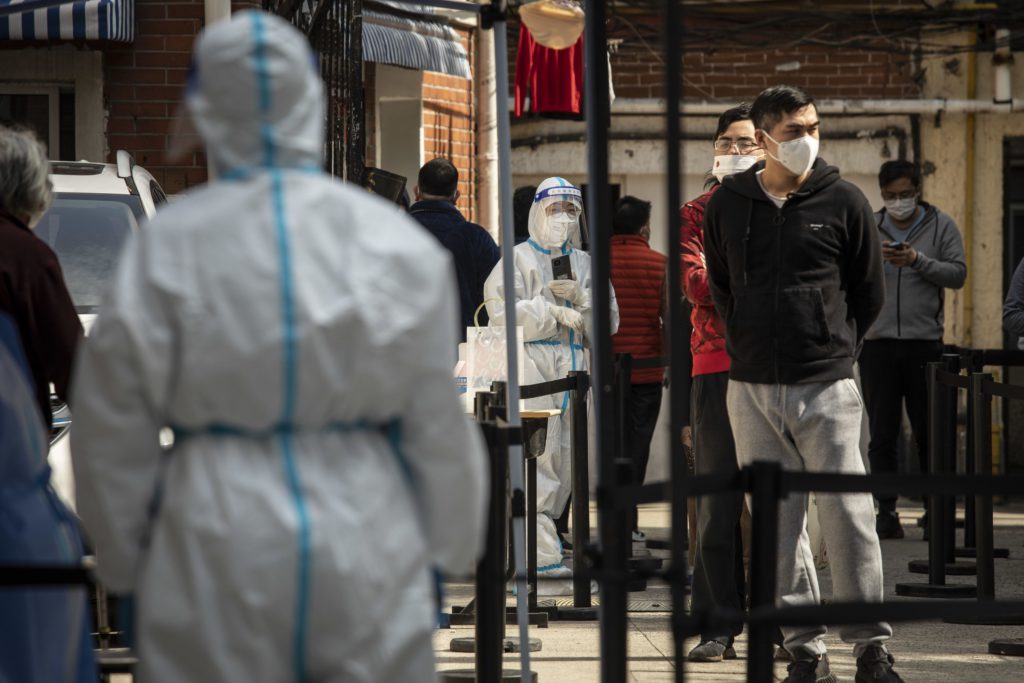
(Bloomberg) — China’s central bank announced a spate of measures to support individuals and small businesses as the economy faces headwinds from Covid-led lockdowns.

The People’s Bank of China urged banks to expand lending to people with “flexible employment” such as taxi drivers, online shop-owners and truck drivers, and provide longer-term and cheaper loans to small businesses hit by the outbreak, it said in a joint document with the forex regulator on Monday. 

In an announcement that includes 23 measures, the central bank vowed to step up the use of targeted tools including the relending program, which provides funds for banks to lend to sectors including those hit by the pandemic. The various expanded and newly-set up relending programs are expected to lead to 1 trillion yuan ($157 billion) in additional bank loans, it said.

The measures came after China reported its biggest decline in consumer spending and worst unemployment rate since the early months of the pandemic, as lockdown measures to curb Covid infections intensified economic risks and disrupted activities.

The PBOC called on local authorities to set appropriate minimum down payment requirements and mortgage rates based on each city’s conditions, and urged banks to support the reasonable financing needs of property developers and construction companies, according to the document.

Policy banks will need to step up their financing to major investment projects, while banks should be more proactive in lending to infrastructure projects and purchase local government bonds to support advanced construction, the PBOC said. Banks should also ensure reasonable financing needs of local government financing vehicles and avoid suspending or withdrawing loans from them blindly, it said.

The central bank also asked banks to increase the share of private companies among the recipients of new corporate loans.

The PBOC has transferred 600 billion yuan of profit to the central government as of mid-April, which was mainly used for tax rebates and transfer payments to local governments, it said. The profit transfer had the impact of increasing base money supply by 600 billion yuan, equivalent to what a 25 basis-point cut in the reserve requirement ratio would achieve, it said.

Separately, the China Banking and Insurance Regulatory Commission vowed to increase financial resources to logistics, transportation and courier industries, and use the relending funds well to lower financing costs. It will provide funding help to smaller businesses suffering from temporary difficulties due to the Covid, the regulator said in a statement on Monday.


More stories like this are available on bloomberg.com

©2022 Bloomberg L.P.
Tesla Autopilot Stirs U.S. Alarm as ‘Disaster Waiting to Happen’

(Bloomberg) — Derrick Monet and his wife, Jenna, were driving on an Indiana interstate in 2019 when their Tesla Model 3 sedan operating on Autopilot crashed into a parked fire truck. Derrick, then 25, sustained spine, neck, shoulder, rib and leg fractures. Jenna, 23, died at the hospital.

The incident was one of a dozen in the last four years in which Teslas using this driver-assistance system collided with first-responder vehicles, raising questions about the safety of technology the world’s most valuable car company considers one of its crown jewels.

Now, U.S. regulators are applying greater scrutiny to Autopilot than ever before. The National Highway Traffic Safety Administration, which has the authority to force recalls, has opened two formal defect investigations that could ultimately lead Tesla Inc. to have to retrofit cars and restrict use of Autopilot in situations it still can’t safely handle.

A clampdown on Autopilot could tarnish Tesla’s reputation with consumers and spook investors whose belief in the company’s self-driving bona fides have helped make Tesla Chief Executive Officer Elon Musk the world’s wealthiest person. It could damage confidence in technology other auto and software companies are spending billions to develop in hope of reversing a troubling trend of soaring U.S. traffic fatalities.

It could also bring long-simmering tensions between Washington and Tesla to a boil. The iconoclastic Musk has already derided NHTSA as the “fun police” and chafed at President Joe Biden’s unwillingness to lavish the pioneering company with praise. He’s not shy about lambasting lawmakers and regulators on Twitter, the social media platform he has offered to purchase for $43 billion. 

Tesla, which reports earnings later this week, has lately had an aura of invincibility. As larger rivals were hobbled by the global chip shortage and other pandemic disruptions, the electric-car maker managed to substantially increase production. A modestly funded, slow-moving government agency is one of few obstacles threatening to throw it off course.

Musk and Tesla did not respond to requests for comment. “Making our vehicles safer is foundational to our company culture and how we innovate new technologies,” Rohan Patel, Tesla’s senior director of public policy and business development, wrote in a March letter to lawmakers. 

A crackdown from NHTSA would follow repeated pleas from the National Transportation Safety Board, the independent accident-investigation agency, to tighten oversight of automated vehicles. The NTSB, which doesn’t have the power to compel carmakers to follow its recommendations, has suggested Tesla embrace automated-driving system safeguards that General Motors Co. and Ford Motor Co. have adopted for their systems. Tesla hasn’t responded to the NTSB’s guidance and instead continued its riskier approach.

“We essentially have the Wild West on our roads right now,” Jennifer Homendy, the chair of the NTSB, said in an interview. She describes Tesla’s deployment of features marketed as Autopilot and Full Self-Driving as artificial-intelligence experiments using untrained operators of 5,000-pound vehicles. “It is a disaster waiting to happen.”

Light Touch

Musk has taken advantage of a light-touch approach in the U.S. to regulating self-driving technology. Within days of Tesla releasing a software update that enabled Autopilot in October 2015, YouTubers posted videos of themselves ignoring the company’s warnings against taking their hands off the wheel. One nearly auto-steered off the road; the other almost veered into an oncoming car.

Two months before a Tesla driver in Florida died when his Model S on Autopilot plowed into an 18-wheel trailer in May 2016, NHTSA said existing laws in the country posed few barriers to driver-assistance systems. Then-Transportation Secretary Anthony Foxx said weeks after the crash that NHTSA would release guidelines, rather than rules, for the technology. Congress hasn’t enacted any laws specifically addressing oversight of vehicle automation.

Musk alluded to this regulatory permissiveness in March when he was asked when Europeans will get to test Full Self-Driving, or FSD, a set of beta features available in the U.S. Contrary to the name, FSD doesn’t render Tesla cars capable of driving themselves.

“In the U.S., things are legal by default,” Musk said. “In Europe, they’re illegal by default. So we have to get approval beforehand, whereas in the U.S., you can kind of do it on your own cognizance, more or less.”

Tesla’s approach to automated-driving features contrasts with that of legacy automakers GM and Ford, whose systems use cameras behind the steering wheel to monitor whether drivers are paying attention. The companies also restrict use of the systems to highways their engineers have mapped and tested out before deploying the technology to drivers.

“Tesla sticks out like a sore thumb,” said David Friedman, who was deputy and acting administrator of NHTSA from 2013 to 2015. “And it has for years.”

NHTSA has repeatedly reminded the public — including in comments provided for this story — that no commercially available vehicle can drive itself. The agency has opened 31 special investigations into crashes involving driver-assistance systems, 24 of which involved Teslas. But the company keeps hawking FSD — and charges $12,000 for it.

There’s growing discomfort with this state of play in Washington.

“I really dislike a lot of what Tesla has done, and at the top of the list in bright, bold letters, is Elon Musk’s habit of making false public claims, and using his podium in a way that creates safety risks,” Heidi King, a deputy and acting administrator of NHTSA during the Trump administration, said in an interview.

“We all admire his visionary attributes,” King said of Musk. “But visionary exaggerations about a consumer product can be very, very dangerous.”

Growing Scrutiny

King was one of several acting heads of NHTSA during what has been a five-year leadership vacuum. The last Senate-confirmed administrator left the post in January 2017. A vote to permanently place Biden’s pick to run the agency, Steve Cliff, in the position is being held up indefinitely.

Impermanent leadership — along with a tight budget and modest headcount — may have prolonged Autopilot’s free ride. But a series of moves NHTSA has made over the last 10 months suggest it may not last much longer:

  • In June, NHTSA ordered automakers to report crashes in which automated-driving systems are activated
  • In August, NHTSA opened the defect investigation related to first-responder crash scenes
  • In September, NHTSA sought documents from a dozen Tesla competitors about their automated systems
  • In October, NHTSA grilled Tesla over why it neglected to do a recall when it deployed a software update to improve emergency-vehicle detection, and sought information about expanded availability of FSD
  • In November, Tesla recalled a version of FSD
  • In February, Tesla conducted another FSD-related recall to disable a setting that allowed vehicles to roll through stop signs, and NHTSA opened a second Autopilot defect investigation

Former safety officials are encouraged by the growing scrutiny on Autopilot, seeing it as long overdue. They are calling for NHTSA to put its recall authority to use and seek additional powers and resources from Congress that would allow it to modernize safety standards.

“NHTSA is empowered with robust tools and authorities to protect the public, to investigate potential safety issues, and to compel recalls when we find evidence of noncompliance or an unreasonable risk to safety,” a spokesperson for the agency said in a statement. “NHTSA has collected data and conducted research, developed test procedures and measured their effectiveness, which are all necessary requirements before a safety standard can be developed.”

Two Democratic Senators — Ed Markey and Richard Blumenthal — have called for the Federal Trade Commission to probe whether Tesla has deceptively marketed Autopilot and FSD. FTC Chair Lina Khan told the lawmakers in September she couldn’t reveal information regarding any non-public investigations.

Recall Options

In the event NHTSA determines from either of its investigations there are defects pertaining to Autopilot, it can order Tesla to conduct recalls. Those could take a variety of different forms, because Tesla is permitted by law to choose how exactly it responds to such an order.

Addressing a defect could be as simple as beaming an over-the-air update to Tesla cars using their internet connection, much in the way smartphones receive software updates. Tesla has already carried out several recalls this way, and could update Autopilot’s software to keep the system from operating in certain domains it’s not yet able to safely navigate.

But pricier fixes may end up being needed. One example: Tesla could determine it needs to install cameras behind its steering wheel to monitor whether drivers are paying attention while using its systems, as other automakers do.

While the company has put cabin-facing cameras in its cars for years, they’re positioned over the rear-view mirror, rather than directly in front of the driver. Musk has said the cameras are meant for a robotaxi service that doesn’t yet exist.

It’s unlikely Tesla would opt for the most expensive outcome of all: replacing vehicles entirely. But a third option for manufacturers to remedy vehicles they’re forced to recall is to issue refunds, which also would be costly. Tesla has steadily increased the price of FSD, and used to charge thousands of dollars for Autopilot before making it a standard feature in 2019.

Tesla will have had it coming if NHTSA does take action on Autopilot, according to Friedman.

“The NTSB has been pointing out since that 2016 crash — where the Tesla literally couldn’t see the broadside of an 18-wheeler — that there are serious concerns,” Friedman, who is now vice president of advocacy for Consumer Reports, said in an interview. “How is it that an automated vehicle can’t safely maneuver around an emergency vehicle? That’s literally one of the first things you learn in driver’s ed: if there’s an emergency vehicle, you don’t run into it.”

Taking the Mantle

When NHTSA first investigated more than five years ago whether Autopilot was defective, it found that the driver of the Tesla Model S that crashed into a trailer in Florida had ignored his Tesla’s warnings to maintain control. In a report stating it found no defect and was closing its probe, NHTSA said Tesla supplied data that showed Tesla vehicles’ crash rate dropped almost 40% after installation of Autosteer, an Autopilot feature.

Two years later, a data-analysis company issued a report calling that finding into question. Quality Control Systems, a firm that sued the Transportation Department to obtain the mileage and crash figures NHTSA studied, found the data were incomplete and criticized the company and regulator for making “tenuous” safety claims.

“NHTSA never, ever, ever, should have just taken Tesla at their word,” Friedman said. “It’s NHTSA’s responsibility to do high-quality analysis, and dot their i’s and cross their t’s. In this case, it doesn’t look like they did either.”

An agency spokesperson said NHTSA made no claim in its report regarding the effectiveness of Autosteer, and that it lacked critical information to do so.

NHTSA will have a fresh advantage in its latest probes of Autopilot: Now that other companies have followed Tesla to market with automated-driving features, the agency has other systems to compare against.

Friedman likens the situation to decades ago, when it wasn’t unusual for carmakers to put gas tanks behind or hovering over the rear axle. When manufacturers started moving tanks inboard, and Ford didn’t with its Pinto model — rendering the car prone to catching fire — the agency deemed the design an unreasonable safety risk.

“Only NHTSA knows their intentions relative to this,” Friedman said of the agency’s Autopilot investigations. “But it is certainly great to see NHTSA spending more time doing its core job when it comes to putting safety first.”

More stories like this are available on bloomberg.com

©2022 Bloomberg L.P.
Cisco to Shift Some Pay From Bonuses to Salaries Amid Inflation Crunch

(Bloomberg) — Cisco Systems Inc. is shifting a slice of its workers’ pay out of bonuses and into their base salary, in response to concerns about soaring inflation.The biggest maker of computer networking equipment will rejigger compensation packages at the start of its new fiscal year in August, according to Chief People, Policy and Purpose Officer Fran Katsoudas. The decision came after the company surveyed employees to find out what mattered most to them regarding their paychecks. The company is also experimenting with a four-day workweek and aims to reduce its real estate footprint by as much as 30% by shutting some older offices and creating new “collaboration hubs” in New York, Atlanta and other cities.

“We asked them what compensation levers they appreciate more,” Katsoudas said in an interview. “With inflation going on around the world, they want cash in hand. So we’re shifting a few of our programs to really drive more of that cash to employees.” 

Cisco’s move comes as inflation continues to take a big bite out of household budgets. U.S. consumer prices rose in March by the most since late 1981, and Americans are paying much more for gas, food and rent. Wages have also risen, but they’re not keeping up with inflation. That’s prompted millions of employees to jump ship for the promise of higher pay, a trend that Cisco hopes to ward off by tweaking salaries and bonus pay. Cisco’s shares are down nearly 20% this year, part of a broader selloff of technology stocks. 

The networking giant also expects to need between 20% and 30% less office space, Katsoudas said, as it consolidates its holdings and builds new offices that feature a blend of open space, small “huddle” rooms and places to socialize. The 59,000-square-foot New York office at 1 Penn Plaza next to Madison Square Garden, which reopened earlier this month, has only 50 desks, down from the original plan to include 150, leaving much more space for groups to gather for teamwork, training or socializing.  One conference room includes bar stools, while others have small booths right outside for post-meeting conversations. The company is even looking to hire a “collaboration concierge,” a sort of cruise director for the office who will organize events and activities, while also helping staff navigate their new environs.  

“I have to create a buzz here,” said Mark Miller, a Cisco business development director who spearheaded the office’s redesign, which began in October 2019 but was delayed by the pandemic. “We don’t want to commute just to compute.”

So far at least, most Cisco employees are forgoing the commute entirely. Just under 20% have returned to its offices at least three days a week since reopening its U.S. locations March 1, which is lower than Katsoudas expected. Early enthusiasm for returning to the office has waned since last year, according to a January survey of more than 6,600 U.S. adults from pollster Morning Consult. Fewer than half of workers who were fully remote due to Covid-19 would like to return to the office as soon as it’s safe to do so, down from 64% who said so in January 2021.

“We are still ramping up,” she said. “Work is not a place you go, it’s a thing you do. I want people to feel they have choice.”  

Like other companies, Cisco hopes to entice workers back into offices with relocations and refurbishments that make the office more of a destination than daily drudgery. Last year it moved its Midwest regional office from suburban Rosemont to downtown Chicago, leasing space in the city’s landmark Old Post Office building. The company is also opening a new Paris office, Katsoudas said, and plans to consolidate its scattered buildings in the tech hub of Austin. The shift has prompted the closure of regional offices, like those in Connecticut and New Jersey.

“In many cases, we were in the right cities but the wrong neighborhoods,” Katsoudas said. “Right now people want to be in cities, they want to be downtown, where they can walk around and grab dinner afterwards. It’s not just about the square footage, but the experience we want for our people.” 

More stories like this are available on bloomberg.com

©2022 Bloomberg L.P.

DeFi Project Beanstalk Loses $182 Million in Flash Loan Attack

(Bloomberg) — Decentralized finance project Beanstalk Farms suffered one of the largest-ever flash-loan exploits on Sunday, sending its price tumbling. 

The credit-focused, Ethereum-based stablecoin protocol suffered a total loss of around $182 million and the attacker got away with around $80 million of crypto tokens, according to blockchain security firm PeckShield, which had flagged the incident on Twitter. The project’s native token BEAN fell about 75% from its $1 peg against the dollar, pricing from CoinGecko showed.

The protocol’s creators disclosed their identities on Beanstalk’s Discord server, and said that they were not involved in the attack. 

“We are not aware of the identity of the individuals who were involved. Like all other investors in Beanstalk, we lost all of our deposited assets in the Silo, which was substantial,” the founders wrote.

It isn’t yet clear whether investors who lost funds will be reimbursed — or if so, how and to what extent. Beanstalk didn’t reply to an email from Bloomberg seeking comment.

Unlike traditional lending, which requires a loan to be secured with a collateral or credit checks, DeFi smart contracts allow users to borrow huge sums of stablecoins in what are known as flash loans, without any form of security. Flash loans, where the entire process of borrowing and returning the loan happens in a single transaction on the blockchain, are fairly popular among arbitrage traders.

Flash loans have also turned out to be a soft target for exploits, as any lapse in a smart contract code lets an attacker manipulate the protocol and drain millions. Last year Cream Finance and Alpha Homora lost $130 million and $37 million, respectively, in the same manner.

According to PeckShield, the hacker has already moved the entire $80 million onto crypto asset mixing service Tornado Cash to hide their tracks. The perpetrator also donated $250,000 in stablecoin USDC to Ukraine.


More stories like this are available on bloomberg.com

©2022 Bloomberg L.P.
Jon Stewart’s Struggles Add to List of Streaming Talk Show Flops

(Bloomberg) — Streaming services have already proved that they can produce Oscar-winning movies, Emmy-worthy dramatic series and high-profile live sports. But there’s one genre that the new wave of home entertainment platforms have yet to figure out: talk shows.

Witness the current stumbles of Jon Stewart.

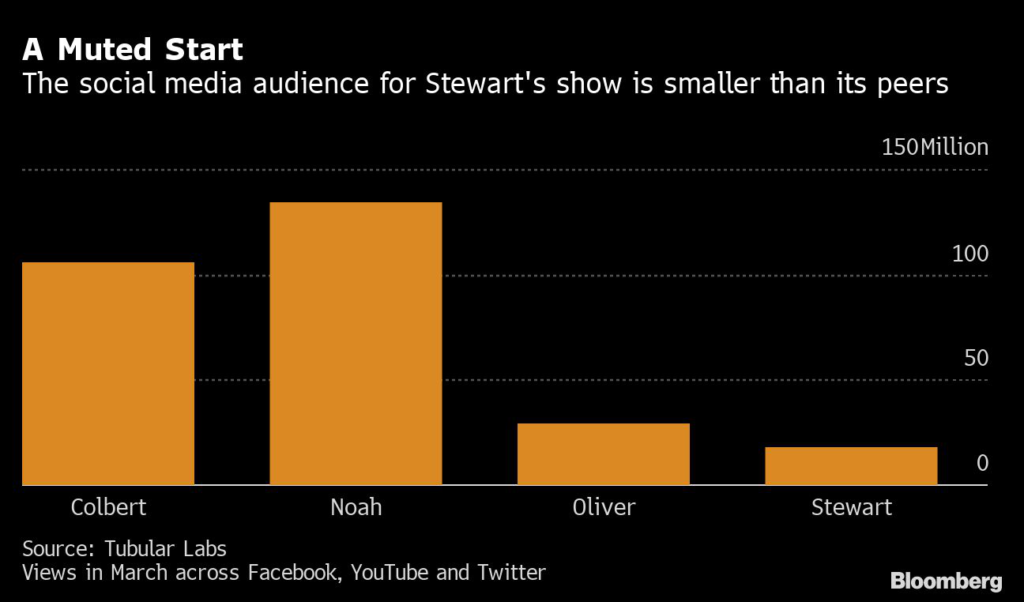
His Apple TV+ show, “The Problem with Jon Stewart,” which debuted in September, has failed to gain traction in its first season and lags far behind its competitors on broadcast and cable TV.

Last fall, about 180,000 U.S. homes saw the show’s first episode within the first seven days, according to the measurement firm Samba TV. By the fifth episode, which aired in early March, about 40,000 U.S. homes tuned in, down 78% from the season premiere. By comparison, an episode in March of HBO’s “Last Week Tonight with John Oliver” was seen in 844,000 U.S. homes, Samba TV says.

Stewart declined to comment, though the magazine Entertainment Weekly said the show is the No. 1 unscripted series on Apple TV+, citing sources. To date, Apple hasn’t disclosed any viewership numbers for Stewart’s show, which since its debut has aired on a sporadic schedule. According to Parrot Analytics, Stewart’s program is the eighth most in-demand talk show in the U.S., ahead of programs hosted by Ellen DeGeneres and James Corden and behind ones hosted by the likes of Jimmy Kimmel, Jimmy Fallon, Stephen Colbert and Trevor Noah.

“We are thrilled that ‘The Problem with Jon Stewart’ has resonated with viewers all over the world,” said Molly Thompson, head of unscripted and documentaries at Apple TV+. “The series has sparked complex conversations about critical issues, and we’re proud to team with Jon for season two and beyond.” 


Stewart’s predicament is hardly unique. The list of successful, prominent comedians who have hosted short-lived shows on Netflix or Hulu already includes Chelsea Handler, Michelle Wolf, the late Norm Macdonald, Joel McHale and Sarah Silverman. Years into the streaming revolution, the classic talk show format is still struggling to adapt. One problem is that people often watch streaming shows days or weeks after the programming initially aired, making it difficult for hosts to rely on jokes pegged to current events, long a pillar of traditional late-night programs.

“A late-night-style show on a streaming service can’t be very topical because content based on the events of the day would seem stale,” said Joe Toplyn, a former writer for “Late Show with David Letterman” and “The Tonight Show with Jay Leno.” 

Another challenge is that increasingly streaming services want programming that can appeal to subscribers around the world. That may have contributed to McHale’s short run on Netflix, said K.P. Anderson, an executive producer on the shows hosted by McHale and by Macdonald. Anderson said his conversations with Netflix executives led him to believe that McHale’s show did well in North America, but they wanted more viewers in other countries.

“If I had to point to one thing that makes it tougher, it’s making a global thing,” he said. “Especially a show like Joel’s, where we focused on American pop culture.”

Whereas broadcast TV networks have spent decades building and reinforcing a schedule that reliably steers viewers to their late-night talk shows, streaming services lack anything equivalent. 

“It’s all about building a ramp for the next thing,” Anderson said. “If I pop on Netflix, I don’t know what I’m going to watch half the time.”

Streaming talk shows that do catch on with viewers tend to focus on topics with long shelf lives, said Jason Kilar, who recently stepped down as chief executive officer of HBO’s parent company, WarnerMedia.

“There’s a long history of these kind of shows that have been so time sensitive and tied to this evening’s topic of jokes,” Kilar said. With John Oliver’s show, which airs on HBO and HBO Max, “it doesn’t matter if you watch Sunday night or Thursday night or a week later, it has great resonance.”

“You don’t even know how to get Apple TV, do you?”

Stewart fans may have had a particularly hard time settling into a viewership routine. Stewart initially released episodes on Apple every two weeks. Then he took four months off. In March, he returned from hiatus and began releasing episodes once a week. Along the way, Stewart has poked fun at the slow rollout, saying recently that it’s “like I’m an Etsy store of shows, knitting each one myself.”

To judge by the program’s sluggish start, sticking to evergreen topics is no guarantee of success. Each hour-long episode of “The Problem” focuses on a single issue, such as gun control, race relations, the stock market or climate change. It opens with a meeting between the host and his producers. Then the gray-bearded Stewart, sporting a bomber jacket, delivers a monologue, holds a panel discussion and closes by interviewing a prominent figure, like former Disney CEO Bob Iger, Treasury Secretary Janet Yellen or U.S. Senator Cory Booker.

Reviews have been mixed. After watching the first two episodes, NPR TV critic Eric Deggans wrote that its “focus on important subjects, explored with passion and compassion, makes for compelling viewing,” but added that much of it “feels like a stitched-together pastiche of items from Stewart’s old show and a few other programs he inspired.” In February, Variety TV critic Daniel D’Addario wrote the show’s launch “has not been what one might expect from the grand return of a superstar.” 

About 70 million people still subscribe to cable TV, where for 16 years Stewart hosted “The Daily Show” on Comedy Central. Stewart is now attempting to reach viewers from a much smaller platform. Apple doesn’t disclose the size of its overall audience of paying customers, but  the research firm MoffettNathanson estimates it has 12 million subscribers.

“There’s no doubt Jon Stewart made much more of a splash in public discourse 20 years ago than he’s making today,” said Stephen Farnsworth, a professor of political science and international affairs at University of Mary Washington and co-author of a book about late-night TV shows during the Trump era. 

Stewart hasn’t shied away from joking about his own relatively low profile on Apple.

“Thank you for watching but my guess is you didn’t,” he said at the end of the premiere episode. “You’re probably just going to look at aggregated clips of it somewhere, on YouTube, where you pirate ‘ Ted Lasso.’ You don’t even know how to get Apple TV, do you?”

More stories like this are available on bloomberg.com

©2022 Bloomberg L.P.
Bitcoin Looks Soft in the Era of Hard Assets to Hedge Inflation

(Bloomberg) — Bitcoin’s negative correlation with commodity markets is providing more fodder for critics of its suitability as a hedge for inflation.

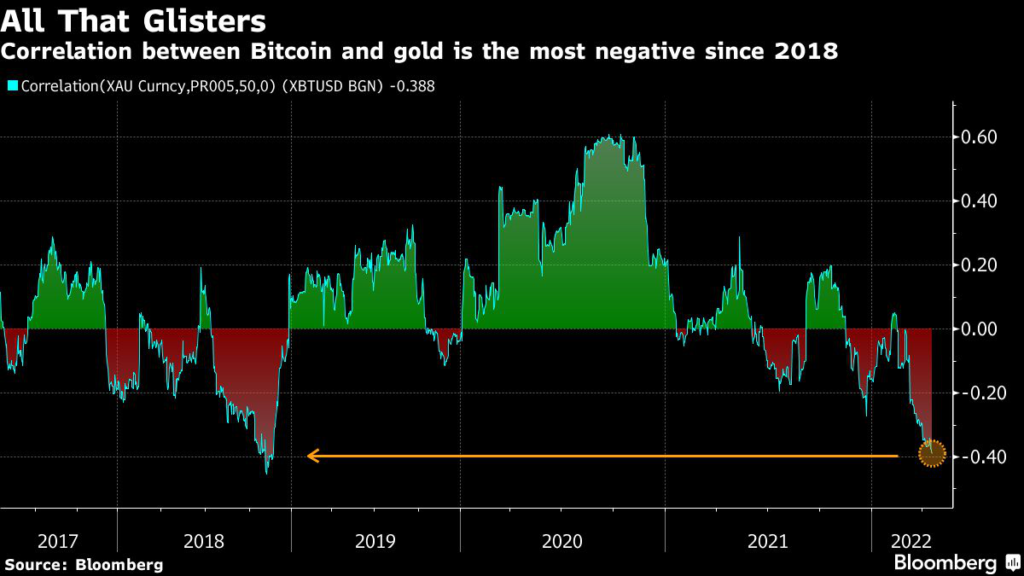
A 50-day correlation coefficient for Bitcoin and gold is around minus 0.4, the lowest since 2018, while a similar measure for the token and the Bloomberg Commodity Spot Index is also negative and at a multi-year nadir. A reading of 1 implies assets are moving in lockstep and minus 1 the reverse.

So while demand for portfolio buffers against price pressures catalyzed commodity performance this year, Bitcoin has gone the other way — leaving backers of its store-of-value narrative with a tougher story to sell.

“It could well be that as Bitcoin is tested in a high inflation, rising rate environment for the first time, investors are choosing tradition over a new frontier,” said Jeffrey Halley, senior market analyst at Oanda Asia-Pacific Pte. “Gold has been an inflation hedge for millennia.”

Bitcoin advocates remain undeterred, arguing the cryptocurrency will prove its worth in time partly thanks to a capped supply of 21 million tokens.

MicroStrategy Inc. founder Michael Saylor said in a recent Bloomberg Television interview that he can’t think of “anything better to position our company in an inflationary environment than to convert our balance sheet to Bitcoin.”

For now, Bitcoin remains tightly correlated with the Nasdaq 100 index — and investors have ditched the token and the technology-heavy gauge in 2022, fearful that sharply tighter U.S. monetary policy will hurt risk appetite.

The Nasdaq 100 is down about 15% this year, while the world’s largest cryptocurrency has shed some 16%. The token fell 3.3% as of 11:55 a.m. Monday in London, dropping to a one-month low of about $39,000.

More stories like this are available on bloomberg.com

©2022 Bloomberg L.P.

Elon Musk’s Cryptic Tweet Channeling Elvis Baffles Investors

(Bloomberg) — Billionaire entrepreneur Elon Musk kept investors in the dark this weekend, floating a cryptic tweet with the word “tender,” a likely wink-and-nod reference to a potential tender offer to Twitter Inc. shareholders for control of the company. 

The world’s richest person caused a stir last week after he filed a $43 billion proposal offering $54.20 a share for the social network, which led Twitter to adopt a so-called poison-pill provision on Friday to make it harder for Musk or a group of investors to acquire more shares. 

If Twitter directors ultimately reject him, the world could learn whether Musk was truly threatening a direct appeal to shareholders or had just added the 1956 Elvis Presley hit “Love Me Tender” to his playlist.

Musk may try to partner with investors including Oracle Corp., given that its co-founder Larry Ellison is on Tesla Inc.’s board, along with a group of private equity firms including Thoma Bravo, Bloomberg Intelligence analysts Mandeep Singh and Ashley Kim wrote Friday. That partnership could raise the bid to $50 billion, they wrote. 

Shares of Twitter rose 3.2% in trading before U.S. markets opened Monday. They gained 4.3% this year through Friday’s close. 

An acquisition is far from certain even without the poison-pill provision and defensive tactics from the company’s board. Musk said at an April 14 TED conference that he is “unsure” if he’ll actually be able to acquire the company, adding that he has a back-up plan, without offering details. 

Over the weekend, Musk said the economic interests of Twitter’s board are not aligned with shareholders. He was responding to a tweet about board members’ stock holdings, saying that with the departure of Twitter founder Jack Dorsey, the board “collectively owns almost no shares.” He had previously tweeted that the board risks liability if it acted against shareholders.

Dorsey, who remains on the company’s board until later this year, also took the unusual step of criticizing its managers on the platform. “It’s consistently been the dysfunction of the company,” Dorsey wrote of Twitter’s board. 

With all eyes on the battle for Twitter, Wall Street banks are taking sides. Twitter has hired Goldman Sachs Group Inc. and JPMorgan Chase & Co., the latter of which has sparred previously with Musk over the valuation of hundreds of millions of dollars in Tesla stock warrants. Morgan Stanley is advising Musk. 

Twitter shares have risen about 15% since Musk disclosed a 9.2% stake in the company on April 4 but, at $45.08 as of April 14, are well shy of his offer price, reflecting doubts that a deal will go through. Tesla has dropped 9.2% in the same period, as its investors grapple with the prospect of its CEO being distracted with another public company or passion project. The electric-vehicle maker is also under pressure in China, where its massive Shanghai automobile factory has been shuttered for weeks by the region’s Covid-19 lockdowns.

Later this week, Tesla will report first-quarter earnings after posting record deliveries in the first three months of the year. Analysts are estimating revenue of about $17.8 billion and adjusted earnings of $2.27 a share. 

“Tesla’s next phase of growth depends primarily on eliminating capacity constraints in Europe as the Berlin factory begins deliveries,” Bloomberg Intelligence analysts Kevin Tynan and Andreas Krohn wrote last week. “The pace of adoption and subsequent competition — given a more intense government regulatory and subsidy environment — ratchets up the urgency of getting high-volume nameplates built overseas.”

(Updates with premarket trading in fifth paragraph.)

More stories like this are available on bloomberg.com

©2022 Bloomberg L.P.
Rivian’s New Factory, Constrained by Chips, Is Off to Slow Start

(Bloomberg) —

Rivian Automotive Inc.’s “launch mode” is impressive — at least on its trucks. 

While the battery-powered pickups go from 0 to 60 miles per hour in 3.3 seconds, the 3.3 million-square-foot factory they roll out of is off to a protracted start. The assembly lines are perfectly capable of cruising speed; they just need more computer chips. 

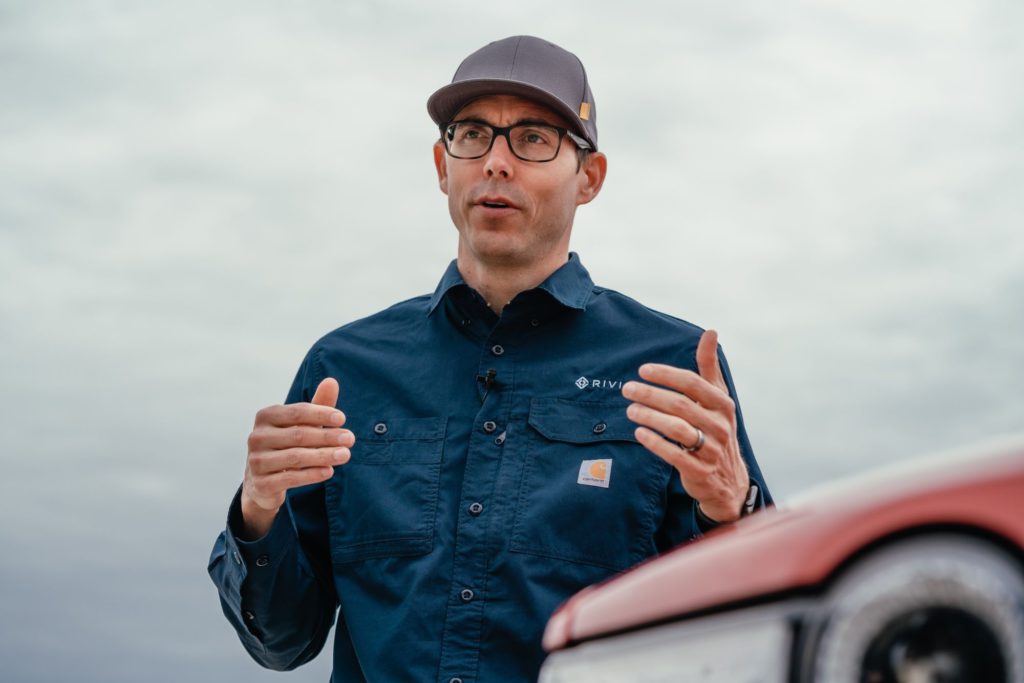
That was the message from Chief Executive Officer  R.J. Scaringe last week as he took Bloomberg on a tour of the company’s Normal, Illinois, plant two hours southwest of Chicago. The cavernous facility was packed with people — 5,200 in all, spread across different shifts. Industrial tools were punching metal into door frames and scores of robotic arms were welding body panels, smooshing on windshields and spraying paint.

The parking lot behind the factory is crammed with hundreds of battery-electric pickups called R1T, Rivian’s debut consumer product. Parked alongside in trademark “Prime Blue” were dozens of plug-in commercial delivery vans for Amazon.com Inc., a critical customer and investor. All of the machines are awaiting shipment to their new owners, a dormant cavalcade ready to deploy in the coming electric vehicle wars.

Still, for all the activity, the factory is limping compared to rival facilities. Rivian forecasts it will run at just 50% capacity this year as a shortage of key parts constrains output. The assembly line was static in places and some workers were diligently organizing parts bins and re-checking machinery. At times, the first shift of the day files out at around 3 p.m., Scaringe said in an interview, simply because they don’t have enough to do.

“I would love to be in a position where we’re running two shifts, but two shifts would gain us nothing right now,” Scaringe said. “We need parts.”

Rivian is not an exception in the auto industry; it’s only different because it’s new. A few months ago, Rivian brought the first battery-powered electric pickup to the U.S. market, beating Tesla Inc, Ford Motor Co. and General Motors Co. in the process. The company counts Jeff Bezos and Amazon among its biggest investors (and customers) and its initial public offering in 2021 was the sixth largest in U.S. history. But since the debut, shares have swooned and analysts have slashed projections and hopes for the stock. 

Rivian has managed to speed the flow of certain products, in part by sending employees to supplier plants to step up the pressure. Computer chips, however, remain a challenge. There’s a fixed supply and typically chipmakers allocate them based on historic production, which is a huge disadvantage to a newcomer like Rivian. Scaringe says he spends much of his time calling chip executives and assuring them his factory is humming. Inviting a gaggle of reporters for a tour puts a nice underline on that missive.

“The allocation is being set based on whether they think we’re using the chips or not,” Scaringe said. “But it’s a self-fulfilling prophecy, because if Intel believes we’re not going to produce more than the next number, then that’s the number we’re going to produce.”

Scaringe reiterated a pledge that his factory will roll out 25,000 vehicles this year — including 10,000 vans Amazon is expecting, the first tranche of a 100,000-unit order to be completed by the end of this decade. That’s roughly half of what the plant would be capable of if it had a steady stream of parts.

The company has invested billions of dollars retrofitting a former Mitsubishi plant it acquired in 2017 for $16.5 million. Since then, the facility has expanded by 700,000 square feet. It’s now chock-a-block with tooling and machinery that takes months to map and install. One of Rivian’s biggest expenses to date, a state-of-the-art paint shop, is humming away like a wing of the Star Wars Death Star. Two assembly lines — one for the commercial van, the other for the company’s passenger pickup and SUV — weave around each other in a carefully choreographed industrial ballet. At one end of the plant, battery cells are packed into modules and joined with electric motors to form the “skateboards” which are bolted under all Rivian vehicles before they’re driven out of the facility to the parking lot outside.

Rivian currently is producing vehicles in batches: when enough parts pile up, managers crank up the conveyer belts and workers make a few dozen trucks. “We accumulate enough parts to build as fast as the plant can build,” Scaringe said, “but we can’t run like that for a week; we run through the parts so fast.” Eventually, Rivian plans for the facility to stamp out 200,000 machines a year by 2023. But so far, the factory’s limitations don’t appear to have had any effect on demand. Orders are coming in at an increasing rate, Scaringe said, as more of the trucks make their way into neighborhoods and parking lots. The high-profile IPO didn’t hurt either.

That presents its own set of challenges, however. With a wait list of more than 85,000, Rivian is selling hardware that customers won’t receive for nearly two years.  Given that widening window, Rivian is about to change the way it takes orders, essentially uncoupling reservations from detailed prices. New customers will still be able to choose a truck, put down a deposit and claim a place in line, but they won’t be able to choose options — or configure their vehicle — and lock in a specific price until closer to an appointed delivery date. 

“It’s a conversation we need to have,” Scaringe said. “Content is going to evolve, pricing is going to evolve; it allows those evolutions to occur without having to predict what they’re going to be precisely.”

The change will help Rivian account for inflation and fast fluctuating prices for commodities and parts. The company in early March walked back an announced price increase for people with standing orders when a swell of those customers cancelled their reservations (although it maintained the higher stick price for new buyers). Also, Scaringe said, Rivian vehicles will change drastically in the next two years. They may look the same, but he says they will be more efficient, with improved charging speed and driving dynamics.

The R&D squad, in short, is working at a frenzy, even as the line workers wait for 10 or so parts out of 2,000 — each the size of a fingernail — which are holding up the process. “Layered on top of this is the question,” Scaringe said, “‘Is the plant actually not running and using the semi-conductor shortage as an excuse?’ It’s really complex and it’s really frustrating.”

More stories like this are available on bloomberg.com

©2022 Bloomberg L.P.

Close Bitnami banner
Bitnami
