
Bloomberg

Fan Tokens From Manchester City to PSG Prove Disappointing

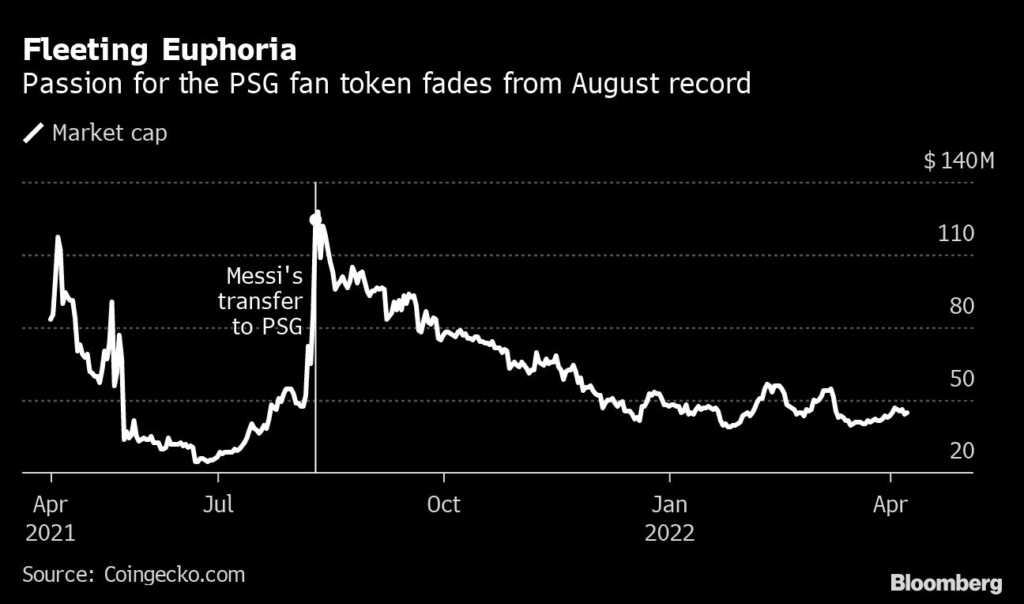
(Bloomberg) — As soon as rumors started buzzing that soccer star Lionel Messi would transfer from FC Barcelona to Paris Saint-Germain in August, Miguel Schweizer decided to buy the French club’s fan token, $PSG, on a hunch that prices would spike. They did – but he didn’t hold the tokens for long.

He sold them a few days later, betting the rally would be short-lived. His trade proved correct: prices were down 34% a week later, and 73% from when the tokens were issued after four months. 

“I would never keep them in my investment portfolio for the long term,” said Schweizer, 29, chief executive officer of Decrypto, a Buenos-Aires based exchange and wallet. “They’re trade opportunities.”

For many hopeful fans, soccer club tokens have proved a disappointment, with prices quickly losing steam within days. It’s now three years since fan tokens started trading in the main crypto exchanges, promising an alternative for clubs to gain financing and for fans to be closer to their favorite teams. 

Both these options have yet to live up to expectation. Clubs that have issued tokens include the likes of Manchester City, SS Lazio, FC Porto, Santos FC, FC Barcelona, AC Milan and Trabzonspor. Some, like FC Arsenal have raised as much as $5.5 million in first-day sales of fan tokens, dubbed “initial fan token offerings,” though most have raised closer to $2 million in these sales. That’s a fraction of these clubs’ expenses. Clubs can potentially generate additional revenue from future token sales and from the fees they charge for volumes traded on Binance.

Analysts caution that demand for fan tokens quickly goes from euphoria to indifference. The main criticism they make is that these have few tangible benefits for the fans. The Juventus token, for example, allows fans to use the tokens to obtain VIP tickets with loyalty points they earn as token holders, while the PSG token was used to allow holders to vote on the design for the new team bus and club slogan. 

“The problem with current fan tokens is the clubs do not actively promote them or the utility the tokens have”, said Oliver Bell, CEO and co-founder of XCAD Network, a company that makes tokens for content creators. “The people that are buying them are not necessarily fans of the clubs at all; the only buyers are crypto enthusiasts.”

Meanwhile, the market remains small. The market value of the sports fan tokens is as high as $491 million and its daily traded volume is $241 million. The biggest 10 fan tokens have an average daily volume of $13 million, which is only 28% of the daily volume traded on average for the 364 coins listed on Binance, according to CoinMarketCap and Coingecko data.

The world’s largest fan token by market capitalization, Manchester City, has a market value of $56 million and the daily traded volume is under $15 million, according to data from CoinMarketCap.com. Its price is half of what it was issued for. 

Room for Growth

Proponents of fan tokens say it’s too early to assess their success. These coins are not intended to be investment assets, but rather to provide a service, said Alexandre Dreyfus, founder and CEO of Socios.com, a company that partners with clubs to develop the tokens. 

Socios.com has 57 fan token partners, according to the company, ranging from soccer to Formula 1. That’s up from 20 a year ago, which Dreyfus says indicates growing interest. 

“We’re seeing an uptick in interest from clubs in issuing fan tokens,” he said. “Fans will be able enjoy exclusive games and content and score points that they can redeem for official signed products, free tickets or VIP experiences.”

To promote their use, on April 7, Binance began offering Lazio fan token holders the opportunity to stake, a process that allows owners to earn passive income on the coins without having to sell them. The tokens are used to help validate transactions on the blockchain, with the rewards and fees divided among the participants and the exchange. Binance offered holders 8% of annualized returns when they keep the Lazio tokens locked for 30 days, or 15% if they keep them for 90 days.

Some say they still see a good investment opportunity, even amid low volumes that reflect the wider mood on crypto on high volatility. They point to certain tokens, like PSG’s or Barca’s, which have seen spikes of interest when there’s big news. 

“When the market becomes more bullish, there we will see how the volumes traded in all tokens increase”, said Maximiliano Hinz, Latin America general director of Binance, the world’s largest crypto exchange by traded volume, which has issued four fan tokens. “It’s the free market that governs their prices.” 

(The fifth paragraph was updated to include the potential for clubs to raise more revenue via additional token sales and fees.)

More stories like this are available on bloomberg.com

©2022 Bloomberg L.P.
Bitcoin Risk-Reward Calculation is Being Upended by Rising Rates

(Bloomberg) — A funny thing happened to Bitcoin as interest rates started to rise: trading volumes went way down. Now market-watchers are grappling with the implications and what a world of less-loose monetary policy means for digital assets.

The aggregate 30-day moving-average volume for Bitcoin across Coinbase, Bitfinex, Kraken and Bitstamp is at its lowest level since August 2021, according to data compiled by Strahinja Savic at FRNT Financial. Over the last month, the aggregate daily volume on those venues has averaged just over $1 billion. That reading stood at $2.57 billion in May 2021, a nearly 60% decline.

That’s happened as the Federal Reserve and other central banks accelerate their fight against inflation, which has remained hotter for longer than many had expected it would. With rates rising and the cost of money no longer hovering around zero, crypto prices have flagged, prompting investors to recalculate their desires to be invested in the cutting-edge market. 

For one, the withdrawal of liquidity impacts volumes in crypto — and elsewhere — by reducing the funds available to invest, says Noelle Acheson, head of market insights at Genesis Global Trading. Second, higher rates increase the opportunity cost of investing in non-yielding assets such as Bitcoin. And those buying the coin using leverage could feel an extra pinch: higher borrowing costs alter the risk-reward scenario of such trades, meaning that your potential return drops as your costs go up. 

“Volumes are down because of the uncertainty,” she said. “Investors seem to be worried that things could get worse before they get better.”

Acheson notes that the percentage of Bitcoin that has not moved for over a year is at an all-time high, with roughly 76% of the coin held in addresses considered illiquid, meaning they exhibit little movement. 

While that could show conviction in the idea Bitcoin could be used as a store of wealth in an environment of “intensifying macroeconomic uncertainty and unrest,” for now, “price movements are determined by the risk preferences of macro investors who are concerned about the global rates and economic outlook.”

Data from Glassnode suggests that interest in Bitcoin has remained muted — on-chain measures indicate little growth in the coin’s user-base and minimal flows of new demand. Plus, Bitcoin has been stuck in a tight trading range as it’s largely dominated by HODLers, a term that refers to investors who’ve got the gumption to stick around during major bouts of volatility. 

Strategists at the research firm say “it is hard to find many observations that suggest the network user-base is recovering or growing strongly.” They cite the number of active entities, something akin to daily active users — that measure is stuck in the same bear-market channel it’s been mired in for six years. 

David Shafrir, CEO of SDM, an institutional OTC trading desk, says he’s seeing new clients coming in but that average volumes from pre-existing clients have dropped anywhere from 8% to 15%. A slowdown in consumer power is one factor behind that, as is uncertainty around the Fed’s reaction to persistently high inflation.

That’s “caused some significant insecurity within the entire market as a whole,” Shafrir said by phone. “Now we’re starting to see the effects of that.”

As is the case with other asset classes, Bitcoin needs new backers for prices to stabilize. The emergence of new crypto fans — institutional as well as retail — over the past two years coincided with a skyrocketing in prices. Bitcoin rose more than 300% in 2020 and another 60% in 2021. That desire to be in on the asset class may have changed — so far this year, it’s lost more than 10% amid a similar slump in other riskier assets, with analysts saying it will take a whole new catalyst to jolt prices higher once again. 

“We’re not getting follow-through from new investors. Despite the relentless advertising, most of those who were inclined to buy Bitcoin have already done so,” said Steve Sosnick, chief strategist at Interactive Brokers LLC. Ultimately, Bitcoin is a risk asset and will behave the way other risk assets do, he said. 

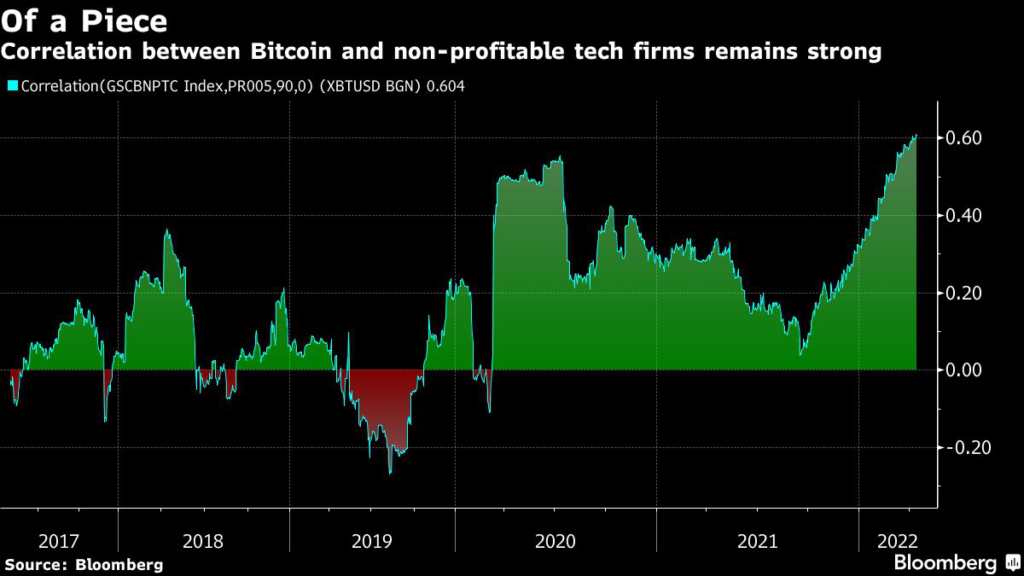
An oft-cited measure is that of Bitcoin’s correlation to other areas of the traditional market that might be hurt in a rising-rate environment. The 90-day correlation coefficient of the coin and a basket of non-profitable tech stocks now stands above 0.60, the highest such reading on record. (A coefficient of 1 means the assets are moving in lockstep, while minus-1 would show they’re moving in opposite directions.)

Meanwhile, Bank of America’s Alkesh Shah and Andrew Moss in an April 12 note said that Bitcoin exchange outflows in the prior week totaled $1.2 billion and were the largest of the year. The week prior to that one saw investors pulling out $532 million. Overall, exchange outflows in recent weeks were many times larger than average outflows seen during weeks at the start of February and the beginning of March. The strategists say the trends “indicate that investors are HODLing.” 

Still, Russell Starr, CEO and executive chairman of DeFi Technologies, says Bitcoin is more an inflation hedge than a risk asset. Inflation is likely worse than current readings are reflecting, he says, citing a common refrain in the crypto community. The U.S. could fall into a recession and that would spur the Fed to loosen monetary policy again, he said. 

“Yes, you may see some near-term weakness,” he said by phone. But ultimately, Bitcoin, under this scenario, will “test $60,000, $70,000, $80,000, $100,000.”

More stories like this are available on bloomberg.com

©2022 Bloomberg L.P.
Taxpayers Get Crypto Jolt in Otherwise Shockingly Normal Season

(Bloomberg) — The 2022 tax season, predicted by some to be a perfect storm, is coming to a close with barely a stiff wind.

For the first time in three years, the scheduled deadline — April 18 — will be met, as the Internal Revenue Service ended up largely being able to manage processing the millions of individual returns despite continuing complications from the pandemic. Delayed due dates for 2020 and 2021 returns had sown confusion for taxpayers and created a last-minute chaos within the IRS to update systems. 

“For most taxpayers who have fairly simple taxes, and they e-file and they choose direct deposit, that process — for the most part — has been very smooth,” said Mark Jaeger, VP of Tax Operations at TaxAct, a tax-prep software company.

It’s a big contrast with the picture in January, when Treasury officials warned to gird for a challenging and frustrating season, with processing delays and customer-service shortages. A shift in how the child tax credit was administered in 2021, with half of it distributed in monthly payouts, meant some might have seen smaller refunds than past years.

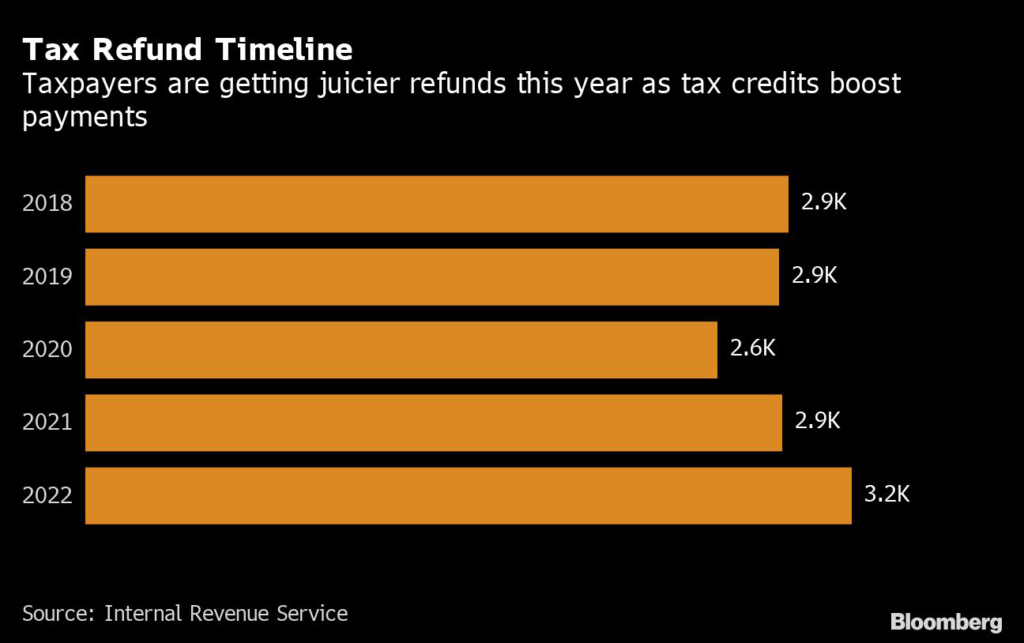
The average refund so far for 2021 is $3,175,  9.9% higher than in 2020. That’s likely the result of several credits that were expanded under President Joe Biden’s $1.9 trillion American Rescue Plan.

One surprise for many: an increasing attention by the IRS to transactions in digital currencies and non-fungible tokens. While a law requiring notification to the IRS of transfers of at least $10,000 in cryptocurrency doesn’t take effect until 2023, the agency does have reporting requirements for acquisitions and sales on individual returns.

This is surprising many new crypto owners who don’t yet realize that the IRS asks for the data, Mike Greenwald, a partner at accounting firm Friedman LLP, said.

“It requires a conversation that clients weren’t expecting to have,” Greenwald said. “They don’t think about digital currencies the same way the IRS does.”

More broadly, those who’ve participated in the the kind of retail trading popularized by Robinhood are finding the need to account for how they’ve fared. 

Day Traders

Nicole Rosen, a Washington-state based tax preparer, has noticed a significant increase among her clients of people using services like Robinhood to buy and sell stock. That requires additional forms and adds to the complexity of the tax returns.

In the past, about one-third of the returns Rosen prepared reported stock transactions, she estimates. Now, that’s closer to 80% to 90%. The average time to complete a return has accordingly increased from taking as many as two hours to as much as four. New automated IRS tools, such as a platform to upload power-of-attorney paperwork, have helped save time in other areas, Rosen said.

The IRS has been working hard on its own paperwork. The backlog of paper returns reached a high-water mark of 24 million this year. IRS Commissioner Chuck Rettig has said that should be reduced to the normal levels of less than 1 million by the year-end.

With less catch-up work to focus on, the IRS could now be in better position to step up audits of the wealthy, as advocated by progressive Democratic lawmakers.

No Jinxing

The IRS recently got approval for an expedited hiring process to bring on as many as 10,000 new employees, with half of those being hired in the coming months. Rettig has said this will help improve customer service and speed up processing times.

“IRS employees want to do more to help taxpayers,” Rettig said in testimony to the Senate Finance Committee this month. “We want to be able to answer the phones and respond to questions.”

Read More: House Democrats’ Proposed Outlines for Tax Reforms

Tax professionals, who are scarred from the past two years helping their clients navigate ever-changing pandemic payments, Paycheck Protection Program loans and unemployment benefits, are wary of jinxing the possibility of easier tax seasons ahead.

“We’re hopeful that there aren’t going to be any changes that are going to create the mechanical chaos that’s been going on over the last couple of years,” Bret Scholl, a California-based CPA, said. “But while things are so fluid and unpredictable I’m hesitant to predict just about anything.”

More stories like this are available on bloomberg.com

©2022 Bloomberg L.P.

If You Bought Crypto, Tax Season Could Be Complicated For You

(Bloomberg) — The 2022 tax season, predicted by some to be a perfect storm, is coming to a close with barely a stiff wind.

For the first time in three years, the scheduled deadline — April 18 — will be met, as the Internal Revenue Service ended up largely being able to manage processing the millions of individual returns despite continuing complications from the pandemic. Delayed due dates for 2020 and 2021 returns had sown confusion for taxpayers and created a last-minute chaos within the IRS to update systems. 

“For most taxpayers who have fairly simple taxes, and they e-file and they choose direct deposit, that process — for the most part — has been very smooth,” said Mark Jaeger, VP of Tax Operations at TaxAct, a tax-prep software company.

It’s a big contrast with the picture in January, when Treasury officials warned to gird for a challenging and frustrating season, with processing delays and customer-service shortages. A shift in how the child tax credit was administered in 2021, with half of it distributed in monthly payouts, meant some might have seen smaller refunds than past years.

The average refund so far for 2021 is $3,175,  9.9% higher than in 2020. That’s likely the result of several credits that were expanded under President Joe Biden’s $1.9 trillion American Rescue Plan.

One surprise for many: an increasing attention by the IRS to transactions in digital currencies and non-fungible tokens. While a law requiring notification to the IRS of transfers of at least $10,000 in cryptocurrency doesn’t take effect until 2023, the agency does have reporting requirements for acquisitions and sales on individual returns.

This is surprising many new crypto owners who don’t yet realize that the IRS asks for the data, Mike Greenwald, a partner at accounting firm Friedman LLP, said.

“It requires a conversation that clients weren’t expecting to have,” Greenwald said. “They don’t think about digital currencies the same way the IRS does.”

More broadly, those who’ve participated in the the kind of retail trading popularized by Robinhood are finding the need to account for how they’ve fared. 

Day Traders

Nicole Rosen, a Washington-state based tax preparer, has noticed a significant increase among her clients of people using services like Robinhood to buy and sell stock. That requires additional forms and adds to the complexity of the tax returns.

In the past, about one-third of the returns Rosen prepared reported stock transactions, she estimates. Now, that’s closer to 80% to 90%. The average time to complete a return has accordingly increased from taking as many as two hours to as much as four. New automated IRS tools, such as a platform to upload power-of-attorney paperwork, have helped save time in other areas, Rosen said.

The IRS has been working hard on its own paperwork. The backlog of paper returns reached a high-water mark of 24 million this year. IRS Commissioner Chuck Rettig has said that should be reduced to the normal levels of less than 1 million by the year-end.

With less catch-up work to focus on, the IRS could now be in better position to step up audits of the wealthy, as advocated by progressive Democratic lawmakers.

No Jinxing

The IRS recently got approval for an expedited hiring process to bring on as many as 10,000 new employees, with half of those being hired in the coming months. Rettig has said this will help improve customer service and speed up processing times.

“IRS employees want to do more to help taxpayers,” Rettig said in testimony to the Senate Finance Committee this month. “We want to be able to answer the phones and respond to questions.”

Read More: House Democrats’ Proposed Outlines for Tax Reforms

Tax professionals, who are scarred from the past two years helping their clients navigate ever-changing pandemic payments, Paycheck Protection Program loans and unemployment benefits, are wary of jinxing the possibility of easier tax seasons ahead.

“We’re hopeful that there aren’t going to be any changes that are going to create the mechanical chaos that’s been going on over the last couple of years,” Bret Scholl, a California-based CPA, said. “But while things are so fluid and unpredictable I’m hesitant to predict just about anything.”

More stories like this are available on bloomberg.com

©2022 Bloomberg L.P.

DiDi Plans Shareholder Meeting in May to Vote on U.S. Delisting

(Bloomberg) — DiDi Global Inc. will hold an extraordinary general meeting on May 23 to vote on delisting its shares from the New York Stock Exchange, a sign the ride-hailing giant is heeding Beijing’s call to address concerns about how its data is handled abroad. 

The company said in statement on Saturday it won’t apply to sell shares on any other stock exchange before finishing the move in the U.S., adding that it would continue to explore a potential listing on another internationally recognized exchange.

The China Securities Regulatory Commission said in a statement published on its website the same day that DiDi made the decision to delist based on the market and its own situation.

The Chinese government was angered by DiDi’s U.S. listing in mid-2021, and days later launched a cybersecurity probe into the firm and forced its services off domestic app stores. The agency in Beijing responsible for data security was later said to have asked DiDi’s top executives to devise a plan to delist because of concern sensitive data may leak. 

DiDi announced in December that its board authorized the company to file for a removal and that it would pursue a share sale in Hong Kong. It added that the U.S. stock will be convertible into freely tradable shares on another major stock exchange. 

DiDi’s Move From NYSE to Hong Kong — What to Know: QuickTake

Bloomberg reported in March that DiDi suspended work on a Hong Kong float slated for around this summer because the Cyberspace Administration of China had told executives their proposals on ways to prevent data leaks had fallen short.

The CSRC statement said the DiDi case wouldn’t affect talks with the U.S. on audits of firms listed in America.

China recently modified a decade-old rule that restricted offshore-listed firms’ practices for sharing financial data, potentially removing a key hurdle for U.S. regulators to gain full access to auditing reports of the majority of the 200-plus Chinese companies trading in New York.

More stories like this are available on bloomberg.com

©2022 Bloomberg L.P.
Twitter Board’s Interest Not Aligned With Holders, Musk Says

(Bloomberg) — The economic interests of Twitter Inc.’s board are not aligned with shareholders, Elon Musk said Saturday after the social media company took steps to ward off his takeover attempt.

The billionaire was responding to a tweet about board members’ stock holdings, saying that with the departure of Jack Dorsey, the board “collectively owns almost no shares.” 

Twitter on Friday set up a shareholder rights plan that could thwart Musk’s hostile acquisition bid. The plan is exercisable if a party acquires 15% of the stock without prior approval and seeks to ensure that anyone taking control of Twitter through open market accumulation pays all shareholders an appropriate control premium.

Responding to a subsequent tweet by a user about whether the so-called poison pill plan could amount to “criminal negligence,” Musk said the plan could be “more of a concern about other potential bidders” instead of “just” him.

Read more: Twitter Adopts ‘Poison Pill’ to Ward Off Musk Takeover

Since making the offer, Musk has been actively posting on his Twitter account in what appears to be a social media campaign to sway public opinion in favor of his bid. 

The Tesla co-founder on Thursday tweeted that the board risks liability if it acted against shareholders. He has also thanked followers who voted in online polls supporting his bid. 

In response to tweets about board members who could make or break a firm, Dorsey said “it’s consistently been the dysfunction of the company.”

(Updates with Dorsey’s tweet in last paragraph)

More stories like this are available on bloomberg.com

©2022 Bloomberg L.P.

S.Korea Could Have Prolonged High Inflation Period, BOK Says

(Bloomberg) — Sign up for the New Economy Daily newsletter, follow us @economics and subscribe to our podcast.

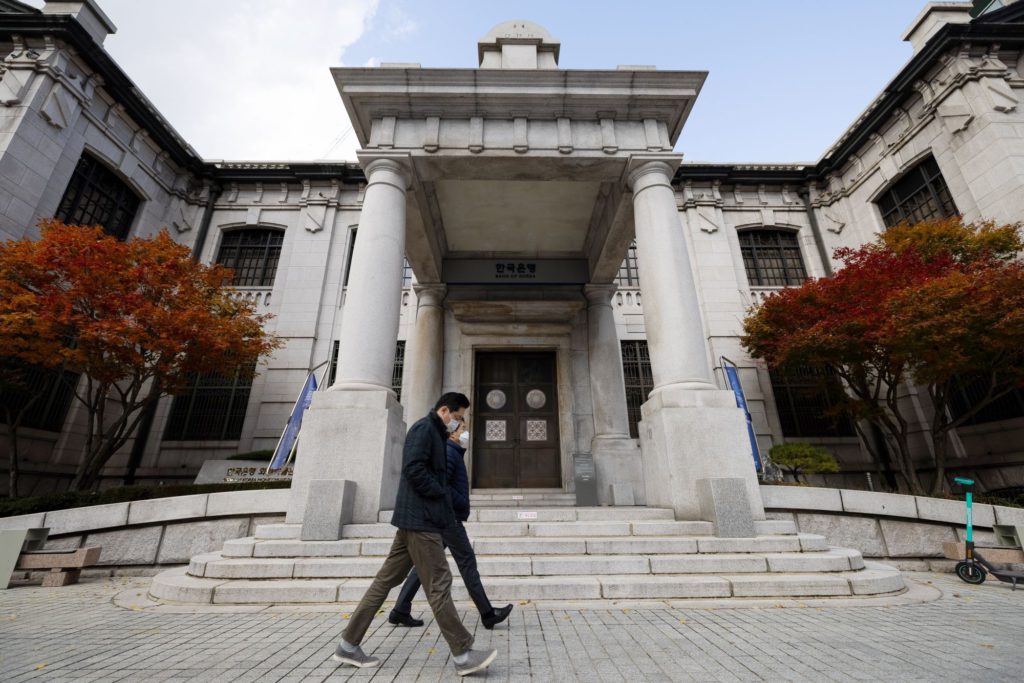
South Korea could have a high inflation rate for a prolonged period of time along with other countries as upside risks to prices rise, according to Bank of Korea analysts. 

The expansionary fiscal policies and abundant liquidity in global markets provided during the pandemic will continue to accelerate inflation as there is a “time lag” of those policies, according to a report by five analysts at the central bank released Sunday. 

Concerns are growing that the supply disruption in China — South Korea’s biggest trade partner — may last a long time, adding to worries over surging commodity prices amid Russia’s invasion of Ukraine, they said. 

The BOK needs to take monetary policy measures to curb inflation and soothe worries of economic participants over rising consumer prices, the analysts said. If the bank doesn’t take active steps to combat price increases, it may cause “huge damage” on the stability of Korea’s macroeconomy, they said, citing stress tests they had conducted. 

South Korea’s plan for relaxing social-distancing measures will add to inflationary pressures as consumer spending will likely recover to pre-Covid levels, the report said. 

South Korea to Lift Most Social Distancing Rules From April 18

The South Korean central bank hiked its key policy rate by a quarter percentage point last week to 1.5% despite the absence of a governor. While inflation remains a key factor for future rate decisions, it’s hard to ignore the risk of an increase on economic growth, Joo Sang-yong, acting chairman of the policy committee, said at a press briefing. 

Rhee Chang-yong, nominated to be the next Bank of Korea governor, also said the monetary authority needs to contain inflation, Yonhap News reported, citing a statement by him Sunday sent to lawmakers on his opinions on a rate hike. 

The BOK needs to “adjust the level of easing” in its monetary policies as high inflation in South Korea is expected to “continue for quite a long period,” he was quoted as saying by Yonhap. Rhee also said that he supported the latest rate hike by the BOK.

When asked if the bank’s potential rate hikes at the upcoming meetings would be inconsistent with President-Elect Yoon Suk Yeol’s extra budget plan, Rhee said he will make efforts to communicate with the new government, Yonhap reported. 

Bank of Korea Hikes Rates Without Governor as Price Fears Mount

(Updates with a Yonhap News report on nominated governor’s comments.)

More stories like this are available on bloomberg.com

©2022 Bloomberg L.P.

Twitter Board’s Economic Interest Not Aligned With Holders: Musk

(Bloomberg) — The economic interests of Twitter Inc.’s board are not aligned with shareholders, Elon Musk said Saturday.

The billionaire was responding to a tweet about boardmembers’ stock holdings, saying that with the departure of Jack Dorsey, the board “collectively owns almost no shares.” 

Twitter on Friday set up a shareholder rights plan that could thwart Musk’s hostile acquisition bid. The plan is exercisable if a party acquires 15% of the stock without prior approval and seeks to ensure that anyone taking control of Twitter through open market accumulation pays all shareholders an appropriate control premium. 

Read more: Twitter Adopts ‘Poison Pill’ to Ward Off Musk Takeover

Musk has been waging a social media campaign to sway public opinion in favor of his bid. The Tesla co-founder on Thursday tweeted that the board risks liability if it acted against shareholders. He has also thanked followers who voted in online polls supporting his bid. 

More stories like this are available on bloomberg.com

©2022 Bloomberg L.P.

Musk’s Venting About SEC Ires Investors Suing Over 2018 Tweets

(Bloomberg) — Elon Musk’s public venting about the U.S. Securities and Exchange Commission at a TED talk went too far and a judge should make him shut up, according to investors who are suing the billionaire and Tesla Inc.

The electric-car maker chief executive officer’s caustic comments about the federal regulator threaten to taint a jury trial set for late May in San Francisco over shareholder claims that Musk defrauded them when he tweeted in 2018 about taking the company private, the investors said in a court filing late Friday.

Read More: Musk Hints at Twitter Plan B, Lambastes SEC Over Settlement

“The gratuitous and apparently premeditated nature of Musk’s comments and his flagrant disregard of the opinions of the SEC, this court, and his own written consent, strongly suggest that Musk is likely to continue making similar statements up to trial,” the investors said.

The investors took particular umbrage at comments by the world’s richest person during a TED event this week in Vancouver. He said “I was forced to concede to the SEC unlawfully” and settle the agency’s lawsuit alleging that the 2018 tweets were fraudulent. He also said the pressure he faced to settle was “like having a gun to your child’s head.”

The shareholders urged U.S. District Judge Edward Chen to order the multi-billionaire to keep his opinions to himself until after trial, lest he confuse potential jurors.

“Such confusion could taint any further determinations that the jury may need to make, such as the liability of Tesla, Inc. and its board or the amount of damages owed by Musk and the other defendants,” lawyers for the investors wrote.

Alex Spiro, a lawyer for Musk and Tesla, responded Saturday.

“Nothing will ever change the truth which is that Elon Musk was considering taking Tesla private and could have,” he said. “All that’s left some half decade later is random plaintiffs lawyers trying to make a buck and others trying to block that truth from coming to light all to the detriment of free speech.”

More stories like this are available on bloomberg.com

©2022 Bloomberg L.P.

Social Media Buzz: Coachella, Don Lemon, Jackie Robinson

(Bloomberg) — What’s buzzing on social media this morning: 

BUZZING COMPANIES

Twitter is taking steps to block Elon Musk from acquiring the company by deploying a so-called poison pill. It allows existing investors to buy more stake at a discounted price, effectively diluting the ownership of the hostile party. The plan would take effect if Musk’s 9% stake grows to 15% or more.

BUZZING HEADLINES

Russia banned U.K. Prime Minister Boris Johnson and several high-ranking U.K. officials from entering the country over their support of Ukraine. The action is viewed as largely symbolic given Western officials have all but stopped traveling to Russia after it invaded Ukraine. The U.K. has been among the most aggressive Western nations in imposing sanctions on Moscow and supplying military aid to Kyiv.

New York City celebrated the 75th anniversary of Jackie Robinson’s debut as the first Black Major League Baseball player on Friday by temporarily renaming the busy intersection of 42nd Street and Broadway in Times Square “Jackie Robinson Way.”

The second day of Coachella is underway after the opener featured performances from Harry Styles, Justin Bieber and Daniel Caesar.

BUZZING TWEETS

Don Lemon is launching his own show on CNN+, the new streaming channel of the cable news network. The service garnered 100,000 subscribers in its first week, Bloomberg News reported, a strong start in the competitive market for news and streaming subscriptions.

More stories like this are available on bloomberg.com

©2022 Bloomberg L.P.

Close Bitnami banner
Bitnami