Bloomberg

Netflix and Meta See Earnings Pessimism After Slumps 

(Bloomberg) — Meta Platforms Inc. and Netflix Inc. may have a hard time turning around the slumps that have wiped more than a third off their market value this year, as ongoing business headwinds and a weak macroeconomic backdrop keep investors at bay despite historically cheap multiples.

The two internet giants were among the most high-profile disappointments of the last earnings season, with slowing growth at both companies sparking selloffs that erased hundreds of billions of dollars in value. With fresh results around the corner, analysts are showing they remain skeptical by trimming their price estimates. The average target for both has fallen to their lowest since 2020, according Bloomberg-compiled data.

Netflix shares fell 1.1% on Thursday, while Meta dropped 0.4%.

This reporting season comes at a time when inflation and rising bond yields have underlined concerns that the economy could be headed toward a recession. 

While this has weighed on tech broadly, Netflix and Meta suffered bigger selloffs. The streaming giant’s growth has slowed more than Wall Street forecast amid mounting competition for viewers, while Meta’s Facebook also is struggling to draw new users at the same time that it’s investing billions to expand in the so-called metaverse.

“The outlook is incredibly uncertain, and when the market is as uncertain as it is right now, investors will favor names with more certain fundamentals,” said Tavis McCourt, institutional equity strategist at Raymond James. “This isn’t the kind of environment where, if you disappoint, you can expect to bounce back quickly.”

Netflix investors’ caution about subscriber growth was amplified after the video-streaming company pulled out of Russia following the country’s invasion of Ukraine. 

For Meta, analysts continue to see headwinds stemming from a changed privacy policy at Apple Inc., which has diminished the Facebook parent’s ability to target ads. Meta “is likely to see another rocky quarter” given this issue, RBC Capital Markets wrote in a note.

Netflix has shed more than 40% so far this year while Meta lost 36%. Both are among the worst-performing members of the Nasdaq 100 Index, which is down 13% in 2022. 

The selling has both stocks trading at a discount to their historical averages. Netflix now sells for 29 times forward earnings, less than half its five-year average. Meta is at less than 15 times estimated profits, cheaper than the S&P 500 Value Index.

Michael Cuggino, president and portfolio manager of the Permanent Portfolio Family of Funds, said he had “nibbled a little” on Meta shares given the valuation, though broader concerns were keeping him from buying more aggressively.

“The valuation is reasonable, especially for a growth tech name, but the uncertainties are real,” he said in a phone interview, citing Apple’s policy and the weaker backdrop for equities in general. “The biggest X factor is a recessionary environment where ad budgets are significantly reduced.”

Tech Chart of the Day

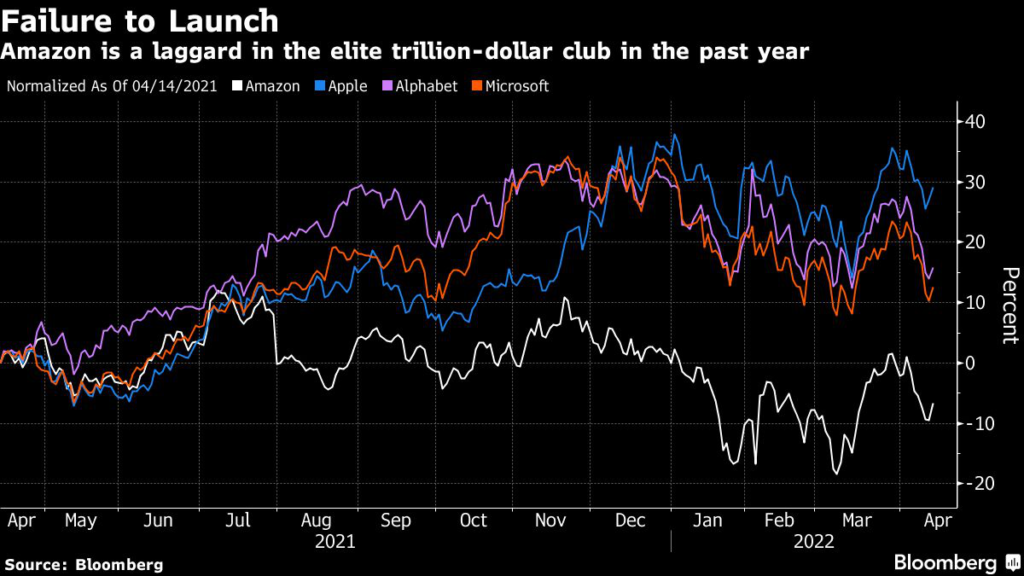
Shares of Amazon.com Inc. have lagged behind those of fellow trillion-dollar megacaps Apple, Microsoft Corp. and Alphabet Inc. over the past year as the e-commerce giant faced tough year-over-year comparisons to 2020, when Covid-induced lockdowns boosted sales. It also launched a $10 billion buyback program — the smallest repurchase authorization in the trillion-dollar club. However, the stock has recently received retail investor interest after Amazon announced a 20-for-1 stock split last month.

Top Tech Stories

  • Taiwan Semiconductor Manufacturing Co. raised its sales outlook for the year after quarterly earnings jumped 45%, helped by solid demand for chips used in everything from smartphones to cars
  • China’s top anti-graft watchdog was among the agencies involved in a recent inquiry into links between Jack Ma’s Ant Group Co. and state-owned Chinese companies, according to people familiar with the matter
  • Tens of thousands of staff at China’s main iPhone manufacturing base will have to go undergo mandatory Covid-testing on Thursday, a potential risk to global supply of Apple’s signature device
  • Blackstone Inc.’s growth investing team committed more than $1 billion of financing to Europe tech companies over the last year, and it has plans to increase that further.
  • A federal judge cut to $15 million a staggering $137 million in damages awarded by a jury in a racial discrimination case against Tesla Inc. over abusive conduct toward a former elevator operator at its northern California factory
  • Synopsys Inc., the biggest supplier of software used to design semiconductors, is under investigation by the U.S. Department of Commerce for possibly passing key technology to banned Chinese companies, according to people familiar with the matter

(Updates to market open.)

More stories like this are available on bloomberg.com

©2022 Bloomberg L.P.
Retail Sales in U.S. Show Impact of Surging Gasoline Prices

(Bloomberg) — U.S. retail sales picked up in March, helped by a surge in gas station receipts that masked mixed results in other large spending categories as consumers contend with decades-high inflation.

The value of overall retail purchases climbed 0.5%, Commerce Department figures showed Thursday. While that was just shy of expectations, the prior month was revised up sharply to show a 0.8% increase.

The March advance was led by a 8.9% jump in spending for gasoline. Excluding receipts at gas stations, sales fell 0.3% last month as vehicle and e-commerce purchases — the two-largest spending categories — declined. The figures aren’t adjusted for inflation.

“In some discretionary categories, such as apparel and restaurant spending, the rise in nominal sales outstripped inflation and suggested that the easing in pandemic-related restrictions is helping consumer spending, while in other components it was clear that inflation played a large role in boosting spending,” Omair Sharif, founder of Inflation Insights LLC, said in a note.

After the largest monthly percentage increase in average gasoline prices in six years, and along with rising food and shelter costs, Americans have tougher spending choices to make beyond essentials. Russia’s war in Ukraine is driving up costs for energy and commodities, adding to rampant inflation that’s crumbling purchasing power.

There are other signs that that’s already happening. Retailers like Bed Bath & Beyond Inc. blamed slowing sales on inflation that’s hurting consumer confidence, and and grocery chain Albertsons Inc. is bracing for less spending by lower-income customers as food prices surge.

A report Tuesday showed consumer prices rose 1.2% in March from a month earlier, underscoring the painfully high cost of living and reinforcing pressure on the Federal Reserve to tighten policy even more aggressively. Data out Wednesday showed producer prices also rose notably, which will feed through to consumers even more.

Retail sales excluding motor vehicles and gasoline rose 0.2% last month after a 0.1% dip in February, the Commerce Department’s report showed.

Balance Sheets

Still, household balance sheets remain healthy by several measures, with the unemployment rate near the lowest in five decades at 3.6% and elevated savings throughout the pandemic.

Separate data Thursday showed initial jobless claims rose slightly last week but remained at a historically low level. Applications for benefits increased by 18,000 to 185,000.

Ten of the 13 retail categories showed growth last month. Outside of gas stations, sales at general merchandise stores, electronics and appliances merchants and clothing outlets also rose. Non-store retailers, the second-largest sales category and volatile from month to month, fell 6.4%.

Receipts at grocery stores increased 1.3%, which may have reflected a pickup in food prices. Restaurant sales, the report’s only services component, increased 1% after a 3% gain. Some eateries are removing more expensive menu items and promoting deals in response to consumers feeling the squeeze of inflation.

Still, dining out will be one of the first luxuries to go for price-conscious consumers, as well as impulse purchases, driving and other experiences, according to a nationally representative survey conducted by the Harris Poll for Bloomberg News. The poll found about 84% of Americans plan to cut back on spending as a result of higher prices.

So-called control group sales — which economists use to calculate gross domestic product and exclude food services, auto dealers, building materials stores and gasoline stations — fell 0.1% in March from a month earlier.

(Adds economist’s comment)

More stories like this are available on bloomberg.com

©2022 Bloomberg L.P.
Tata to Offer Outside Brands on Its Super App to Take on Rivals

(Bloomberg) — The $103 billion Tata Group’s all-in-one e-commerce application will offer products and services other than its own, as the conglomerate prepares to take on Amazon.com Inc., Walmart Inc. and Reliance Industries Ltd. in the digital space.

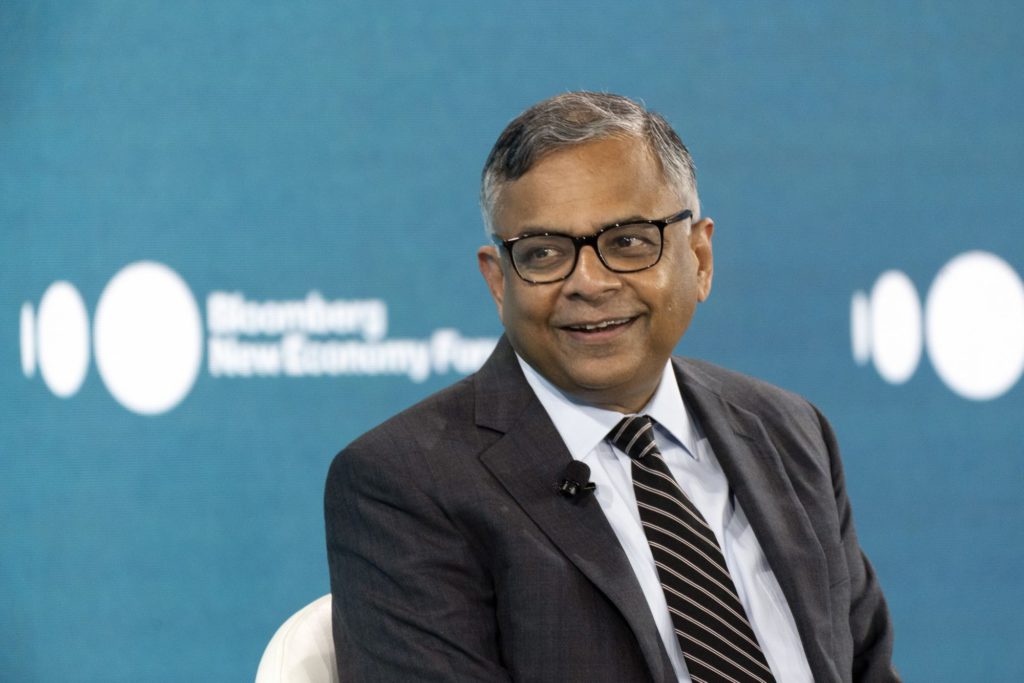
“The decisions on adding new products and services to Tata Neu beyond Tata group will be customer driven, not contract driven,” said Natarajan Chandrasekaran, chairman of its holding company Tata Sons Pvt. 

Mumbai-based Tata Digital Pvt.’s digital services platform, which went live to consumers on April 7, allows users to buy everything from apparel to airline tickets. It offers in-house brands including Croma, Westside, AirAsia India, the Taj chain of luxury hotels and BigBasket.

Described as a “super-app” and in the pipeline since at least mid-2020, it has been downloaded 2.2 million times in the past week, according to Tata Digital Chief Executive Officer Pratik Pal. While the app will add newer categories and services, he said that the company isn’t currently focused on getting external funding.

More stories like this are available on bloomberg.com

©2022 Bloomberg L.P.
Crypto’s Top Decentralized Spot Market Eyes Way to Dominate Web3

(Bloomberg) — Uniswap Labs, the main developer of the biggest decentralized exchange for spot-market cryptocurrency trading, is launching computer code that can embed its capabilities into any website, a step that could expand its growth.

The so-called swap widget, which can be added by pasting in a line of code, will let OpenSea users swap various tokens without leaving the web site that runs it. The widget will also be initially available on the sites Oasis.app and Friends With Benefits. 

PayPal Holdings Inc. used such a tactic decades ago to expand its reach and spur the growth of online commerce, said Richard Crone, the head of Crone Consulting LLC. In the cryptocurrency industry, however, such widgets are less pervasive, with Coinbase Global Inc. among those that provide them for certain functions. 

“We believe that value exchange is essential to Web3,” which is a slew of apps using tokens and blockchains, Mary-Catherine Lader, chief operating officer at Uniswap, said in an interview. “To grow, we have to grow the whole market.”

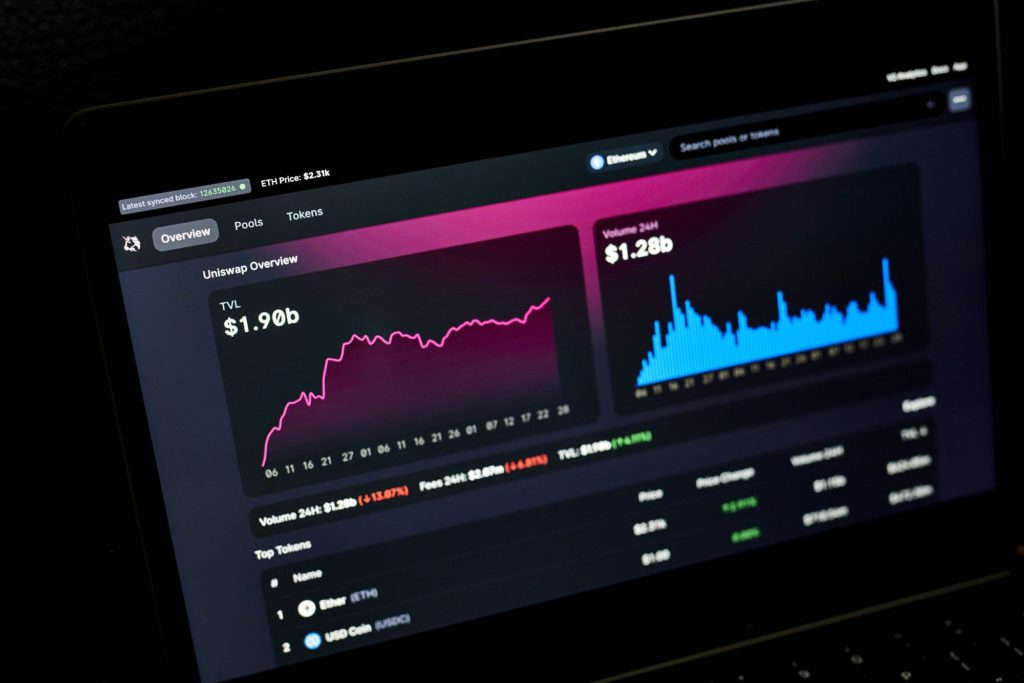
Since the start of 2021, Uniswap’s total value locked — a measure of how much money has been put into its platform — has grown by more than 200% to $7.8 billion, according to researcher CryptoCompare. But by that metric, its market share on Ethereum has dropped from 12.4% at the start of 2021 to 6.4% as financial apps like Curve and Aave expanded, said David Moreno Darocas, a research analyst at CryptoCompare.

The widget is a key part of Uniswap’s growth strategy, which recently lead to the company’s launch of a venture arm to invest in Web3 startups. Uniswap has also been expanding onto other blockchains, such as Polygon, and is quickly gaining traction there.

Uniswap Chief Executive Officer Hayden Adams founded the New York-based decentralized exchange after losing his job as a mechanical engineer at Siemens AG in 2017. Since then, Uniswap has come to dominate decentralized spot trading on Ethereum, with only dydx, which focuses on crypto derivatives, having higher trading volumes, according to CoinMarketCap. Currently, Uniswap’s trading volume is similar to FTX, a major centralized spot exchange, according to CoinMarketCap.

Unlike most traditional crypto exchanges, Uniswap doesn’t charge issuers to list new tokens, generating revenue instead through transaction fees.

More stories like this are available on bloomberg.com

©2022 Bloomberg L.P.
Turkey Keeps Rates Unchanged Again as Lira’s Calm Buys Time

(Bloomberg) — Sign up for the New Economy Daily newsletter, follow us @economics and subscribe to our podcast.

Turkey kept interest rates unchanged for a fourth straight month despite a surge in inflation past 60%, putting more onus on the central bank’s unconventional policies to tether the lira.

The Monetary Policy Committee held its benchmark at 14% on Thursday, as forecast by all analysts surveyed by Bloomberg, prolonging a pause in place since it halted a series of rate cuts at the end of last year.

The decision reflects a risky balancing act that hinges on keeping Turkey’s currency stable for longer with measures that include foreign-exchange sales by state banks and a costly program to shield savers from lira weakness. Rather than adding to Turkey’s rate buffer, authorities are now leaning even more heavily on other policies that could bring in more hard currency and boost the central bank’s reserves. 

Deepening trade imbalances and the world’s most negative borrowing costs when adjusted for prices have made the $800 billion economy increasingly vulnerable at a time of intensifying global tightening led by the U.S. Federal Reserve.

Turkish policy makers said in Thursday’s decision that they were keeping an eye on the nation’s current account with higher energy prices widening the trade gap. The central bank is also assessing growth in long-term investment loans against the need to keep the current-account in check.

“In this context, the committee decided to strengthen the macroprudential policy set,” the bank said, leaving the door open for fringe measures that might be used to keep credit growth strong without further stoking inflation.

What Bloomberg Economics Says…

“The economy needs higher rates. But political considerations not economic indicators drove the decision, further damaging the credibility of the bank and raising the risks for another lira crisis.”

— Ziad Daoud, chief emerging markets economist. For full react, click here.

Under pressure from President Recep Tayyip Erdogan, a self-described “enemy” of interest rates, the central bank led by Governor Sahap Kavcioglu has yet to signal it’s anywhere near a policy adjustment after ending last year with 500 basis points in monetary easing. The multiple rounds of rate cuts triggered a collapse in the currency and touched off inflation.

The soaring cost of commodities and energy has left Turkey more exposed this year. Central banks around the world are meanwhile raising rates to combat inflation amid risks from Russia’s invasion of Ukraine and worsening supply-chain disruptions. 

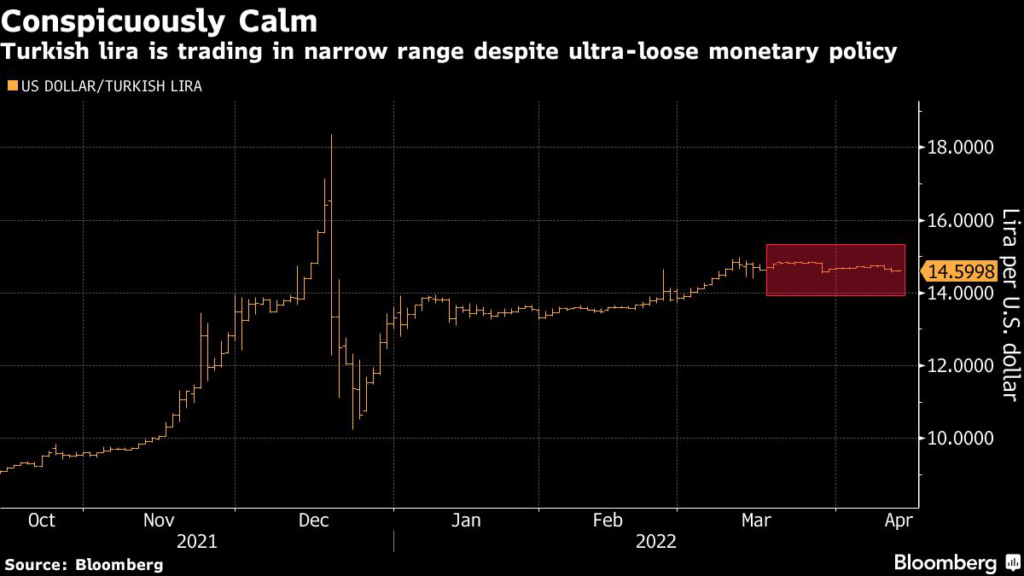
Turkey’s currency moved little after the decision and was trading 0.2% weaker at 14.6210 per dollar as of 2:19 p.m. in Istanbul. It’s down nearly 45% from a year earlier, the biggest drop among major currencies tracked by Bloomberg, but most of that decline took place in 2021.

A somewhat more stable lira in recent months has hardly moved the needle for inflation, which surged in March to a fresh two-decade high of over 61% from a year earlier. Finance Minister Nureddin Nebati now anticipates price growth to start declining from December — after earlier predicting it could peak in April and then expecting it will slow from this summer.  

The central bank’s arguments to justify its decision Thursday “are not particularly convincing to all those economists who have been taught at universities that in order to regain control over surging inflation a central bank needs to raise interest rates,” said Piotr Matys, an analyst at InTouch Capital Markets Ltd.

(Updates with central bank comments starting in fifth paragraph, economist comment in last.)

More stories like this are available on bloomberg.com

©2022 Bloomberg L.P.
VW Sees Profit Surge on $3.8 Billion Hedging Boost

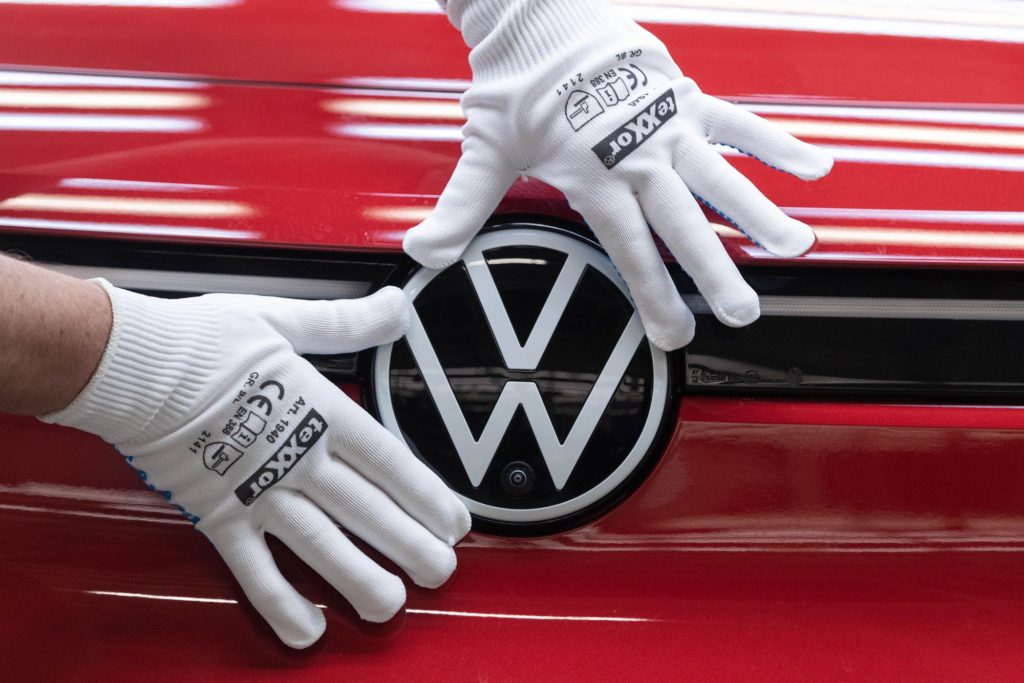
(Bloomberg) — Volkswagen AG’s commodity trading profits are outshining carmaking earnings after the company’s nickel hedging position surged in value following last month’s historic short squeeze.

Gains in commodity hedging positions will add 3.5 billion euros ($3.8 billion) to first-quarter earnings, Europe’s biggest automaker said Thursday. Total operating profit before special items is expected to almost double in the period to 8.5 billion euros, with strong operational performance also driving returns.

VW shares fell 2.1% at 1:27 p.m. in Frankfurt, taking the decline since the start of the year to about 17%.

VW has one of the largest long positions in nickel on the London Metal Exchange, where a huge squeeze in March stunned traders before the exchange stepped in. Nickel, important for making electric-vehicle batteries, surged 55% during the first quarter, as concerns over supply also fanned gains. 

VW and other major commodities consumers use hedging instruments to shield against often volatile price moves on raw materials they depend on. Russia’s invasion of Ukraine is exacerbating an already tight supply of a range of inputs such as nickel and aluminum as the global economy recovers following the pandemic. Sanctions against Russia, a major source of commodities, are further squeezing supplies.

The illustrative mark-to-market gain on VW’s nickel hedges disclosed in its annual report would have been about 1.5 billion euros, according to Bloomberg calculations. VW’s aluminum position would have gained about 500 million euros, having been valued at 2.5 billion euros at the start of the year. VW also has forward contracts and swaps for copper and coal, alongside price protection on platinum, palladium and rhodium.

Supply Issues

The carmaker, hit by a range of component shortages led by semiconductors, also warned of renewed pressure on already fragile supply lines. VW halted a number of plants in Europe following the start of war after manufacturers of wire harnesses in Ukraine were disrupted. 

The company’s global deliveries slumped 31.4% last month to end a difficult sales quarter. VW said net cash flow of its automotive division is at around 1.5 billion euros.

There is “still a risk that further developments in the Ukraine war will have a negative impact,” Volkswagen said. “This may also result from bottlenecks in the supply chain.” 

(Updates with VW’s global delivery figures in 8th paragraph.)

More stories like this are available on bloomberg.com

©2022 Bloomberg L.P.

South Africa Gauge Signals Strong First-Quarter Economic Growth

(Bloomberg) — South Africa’s economy likely grew more than 2% in the first quarter, beating economists’ forecasts, an index with a strong correlation to gross domestic product shows. The BankservAfrica Economic Transactions Index, which measures EFT-originated transactions, increased 2.4% in the first quarter. That suggests growth may have exceeded 2% in the three months through …

South Africa Gauge Signals Strong First-Quarter Economic Growth Read More »

South Africa Declares Floods a Disaster After More Than 300 Die

(Bloomberg) — South Africa declared floods that killed more than 300 people in the eastern KwaZulu-Natal province a disaster, enabling the government to free up funds to assist with reconstruction in the area. The heaviest rainfall in at least six decades this week caused landslides, interrupted port operations, damaged roads and washed away houses. At …

South Africa Declares Floods a Disaster After More Than 300 Die Read More »

Here’s The Message Elon Musk Sent to Make His $43 Billion Twitter Offer

(Bloomberg) — Elon Musk’s $43 billion offer to buy Twitter — which was made public on Thursday — was first made in a 281-character message to the company. Twitter’s character limit for a tweet is 280.

“As I indicated this weekend, I believe that the company should be private to go through the changes that need to be made. After the past several days of thinking this over, I have decided I want to acquire the company and take it private. I am going to send you an offer letter tonight, it will be public in the morning. Are you available to chat?” according to an SEC filing.

The filing also included a voice script in which he said the $54.20-per-share offer was his best and final. 

“I am not playing the back-and-forth game,” Musk said. “I have moved straight to the end. It’s a high price and your shareholders will love it. If the deal doesn’t work, given that I don’t have confidence in management nor do I believe I can drive the necessary change in the public market, I would need to reconsider my position as a shareholder.” 

He made clear that “this is not a threat, it’s simply not a good investment without the changes that need to be made. And those changes won’t happen without taking the company private.”

Formal Letter

Musk then sent the following formal letter to Bret Taylor, chairman of Twitter’s board: 

I invested in Twitter as I believe in its potential to be the platform for free speech around the globe, and I believe free speech is a societal imperative for a functioning democracy.  

However, since making my investment I now realize the company will neither thrive nor serve this societal imperative in its current form. Twitter needs to be transformed as a private company.

As a result, I am offering to buy 100% of Twitter for $54.20 per share in cash, a 54% premium over the day before I began investing in Twitter and a 38% premium over the day before my investment was publicly announced. My offer is my best and final offer and if it is not accepted, I would need to reconsider my position as a shareholder.

Twitter has extraordinary potential.  I will unlock it.

Read this next:  How Jack Dorsey Quit Twitter to Become Bitcoin’s Spiritual Leader

More stories like this are available on bloomberg.com

©2022 Bloomberg L.P.

Elon Musk Launches $43 Billion Hostile Takeover of Twitter

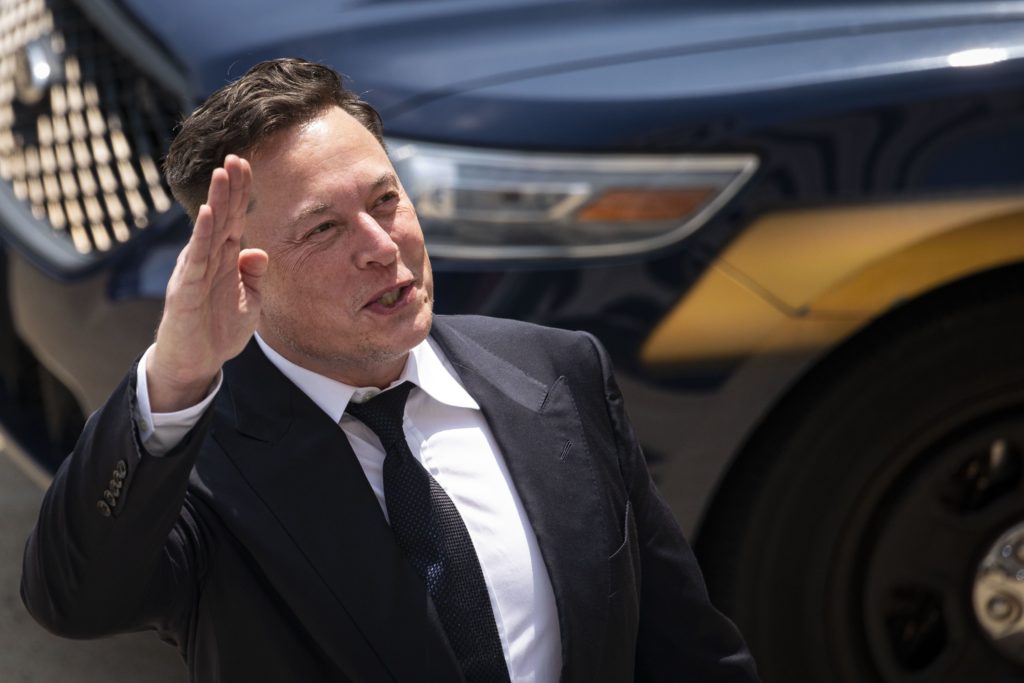
(Bloomberg) — Elon Musk has made a “best and final” offer to buy Twitter Inc., saying the company has extraordinary potential and he is the person to unlock it.

The world’s richest person will offer $54.20 per share in cash, representing a 54% premium over the Jan. 28 closing price and a value of about $43 billion. The social media company’s shares soared 18% in pre-market trading.

Musk, 50, announced the offer in a filing with the U.S. Securities and Exchange Commission on Thursday, after turning down a potential board seat at the company. The billionaire, who also controls Tesla Inc., first disclosed a stake of about 9% on April 4. Tesla shares fell about 1.5% in pre-market trading on the news. 

The bid is the latest saga in Musk’s volatile relationship with Twitter. The executive is one of the platform’s most-watched firebrands, often tweeting out memes and taunts to @elonmusk’s more than 80 million followers. He has been outspoken about changes he’d like to consider imposing at the social media platform, and the company offered him a seat on the board following the announcement of his stake, which made him the largest individual shareholder.

After his stake became public, Musk immediately began appealing to fellow users about prospective moves, from turning Twitter’s San Francisco headquarters into a homeless shelter and adding an edit button for tweets to granting automatic verification marks to premium users. One tweet suggested Twitter might be dying, given that several celebrities with high numbers of followers rarely tweet. 

Unsatisfied with the influence that comes with being Twitter’s largest investor, he has now launched a full takeover, one of the few individuals who can afford it outright. He’s currently worth about $260 billion according to the Bloomberg Billionaire’s Index, compared with Twitter’s market valuation of about $37 billion.

In a letter to Twitter’s board, Musk said he believes Twitter “will neither thrive nor serve [its free speech] societal imperative in its current form. Twitter needs to be transformed as a private company”

The takeover is unlikely to be a drawn-out process. “If the deal doesn’t work, given that I don’t have confidence in management nor do I believe I can drive the necessary change in the public market, I would need to reconsider my position as a shareholder,” said Musk.

Musk informed Twitter’s board over the previous weekend that he thought the company should be taken private, according to today’s statement. 

The $54.20 per share offer is “too low” for shareholders or the board to accept, said Vital Knowledge’s Adam Crisafulli in a report, adding that the company’s shares hit $70 less than a year ago.

Musk has hired Morgan Stanley as his adviser for the takeover. The offer price also includes the number 420, widely recognized as a coded reference to marijuana. He also picked $420 as the share price for possibly taking Tesla private in 2018, a move that brought him scrutiny from the SEC.

I invested in Twitter as I believe in its potential to be the platform for free speech around the globe, and I believe free speech is a societal imperative for a functioning democracy.  

However, since making my investment I now realize the company will neither thrive nor serve this societal imperative in its current form. Twitter needs to be transformed as a private company.

As a result, I am offering to buy 100% of Twitter for $54.20 per share in cash, a 54% premium over the day before I began investing in Twitter and a 38% premium over the day before my investment was publicly announced. My offer is my best and final offer and if it is not accepted, I would need to reconsider my position as a shareholder.

Twitter has extraordinary potential.  I will unlock it.

Elon Musk’s full letter to Twitter’s board

(Additional context throughout, Musk’s letter)

More stories like this are available on bloomberg.com

©2022 Bloomberg L.P.
Close Bitnami banner
Bitnami