Bloomberg

Private Fundraising Deals Slump as Public Valuations Tumble

(Bloomberg) — Private companies globally are pulling back sharply on raising new funds, as pressure on public markets begins to weigh on the lofty valuations sought by fast-growing startups.

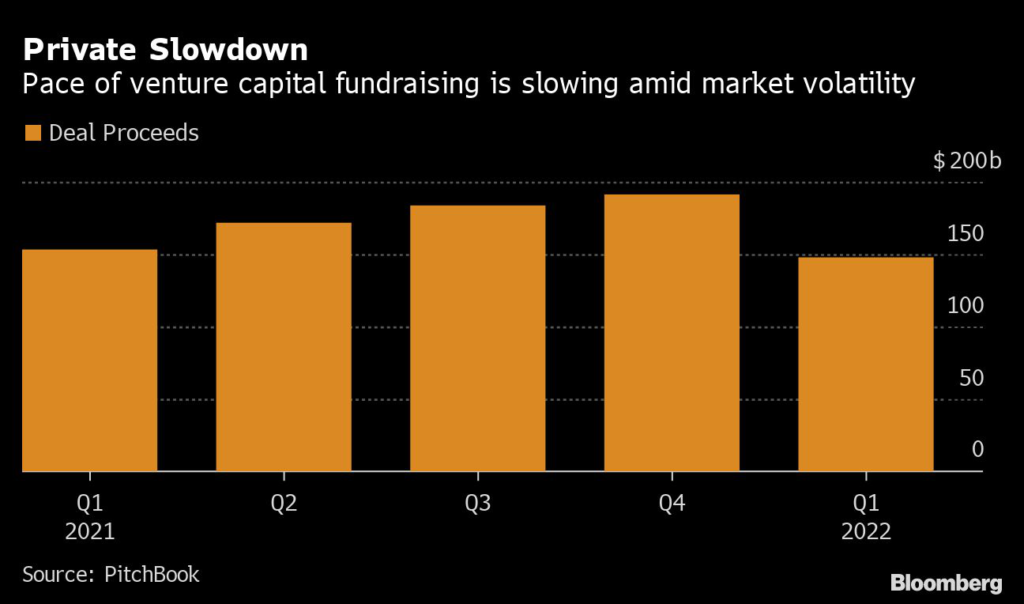
Venture capital transactions raised $148 billion globally in the first quarter, down nearly 25% from the last three months of 2021, according to data provided by analytics firm PitchBook.

Rising interest rates, surging inflation and Russia’s invasion of Ukraine have all put a damper on risk appetite, hitting growth stocks particularly hard. The tech-heavy Nasdaq has tumbled more than 14% from a record high in November, underperforming the 5.4% drop in the S&P 500 Index over the same period.

“The distress in public markets is catching up with private markets,” said Aga Masud, head of private capital markets for Europe, the Middle East and Africa at Bank of America Corp. “A lot of investors are doubling down on their existing investments, rather than putting money in new names.”

Increased Caution

Private capital deals boomed in 2021, reaching $700 billion, the data show. That’s more than the record $655 billion haul for global initial public offering markets last year. But now, the drop in valuations for listed peers is making it harder for startups to justify lofty price tags.

And with IPO markets worldwide largely closed off to blockbuster deals for the time being, private market investors are becoming more cautious about the tickets they write.

“Private market valuations are in large part driven by exit opportunities,” said Isabelle Freidheim, founder and chairman of growth equity and investing firm Athena Technology Acquisition Corp. “Downward pressure on valuations in the public markets affects the private market and is being felt.”

To be sure, some startups still command sky-high valuations. Cryptocurrency firm Blockchain.com and Turkish grocery-delivery company Getir were valued at more than $10 billion each in recent funding rounds. And Swedish payments firm Klarna Bank AB is weighing plans to raise new money at a valuation of roughly $50 billion to $60 billion.

More stories like this are available on bloomberg.com

©2022 Bloomberg L.P.

TSMC Raises Sales Outlook Despite Fears Around Global Demand

(Bloomberg) — Taiwan Semiconductor Manufacturing Co. raised its sales outlook for the year after quarterly earnings jumped 45%, helped by solid demand for chips used in everything from smartphones to cars.

Annual revenue in dollar terms will top the previous outlook for as much as 20%-plus growth, the world’s biggest contract manufacturer of chips said Thursday. Sales will rise to $17.6 billion to $18.2 billion in the quarter through June, it said, implying growth of more than 30%. Analysts were estimating $16.9 billion on average, according to data compiled by Bloomberg.

The company also predicted wider earnings margins, signaling sustained demand for mobile phones, smart televisions and other gadgets from makers such as Apple Inc. and Samsung Electronics Co. even as consumers exit pandemic-era work-from-home arrangements. Meanwhile a chip shortage is yet to ease — the wait times for semiconductor delivery grew again in March due to China’s Covid lockdowns and a Japan earthquake that hit production, according to research by Susquehanna Financial Group.

The forecasts alleviate concerns that the war in Ukraine and Chinese lockdowns that are hampering the world’s biggest market for chips are hitting demand for gadgets.

TSMC to Spend at Least $40 Billion to Address Chip Shortage 

Strong vehicle sales are set to help drive growth this year too — TSMC Chief Executive Officer C.C. Wei said on a conference call that demand for microcontrollers, essential components for cars, remains strong. Automakers are still struggling to secure enough semiconductors, with Stellantis NV saying this week that chip shortages remain at the same level as last year.

Gross margin, or what’s left of sales after production costs are deducted, will expand to 56% to 58% this quarter from 55.6% in the first quarter, TSMC predicted. That’s the widest in at least a decade.

Net income rose to NT$202.7 billion ($7 billion) in the three months through March, topping the NT$186.1 billion analysts estimated  on average. Revenue jumped 36% to a record NT$491.1 billion based on previously reported numbers.

TSMC has kept production running in China, even as many other factories suspended operations to cope with the local pandemic policy. The chipmaker said in end-March that it will rearrange production priorities to deal with a shift in demand caused by Covid restrictions in China.

What Bloomberg Intelligence Says:

TSMC’s inventory strategy on key materials such as silicon wafers and industrial gases will be a key focus at the 1Q results briefing, as rising geopolitical tension and slow global wafer capacity gains keep the supply picture foggy.

– Charles Shum, analyst

Click here for research

The company reiterated that it’s earmarked $40 billion to $44 billion this year to expand and upgrade its facilities — a record outlay intended to keep the company at the forefront of a rapidly evolving technology and sating future demand. But analysts including Credit Suisse’s Randy Abrams warn that semiconductor sector growth could slow in the second half as higher interest rates, China’s covid policies and rising commodity prices sap spending on consumer electronics.

Shares of TSMC have lost about 7% this year, dragged down by a broader decline in global technology stocks and China’s lockdowns which have weighed on consumer demand and affected supply chains. The stock was little changed ahead of the company’s report, which was published after market close.

(Updates with comment from CEO in fifth paragraph)

More stories like this are available on bloomberg.com

©2022 Bloomberg L.P.

Ericsson Says Fines Likely on Iraq Scandal, Misses Estimates

(Bloomberg) — Ericsson AB indicated it faces new fines related to its corruption scandal in Iraq and associated breach notices of its deferred prosecution agreement by the U.S. Department of Justice as the telecommunications networks maker presented its first-quarter earnings report.

The magnitude of any additional payments “cannot at this time be reliably estimated,” it said, avoiding adding clarity on the misconduct and failure to properly inform the U.S. authorities.

“We are engaging with the DOJ” and “we are committed to being super transparent, to follow the DPA completely,” Chief Financial Officer Carl Mellander said in an interview. “There is no provision in the books or anything. We are really in that position where we cannot estimate reliably any monetary impact.”

Shares fells as much as 9% in trading on Thursday.

Earnings

  • The Stockholm-based network equipment manufacturer reported adjusted operating profit of 4.8 billion kronor ($507 million), missing average analyst estimates of 6.44 billion kronor. Profit was hurt by its provision on exiting Russia, Ericsson said.
  • The company said Thursday its adjusted operating margin was 8.7%, compared to an 11.85% average estimate. Sales grew to 55.1 billion kronor in the quarter, above the 53.64 billion kronor expected by analysts.

Key Insights

  • The start to the year has been turbulent with shares plunging by as much as a third after the media revelation, before paring some losses. As shareholders voted against discharging Chief Executive Officer Bjorn Ekholm from legal liability at the company’s annual general meeting in March, the CEO acknowledged that the repercussions of the Iraq episode had “continued under his watch” and that the company still has “a lot more work to do” when it comes to changing culture. He also wowed to step up an overhaul of the company’s compliance function.
  • In March, Ericsson and some managers were named as defendants in a class action suit filed in the U.S. alleging violations of securities laws, in connection with allegedly false and misleading statements on its Iraq business.
  • Ericsson said it continues to work toward closing the acquisition of cloud-based services company Vonage Holdings Corp. during the first half of the year. The Iraq scandal has led to raised questions on whether U.S. authorities might disqualify Ericsson’s bid. Given the “hefty price tag,” analysts have said a walk-away from the acquisition might be a key positive trigger for the share.
  • Earlier in the week, the company said it had decided to halt its Russian operations “indefinitely,” while making a $95 million provision in its network business for the quarter.
  • The global radio access networks market is set to grow 5% this year with faster growth in all areas, up from a prior forecast of 3%, Ericsson said, citing estimates by Dell’Oro. The company sees “really good momentum for 5G,” CFO Mellander said, adding that the company has been even more optimistic as “every time Dell’oro comes with new predictions, they raise those predictions.”
  • Ericsson has also created “a buffer of vital components” to secure customer deliveries amid global supply chain challenges, it said.

Market Context

  • Ericsson shares have lost about 25% in the 12 months to Wednesday’s close.
  • 19 analysts tracked by Bloomberg recommend buying the stock, 10 had a “hold” recommendation and 1 recommended selling.

Get More

  • Statement

(Updates with CFO comments from third paragraph, shares.)

More stories like this are available on bloomberg.com

©2022 Bloomberg L.P.

Cartier CEO Sees Luxury Demand Withstanding Rising Prices

(Bloomberg) — Cartier plans to raise prices in the next several weeks, making it the latest luxury brand to bet its customers are willing to spend more for their high-end watches, jewelry and accessories. 

The “mild” price increase will partially offset the rise of the U.S. and Chinese currencies against the euro, according to Chief Executive Officer Cyrille Vigneron. It will also help to cover higher costs for key materials, such as the diamonds, platinum and gold used in the company’s jewelry, including $275,000 bracelets and $104,000 earrings. 

“We’re in a long-term business, and we have to be careful not to adjust our pricing too quickly,” Vigneron said in an interview. He previously said any potential price increases by Cartier would likely be between 3% and 5%. Some other European luxury houses have been more active — Chanel, for instance, has raised the prices on some its handbags by more than 50%. 

Like many businesses worldwide, high-end brands and luxury watchmakers are raising their prices to counter a bevy of rising expenses — from currency fluctuations to the cost of materials, shipping and labor. While there are signs that lower-income consumers are feeling the squeeze from the highest inflation in decades, rising prices across the economy have yet to deter wealthier shoppers. 

LVMH Isn’t Feeling Pain of War, Inflation Yet: Andrea Felsted

That’s sparked optimism at Cartier and other luxury brands, despite a growing list of potential hurdles to growth. Shares in rival LVMH, which owns Tiffany & Co. and Bulgari, rose this week after reporting strong revenue growth in spite of inflation, Chinese lockdowns and the war in Ukraine. Cartier’s parent, Richemont, isn’t scheduled to release quarterly results until May.

In the long term, “we don’t see so many headwinds coming — hiccups for sure,” Vigneron said. “The overall growth of world wealth and the overall distribution is coming in favor of global luxury.”

So far this year, he said, Cartier has had robust sales in the U.S., Europe, Middle East, South Korea and Japan. Mercedes Abramo, Cartier’s North America CEO, said the region has showed “tremendous resilience.”

That will help to counter an expected temporary dip in Cartier’s Asia business amid China’s Covid-19 lockdowns, Vigneron said. He’s confident the country will bounce back and help maintain global demand for luxury goods. He said Asia’s market has “probably the highest potential for growth” in the next five to 10 years. 

Russian Diamonds

For now, a potential increase in diamond prices could add to cost pressures, Vigneron said. Cartier and rivals including Tiffany have said they would stop purchasing stones mined in Russia following its invasion of Ukraine. The country is the world’s largest source of diamonds by volume. Other nations are likely to step up their production to fill the void, he said, meaning any price increases are likely to be short-lived. 

Cartier continues to pay the salaries of its 250 employees in Russia, and Vigneron said the company has “enough cash in there to be able to hold on for quite some time.” He declined to provide more details. 

In the U.S., Cartier is mulling more brick-and-mortar stores outside of major cities like New York, Miami and San Francisco. First, the company will test whether strong pandemic-era demand in states such as Texas and Florida persists, Abramo said. The company has opened a seasonal pop-up store in Palm Beach, for example, which it plans to keep open for another year. 

Cartier’s toe-dip approach contrasts with some other luxury brands, which have already announced plans to open new stores across the U.S.

Online Sales

E-commerce also has an important role in the company’s planned growth. Online sales surged to 9% of Cartier’s global sales in 2021 — up from 1% in 2019. Vigneron said that percentage is even higher for the U.S., without giving the exact figure. The spike is part of a broader pandemic trend of consumers’ growing comfort with purchasing expensive items online.

Online purchases have slowed some as pandemic restrictions have lifted, but growth remains robust, Vigneron said. That’s helped Cartier reach younger customers — a demographic that Tiffany is also chasing.

Vigneron said that Cartier’s customer base is 65% millennials, or those born between 1981 and 1996. This means that, even though the company dates back to 1847, “we are a young brand,” he said.

More stories like this are available on bloomberg.com

©2022 Bloomberg L.P.

IPhone City Staff in China to Undergo Mandatory Virus Tests

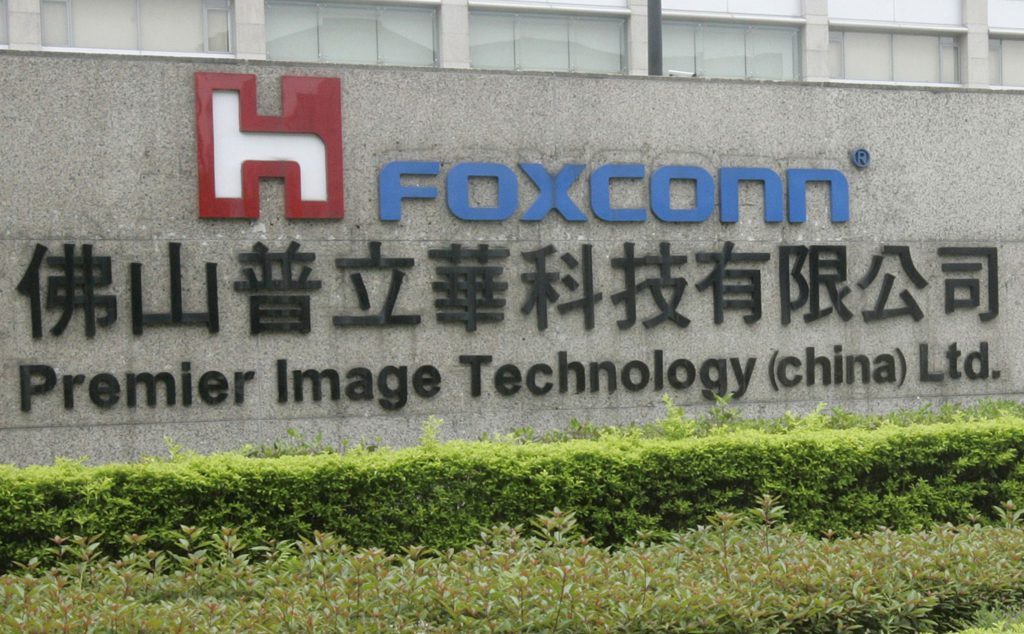
(Bloomberg) — Tens of thousands of staff at China’s main iPhone manufacturing base will have to go undergo mandatory Covid-testing on Thursday, a potential risk to global supply of Apple Inc.’s signature device.

Local authorities in Zhengzhou, where Foxconn Technology Group operates its main iPhone-making complex, ordered compulsory testing for areas that include the plant and adjacent parts of the city.

The mass-testing exercise represents a risk because Chinese officials have been quick to lock down areas in the event of positive tests. This week, more than 30 Taiwanese companies including iPhone assembler Pegatron Corp. and Apple laptop maker Quanta Computer Inc. have now halted production in the electronics hubs of eastern China to comply with local Covid-related restrictions, spelling more trouble for an already fragile global tech supply chain.

“Foxconn is complying with the local government’s Covid-combating measures,” the company said in a statement. “Operations in Zhengzhou are normal right now.”

Apple Laptop Maker Joins Growing Covid Plant Closures in China

President Xi Jinping has championed a zero-tolerance approach to Covid that includes rapid lockdowns if even a small number of people test positive. His administration has held firm, even as public anger simmers in Shanghai and economic costs mount.

“Prevention and control work cannot be relaxed,” Xi said during a trip to the island province of Hainan, the official Xinhua News Agency reported late Wednesday, the same day Shanghai saw a record 27,719 new cases. 

(Updates with Foxconn’s statement from the fourth paragraph)

More stories like this are available on bloomberg.com

©2022 Bloomberg L.P.

Porsche Sales Stumble on Supply Chain Snarls, Virus Restrictions

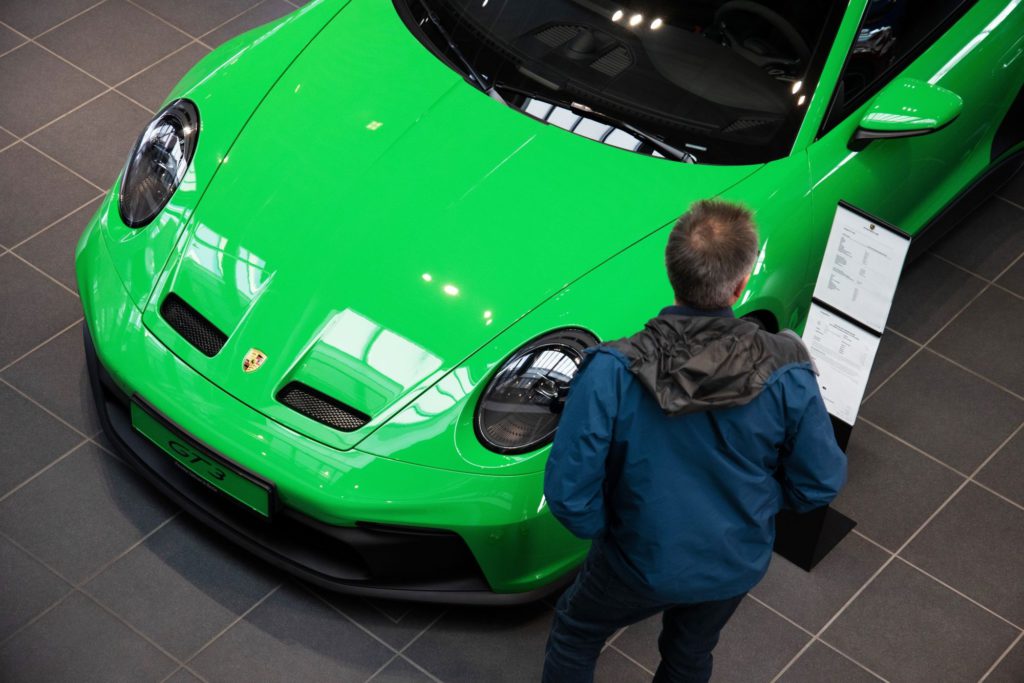
(Bloomberg) — Porsche deliveries fell during the first quarter after outbreaks of coronavirus in China shut dealerships and a number of vehicles were lost at sea when a cargo ship caught fire and sank.

The Volkswagen AG brand’s shipments dropped 5% to 68,426 vehicles globally during the first three months of the year after significant declines in the U.S. and China outweighed a surge in Europe, the sports-car maker said Thursday. Last year, Porsche delivered a record number of vehicles even as the global chip shortage roiled carmakers. 


“The latest outbreak in the pandemic in China and other regions, as well as considerable delivery-related and logistical challenges, have put us under considerable pressure,” Detlev von Platen, Porsche’s sales and marketing chief, said in a statement.

Carmakers continue to battle significant strains from stretched supply chains, chief among them shortages of semiconductors that have idled production lines. While manufacturers have outlined hopes for improved supplies during the second half of the year, Mercedes-Benz AG reported a 15% slump in deliveries during the first quarter. In addition, renewed lockdowns in China to combat coronavirus and Russia’s war in Ukraine is straining global business. 

In China, Porsche’s largest single market, sales fell 20% as government-imposed lockdowns forced trade and consumer businesses to a halt. The carmaker, one of VW’s most profitable units, continues work on an initial public offering targeted for the fourth quarter, which could value to iconic brand at as much as 90 billion euros ($97.5 billion). 

“We are starting the second quarter with hyper-vigilance — particularly in view of the armed conflicts in Ukraine,” said von Platen. “The impact on our business is continuously reviewed and assessed by experts in a task force.”

More stories like this are available on bloomberg.com

©2022 Bloomberg L.P.

Sequoia’s Singh Leaves Zilingo Board Amid Accounting Probe

(Bloomberg) — Sequoia Capital India’s Shailendra Singh has stepped down from the board of troubled Zilingo Pte following questions about the high-profile Singapore startup’s accounting practices, according to people familiar with the matter.

Singh, a managing director at the influential venture capital firm, resigned as a director about a week ago, after the departures of Temasek Holdings Pte’s Xu Wei Yang and Burda Principal Investments Ltd.’s Albert Shyy, said the people, asking not to be identified because the move hasn’t yet been made public. All three firms have been prominent backers of the fashion e-commerce platform once hailed as a symbol of Southeast Asia’s booming internet economy.

Sequoia and Zilingo declined to comment. Sequoia plans to appoint a replacement and still holds the board seat.

Zilingo has suspended Chief Executive Officer Ankiti Bose and begun an investigation into its financial practices, Bloomberg News reported Tuesday. The company had been trying to raise $150 million to $200 million with help from Goldman Sachs Group Inc. when investors began to question its finances as part of the due diligence process, people familiar with the matter said. 

The concerns centered on the way that Zilingo accounted for transactions and revenue across a platform spanning thousands of small merchants, Bloomberg News reported. Singapore regulators have said the company has not filed annual financial statements since 2019.

Bose has disputed allegations of wrongdoing and contends her suspension was due in part to her complaints about harassment. She has hired an attorney to represent her, Abraham Vergis of Providence Law Asia, and has called the investigation a “witch hunt,” according to correspondence reviewed by Bloomberg News. 

Bose and her lawyer have declined to comment.

Read more: Singapore’s Zilingo Is Said to Suspend CEO Amid Probe

The clash represents a dramatic turn of fate for one of Singapore’s most celebrated startups. Zilingo was founded by Bose and Chief Technology and Product Officer Dhruv Kapoor in Singapore seven years ago to help small businesses across South and Southeast Asia sell their goods online. Its valuation surged at one point to almost $1 billion and Bose became a regular speaker on technology and the promise of Southeast Asia.

More stories like this are available on bloomberg.com

©2022 Bloomberg L.P.

TSMC Sales Forecast Tops Estimates on Sustained Gadget Demand

(Bloomberg) — Taiwan Semiconductor Manufacturing Co. forecast sales exceeding analysts’ estimates after earnings jumped 45%, helped by solid demand for chips used in everything from smartphones to cars.

Sales will rise to $17.6 billion to $18.2 billion in the quarter through June, the company said Thursday, implying growth of more than 30%. Analysts were estimating $16.9 billion on average, according to data compiled by Bloomberg. For the full year, revenue in dollar terms will top TSMC’s previous outlook for as much as 20%-plus growth, it said. 

Consumers in the U.S. and Europe are snapping up mobile phones, smart televisions and other gadgets from makers such as Apple Inc. and Samsung Electronics Co. even as they exit pandemic-era work-from-home arrangements. Meanwhile a chip shortage is yet to ease — the wait times for semiconductor delivery grew again in March due to China’s Covid lockdowns and a Japan earthquake that hit production, according to research by Susquehanna Financial Group.

TSMC to Spend at Least $40 Billion to Address Chip Shortage 

Net income rose to NT$202.7 billion ($7 billion) in the three months through March, the world’s biggest contract manufacturer of chips said. Analysts estimated NT$186.1 billion on average. Revenue jumped 36% to a record NT$491.1 billion based on previously reported numbers.

TSMC has kept production running in China, even as many other factories suspended operations to cope with the local pandemic policy. The chipmaker said in end-March that it will rearrange production priorities to deal with a shift in demand caused by Covid restrictions in China.

What Bloomberg Intelligence Says:

TSMC’s inventory strategy on key materials such as silicon wafers and industrial gases will be a key focus at the 1Q results briefing, as rising geopolitical tension and slow global wafer capacity gains keep the supply picture foggy.

– Charles Shum, analyst

Click here for research

The company reiterated that it’s earmarked $40 billion to $44 billion this year to expand and upgrade its facilities — a record outlay intended to keep the company at the forefront of a rapidly evolving technology and sating future demand. But analysts including Credit Suisse’s Randy Abrams warn that semiconductor sector growth could slow in the second half as higher interest rates, Chinese lockdowns and rising commodity prices sap spending on consumer electronics.

Shares of TSMC have lost about 7% this year, dragged down by a broader decline in global technology stocks and China’s lockdowns which have weighed on consumer demand and affected supply chains. The stock was little changed ahead of the company’s report.

More stories like this are available on bloomberg.com

©2022 Bloomberg L.P.

Tiger Global Backs Pakistani Raw-Materials Startup Zaraye

(Bloomberg) — Pakistani raw-materials procurement platform Zaraye raised capital from Tiger Global Management, signaling increasing interest by the world’s top venture investors in the country’s startups after they obtained record funding last year.

The $2.1 million pre-seed round marks Tiger’s first such an early-stage investment in Pakistan and was co-led by Zayn Capital, the Karachi-based upstart said in a statement Thursday. Founded in late 2021, Zaraye helps manufacturers procure raw materials and finance their working capital.

Starting from a low base, the world’s fifth-largest nation is starting to attract venture investors with companies including Kleiner Perkins and Dragoneer Investment Group recently making their first bets in the country. Pakistan had a breakout year in 2021 with startups raising more than $350 million, greater than the amount over the previous six years combined.

Industrial manufacturing makes up 20% of Pakistan’s economy, with the $35 billion raw-materials market accounting for as much as 65% of manufacturers’ costs. Zaraye aggregates multiple buyers and suppliers, reducing the need for manufacturers to make multiple phone calls to get prices, Ahsan Ali Khan, co-founder and chief executive officer, said in an interview.

Zaraye, founded by three university friends, serves customers across textile and construction industries. It also provides financing to small and medium enterprises that find it difficult to get loans from banks.

“Procurement in the manufacturing industry is a massive problem with similar models showing immense success in comparable markets,” said Faisal Aftab, managing partner and co-founder of Zayn Capital BitRate Fund.

More stories like this are available on bloomberg.com

©2022 Bloomberg L.P.

Truckers Caught in Covid Controls Snarl China Supply Chains

(Bloomberg) — China’s network of delivering everything from electronic parts to raw materials to the nation’s factories has nearly ground to a halt as Covid-19 restrictions leave hundreds of thousands of truck drivers caught in a web of quarantine controls. 

The country relies on its 17.3 million truckers to keep store shelves full while also connecting the nation’s ports with its manufacturing hubs. The logjam is preventing crucial deliveries from reaching companies, stalling production in key industrial regions, with the impact likely to continue rippling across the economy even as cities move to loosen lockdowns. 

Tech giants including Semiconductor Manufacturing International Corp. have been hampered by a lack of trucks to ship out chip sets. Logistics jams are creating parts shortages for companies such as iPhone assembler Pegatron Corp. Automakers including Tesla Inc. have shut down factories, awaiting deliveries of semiconductors.

Read more: Apple Laptop Maker Joins Growing Covid Plant Closures in China

China reported a record 29,317 Covid-19 cases for Thursday, the National Health Commission said.

The stalled productivity threatens to further slow the economy, with economists now predicting an expansion of 5% this year, below the official target of around 5.5%. China’s pursuit of a Covid Zero strategy is likely to create supply-chain disruptions that last through the majority of 2022, according to Morgan Stanley.

The impact of Covid measures has been severe. One measure of nationwide truck traffic is already down about 40% from mid-March, with activity around Shanghai itself a mere 15% of normal levels, according to Ernan Cui, an analyst with Gavekal Dragonomics.

“The central government is now trying to clear up these transportation snarls, so the problem may have stopped getting worse,” according to Cui. “But a full recovery is impossible until more cities relax their border controls and other public-health restrictions, which is unlikely before the end of April.”

Trucks dominate China’s local transportation, hauling about three-quarters of total freight, according to data from the Ministry of Transport.

Read more: Here’s How China’s Lockdowns Are Rippling Through the Economy

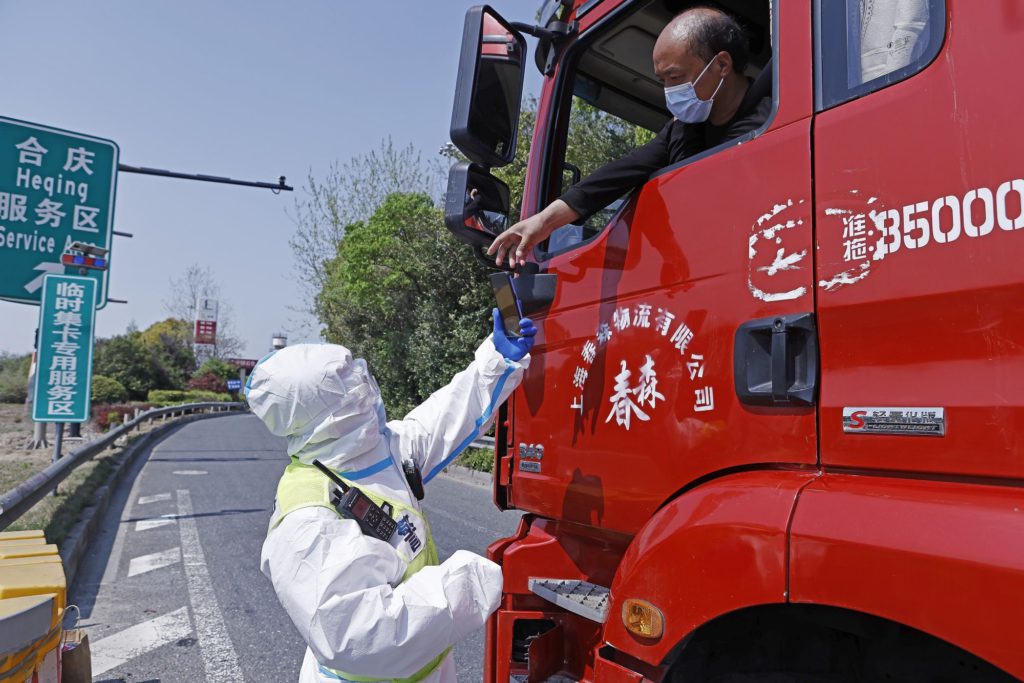
Covid Zero orders are creating difficult conditions for the truckers themselves. Drivers have been hampered by the need to undergo compulsory mass testing being conducted in cities like Shanghai and the need to show negative Covid results at multiple checkpoints. 

In some instances, truck drivers have been sealed inside their cabins, their doors and windows taped over with plastic, leaving them locked inside their vehicles. 

“I was stuck in my truck for almost 24 hours last weekend,” said one driver, surnamed Song, who didn’t want to give his full name. “Like every other exhausted trucker who’s helping out the supply shortage, I need to eat, drink, pee. They sealed our truck windows at almost every check point.”

That’s left long queues of trucks parked on highways with nowhere to go or clogging the few service centers areas that remain open, state broadcaster CCTV reported.    

Truckers were facing onerous conditions even before the lockdowns were implemented, with more than 37% of drivers working more than 12 hours on average a day, according to a June 2021 report from the China Federation of Logistics & Purchasing. 

Many truckers bristle at the restrictions, seeing themselves as essential workers during the pandemic. 

“Delivering materials to build the makeshift hospitals, vegetables and necessity supplies — which of these could be done without us truck drivers?” said one trucker in a video widely circulated on social media. 

The harsh containment measures have paralyzed transportation across the Yangtze Delta region. That includes the world’s largest port of Shanghai, where inefficient Covid testing reduced the number of truck drivers with valid certificates while other drivers stayed away to avoid mandatory quarantines, according to a Caixin report late last month.

The trucking of base metals like copper and zinc in and out of warehouses in Shanghai, including those in the duty-free bonded zones, has largely ground to a halt since the start of this month, according to traders and logistic managers. 

Nick Bartlett, director of CBIP Logistics in Hong Kong, said efforts to divert export cargo from Shanghai to ports such as Ningbo were running into issues. “We’ve got hauliers that have said they are not sure if the highways are going to be open because they might impose restrictions,” he said. “They are worried.”

Read more: Sudden Shanghai Lockdown Snarls China’s Biggest Metals Hub

The auto industry has also been hit by the supply chain snarls. EV maker Nio Inc. has halted production and suspended deliveries because many of its suppliers have had to idle factories. 

“The sprawling pandemic across the regions, in particular in Jilin province and Shanghai city, has a huge impact on both the production end and dealership end,” Cui Dongshu, the secretary general of the China Passenger Car Association, said at a briefing earlier this week. “The change in Covid prevention policies in different cities has imposed an extraordinarily severe impact on logistics.” 

(Adds comment from logistics company in third-last paragraph.)

More stories like this are available on bloomberg.com

©2022 Bloomberg L.P.

Close Bitnami banner
Bitnami