Bloomberg

Jeff Bezos Leaves Amazon for the Final Frontier

(Bloomberg) —

It was the end of an era. Jeff Bezos announced he was leaving the chief executive officer role at Amazon.com Inc. and becoming executive chairman. But as one epic business story was ending, another was beginning. His handpicked successor, Andy Jassy, would have to defuse the company’s mounting confrontations with regulators and employees, including a rising labor union at a Staten Island, New York, warehouse.

The seventh and final episode of Foundering: The Amazon Story chronicles what happened when Bezos’s feet left the ground — literally. One of the world’s wealthiest people wanted to spend more time on space travel, philanthropy and a life of peripatetic indulgence with his new partner, Lauren Sanchez.

Over the summer of 2021, Bezos took an historic trip on a suborbital rocket built by his private space company, Blue Origin LLC. The flight turned into a wild media spectacle. But with pressing problems facing his company — and the planet — how serious is Bezos about deploying his vast resources and keen intellect to solving real problems? And 30 years after he started Amazon in a Seattle area garage, what will be the legacy of Bezos and the company he built?

More stories like this are available on bloomberg.com

©2022 Bloomberg L.P.

Crypto Revolution Spurs Central Banks to Design Money’s Future

(Bloomberg Markets) — When the U.S. and its allies decided to punish Russia for its invasion of Ukraine, they used their power over the global financial system to isolate the nation, crippling its economy and crushing the value of the ruble. But what if, in the future, countries don’t need those U.S.-dominated payment networks?

That’s one of the big questions also being asked now about China’s digital yuan and the European Central Bank’s plans for a digital euro, just two of the many so-called central bank digital currencies (CBDCs) that are being tested or studied around the world. CBDCs have emerged amid the rise of thousands of cryptocurrencies, which are quickly disrupting traditional payment systems and pushing central bankers to innovate to compete.

It’s not the first time. Consumers and businesses used to transact in numerous privately issued banknotes until central banks ended the chaos by monopolizing currency issuance in the 19th and early 20th century. Today, policymakers face a similar challenge of trying to maintain their footprint in global money supply.

CBDCs aim to make payment systems safer, faster, cheaper, and more reliable. Digital money also can give governments in poor nations an alternative to underdeveloped banking systems or help authorities provide lifesaving funds to citizens quickly during a crisis.

The International Monetary Fund estimates that about 100 countries have either rolled out CBDCs or are considering them. The U.S. is among those with a project that’s still on the drawing board, though an executive order by President Joe Biden in March sought to prioritize the study of a digital dollar.

But isn’t money already digital? For most of us, our savings or debts are just numbers on a computer or smartphone screen. We perform most transactions without ever touching paper currency or coins.

CBDCs are different in one important respect. The traditional dollars or euros or yuan on our screen today are actually the liabilities of a commercial bank or other financial institution, which makes them vulnerable to that company’s financial health as well as to actions taken by governments. But CBDCs, like physical cash, are direct liabilities of the central bank. In theory, a CBDC would allow a central bank to transfer currency directly to the digital wallet of an individual, corporation, or other counterparty without needing any other bank or intermediary. In practice, most central banks aren’t willing to cut out the private financial sector completely.

As with most innovations, there are pluses and minuses. Governments will be able to track the movement of central bank digital currencies easily. That will help policy­makers better understand how the economy is functioning. But it could also help in the surveillance of citizens. And given the enormous impact that CBDCs could have on economies, they have to work flawlessly if they’re to be trusted. In their early days, that hasn’t always been the case.

Some of the most-motivated nations are smaller, less-developed countries that aren’t worried about ­sanctions—they’re just trying to solve real-world problems for their people. Those issues include the high number of citizens without bank accounts, the costly system for sending money around the world, and even simple geographic isolation. For example, Palau, a cluster of tiny islands in the Pacific that use the U.S. dollar, sometimes runs out of pennies, so merchants have been known to give out pieces of candy as change instead.

What follows is a closer look at six key projects that are up and running, being tested in pilot programs, or close to being rolled out.

CHINA: Digital Yuan (e-CNY)STATUS: In testing since 2020USERS: 140 million people, more than 1.5 million merchants

Although the digital yuan is still in the pilot phase, the numbers are staggering: The virtual currency has been tested in about a dozen regions since 2020, with the number of individual users surging by late last year to 140 million, or about one-tenth of the population. More than 1.5 million merchants accept it, according to official data. China hasn’t officially set a timeline for a national rollout, but more cities are expected to join the trial.

The central bank adopted a two-tier system for the digital yuan, officially known as the e-CNY. The People’s Bank of China first issues e-CNY to commercial banks, which then distribute it to the public. In trials, banks have become partners with merchants, promoting use by handing out free digital cash and consumption vouchers and offering discounts on purchases in digital yuan. China tested the e-CNY during the Winter Olympics in Beijing, though the scope was limited because the games were open to only a small domestic audience because of the Covid-19 pandemic.

Despite making the fastest progress on a digital ­currency among major economies, China is taking a measured approach in its promotion of the e-CNY. It faces overseas scrutiny and criticism over the possibility that the government may track users’ transactions. Domestically, it also needs to overcome challenges posed by WeChat Pay and Alipay, mobile-payment platforms operated by the nation’s tech giants that the vast majority of the public relies on for day-to-day transactions. Officials from the PBOC said e-CNY wallets would actually collect less transaction information than private platforms.

Although some U.S. lawmakers worry that the digital yuan could be used to help a nation like Russia avoid sanctions, officials from the PBOC have stressed that the e-CNY is meant primarily for domestic retail transactions. The goal is to allow more people in rural areas to enjoy digital payments while providing a backup to private platforms and making the payment system more efficient.

EURO AREA: Digital EuroSTATUS: Being investigated

In 2018, European banks faced a dilemma. U.S. President Donald Trump’s administration had reinstated sanctions on Iran against the wishes of European governments. One by one, Europe’s banks pulled the plug on payments linked to trade with the country, defying the wishes of their own governments in an effort to comply with U.S. sanctions. European governments imposed a blocking rule against Trump’s “­secondary sanctions,” which pressured banks into not ­cooperating with them, and tried to create a special-­purpose vehicle for payments. Still, thousands of businesses were ultimately forced to cut ties with Iran.

The episode showed the leverage that Washington can wield over banks almost anywhere in the world. The European Central Bank took note. Concern over the sovereignty of the euro zone’s payment infrastructure was a key reason it began to accelerate efforts to introduce a digital euro when the Covid pandemic struck about a year and a half later.

“We have a responsibility to ensure that our citizens have choice and cannot be excluded from the payments ecosystem due to the unilateral actions of others,” ECB President Christine Lagarde said in a September 2020 speech. A digital euro would “ensure that sovereign money remains at the core of European payment systems.”

The digital euro would also help bring down costs linked to electronic payments. Although cash use declined somewhat during the pandemic, the share of electronic payments is considerably lower in the euro zone than in other parts of the world—in part because vendors say they’re expensive. The ECB doesn’t want to let foreign service providers or cryptocurrencies take the lead in technological improvements.

Like other central banks, the ECB is toying with Bitcoin-like distributed ledger technology for its digital currency, but it already has an instant payments system called TIPS, short for Target Instant Payment Settlement, which could be expanded to allow retail use. Unlike the blockchains used by Bitcoin and other cryptos, it’s a centralized ledger—and that makes it faster and likely more environmentally friendly. Officials say the plan is to have a functioning digital euro by the middle of this decade.

BRAZIL: Digital RealSTATUS: To begin testing in 2022

Latin America’s largest economy is set to test its digital ­currency in parts of the country by the second half of this year. To Brazil’s central bank chief, Roberto Campos Neto, a digital real is the natural next step in the country’s evolution toward a faster, cheaper, and more inclusive payment system.

“We hope it will be part of everyday life, to be used in tandem with bank accounts, payment accounts, credit cards, and physical money,” he said in late November at an online event.

Brazil’s ambition for the digital currency in its initial phases is to promote investment and innovation rather than to serve as a traditional means of payment. Proposals are rolling in from companies in Brazil and around the world for projects that could be facilitated with digital money. Examples include creating digital tokens to represent ownership of vehicles and real estate and financing small businesses and projects in rural areas that would be more expensive or even unfeasible with traditional currency.

“We want to add services that don’t yet exist in Brazil, such as new ways of payments and settlements—we see the digital real as the foundation of a smart-payment ­platform,” says Fabio Araújo, who oversees the digital real working group at the central bank.

The digital real would build on existing projects, ­including Brazil’s instant-payments platform Pix and open banking, a data system for financial institutions in which clients can share their personal information. Pix has been a success, with more than 113 million Brazilians and 8 million companies using it to make instant payments or transfers. But the government has ruled out allowing Brazilians to hold accounts directly with the central bank instead of commercial banks.

“We want to maintain the partnership we have with the financial system and open the door to new business and fintechs,” Araújo says.

Allowing conversion from digital to physical money is a goal, meaning Brazilians could hold CBDC in their bank accounts or e-wallets and still withdraw cash from an ATM. That won’t happen before 2024, because it requires changes in legislation to allow the circulation of digital money.

As of now, the central bank is collaborating with private companies on a set of projects to be implemented in small cities and other locations around the country.

“We want Brazilians to have a very natural relationship with the digital real,” Araújo says. “It’s not about saying ‘now I’m using digital reais.’ It’s about allowing citizens to do transactions that were very difficult to implement in the past.”

NIGERIA: eNairaSTATUS: Introduced in October 2021USERS: About 700,000 at the end of January

Nigeria hopes its CBDC will bring basic financial ­services to more of its citizens, but so far it’s been slow going. The eNaira went into circulation in October 2021 with the goals of improving monetary policy, boosting financial inclusion, allowing residents to increase remittances from Nigerians living abroad, and completing transactions more efficiently, according to the country’s central bank. The regulator accelerated the project last year after banning financial institutions from transacting in cryptocurrencies, which it said posed a threat to the financial system.

The West African nation has been failing to meet its goal to bring more citizens into the regulated financial system. At the end of 2020, almost 36% of adults in Nigeria didn’t have a bank account, according to Enhancing Financial Innovation & Access, a development organization that tracks the data. The government’s 2013 goal was to cut that ­proportion to 20% by 2020.

The eNaira has also struggled to meet its objectives. Not enough people know about it, especially in rural areas. And as of now it’s only available to bank customers, while the central bank monitors how secure it is before deciding when to extend it to the unbanked. Users need a smartphone and a biometric verification number (BVN) from their bank for the platform’s security. Even those who qualify aren’t always able to link the e-wallet with their BVN.

The scarcity of individual users has slowed merchant enrollment. About 700,000 customers from a population of 200 million were in the program at the end of January, according to Lagos-based ThisDay newspaper. Fewer than 10% of transactions were person-to-person or person-to-merchant and vice versa, while about 90% involved banks, Central Bank Governor Godwin Emefiele said in January.

For the eNaira to succeed, it “needs more consumers to download and fund the wallet, and the wallet needs to have multiple-use cases that appeal to customers and merchants,” says Adesoji Solanke, director for frontier and sub-Saharan African banks and financial technology at Renaissance Capital.

Nigeria is working with banks to resolve the technical issues and make it easier to enroll, including enabling Nigerians who don’t have smartphones to use the currency, according to Emefiele. The central bank is working to get more people to understand the eNaira and also engaging fintechs to create products on the virtual platform to increase payments and broaden penetration, the governor said.

EASTERN CARIBBEAN: DCashSTATUS: Pilot launched in 2021USERS: More than 4,000 people, 120 merchants

In April 2021, La Soufrière volcano erupted, covering many of the islands of St. Vincent and the Grenadines in ash and forcing more than 20,000 people–almost one-fifth of the population—to leave. Evacuees waited in line for hours for money transfers that could take days to clear and came with hefty fees.

The Eastern Caribbean Central Bank, issuer of the Eastern Caribbean Dollar used by eight island nations, had a solution. A month earlier, the bank had become the world’s first currency union to mint CBDC. So it expedited its plan for St. Vincent, and by July it was offering suffering residents access to DCash. With DCash, anyone with a mobile phone and a digital wallet could receive e-money immediately at no charge. No bank account, no problem.

The influx of money—particularly from relatives on neighboring islands—helped jump-start recovery efforts. DCash allowed people to pay for services remotely when they were cut off from their communities, says Sharmyn Powell, chair of the Fintech Working Group at the ECCB. As with other central banks, the ECCB’s prime reason for introducing DCash was to bring more people into the financial system and to boost the regional economy, Powell says.

“If you want innovation, you have to have a payment platform that supports innovation,” she says. “If you want to support competitiveness and trade within countries, you need a payment method that gives people confidence that they can get quick, real-time settlement.”

That’s especially true during an emergency. When the Bahamas introduced the world’s first CBDC, the Sand Dollar, in 2020, one motivation was to be able to get money to far-flung islands after hurricanes. Jamaica and Haiti have similar ambitions for their own CBDCs.

DCash’s initial rollout hasn’t been smooth. Although more than 4,000 people have downloaded wallets and more than 120 merchants accept DCash, Covid and technical glitches have hampered its adoption, Powell says. In January the currency platform crashed, and it took the ECCB almost two months to fully restore it.

Even so, the e-currency is being used in Antigua and Barbuda, Dominica, Grenada, Montserrat, St. Kitts and Nevis, St. Lucia, and St. Vincent and the Grenadines. Anguilla, the final currency union member, is expected to come online soon. That will be followed by a broader marketing and education push, Powell says.

“In the next six months or so we will see a whole new picture in terms of penetration of DCash across the currency union,” she predicts. “We are going to come out of this much stronger than before.”

MARSHALL ISLANDS: SovSTATUS: Made legal tender in 2018, still under development

It’s not easy for people—or money—to flow around the Marshall Islands. A population of about 68,000 is spread over 1,100 islands and islets scattered across 750,000 square miles of the Pacific.

The nation passed a law in 2018 making the blockchain-­based Sov—short for “sovereign”—legal tender. Supply growth is meant to be limited to 4% each year to keep a lid on inflation. “It’s as close to Bitcoin as it gets if you want a decentralized cryptocurrency issued by government,” says Henri Arslanian, PwC’s crypto leader.

Other countries in the Pacific with dispersed and isolated populations are working on their own projects.

“We’ve run out of pennies, run out of quarters,” says Surangel Whipps Jr., the president of Palau. Sometimes, people even “get a piece of candy as a replacement for a coin.”

The Pacific archipelago has formed a partnership with crypto firm Ripple to develop a digital currency strategy. Whipps sees potential for a stablecoin—a cryptocurrency meant to track the value of a traditional currency or other asset—based on the U.S. dollar.

“Innovation is coming from economies that need to create these things,” says Josh Lipsky, director of the Atlantic Council’s GeoEconomics Center. “Larger economies are looking at them to see whether they could apply that.” –With assistance from Yujing Liu in Beijing; Jim Wyss in San Juan, Puerto Rico; Maria Eloisa Capurro in Brasilia; and Emele Onu in Lagos

Ossinger covers cryptocurrencies in Singapore, and Look reports on the European economy and central bank in Frankfurt.

More stories like this are available on bloomberg.com

©2022 Bloomberg L.P.

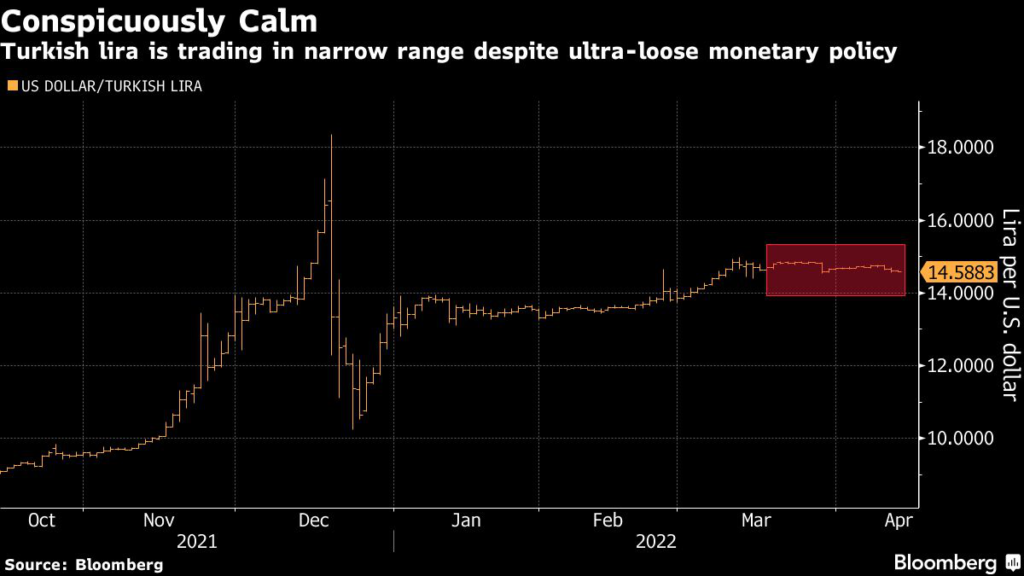
Turkish Rate Hike Is Off Table as Lira Calm Buys Time: Day Guide

(Bloomberg) — Turkey is set to refrain from raising interest rates for a fourth straight month despite a surge in inflation past 60%, putting more onus on the central bank’s unconventional policies to tether the lira.

Deepening trade imbalances and the world’s most negative borrowing costs when adjusted for prices have made the $800 billion economy increasingly vulnerable at a time of intensifying global tightening led by the U.S. Federal Reserve. All economists surveyed by Bloomberg predict Turkey’s central bank will hold its benchmark at 14% on Thursday, after it halted a series of rate cuts at the end of last year.

It’s a risky balancing act that hinges on keeping Turkey’s currency stable for longer with measures that include a costly program to shield savers from lira weakness, and foreign-exchange sales, which Bloomberg reported on April 7 were carried out via state banks, according to traders. So far the lira has held firm, becoming one of a handful of emerging-market currencies to appreciate against the dollar this month.

“The market may start to fear that things go sour at some point, accelerating the lira sell-off,” said Cristian Maggio, head of portfolio strategy at TD Securities. “Inflation will continue to rise and Turks will get impoverished by a massive loss of purchasing power.” 

Under pressure from President Recep Tayyip Erdogan, a self-described “enemy” of interest rates, the central bank led by Governor Sahap Kavcioglu has yet to signal it’s anywhere near a policy adjustment after ending last year with 500 basis points in monetary easing. The multiple rate cuts triggered a collapse in the currency and touched off inflation.

Rather than adding to Turkey’s rate buffer, authorities are now leaning even more heavily on other policies that could bring in more hard currency and boost the central bank’s reserves. 

Turkey is discussing a proposal to mandate exporters to convert more of their foreign revenue into lira, alongside another plan to offer tax incentives for companies’ earnings from converting hard currency.

What Bloomberg Economics Says…

Despite its recent stability, the lira remains among the worst-performing emerging market currencies this year. It’s facing pressure from runaway inflation, a high commodity-import bill and rising U.S. yields. Keeping rates on hold add another ingredient to this explosive mix.

— Ziad Daoud, chief emerging markets economist. For full react, click here.

The soaring cost of commodities and energy has left Turkey more exposed this year. Central banks around the world are meanwhile raising rates to combat inflation amid risks from Russia’s invasion of Ukraine and worsening supply-chain disruptions. 

A more stable lira has hardly moved the needle for inflation, which surged in March to a fresh two-decade high of over 61% from a year earlier. Finance Minister Nureddin Nebati now anticipates price growth will start declining from December — after earlier predicting it could peak in April and then expecting it would slow from this summer. 

With the U.S. central bank likely to move more aggressively in the months ahead after a quarter-point hike in March, the time left for Turkey to act may be short.

“The lira seems to be trading on very thin ice, which may crack soon as the Fed intends to raise rates rapidly to rein in inflation,” said Piotr Matys, an analyst at InTouch Capital Markets Ltd.

More stories like this are available on bloomberg.com

©2022 Bloomberg L.P.

Turkish Rate Hike Is Off Table as Lira Calm Buys Time: Day Guide

(Bloomberg) — Sign up for the New Economy Daily newsletter, follow us @economics and subscribe to our podcast.

Turkey is set to refrain from raising interest rates for a fourth straight month despite a surge in inflation past 60%, putting more onus on the central bank’s unconventional policies to tether the lira.

Deepening trade imbalances and the world’s most negative borrowing costs when adjusted for prices have made the $800 billion economy increasingly vulnerable at a time of intensifying global tightening led by the U.S. Federal Reserve. All economists surveyed by Bloomberg predict Turkey’s central bank will hold its benchmark at 14% on Thursday, after it halted a series of rate cuts at the end of last year.

It’s a risky balancing act that hinges on keeping Turkey’s currency stable for longer with measures that include a costly program to shield savers from lira weakness, and foreign-exchange sales, which Bloomberg reported on April 7 were carried out via state banks, according to traders. So far the lira has held firm, becoming one of a handful of emerging-market currencies to appreciate against the dollar this month.

“The market may start to fear that things go sour at some point, accelerating the lira sell-off,” said Cristian Maggio, head of portfolio strategy at TD Securities. “Inflation will continue to rise and Turks will get impoverished by a massive loss of purchasing power.” 

Under pressure from President Recep Tayyip Erdogan, a self-described “enemy” of interest rates, the central bank led by Governor Sahap Kavcioglu has yet to signal it’s anywhere near a policy adjustment after ending last year with 500 basis points in monetary easing. The multiple rate cuts triggered a collapse in the currency and touched off inflation.

Rather than adding to Turkey’s rate buffer, authorities are now leaning even more heavily on other policies that could bring in more hard currency and boost the central bank’s reserves. 

Turkey is discussing a proposal to mandate exporters to convert more of their foreign revenue into lira, alongside another plan to offer tax incentives for companies’ earnings from converting hard currency.

What Bloomberg Economics Says…

Despite its recent stability, the lira remains among the worst-performing emerging market currencies this year. It’s facing pressure from runaway inflation, a high commodity-import bill and rising U.S. yields. Keeping rates on hold add another ingredient to this explosive mix.

— Ziad Daoud, chief emerging markets economist. For full react, click here.

The soaring cost of commodities and energy has left Turkey more exposed this year. Central banks around the world are meanwhile raising rates to combat inflation amid risks from Russia’s invasion of Ukraine and worsening supply-chain disruptions. 

A more stable lira has hardly moved the needle for inflation, which surged in March to a fresh two-decade high of over 61% from a year earlier. Finance Minister Nureddin Nebati now anticipates price growth will start declining from December — after earlier predicting it could peak in April and then expecting it would slow from this summer. 

With the U.S. central bank likely to move more aggressively in the months ahead after a quarter-point hike in March, the time left for Turkey to act may be short.

“The lira seems to be trading on very thin ice, which may crack soon as the Fed intends to raise rates rapidly to rein in inflation,” said Piotr Matys, an analyst at InTouch Capital Markets Ltd.

More stories like this are available on bloomberg.com

©2022 Bloomberg L.P.
PSG Signs Sponsorship Deal With Sneaker Marketplace Goat

(Bloomberg) — French football club Paris Saint-Germain has signed a three-year agreement with Goat Group Inc. as the online sneaker marketplace moves into team sponsorships and looks to expand outside the U.S.

The deal is valued at more than $50 million, according to a person familiar with the terms. PSG will be the first sports team to have its own store on Goat’s e-commerce platform, which will release limited-edition merchandise, collaborations and vintage items. The Goat brand will appear on the sleeve of PSG’s kits this season and will be advertised on television, online and in the Parc des Princes stadium in Paris.

“They have a like-minded audience that really cares about fashion and style,” Eddy Lu, co-founder and chief executive officer of Goat Group, said in an interview. “Paris, of course, is the home of high fashion.”

PSG, which is owned by  Qatar Sports Investments, a subsidiary of the state’s sovereign wealth fund, has worked with many fashion brands on collections in recent years, including Balmain, Stussy and A Bathing Ape. Last year, it brought on Dior in a two-year deal to provide off-field casual and formal attire. 

The club’s biggest arrangement is with Nike Inc., which in 2019 extended its kit-sponsorship pact until 2032 in a deal that was said to be worth more than $90 million per year. The addition of Goat to PSG’s jerseys creates the rare case where a sneaker reseller will be touted on the same uniform as Nike. All major sponsors get access to the team’s top players, such as global stars Lionel Messi and Neymar, for marketing and events.

“There’s a real chance to take this way beyond the traditional partnership,” said Marc Armstrong, PSG’s chief partnerships officer.

Into Europe

Goat has been moving into new product categories such as apparel and last year led a $60 million investment in streetwear-resale specialist Grailed. The U.S. accounts for the majority of its business, but management has been pushing into international markets including Europe and the Middle East. The company has facilities in the U.K. and the Netherlands.

Lu said the retailer is getting deeper into sales of new products, as it will with its PSG store, in addition to its market of 700,000 resellers. The company is now working directly with brands on releases, including Capri Holdings Ltd.-owned Versace and Kering SA’s Balenciaga.

Goat is backed by Kering’s top shareholder,  Groupe Artemis, as well as Foot Locker Inc. and venture capital firms such as Accel, Upfront Ventures and Index Ventures. The company was last valued at $3.7 billion in a funding round in June, fueling buzz about a potential initial public offering.

“Our mission is to continue growing the business and when the time is right, we’ll go public,” said Lu.

More stories like this are available on bloomberg.com

©2022 Bloomberg L.P.
Bitcoin Surpasses $41,000 as Technical Analysts Predict Bounce

(Bloomberg) — Bitcoin climbed above $41,000, advancing along with equities after China indicated it’s about to loosen monetary policy.  

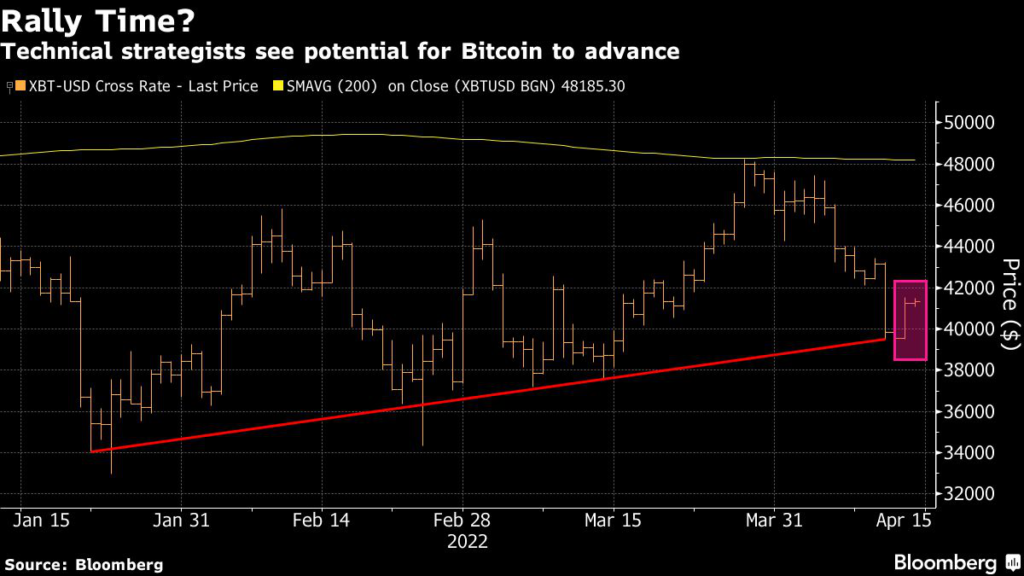
The largest cryptocurrency rose as much as 0.6% to $41,500 on Thursday, gaining for a second day. Katie Stockton, co-founder of Fairlead Strategies LLC, said technical indicators she follows suggest Bitcoin could be due for a short-term bounce to as high as $51,000, assuming it can break through its 200-day moving average, which stands at just above $48,000.  

“We expect an oversold bounce and a higher low,” Stockton said. 

Bitcoin has been largely stuck in a range of about $35,000 to $45,000 this year. A brief breakout to touch the 200-day moving average in late March was followed by a drop of as much as 19%, as concerns about monetary tightening triggered declines across risk assets. During that period, the token’s correlation with large technology stocks rose to a record. 

The tighter link with stocks worked in crypto’s favor on Thursday, as coins broadly tracked advances in Asian stock markets. China’s State Council said Wednesday it will “step up financial support to the real economy, especially industries and small businesses that have been hit hard by the pandemic.”

“Bitcoin looks attractive to buy dips after falling to test a nearly three-month trend connecting prior lows since early January,” said Mark Newton, managing director and head of technical strategy at Fundstrat. The token “should bounce over the next week, with upside targets at $43,750 up to $44,200 which looks like the first meaningful upside target,” he added.

Bitcoin’s struggles have shined a spotlight on so-called altcoins like Cardano, Avalanche and Solana, which have outperformed it recently. Even the second-biggest token Ether is up 24% in the past month, compared with Bitcoin’s rise of around 7%. 

Read more: Crypto ‘Altcoin Season’ Returns as Bitcoin Dominance Fades

Both Stockton and Newton offered notes of caution about the sustainability of Bitcoin’s recovery. Newton said the bounce will provably be short-lived, and “movement back above $48,248 would be necessary to expect the start of a new multi-week or multi-month rally had begun.”

Should Bitcoin fall back below $40,000, it would run the risk of sliding to a “secondary support” level of close to $27,200,” according to Stockton. Bitcoin hasn’t traded that low since December 2020. 

More stories like this are available on bloomberg.com

©2022 Bloomberg L.P.
Here’s How China’s Lockdowns Are Rippling Through Economy

(Bloomberg) — China’s lockdowns to contain the country’s worst Covid outbreak since early 2020 have battered the economy, stalling production in major cities like Shanghai, and halting spending by millions of people shut in their homes. 

The restrictions are intended to eradicate any trace of the virus in the community, but they’ve also pressured everything from manufacturing and trade to inflation and food prices. 

Premier Li Keqiang has repeatedly warned of risks to economic growth, telling local authorities on Monday they should “add a sense of urgency” when implementing existing policies. The government is holding firm to its Covid Zero approach for now: President Xi Jinping said this week that “prevention and control work cannot be relaxed.” But it’s a strategy economists say will push growth down to 5% this year, below the official target of around 5.5%.

Here’s a deeper look at how the lockdowns are impacting critical sectors across the world’s second-largest economy.

Commodities Hit

China posted sluggish commodities imports in March, as elevated prices due to the war in Ukraine and tightening virus restrictions took their toll on demand. 

Natural gas purchases were worst affected, dropping below 8 million tons to their lowest level since October 2020. Crude and coal purchases were also running well behind last year’s schedule.

Chinese demand for jet fuel is projected to drop by 25,000 barrels per day from a year earlier, a 3.5% fall, according to the International Energy Agency. The IEA previously expected 10,000 barrels per day of growth. The number of daily flights in China, as averaged over seven days, has fallen below the lowest level seen in 2020, with less than 2,700 active flights on Tuesday, according to Airportia, a real-time flight tracker.

The number of passenger trains has also dropped to about 3,000 a day, which is only 30% of the normal level, according to a post on WeChat by China Railway.  

China’s domestic metals fabricators are facing hurdles to transport raw materials and finished products, which have led to output cuts. Six out of twelve copper-rod plants in Shanghai’s neighboring provinces surveyed by Shanghai Metals Market earlier said they either have halted or plan to halt output. The researcher also predicted a rise in aluminum inventories.

Meanwhile, Chinese buyers have slashed liquefied natural gas purchases in the world’s biggest LNG importer as prices soar and domestic demand stalls. Imports in the first quarter fell 14% from the same period last year, according to shipping data, and private companies are spurning offers to use once-highly coveted slots at state-owned receiving terminals.

Port Congestion 

Shanghai’s city-wide lockdown has created congestion at the world’s largest port, with queues of vessels building there and at other stops handling diverted shipments. The number of container ships waiting off Shanghai as of April 11 was 15% higher than a month earlier, according to Bloomberg shipping data. 

A shortage of port workers in Shanghai is slowing the delivery of documentation needed for ships to unload cargoes, according to ship owners and traders. Meanwhile, vessels carrying metals like copper and iron ore are left stranded offshore as trucks are unable to send goods from the port to processing mills, they said.

Data on Wednesday also showed the lockdowns having a notable impact on imports, which fell 0.1% on year in March, the first contraction since August 2020.

Manufacturing Woes

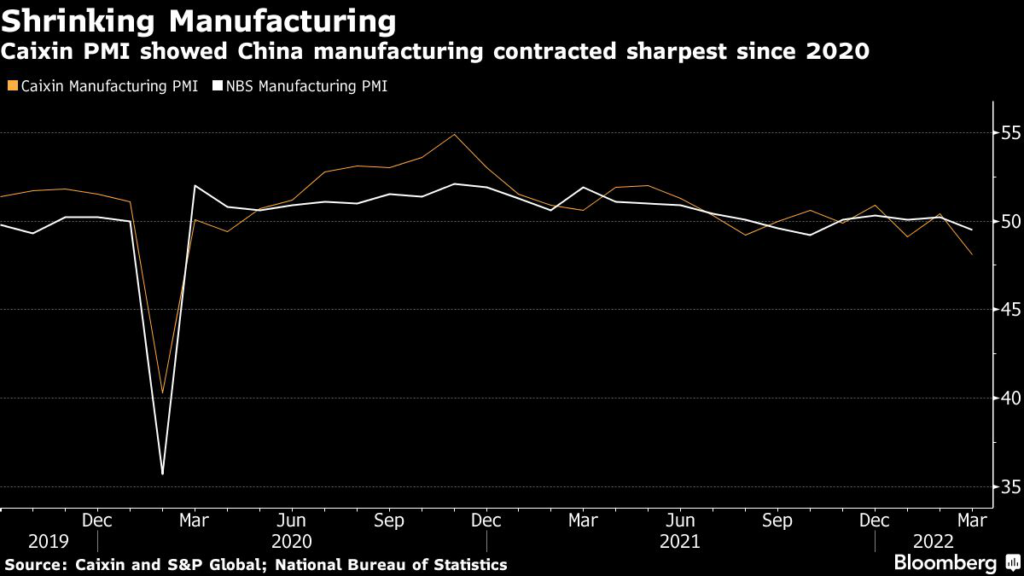
China’s purchasing managers surveys show manufacturing contracted in March, with small and medium-sized firms particularly shaken by operational snags. The Caixin index, based on surveys of smaller, export-oriented businesses, dropped to its worst level since the start of the pandemic two years ago. 

Some large manufacturing firms have been able to keep operations going by adopting a so-called closed loop system, in which employees were kept at factory locations and tested regularly. However, those protocols aren’t perfect: One member of a European Union trade group said last week that work can be “very, very difficult,” even with permission to operate amid restrictions.

Solar companies are seeing a “severe impact” on both panel production and installations, according to a survey conducted by the Shanghai Solar Energy Society. Wafer production has been suspended in some factories in the coastal region close to Shanghai, driving up prices in recent weeks, Jefferies analysts said in a note.

The restrictions are also causing major headaches for China’s 17.3 million truckers who keep store shelves full while also connecting the nation’s ports with its manufacturing hubs. The logjam is preventing crucial deliveries from reaching companies, stalling production in key industrial regions, with the impact likely to continue rippling across the economy even as cities move to loosen lockdowns.

Trucks dominate China’s local transportation, hauling about three-quarters of total freight, according to data from the Ministry of Transport. But Covid Zero orders are creating difficult conditions for the truckers themselves, as drivers have been hampered by the need to undergo compulsory mass testing being conducted in cities like Shanghai and the need to show negative Covid results at multiple checkpoints. 

Tech Disrupted

Some technology companies have suspended production as China’s restrictive policies weigh on a sector already contending with a shortage of components.

Most major tech manufacturers — from Semiconductor Manufacturing International Corp. to Taiwan Semiconductor Manufacturing Co. and iPhone maker Foxconn Technology Group — froze operations in the early days of Shanghai’s outbreak. Many have since resumed after setting up closed-loop systems. 

As of Wednesday, more than than 30 Taiwanese companies including Pegatron Corp. and Macbook maker Quanta Computer Inc. had halted production in eastern China’s electronics hubs because of Covid rules. 

Logistics jams are constricting shipments of components, draining inventories to the point where some manufacturers including Pegatron, Wistron Corp. and Compal Electronics Inc. are down to just a few weeks’ stocks, consultancy Trendforce estimates. The ongoing global supply crunch could worsen if local manufacturing is disrupted, constraining stock of computers and gaming consoles to smartphones, servers and electric vehicles.

Automotive Pain 

Overall passenger vehicle sales slid 10.9% last month, suggesting pressure in the massive car market. 

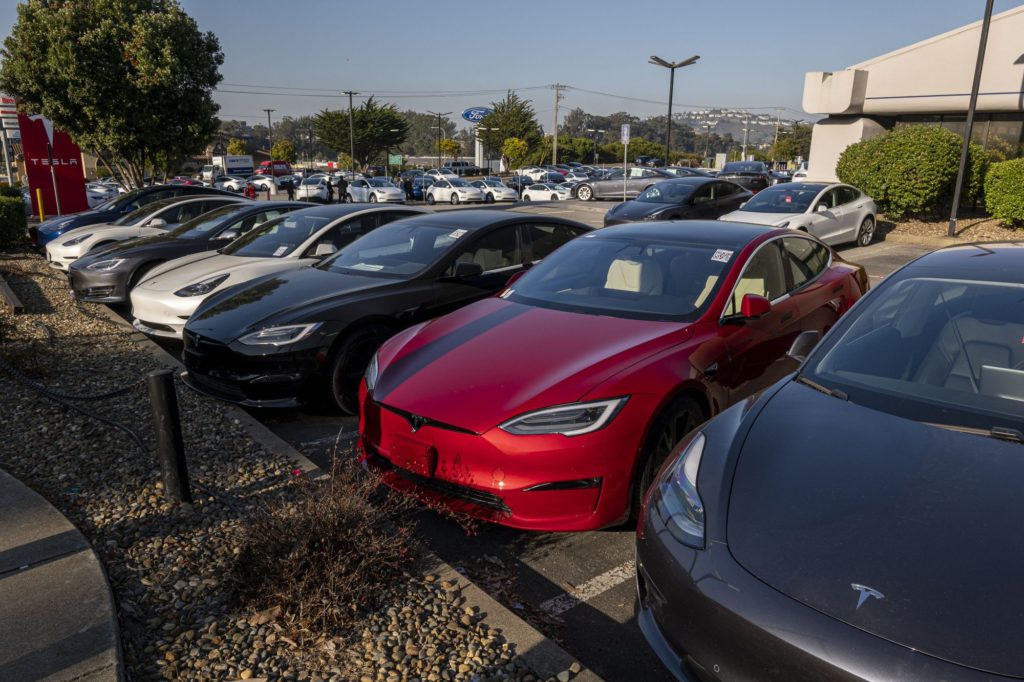
Some automakers are hitting production snags because of lockdowns. Tesla Inc.’s Shanghai factory has been shut down since March 28 because of restrictions in the city. The plant typically produces more than 2,000 cars every day, according to an estimate earlier this month from Dan Ives, an analyst at Wedbush Securities Inc. 

Volkswagen AG was also forced to suspend production in Shanghai this month, while Chinese EV upstart Nio Inc. said Saturday it halted production and delayed deliveries because many suppliers had to close shop. 

Auto parts maker Robert Bosch GmbH said Monday it shuttered two of its factories in China and operated closed-loop systems at two others, adding that it was seeing “temporary effects on logistics and supply chain sourcing.”

Construction Snags

Domestic sales of excavators — a leading indicator for construction — plunged almost 64% in March from a year ago, indicating strain in the sector.

China’s home sales slump also deepened last month: The 100 biggest companies in the debt-ridden property industry saw a 53% drop in sales from a year earlier, according to preliminary data from China Real Estate Information Corp. The decline was the steepest this year.

Steel rebar inventory in China suggests construction activity “may have shifted to a lower gear,” according to analysis published last week by David Qu, an economist covering China for Bloomberg Economics.

Inflation Risks

The lockdowns have driven up food costs and may endanger the nation’s ability to secure enough grains for the year as the curbs complicate China’s important spring planting season. 

Fresh vegetable prices jumped 17.2% on year in March, compared to a drop of 0.1% in February, data from the National Bureau of Statistics showed this week. Chinese farmers in some parts of the northeast, which produces more than a fifth of China’s national grain output, have had to contend with restrictions that prevent them from plowing their fields and sowing seeds.

(Adds details about President Xi Jinping’s visit to Hainan, train journeys and supply chain snags facing truck drivers.)

More stories like this are available on bloomberg.com

©2022 Bloomberg L.P.
Tesla Racism Case Award Cut to $15 Million From $137 Million

(Bloomberg) — A federal judge cut to $15 million a staggering $137 million in damages awarded by a jury in a racial discrimination case against Tesla Inc. over abusive conduct toward a former elevator operator at its northern California factory.

U.S. District Judge William Orrick said in a ruling Wednesday he was compelled by legal principles to reduce the jury’s October verdict, but he also concluded there was ample “disturbing” evidence to support the outcome of the trial.

Jurors heard that the Tesla factory in Fremont “was saturated with racism,” Orrick wrote, adding that plaintiff Owen Diaz’s co-workers called him “the N-word and other slurs,” and that supervisors and Tesla’s broader management failed to help. “And supervisors even joined in on the abuse, one going so far as to threaten Diaz and draw a racist caricature near his workstation,” the judge said.

The jury’s award to Diaz after a seven-day trial in San Francisco is believed to be one of the largest in U.S. history for an individual plaintiff in a racial discrimination case. 

Tesla has faced a number of high-profile suits — including one filed by the state of California in February — over its treatment of Black employees and subcontracted workers at the Fremont factory.

Read More: Tesla Sued by California Over ‘Rampant Racism’ at Factory

At a January hearing on Tesla’s request for a new trial, Orrick said he was “troubled” that the $6.9 million jurors awarded as emotional distress damages “may be untethered to the distress to which Mr. Diaz and his witnesses testified.” Moreover, punitive damages of almost 20 times that amount are “extremely high,” the judge said. 

In his ruling, Orrick said “the highest award supported by the evidence” to compensate Diaz is $1.5 million. He cited U.S. Supreme Court rulings as the basis for his conclusion that the Constitution permits a punitive damages award of $13.5 million — nine times the amount of the compensatory damages. 

“What’s clear is that the judge rejected every single argument that Tesla made,” Larry Organ, the attorney for Diaz, said in a phone interview. “The judge gave the highest ratio that he constitutionally thought he could give.”

Organ said that while a $15 million award is still significant, it remains far lower than what the jury determined and that his team is exploring options for a possible appeal.

Tesla’s acting legal chief didn’t immediately respond to a request for comment.

“This remains one of the highest awards ever made in a racial discrimination case or an employment discrimination case,” said David Oppenheimer, a clinical professor of law at Berkeley Law. “He wrote a very careful opinion that will make it hard for Tesla to appeal. They don’t have much to work with.”

Orrick roundly rejected Tesla’s argument that damages should be no more than $300,000.

“This is not, as Tesla attempts to frame it, a case of ‘garden variety’ emotional distress that was ‘fortunately mild and short-lived,’” Orrick wrote. “It is difficult to see how Tesla reached that interpretation of the evidence other than ignoring it.”

The judge also rejected Tesla’s claim that it wasn’t liable because Diaz worked for a staffing agency that the company contracted with. Jurors found Tesla qualified as Diaz’s employer under the law, “if not on paper,” he wrote. The judge also turned down Tesla’s request for a new trial.  

Diaz’s case marks a rare instance in which Tesla, which typically uses mandatory arbitration to resolve employee disputes, had to defend itself in a public trial. 

The world’s most-valuable automaker almost never loses workplace arbitrations, though it was hit with a $1 million award in May in a case brought by a former employee that was similar to Diaz’s.

The case is Diaz v. Tesla Inc., 17-cv-06748, U.S. District Court, Northern District of California (San Francisco).

(Updates with law professor’s comment.)

More stories like this are available on bloomberg.com

©2022 Bloomberg L.P.
Xi’s Graft-Buster Has Direct Role in Probe of Jack Ma’s Ant

(Bloomberg) — China’s top anti-graft watchdog was among the agencies involved in a recent inquiry into links between Jack Ma’s Ant Group Co. and state-owned Chinese companies, according to people familiar with the matter, escalating the risks for the country’s most recognizable tech tycoon and his internet empire.

The Central Commission for Discipline Inspection was seeking to understand the influence of Ma’s fintech empire and the extent of its transactions with state banks and enterprises, the people said, asking not to be identified discussing a sensitive issue. The agency’s involvement hasn’t been previously reported.

The CCDI, which oversees corruption probes involving senior members of the Communist Party, was involved in the queries sent to state firms in February about their exposure as part of its investigation of former Hangzhou party chief Zhou Jiangyong, one of the people said. Both Ant and Alibaba Group Holding Ltd. are headquartered in Hangzhou.

Chinese prosecutors this week charged Zhou with accepting “huge” bribes, though the statement from the Supreme People’s Procuratorate did not name Ant or any other companies. One person familiar with the situation said that though state-owned banks and enterprises had already submitted their reports on any exposure to Ant, there had yet to be a follow-up decision by senior leaders on any additional action. It’s unclear whether the probe is ongoing.

In January, Zhou appeared in a state media documentary that claimed the former party secretary used his influence in the Chinese tech hub to help his younger brother’s businesses. One of those companies received investment from a firm controlled by Ant, according to a local media report in August. Neither Ant nor Ma have been accused of wrongdoing related to the case.

Ant didn’t immediately respond to a request seeking comment. Calls to CCDI representatives went unanswered.

Shares of Alibaba, which owns a third of Ant, slumped as much as 4.7% in Hong Kong on Thursday. It was the biggest decliner on the benchmark Hang Seng Index.

Read more: China Charges Ex-Hangzhou Party Chief With Taking ‘Huge’ Bribes

Xi Jinping’s administration has pursued an unprecedented campaign to root out graft within the Communist Party, regarded by observers as a means to legitimize his government while tamping down internal dissent. Most recently it’s empowered the CCDI to go after officials in the financial industry, initiating a campaign that’s ensnared dozens of executives in the sector.

The nation’s top anti-graft group in January made rooting out corruption tied to “disorderly expansion of capital” one of its priorities, acquiring a mandate to examine decades of cozy ties between government and the big businesses that help local officials boost employment and meet growth targets. 

More than a year after the Chinese government snuffed out the biggest initial public offering in history by Ant, Beijing continues to scrutinize every corner of China’s technosphere. Officials have handed out billions of dollars in antitrust fines to end the domination of a few heavyweights as President Xi pushes for more “common prosperity.”  

Ant was among the hardest hit. Beijing scuttled the fintech giant’s $35 billion IPO in November 2020, ordering it to overhaul businesses including lending, insurance and wealth management, and set up a financial holding company so it could be regulated like a bank. 

As part of the restructuring, Ant has ramped up its capital base to 35 billion yuan ($5.5 billion) and moved to build firewalls in an ecosystem that once allowed it to direct traffic from Alipay, with a billion users, to services like wealth management, consumer lending and delivery. Consumer loans jointly made with banks were split from its “Jiebei” and “Huabei” brands. Assets under management at its money-market fund Yu’ebao — once the world’s largest — dropped by more than a third last year to 765 billion yuan by December.

The myriad restrictions mean Ant is worth a fraction of its former self as its growth prospects wane, according to some of its early Wall Street backers. Fidelity Investments slashed its valuation estimate for at least the second time last year to about $78 billion as of June 30. Others are more optimistic: BlackRock Inc. values the company at $174 billion and T Rowe Price Group Inc. views it at $189 billion. 

(Updates with share slump in the seventh paragraph)

More stories like this are available on bloomberg.com

©2022 Bloomberg L.P.
Crypto Startup Ava Labs Raises Funds at $5 Billion Valuation

(Bloomberg) — Ava Labs Inc., the lead developer of the Avalanche blockchain, is in the process of raising a new round of funding, according to people familiar with the discussions. Its new valuation would make it one of world’s most highly valued crypto startups.

The company, founded and helmed by Cornell University professor Emin Gun Sirer, is raising $350 million at a $5.25 billion valuation, said one of the people, who spoke on condition of anonymity because the round hasn’t been made public. 

Avalanche is attempting to compete with the likes of Ethereum and Solana by offering high speeds and low transaction fees for applications ranging from trading and lending to games. It has been gaining traction with users and developers, who flocked to the Avalanche Summit in Barcelona in March. Almost 250 active apps are running on Avalanche, many of them in decentralized finance or gaming, according to tracker DappRadar. The related AVAX token has a $21.5 billion market cap and its price is up about 19% over the past month, according to CoinMarketCap.com. 

Ava Labs is raising money even as crypto markets remain choppy, with Bitcoin well down from its November all-time high amid worries over Fed tightening, inflation and Russia’s invasion of Ukraine.

Last year, Polychain Capital and Three Arrows Capital led a $230 million round in the Avalanche public blockchain ecosystem via a token sale that benefited the Avalanche Foundation. In 2020, Ava Labs raised $12 million for the project through a private token sale led by Bitmain, Galaxy Digital and others.

Founded in 2018, Ava Labs also raised a $6 million round in 2019, from investors including Andreessen Horowitz and Polychain. The company has 170 employees, according to PitchBook.

Representatives for Ava Labs didn’t immediately respond to requests for comment. 

More stories like this are available on bloomberg.com

©2022 Bloomberg L.P.
Close Bitnami banner
Bitnami

