
Bloomberg

Ukraine Update: Putin Calls Talks With Kyiv ‘at a Dead End’

(Bloomberg) — Russian President Vladimir Putin said peace talks with Ukraine are stalled and vowed to continue his “military operation” there even as he called the conflict “a tragedy.”

There’s been little sign of progress in negotiations at a lower level after Ukraine accused Russian troops of carrying out war crimes in northern towns like Bucha by killing unarmed civilians. Ukrainian negotiator Mykhailo Podolyak said talks are “extremely difficult.”

Ukrainian President Volodymyr Zelenskiy again called for further European Union sanctions on Russia to include oil as well as all banks.


(See RSAN on the Bloomberg Terminal for the Russian Sanctions Dashboard.)

Key Developments

  • Germany May Snub India as G-7 Guest Over Russia Stance
  • Richest Russian Strikes Deal as Sanctions Snare Other Oligarchs
  • Germany Plans Law to Secure Critical Energy Infrastructure
  • Ukraine War Will Start Rippling Through U.S. Corporate Earnings

All times CET:

German President Isn’t Welcome in Kyiv (6:36 p.m.)

German President Frank-Walter Steinmeier planned to visit Kyiv in a gesture of solidarity with the Ukrainian government, but he wasn’t welcome, according to Bild.

“I was prepared for it,” the newspaper cited Steinmeier as saying in Warsaw on Tuesday. “But apparently, and I have to take this on board, that wasn’t wanted in Kyiv.”

Steinmeier has been criticized by Ukrainian officials for his previous support of the Nord Stream 2 gas pipeline from Russia to Germany. In a rare admission, the former foreign minister said in a TV interview this month that he and other German officials had failed in their policy toward Russia and President Vladimir Putin over the past two decades.

UN Backs French Plan To Offset Food Crisis (5:24 p.m.)

David Beasley, the World Food Programme’s executive director, said he will join efforts to ensure the “people in the greatest need around the world receive the support they need.” 

Details of the plan are set be outlined by the end of June, French Foreign Minister Jean-Yves Le Drian said, adding the food crisis will be discussed within the Group of Seven format.

Ukraine Negotiator Says Talks Continue, Are Difficult (4:42 p.m.)

Talks continue with Russia in working subgroups, Mykhailo Podolyak said by WhatsApp message, adding “the emotional background is difficult.” He said Moscow was seeking to use public statements to drive its claims in the negotiation process.

Putin Says Peace Talks ‘at Dead End’ (4:15 p.m.)

The “military operation” is going “according to plan,” Putin said in a joint press conference with Belarusian President Alexander Lukashenko. In his first public comments on the atrocities reported in Bucha, he said allegations that Russia was responsible were “fake.”

Putin also accused Ukraine of backing off earlier concessions. The government in Kyiv says it has not changed its position and in turn blames Russia for the lack of progress.

Russia’s economy has withstood the sanctions “blitzkrieg,” Putin said, citing the recovery of the ruble exchange rate. But he conceded that logistics and payment systems remain a weakness and the long-term impact could be more painful. 

ArcelorMittal to Restart Blast Furnace in Ukraine (4:04 p.m.)

Europe’s biggest steelmaker said it was responding to a request from the government in Kyiv. The company idled operations at its Kryvyi Rih facility when the war broke out. Pig iron production will return to around fifth of the plant’s normal output.

Airbus Defends Decision to Buy Russian Titanium (4:03 p.m.)

The company said sanctions would hurt aerospace manufacturers who depend on the lightweight metal and wouldn’t deter Putin when it comes to Ukraine.

The European plane maker has been stockpiling titanium for many years, Chief Executive Officer Guillaume Faury said at the company’s AGM. That’s given it some breathing room in the short and medium term, even if an embargo does take effect.

OPEC Sees War Curbing Oil Supply and Demand (3:32 p.m.)

The comment from the cartel suggests it sees little need to divert from its current production policy. OPEC Secretary-General Mohammad Barkindo told the European Union on Monday that the oil market was beyond its control.

The Organization of Petroleum Exporting Countries cut forecasts for global oil consumption in 2022 by 410,000 barrels a day, according to its latest monthly report. At the same time, it lowered projections for supplies from outside the cartel by 330,000 barrels a day, with Russia’s output now seen 530,000 barrels a day below previous estimates.

World Bank Announces $1.5 Billion for Ukraine (2:19 p.m.)

The World Bank is preparing $1.5 billion for Ukraine to support the continuation of essential government services during the war, the institution’s president, David Malpass, said in Warsaw. 

Donors and recipient countries approved $1 billion for Ukraine and $100 million for Moldova, according to Malpass. The disbursement is part of as much as $3 billion that the World Bank has pledged in funding for Ukraine following Russia’s invasion.

Number of People Returning to Ukraine Surges (12:30 p.m.)

The number of people returning to Ukraine from abroad has jumped to about 30,000 per day, according to Andriy Demchenko, a spokesman for the State Border Guard Service.

While in the first days of the war mostly men were coming back to Ukraine, now there are more women, elderly people and children returning, Demchenko said in a video briefing. The United Nations Refugee Agency estimates that more than 4.3 million refugees fled the country after the outbreak of war, with some 7.1 million displaced internally.

Putin Says Conflict With West Inevitable (11:30 a.m.)

Speaking to workers at the Vostochny Cosmodrome in Russia’s Far East, Putin said conflict with the West was inevitable and that Russia is too large to isolate from the rest of the world.

Western sanctions imposed over the invasion of Ukraine won’t keep Moscow from developing space-exploration efforts, he added, vowing to resume the country’s lunar program. 

German Investor Mood Deteriorates (11 a.m.)

Confidence in Germany’s economic recovery slid for a second month as investors worry that price spikes driven by the war in Ukraine will dampen output.

The ZEW Institute’s gauge of expectations dropped to -41 in April from -39.3 the previous month, hitting the lowest since the Covid-19 pandemic took hold in early 2020. An index of current conditions also worsened. 

Zelenskiy Repeats Call for Oil Sanctions (10:45 a.m.)

“Some very powerful decisions must be taken and they must be taken now with the sixth package of sanctions,” Zelenskiy said in an address to the Lithuanian parliament, referring to EU measures against Russia.

He warned that if Russia’s assault on Ukraine is not repelled, Europe may face security threats against nations including Poland, Georgia, Moldova and the Baltic states.

Slovakia Mulls Giving Fighter Jets to Ukraine (10:35 a.m.)

The Slovak government signaled it’s considering donating its fleet of Soviet-era MiG fighter jets to Ukraine, the Sme newspaper reported, citing an interview with Prime Minister Eduard Heger.

“If this equipment is to be useful somewhere, then it’s in Ukraine,” Sme quoted Heger as saying. European nations are attempting to ramp up weapons shipments to Ukraine amid concerns sanctions on Russia are insufficient to force Moscow to end the war.

Ukraine Says it Thwarted Cyberattack (10:30 a.m.)

Ukraine said it prevented a cyberattack on its energy infrastructure this month that was apparently launched by Sandworm, a group of hackers linked to Russia’s military intelligence agency.

Microsoft and ESET helped repel the attack, in which the hackers sought to disable power facilities using Industroyer2 and CaddyWiper malware, the nation’s telecommunications agency said.

India Plans to Boost Exports to Russia (10:10 a.m.)

India is planning to boost exports to Russia by an additional $2 billion as the two nations work out a payment system in local currencies to continue bilateral trade, according to people with knowledge of the matter.

Prime Minister Narendra Modi’s administration is in talks with Moscow to liberalize market access for several Indian-made products, the people said, asking not to be identified as the talks are private. This comes as the two governments work toward a proposal to settle trade in rupees and rubles and look for ways to balance trade given that India is a net importer of Russian goods.

Inflation in Ukraine Surged Last Month (9:30 a.m.)

Ukraine saw a rapid increase in prices for food staples, drugs and fuel last month, as Russia’s invasion disrupted supply chains and complicated access to imports, according to the country’s central bank.

Fuel costs rose by 30% from the previous year due to soaring prices in global markets and Russia’s targeting of Ukraine’s oil-storage facilities, even though the government scrapped sales and excise taxes on fuel to help ease the burden on consumers. Annual inflation accelerated to 13.7% from 10.7% in February.

Asos Warns of Earnings Impact (8:30 a.m.)

British online fashion retailer Asos said its full-year earnings goal is at risk due to the fallout from Russia’s war in Ukraine and accelerating inflation. U.S. consultant Accenture completed an exit from its Russian business following a transfer to several of its local leaders.

Finnish 5G Gear Maker Nokia to Exit Russia (8 a.m.)

Nokia will exit the Russian market after having suspended deliveries, stopped new business and initiated a move of its limited R&D activities out of Russia in the past weeks, the Espoo, Finland-based telecommunications networks maker said.

Russia accounted for less than 2% of net sales in 2021 for Nokia, whose rival Ericsson on Monday said it had suspended business with customers in Russia “indefinitely” and put about 600 staff on paid leave.

Oil Rebounds After Fall That Erased War Gains (7:31 a.m.)

Oil rebounded after a tumble that saw crude erase most of the gains sparked by Russia’s invasion of Ukraine. China’s virus outbreaks and mobility curbs are imperiling demand as it locks down Shanghai and other areas in pursuit of a Covid Zero strategy that has made it a global outlier in handling the pandemic.

The next major test for markets looms later Tuesday, when the U.S. is expected to unveil an inflation print for March of more than 8%. The Ukraine war is disrupting flows of essential commodities, and China’s lockdowns are straining supply chains.

Russia Significant Military Threat, Say Finns (5:23 a.m.)

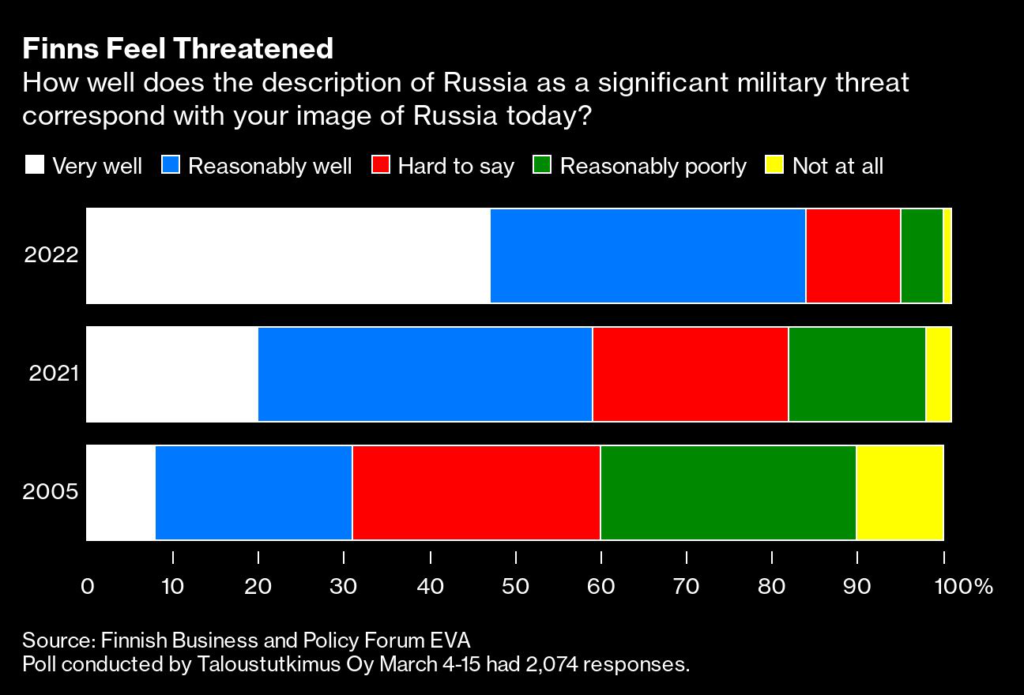
Some 84% of Finns believe Russia poses a significant military threat, according to a survey by Finnish Business and Policy Forum EVA, with the government set to kick off a process that may culminate in an application to join NATO.

In 2005, fewer than one in three in the Nordic country with a 1,300-kilometer (800-mile) border with Russia considered Moscow a major threat. The change helps explain why Finns now back NATO membership, with the government seen leaning toward an application within weeks.

More stories like this are available on bloomberg.com

©2022 Bloomberg L.P.

Microsoft Customers Decry Cloud Contracts That Sideline Rivals

(Bloomberg) — The current tide of antitrust scrutiny and regulations focused on big technology companies has conspicuously omitted one company: Microsoft Corp., the software and cloud-computing behemoth that was the notorious target of a landmark U.S. government lawsuit in the 1990s. Microsoft, the thinking goes, was already humbled by years of intense government oversight, and since it largely caters to other companies, instead of consumers, it doesn’t belong in the same category as Facebook, Amazon, Google and Apple.But now some Microsoft customers, and some of its fiercest rivals, are making a bold claim: The software giant is again using its sway over one market to thwart competition in another. Microsoft three years ago overhauled the way it licenses some of its most ubiquitous software programs, including Windows and Office, in ways that increase the cost of running those programs on rival cloud-computing systems like Amazon Web Services and Google Cloud Platform. In some cases, the revamped agreements outright forbid using some products on competing cloud services. AWS and Google say they have complained to Microsoft on behalf of multiple customers. French cloud provider OVH, along with other unidentified companies, filed a complaint last year with European regulators about the practice, saying it’s also being hurt by Microsoft’s policies. 

Major business software customers, some of which are only now starting to see the impact as they renew deals or replace aging programs, are also incensed. Over a six-month period, Bloomberg spoke with five Microsoft customers and three software resellers working with clients affected by the changes.After being contacted by Bloomberg News, Microsoft President and Vice Chair Brad Smith said the company will talk with customers and rivals and is committed to addressing the issues. “There definitely are some valid concerns,” he said in an interview. “It’s very important for us to learn more and then make some changes.”

Microsoft shares slipped less than 1% in New York on Tuesday. 

CISPE, a European cloud-company policy group backed by Amazon and OVH, said it welcomes Smith’s comments but wants to see real changes. “European cloud infrastructure providers demand urgent action, not only vague commitments to talk,” the group said in a statement.

The impact has been felt at companies and organizations both large and small. A person familiar with the software systems at a Fortune 100 company said Microsoft’s rules don’t allow running its existing Office software on Amazon’s cloud, and require it to pay more to run the Windows operating system on its rival’s servers. One consultant tried to help a Fortune 10 customer move to Google Cloud, but the client abandoned the idea after finding it would increase the costs of Windows licenses by $50 million over five years. Customers, consultants and resellers spoke on the condition of anonymity because they weren’t authorized to discuss confidential license details publicly, and some said they feared retaliation from Microsoft.

“The excrement is about to hit the fan,” said Wes Miller, an analyst at Directions on Microsoft, a research firm that advises customers on Microsoft licensing. He said that using the company’s software on a competing cloud service is “significantly more expensive than it used to be, and more expensive than it costs you to do the same thing on Azure.”Microsoft’s practices cut across two of the most lucrative areas of technology aimed at businesses: cloud computing, where it’s playing catch-up, and productivity software, which it dominates. Amazon.com Inc.’s $62 billion cloud unit leads the market for cloud infrastructure services, which let companies tap computing power to run applications and store data. Microsoft’s Azure is a growing No. 2, while Alphabet Inc.’s Google Cloud is chasing Azure. More businesses are shifting their corporate programs—office software, databases, payroll programs and customer websites—into data centers owned by Amazon, Microsoft, Google and other cloud providers, sparing them the expense of owning and maintaining their own equipment.

But most companies still use Microsoft’s Windows and Office to run corporate computers and for tasks like sending email and creating spreadsheets and presentations. The Windows operating system held a 96% share of the personal-computer market last year, according to Gartner, while the Office suite captured 86% of its market in 2020. Many customers also use Windows Server software and the SQL Server database, which are also impacted by the rule changes.Linking a product with the market power of Windows to another offering, like Azure, to gain leverage with customers, or making the product work less well with a rival’s service, can be an antitrust violation called tying, said Herbert Hovenkamp, an antitrust law professor at the University of Pennsylvania, who consulted on the U.S. states’ antitrust case against Microsoft in the late 1990s and early 2000s. 

“Microsoft is playing with fire here to a certain extent,” Hovenkamp said.

The 2019 changes technically applied only to the largest cloud providers, but smaller, regional sellers like OVH say they are also facing higher prices when hosting Microsoft programs on their servers. In order to sell customers OVH’s cloud services to work with Microsoft’s programs, OVH said it must sign on to a Microsoft license agreement under which Microsoft “charges higher prices for must-have products,” according to a confidential summary of the OVH complaint viewed by Bloomberg. OVH said it’s also forced to agree to “onerous and abusive clauses,” like submitting to audits and providing Microsoft confidential information about users. In March, European regulators sent a questionnaire to Microsoft cloud rivals and partners that asked about some of the issues OVH raised, according to copies of the document seen by Bloomberg.

In response to an inquiry about the licensing practices, Microsoft said it does offer discounts to existing customers who opt to run some of its programs in Azure, compared with the cost of using the same products with Amazon or Google—but it argues Google and Amazon could offer their own discounts to those customers to win their business. The company also said it does currently restrict using some versions of Office in Google, Amazon and Alibaba’s clouds.

The goal of these policies was not to put rivals at a disadvantage, Smith said, but there clearly have been some “unintended consequences.” In particular Microsoft wants to speak with European cloud providers and address their concerns. “We should be especially sensitive to the unintended impact on European cloud providers. We’re very interested in connecting directly with them and really listening to and understanding better what their concerns are,” he said. Smith didn’t elaborate on what changes the company is considering.

Software licensing rules are lengthy and complex, and Microsoft’s policies vary for each product. The issue creating tension now affects customers that bought rights to use software in their own data centers and offices, but now want to use those programs in the cloud—meaning the software would be delivered via Amazon, Google, Alibaba or Microsoft’s own Azure cloud.Microsoft outlined the restrictions in new licensing agreements starting in 2019, saying certain programs “cannot be deployed with dedicated hosted cloud services offered by the following public cloud providers: Microsoft, Alibaba, Amazon (including VMware Cloud on AWS), and Google.”

Office, the software package that includes common business programs such as Word, Excel and PowerPoint, is “the worst and most complicated,” according to Directions on Microsoft’s Miller. One version of the Office suite—the one used in cloud-computing environments—is no longer allowed for use on rival cloud providers. And newer versions of the traditional Office product have similar limitations. Instead customers must either rely on old versions of Office, which will lose support in 2025, or pay a higher price for a version of Office that is authorized. For many customers, that fee comes on top of the cost of copies of Office cloud apps they had already purchased, Miller said. 

Customers say Microsoft’s extra costs are restricting choices. A representative from a large educational institution that is accelerating a move to the cloud wants to take a multi-cloud approach rather than relying on one vendor, and wants to begin shifting Windows Server applications to other cloud systems. But the organization’s license says the products can be used in their own offices or hosted “on Microsoft Azure only,” according to a copy of the agreement with Microsoft viewed by Bloomberg. The institution may try to persuade Microsoft to amend the agreement when it’s next up for renewal, anticipating that trying to use Amazon or Google could cost more. When the U.S. Justice Department sued Microsoft in the late 1990s, the company was accused of illegally tying the omnipresent Windows to the Internet Explorer browser, and using that bond to crush Netscape Navigator. Microsoft was ultimately found guilty of illegally defending its Windows monopoly. A trial court judge also found the company guilty on the tying charge, but that part of the ruling was set aside by an appellate court, and the U.S. government declined to pursue it further. 

One of the biggest current pain points for customers concerns the use of technology called a virtual desktop, which lets software like Windows and Office run on PCs through the internet, instead of installing individual copies of the programs on each machine. Amazon offers a service for this called WorkSpaces. Microsoft has competing products, including Azure Virtual Desktop and the new Windows 365 Cloud PC—and clients and software resellers said the Redmond, Washington-based company has gotten more forceful in trying to push customers to it.

This is the issue that ensnared a Fortune 100 company that uses Amazon’s cloud software along with Windows. A person familiar with the company said it started using AWS when it began rolling out mobile devices to employees. The company used its Amazon and Windows combination successfully for several years, until the changes in late 2019. The conflict came to a head more recently, when the company began renewing its contracts with Microsoft—to keep using Windows on virtual desktops via Amazon’s cloud, the customer is required to buy a license that was formerly included, adding millions of dollars to the total cost.

The company considers this a penalty, the person familiar said, because Azure customers get that additional license for free. The customer isn’t allowed to run Office software through a competing cloud at all without violating the terms of its license with Microsoft, the person said. The company spent months negotiating with Microsoft on the issue, eventually getting a reprieve of several years. After that expires, this customer will again be out of compliance.

A person familiar with another client, a financial-services firm, said it wasn’t given any extension to the old policies, so its use of Office with a rival cloud now violates the terms of its license. Using Office on another cloud often requires companies and their software developers to “do all of these exotic, weird modes to be able to try and get something like that to work,” said Miles Ward, a former Google employee who is now chief technology officer at SADA Systems, which helps customers move to Google Cloud. “That sits inside what seems like sort of a comprehensive, intentional program to create friction for clouds other than Azure.”

AWS and Google said their complaints to Microsoft have gone nowhere. “It’s probably Microsoft’s biggest competitive lever to force their licensees to use Azure,” said Matt Garman, a senior vice president for AWS sales and marketing. Google declined to elaborate on its complaints.

Amazon is also lobbying regulators to look at Microsoft’s behavior. In February, CISPE, the cloud-computing group that includes AWS, started pushing the European Union to include Microsoft in a sweeping law being planned on digital markets.  It argued that business software makers were abusing licenses to box customers into their own cloud infrastructure. In other words: Microsoft was up to its same old tricks.

Though much of the recent criticism of big U.S. technology companies has omitted Microsoft and instead focused on social media platforms and other consumer services, regulators in the EU have expressed concern about cloud providers, including Microsoft. French competition authorities are probing providers to examine “competitive dynamics” in the cloud industry and contracts between providers that team up to offer services.

“This is a really screwy convergence of nerd porn and accounting,” Directions on Microsoft’s Miller said. “Regulators seem to get and respond to consumer concerns much better than they are able to get enterprise concerns.”Even if the company is offering incentives to use more than one of its products as a bundle, there are ways to successfully argue that such tying is legal, Hovenkamp said.

 “I’m not telling you that there is a violation—I don’t know,” he said. Still, “they’re in dangerous territory when they try to use monetary leverage, or leverage in terms, to switch Windows users or Office users to Microsoft cloud services and away from alternative services.”

When the new licensing rules were unveiled in 2019, they officially applied to Azure, too, meaning that technically the higher costs to run these programs in the cloud would be levied on Microsoft’s own service. But Microsoft also put in place programs like the Azure Hybrid Benefit, which offers discounts on Azure for moving existing Windows Server and SQL Server to the cloud. Since that benefit doesn’t exist for rivals, in practice, it’s cheaper to select Microsoft’s cloud.

In fact, Microsoft recently bragged about how customers can save money by using Azure Hybrid Benefit to move traditional licenses to Azure, listing 50% savings in a January blog post, compared with the cost of buying those licenses through the standard pay-as-you-go Azure rate.Customers who want to use the software on AWS or Google Cloud are stuck with the higher rates.

(Adds comments from rival cloud group in seventh paragraph.)

More stories like this are available on bloomberg.com

©2022 Bloomberg L.P.

Russian Hackers Tried Damaging Power Equipment, Ukraine Says

(Bloomberg) — A notorious hacking group linked to Russia’s military intelligence agency launched a cyberattack on Ukrainian energy facilities, according to Ukrainian cybersecurity officials.

The group, known as Sandworm, sought to damage high-voltage electrical substations, computers and networking equipment, according to a statement Tuesday from Ukraine’s Computer Emergency Response Team.

The hackers carried out two waves of attacks and had sought to take offline an unnamed energy company’s infrastructure on the evening of April 8, according to the cybersecurity agency, following an initial breach that occurred “no later than” February. 

However, “the implementation of the malicious plan has so far been prevented,” the agency said in its statement.

The hacking campaign deployed malicious “wiper” software that can delete data stored on computers, rendering them inoperable, according to researchers at the cybersecurity firm Eset LLC. ESET and Microsoft Corp. assisted Ukraine with an investigation of the breach.

The hackers also deployed malicious software, known as Industroyer, which was capable of interacting with industrial control systems, according to Eset’s researchers. A previous version of the Industroyer malware was previously seen in an attack carried out by the Sandworm group on Ukraine’s power grid in 2016, the researchers said. That incident, also tied to the Sandworm group, resulted in an electrical blackout. 

Victor Zhora, deputy chief of Ukraine’s information protection service, said in a briefing Tuesday that the hackers had targeted a regional energy distribution provider, known as an Oblenergo, in what was a “thoroughly planned and quite sophisticated” effort to cause electricity outages across Ukraine. Attackers caused damage to some computers and were able to access a command and control system, known as ICS Scada, but were stopped before they could cause significant damage, he said.

“We were able to identify it, fight it and destroy it,” Zhora said of the malware. “It looks like we have been very lucky we were able to respond to this attack in such a timely manner.”

The U.S. Department of Justice and the U.K.’s National Cyber Security Centre have previously alleged that the GRU, Russia’s military intelligence agency, is behind Sandworm.

The Russian government has denied involvement in the attacks.

According to British and American officials, the Sandworm group was in 2017 responsible for NotPetya, a disruptive hacking campaign that originated in Ukraine and later spread worldwide, causing billions of dollars of damage to some of the world’s largest companies. 

(Updated to include additional details fro Victor Zhora’s statement in seventh and eighth paragraphs.)

More stories like this are available on bloomberg.com

©2022 Bloomberg L.P.
Bitcoin Reclaims $40,000; Shiba Inu Surges on Robinhood Listing

(Bloomberg) —

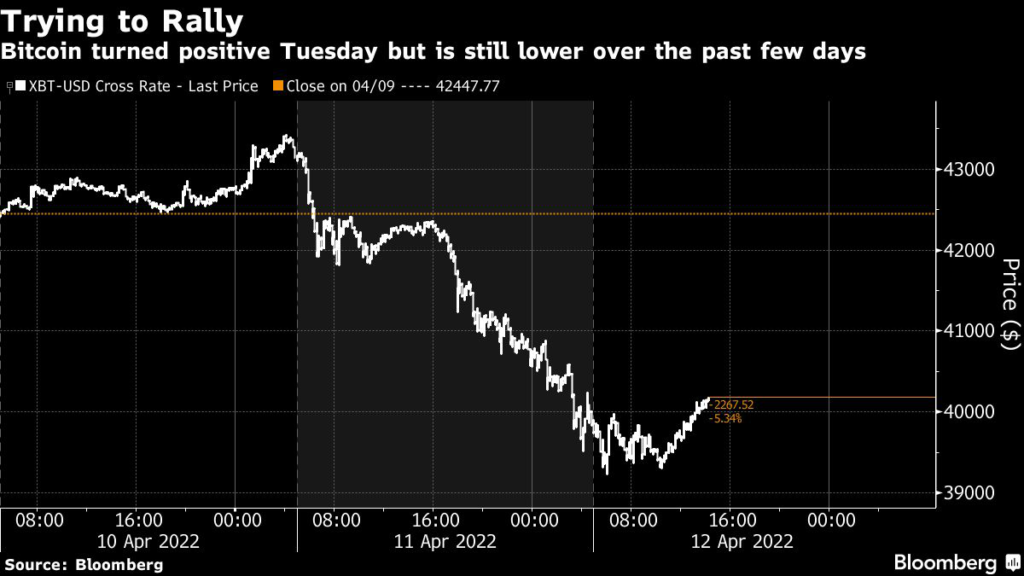
Bitcoin climbed back above $40,000 amid a broad rally in financial markets, while day-trader favorite Shiba Inu surged more than 20%. 

Shiba Inu and three other tokens — Solana’s SOL, Polygon’s Matic and Compound’s COMP — were all listed for the first time on Robinhood Markets Inc.’s platform. Shiba, which trades at a fraction of one U.S. cent, was the biggest gainer of the four, which all climbed in price.

Bitcoin had dropped Monday to below $40,000 for the first time in more than three weeks. It was about 1.1% higher at $40,300 as of 12:17 p.m. in New York. Ether also strengthened, rising to just above $3,000. Some smaller coins posted larger gains, with Avalanche rising nearly 4% and Cardano advancing 2.1%. 

Bitcoin and the broader crypto market have struggled in recent weeks as the Federal Reserve began hiking rates to combat stubbornly high inflation and geopolitical turmoil hurt risk appetite. A report Tuesday showed core inflation increased less than forecast in March.

Bitcoin “is still consolidating in a triangle pattern stretching back to mid-January,” said Jeffrey Halley, senior market analyst at Oanda. “The lower and upper boundaries today are $36,500 and $47,500,” he said, implying that Bitcoin was well within its range.  

Bitcoin Bearish Flag Has Analysts Looking For Crash Lows: Chart

Crypto’s correlation with U.S. tech stocks has risen sharply in the past few weeks, suggesting investors increasingly view digital assets as vulnerable to tightening monetary conditions. By contrast, the massive stimulus the Fed flooded markets with during the Covid outbreak drove Bitcoin to a record of almost $69,000 in November.  

A break above or below those support or resistance levels could lead to an $18,000 move either way, Halley added.

Strategists at Bespoke Investment Group point out that Bitcoin’s drubbing on Monday led to the coin collapsing through its 50-day moving average. “From a strictly technical perspective, Bitcoin isn’t trading well right now as the benchmark crypto asset has followed a similar playbook to stocks since late 2021: a major downtrend, a failure to make new highs on the rebound (and indeed, an outright rejection of its 200-DMA in BTC’s case), and now another trip below the 50-day,” they wrote in a note.

Noelle Acheson, head of market insights at Genesis Global Trading, says there are two big narratives at play for Bitcoin: one is that the coin is a risk asset and it’s going to move in tandem with other riskier assets. She points to its correlation with a basket of non-profitable tech companies — a 90-day reading shows the highest correlation on record. Another narrative is that long-term investors are accumulating Bitcoin because they don’t see it as a high-volatility play — instead, they view it as a store of value or an inflation hedge. 

“With so much accumulation and with more and more Bitcoin being held in illiquid or longer-term addresses, whichever definition you wish to choose, there’s less available for the macro investors or for the new market participants,” she said by phone. “Anyone new coming in has to source the Bitcoin from an ever-dwindling stockpile of liquid Bitcoin — in other words, those that are moved around by traders, which is what’s keeping the volatility relatively high.”

(Updates prices, adds Acheson comment, adds Bespoke comment)

More stories like this are available on bloomberg.com

©2022 Bloomberg L.P.

Heaviest Downpour in Six Decades Shuts Key South African Port

(Bloomberg) — South Africa suspended shipping at its main port in Durban after the heaviest rains in more than six decades and resultant flooding damaged roads leading to the harbor.

Operations at Durban Terminals were suspended on Monday night, Transnet SOC Ltd. said in an emailed statement. The harbor is a key trade route for South Africa and its landlocked neighbors including Botswana, Zimbabwe and Zambia. 

“The exceptionally heavy rainfall overnight and this morning exceeded even the expectations of the southern African meteorological community at large,” the South African Weather Service said in a statement. The department attributed the heavy rainfall to a low pressure system called a cutoff low, which is associated with widespread instability in the atmosphere and can lead to prolonged periods of rainfall.

A weather station at Mount Edgecombe on the outskirts of Durban received 307 millimeters of rainfall within 24 hours on Monday — the most since it began gathering data 62 years ago and almost double the previous high in 2019, according to the SAWS. That amount of rain is normally associated with intense hurricanes.

Read: UPL Pollution Control Dam at South African Chemical Depot Spills

At least 45 people may have been killed by the flooding, Johannesburg-based broadcaster eNCA reported. Local media reports showed videos and images of A.P. Moller-Maersk A/S-labeled shipping containers adrift in the water.

The so-called N3 highway that connects Johannesburg to Durban was closed to southbound traffic because of debris on the road caused by flooding, KwaZulu-Natal’s Transport Department said on Twitter. Some bridges on the N2, the main highway along the nation’s Indian Ocean coastline, have been washed away, Parboo Sewpersad, a spokesman for eThekwini Metropolitan police, said on Durban-based East Coast Radio.

“Shipping has been suspended until further notice as a result of environmental damage caused by the adverse weather, and vessels on berth are on standby,” Transnet spokeswoman Ayanda Shezi said in statement. “There have been no major incidents reported at the terminals thus far.”

South Africa’s largest exporter of thermal coal, Thungela Resources Ltd., said its operations have resumed after a “small interruption,” according to a spokeswoman. Rival Exxaro Resources Ltd. said it hasn’t been affected. 

South Africa is this year experiencing the La Nina weather phenomenon, which usually causes above normal rainfall in the country and its neighbors. In January, many parts of the nation experienced the heaviest rains since tracking by district began in 1921.

More stories like this are available on bloomberg.com

©2022 Bloomberg L.P.
Apple Poised to Boost Buybacks by $90 Billion, Citi Says

(Bloomberg) — For years, Apple Inc. has been at the forefront of multi-billion dollar stock repurchases among technology mega-caps. According to Citigroup Inc. analyst Jim Suva, it may be about to raise its game.

In a note published Tuesday, Suva estimated that the iPhone maker might announce a buyback of $80 billion to $90 billion, while also increasing its dividend by 5% to 10%. All eyes will be on its second-quarter results due after the closing bell on April 28.

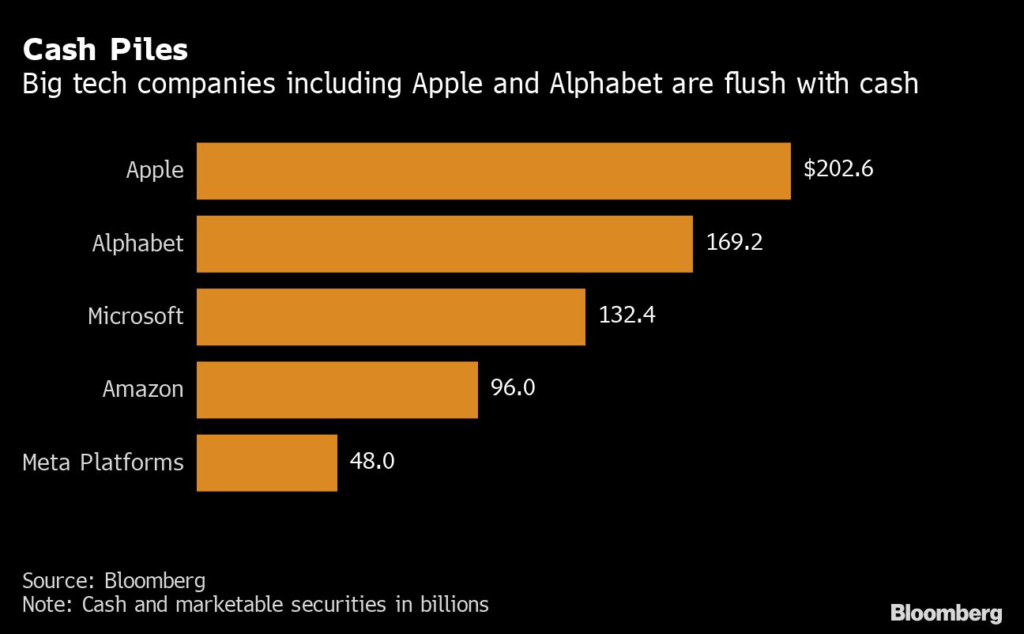
With their coffers filling fast, companies including Alphabet Inc. and Microsoft Corp. have been looking for ways to employ excess cash. Apple’s repurchases have totalled $274.5 billion, including $20.4 billion in the December quarter alone. Yet the company still has cash of more than $200 billion on the balance sheet, and with authorization to purchase up to $315 billion of stock, has scope to do a lot more.

“We expect Apple to add as much as $300 billion to share repurchases following 2Q results as availability wanes in its existing program,” Robert Schiffman, Bloomberg Intelligence senior credit analyst, wrote in a report last week, noting that the company historically reloads the repurchase program following the second quarter. 

The Cupertino-California-based company had increased its buyback program by $90 billion and hiked its dividend by 7% last April, along with its announcement of second-quarter results. 

Apple shares have fared better than peers this year, falling 6.7% versus the 14% drop of the tech-heavy Nasdaq 100 index. That’s despite reports of production difficulties that Suva says “could provide a near-term stock pullback which we would use as a buying opportunity.”

According to the Citi analyst, the company’s current market value does not reflect potential new product category launches such as augmented reality/virtual reality headsets and the Apple car.

Apple shares rose as much as 2.5% on Tuesday as U.S. stocks advanced after a report showed core inflation increased less than forecast in March. The Nasdaq 100 index was up 1.2% at 11:50 a.m. in New York.

(Adds BI analyst comment in fourth paragraph, background on buybacks in fifth.)

More stories like this are available on bloomberg.com

©2022 Bloomberg L.P.

KKR Is in Advanced Talks to Buy Thoma-Backed Cybersecurity Company Barracuda

(Bloomberg) — KKR & Co. has agreed to to acquire cybersecurity company Barracuda Networks Inc. from Thoma Bravo.

The transaction values Barracuda at about $3.8 billion, including debt, according to people familiar with the matter, asking not to be identified because the terms are private.

“With the support of KKR, we will continue to invest in growth and foster a culture that gives our team the resources and inspiration to continue to create and deliver the next generation of leading cybersecurity solutions,” Barracuda Chief Executive Officer Hatem Naguib said in a statement announcing the deal Tuesday, which confirmed a Bloomberg News report. 

Private equity firms have been gravitating toward cybersecurity assets for years, attracted by the steady cash flows and market opportunity as companies around the world want to protect themselves from hackers. 

Thoma Bravo took Campbell, California-based Barracuda private in 2018 for about $1.6 billion, according to a statement at the time. It helps customers guard their networks and employee emails, its website showed. 

Under Thoma Bravo, the company expanded its products and executed a number of acquisitions, according to Tuesday’s statement. KKR will support its expansion in areas including managed detection and response. Barracuda will also implement KKR’s employee-ownership program, which lets employees share in the ownership of their companies, the statement showed. 

One of the busiest cybersecurity investors has been Thoma Bravo. Earlier this week, the private equity firm agreed to buy Sailpoint Technologies Holdings Inc., a company it previously owned, for $6.9 billion. 

KKR also owns some cybersecurity companies such as Optiv Security, according to its website.

JPMorgan Chase & Co. advised Thoma Bravo and Barracuda on the deal. Guggenheim Partners, DBO Partners and Barclays Plc advised KKR. 

(Updates with details from statement starting in first paragraph)

More stories like this are available on bloomberg.com

©2022 Bloomberg L.P.

KKR Agrees to Buy Thoma-Backed Cybersecurity Company Barracuda

(Bloomberg) — KKR & Co. has agreed to to acquire cybersecurity company Barracuda Networks Inc. from Thoma Bravo.

The transaction values Barracuda at about $3.8 billion, including debt, according to people familiar with the matter, asking not to be identified because the terms are private.

“With the support of KKR, we will continue to invest in growth and foster a culture that gives our team the resources and inspiration to continue to create and deliver the next generation of leading cybersecurity solutions,” Barracuda Chief Executive Officer Hatem Naguib said in a statement announcing the deal Tuesday, which confirmed a Bloomberg News report. 

Private equity firms have been gravitating toward cybersecurity assets for years, attracted by the steady cash flows and market opportunity as companies around the world want to protect themselves from hackers. 

Thoma Bravo took Campbell, California-based Barracuda private in 2018 for about $1.6 billion, according to a statement at the time. It helps customers guard their networks and employee emails, its website showed. 

Under Thoma Bravo, the company expanded its products and executed a number of acquisitions, according to Tuesday’s statement. KKR will support its expansion in areas including managed detection and response. Barracuda will also implement KKR’s employee-ownership program, which lets employees share in the ownership of their companies, the statement showed. 

One of the busiest cybersecurity investors has been Thoma Bravo. Earlier this week, the private equity firm agreed to buy Sailpoint Technologies Holdings Inc., a company it previously owned, for $6.9 billion. 

KKR also owns some cybersecurity companies such as Optiv Security, according to its website.

JPMorgan Chase & Co. advised Thoma Bravo and Barracuda on the deal. Guggenheim Partners, DBO Partners and Barclays Plc advised KKR. 

(Updates with details from statement starting in first paragraph)

More stories like this are available on bloomberg.com

©2022 Bloomberg L.P.

Billions Are Pouring Into Chipmaker ETFs Stung by Stock Drops

(Bloomberg) — Investors are flooding into exchange-traded funds focused on semiconductor stocks, wagering the industry will rebound from the supply-chain snags and chip shortage that have dragged the shares lower. 

Semiconductor ETFs have seen roughly $6.8 billion of inflows since the beginning of the year, surpassing the $5.2 billion for all of 2021 and the $2.1 billion for the year before, according to data compiled by Bloomberg.

That represents a show of faith that the sector will recover from the supply-chain turmoil caused by the pandemic, which could worsen as China ushers in a new round of lockdowns to contain outbreaks. That troubles have weighed on the ETFs and pushed the Philadelphia Semiconductor Index to a loss of 21% this year, more than three times the drop in the S&P 500.

“The underperformance kind of makes sense given the near-term macro environment,” said Ross Mayfield, an investment-strategy analyst at Baird. But “people believe in the long-term growth story, especially as they’ve come into focus this year with the supply chain shortages.” 

The two biggest funds by assets, iShares Semiconductor ETF (ticker SOXX) and VanEck Semiconductor ETF (ticker SMH), have both dropped more than 20% this year. But they have seen year-to-date inflows of $137 million and $2.5 billion, respectively. 

Demand for semiconductors remain sky-high, with industry sales jumping by more than 20% each month for almost a year already. The stock market’s slide has also made valuations more attractive, said Kevin Kelly, the chief executive officer of Kelly ETFs.

“It’s investors positioning for the long term as semiconductors are at the convergence of multiple thematic demand drivers,” he said, such as electric cars, the metaverse and cryptocurrencies. “If there is a cyclical industry to put new capital to work, semis appear to be an interesting sector to allocate in today’s market.”

While sentiment around the industry remains hopeful, Frank Cappelleri, a trading-desk strategist at Instinet, said the biggest semiconductor ETFs may not see a turnaround in the near term. 

“Oftentimes, an inflection point — a turn higher — doesn’t come until sentiment turns sour,” Cappelleri said. “That may not have to happen now, but continued weakness from here eventually could alter the flow data.”

More stories like this are available on bloomberg.com

©2022 Bloomberg L.P.

Apple’s Cook Says Circumventing App Store Would Harm User Privacy

(Bloomberg) — Apple Inc. Chief Executive Officer Tim Cook said that proposed app store regulations in the U.S. and European Union would put iPhone users’ privacy at risk. 

“If we are forced to let unvetted apps onto iPhones, the unintended consequences will be profound,” Cook said during a keynote address at the Global Privacy Summit on Tuesday in Washington. “Data-hungry companies would be able to avoid our privacy rules and once again track our users against their will.”

Apple is under global scrutiny over app store policies. The EU is working on legislation that would force the company to allow apps to be installed from outside the Apple App Store, threatening Apple’s grip on its platform and potentially limiting its ability to collect a commission from developers.

In the U.S., two bills that would regulate app stores run by Apple and Alphabet Inc.’s Google have the best chance of becoming law among proposals aimed at reining in big technology companies. In July, three dozen states sued Google, alleging that the company illegally abused its power over the app industry through the Google Play store on mobile devices.

Apple has lobbied hard against app store regulations, arguing that they would make the iPhone ecosystem more similar to Android, limiting consumer choice and privacy. Last December, Cook met with several senators, including Minnesota Democrat Amy Klobuchar, about this bill and other antitrust proposals.

Other major tech companies, such as Spotify Technology SA and Microsoft Corp., have lobbied in favor of opening up the iPhone App Store ecosystem. Last month, Google said it would begin letting some apps bill users directly as an alternative to paying through the Play Store, a concession to the mounting antitrust concerns. 

More stories like this are available on bloomberg.com

©2022 Bloomberg L.P.

Close Bitnami banner
Bitnami