Bloomberg

Thoma Bravo to Buy Sailpoint for $6.9 Billion

(Bloomberg) — Investment firm Thoma Bravo has agreed to acquire cyber security company Sailpoint Technologies Holdings Inc. for $6.9 billion, according to a statement Monday.

Thoma Bravo is paying $65.25 per share in cash for the Austin-based company, which represents a 48% premium to the company’s 90-day, volume-weighted average price, the statement showed. 

The deal includes a so-called go-shop period that will let Sailpoint solicit other offers through the end of May 16. 

“Sailpoint is ideally positioned to capitalize on the large and growing demand from modern enterprises for robust identity security solutions that secure their business and reduce risk,” Seth Boro, a managing partner at Thoma Bravo, said in a statement. 

Sailpoint rose more than 29% to $64.01 at 11:33 a.m. in New York on Monday, giving the company a market value of about $6 billion. 

Sailpoint won’t be a new investment for Thoma Bravo. It previously backed Sailpoint and took the company public in 2017. 

(Corrects Sailpoint name in fourth paragraph)

More stories like this are available on bloomberg.com

©2022 Bloomberg L.P.

Yelp Joins Citi, Apple to Offer Workers Abortion Travel Benefits

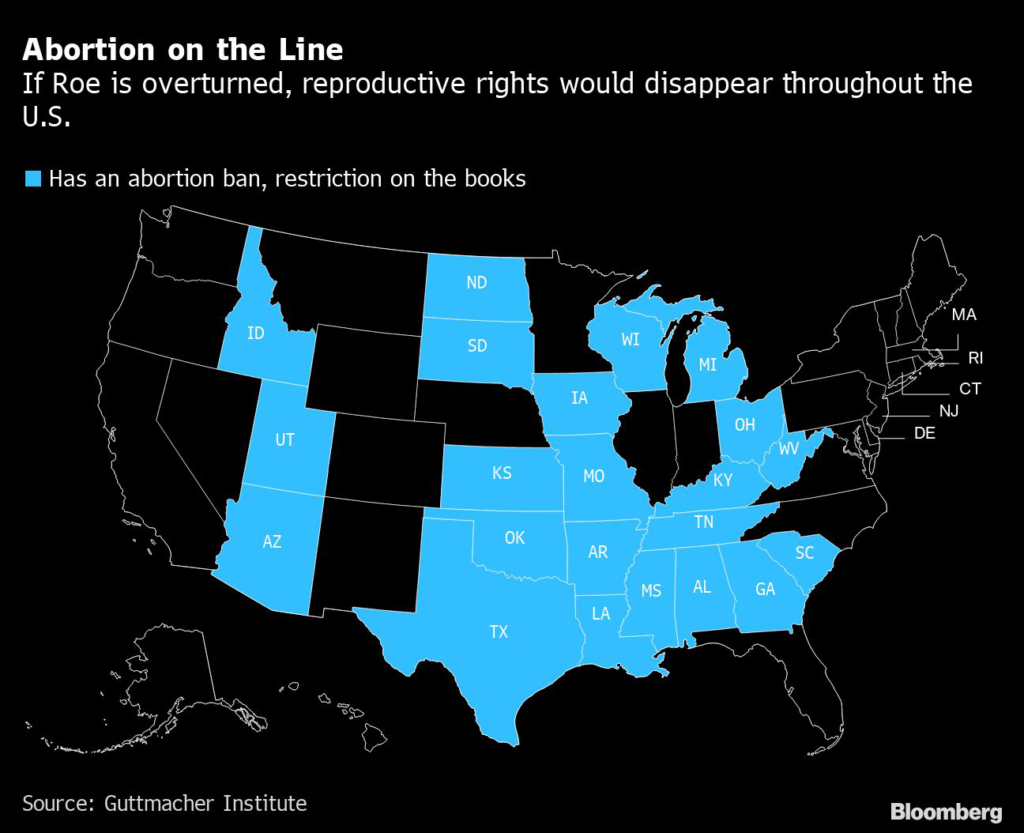
(Bloomberg) — In the wake of increasingly restrictive abortion laws sweeping the U.S., Yelp Inc. is the latest company to cover travel costs for employees who need to leave their home states to get reproductive care.

The company has nearly 4,000 workers in the U.S. and just over 200 in Texas, where a bill has banned abortions after six weeks. Yelp will offer its benefit through the company’s insurance provider starting next month, according to a person familiar with the matter. It will also extend coverage to dependents. 

“As a remote-first company with a distributed workforce, this new benefit allows our U.S. employees and their dependents to have equitable access to reproductive care, regardless of where they live,” Miriam Warren, the company’s chief diversity officer, said in an emailed statement.

With the Supreme Court expected to rule on a case this year that could lead to further abortion restrictions in many states, large U.S. companies with workers based in those places, such as Citigroup Inc., Apple Inc. and  Levi Strauss & Co.  have begun offering a travel benefit for getting reproductive health care out of state.

Read more:  How Big U.S. Companies Are Creating a Brand New Abortion Benefit

If the justices overturn Roe v. Wade, the landmark ruling that guarantees a federal right to abortion in the U.S., the availability of the procedure will vary widely by state. There are abortion deserts — where patients have to travel more than 100 miles to get to the nearest clinic — in every region of the country except the Northeast, according to the Bixby Center for Global Reproductive Health. Three-quarters of people who seek abortion care have incomes that are near or below the federal poverty line.

Already, in Texas, around 1,400 people a month are traveling out of the state for abortions, according to a March study from the University of Texas at Austin’s Texas Policy Evaluation Project.

State-level abortion restrictions cost those local economies $105 billion annually by cutting labor force participation and earnings, and increasing employee turnover and time off from work, according to the Institute for Women’s Policy Research.

Women who want an abortion but don’t get one are four times more likely to live below the federal poverty level.

More stories like this are available on bloomberg.com

©2022 Bloomberg L.P.

The Chipmakers Paradox: Stocks in Freefall Even as Demand Stays Strong

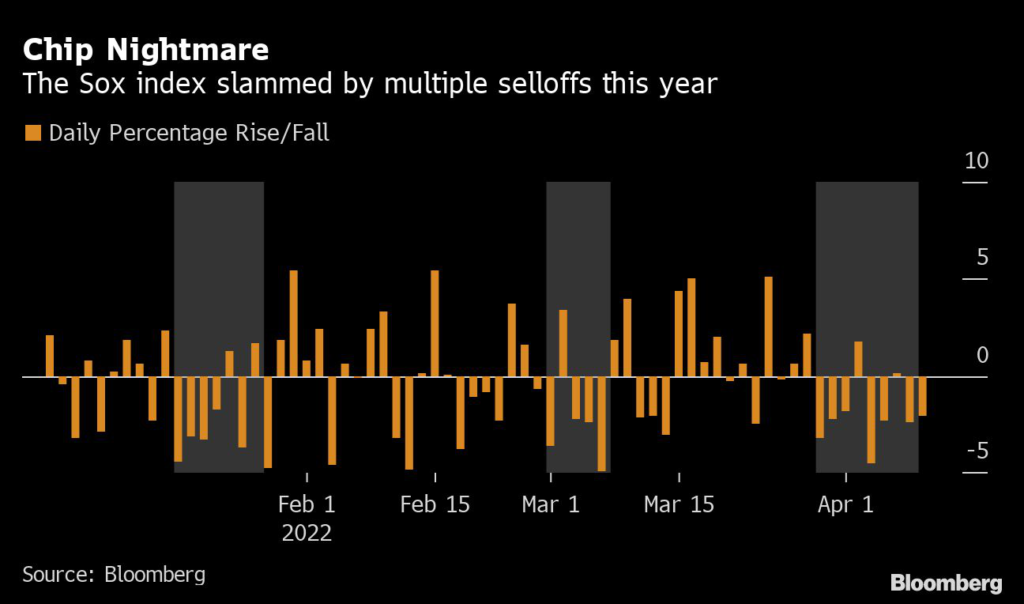
(Bloomberg) — Demand for semiconductors has never been higher, with industry sales increasing by more than 20% each month for almost a year now. Yet chip stocks are one of the worst-performing sectors in the U.S. market this year. 

That paradox reflects the cliff that investors see looming for the economy and the stock market because of a toxic combination of surging inflation and higher interest rates. Chips, used in everything from cars to computers to factory equipment, are seen as one of the sectors in technology that’s most tied to the cycles of the economy.

The Philadelphia semiconductor index, known as the Sox, has shed 23% this year after gaining at least 40% in each of the past three years. The decline has wiped out about $750 billion in market value.

“The thinking is, ‘Uh oh, the economy might be going south, so let’s sell the heck out of the semis,’” said Kim Forrest, chief investment officer and founder of Bokeh Capital Partners. “When the downturn comes, I think there will be a softening but I don’t think there will be a big collapse like there used to be.”

Investors have been spooked by surging yields on U.S. Treasury bonds and hawkish comments by Federal Reserve officials eager to tamp down inflation. The Nasdaq 100 Stock Index fell 2.4% Monday, adding to losses sustained last week that have erased more than $1 trillion in market value from the tech-heavy benchmark in the past five sessions. 

However, the index was up 1% on Tuesday, snapping a two-day drop after a report showed core inflation increased less than forecast in March.  

If there’s trouble brewing, it’s not yet registering with analysts on Wall Street. Since the start of the year, estimates for profit growth at semiconductor companies this year have increased by about 4 percentage points to 18%, according to data compiled by Bloomberg Intelligence. That compares with earnings growth of 10% for the S&P 500 Index. 

Chips have become so critical for an expanding range of products that there’s unlikely to be a massive pullback in orders, according to Forrest.

Lockdowns in China have disrupted manufacturing, but chipmakers have yet to estimate the loss that the latest Covid-induced restrictions will have on their businesses. 

And a chip shortage is yet to ease, helping to boost prices.

Last week, one of Apple Inc.’s most important suppliers, Taiwan Semiconductor Manufacturing Co., reported record first-quarter revenue. Analog Devices Inc. said its current quarter sales would exceed its previous forecast range, indicating that demand remains strong and downplaying concerns that customers are stockpiling inventory.

“The consensus right now is to be negative on chips but we’re not seeing that in the fundamentals,” said Daniel Morgan, a senior portfolio manager at Synovus Trust. “I’m more optimistic.” 

Tech Chart of the Day

The markets have had a rough start to 2022, but the Philadelphia semiconductor index has had it worse. The chip benchmark has closed down in more than half of the sessions this year, with 27 declines of greater than 2%.

Top Tech Stories

  • Alphabet Inc.’s Google will tighten approval for personal loan apps made available in the Philippines to fight illegal and abusive lending practices, the U.S. Securities and Exchange Commission said.
  • IPhone assembler Pegatron Corp. suspended production at its Chinese plants in Shanghai and Kunshan as the country’s policies to control the worst virus outbreak in two years disrupt global supply chains.
  • Some Microsoft Corp. customers, and some of its fiercest rivals, are making a bold claim that the software giant is again using its sway over one market to thwart competition in another.
  • Tencent Holdings Ltd. surged more than 5%, joining the rest of China’s gaming industry in a rally after regulators approved the country’s first batch of new titles in more than eight months.
  • For years, Apple Inc. has been at the forefront of multi-billion dollar stock repurchases among technology mega-caps. According to Citigroup Inc. analyst Jim Suva, it may be about to raise its game.
  • Deliveroo Plc’s customers ordered less than expected at the start of this year, a setback for the company as it aims to sustain momentum from the pandemic and reach closer to profitability.
  • Intel Corp. announced the opening of a $3 billion extension to its D1X plant in Oregon, an investment aimed at speeding up technology development needed to regain leadership of the chip industry.

(Updates shares in paragraph six.)

More stories like this are available on bloomberg.com

©2022 Bloomberg L.P.

Apple Poised to Boost Buybacks by $90 Billion, Citi Analyst Says

(Bloomberg) — For years, Apple Inc. has been at the forefront of multi-billion dollar stock repurchases among technology mega-caps. According to Citigroup Inc. analyst Jim Suva, it may be about to raise its game.

In a note published Tuesday, Suva estimated that the iPhone maker might announce a buyback of $80 billion to $90 billion, while also increasing its dividend by 5% to 10%. All eyes will be on its second-quarter results due after the closing bell on April 28.

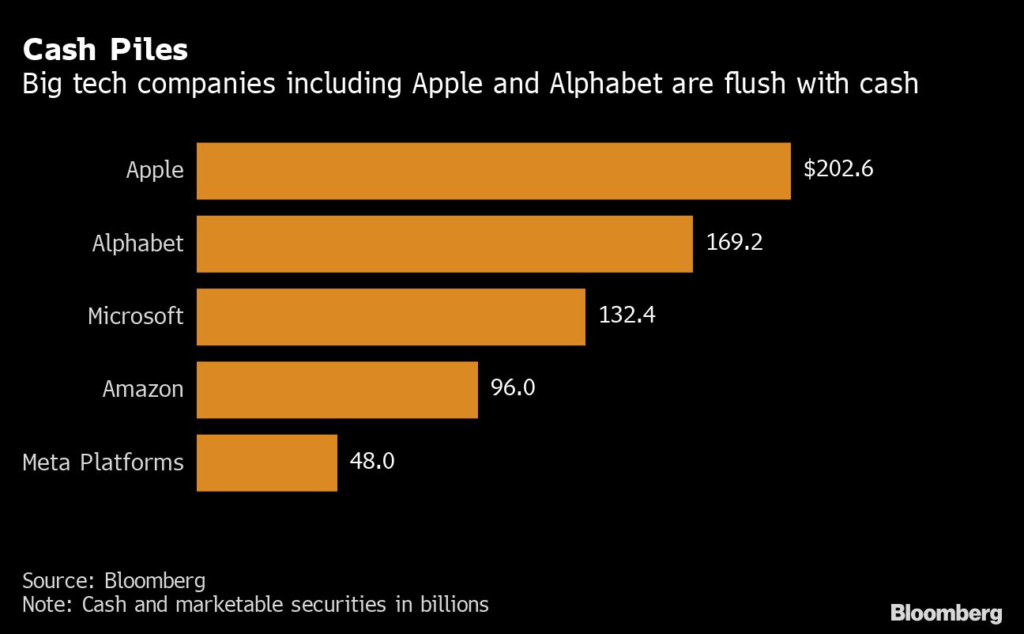
With their coffers filling fast, companies including Alphabet Inc. and Microsoft Corp. have been looking for ways to employ excess cash. Apple’s repurchases have totalled $274.5 billion, including $20.4 billion in the December quarter alone. Yet the company still has cash of more than $200 billion on the balance sheet, and with authorization to purchase up to $315 billion of stock, has scope to do a lot more.

Apple shares have fared better than peers this year, falling 6.7% versus the 14% drop of the tech-heavy Nasdaq 100 index. That’s despite reports of production difficulties that Suva says “could provide a near-term stock pullback which we would use as a buying opportunity.”

According to the Citi analyst, the company’s current market value does not reflect potential new product category launches such as augmented reality/virtual reality headsets and the Apple car.

Apple shares rose as much as 1.6% in early trading Tuesday as U.S. stocks advanced after a report showed core inflation increased less than forecast in March. The Nasdaq 100 index was up 1% at 9:35 a.m. in New York.

(Updates to add shares.)

More stories like this are available on bloomberg.com

©2022 Bloomberg L.P.

Apple Targets Watch Blood-Pressure Tool for 2024 After Snags

(Bloomberg) — Apple Inc.’s plan to add a highly anticipated blood-pressure monitor to its smartwatch has hit some snags and the technology isn’t expected to be ready until 2024 at the earliest, according to people with knowledge of the matter. 

The company has teams working on an updated sensor and software for the Apple Watch that would determine if a user has high blood pressure, but accuracy has been a challenge during testing, said the people, who asked not to be identified because the matter is private. The feature has been planned for at least four years, but it’s probably two years away from hitting the market and may slip until 2025, they said. Apple’s shares were up about 1% at 9:41 a.m. in New York.

Blood-pressure features may become a key selling point for smartwatches in coming years, but the technology hasn’t been easy to master. Though Apple rivals such as Samsung Electronics Co. have launched watches with the capability, they require monthly calibration with a traditional monitor. Last year, Alphabet Inc.-owned Fitbit launched a public study to test wrist-based blood-pressure measurement.

The iPhone maker is running trials of its blood-pressure technology on employees. Its planned approach won’t tell users their specific systolic and diastolic readings — the numbers used to assess blood pressure — but would warn those wearing the watch that they may have hypertension, which is high-blood pressure, and should consult a doctor or use a standard blood pressure checker.

The company also has teams working to add noninvasive blood sugar monitoring to the watch, a move that could be a boon to diabetics. That feature is still several years away and hasn’t been assigned a target year of release yet. In the interim, the company has discussed adding improved support for third-party glucose meters to the watch and the iPhone’s Health app. 

While Apple’s blood-pressure and glucose features are still far off, the company is working on other upgrades that will launch sooner. That includes new women’s health, sleep, fitness and medication management features. 

A spokeswoman for Cupertino, California-based Apple declined to comment.

The Apple Watch has become a vital piece of Apple’s hardware lineup since it launched in 2015. It’s part of the company’s wearables, home and accessories division. Sales in the segment increased 25% last year to $38.4 billion — more revenue than what the Mac or iPad generates. 

The company is planning to add a body-temperature sensor to the watch as early as this year. The feature, which Bloomberg first reported on last year, would initially be designed to help with fertility planning. Future versions of the watch could expand the feature to determine if a user has a higher than normal body temperature, but — like with blood pressure — is unlikely to show an actual measurement. 

Apple is also looking to expand its atrial fibrillation detection feature on its watch to calculate what is known as “burden,” or how often a person is in a state of atrial fibrillation across a certain period. That feature could appear in watchOS 9, the next software update that will debut in June and ship with the next watches in the fall. 

For watchOS 9, Apple also is planning a new low-power mode that is designed to let its smartwatch run some apps and features without using as much battery life. Currently, Apple Watches in low-power mode — known on the device as Power Reserve — can only access the time. The company is also planning to refresh many of its built-in watch faces currently shipping with the device. 

An updated version of the Health app on the iPhone this year is expected to add expanded sleep tracking functionality, medicine management and new women’s health features. Apple has been working on a medicine management tool that will let users scan their pill bottles into the app. The software will monitor adherence and remind users to take their medication. But the initial version of the feature for this year is unlikely to include all of the planned functionality. 

Apple also is planning to add more workout types and additional metrics related to running within the Workout app on the watch.

While Apple is making headway with several health features, some employees haven’t been satisfied with the company’s progress. They argue that enhancements are taking too long and that the company isn’t making big enough bets in the area. 

Recently, the company has seen a larger than normal number of departures by physicians who work on health teams. The exits include Charles Wang, a former Johnson & Johnson executive; as well as James Kretlow, Lawrence Huan, Yaniv Kerem and Bronwyn Harris.

The Health team has about 1,000 employees but hasn’t grown in at least two years. Separately, a pair of health-focused executives on the company’s strategic deals team — Gregg Spivey and Maziar Brumand — left in recent months. Last year, Kevin Lynch, who has run Apple Watch and Health software, stepped back from the team to lead the company’s self-driving car efforts. 

Apple is planning as many as three new Apple Watches for this year, including a standard Series 8 model, a low-end SE version and an upscale model with a rugged casing that is aimed at extreme athletes.

The company is also working to eventually bring satellite connectivity to the Apple Watch, setting the stage for emergency texting and SOS response features. It’s planning to release those capabilities on iPhone as early as this year. The technology would allow users to send text messages to emergency personnel over satellite networks and report incidents.

(Updates with shares.)

More stories like this are available on bloomberg.com

©2022 Bloomberg L.P.

Joke No More: Shiba Inu Is Among Four Crypto Tokens Listed on Robinhood

(Bloomberg) — Robinhood Markets Inc. included four new cryptocurrencies on its platform, including the Shiba Inu coin, in a win for proponents who had long argued in favor of the joke token becoming available for trading. 

The platform popular with daytraders also added Solana’s SOL, Polygon’s Matic and Compound’s COMP to its list of available trades in a possible appeal to users now that the surge in retail trading that came during the outbreak of the pandemic lockdowns has abated. Prices of all the tokens listed rose. Shares of Robinhood were up 4.6% as of 9:33 a.m. in New York.

“We’re excited to add more choices for our customers as we work to make Robinhood the best place to invest in crypto,” Steve Quirk, chief brokerage officer at Robinhood, said in a blog post. “As a safety-first company, we have a rigorous framework in place to help us evaluate assets for listing, and we remain committed to providing a safe and educational crypto platform.”

Robinhood users have long requested the brokerage allow SHIB, as the Shiba coin is known, to be traded — a Change.org petition started last year has seen more than 550,000 signatories in favor of the move. 

The company has said all along it carefully considers the new coins it adds to its offerings — besides customer demand, its listing committee deliberates factors including on-chain analysis, tech and security, as well as legal and financial variables, among others.

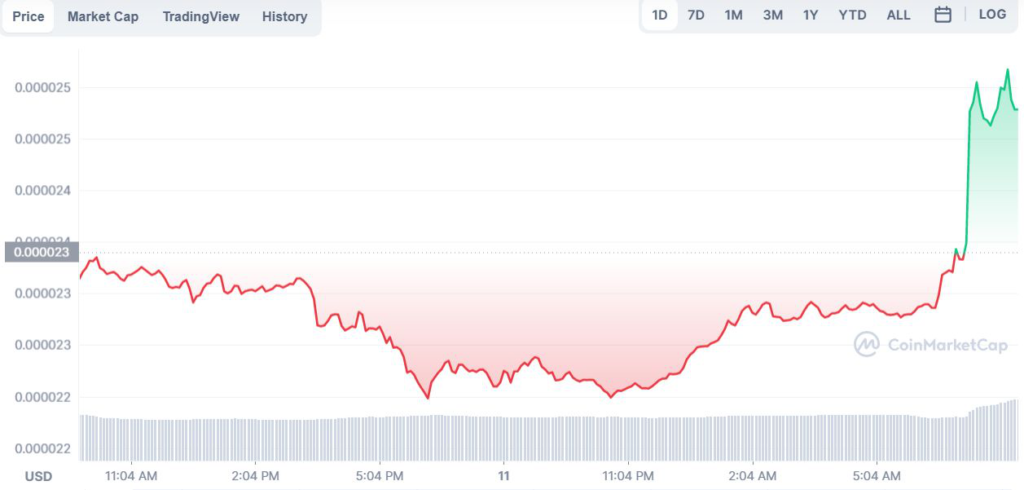
Retail investors behind the push often cite last year’s meteoric rise of another joke token, Dogecoin, with many at-home traders projecting that the Shiba coin would see similar success. Trading in SHIB, meanwhile, has been volatile, with Coinmarketcap.com showing a roughly 30% drop for the digital asset this year before the announcement. SHIB rose roughly 7% on Tuesday, according to Coinmarketcap.com. Other cryptocurrencies, including Bitcoin, also advanced. 

Robinhood has been active around its crypto offerings in recent days — last week, it announced the rollout of its cryptocurrency wallet, which granted access to more than 2 million customers who were on a waiting list for the product. The wallet enables users to interact with crypto outside of Robinhood’s trading platform, including allowing them to buy non-fungible tokens, Bloomberg reported. The product was first announced in September, not long after Robinhood Chief Executive Vlad Tenev said that such a wallet was in high demand among customers. 

(Updates with chart; adds Quirk comment; adds HOOD price.)

More stories like this are available on bloomberg.com

©2022 Bloomberg L.P.

RBC Hires Three Citi Retail Investment Bankers in Expansion

(Bloomberg) — Royal Bank of Canada’s capital-markets division is bulking up its consumer and retail investment-banking franchise with three bankers from Citigroup Inc., including hiring Douglas Trauber as the new global head of the business.

Also joining RBC from Citi are Hugh Paisley and Jason Neumann, according to an internal memo seen by Bloomberg News. Carrie Cook, RBC’s current global head of consumer and retail investment banking, was promoted to co-head of Canadian investment banking.

RBC Capital Markets Chief Derek Neldner has said he plans to hire around 25 managing directors globally this year, even amid fierce competition for top talent. The firm’s consumer and retail franchise has been involved in recent transactions including Neighbourly Pharmacy Inc.’s C$435 million ($345 million) acquisition of Rubicon Pharmacies and Pet Valu Holdings Ltd.’s C$226 million secondary offering.

Trauber will take over as global head of consumer and retail investment banking and be based in New York, according to the memo from RBC Capital Markets’ U.S. investment-banking co-heads Matthew Stopnik and Jim Wolfe, along with European investment-banking head Josh Critchley and Canadian investment-banking chief Trevor Gardner. 

Trauber joined Citi in 2015, and was the firm’s global head of retail investment banking. Before that, he was head of retail investment banking at Credit Suisse Group AG and covered the sector at UBS Group AG. Throughout his 30-year career, Trauber has advised on more than $75 billion of transactions, according to the memo.

Paisley is joining RBC as managing director and co-head of U.S. consumer and retail investment banking, working alongside Marco Habert. He’ll be based in New York. 

Paisley was Citi’s co-head of North American retail investment banking and previously covered the retail sector at Credit Suisse and UBS. He has advised retailers including Walmart Inc., Lowe’s Cos. and Williams-Sonoma Inc.

Neumann will join the firm as a managing director in the consumer and retail group. Prior to Citi, he worked at Credit Suisse as part of its consumer and retail investment-banking coverage teams, with experience in categories including specialty, discount, food and beverage, fitness and e-commerce.

(Updates with previous global head’s promotion in second paragraph.)

More stories like this are available on bloomberg.com

©2022 Bloomberg L.P.

BlackRock, Fidelity Back Stablecoin Firm Circle in $400 Million Funding Round

(Bloomberg) — Circle Internet Financial Ltd., the issuer of USD Coin, the second-largest stablecoin, landed $400 million in funding from a group that includes BlackRock Inc. and Fidelity Management and Research LLC, in a sign of traditional finance’s growing acceptance of the exploding cryptocurrency industry.

BlackRock, based in New York, also entered into a broader partnership with Boston-based Circle, including exploring capital-market applications for USD Coin, in addition to serving as a primary asset manager for the stablecoin’s cash reserves. Other investors include Marshall Wace LLP and Fin Capital, according to a statement Tuesday.

The latest investment underscores how Wall Street’s biggest players are preparing for the wider adoption of cryptocurrencies and associated technologies. Last month, BlackRock Chief Executive Officer Larry Fink said the company is studying how digital currencies and stablecoins can be used to help clients. 

“We believe digital assets and blockchain technologies are going to become increasingly relevant for BlackRock and our clients,” Chief Operating Officer Rob Goldstein and Salim Ramji, global head of ETFs and index investments, wrote in a memo to employees Tuesday. The company has been conducting work in crypto assets, stablecoins, tokenization of ownership for a range of asset types, and permissioned blockchains. 

Stablecoins, typically pegged to a government-backed currency such as the dollar or euro, are a key part of the crypto universe because investors use them to buy and sell other digital currencies that are more volatile. USD Coin, currently the fifth-biggest cryptocurrency, has a market value of more than $50 billion, according to CoinGecko. USD Coin is the largest stablecoin by market value after Tether.

“Dollar digital currencies like USDC are fueling a global economic transformation,” Circle Chief Executive Officer Jeremy Allaire said in the statement. “It’s particularly gratifying to add BlackRock as a strategic investor in the company. We look forward to developing our partnership.”

In February, Circle revised the terms of a planned merger with special purpose acquisition company Concord Acquisition Corp., with the value of the transaction doubling to $9 billion. 

The funding round is expected to close in the second quarter.

(Updates with BlackRock employee memo in fourth paragraph.)

More stories like this are available on bloomberg.com

©2022 Bloomberg L.P.

U.S. Cyber Firms Seek Tech Standards as Russian Hacking Fears Grow

(Bloomberg) — A group of cybersecurity companies that specialize in securing critical infrastructure said Tuesday they’ve formed a lobbying group to push for technological standards among the private sector and government. 

The Operational Technology Cybersecurity Coalition said it will directly work with the U.S. government to share feedback on policy proposals and adopt uniform technological standards for securing places such as pipelines and industrial facilities. Founding members include Claroty Inc., Tenable Holdings Inc., Honeywell International Inc., Nozomi Networks Inc. and Forescout Technologies Inc. 

The effort comes as experts have placed increased scrutiny on what’s known as operational technology, or OT, a broad swath of systems that monitor industrial equipment. In May, the cybersecurity firm Mandiant Inc. warned that compromises against internet-connected OT devices were on the rise.

“This work is essential to protect our country’s critical infrastructure,” said Jeff Zindel, vice president and general manager for cybersecurity at Honeywell.

The U.S. government has also recently warned of increased threats from Russia amid the Kremlin’s war in Ukraine. The Justice Department in March announced indictments against four Russian nationals for their alleged role in cyberattacks against hundreds of companies in the energy sector, including the operator of a nuclear power facility in Kansas. 

More stories like this are available on bloomberg.com

©2022 Bloomberg L.P.

Web3 Is Useless If It’s Not User-Friendly

(Bloomberg Markets) — Seemingly out of nowhere, web3 has become one of the biggest technology trends of 2022. It’s captivated investors, the technorati, and Paris Hilton. But the number of people who’ve heard of it well outnumber those who understand what it really is: essentially just a rebrand of blockchain, the software at its heart.

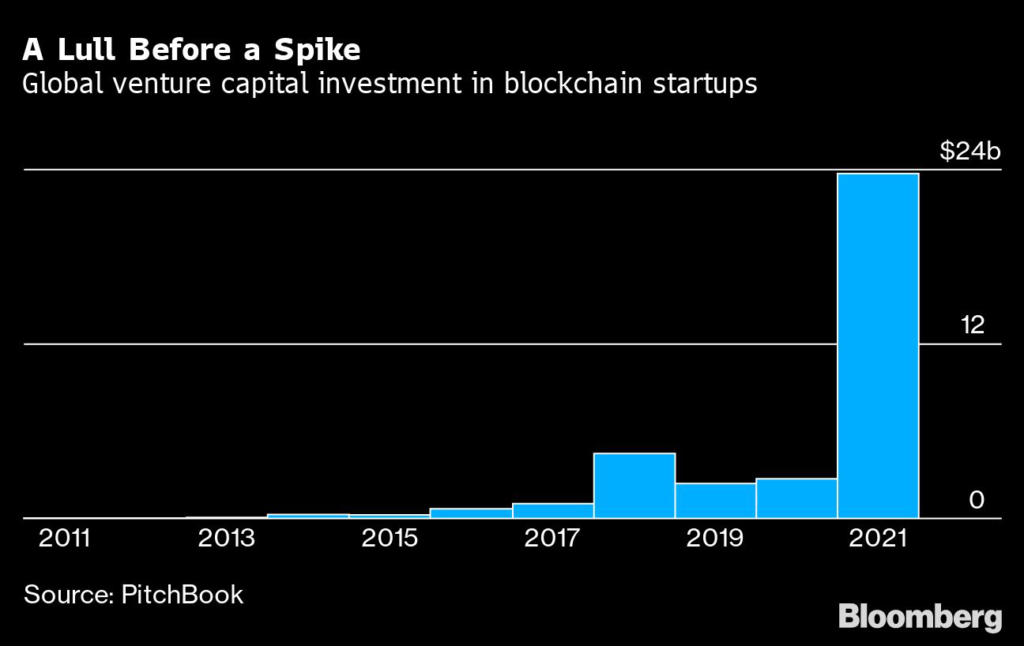
Blockchain was an ultra-hot investment sector that started to lose momentum with venture capital investors about three years ago. Then, last year, the idea of “decentralized ledger technology” soared back into popularity under a new name, claiming to be the next chapter of the entire internet. But concerns about how blockchain technology works under the hood, which bogged down investors’ interest before, remain real and aren’t going away.

Web3 enthusiasts posit that the internet of websites and blogs dominated by a handful of trillion-dollar technology companies is the past: web2. The future is a far more decentralized and equitable internet underpinned by cryptocurrencies and tokens. How far away is that future? Much farther than is justified by the investment being made in web3 assets and companies today; venture capitalists put $18 billion into web3 startups in 2021 alone, according to Crunchbase, a research firm that tracks the technology industry.

A web3 internet may never find mainstream adoption, because so far it’s been unable to host apps and services that are user-friendly and developer-friendly. In short, web3 is clunky. Attempts to popularize decentralized apps, or dapps—software applications that run on blockchain-enabled smart contracts instead of on the internet’s current protocols—have struggled to gain traction.

One example is a Twitter clone called Peepeth, a dapp that picked up a few thousand users when it launched in 2018. Posting a “peep” (instead of a tweet) required paying a fraction of a cent in Ether—the cryptocurrency that underpins Ethereum—by using a cryptocurrency wallet and browser plugin such as MetaMask. (Plugins or dedicated browsers, including Brave and Opera, are the primary means for interacting with web3.) A few months after Peepeth was launched, the controversial American podcast host Joe Rogan talked about the app on his show, praising it as a censorship-proof tool because data on the blockchain can’t be altered. Analysts that year also said mainstream adoption of dapps was just a year or two away.

Despite the fanfare, San Francisco-based Peepeth and other distributed apps struggled to attract a big audience. Active user numbers languished in the thousands or even the hundreds. One reason: The services were hard to use. It took about a day to post a single peep, for instance, compared to a split second with Twitter, and buying and spending tokens with MetaMask was cumbersome. Peepeth creator Bevan Barton didn’t respond to a request for comment.

In 2018 the most popular dapps on Ethereum enabled speculative trading of crypto assets. CryptoKitties, for instance, allowed you to collect and “breed” digital cats on the blockchain, sometimes at a cost of thousands of dollars. The number of dapps has grown from 1,500 in 2018 to almost 10,000 today–but the most popular services are still limited to financing and trading, with some games dotted into the mix. The most popular dapps are marketplaces for nonfungible tokens (NFTs) with names such as OpenSea and PancakeSwap, according to DappRadar UAB, a Lithuania-based online store for dapps.

Web3’s other challenge is actually living up to its decentralized ideals. So far, it’s not very distributed.

With his dreadlocks and freewheeling sailor’s lifestyle, Moxie Marlinspike is among the world’s best-known cryptographers. Marlinspike, who once led Twitter’s security team, created the encrypted messaging app Signal and co-authored the encryption protocol that underpins WhatsApp, Facebook Messenger, Google Messages, and Skype. Marlinspike caused a stir when he wrote in a January blog post that web3’s fundamental principles have fallen by the wayside in practice. Web3 has, for a start, surprisingly little cryptography for a technology that’s supposedly “built on ‘crypto,’ ” Marlinspike wrote. In fact, popular web3 services, such as the NFT marketplaces, still rely on web2-style processes to link to blockchains, he wrote.

APIs, or application programming interfaces, are a cornerstone of web2. They connect different software programs, allowing online businesses to communicate with one another. Amazon.com Inc., for instance, charges customers of its cloud-computing business, Amazon Web Services, by tallying up the number of times they “call” its APIs.

Marlinspike noted that popular web3 services such as OpenSea and MetaMask, the browser plugin for accessing web3 apps, are using APIs to access the Ethereum blockchain through a third party. That means people utilizing these services aren’t accessing the blockchain directly either. Marlinspike, by way of example, created an NFT on Ethereum, which was stored in his MetaMask crypto wallet and displayed on the OpenSea marketplace. But when OpenSea took his NFT down from its marketplace, it also disappeared from his crypto wallet.

Imagine uploading a photo to Facebook and then discovering the image has been deleted from your computer hard drive after being removed from the social network. That’s similar to what happened to Marlinspike’s NFT. In theory it should have continued to appear in his MetaMask crypto wallet, but MetaMask couldn’t interact with the blockchain directly. It had to make API calls to at least one other company, essentially acting as a gatekeeper, to show the NFT. It didn’t matter that Marlinspike’s NFT was indelibly on the blockchain, because his crypto wallet needed to use OpenSea’s API to display it. MetaMask was acting more like a window than a wallet. (Dan Finlay, MetaMask’s co-founder, confirms that his service relies on the OpenSea API to display NFTs in users’ MetaMask wallets. “We know that hitting a centralized index for your possessions is a flawed strategy and have ways of moving off it,” he adds.)

The ideals of distributed and transparent data are moot when individuals with mobile phones and computers aren’t able to plug directly into a blockchain, because those networks are connected by servers, powerful computers that are generally controlled by companies. As it consolidates around platforms, web3 is taking on the centralized look of web2, and far from disrupting the power of gatekeepers, web3 is cultivating them.

It’s easy to take for granted the standardization that underpins the internet today, built on 30 years of experimentation, implementation, and slow-moving steps to achieve consensus by organizations such as the World Wide Web Consortium or WC3 (not to be confused with web3). So well-oiled and interoperable is today’s infrastructure that we almost never notice it. The exception might be when, for instance, an Android phone can play a high-quality video but an iPhone cannot because its browser hasn’t implemented a new standard.

The traditional web works on a mass, global scale because almost all sites and services use TCP/IP (transmission control protocol/internet protocol), an architecture that stemmed from research conducted by the U.S.’s Defense Advanced Research Projects Agency in the late 1960s. It also relies on HTTP (hypertext transfer protocol), another critical set of rules for transferring files including text, images, and video. If the internet is a landscape that we’re all traversing, TCP/IP is a series of roads, and HTTP is a particular kind of truck on those roads. There are other protocols that act like HTTP–different cars and trucks–but HTTP “trucks” are the most popular and all drive on the same roads.

Blockchains like Bitcoin and Ethereum lack a unified “road system” and a similar series of “trucks” to handle data. Without unifying standards and with no obvious contenders in the pipeline, web3 is still a disjointed series of networks. As a result services remain difficult to build, scale up, and interact with.

“It’s complicated for the developer, and it’s complicated for the user,” says Dan Hughes, founder of Radix Tokens Ltd., a British company building its own decentralized networking technology. Hughes started designing his own distributed ledger system a decade ago, a few years after Bitcoin creator Satoshi Nakamoto published the famous white paper. He has also been researching the possibility of designing a single protocol to host distributed finance, or DeFi services, to help solve the fragmentation problem. Hughes doesn’t know how long it will take to build a workable web3 infrastructure, though he does believe the technology will achieve mainstream adoption within the next 10 years.

“If there is no possible way for a single protocol to handle all this data and transactions, [web3] will take longer to mature,” he says. Without standardized protocols, the system is vulnerable to hacks and bugs. “Normal users will say, ‘This is too complicated,’ ” he adds.

Blockchain already has a reputation for befuddling even experienced technologists. The web3 rebrand has helped people outside the world of crypto to grasp the ramifications of distributed technology for the internet. But if its disjointed infrastructure continues to hamper developers and users, the primary beneficiaries will be a few big companies that have jumped in as early gatekeepers. For everyone else, web3 will be a faded promise.

Olson is a Bloomberg Opinion columnist in London covering technology. This column doesn’t necessarily reflect the opinion of Bloomberg LP and its owners.

More stories like this are available on bloomberg.com

©2022 Bloomberg L.P.

Close Bitnami banner
Bitnami