Bloomberg

OPEC Sees Russia Conflict Curbing Both Oil Supply and Demand

(Bloomberg) — OPEC sees Russia’s invasion of Ukraine curtailing both world oil demand and supply, indicating little need for the group to divert from its current production policy.

It’s the latest sign that the cartel will remain on the sidelines of the escalating energy crisis. OPEC Secretary-General Mohammad Barkindo told the European Union on Monday that the oil market was beyond its control.

The Organization of Petroleum Exporting Countries cut forecasts for global oil consumption in 2022 by 410,000 barrels a day, according to its latest monthly report. At the same time, it lowered projections for supplies from outside the cartel by 330,000 barrels a day, with Russia’s output now seen 530,000 barrels a day below previous estimates.

Many oil refiners are boycotting Russian crude as international sanctions complicate dealings with Moscow, while widespread condemnation over its aggression in Ukraine grows entrenched. Demand has also been rattled, especially as China reimposes strict lockdowns to contain the virus’ latest spread. 

The resultantly neutral picture suggests that OPEC’s de facto leader, Saudi Arabia, will continue to rebuff international calls to fill the gap left by Russia by opening the taps. The kingdom has been keen to preserve ties with Moscow, with which it jointly leads an alliance of producers known as OPEC+.

Riyadh’s inaction is leaving crude prices near $100 a barrel, adding to inflationary pressures buffeting the world economy, and the acute cost-of-living distress being suffered by millions of consumers.

Nonetheless, the analysis from OPEC’s Vienna-based research department pointed to a continuation of the status quo.

“Oil-demand growth was revised to the downside” to account for “declines in global GDP on account of the geopolitical developments and the resurgence of the omicron variant” in China, the report said. 

The OPEC+ coalition has instead stuck with a policy of restoring output halted during the pandemic in modest tranches of roughly 400,000 barrels a day, though most of its 23 members are struggling to make the increases agreed. Many, such as Nigeria and Angola, have seen their capacity eroded by diminished investment and operational disruptions.

Data in OPEC’s latest monthly report showed that the group’s troubles persist, with its 13 members adding only 57,000 barrels a day in March — about a fifth of the amount planned.  

More stories like this are available on bloomberg.com

©2022 Bloomberg L.P.

South Africa Halts Shipping at Key Port of Durban After Floods

(Bloomberg) — South Africa suspended shipping at its main port in Durban after flooding damaged roads leading to the harbor.

Operations at Durban Terminals were suspended on Monday night, Transnet SOC Ltd. said in an emailed statement. The port is a key trade route for South Africa’s landlocked neighbors including Botswana, Zimbabwe and Zambia. 

“Shipping has been suspended until further notice as a result of environmental damage caused by the adverse weather, and vessels on berth are on standby,” spokeswoman Ayanda Shezi said in statement. “There have been no major incidents reported at the terminals thus far.”

Two key highways linking the port of Durban to the commercial hub of Johannesburg and its eastern seaboard were shut earlier on Tuesday because of the flooding.

The so-called N3 highway that connects Johannesburg to the port of Durban was closed to southbound traffic because of debris on the road caused by the floods, KwaZulu-Natal’s Transport Department said on Twitter. Bridges on the N2, the main highway along the nation’s Indian Ocean coastline, have been washed away, Parboo Sewpersad, a spokesman for eThekwini Metropolitan police, said on Durban-based East Coast Radio.

At least 20 people may have been killed because of the flooding, Johannesburg-based broadcaster eNCA reported. Local media reports showed videos and images of A.P. Moller-Maersk A/S-labeled shipping containers adrift in the water. 

“The inclement weather conditions are expected to continue today” in areas around eThekwini municipality, which includes the city of Durban, KwaZulu-Natal’s Cooperative Governance and Traditional Affairs department said in a statement. “This increases the risk of flooding getting worse in all these areas.”

South Africa is this year experiencing the La Nina weather phenomenon, which usually causes above normal rainfall in the country and its neighbors. In January, many parts of the nation experienced the heaviest rains since tracking by district began in 1921.

More stories like this are available on bloomberg.com

©2022 Bloomberg L.P.

Singapore’s Zilingo Is Said to Suspend CEO Amid Probe

(Bloomberg) — Zilingo Pte, one of Singapore’s highest-profile startups, has suspended Chief Executive Officer Ankiti Bose after an effort to raise new funding led to questions about the company’s accounting, according to people familiar with the matter.

The company, which supplies technology to apparel merchants and factories, had been trying to raise $150 million to $200 million with help from Goldman Sachs Group Inc. when investors began to question its finances as part of the due diligence process, said the people, asking not to be identified because the information is confidential. The talks, which could have boosted Zilingo’s valuation to more than $1 billion, stalled, they said. 

The startup’s investors, which include Temasek Holdings Pte and Sequoia Capital India, have started an investigation into the financial practices, the people said. Zilingo’s auditor raised questions about its accounting, they said. The concerns center on the way that Zilingo, which regulators said had not filed annual financial statements since 2019, accounted for transactions and revenue across a platform spanning thousands of small merchants.

Bose has disputed allegations of wrongdoing and contends her suspension was due in part to her complaints about harassment, according to two people close to the situation. She has hired an attorney to represent her, Abraham Vergis of Providence Law Asia, and has called the investigation a “witch hunt,” according to correspondence reviewed by Bloomberg News. 

Zilingo and Temasek declined to comment. Both Bose and her lawyer declined to comment.

Two of Zilingo’s directors, Temasek’s Xu Wei Yang and Burda Principal Investments Ltd.’s Albert Shyy, left its board last month, according to regulatory filings. Zilingo had hired James Perry, a Citigroup Inc. veteran, as its chief financial officer in mid-2019, but he left about a year later to return to the U.S. bank.

The clash represents a dramatic turn of fate for one of Singapore’s most celebrated startups. Zilingo was founded by Bose and Chief Technology and Product Officer Dhruv Kapoor in Singapore seven years ago to help small businesses across South and Southeast Asia sell their goods online.

The company began by working with small merchants that sell to consumers, and then expanded into adjacent areas. As the founders started talking with small sellers, they realized many lacked access to robust technology and essential capital.

That led them to develop software and other tools that would allow merchants to access factories in places like Vietnam or Bangalore, and would smooth the complicated process of shipping across borders. In 2018, Zilingo began to team up with financial technology firms to provide working capital to small sellers so they can buy raw materials to produce goods.

In early 2019, Zilingo raised $226 million from investors including Sequoia and Temasek, and pushed its valuation to $970 million, almost the $1 billion mark that earns startups designation as a unicorn. Bose, then 27, was celebrated as a visionary and a sign of the entrepreneurial potential for Southeast Asia. 

“We were a bunch of twenty-somethings with nothing except this dream and we decided to chase it,” she said at the time. Bose had worked at Sequoia earlier and had said the experience helped her build the startup.

Zilingo, which had grown into a full-blown marketplace for wholesale buyers and sellers in the fashion industry, faced growth troubles after pandemic-fueled restrictions forced many small businesses to shut their doors. To rein in its own costs, Zilingo said it cut a number of jobs in 2020 and downsized marketing, sourcing and support teams in the U.S., Australia, Singapore and Indonesia. 

The company made an aggressive pitch in its latest effort to raise fresh capital. Late last year, it forecast that core net revenue would rise from about $40 million in fiscal 2021 to roughly $60 million in fiscal 2022 and $100 million the year after, according to presentation documents reviewed by Bloomberg News. Zilingo said it anticipated breaking even on core Ebitda — or earnings before interest, taxes, depreciation and amortization — in fiscal 2023 and then reach almost $200 million in fiscal 2026.

On March 31, Bose was called to a meeting with three board members and told about “serious” complaints about discrepancies in accounts and mismanagement, according to the correspondence reviewed by Bloomberg. She was later questioned by two people from Kroll, the investigations firm. Her suspension is scheduled to run until May 5.

Bose, through her lawyer, has argued that the directors did not follow proper procedures during the process and questioned their right to suspend her, according to the correspondence from her attorney to Zilingo. 

“We are of the view that our client’s suspension has been procured by invalid and defective means; that the investigation commenced into her is unfair and lacking in due process, and that she has been suspended without proper and reasonable cause,” her attorney wrote.

(Updates to add Bose and her lawyer declined to comment)

More stories like this are available on bloomberg.com

©2022 Bloomberg L.P.

Brooklinen CEO Has Answer to Woes of Digital Brands: Be Profitable

(Bloomberg) — Brooklinen co-founder Rich Fulop says his company avoids the pitfalls of its direct-to-consumer peers for one big reason: It’s profitable.

The 36-year-old started the bedding company with his wife, Vicki, in 2014 and said it makes money and generates cash. That may help it stand out from other DTC companies that have gone public in recent years and disappointed investors.

The business model disrupted retail last decade when companies like Warby Parker pitched consumer goods at lower prices by cutting out retailers and selling directly to shoppers. But enthusiasm has waned because many of these businesses have struggled to keep growing without spending heavily on advertising and racking up losses.

Many have tried to offset marketing costs by opening stores to acquire customers and improve repeat purchases. Brooklinen went down that path in 2019, but with a focus on locations being profitable, Fulop said. The Brooklyn-based brand has two stores — both in New York — and will triple that in the coming months with locations in cities such as Philadelphia and Santa Monica, California. By the end of 2024, the company aims to have 30 stores.

Bloomberg recently interviewed Fulop about Brooklinen, brand building and the business topic of the moment — inflation.

What kind of mistakes have you seen in the DTC world when it comes to opening stores?

There’s a lot of sentiment out there that it’s random for some brands or not as well thought out — something that’s meant to cover deficiencies elsewhere.

It can serve as somewhat of a life raft for the business.

How does profitability play out when expanding locations?

We don’t pay for flagship stores that might be in the center of the city, but impossible to make profits due to high rents. The store should serve as a billboard to help marketing, but at the end of the day we need people to come in and transact.

What other missteps have you seen that you want to avoid?

Oh that’s an easy one. Wholesale is one that could be a mistake. It’s very, very tricky, and I’ve heard a lot of horror stories about the big retailers that you might partner with for wholesale — ‘they love you until they don’t love you.’

But to gain real scale, like billions in revenue, some brands are turning to retail partners. So what worries you about wholesale?

It’s hard to build a supply chain. In some cases, you get the inventory sent back to you if it doesn’t sell. You’re kind of at the mercy of another brand’s performance and marketing strategy. It’s one of those life raft approaches compared to a strategic one.

That’s not to say we’ll never do it. I don’t want to do it as a desperate move, and I don’t want to do it at the wrong time.

Brooklinen has raised a lot of money recently, including from private equity firms Summit Partners and Freeman Spogli & Co. (The company declined to disclose its funding and annual revenue or profit.) What is the big goal for the company?

Our goal is to go public. We have private equity investors, so we’re excited for their partnership with us and their expertise on that.

It’s a big part of the company as well. Everybody at Brooklinen has stock options, even our entry-level people and customer service. Everyone has skin in the game.

You’ve said that you currently don’t need to do an initial public offering for liquidity purposes. So what will be the catalyst?

Valuation is the honest answer. We would go when it makes economic sense for shareholders. It wouldn’t be a desperation move. We have cash. We’re profitable. We generate cash as a business.

And we have to talk about inflation. Does it keep you up at night?

It’s tough. Marketing costs have certainly risen. Supply chains have become more complicated and more expensive. Commodities like cotton that we deal with are very expensive. So there are a lot of things that are adding up.

We raised our prices on our site [earlier this month]. We were just honest with our customers about why — again — profitability is important to the business. I hope that customers somewhat understand that we need to charge what we need to charge in order to keep the lights on, keep our people employed and keep making good products.

Editor’s note: This interview has been edited and condensed.


More stories like this are available on bloomberg.com

©2022 Bloomberg L.P.

Brooklinen’s CEO Is Turning a Profit, Opening Stores and Weighing an IPO

(Bloomberg) — Brooklinen co-founder Rich Fulop says his company avoids the pitfalls of its direct-to-consumer peers for one big reason: It’s profitable.

The 36-year-old started the bedding company with his wife, Vicki, in 2014 and said it makes money and generates cash. That may help it stand out from other DTC companies that have gone public in recent years and disappointed investors.

The business model disrupted retail last decade when companies like Warby Parker pitched consumer goods at lower prices by cutting out retailers and selling directly to shoppers. But enthusiasm has waned because many of these businesses have struggled to keep growing without spending heavily on advertising and racking up losses.

Many have tried to offset marketing costs by opening stores to acquire customers and improve repeat purchases. Brooklinen went down that path in 2019, but with a focus on locations being profitable, Fulop said. The Brooklyn-based brand has two stores — both in New York — and will triple that in the coming months with locations in cities such as Philadelphia and Santa Monica, California. By the end of 2024, the company aims to have 30 stores.

Bloomberg recently interviewed Fulop about Brooklinen, brand building and the business topic of the moment — inflation.

What kind of mistakes have you seen in the DTC world when it comes to opening stores?

There’s a lot of sentiment out there that it’s random for some brands or not as well thought out — something that’s meant to cover deficiencies elsewhere.

It can serve as somewhat of a life raft for the business.

How does profitability play out when expanding locations?

We don’t pay for flagship stores that might be in the center of the city, but impossible to make profits due to high rents. The store should serve as a billboard to help marketing, but at the end of the day we need people to come in and transact.

What other missteps have you seen that you want to avoid?

Oh that’s an easy one. Wholesale is one that could be a mistake. It’s very, very tricky, and I’ve heard a lot of horror stories about the big retailers that you might partner with for wholesale — ‘they love you until they don’t love you.’

But to gain real scale, like billions in revenue, some brands are turning to retail partners. So what worries you about wholesale?

It’s hard to build a supply chain. In some cases, you get the inventory sent back to you if it doesn’t sell. You’re kind of at the mercy of another brand’s performance and marketing strategy. It’s one of those life raft approaches compared to a strategic one.

That’s not to say we’ll never do it. I don’t want to do it as a desperate move, and I don’t want to do it at the wrong time.

Brooklinen has raised a lot of money recently, including from private equity firms Summit Partners and Freeman Spogli & Co. (The company declined to disclose its funding and annual revenue or profit.) What is the big goal for the company?

Our goal is to go public. We have private equity investors, so we’re excited for their partnership with us and their expertise on that.

It’s a big part of the company as well. Everybody at Brooklinen has stock options, even our entry-level people and customer service. Everyone has skin in the game.

You’ve said that you currently don’t need to do an initial public offering for liquidity purposes. So what will be the catalyst?

Valuation is the honest answer. We would go when it makes economic sense for shareholders. It wouldn’t be a desperation move. We have cash. We’re profitable. We generate cash as a business.

And we have to talk about inflation. Does it keep you up at night?

It’s tough. Marketing costs have certainly risen. Supply chains have become more complicated and more expensive. Commodities like cotton that we deal with are very expensive. So there are a lot of things that are adding up.

We raised our prices on our site [earlier this month]. We were just honest with our customers about why — again — profitability is important to the business. I hope that customers somewhat understand that we need to charge what we need to charge in order to keep the lights on, keep our people employed and keep making good products.

Editor’s note: This interview has been edited and condensed.


More stories like this are available on bloomberg.com

©2022 Bloomberg L.P.

U.S. Online Inflation Held at Record High of 3.6% in March

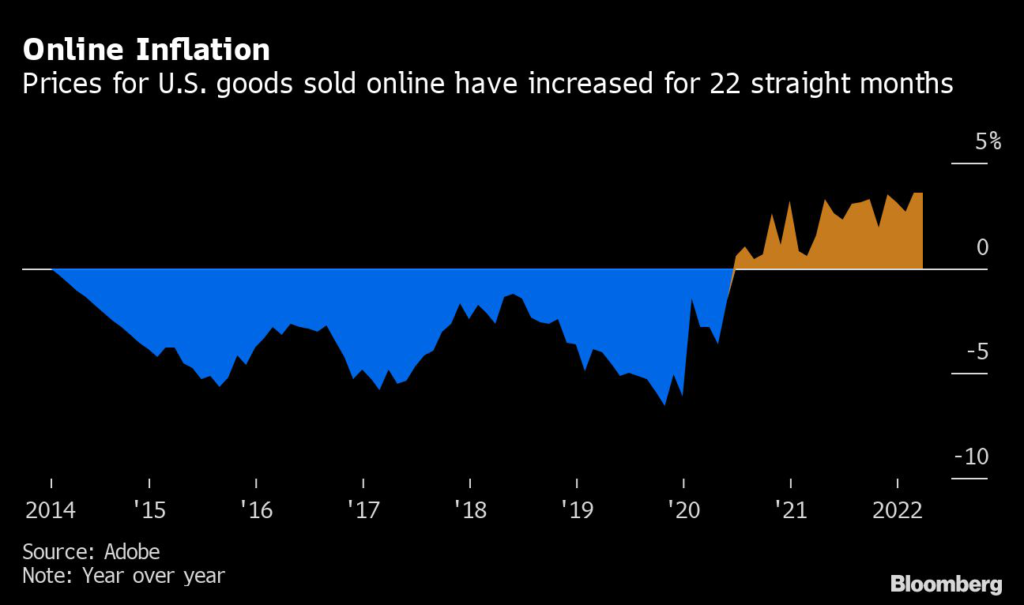
(Bloomberg) — Online prices in the U.S. rose 3.6% last month from a year earlier, matching February’s record high, according to data compiled by Adobe Inc. 

From groceries to clothes and pet products, 14 of the 18 categories tracked by Adobe recorded price increases since March 2021. Online inflation, first observed in June 2020 after years of declines, has now persisted for 22 consecutive months.

Some of the biggest price gains in Adobe’s March data:

  • Apparel: 16.3%
  • Groceries: 9%
  • Pet products: 7%

Before Covid-19, e-commerce was a haven of discounts, with Adobe’s monthly digital price index recording persistent declines. But the pandemic has turbocharged the boom in e-commerce, adding pressure on prices and transportation costs. 

The only categories where Adobe recorded a year-on-year decline in prices last month were electronics, jewelry, toys, and computers.

The software company’s price tracker covers about 1 trillion visits to retail sites and more than 100 million products.   

Read More: Inflation Outlook Rises to Fresh Record in New York Fed Survey

More stories like this are available on bloomberg.com

©2022 Bloomberg L.P.

Insurance Broker Newfront Hits $2.2 Billion Valuation in Latest Funding Round

(Bloomberg) — Newfront, the brokerage that merged with ABD Insurance and Financial Services, notched a $2.2 billion valuation in its latest funding round from investors including Goldman Sachs Group Inc.’s asset manager. 

The company raised $200 million from investors including the growth equity business within Goldman Sachs Asset Management and B Capital, Newfront said Tuesday in a statement. The San Francisco-based company expects the money to help build its technology platform and expand geographically. 

The funding round marks the latest expansion for Newfront. The brokerage merged with ABD last year in a deal that valued the combined businesses at $1.35 billion. Since then, it has added more than 200 employees, created a new client dashboard and posted a profit in 2021. 

“We see this as huge validation of the merger between Newfront and ABD,” Spike Lipkin, Newfront’s co-founder and chief executive officer, said in an interview. “We’re seeing a huge pull from our clients for a more modern solution and we think that this funding from Goldman Sachs and B Capital really establishes Newfront as the leader of building the modern platform for insurance professionals.”

Newfront counts industries such as life sciences, technology and financial services among its core businesses. That’s leading the company to look to grow in areas such as New York, Boston and Texas, according to Lipkin.

While the industry has become very good at insuring physical assets, Newfront’s Lipkin says there’s a huge demand from clients to understand more-complex risks. Newfront is pushing to build its expertise in industries such as technology, life sciences, financial technology, venture capital and private equity.

“We see modern, full-stack platforms transforming large parts of financial services,” Paul Pate, a vice president at Goldman Sachs Asset Management, said in the statement. “We believe Newfront’s marriage of technology, people, and domain expertise represents the future of the insurance industry.”

Newfront currently has around 800 employees and is expecting to cross the 1,000 mark this year, according to Lipkin. Bloomberg Beta, a venture firm backed by Bloomberg News parent Bloomberg LP, is an investor in Newfront.

More stories like this are available on bloomberg.com

©2022 Bloomberg L.P.

Electric Vehicle Growth Outpaces Installation of Battery Chargers

(Bloomberg) —

As electric vehicle sales take off, the number of those EVs on the road is growing faster than the number of public charging points to support them. That’s one of the high-level conclusions from an in-depth study on the state of public charging infrastructure that my BNEF colleague Ryan Fisher published recently.

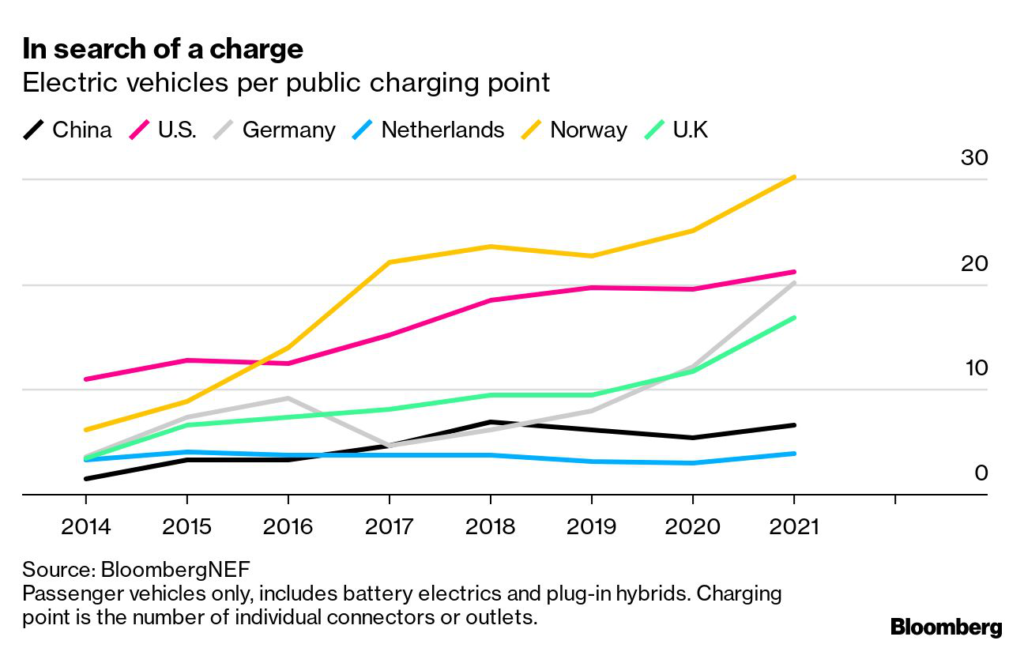
The number of EVs on the road per public charging point globally rose to 9.2 at the end of last year, from 7.4 at the end of 2020.

That’s not surprising. Last year was a breakout year for plug-in vehicle sales globally, with 6.6 million sold, while charging infrastructure growth was more in line with historical averages. The global data hides a lot of nuance though. At the country level the dynamics get really interesting. For example, despite record EV sales in China last year, public charging points there kept pace and the ratio between EVs and chargers has been relatively constant since 2018. This is because of a huge push taking place in China to expand charging infrastructure taking place — the country claims more than half the world’s public charging points.

In markets like the U.S., the number of EVs on the road per charger has grown steadily higher over the last year, so there are fewer chargers for every EV on the road. That effect is even more pronounced in Europe, where EV sales have surged since 2019. In Germany, the ratio went from 8 EVs per public charging point in 2019 to 20 in 2021.

A country like China probably needs more public chargers than the U.S. or Germany because of the housing stock there, as a much higher share of people there live in high rise apartments. Those high-rise dwellers are less likely to have home charging options and will need to rely on the public network more than an EV owner in a U.S. suburb who does 80-90% of their charging at home in their garage.

The landscape in the respective geographic regions is similar when it comes to fast and ultra-fast chargers. In China, there are 16 EVs for every ultra-fast charger; in the US that figure is over 100. In the Netherlands, which has the most favorable charger-to-EV ratio overall, most of the plugs are slow chargers. ​

There’s a temptation, when analyzing the data, to fall back on widely accepted, general notions about how more charging infrastructure is needed. That’s certainly true, especially given the growing EV fleet in the years ahead. But it’s not inherently a bad thing if the ratio of EVs on the road per charger rises. More private investment in charging infrastructure is needed, and to get there, higher utilization per charger will be required to improve the economics of operating a given station.

Many stations are under-utilized. Most fast chargers need somewhere between 8-10 charging events per day to start to make a decent return for the investor, according to our analysis at BNEF. The exact number depends heavily on prices, charging speeds, site costs, fee structure, government support, and several other issues.

A balancing act is needed: fast charging operators want more charging sessions per day. But too many sessions could mean there are times when a driver will have to wait because a charging station already is occupied. That in turn worsens the customer experience. Operators want high utilization, but not so high that customers get frustrated. Tesla’s Supercharger stations are unique on this front. Supercharger sites have an average of 10 ultra-fast charging points or outlets, while competing networks generally have two to four. Unsurprisingly, Tesla customers love this.

That may not be scalable globally, and getting it right every time will be tricky. In the long term, we’re expecting the ratio to level out somewhere between 30 to 40 EVs on the road per public charging point. That’s about where Norway, the most mature EV market in the world, is today.

Some markets will be higher or lower depending on the types of houses in the area, the strength of the electrical grid, how high charging speeds eventually go, and government policy. Already there are a growing number of 350kW stations popping up that are capable of adding 100 kilometers of range to an EV in just a few minutes.

Each country will likely end up with a different mix of home, public and workplace charging, and varying spreads of power outputs. On a global level, the ratio of EVs on the road to charging points will likely keep climbing in the years ahead. That’s not necessarily a bad thing.

More stories like this are available on bloomberg.com

©2022 Bloomberg L.P.

Todd Boehly’s Eldridge Bets on Digital Media Firm Viral Nation

(Bloomberg) — Viral Nation Inc., a digital marketing firm that manages social media influencers and works with some of the world’s largest tech companies, raised C$250 million ($198 million) in equity funding from Todd Boehly’s Eldridge Industries and Maverix Private Equity. 

The transaction values the Toronto-based company at C$650 million, Joe Gagliese, Viral Nation’s co-founder and chief executive officer, said in an interview.

“We believe the future of the world is influence,” Gagliese said. Viral Nation provides brand marketing services to large corporations seeking to connect with customers on social platforms including Instagram, YouTube and TikTok. Its client list includes Facebook parent Meta Platforms Inc., Tencent Holdings Ltd., Coca Cola Co., Walt Disney Co., and Uber Technologies Inc.

Viral Nation also works with Eldridge-backed online ticket seller Vivid Seats Inc. and the Hollywood Foreign Press Association, the organization behind the Golden Globes award show, which is produced by Eldridge’s MRC Live & Alternative. It’s trying to help modernize the show, following a backlash about its poor record on diversity.

The funding — C$150 million upfront and another C$100 million within 18 months — will be used in part to fund the company’s global expansion via acquisitions in regions including Brazil, Israel and Europe, said Gagliese. 

“We’re trying to find talent and marketing companies where we can supercharge growth by giving them the platform and resources to explode,” he said. The company plans to bolster its content-service offerings and double the headcount of its engineering team.

Founded in 2014 and profitable from inception, the company derives the majority of its earnings from the U.S. and China, Gagliese said, adding that Viral Nation’s revenue for this year is projected to exceed C$220 million. Investments in technology to help manage the company’s talent and marketing divisions will increase its margins, he added.

Viral Nation offers subscription-based software and analytics services. In June, it aims to launch an AI-powered tool for use by businesses and individuals that aims to ensure responsible online conduct, Gagliese said.

Athlete Deals

Viral Nation also develops brands in conjunction with clients managed by its talent arm, which includes the management of U.S. college athletes. It has launched two direct-to-consumer cosmetics companies, one of which has reached $20 million in annual revenue, Gagliese said, declining to provide further details. 

Read More: College Athletes Finally Make Cash With Meet-and-Greets, Tweets

“Viral Nation’s expertise in connecting brands, creators, and audiences gives them unique insight into the broader needs of organizations and individuals embracing new media,” Boehly said in an emailed statement. “We’re excited to partner with them on expansion and innovation that enables everyone to grow and thrive across the entire social ecosystem.” 

Eldridge’s Boehly and Jeff Wilbur and Maverix’s John Ruffolo have joined Viral Nation’s board. The deal marks the first investment by Maverix, which aims to make bets on fast-growing, technology-enabled companies. 

More stories like this are available on bloomberg.com

©2022 Bloomberg L.P.

Ukraine Update: Putin ‘Confident,’ Zelenskiy Wants Oil Sanctions

(Bloomberg) — President Vladimir Putin said he remains confident the goals for what he called Russia’s “special military operation” will be met, as the U.S. predicted “a more protracted and a very bloody phase” of the conflict.

Ukraine expects Russia to widen its offensive this week in the eastern Donbas region, which has been partially occupied by self-proclaimed separatist republics. Putin described Russia’s aims as protecting the people there.

Ukraine President Volodymyr Zelenskiy reiterated a call for the European Union’s next package of sanctions on Russia to include oil as well as all banks, and said EU member states should declare when they plan to stop importing Russian energy.

(See RSAN on the Bloomberg Terminal for the Russian Sanctions Dashboard.)

Key Developments

  • Germany May Snub India as G-7 Guest Over Russia Stance
  • Global Oil Market Swings From Chaos to Calm as War Shock Ebbs
  • Biden, Modi Talk About Managing Ukraine Fallout Amid Tensions
  • Russia’s Export Windfall Catapults Key Trade Barometer to Record
  • Europe Moves to Arm Ukraine as Sanctions Fail to Sway Putin

All times CET:

Number of People Returning to Ukraine Surges (12:30 p.m.)

The number of people returning to Ukraine from abroad has jumped to about 30,000 per day, according to Andriy Demchenko, a spokesman for the State Border Guard Service.

While in the first days of the war mostly men were coming back to Ukraine, now there are more women, elderly people and children returning, Demchenko said in a video briefing. The United Nations Refugee Agency estimates that more than 4.3 million refugees fled the country after the outbreak of war, with some 7.1 million displaced internally.

Putin Says Conflict With West Inevitable (11:30 a.m.)

Speaking to workers at the Vostochny Cosmodrome in Russia’s Far East, Putin said conflict with the West was inevitable and that Russia is too large to isolate from the rest of the world.

Western sanctions imposed over the invasion of Ukraine won’t keep Moscow from developing space-exploration efforts, he added, vowing to resume the country’s lunar program. He’s also due to hold talks with Belarus President Alexander Lukashenko.

German Investor Mood Deteriorates (11 a.m.)

Confidence in Germany’s economic recovery slid for a second month as investors worry that price spikes driven by the war in Ukraine will dampen output.

The ZEW institute’s gauge of expectations dropped to -41 in April from -39.3 the previous month, hitting the lowest since the Covid-19 pandemic took hold in early 2020. An index of current conditions also worsened. “The experts are pessimistic about the current economic situation and assume that it will continue to deteriorate,” ZEW President Achim Wambach said Tuesday in a statement.

Zelenskiy Repeats Call for Oil Sanctions (10:45 a.m.)

“Some very powerful decisions must be taken and they must be taken now with the sixth package of sanctions,” Zelenskiy said in an address to the Lithuanian parliament, referring to EU measures against Russia.

He warned that if Russia’s assault on Ukraine is not repelled, Europe may face security threats against nations including Poland, Georgia, Moldova and the Baltic states.

Slovakia Mulls Giving Fighter Jets to Ukraine (10:35 a.m.)

The Slovak government signaled it’s considering donating its fleet of Soviet-era MiG fighter jets to Ukraine, the Sme newspaper reported, citing an interview with Prime Minister Eduard Heger.

“If this equipment is to be useful somewhere, then it’s in Ukraine,” Sme quoted Heger as saying. European nations are attempting to ramp up weapons shipments to Ukraine amid concerns sanctions on Russia are insufficient to force Moscow to end the war.

Ukraine Says it Thwarted Cyberattack (10:30 a.m.)

Ukraine said it prevented a cyberattack on its energy infrastructure this month that was apparently launched by Sandworm, a group of hackers linked to Russia’s military intelligence agency.

Microsoft and ESET helped repel the attack, in which the hackers sought to disable power facilities using Industroyer2 and CaddyWiper malware, the nation’s telecommunications agency said.

India Plans to Boost Exports to Russia (10:10 a.m.)

India is planning to boost exports to Russia by an additional $2 billion as the two nations work out a payment system in local currencies to continue bilateral trade, according to people with knowledge of the matter.

Prime Minister Narendra Modi’s administration is in talks with Moscow to liberalize market access for several Indian-made products, the people said, asking not to be identified as the talks are private. This comes as the two governments work toward a proposal to settle trade in rupees and rubles and look for ways to balance trade given that India is a net importer of Russian goods.

Inflation in Ukraine Surged Last Month (9:30 a.m.)

Ukraine saw a rapid increase in prices for food staples, drugs and fuel last month, as Russia’s invasion disrupted supply chains and complicated access to imports, according to the country’s central bank.

Fuel costs rose by 30% from the previous year due to soaring prices in global markets and Russia’s targeting of Ukraine’s oil-storage facilities, even though the government scrapped sales and excise taxes on fuel to help ease the burden on consumers. Annual inflation accelerated to 13.7% from 10.7% in February.

Asos Warns of Earnings Impact (8:30 a.m.)

British online fashion retailer Asos said its full-year earnings goal is at risk due to the fallout from Russia’s war in Ukraine and accelerating inflation. U.S. consultant Accenture completed an exit from its Russian business following a transfer to several of its local leaders.

Finnish 5G Gear Maker Nokia to Exit Russia (8 a.m.)

Nokia will exit the Russian market after having suspended deliveries, stopped new business and initiated a move of its limited R&D activities out of Russia in the past weeks, the Espoo, Finland-based telecommunications networks maker said.

Russia accounted for less than 2% of net sales in 2021 for Nokia, whose rival Ericsson on Monday said it had suspended business with customers in Russia “indefinitely” and put about 600 staff on paid leave.

Oil Rebounds After Fall That Erased War Gains (7:31 a.m.)

Oil rebounded after a tumble that saw crude erase most of the gains sparked by Russia’s invasion of Ukraine. China’s virus outbreaks and mobility curbs are imperiling demand as it locks down Shanghai and other areas in pursuit of a Covid Zero strategy that has made it a global outlier in handling the pandemic.

The next major test for markets looms later Tuesday, when the U.S. is expected to unveil an inflation print for March of more than 8%. The Ukraine war is disrupting flows of essential commodities, and China’s lockdowns are straining supply chains.

Russia Significant Military Threat, Say Finns (5:23 a.m.)

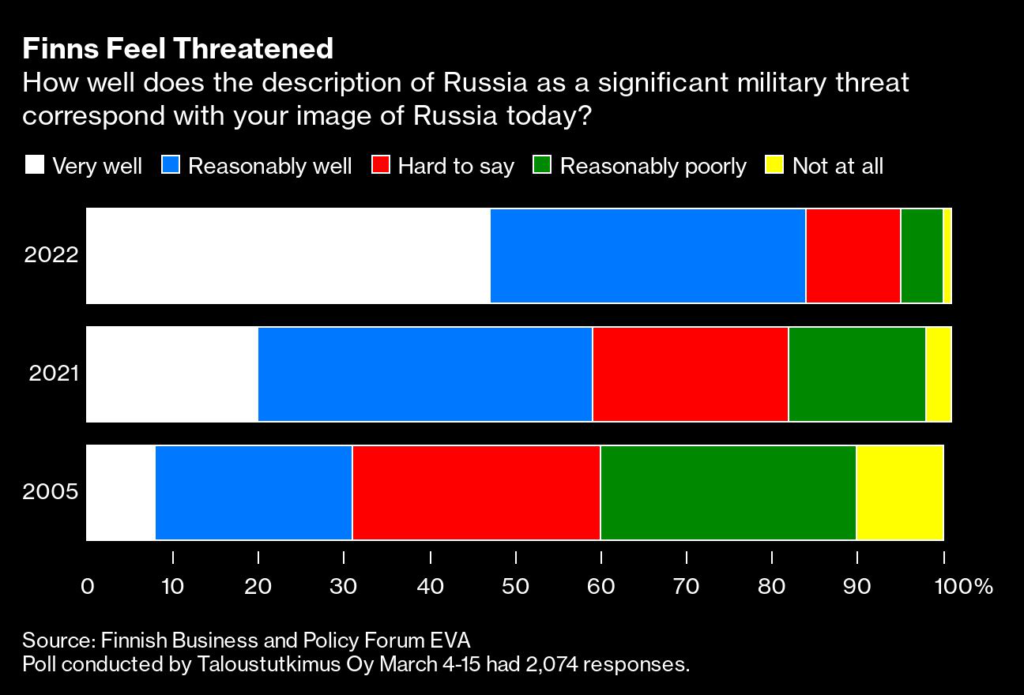
Some 84% of Finns believe Russia poses a significant military threat, according to a survey by Finnish Business and Policy Forum EVA, with the government set to kick off a process that may culminate in an application to join NATO.

In 2005, fewer than one in three in the Nordic country with a 1,300-kilometer (800-mile) border with Russia considered Moscow a major threat. The change helps explain why Finns now back NATO membership, with the government seen leaning toward an application within weeks.

War Damage Amounts to $270 Billion, Minister Says (3:10 a.m.)

Ukraine’s infrastructure war damage is an estimated $270 billion, Finance Minister Serhiy Marchenko told the Financial Times. Some 7,000 residential buildings have been damaged or ruined, about 30% of Ukrainian companies have ceased operations and electricity consumption has dropped 35%, the minister said.

Despite that, Ukraine plans to continue servicing its debt and expects to avoid borrowing restructuring, he said. Last month, the country paid $292 million on a dollar-denominated Eurobond maturing in September.

“A lot of politicians advise us to talk about restructuring but that is not our policy,” he said, adding Ukraine expects to access financing and continue to issue external debt.

Japan Sanctions Putin’s Daughters (2:42 a.m.)

Japan’s government announced asset freezes on 398 individuals, including the two adult daughters of Putin as part of its latest round of sanctions over the war in Ukraine. Russian Foreign Minister Sergei Lavrov’s wife and daughter were also added to list.

Asset freezes were also expanded to 28 entities including the country’s biggest bank Sberbank.

Biden, Modi Discuss Managing Ukraine Fallout (2:37 a.m.)

U.S. President Joe Biden and his Indian counterpart held a candid discussion Monday about how to counter the fallout from Russia’s invasion of Ukraine, a senior U.S. administration official said.

“The president has made clear that he does not believe it’s in India’s interest to accelerate or increase imports of Russian energy and other commodities,” White House Press Secretary Jen Psaki told reporters.

Modi, via a translator, said he’d been appealing for peace and called the killings in the Ukrainian city of Bucha “very worrying.”

More stories like this are available on bloomberg.com

©2022 Bloomberg L.P.

Close Bitnami banner
Bitnami