Bloomberg

The Business Lives of Putin’s Daughters, Who Now Face Sanctions

(Bloomberg) — For decades, the lives of Vladimir Putin’s two daughters by his first marriage have been shrouded in mystery. Now sanctions on his children have brought them — and their opaque business dealings — into the spotlight.

The measures against Maria Vorontsova and Katerina Tikhonova, who Putin doesn’t publicly acknowledge as his daughters, is a largely symbolic move since it’s unclear they have significant assets outside of Russia.

Putin had said in a 2011 state-run TV interview that his daughters led “ordinary lives.” “They’re not involved in politics or business, thank God,” he told Channel One television at the time. This appears to have changed in succeeding years, with both daughters stepping into business positions while in academia.

Vorontsova, 36, is an endocrinologist. She is a co-owner of a medical company called Nomeko, focusing on high-tech diagnostics and treatment.

Tikhonova, 35, the younger Putin daughter, was linked to a $1.6 billion project to develop a science center and startup incubator next to Moscow State University. She also headed the elite school’s artificial-intelligence center and its sister fund called the National Intellectual Development Fund. Both are managed by the Innopraktika foundation, which counts Putin associates including Rosneft CEO Igor Sechin and Gazprombank CEO Andrei Akimov as board trustees.

Tikhonova’s ex-husband Kirill Shamalov made a fortune from investing in petrochemical giant Sibur Holding, with the help of a loan from Akimov’s state-controlled bank. He later sold the shares after they divorced.

Putin, who tightly guards his private life, has said very little publicly about his children with ex-wife Lyudmila. During more than two decades in power, he has given drips of information about where they live, a few of their intellectual interests such as biology and Japanese culture, and that they speak multiple languages.

The daughters have given media interviews, but have not been identified as Putin’s daughters. They have rarely appeared on camera as adults, though Tikhonova was spotted competing in an acrobatic rock and roll competition in Switzerland in 2013.

Lyudmila, a former flight attendant, has so far escaped sanctions that ensnared his allies, companies linked to them and their families.

More stories like this are available on bloomberg.com

©2022 Bloomberg L.P.

China Tech Stocks Rise as Gaming Approval Lifts Sentiment

(Bloomberg) — Chinese tech stocks edged higher on Tuesday after a volatile trade, as investors weighed optimism from Beijing’s approval of new video game licenses against worries over rising interest rates and Covid-19 lockdowns.

The Hang Seng Tech Index advanced 1.4% at the close, snapping four sessions of declines. Bilibili Inc. and GDS Holdings Ltd. were the best performers. The benchmark Hang Seng Index rose 0.5%, in line with a broader market rally.

China ending its months-long freeze on gaming approvals will likely help ease market anxiety that’s plagued the sector following a yearlong crackdown. Still, investors remain wary over other headwinds, including a surge in Treasury yields before U.S. inflation data due later, and a dimming growth outlook for China as lockdowns continue.

Read more: China Ends Game Freeze by Approving First Titles Since July 

“The market is waiting for the U.S. inflation figure so the broader sentiment is a bit cautious today, despite the good news in the regulatory front in China,” said Linus Yip, a strategist at First Shanghai Securities. “Investors won’t pile in at this moment given so many uncertainties, such as pace of rate hikes, Covid situation in China and that property crackdown is still going on.” 

Chinese authorities’ actions to stabilize markets in recent weeks have done little to soothe market jitters, with the broader Hang Seng Index down nearly 9% this year and China’s benchmark CSI 300 down some 15%. 

On Monday, the China Securities Regulatory Commission again pledged further support to the “healthy” development of listed companies. 

Meanwhile, Alibaba Group Holding Ltd. climbed 0.5% even as the Daily Journal Corp., a newspaper and software business that counts Charlie Munger as one of the overseers of its stock portfolio, cut its stake in half.

More stories like this are available on bloomberg.com

©2022 Bloomberg L.P.

Singapore’s Zilingo Is Said to Suspend CEO Amid Investigation

(Bloomberg) — Zilingo Pte, one of Singapore’s highest-profile startups, has suspended Chief Executive Officer Ankiti Bose after an effort to raise new funding led to questions about the company’s accounting, according to people familiar with the matter.

The company, which supplies technology to apparel merchants and factories, had been trying to raise $150 million to $200 million with help from Goldman Sachs Group Inc. when investors began to question its finances as part of the due diligence process, said the people, asking not to be identified because the information is confidential. The talks, which could have boosted Zilingo’s valuation to more than $1 billion, stalled, they said. 

The startup’s investors, which include Temasek Holdings Pte and Sequoia Capital India, have started an investigation into the financial practices, the people said. Zilingo’s auditor raised questions about its accounting, they said. The concerns center on the way that Zilingo, which regulators said had not filed annual financial statements since 2019, accounted for transactions and revenue across a platform spanning thousands of small merchants.

Bose has disputed allegations of wrongdoing and contends her suspension was due in part to her complaints about harassment, according to two people close to the situation. She has hired an attorney to represent her, Abraham Vergis of Providence Law Asia, and has called the investigation a “witch hunt,” according to correspondence reviewed by Bloomberg News. 

Zilingo and Temasek declined to comment.

Two of Zilingo’s directors, Temasek’s Xu Wei Yang and Burda Principal Investments Ltd.’s Albert Shyy, left its board last month, according to regulatory filings. Zilingo had hired James Perry, a Citigroup Inc. veteran, as its chief financial officer in mid-2019, but he left about a year later to return to the U.S. bank.

The clash represents a dramatic turn of fate for one of Singapore’s most celebrated startups. Zilingo was founded by Bose and Chief Technology and Product Officer Dhruv Kapoor in Singapore seven years ago to help small businesses across South and Southeast Asia sell their goods online.

The company began by working with small merchants that sell to consumers, and then expanded into adjacent areas. As the founders started talking with small sellers, they realized many lacked access to robust technology and essential capital.

That led them to develop software and other tools that would allow merchants to access factories in places like Vietnam or Bangalore, and would smooth the complicated process of shipping across borders. In 2018, Zilingo began to team up with financial technology firms to provide working capital to small sellers so they can buy raw materials to produce goods.

In early 2019, Zilingo raised $226 million from investors including Sequoia and Temasek, and pushed its valuation to $970 million, almost the $1 billion mark that earns startups designation as a unicorn. Bose, then 27, was celebrated as a visionary and a sign of the entrepreneurial potential for Southeast Asia. 

“We were a bunch of twenty-somethings with nothing except this dream and we decided to chase it,” she said at the time. Bose had worked at Sequoia earlier and had said the experience helped her build the startup.

Zilingo, which had grown into a full-blown marketplace for wholesale buyers and sellers in the fashion industry, faced growth troubles after pandemic-fueled restrictions forced many small businesses to shut their doors. To rein in its own costs, Zilingo said it cut a number of jobs in 2020 and downsized marketing, sourcing and support teams in the U.S., Australia, Singapore and Indonesia. 

The company made an aggressive pitch in its latest effort to raise fresh capital. Late last year, it forecast that core net revenue would rise from about $40 million in fiscal 2021 to roughly $60 million in fiscal 2022 and $100 million the year after, according to presentation documents reviewed by Bloomberg News. Zilingo said it anticipated breaking even on core Ebitda — or earnings before interest, taxes, depreciation and amortization — in fiscal 2023 and then reach almost $200 million in fiscal 2026.

On March 31, Bose was called to a meeting with three board members and told about “serious” complaints about discrepancies in accounts and mismanagement, according to the correspondence reviewed by Bloomberg. She was later questioned by two people from Kroll, the investigations firm. Her suspension is scheduled to run until May 5.

Bose, through her lawyer, has argued that the directors did not follow proper procedures during the process and questioned their right to suspend her, according to the correspondence from her attorney to Zilingo. 

“We are of the view that our client’s suspension has been procured by invalid and defective means; that the investigation commenced into her is unfair and lacking in due process, and that she has been suspended without proper and reasonable cause,” her attorney wrote.

More stories like this are available on bloomberg.com

©2022 Bloomberg L.P.

Asos Warns Full-Year Target Is at Risk From Inflation, War

(Bloomberg) — Asos Plc, the British online fashion retailer, said its full-year earnings goal is at risk from accelerating inflation and disruption from Russia’s war in Ukraine.

The retailer said Tuesday it’s maintaining its forecast for the fiscal year ending in August, except for the loss of business due to a suspension of sales in Russia. 

The stock touched a two-year low and later whipsawed, rising as much as 3.8% on a forecast for sales growth to accelerate in the second half as shoppers buy more clothes for social events and vacations. 

Asos has suffered a change in fortunes over the past year as its winning position in online retail during Covid lockdowns was weakened by stores reopening. The shares have lost a third of their value this year as shopping habits normalize, and the retailer is still seeking a chief executive officer to replace Nick Beighton, who stepped down in October.

Chief Operating Officer Mat Dunn, who is overseeing the business during the hunt for a new CEO, said that while Asos is selling 10 dresses a minute at the moment, inflation and its potential impact on discretionary spending may pose a threat for the retailer.

“What we are noticing is a degree of caution around consumer sentiment and the fact that that hasn’t fully been felt by consumers yet,” he said in a phone interview. “We’re probably in a situation where predicting the second half is as difficult as it’s ever been.”

Asos said its inventory is better, comparisons with the year earlier are becoming easier, and it’s boosting advertising in markets outside the U.K. that have lagged. Supply-chain issues are also improving.

Read more: U.K. Retailers Warn Inflation Is Curbing Demand as Sales Slow

The operating loss in the first half was 4.4 million pounds ($5.7 million) compared with earnings of 109.7 million pounds in the year-earlier period.

The search for a new CEO is progressing, Dunn said, without giving guidance on the timing of an appointment. “There’s an awful lot of engagement, but the job is to secure the right person.”

After passing on some higher prices to shoppers earlier, Asos doesn’t plan further increases for the rest of the financial year, according to Dunn. The retailer is trying to stick to offering value to consumers and may benefit from shoppers choosing its brands rather than higher-priced alternatives, he said.

Asos’s forecast is for pretax earnings of 110 million pounds to 140 million pounds. Analysts have been expecting 103 million pounds. The company said the economy has worsened since it gave the guidance in October, and there’s more risk than normal in the second half. 

The suspension in Russia will cut 2% off annual revenue and 14 million pounds from profit, Dunn said.


(Updates with executive comments starting in fifth paragraph)

More stories like this are available on bloomberg.com

©2022 Bloomberg L.P.

Ukraine Update: Russia Seen Widening Eastern Offensive This Week

(Bloomberg) — Ukraine expects Russia to widen its offensive in the east of the country this week, President Volodymyr Zelenskiy said, echoing a U.S. warning which also predicted “a more protracted and a very bloody phase” of the conflict.

Russian troops will likely maintain a push to take the port city of Mariupol as well as other targets, Urkaine’s military staff said. Moscow is pursuing the goal to seize the whole Donbas region, which has been partially occupied by self-proclaimed separatist republics.

The mayor of Mariupol said more than 10,000 civilians had died in the city since the invasion, and Poland’s prime minister predicted Europe would soon see its biggest tank battle since World War II.

(See RSAN on the Bloomberg Terminal for the Russian Sanctions Dashboard.)

Key Developments

  • Global Oil Market Swings From Chaos to Calm as War Shock Ebbs
  • Biden, Modi Talk About Managing Ukraine Fallout Amid Tensions
  • Russia’s Export Windfall Catapults Key Trade Barometer to Record
  • Europe Moves to Arm Ukraine as Sanctions Fail to Sway Putin
  • Ukraine Seeks Russia Assets, Oil Fleet Seizure as Reparations

All times CET:

Inflation in Ukraine Surged Last Month (9:30 a.m.)

Ukraine saw a rapid increase in prices for food staples, drugs and fuel last month, as Russia’s invasion disrupted supply chains and complicated access to imports, according to the country’s central bank.

Fuel costs rose by 30% from the previous year due to soaring prices in global markets and Russia’s targeting of Ukraine’s oil-storage facilities, even though the government scrapped sales and excise taxes on fuel to help ease the burden on consumers. Annual inflation accelerated to 13.7% from 10.7% in February.

Asos Warns of Earnings Impact (8:30 a.m.)

British online fashion retailer Asos said its full-year earnings goal is at risk due to the fallout from Russia’s war in Ukraine and accelerating inflation. U.S. consultant Accenture completed an exit from its Russian business following a transfer to several of its local leaders.

Finnish 5G Gear Maker Nokia to Exit Russia (8 a.m.)

Nokia will exit the Russian market after having suspended deliveries, stopped new business and initiated a move of its limited R&D activities out of Russia in the past weeks, the Espoo, Finland-based telecommunications networks maker said.

Russia accounted for less than 2% of net sales in 2021 for Nokia, whose rival Ericsson on Monday said it had suspended business with customers in Russia “indefinitely” and put about 600 staff on paid leave.

Oil Rebounds After Fall That Erased War Gains (7:31 a.m.)

Oil rebounded after a tumble that saw crude erase most of the gains sparked by Russia’s invasion of Ukraine. China’s virus outbreaks and mobility curbs are imperiling demand as it locks down Shanghai and other areas in pursuit of a Covid Zero strategy that has made it a global outlier in handling the pandemic.

The next major test for markets looms later Tuesday, when the U.S. is expected to unveil an inflation print for March of more than 8%. The Ukraine war is disrupting flows of essential commodities, and China’s lockdowns are straining supply chains.

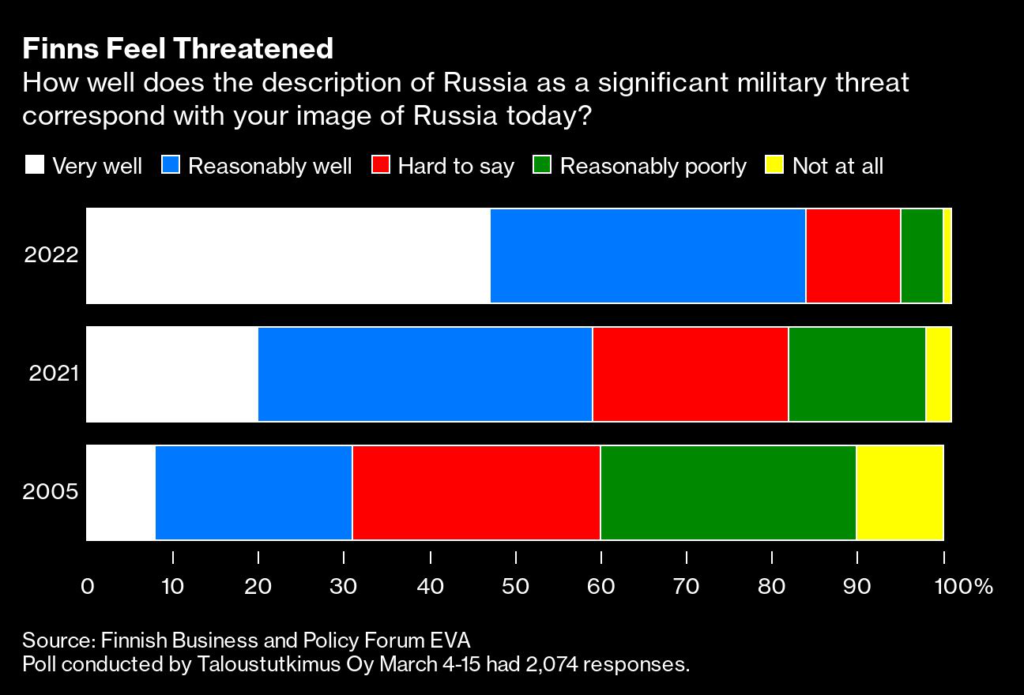
Russia Significant Military Threat, Say Finns (5:23 a.m.)

Some 84% of Finns believe Russia poses a significant military threat, according to a survey by Finnish Business and Policy Forum EVA, with the government set to kick off a process that may culminate in an application to join NATO.

In 2005, fewer than one in three in the Nordic country with a 1,300-kilometer (800-mile) border with Russia considered Moscow a major threat. The change helps explain why Finns now back NATO membership, with the government seen leaning toward an application within weeks.

War Damage Amounts to $270 Billion, Minister Says (3:10 a.m.)

Ukraine’s infrastructure war damage is an estimated $270 billion, Finance Minister Serhiy Marchenko told the Financial Times. Some 7,000 residential buildings have been damaged or ruined, about 30% of Ukrainian companies have ceased operations and electricity consumption has dropped 35%, the minister said.

Despite that, Ukraine plans to continue servicing its debt and expects to avoid borrowing restructuring, he said. Last month, the country paid $292 million on a dollar-denominated Eurobond maturing in September.

“A lot of politicians advise us to talk about restructuring but that is not our policy,” he said, adding Ukraine expects to access financing and continue to issue external debt.

Japan Sanctions Putin’s Daughters (2:42 a.m.)

Japan’s government announced asset freezes on 398 individuals, including the two adult daughters of Putin as part of its latest round of sanctions over the war in Ukraine. Russian Foreign Minister Sergei Lavrov’s wife and daughter were also added to list.

Asset freezes were also expanded to 28 entities including the country’s biggest bank Sberbank.

Biden, Modi Discuss Managing Ukraine Fallout (2:37 a.m.)

U.S. President Joe Biden and his Indian counterpart Narendra Modi held a candid discussion Monday about how to counter the fallout from Russia’s invasion of Ukraine, a senior U.S. administration official said.

“The president has made clear that he does not believe it’s in India’s interest to accelerate or increase imports of Russian energy and other commodities,” White House Press Secretary Jen Psaki told reporters.

Modi, via a translator, said he’d been appealing for peace and called the killings in the Ukrainian city of Bucha “very worrying.”

More stories like this are available on bloomberg.com

©2022 Bloomberg L.P.

Egypt’s Paymob to Start Pakistan Operation to Tap Growing Market

(Bloomberg) — Egypt’s digital payments provider Paymob plans to start its operations in Pakistan this month, taking advantage of a market that has seen a funding frenzy in its startups.

The Cairo-based company, which allows online businesses and offline merchants to accept and send payments, sees a significant opportunity in Pakistan, Islam Shawky, CEO and co-founder of Paymob, said in an interview. The company plans to have 100,000 merchants in its first two years in Pakistan, he said and added it currently operates in Egypt, Jordan and Kenya and aims to enter Saudi Arabia later this year. 

The expansion comes after the startup scene in Pakistan, the world’s fifth-largest nation, had a record funding of more than $350 million last year. Dragoneer Investment Group and Tiger Global Management have made their first investments in the past few months. 

“Our focus is small and medium enterprises that are a cornerstone of the economy but under served,” said Shawky “There is a huge gap in emerging markets.” 

Pakistan’s digital payments is low with just over 80,000 POS terminals and less than 3,000 e-commerce gateways, said Shawky. The company also plans to extend its tap-on-phone payment service in Pakistan that has been recently introduced in its home market with MasterCard Inc.

LG Corp., Samsonite International SA and Uber Technologies Inc. are among the clients of the company.

More stories like this are available on bloomberg.com

©2022 Bloomberg L.P.

Bitcoin Rallies Back Above $40,000 to Show Some Recovery Signs

(Bloomberg) —

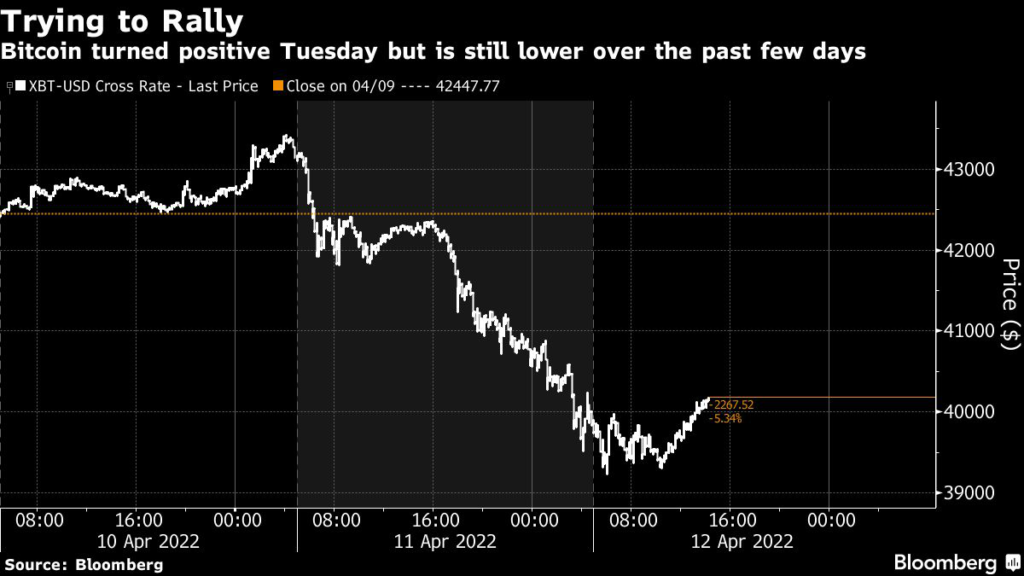
Bitcoin recovered above $40,000 on Tuesday, gaining back some ground after dropping for seven days out of the past eight.

The largest cryptocurrency rose as much as 0.8% to $40,146, gaining steam around midday in Hong Kong after dropping 1.5% earlier in the session. Ether also rallied around the same time, reaching past $3,000. Altcoins like Solana and Cardano were still lower over the past 24 hours, according to pricing from CoinGecko.

The top tokens are now sitting just above levels considered key by technical analysts.

“Both Bitcoin and Ethereum failed into resistance at their 200-day moving averages (just like the Nasdaq 100) and now must hold support at $40,000 and $2,900,” said Rich Ross, a technical strategist at Evercore ISI, in a note Monday.

Bitcoin and the broader crypto market have struggled in recent weeks as the Federal Reserve began hiking rates amid stubbornly high inflation and continuing geopolitical turmoil. U.S. inflation likely accelerated to 8.4% in March, the fastest pace since early 1982, economists surveyed ahead of data due Tuesday predict. 

The Federal Reserve may need to raise interest rates “significantly” higher than it currently expects to cool an overheated U.S. economy, Goldman Sachs Group Inc. Chief Economist Jan Hatzius said Friday.

Bitcoin “is still consolidating in a triangle pattern stretching back to mid-January,” said Jeffrey Halley, senior market analyst at Oanda. “The lower and upper boundaries today are $36,500 and $47,500,” he said, implying that Bitcoin was well within its range. 

A break above or below those support or resistance levels could lead to an $18,000 move either way, Halley added.

More stories like this are available on bloomberg.com

©2022 Bloomberg L.P.
EasyJet Summer Bookings Above 2019 Levels: The London Rush

(Bloomberg) — Here’s the key business news from London-listed companies this morning:

Deliveroo Plc: The food delivery group’s customers ordered less than expected at the start of this year, a setback for the company as it aims to sustain momentum from the pandemic.

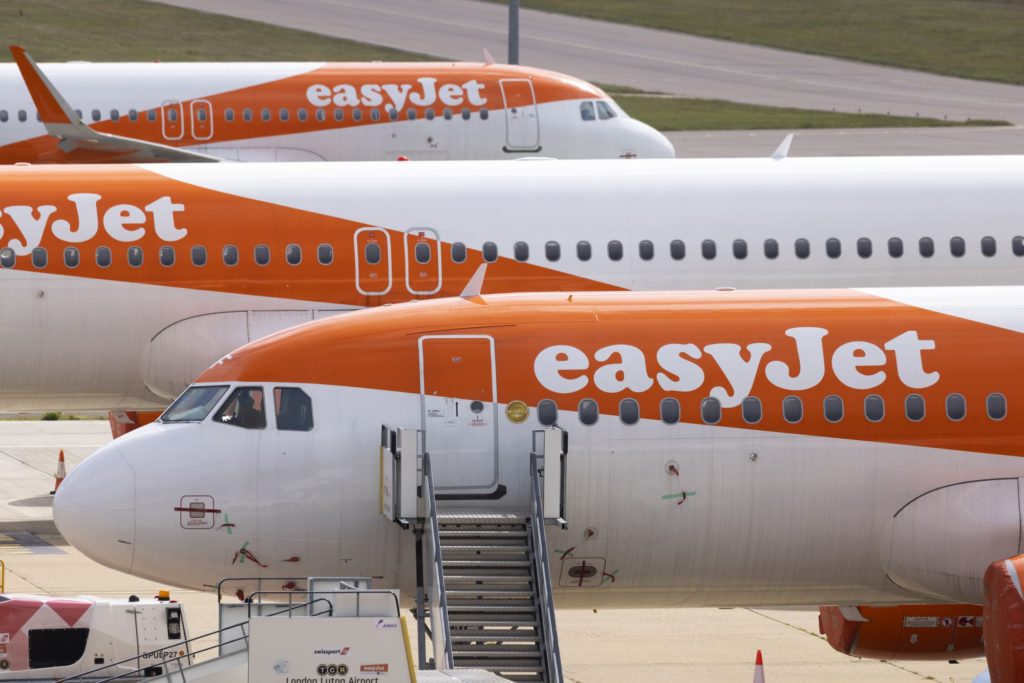
EasyJet Plc: The low-cost airline posted an upbeat trading update, reporting bookings for this summer over the last six weeks ahead of 2019 levels, and said it expects to “emerge as one of the winners in the recovery.” 

  • Still, the airline expects to post a headline loss before tax in the range of £535 million and £565 million for the first half of the year

Asos Plc: The fast fashion company warned that higher inflation squeezing customers’ disposable income and disruption from Russia’s war in Ukraine has put its full year guidance at risk. 

  • That’s as it reports easing supply chain constraints and better stock levels

Outside The City

U.K. retail sales were just 3.1% higher than in March last year, when the country was still under coronavirus restrictions, the British Retail Consortium and consultancy KPMG said. The figures suggest the cost of living crisis is already being felt on the high street.

A Conservative Party MP has been found guilty of committing assault on a boy in 2008, in a conviction that’ll likely trigger a by-election in a seat formerly held by Labour.

Read the latest coverage of the war in Ukraine here.

In Case You Missed It 

Economic Secretary to the Treasury John Glen joined Bloomberg TV’s Caroline Hyde to talk about the inflationary situation in the country following the war in Ukraine and how crypto might help hedge inflation. Glen also reacted to the tax scandal surrounding Rishi Sunak.

In other news, London-based biotech firm Engitix Ltd. and Japanese drugmaker Takeda Pharmaceutical Co. have agreed to extend their partnership in a deal that could be valued at as much as $300 million.

Looking Ahead

Tesco Plc is set to publish full year results tomorrow, the first of the major supermarkets to report this season. Any commentary on the impact of inflation will be in focus. We’ll also get inflation data for March, which is expected to show prices rising at a faster rate, further squeezing the cost of living.

More stories like this are available on bloomberg.com

©2022 Bloomberg L.P.
Bitcoin Bearish Flag Has Analysts Looking for Crash Lows

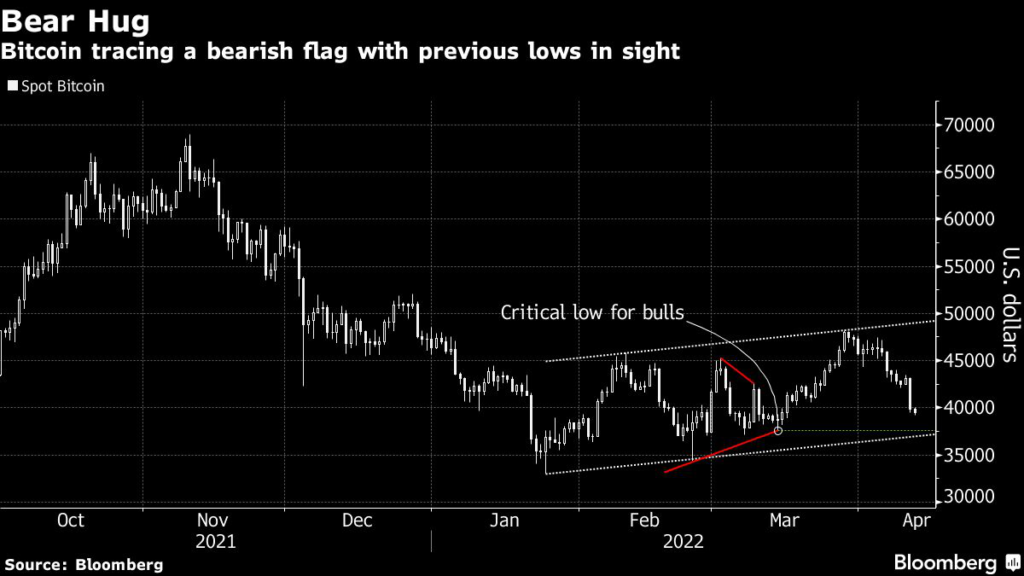
(Bloomberg) — Bitcoin has lost about 13% this month and is on track to test support from the lower end of a so-called “bearish flag” technical pattern. Immediate support in the pattern for the largest cryptocurrency, which is currently trading around $38,000, lies at $37,582 — under which the next key level is the lower end of the flag around $36,700. Any break of the flag will bring $26,000 into focus. 

More stories like this are available on bloomberg.com

©2022 Bloomberg L.P.

Honda to Spend $40 Billion on EV Push, Plans 30 Models

(Bloomberg) — Honda Motor Co. plans to spend 5 trillion yen ($40 billion) on its push into electric vehicles over the next decade, as the Japanese automaker with the most aggressive EV ambitions moves to back its bold advance into next-generation cars with concrete plans.

Some 30 EV models will be launched by 2030 with production volume of more than 2 million vehicles a year, Japan’s second-biggest automaker said in a statement Tuesday. EVs will make up around 40% of the company’s fleet by the end of the decade, Honda said. 

Honda declared in June of last year it would phase out sales of gasoline-powered cars completely by 2040, becoming Japan’s first automaker to publicly say so. In the months since, newly minted Chief Executive Officer Toshihiro Mibe has pushed to hasten the Tokyo-based company’s drive into the increasingly competitive electric segment. 

Today, Honda has “clear plans in place” with regard to electrification and making its EV business profitable, CEO Mibe said in a briefing Tuesday. “We are moving steadily forward in line with those plans.”

Last month, Honda issued $2.75 billion of green bonds that it intends to use to fund development and production of EVs and fuel-cell cars. Honda said on Tuesday it will consider issuing more of the securities to fund its electrification spending, though it will have to look further into specifics around budget and timing. 

Part of Honda’s electrification offensive has involved doubling down on the world’s biggest EV market — China. In October, Honda announced plans to launch 10 EVs under its “e:N Series” within five years in the nation. Honda also pledged that all models it introduces in China after 2030 will be electric and announced plans for several dedicated EV production plants in the country.

Read More: Honda Pledges to Only Sell Electric Cars in China After 2030 

Another of Mibe’s pushes has been around changing Honda’s long-standing go-it-alone strategy when it comes to developing and selling EVs. Mibe hinted at as much in his first briefing after being promoted to the top role in February last year, saying as Honda pivots toward EVs, “time is of the essence and I would opt to use alliances and external insight to accelerate our shift.”

Last month, Honda announced it’s joining forces with tech giant Sony Group Corp. to develop EVs slated to go on sale starting in 2025. And earlier this month, Honda and General Motors Co. expanded their existing tie-up with plans to jointly develop affordable EVs in major global markets. The duo plan to introduce their first model — with a starting price below $30,000 — in North America in 2027.

At Tuesday’s briefing, Honda, which sources Ultium batteries from GM, said it’s exploring the possibility of creating a joint venture with another company for battery production. Honda also said it plans to start demonstration production of solid-state batteries in early 2024. 

A major reason for pursuing such partnerships is cost savings. Along with GM, Honda is seeking to bring EV costs down to an extent that they reach price-parity with gasoline-powered cars. 

“Once we’ve achieved large volumes of millions of EVs, we’ll be able to drastically reduce costs,” Mibe said. 

(Updates with CEO comments, context throughout.)

More stories like this are available on bloomberg.com

©2022 Bloomberg L.P.
Close Bitnami banner
Bitnami