Bloomberg

Twitter Says It Stopped Policing Covid Misinformation Under Musk

(Bloomberg) — Twitter Inc. said it ended a policy designed to suppress false or misleading information about Covid-19, part of Elon Musk’s polarizing mission to remake the social network as a place for unmoderated speech.

By discarding the Covid rule, the company will no longer apply labels to posts containing falsehoods about the disease or provide supplemental corrective information as it did before. It will apparently no longer remove inaccurate tweets or ban offending accounts either.

The company disclosed the change in a note added to a page on its website outlining the old Covid policy. It says Twitter stopped enforcing the rule on Nov. 23.

Twitter didn’t immediately respond to a request for comment. Sky News reported on the revision earlier Tuesday.

Over 11,000 accounts had been suspended and over 97,000 pieces of misleading content had been removed from the time Twitter introduced the Covid policy in January 2020 to when it ended last week, according to data on Twitter’s website.

Twitter has received frequent criticism for its lack of action against disinformation and misinformation over the last decade. The critiques were heightened during the presidency of Donald Trump due to his controversial and prolific tweeting, including ones that violated Twitter’s policies on coronavirus misinformation. Musk moved to reinstate Trump’s Twitter account this month, though the former president has yet to post from it.

More stories like this are available on bloomberg.com

©2022 Bloomberg L.P.

Apple’s Historic Buyback Keeps Investors Captivated

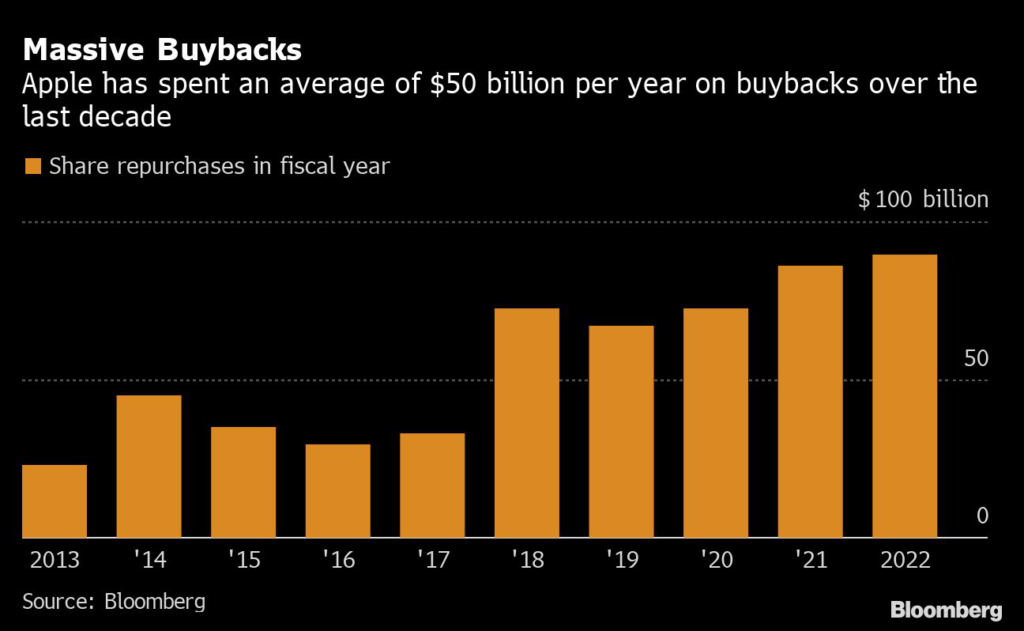
(Bloomberg) — Apple Inc. has shelled out more than $550 billion buying back its own shares over the past decade, more than any other US company, and the technology juggernaut shows no signs of slowing down. 

Even with the stock under pressure the past few days because of production delays for its newest handsets, Apple has fared better than other megacap tech companies in this year’s bear market. Solid earnings and generous buybacks have become a central part of the investment thesis, making the stock more attractive during turbulent times. 

Shares fell 0.4% on Tuesday.

“That’s how they get the safe haven, the gold standard view from investors,” said Gene Munster, who covered Apple during a 21-year career as an analyst before co-founding venture-capital firm Loup Ventures. “When they just keep showing up and generating the kind of cash they do and buying their own stock back, it sends a strong message and I think they’ll continue to do that as much as they can.” 

The next signpost for investors about Apple’s appetite for its own stock will come in April, which is when the company typically tops up its repurchase authorization. It’s added $90 billion to the program in each of the past two years. It’s still generating the earnings to replenish its bank account: It was the only megacap to rally in the wake of its results this quarter, and the report kept analysts from dramatically slashing estimates, in contrast to widespread cuts at its peers. 

Net Cash Neutral

Even with economies slowing around the world, demand is still strong for Apple’s most expensive iPhones, analysts say. The problem now is manufacturing delays because of Covid lockdowns in China, leading to what analysts say are record wait times for deliveries just as the holiday shopping season kicks off. While that may cause a short-term hit to revenue, there’s no sign it’s denting the longer-term case for the stock. 

Apple accumulated cash for years under co-founder Steve Jobs, and Chief Executive Officer Tim Cook has been working on ways to better invest the money and return it to shareholders. Apple, which ended last quarter with $169 billion in cash and marketable securities, aims to have net cash — cash minus debt outstanding — of zero in the future. 

“This is an aggressive bet that they made, something that Steve Jobs would have never done, and it’s paid off nicely for the company and its investors in part because the stock has done well during that period,” Munster said of the share repurchases.

Apple, the world’s largest company with a market value of almost $2.3 trillion, also is in a league of its own when it comes to share buybacks. 

In two of the last five years, it has outspent the second-highest repurchaser by least $50 billion. It spent almost $90 billion last year, about equal to the market value of Citigroup Inc. 

Investors like buybacks because they reduce a company’s share count and thereby provide a lift to earnings per share. The risk is that a company overpays, buying at a time when the stock is overvalued. Apple, though, says it’s paid an average price of $47 a share since it began buying back stock a decade ago, compared with the current share price of $143.63. 

Apple has steered clear from using its cash pile to make large acquisitions, at a time when scrutiny of the size and clout of megacap tech firms is rising. Bulls say buybacks have been a good strategy for the company, until it turns its resources to a new product category like automotive, which could prove more capital intensive. 

“In general, investors would like to see cash being used to generate growth,” said Lewis Grant, senior portfolio manager for global equities at Federated Hermes Ltd. “But when you look at a company the size of Apple and the amount of cash that we’re really talking about, deploying tens of billions of dollars every year to generate growth is perhaps overly ambitious.”

Apple also pays a cash dividend, but it’s almost an afterthought. The quarterly payout of 23 cents a share equals 0.6% of the stock price, one of the lowest yields in the S&P 500 index. Apple raised the payout by a penny in May and said it’s committed to annual increases.

However, investors don’t seem overly concerned how the company chooses to return capital, as long as they continue to do so. 

“We actually don’t care which way you send the capital back to us,” said Mark Stoeckle, Adams Funds’ chief executive officer, adding that Apple would have to raise its dividend by “an enormous amount” to get to a yield that would matter. “We just don’t see that happening, so we’re just as happy with the stock buyback.”

Tech Chart of the Day

Activision Blizzard Inc. analysts are growing more positive on the video-game maker, seeing value in the stock even as Microsoft Corp.’s planned acquisition looks increasingly dicey. At least six firms have upgraded their ratings in November, including three on Monday. 

The trend has lifted the Bloomberg consensus rating on the stock — a ratio of its buy, hold and sell ratings — to 4.6 out of 5, its highest since January, and up from an April low of 3.94. This has made Activision nearly as well liked among Wall Street analysts as Take-Two Interactive Software Inc., which boasts a consensus rating of 4.57, and above Electronic Arts Inc., which has a consensus rating of 4.29.  

Top Tech Stories

  • Apple’s manufacturing partner is trying yet another special payout to workers in China to soothe unrest and restore production at the world’s biggest iPhone factory, a flashpoint in Beijing’s efforts to sustain its economy while fighting Covid infections.
  • Elon Musk’s tumultuous month atop Twitter Inc. has already included firing most of the company’s employees, tinkering with key features and restoring banned accounts. Now he’s embarking on what could be his riskiest gambit yet: a war with Apple.
  • An activist group will launch an ad campaign Tuesday featuring a fake video of Meta Platforms Inc. Chief Executive Officer Mark Zuckerberg thanking Congress for failing to take action against the biggest tech companies.
  • European tech unicorns such as Revolut, Klarna and N26 are already generating the next wave of startups as former employees launch their own companies. There are now more than 1,000 businesses founded by ex-staffers from the biggest privately-funded tech firms in Europe and Israel, according to venture fund Accel and data platform Dealroom.
  • Sell-side analyst opinion on SoftBank Group Corp. has tumbled to a six-year low as the Japanese technology giant refrains from new stock buybacks amid continued investment losses.
  • Amazon.com Inc.’s cloud-computing unit is rolling out new chips designed to power the highest-end of computing, supporting tasks such as weather forecasting and gene sequencing.
  • Sony Group Corp.’s latest gadget is a set of wearable motion trackers designed to bring users into the metaverse on their phones.
  • Snap Inc. Chief Executive Officer Evan Spiegel told employees that he expects them to be in the social media company’s offices in person 80% of the time starting in February.

–With assistance from Tom Contiliano, Kit Rees and Ryan Vlastelica.

(Updates to market open.)

More stories like this are available on bloomberg.com

©2022 Bloomberg L.P.

NHS’s Palantir Deal Draws Legal Threat From Patient Groups

(Bloomberg) — A deal between the UK’s National Health Service and Palantir Technologies Inc. has drawn legal threats from UK-based doctor and patient advocacy groups who are demanding more clarity on how the health service plans to comply with data-protection law.

The Doctors’ Association UK, National Pensioners’ Convention and Just Treatment have, with the help of nonprofit activist law firm Foxglove, called on NHS England to disclose how data moved into Palantir’s Foundry software platform will be safeguarded. They’ve also asked for information about what, if any, patient consent mechanism will be put in place as part of the “Fast Data Flows” pilot. 

The advocacy groups also want to know how the pilot impacts the planned procurement process for a £360 million ($432 million) NHS data contract that many believe Palantir is likely to win.

“Our clients are hampered by a lack of clear information regarding the pilot, its origin, purpose and — importantly — its safeguards,” Foxglove lawyer Rosa Curling said in a letter sent to NHS bosses on Monday. She added that the pilot “appears to constitute a significant transfer of sensitive health data from acute trusts into Palantir’s Foundry system without patient consent, consultation, or transparency.”

An NHS spokesperson declined to comment on Foxglove’s letter, and said the project is covered by an existing contract for data collection that was set up during the Covid-19 pandemic. Streamlining data collection will help the health service “better plan and allocate resources to maximize outcomes for patients, whilst ensuring that data control remains with the NHS,” he said. 

Palantir spokesman Ben Mascall said that the company was “happy to meet with Foxglove or anyone else to explain how our software can help save lives and deliver better health outcomes while ensuring data privacy and security.” 

“We’re proud of our work to date with the NHS,” which includes software that supported the Covid-19 vaccine rollout, he said. The company’s software also helped manage waiting lists in Chelsea and Westminster Hospital, which saw a 28% reduction in its backlog, Mascall said.  

According to a description of the pilot included in an NHS Digital board agenda, dated Nov. 1, patient data would be anonymized, according to the Information Commissioner’s Office guidelines. The data, therefore, wouldn’t require an opt-out mechanism. 

The agenda also states that working with Palantir is “likely to be perceived by some privacy campaigners as contentious and therefore there is a relatively high risk of media coverage and adverse comment about this,” and that NHS England’s media team should be prepared.

Working with Palantir is “likely to be perceived by some privacy campaigners as contentious and therefore there is a relatively high risk of media coverage and adverse comment about this.” 

– NHS Digital

Read more: Palantir Had Plan to Crack UK Health System: ‘Buying Our Way In’

The “Fast Data Flows” pilot will collect data about admission, discharge and outpatient activity including patients’ NHS numbers, date of birth and post code daily — instead of weekly or annually — to help managers make better decisions about resource allocation at a time when patient backlogs for treatment are at record highs. NHS Trusts will have access to dashboards of aggregated data, but won’t be able to access or download any individual patient data. 

The development and launch plans are already in process, according to the NHS Digital agenda.

The letter called on NHS England to provide a detailed explanation of the pilot, including how patient data will be processed and pseudonimized, in order to determine whether data-protection laws, which require consent to process and transfer such data, are being breached. It also asked NHS England to publish a data protection impact assessment and explain how the pilot was authorized without a “full and legal procurement process.”

“Every patient has the right to a say about who sees their health record,” said Cori Crider, director of Foxglove. “But through woolly misuse of terms like ‘pseudonymization,’ and pretending this is the same as anonymous data when it isn’t, the government is claiming they don’t have to honor people’s opt-outs. That’s wrong.” 

(Updates with NHS and Palantir’s comments from the fifth paragraph)

More stories like this are available on bloomberg.com

©2022 Bloomberg L.P.

Amazon Kicks Off Five-Part Bond Sale in Second Deal of 2022

(Bloomberg) — Amazon.com Inc. is looking to sell investment-grade bonds for general corporate purposes, its second offering this year in the dollar market.

The online retail giant is issuing senior unsecured bonds in as many as five parts. The longest portion of the offering, a 10-year security, may yield 1.15 percentage points over Treasuries, according to a person with knowledge of the matter, who asked not to be identified as the details are private.

The target size of the offering is $7 billion, but that could change, the person said. 

Proceeds may be used to repay debt as well as funding acquisitions and share buybacks, the person added. Amazon last sold bonds in April, raising $12.75 billion, which was the company’s first offering in about a year at the time. 

Amazon is among 10 companies looking to sell debt on Tuesday ahead of anticipated volatility over the next few days. Federal Reserve chairman Jerome Powell is scheduled to speak Wednesday, with key inflation data to follow Thursday and the employment report on Friday, making Tuesday’s session likely the last wide open window this week.

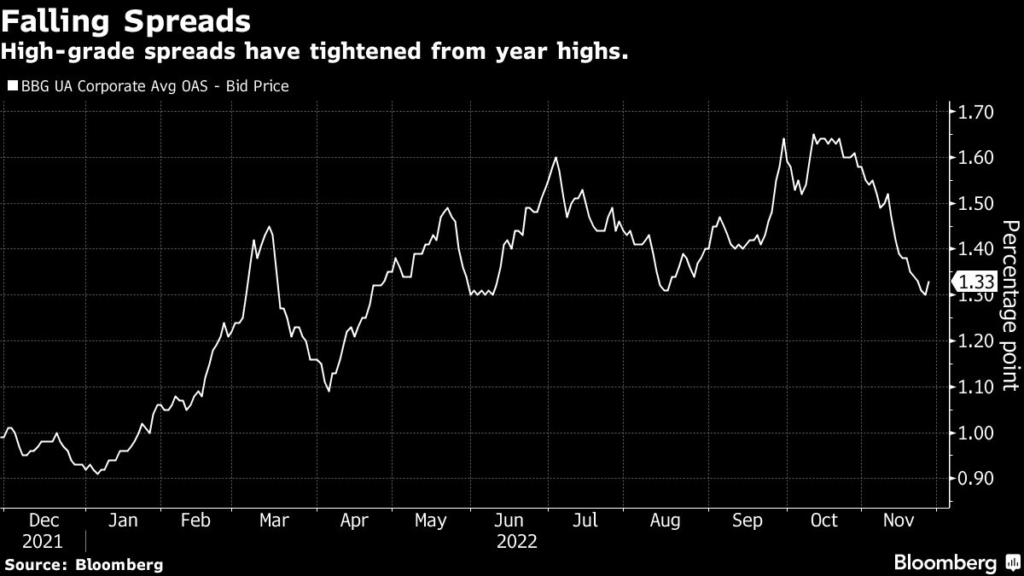
The sale also comes as credit fundamentals create an optimistic backdrop for issuing debt. Investment-grade credit spreads are currently at 133 basis points, more than 30 basis points away from the year’s peak at 165. The cost of issuing debt has also fallen since reaching a high in October, now sitting at 5.36%.

Amazon’s total debt load now exceeds $70 billion, according to Bloomberg Intelligence analyst Robert Schiffman, but that doesn’t keep the company from remaining at the top of its sector. 

“Its five-tranche bond offering, with initial price talk ranging from 45-115 bps over Treasuries for maturities ranging from 2-10 years, is tight to peers for good reasons, we believe, including the company’s dominant cloud and retail businesses, $59 billion of cash and potential for its credit profile (A1/AA/AA-) to continue to improve,” Schiffman wrote in a note Tuesday. “With that amount of cash, funding isn’t needed, but it enhances duration and provides incremental firepower for potential additional M&A and larger share buybacks.”

Barclays Plc, Bank of America Corp., JPMorgan Chase & Co and Societe Generale are managing the bond sale, the person said.

(Updates to add details and context throughout)

More stories like this are available on bloomberg.com

©2022 Bloomberg L.P.

AMC Networks CEO Steps Down After Less Than Three Months

(Bloomberg) — AMC Networks Inc., airer of TV programs including The Walking Dead, said Christina Spade has stepped down as chief executive officer, an abrupt departure less than three months after she took the top job.

The board “is currently finalizing who it will name as a replacement,” according to a statement Tuesday. No reason was given for Spade’s departure. She is entitled to a severance of around $10 million, along with restricted stock units and other awards, according to an earlier filing outlining her employment agreement.

The change continues a leadership revolving door. AMC, known for its flagship cable channel along with brands such as IFC and SundanceTV, had been run by Josh Sapan before a similarly sudden exit last year. Matt Blank served as interim CEO before Spade, AMC’s former chief operating officer and chief financial officer, was named the top executive effective Sept. 9.

“The news is a complete surprise,” said Doug Creutz, an analyst at Cowen & Co. With no apparent successor lined up, Creutz expects AMC shares to be under pressure until the company “can reassure investors that Spade’s exit was not related to any financial-related issues.”

The stock fell 10% at 9:30 a.m. in New York, its biggest drop in more than three weeks. The shares had fallen 40% this year through Monday’s close.

Turnover at the top adds to the challenges faced by AMC, which is shifting to the streaming age as cord-cutters drop their cable packages. While online subscriptions to AMC+ and the company’s other services jumped 44% last quarter from a year earlier to 11.1 million, total sales dropped 16% on lower licensing revenue, advertising and fees from pay-TV companies. A similar blow to profits has roiled other parts of the media world, contributing to the downfall of Walt Disney Co. CEO Bob Chapek earlier this month.

Adding to AMC’s woes, one of its most popular programs just ended its run. Its zombie apocalypse show concluded its 11th and final season on Nov. 20, and the company has struggled to find another hit of that scale. Three Walking Dead spinoffs are in the works, AMC said earlier this month. The company is also banking on a collection of programs based on the works of author Anne Rice, including Interview With the Vampire.

AMC Networks, not to be confused with movie theater company AMC Entertainment, is controlled by the Dolans, one of the most influential families in the cable-TV industry. The Dolans also run Madison Square Garden Sports Corp., which owns basketball’s New York Knicks and hockey’s New York Rangers, and control the company behind Madison Square Garden.

(Updates with severance in second paragraph, analyst commentary in fourth.)

More stories like this are available on bloomberg.com

©2022 Bloomberg L.P.

New Australia Coal Projects to Increase Methane Emissions by 19%

(Bloomberg) — If 15 planned coal mining projects in Australia enter operation they would boost the country’s methane emissions from the dirtiest fossil fuel by nearly a fifth, according to an analysis from energy think tank Ember. 

Australia’s coal mines already cause more planetary warming in a typical year than emissions from all the country’s cars. The new projects were previously approved but are facing fresh scrutiny under Prime Minister Anthony Albanese’s Labor coalition, which has joined the Global Methane Pledge that aims to cut global emissions of the potent greenhouse gas 30% by 2030. 

Cutting emissions from coal mines is the cheapest way for Australia to significantly reduce the amount of methane it releases, a separate Ember analysis found last month. The nation’s coal mines already spew more than 1 million metric tons of methane each year, nearly a quarter of the country’s overall emissions of the gas, the group said in the new report.

The office of Environment Minister Tanya Plibersek did not respond to a request for comment.

Methane has 84 times the warming power of carbon dioxide during its first two decades in the atmosphere. Cutting emissions of the gas is a crucial test for Albanese’s Labor government, which campaigned on a promise to improve the nation’s climate standing on the world stage. In September, the government passed a law requiring a 43% cut in greenhouse gas emissions from 2005 levels by 2030 and setting a net zero goal by 2050, its first binding emissions-reduction target.

Read more: Cheapest Path for Cutting Methane Goes Through Australia’s Mines

If the 15 projects being reviewed move forward they would increase Australian methane emissions from coal mines by roughly 190,000 metric tons a year, according to Ember. In February, Australia disclosed it had revised how it calculates methane pollution from open-cut coal mines and said the change means total national emissions were on average 0.3% higher than previously stated for each year since 1990. That revision was prompted by the use of satellite data, which has improved the ability to estimate greenhouse gas emissions, the government said.

–With assistance from James Fernyhough.

More stories like this are available on bloomberg.com

©2022 Bloomberg L.P.

FTX Collapse Shows Need for EU Crypto Monitoring, Lawmaker Says

(Bloomberg) — The European Union should step up the monitoring of digital currencies to prevent a situation where crypto crises like the collapse of the FTX exchange can pose a systemic risk, a key European lawmaker said.

The crypto spillover risk is small at the moment, but the market has grown exponentially, said Irene Tinagli, a member of the European Parliament. 

“We need to be very carefully monitoring what is going on, and try to put in place regulation that would prevent that to blow up out of proportion and to become a systemic threat,” Tinagli, who chairs the Economic and Monetary Affairs Committee, said in an interview Tuesday on Bloomberg Television. 

The bloc has reached a preliminary agreement on its first major crypto regulation proposal, known as Markets in Cryptoassets, or MiCA, which would address supervision of service providers, as well as consumer protection and environmental safeguards for cryptoassets such as Bitcoin and Ether. A final vote on the directive is scheduled for February. If it goes through, the EU will be the first large jurisdiction to have such regulations in place.

Tinagli said it’s unclear whether MiCA could have prevented the collapse of crypto exchange FTX Group, adding that the matter will be discussed Wednesday during a public hearing in her committee. 

“We are still trying to understand and discover what really happened and if the tools that we have negotiated just a few months ago and that we are about to vote in the plenary would have been sufficient, “ she said. 

However, even if the directive wouldn’t have prevented FTX’s bankruptcy, it’s important to adopt a gradual approach now by putting the rules in force, she said. 

“It’s important to have something in place now,” Tinagli said in a separate interview, noting that reopening negotiations at this stage would lead to a delay of at least a year. “It won’t be wise to reopen MiCA because it is a good piece of legislation”

–With assistance from Jorge Valero.

More stories like this are available on bloomberg.com

©2022 Bloomberg L.P.

Elon Musk’s Job Cuts Decimated Twitter Team Tackling Child Sexual Abuse

(Bloomberg) — Elon Musk has dramatically reduced the size of the Twitter Inc. team devoted to tackling child sexual exploitation on the platform, cutting the global team of experts in half and leaving behind an overwhelmed skeleton crew, people familiar with the matter said. 

The team now has fewer than 10 specialists to review and escalate reports of child sexual exploitation, three people familiar with the matter said, asking not to be identified for fear of retaliation. At the beginning of the year, Twitter had a team of about 20, they said. 

It comes as lawmakers in the European Union and the UK are planning broad-reaching online safety rules that will require social media platforms to better protect children or face significant fines. 

Twitter didn’t respond to a request for comment.

The team — a mix of former law enforcement officers and child safety experts based in the US, Ireland and Singapore — was stretched before the cuts, working long hours to respond to user reports and legal requests, the people said. They were responsible for stopping the distribution of child sexual abuse material, instances of online grooming and media that promoted attraction to minors as an identity or sexual orientation. 

Last week, Musk tweeted that “removing child exploitation is priority #1” and called on people to “reply in the comments if you see anything that Twitter needs to address.”

Read More: Musk’s Threats Toward Apple Jeopardize Ties With Top Advertiser

Some prominent hashtags associated with child sexual exploitation have been removed since Musk took over, changes which had been in the works before he joined, the people said. Still, combating this type of messaging isn’t always as simple as removing tweets containing the offending hashtags since many have another, innocuous purpose, they said. Offenders also constantly change the terms they use to evade detection. 

While artificial intelligence-based tools can be useful for identifying images that have already been reviewed and categorized as child sexual exploitation material by law enforcement, human review is particularly important for understanding the nuances of grooming and other exploitative behaviors, identifying previously unknown abusive images and videos, and understanding regional differences in the law, the people said. Humans are also required to respond to requests from law enforcement as part of criminal investigations.

Losing specialists in Europe and Singapore will make policing non-English speaking markets a particular challenge, the people said. 

These specialists worked closely with dedicated product managers and engineers to build tools and automation to stop the spread of the material, as well as third-party contractors who helped triage posts that users reported. While only a few employees were cut in the first round of layoffs, the team was decimated when Musk called on Twitter’s workers to commit to a “hardcore” culture or lose their jobs, the people said. The people said that Musk didn’t create an environment where the team wanted to stay.

Read More: Musk ‘Hardcore’ Ultimatum Spurs Exodus, With Twitter at Risk

The defections were part of a broader exodus at Twitter’s trust and safety team, which left after Musk sent the ultimatum this month, people familiar with the matter said previously. The company’s also lost a significant number of its employees who block foreign disinformation campaigns on the platform and entire swathes of Twitter’s audience have been left without content moderation, one of the people said. In the Asia-Pacific region, just one contractor hired to help with spam in the Korean market remained, the person said. 

Twitter has also cut a number of contractors who helped moderate content, Axios has reported. Social media platforms including Facebook, TikTok and Twitter use third-party moderators to help sift through flagged posts for violations. 

Unlike other types of egregious content that violate Twitter’s rules, it’s illegal for the platform to host child sexual abuse material and, depending on the country, there are requirements to take down and report material within specific time limits. 

In the UK, the Online Safety Bill gives regulators the power to fine platforms hosting user-generated content, including Twitter and other social media apps, as much as 10% of their revenue if they fail to police their platforms effectively.

The EU is also planning regulation that would require tech companies to take a more aggressive approach to detecting sexual abuse material.

The European Commission’s controversial proposal would give courts the power to require companies to scan for material in messages, even if they are end-to-end encrypted. The commission also wants companies to detect grooming via artificial intelligence and use age verification to find minors on their platforms. 

Read More: EU May Ask Tech Companies to Scan for Sexual Abuse Material

“Elon Musk has been very vocal about his commitment to tackling online child sexual abuse,” said Ylva Johansson, the EU Commissioner in charge of the proposal. “I fully expect him to follow through on these public commitments.”

“Having experienced experts and teams in place, as well as those familiar with EU legislation seems to me an obvious baseline from which to scale up this fight,” she said.

–With assistance from Davey Alba, Jack Gillum and Margi Murphy.

More stories like this are available on bloomberg.com

©2022 Bloomberg L.P.

Stocks Climb, Dollar Fades as China Turmoil Eases: Markets Wrap

(Bloomberg) — US equity futures pointed to a stronger open on Wall Street as speculation mounted that unrest in Chinese cities over Covid restrictions would force authorities to move faster in loosening the curbs.  

While Beijing on Tuesday stopped short of announcing any concrete steps toward reopening the world’s second-largest economy, it pledged to bolster vaccination among its senior citizens, a move regarded as crucial to ending the loop of harsh Covid Zero curbs. A spokesman for the National Health Commission also said local officials must avoid excessive restrictions.

Futures for the tech-heavy Nasdaq rose 0.4%, while those on the S&P 500 were also up, after the underlying indexes fell about 1.5% on Monday. US-listed Chinese stocks, such as Alibaba Group Holding Ltd. and JD.com rallied in premarket trading, while the exchange-traded KraneShares CSI China Internet Fund rose more than 6%, following on from Asian markets’ sharp bounce earlier in the day. 

Tuesday’s moves reverse some of the sharp drops from the previous day, when swathes of anti-Covid protests in China raised fears of a further economic growth setback and fresh disruptions at factories producing goods for Western multinationals.

“My guess is China has reached some kind of tipping point on Covid restrictions,” said Christophe Barraud, chief strategists at the Market Securities brokerage in Paris. “Even before the recent unrest, officials were preparing to implement more targeted measures, but the unrest will only accelerate the process.” 

Another tailwind for stocks is the likelihood that the Federal Reserve will move to a slower rate-hiking pace, with Fed Chair Jerome Powell seen cementing those bets when he speaks on Wednesday. That view, alongside the easing in China tensions, pushed the dollar lower against a basket of peers, following two days of gains.

Powell is, however, expected to remind Americans that the fight against inflation will run into 2023 — a message also flagged on Monday by other Fed officials, including St. Louis President James Bullard and Vice Chair Lael Brainard.

That hawkish drumbeat from central bankers has seen global bonds signal a recession, as a gauge measuring the worldwide yield curve inverted for the first time in at least two decades. 


Investors highlighted stagflation as the key risk for next year, with almost half of the 388 respondents to the latest MLIV Pulse survey expecting a scenario of slowing growth and elevated inflation.  

Elsewhere, oil extended a rebound from the lowest level in almost a year, on speculation that the Organization of Petroleum Exporting Countries and its allies will deepen supply cuts to respond to weakening global demand.

Key events this week:

  • US Conference Board consumer confidence, Tuesday
  • EIA crude oil inventory report, Wednesday
  • China PMI, Wednesday
  • Fed Chair Jerome Powell speech, Wednesday
  • Fed releases its Beige Book, Wednesday
  • US wholesale inventories, GDP, Wednesday
  • S&P Global PMIs, Thursday
  • US construction spending, consumer income, initial jobless claims, ISM Manufacturing, Thursday
  • BOJ’s Haruhiko Kuroda speaks, Thursday
  • US unemployment, nonfarm payrolls, Friday
  • ECB’s Christine Lagarde speaks, Friday

Some of the main moves in markets:

Stocks

  • Futures on the S&P 500 rose 0.2% as of 7:38 a.m. New York time
  • Futures on the Nasdaq 100 rose 0.4%
  • Futures on the Dow Jones Industrial Average were little changed
  • The Stoxx Europe 600 rose 0.2%
  • The MSCI World index rose 0.3%

Currencies

  • The Bloomberg Dollar Spot Index fell 0.5%
  • The euro rose 0.2% to $1.0363
  • The British pound rose 0.3% to $1.1994
  • The Japanese yen rose 0.5% to 138.22 per dollar

Cryptocurrencies

  • Bitcoin rose 1.8% to $16,480.56
  • Ether rose 3.7% to $1,216.01

Bonds

  • The yield on 10-year Treasuries declined two basis points to 3.66%
  • Germany’s 10-year yield declined 11 basis points to 1.88%
  • Britain’s 10-year yield declined three basis points to 3.09%

Commodities

  • West Texas Intermediate crude rose 2.2% to $78.97 a barrel
  • Gold futures rose 0.7% to $1,768.20 an ounce

This story was produced with the assistance of Bloomberg Automation.

–With assistance from Richard Henderson and Brett Miller.

More stories like this are available on bloomberg.com

©2022 Bloomberg L.P.

Elon Musk’s Twitter Is Full of People Swearing Off Tesla

(Bloomberg) — The Twitter chatter of Ford Chief Executive Officer Jim Farley is good vibes only: factory photos, race tracks, corporate boosterism and a lot of retweets of Ford customers gushing about their vehicles. It’s all cars, and it’s all anodyne.

Elon Musk, among Farley’s chief rivals, has taken a decidedly different tack. Since the Tesla CEO also became CEO of Twitter at the end of October, he has dismissed or scared away almost 5,000 Twitter employees (and asked some to return), declared that the social media site may slide into bankruptcy, alienated many of its advertisers, botched a product rollout that allowed brand impostors to proliferate on the site, mocked a US senator, told his followers to vote Republican and invited former US President Donald Trump back onto the platform. All the while, he’s tweeted a play-by-play of the saga alongside a steady stream of lewd memes and score-settling burns — many aimed at his new employees.

This belligerent and erratic performance in his new role as “chief Twit” has raised Musk’s already stratospheric public profile to new heights. If Twitter is a global town square, Musk has transitioned overnight from one of its loudest orators to equal parts mayor and sheriff, with the potential to irritate far beyond the echo chamber of his 118 million followers. For owners and potential buyers of Tesla cars, it has become all but impossible to find neutral ground on the controversies that surround Musk.

Tesla’s lead in the EV market is unquestionably strong — particularly in the US, where the carmaker has steadily sold more vehicles over the course of this year. But there are some signs that the lead is starting to slip. Tesla’s share of new US EV sales dipped to 64% in the third quarter from 75% in year earlier period, according to estimates from Cox Automotive. 

Part of that can be attributed to more EV options than ever before. US consumers now have about 30 fully electric vehicles to choose from, roughly half of which weren’t on the market 12 months ago. “The competition is getting stiffer,” said Rob Pace, founder and CEO of HundredX, a research shop that uses consumer surveys as a fundraising tool.

But the Tesla brand has also taken a hit from Musk’s antics and his protracted Twitter adventure. HundredX has been tracking Tesla since 2019, and in recent months, its research shows a drop in loyalty among Tesla owners. Until May of this year, the company outperformed other automakers, with around 70% of owners saying they were likely to buy from the brand again. That rate has slid below 60%, while the rest of the industry hovers around 65%. The trend is basically the same, HundredX finds, on the question of whether owners would recommend the brand to a friend. Sentiment about Tesla’s quality, reliability, service and brand values have all turned more negative over the past few months.

“The future loyalty data is really, really worrisome if you’re Tesla because it tends to translate into market share six to nine months out,” Pace said. “This would suggest there are storm clouds.”

Market share is already on the wane as thousands of Tesla owners ditch their cars for EVs from startups with both quiet cars and quiet leaders. In the third quarter, almost one-third of Lucid buyers, for example, had owned a Tesla, according to S&P Global Mobility. The story is the same at Polestar and Rivian, which lured far more former fans from Tesla than any other brand.

Jason Weixelbaum, a Baltimore-based historian and science writer, swore off Tesla years before he bought his latest car, a Subaru Crosstrek, in 2021. But in recent months he’s noticed more of his friends drifting away from the brand, too. “It used to be that if you wanted to make a certain statement about yourself, you could do it with a Tesla,” Weixelbaum said. “Musk has trashed all that.”

While Weixelbaum was originally put off by Musk’s juvenile humor, more recently he’s troubled by what appears to be an increase in hate speech on Twitter. Weixelbaum wrote his PhD dissertation on American companies’ financial ties to Nazi Germany and fields the occasional death threat on Twitter. “I don’t see how this doesn’t become a huge debacle,” he said. “And that should trigger some conversations on the board at Tesla.”

Ironically, the #NeverTesla sentiment is most evident on Musk’s new publicity platform, where a steady stream of tweeters are swearing off the brand. Many call out Musk’s erratic management style, often with resolutions to buy a rival EV — say, a Chevrolet Bolt or a Rivian. 

“Musk has overestimated the American public’s appetite for erratic behavior,” said Gaurav Sabnis, an associate professor of marketing at the Stevens Institute of Technology. Sabnis, who lives in Manhattan, had considered upgrading from the family Subaru to a Tesla, but nixed the idea after seeing the Twitter drama of late. In particular, his wife was put off by Musk publicly scrapping with Rep. Alexandria Ocasio-Cortez.

Sabnis points out that more than 80% of car-buying decisions involve women, and Tesla’s customer base is typically affluent, coastal and liberal. “It’s just locker-room behavior,” he said. “And from that perspective, it seems like a horrible marketing decision.

Still, it’s hard to overstate how dominant Tesla is in the EV race. This year through September, the carmaker sold an estimated 391,000 electric vehicles in the US, compared with 41,000 for Ford, the next closest competitor. Every time a Ford Mustang Mach-E rolled out of a dealership in 2022, some seven Tesla Model Ys took to the road.

What’s more, while Musk’s mercurial and public management style is putting off crowds of potential customers, it’s also attracting some. Musk has long cast his company as a contrarian underdog, a foil to Detroit and all things business-as-usual. The occasional lewd meme bolsters that narrative, if for no other reason than it’s something Ford’s Farley wouldn’t dare.

Tech chronicler Kara Swisher calls it “snarketing.”

“You can’t buy this kind of advertising,” she wrote recently on Twitter, “and the crazier the tweeting, the better.”

That said, Musk’s Twitter feed of late doesn’t seem very focused on selling cars. And his time spent steering companies other than Tesla was at the crux of a recent lawsuit challenging his Tesla compensation. In a Delaware court on Nov. 16, Musk said his attention to Twitter would wane after “an initial burst of activity” to reorganize the company; eventually, he would find a new chief executive. Testifying in the same courtroom, Tesla director James Murdoch said Musk had also identified a potential successor for his CEO seat at the car company.

Tesla investors certainly don’t seem thrilled. The carmaker’s shares have skidded by 48% this year and are wallowing far below analysts’ targets.

“I have too much work on my plate, that’s for sure,” Musk conceded earlier this month during a video appearance at a conference in Indonesia. “I’m really working at the absolute most amount that I can work from morning until night, seven days a week. So this is not something I’d recommend, frankly.”

More stories like this are available on bloomberg.com

©2022 Bloomberg L.P.

Close Bitnami banner
Bitnami