Bloomberg

Qatar Wealth Fund Hires Ex-JPMorgan Exec Niall Byrne as CFO

(Bloomberg) —

The Qatar Investment Authority, the Gulf emirate’s $450 billion sovereign wealth fund, has hired former JPMorgan Chase & Co. executive Niall Byrne as its chief financial officer. 

Byrne, who has nearly 30 years’ experience in the finance industry, joined QIA this month, according to his LinkedIn profile. He previously held positions at JPMorgan including chief operating officer and chief financial officer of global fixed income, currency and commodities at its asset management arm. 

QIA has been poaching Wall Street veterans to beef up its senior ranks. It recently hired Gautier Martin-Regnier, a former Morgan Stanley managing director in EMEA equity capital markets, as its global head of capital markets, Bloomberg News reported last month. 

Sovereign wealth funds have continued to be active acquirers this year even as global deal volumes fall and banks cut bank lending for acquisitions. QIA agreed in October to invest €2.4 billion ($2.5 billion) in RWE AG to back the German utility’s purchase of US renewable assets. It was also a cornerstone investor in sports car brand Porsche AG’s IPO and has invested in a string of tech startups. 

In recent months, QIA also promoted Mohammed Al-Hardan to become its new head of technology, media and telecom investments, according to his LinkedIn profile. He replaced Sumit Pande, who left the state-owned fund earlier in the year to pursue another opportunity.

A representative for QIA confirmed the appointments.

(Updates with another appointment, QIA response from fifth paragraph)

More stories like this are available on bloomberg.com

©2022 Bloomberg L.P.

Airbus Reveals Extent of Supplier Crisis, Sees Issues Until 2024

(Bloomberg) — Airbus SE Chief Executive Officer Guillaume Faury said supply constraints will persist until the end of next year as he revealed the full extent of the crisis gripping the firm’s multitude of component producers.

Soaring inflation and energy bills, raw-material shortages, a labor squeeze and disruption to Chinese parts makers amid continuing coronavirus lockdowns are combining to extend disruption, Faury said at a conference in Brussels Tuesday.

“The supply chain crisis is going to be longer than we thought a couple of months ago, more challenging and more difficult,” the CEO said. “I would not expect things to start getting better before the middle of next year. And we don’t expect the situation to be normalized before the end of next year.”

While some issues have eased, such as an engine shortage that left two dozen otherwise flight-ready aircraft waiting on turbines earlier this year, Faury reeled off a list of problems still afflicting production. The supply squeeze comes as Toulouse, France-based Airbus races to meet an already reduced annual delivery goal of 700 jets in the final few weeks of 2022.

The energy crisis will weigh particularly hard on smaller, power-intensive producers, such as those making castings and forgings or relying on high-temperature autoclaves used to produce composites, Faury said at the ASD aerospace industry association event.

A shortage of computer chips meanwhile continues to affect availability of micro-electronic components vital to a wide array of on-board equipment, while a raw-material squeeze is impacting everyone from wing and airframe producers to firms making small metal brackets.

China, Labor

Chinese lockdowns are taking a toll even quite low down the supply chain, reflecting how deeply intertwined Airbus production is with the Asian nation, Faury said, while a shortage of skilled labor is being felt across the industry, from bigger brands to small suppliers that may lack the exposure to attract younger people.

In July, Airbus downgraded its full-year delivery goal from 720 aircraft, and needs to accelerate production over the next few years as it seeks to churn out 75 of its best-selling A320 single-aisle jets a month by 2025.

Faury reiterated that there’s some evidence the long-haul travel market is showing signs of recovery, a positive signal for wide-body aircraft like the Airbus A350. For single-aisle models, the backbone of most commercial fleets, demand is stronger than supply, he said.

(Updates with CEO’s comments on range of supply issues from second paragraph)

More stories like this are available on bloomberg.com

©2022 Bloomberg L.P.

Apple’s Stock Buyback Bonanza Helps to Buoy Shares in Market Slump

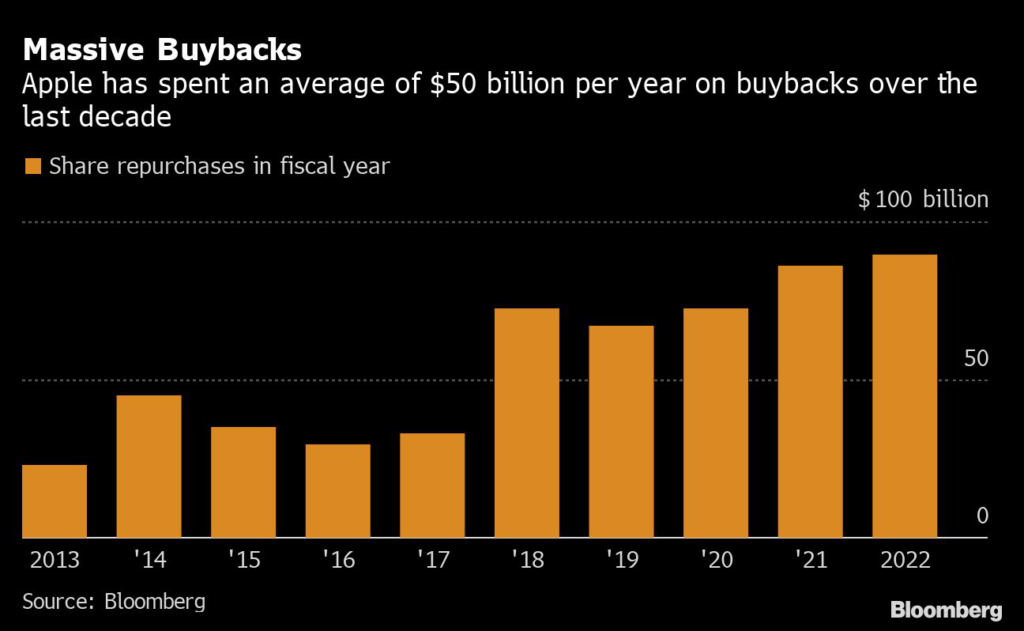
(Bloomberg) — Apple Inc. has shelled out more than $550 billion buying back its own shares over the past decade, more than any other US company, and the technology juggernaut shows no signs of slowing down. 

Even with the stock under pressure the past few days because of production delays for its newest handsets, Apple has fared better than other megacap tech companies in this year’s bear market. Solid earnings and generous buybacks have become a central part of the investment thesis, making the stock more attractive during turbulent times. 

“That’s how they get the safe haven, the gold standard view from investors,” said Gene Munster, who covered Apple during a 21-year career as an analyst before co-founding venture-capital firm Loup Ventures. “When they just keep showing up and generating the kind of cash they do and buying their own stock back, it sends a strong message and I think they’ll continue to do that as much as they can.” 

The next signpost for investors about Apple’s appetite for its own stock will come in April, which is when the company typically tops up its repurchase authorization. It’s added $90 billion to the program in each of the past two years. It’s still generating the earnings to replenish its bank account: It was the only megacap to rally in the wake of its results this quarter, and the report kept analysts from dramatically slashing estimates, in contrast to widespread cuts at its peers. 

Net Cash Neutral

Even with economies slowing around the world, demand is still strong for Apple’s most expensive iPhones, analysts say. The problem now is manufacturing delays because of Covid lockdowns in China, leading to what analysts say are record wait times for deliveries just as the holiday shopping season kicks off. While that may cause a short-term hit to revenue, there’s no sign it’s denting the longer-term case for the stock. 

Apple accumulated cash for years under co-founder Steve Jobs, and Chief Executive Officer Tim Cook has been working on ways to better invest the money and return it to shareholders. Apple, which ended last quarter with $169 billion in cash and marketable securities, aims to have net cash — cash minus debt outstanding — of zero in the future. 

“This is an aggressive bet that they made, something that Steve Jobs would have never done, and it’s paid off nicely for the company and its investors in part because the stock has done well during that period,” Munster said of the share repurchases.

Apple, the world’s largest company with a market value of almost $2.3 trillion, also is in a league of its own when it comes to share buybacks. 

In two of the last five years, it has outspent the second-highest repurchaser by least $50 billion. It spent almost $90 billion last year, about equal to the market value of Citigroup Inc. 

Investors like buybacks because they reduce a company’s share count and thereby provide a lift to earnings per share. The risk is that a company overpays, buying at a time when the stock is overvalued. Apple, though, says it’s paid an average price of $47 a share since it began buying back stock a decade ago, compared with the current share price of $144.22. 

Apple has steered clear from using its cash pile to make large acquisitions, at a time when scrutiny of the size and clout of megacap tech firms is rising. Bulls say buybacks have been a good strategy for the company, until it turns its resources to a new product category like automotive, which could prove more capital intensive. 

“In general, investors would like to see cash being used to generate growth,” said Lewis Grant, senior portfolio manager for global equities at Federated Hermes Ltd. “But when you look at a company the size of Apple and the amount of cash that we’re really talking about, deploying tens of billions of dollars every year to generate growth is perhaps overly ambitious.”

Apple also pays a cash dividend, but it’s almost an afterthought. The quarterly payout of 23 cents a share equals 0.6% of the stock price, one of the lowest yields in the S&P 500 index. Apple raised the payout by a penny in May and said it’s committed to annual increases.

However, investors don’t seem overly concerned how the company chooses to return capital, as long as they continue to do so. 

“We actually don’t care which way you send the capital back to us,” said Mark Stoeckle, Adams Funds’ chief executive officer, adding that Apple would have to raise its dividend by “an enormous amount” to get to a yield that would matter. “We just don’t see that happening, so we’re just as happy with the stock buyback.”

Tech Chart of the Day

Activision Blizzard Inc. analysts are growing more positive on the video-game maker, seeing value in the stock even as Microsoft Corp.’s planned acquisition looks increasingly dicey. At least six firms have upgraded their ratings in November, including three on Monday. The trend has lifted the Bloomberg consensus rating on the stock — a ratio of its buy, hold and sell ratings — to 4.6 out of 5, its highest since January, and up from an April low of 3.94. This has made Activision nearly as well liked among Wall Street analysts as Take-Two Interactive Software Inc., which boasts a consensus rating of 4.57, and above Electronic Arts Inc., which has a consensus rating of 4.29.  

Top Tech Stories

  • Apple’s manufacturing partner is trying yet another special payout to workers in China to soothe unrest and restore production at the world’s biggest iPhone factory, a flashpoint in Beijing’s efforts to sustain its economy while fighting Covid infections.
  • Elon Musk’s tumultuous month atop Twitter Inc. has already included firing most of the company’s employees, tinkering with key features and restoring banned accounts. Now he’s embarking on what could be his riskiest gambit yet: a war with Apple.
  • An activist group will launch an ad campaign Tuesday featuring a fake video of Meta Platforms Inc. Chief Executive Officer Mark Zuckerberg thanking Congress for failing to take action against the biggest tech companies.
  • European tech unicorns such as Revolut, Klarna and N26 are already generating the next wave of startups as former employees launch their own companies. There are now more than 1,000 businesses founded by ex-staffers from the biggest privately-funded tech firms in Europe and Israel, according to venture fund Accel and data platform Dealroom.
  • Sell-side analyst opinion on SoftBank Group Corp. has tumbled to a six-year low as the Japanese technology giant refrains from new stock buybacks amid continued investment losses.
  • Amazon.com Inc.’s cloud-computing unit is rolling out new chips designed to power the highest-end of computing, supporting tasks such as weather forecasting and gene sequencing.
  • Sony Group Corp.’s latest gadget is a set of wearable motion trackers designed to bring users into the metaverse on their phones.
  • Snap Inc. Chief Executive Officer Evan Spiegel told employees that he expects them to be in the social media company’s offices in person 80% of the time starting in February.

–With assistance from Tom Contiliano and Kit Rees.

More stories like this are available on bloomberg.com

©2022 Bloomberg L.P.

India to Test Retail Version of Digital Rupee in Thursday Launch

(Bloomberg) — India’s central bank will launch the retail version of its digital currency on a test basis starting Thursday, a month after allowing some banks to use it for settling secondary-market transactions in government securities. 

Four banks will initially run the digital currency pilot, with another four joining at a later stage, the Reserve Bank of India said in a Tuesday statement. A select group of customers and merchants will take part in the pilot and use the e-rupee as a replacement for hard cash. Digital currency would be issued “in the same denominations that paper currency and coins are currently issued,” the RBI said.

India is joining countries including China in pushing forward with digital versions of their currencies, as it seeks to eliminate private cryptocurrencies that pose risks to financial stability. 

The e-rupee would offer “features of physical cash like trust, safety and settlement finality,” the central bank said, adding that it will not earn any interest and can be converted to other forms of money, including deposits with banks.

Banks will distribute the e-rupee through digital wallets on mobile phones. Both person-to-person transactions and payments to merchants are possible. The latter will involve scanning a QR code, the central bank said. 

Banks participating in the pilot are the State Bank of India, ICICI Bank, Yes Bank and IDFC First Bank in four cities. “The scope of pilot may be expanded gradually to include more banks, users and locations as needed,” the RBI said.

To view the source of this information click here

More stories like this are available on bloomberg.com

©2022 Bloomberg L.P.

Gaming Firm 888 Weighs Tapping Credit Markets as Buyout Debt Hurts Growth

(Bloomberg) — Gambling firm 888 Holdings Plc is considering tapping credit markets in the near future, after its recent buyout of a rival hindered its ability to generate enough cash to invest in growth.

The company’s debt structure is heavier than anticipated in the wake of its buyout of gaming peer William Hill International, as economic conditions have changed since September 2021 when the acquisition was originally announced, according to a statement issued by the company on Tuesday. Floating-rate securities make up about 64% of 888’s gross debt load, which means the interest it pays on those securities have risen this year because of central bank hikes.

The company didn’t say what sort of debt it was considering selling, but it scheduled a capital-markets day that begins at 2 p.m. London time. It plans to repay £347 million ($417 million) of bank loans it drew down to settle the old bonds issued by William Hill before the acquisition, according to the statement.

Investors are starting to fret about spiraling interest bills for highly leveraged firms amid an increasingly gloomy economic outlook. The concerns are even more pronounced when it comes to companies that issued debt recently and have had to accept a much higher cost of borrowing, which in the case of floating debt, rises as central banks hike rates.

To tackle its debt burden over the medium term, 888 has set out a series of financial targets for 2025, including lowering its adjusted net debt to less than 3.5 times earnings. But raising more debt is likely to prove expensive for 888. Its cost of borrowing could be around 11%, given the yield-to-worst on the company’s 2027 note currently stands at 10.9%.  

Read More: Rate Hikes Turn Headache Into Migraine for $3 Trillion of Debt

In July, 888 placed €700 million ($727 million) of bonds with investors at a steep cash discount and with a sky-high yield, as well as a $500 million term loan to finance its acquisition of William Hill. 

Financing banks including JPMorgan Chase & Co, Morgan Stanley, Mediobanca SpA and Barclays Plc held £759 million on their balance sheets, as it became increasingly difficult to offload risky debt to investors. 

–With assistance from Ryan Hesketh.

More stories like this are available on bloomberg.com

©2022 Bloomberg L.P.

Meta’s Mark Zuckerberg Gets ‘Deepfake’ Treatment in Activist Ad

(Bloomberg) — An activist group will launch an ad campaign Tuesday featuring a fake video of Meta Platforms Inc. Chief Executive Officer Mark Zuckerberg thanking Congress for failing to take action against the biggest tech companies. 

In the ad, an actor playing the top-hatted character from the Monopoly board game morphs into Zuckerberg. He says a piece of antitrust legislation aimed at diminishing the power of the tech giants is “about to fade away.” The footage is a “deepfake,” or a video that uses artificial intelligence to make someone appear to do or say something they didn’t. 

The ad comes amid a crescendo of lobbying over landmark antitrust legislation that would prevent the biggest tech companies — Alphabet Inc.’s Google, Amazon.com Inc., Apple Inc. and Meta — from abusing their market dominance. The supporters of the legislation are hoping to push Congress to pass the bill by the end of this year, before a likely GOP majority takes over. Top Republicans have signaled that the legislation would fail in a GOP House. 

The major tech companies and their trade groups have spent more than $120 million on advertising against the bill. 

“Big tech is the golden goose that keeps giving and giving and giving,” Zuckerberg, who is labeled as fake, says in the ad. Referring to lawmakers, he says “We let them pretend to hate us out on the stump, but in Congress, they’re some of our strongest defenders.” 

The ad, which was created by left-leaning digital rights group Demand Progress, will run in New York and Washington. The group, which doesn’t reveal its donors, didn’t disclose how much it is spending on the campaign. A 30 second version will run on TV while a longer one will appear online.

Ultimately, Senate Majority Leader Chuck Schumer and House Speaker Nancy Pelosi will decide whether to bring the measure to a vote before the current Congress’s term expires and the new Congress takes over on Jan. 3.

The ad campaign’s deepfake is a particularly sore subject for Meta’s Facebook, which faced a wave of criticism over its refusal to take down manipulated video footage of Pelosi that appeared to show her slurring her words in 2019. The incident spurred increased scrutiny of the platform’s plans to handle deepfakes, which are expected to become increasingly popular as the technology improves. 

More stories like this are available on bloomberg.com

©2022 Bloomberg L.P.
Hackers Cripple Prestigious Indian Hospital’s Internet Systems

(Bloomberg) — Cyberattackers have crippled systems at one of India’s most prominent hospitals for a week, forcing the institution to operate a raft of key medical services and labs manually.

The All India Institute of Medical Sciences — a hospital that’s traditionally treated the country’s top politicians — has succumbed to a ransomware attack that’s shut down centralized records since Nov. 23, the institution said in a statement.

India’s premier state-run teaching hospital has advised various departments to store data individually until systems can be restored, people familiar with the matter said, asking to remain anonymous disclosing sensitive information. The downtime is exerting a domino effect across a plethora of divisions including its clinics, complicating new patient registrations, the people added.

It’s unclear what data the attackers may have accessed, or what their motives were. The hospital itself hasn’t said what data — or whose — may have been compromised. On Monday, police in the Indian capital, where the hospital is located, said it was unaware of ransom demands in response to local media reports.

A spokesman for AIIMS did not immediately respond to text messages from Bloomberg News seeking comment. On Monday, the institute acknowledged “all hospital services, including outpatient, in-patient, laboratories, etc continue to run on manual mode” and “measures are being taken for cyber security.” It gave no details in the statement, except to describe it as a cyber-security incident.

The incident is the latest in a long and accelerating run of cyber-intrusions that have plagued global institutions for years, as hackers, ranging from state-sponsored attackers to opportunists seeking enrichment, take advantage of endemic deficiencies in cybersecurity.

But the AIIMS incident is notable given the target’s prominence as well as the amount of time it’s taking to secure breached systems. 

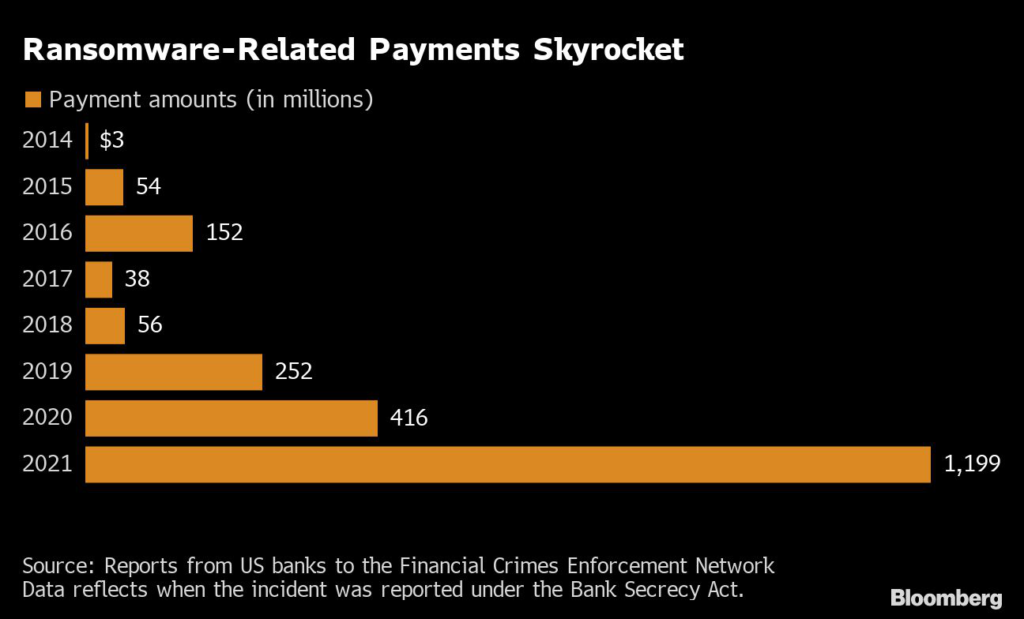
Ransomware is a type of malware that encrypts a victim’s computers. The attackers then demand a ransom payment to unlock them. Ransomware payments have skyrocketed in recent years, US government data shows, as many groups have adopted a type of double extortion. In addition to encrypting files and demanding money, they also are stealing private troves of data and threatening to release it if their demands aren’t met. 

Medical institutions in particular present an attractive target because of the highly sensitive nature of the data they house, as well as their critical societal roles. In October, Australian health insurer Medibank Private Ltd. disclosed that the personal information of nearly 10 million people had been exposed in an attack.

The Treasury Department said that US financial institutions reported nearly $1.2 billion on likely ransomware-related payments in 2021, usually in response to breaches originating with Russian criminal groups.

–With assistance from Jamie Tarabay.

More stories like this are available on bloomberg.com

©2022 Bloomberg L.P.
Bitcoin Climb Fails to Dispel Fears That FTX Contagion Is ‘Far From Over’

(Bloomberg) — Worries about contagion from the implosion of digital-asset exchange FTX clouded a rise in Bitcoin and other cryptocurrencies Tuesday. 

The largest token rose as much as 2.1% and was trading at about $16,485 as of 10:23 a.m. in London. Second-ranked Ether also posted gains, while meme token Dogecoin surged 10% at one point.

Bitcoin has so far mostly weathered BlockFi Inc.’s bankruptcy on Monday. The crypto lender unraveled in the wake of the chaotic demise of Sam Bankman-Fried’s FTX and sister trading house Alameda Research.

The crypto world is now nervously watching for further fallout from FTX, with the spotlight trained on the likes of struggling brokerage Genesis.

“The credit contagion is far from over,” said Cici Lu, founder at Venn Link Partners, a crypto consultancy. There’s “still very low visibility, in the second and third layers of counterparty risk, in terms of who’s exposed to what,” Lu added.

Bitfront, a crypto exchange backed by Japan’s social media giant Line Corp., said it’s shutting down amid industry challenges but indicated the step isn’t connected to the collapse of FTX.

Chart Omen

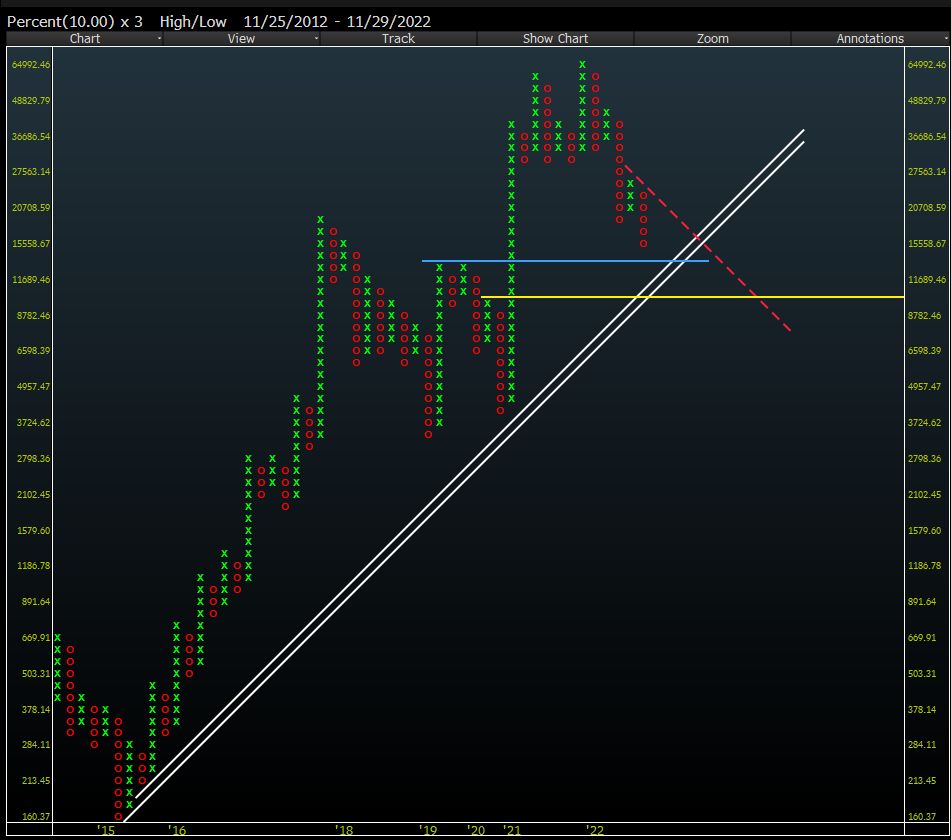
Bitcoin chart patterns continue to flash warning signs about the token’s outlook. An analysis based on plotting sessions when the token moves up or down by at least 10%, a so-called point and figure study, signals the coin is at risk of testing support levels running as low as about $10,000.

Both Bitcoin and a gauge of the top 100 tokens have shed more than 60% this year, a rout that contributed to a spate of blowups at crypto outfits.

For crypto market prices: CRYP; for top crypto news: TOP CRYPTO.

–With assistance from Akshay Chinchalkar.

More stories like this are available on bloomberg.com

©2022 Bloomberg L.P.

Why Some Investors Refuse to Give Up on Metaverse Land

  • Listen to Bloomberg Crypto on the iHeartRadio App
  • Listen to Bloomberg Crypto on Apple Podcasts
  • Listen to Bloomberg Crypto on Spotify  

(Bloomberg) — For a while, there was a real buzz around owning land in the metaverse. As one theory went, Millennials and Gen Z’ers who’d given up on being able to afford a physical property would splurge on a virtual one instead. Well, it’s not quite turning out that way.

Despite the hype – and investments by everyone from Snoop Dogg to the Bajan government – owning property in the metaverse so far hasn’t turned out to be a winning investment. Bloomberg reporter Carly Wanna joins the show to discuss why some are still betting on virtual property despite falling prices and declining user activity.

Follow us on Twitter @crypto, and subscribe to the Bloomberg Crypto Newsletter at https://bloom.bg/cryptonewsletter

This  podcast  is produced by the Bloomberg  Crypto   Podcast  team: Supervising producer: Vicki Vergolina, Senior Producer: Janet Babin, Producers: Sharon Beriro and Muhammad Farouk, Associate Producers: Mo Andam and Ty Butler. Sound Design/Engineer:  Desta Wondirad.

More stories like this are available on bloomberg.com

©2022 Bloomberg L.P.

Satellites Show Climate Change Thinning Rivers, Erasing Glaciers

(Bloomberg) — Climate change is distorting rain patterns across the planet, leading to drought and floods, while rising temperatures are causing glaciers to melt, according to the first ever comprehensive review of water resources by the World Meteorological Organization. The WMO says it aims to publish global water reports annually from now on in response to calls for more accurate data in an era of growing demand and limited supplies. 

The State of Global Water Resources report for 2021, released on Tuesday, analyzes the effects that higher temperatures are having on the planet’s freshwater bodies. Global temperatures are now 1.1C higher than in pre-industrial times, and last year was one of the seven hottest years on record. 

“The impacts of climate change are often felt through water — more intense and frequent droughts, more extreme flooding, more erratic seasonal rainfall and accelerated melting of glaciers,” said WMO Secretary-General Petteri Taalas in a statement. All these events have “cascading effects on economies, ecosystems and all aspects of our daily lives.” 

About three-quarters of all natural disasters between 2001 and 2018 were water related, according to UN-Water, which coordinates the United Nations’ work on water and sanitation. At the same time, 3.6 billion people, almost half of the global population, face inadequate access to water for at least a month every year — and that number is expected to increase to over 5 billion by mid-century. 

Inconsistent measurements and a lack of data collected on the ground made it hard to understand some of the effects that climate change is having on water systems, the WMO said. Researchers filled these gaps partly with modeled data and with information from satellites in NASA’s Gravity Recovery and Climate Experiment program, or GRACE, highlighting the importance of satellites and remote sensing to measure global warming. 

Here’s how some of 2021’s most relevant water impacts looked from space: 

Dying glaciers

Glacial melting accelerated globally in 2021. Masses of ice in Western Canada and the US and in Central Europe experienced the most significant losses over the past four decades, the WMO report shows. Running water from melting glaciers increases at first, feeding rivers and lakes nearby until it reaches a turning point that scientists call “peak water.” After that, the runoff declines and the areas depending on that water can experience drought. 

Widening lakes

Also known among glaciologists as the “Third Pole,” the Tibetan Plateau holds the largest reserve of freshwater outside the polar regions. The water is mostly stored in glaciers high up in the mountains. Higher temperatures are speeding their melting, shrinking the glaciers and occasionally leading to flash floods. Large amounts of water end up in mountain lakes, which are growing as a result. 

Dwindling rivers

Drought in several parts of the US worsened in 2021, with the entire west of the country affected from the month of June. Discharge data from the Colorado, Missouri and Mississippi Rivers shows the amount of water they were carrying was far below normal.

In some places, the amount of water stored in land is growing — nowhere more so than in the Lake Victoria region in Africa. But overall, rivers are shrinking more than they are growing, a trend that continued in 2021. 

Extreme drought

The water deficit that Iran, Iraq and Syria experienced in 2020 was intensified by a warm winter that continued in 2021. That meant lakes and reservoirs didn’t replenish ahead of the hot summer months. The resulting drought affected up to 12 million people in Iraq and Syria and 4.8 million in Iran, leading to deadly clashes in the Khuzestan province.

Drought in the Horn of Africa has led to a devastating food crisis affecting 18 million. Not even intense rainfall between December 2020 to February 2021 — typically the dry season in the region — helped alleviate the situation.

Deadly floods 

Changing weather patterns have led to unprecedented amounts of water falling in very short periods, giving rise to devastating floods. In 2021 floods in Western Europe killed 219 people, causing up to 46 billion euros in damage.

Turkey, Afghanistan, India and China’s Henan province were also hit by floods that led to over 1,500 fatalities. It was a stark reminder that the effects of climate change are being felt everywhere. 


More stories like this are available on bloomberg.com

©2022 Bloomberg L.P.
Close Bitnami banner
Bitnami