

Bloomberg

Scientists Unveil High-Tech Tool to Save Rainforests of the Ocean

(Bloomberg) — Scientists have created the world’s largest digital map of kelp forests, a potentially powerful tool to track the health of these underwater rainforests that store large amounts of carbon dioxide but are threatened by warming oceans. 

In addition to being a bulwark against climate change, kelp forests provide habitat for some 800 marine species, including sea otters, whales and commercially valuable seafood such as abalone. In places like California, kelp helps protect coastlines from storms and grooms waves for a multimillion-dollar surfing industry. It’s also an ingredient in food and cosmetics and can be refined as a biofuel. A climate-driven marine heatwave, though, wiped out 95% of kelp forests along a 200-mile stretch of California’s north coast between 2014 and 2017, devastating local fishing communities. 

The mapping tool at Kelpwatch.org released April 4 shows changes in kelp cover along the length of the California coast since 1984. It will be updated every quarter and can be used to target areas most suitable for kelp restoration. The project is a collaboration between scientists at the Nature Conservancy, the University of California at Los Angeles, the University of California at Santa Barbara and Woods Hole Oceanographic Institution. 

“Kelp forest ecosystems are threatened and in decline in many places around the world,” said Vienna Saccomanno, an ocean scientist who heads the Nature Conservancy’s kelp mapping and monitoring program. “The people charged with managing, protecting and restoring these ecosystems are often paralyzed by a lack of data and the scale of the problem.” 

Researchers trained computers to recognize characteristics of kelp in four decades’ worth of Landsat satellite images. They then spent years compiling that data so it could be used to visualize fluctuations in the size of kelp forests over time. Though the satellites are deployed to recognize phenomena on land, canopies of kelp forests share visual attributes with terrestrial forest canopies, making them detectable from space, according to Kyle Cavanaugh, a marine scientist and associate professor of geography at UCLA. 

“There’s been continuous Landsat coverage of the planet since the early ’80s, and that is just incredibly valuable when you’re trying to look at long-term changes in a marine ecosystem that changes really rapidly,” said Cavanaugh, who began to develop techniques to extract images of kelp from satellite data as part of his PhD research. “That will help identify where kelp might be especially threatened by climate change or other stressors, as well as identifying areas that are more resilient to climate shocks.” 

When you zoom in on the Mendocino County coast north of San Francisco on Kelpwatch and press play on the timeline, ribbons of green appear and disappear offshore. That marks seasonal variations in the bull kelp canopy coverage as the brown algae blooms and then dies off. Commercial divers in harbor towns along the Mendocino coast relied on the predictable lifecycle of those healthy kelp forests to nurture the red urchins they harvested. But when the Kelpwatch timeline approaches 2014, the green fades to gray and does not reappear. 

That’s when the marine heat wave, which scientists have linked to climate change, hit California. Elevated ocean temperatures weakened kelp forests and magnified the impact of a disease that killed off an estimated 91% of the population of sunflower sea stars between Mexico and Alaska. A Technicolored 24-armed predator, the sea star kept kelp-eating purple urchins in check. In the absence of sea stars, purple urchin populations exploded and they devoured kelp forests, leaving large sections of the coast devoid of marine life.

As state officials and environmental organizations plan kelp projects, scientists said Kelpwatch could prove valuable in targeting areas most appropriate for restoration. For instance, in 2021 some spots on the north coast showed signs of kelp recovery, indicating that ocean conditions had improved. 

“Looking at how current dynamics compare to historical dynamics is really important, and that’s where I see Kelpwatch being a potentially cool tool in helping understand that context,” said Michael Esgro, senior biodiversity program manager at the California Ocean Protection Council, a state agency involved in kelp restoration.

Saccomanno said there are plans to expand Kelpwatch to Australia, Chile and other areas of the world where kelp forests are under threat, and that researchers are exploring the potential to include additional satellite data in the program.

Kelpwatch also can alert scientists to kelp forests under stress, said Cavanaugh. Kelp in the Monterey Bay on California’s central coast, for instance, had survived the marine heat wave largely unscathed, thanks in part to a local population of purple urchin-eating sea otters. (The marine mammals had been exterminated on the north coast by hunters a century ago, leaving sunflower sea stars as the purple urchin’s remaining predator there.) 

But he noted that researchers started seeing some areas of kelp loss in Monterey Bay in 2018. “Now, these areas of decline are getting a little bit more widespread so this is definitely an area of concern that we’re watching closely,” Cavanaugh said. “It’s not feasible to monitor the whole coast by eye or boat, but Kelpwatch can serve as an early-warning system.” 

More stories like this are available on bloomberg.com

©2022 Bloomberg L.P.

Fortnite Maker Epic Gets $2 Billion From Sony, Lego Owner

(Bloomberg) — Sony Group Corp. and the owner of the Lego Group invested $2 billion in Epic Games Inc., the maker of Fortnite.

Epic is valued at $31.5 billion after the investment, the Cary, North Carolina-based company said Monday in a statement. Epic’s valuation about a year ago was $28.7 billion.

The game company, among the most valuable startups in the U.S., is currently waging a costly legal battle with Apple Inc. and Alphabet Inc. over fees charged by their app stores. Epic runs its own app store, the Epic Games Store, and alleges that Apple and Alphabet’s Google engage in anti-competitive practices. In September, a California judge found Apple not guilty on nine of 10 counts; Epic is appealing the case.

In addition to producing Fortnite, which has hundreds of millions of registered users, Epic Games also makes one of the most popular game engines, Unreal Engine. Last week, Epic released Unreal Engine 5.

Sony, which works with Epic on the PlayStation and already owned a stake in the company, and Kirkbi, the family-owned holding company behind the Lego toy brand, each invested $1 billion in the new deal. “All three companies highly value both creators and players, and aim to create new social entertainment exploring the connection between digital and physical worlds,” according to the statement.

Last week, Epic said it’s making a “digital experience for kids of all ages” with Lego. Details on the virtual experience remain sparse, but Epic and Lego emphasized it would be a “safe and positive space” for kids to play online.

(Updates with additional context in the third paragraph.)

More stories like this are available on bloomberg.com

©2022 Bloomberg L.P.
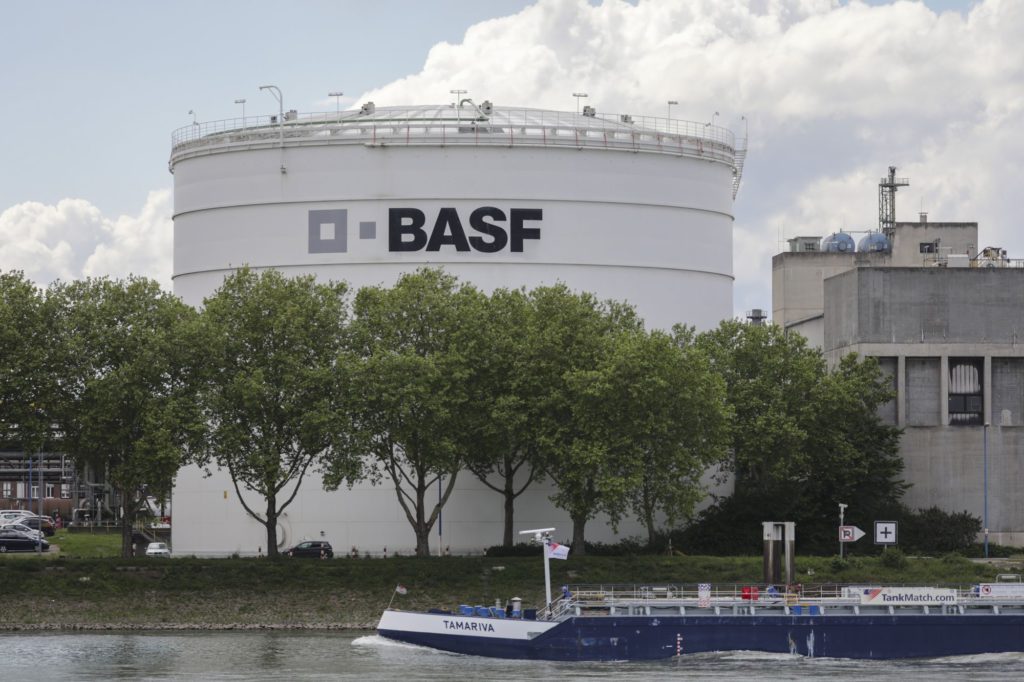
BASF’s Operating Profit Tops Analyst Expectations, Helped by Higher Prices

(Bloomberg) — BASF SE said profits surged after the firm raised the prices of its chemicals to help offset soaring energy costs.

Earnings before interest and tax before special items rose to 2.82 billion euros ($3.1 billion), beating analyst expectations, the German industrial giant said Monday in a release detailing preliminary earnings. 

BASF, one of Europe’s biggest corporate energy users, is weathering surging natural gas, oil and electricity prices, even as Russia’s ongoing invasion of Ukraine threatens to disrupt supplies further. So far, strong demand for its petrochemicals and polyamides have helped the company cope with the crisis. 

BASF shares turned positive after the earnings release and traded 0.29% higher as of 4.54pm in Frankfurt. The stock has fallen around 17% since the start of the year.

The company’s automotive business declined last year amid output disruptions caused by the semiconductor shortage across the industry.

Net income declined to 1.22 billion euros, following an impairment charge of around 1.1 billion euros related to BASF’s Wintershall DEA unit and its loans to the Nord Stream 2 gas pipeline, the company said.

“The impairment on the loan for Wintershall Dea should be priced in already,” Metzler bank analyst David Varga said via email.

More stories like this are available on bloomberg.com

©2022 Bloomberg L.P.
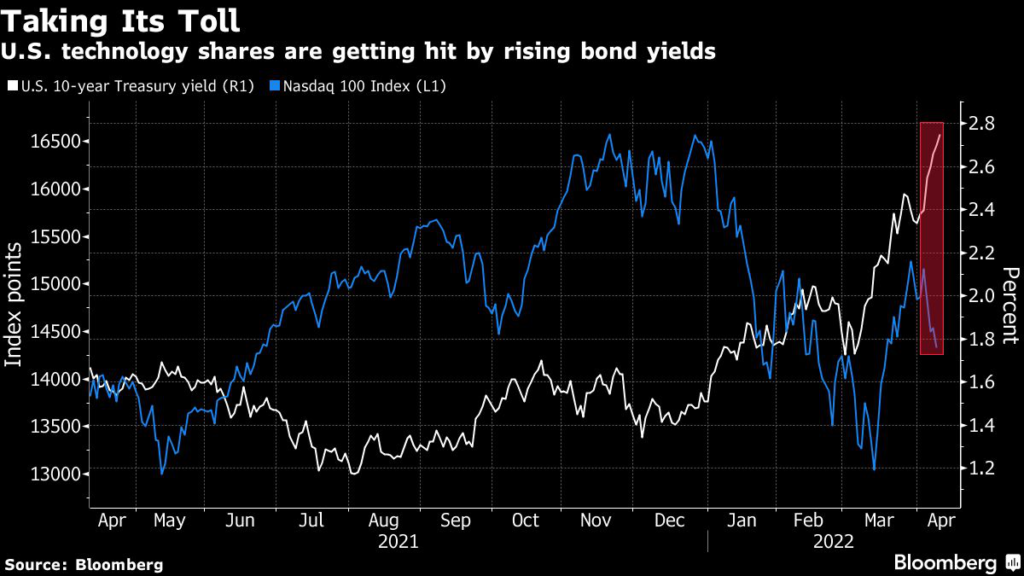
Nasdaq 100 Loses $1 Trillion in Value — Again

(Bloomberg) — The Nasdaq 100 Index lost more than $1 trillion in market value in the past four sessions. Its roller-coaster ride may have just begun.

The tech-heavy benchmark now has seen more than $1 trillion evaporate from peak to trough every month this year, as tighter monetary policy and surging bond yields ignite concern among investors that the economy is headed for a recession. 

“It’s too early to turn positive on U.S. tech stocks,” said Edmund Shing, BNP Paribas Wealth’s chief investment officer. “There’s more downside likely very short term” as high inflation leads to slower discretionary consumption, he said.

The magnitude of the losses reflect the massive size of technology companies, and how far they have to fall: The Nasdaq 100 has returned an average of 38% annually over the past three years versus 26% for the broader S&P 500 Index. Higher interest rates reduce the present value of future earnings, weighing especially on shares of fast-growing companies.

In January, a whopping $3 trillion was wiped out by the time the rout bottomed out, while February and March were relatively better, seeing selloffs of $1.7 trillion and $1.5 trillion, respectively. Companies in the index have a combined market value of $16.9 trillion, led by Apple Inc., Microsoft Corp. and Amazon.com Inc.

The Nasdaq 100 fell as much as 1.6% on Monday as yield on 10-year U.S. Treasuries continued to climb.  

Tech stocks staged a three-week rebound along with the broader market beginning in mid-March. But the war in Ukraine, rising inflation, hawkish Federal Reserve comments and lockdowns across China triggered another decline last week.  

The Fed raised its key rate by a quarter point last month and signaled it expects to lift it to 1.9% by the end of 2022 as the central bank seeks to bring inflation under control. Officials have said they’re open to moving faster if needed, including by hiking a half point at their May 3-4 meeting.

Some parts of the technology industry also have been hit by the fresh lockdowns in China, which have forced the shutdown of factories and foundries, further disrupting already-strained supply chains. 

As a result, chipmakers have been the biggest drag to the index, with Nvidia Corp., Marvell Technology Inc. and Qualcomm Inc. among the worst-performing stocks in the index in the latest selloff. The Philadelphia semiconductor index sank 7.3% in its biggest weekly drop since January.

For now, industry growth is robust, with global revenue increasing 32% in February from a yuear earlier, the 11th consecutive month of growth above 20%, according to Harsh Kumar, an analyst at Piper Sandler Cos.  

And the broader tech sector may find a bottom soon as long as earnings growth trends remain solid, said BNP Paribas Wealth’s Shing.

The Nasdaq 100 now is down 14% from its November peak, valuing it at about 24 times projected profits. While that’s still elevated relative to the average of less than 20 over the past decade, it’s down about 20% from the peak in 2020. 


Tech Chart of the Day

With the selloff in chip stocks, all 30 stocks in the Philadelphia semiconductor index are now down for the year.

Top Tech Stories

  • Twitter Inc.’s shares slid after Elon Musk decided not to join its board, a stunning twist to a week-long saga that’s captivated the tech community and touched off renewed speculation about the company’s future.
  • Investment firm Thoma Bravo has agreed to acquire cyber security company Sailpoint Technologies for $6.9 billion, according to the Financial Times, which cited two people with direct knowledge of the details.
  • Chinese authorities accused the former Communist Party chief of Hangzhou of accepting “huge” bribes, escalating a corruption probe in the affluent eastern city where Jack Ma’s Ant Group Co. and Alibaba Group Holding Ltd. are headquartered.
  • GoTo Group, Indonesia’s biggest tech company, surged on its first day of trading after raising $1.1 billion in one of the world’s largest initial public offerings this year.
  • Swedish telecommunications-equipment maker Ericsson AB said it had suspended business with customers in Russia “indefinitely,” extending a halt from February that was originally billed as temporary, following sanctions imposed as a result of Russia’s war in Ukraine.
  • Singaporean firm Coda Payments Pte is nearing a deal to raise private funds at about a $2.5 billion valuation, according to people familiar with the matter.

(Updates Nasdaq 100 movement in sixth paragraph)

More stories like this are available on bloomberg.com

©2022 Bloomberg L.P.

Africa’s First Fine Wine NFTs to Be Offered on Auction

(Bloomberg) — Africa’s first fine wine nonfungible tokens will be auctioned this month, with well known South African vineyards such as Meerlust Wine Estate and Klein Constantia taking part.

The sale, organized by auction house Strauss & Co. from April 18 to April 25, will offer wines from five producers with each NFT holding between 20 and 50 vintages and between 66 and 288 bottles.

“Nonfungible tokens are a highly efficient way to package a collection of wines for trading and investment,” Strauss & Co. said in a statement on Monday. “The digital contract, stored on the polygon blockchain, includes all the provenance, pricing, transaction, sensorial and aging information.”

The sale joins a global trend of using NFTs to sell luxury beverages ranging from wines to whiskies with the novel method providing a certificate of provenance and providing publicity for the wine makers.

NFTs have soared in popularity in recent months, with caricatures of monkeys and lions commanding prices in the millions of dollars. Sports clubs, prestige automakers and even pop stars are among those getting into the nascent trading business, which uses blockchain technology to authenticate unique ownership tokens.

Each bottle within the collections on sale will carry its own NFT, allowing the drinking or trading of single bottles. 

The NFTs on sale and their estimated prices: 

  • The Strauss Rubicon 80-34 NFT includes the first 50 vintages of the Meerlust Rubicon Stellenbosch wine in varying quantities to total 288 bottles. Estimates at 550,000 rand ($37,741) to 750,000 rand.
  • Strauss Vin de Constance 86-27 NFT offers the first 40 vintages of Klein Constantia’s sweet wine made from Muscat de Frontignan. Estimates at 550,000 rand to 750,000 rand.
  • Strauss Series C 03-27 NFT consists of a 6-bottle case from each of the first 25 years of Vilafonté. Estimates at 550,000 rand to 750,000 rand.
  • Strauss Olerasay 1-20 includes the first 20 iterations of Mullineux Olerasay, a chenin blanc solera-style sweet wine. Estimates at 250,000 rand to 350,000 rand.
  • Strauss Paul Sauer 00-25 spans all vintages from 2000 to 2025. Estimates at 150,000 rand to 250,000 rand.

More stories like this are available on bloomberg.com

©2022 Bloomberg L.P.
NFT Auction to Be Used to Sell Fine Wines in African First

(Bloomberg) — Africa’s first fine wine nonfungible tokens will be auctioned this month, with well known South African vineyards such as Meerlust Wine Estate and Klein Constantia taking part.

The sale, organized by auction house Strauss & Co. from April 18 to April 25, will offer wines from five producers with each NFT holding between 20 and 50 vintages and between 66 and 288 bottles.

“Nonfungible tokens are a highly efficient way to package a collection of wines for trading and investment,” Strauss & Co. said in a statement on Monday. “The digital contract, stored on the polygon blockchain, includes all the provenance, pricing, transaction, sensorial and aging information.”

The sale joins a global trend of using NFTs to sell luxury beverages ranging from wines to whiskies with the novel method providing a certificate of provenance and providing publicity for the wine makers.

NFTs have soared in popularity in recent months, with caricatures of monkeys and lions commanding prices in the millions of dollars. Sports clubs, prestige automakers and even pop stars are among those getting into the nascent trading business, which uses blockchain technology to authenticate unique ownership tokens.

Each bottle within the collections on sale will carry its own NFT, allowing the drinking or trading of single bottles. 

The NFTs on sale and their estimated prices: 

  • The Strauss Rubicon 80-34 NFT includes the first 50 vintages of the Meerlust Rubicon Stellenbosch wine in varying quantities to total 288 bottles. Estimates at 550,000 rand ($37,741) to 750,000 rand.
  • Strauss Vin de Constance 86-27 NFT offers the first 40 vintages of Klein Constantia’s sweet wine made from Muscat de Frontignan. Estimates at 550,000 rand to 750,000 rand.
  • Strauss Series C 03-27 NFT consists of a 6-bottle case from each of the first 25 years of Vilafonté. Estimates at 550,000 rand to 750,000 rand.
  • Strauss Olerasay 1-20 includes the first 20 iterations of Mullineux Olerasay, a chenin blanc solera-style sweet wine. Estimates at 250,000 rand to 350,000 rand.
  • Strauss Paul Sauer 00-25 spans all vintages from 2000 to 2025. Estimates at 150,000 rand to 250,000 rand.

More stories like this are available on bloomberg.com

©2022 Bloomberg L.P.

Shopify Plans 10-for-1 Split, Golden Share for Founder CEO

(Bloomberg) — Shopify Inc. said it plans a 10-for-1 stock split and will give Chief Executive Officer Tobi Lutke a special “founder share” that will preserve his voting power as long as he’s at the company. 

The Canadian e-commerce software firm said Monday that the new structure would “strengthen the foundation for long-term stewardship by Mr. Lutke,” the company’s founder. Under the plan, Lutke, his family and his affiliates would together retain 40% of the votes at the company, even as their ownership stake changes. 

Shopify was down 0.1% at $602.59 in New York at 9:43 a.m.

Lutke, 41, would have to give up his founder share if he’s no longer with the company as an executive, director or consultant, Ottawa-based Shopify said in a statement Monday. He wouldn’t be allowed to transfer it to anyone else. 

He would also forfeit the special share if his ownership stake — including family members and affiliates — drops below 30% of the number of class B shares they have today. 

Shopify soared above C$250 billion ($198 billion) in market value during the pandemic as online selling took off, but it has given back most of those gains. 

Read More: Shopify’s Slump Proves That It’s No Amazon

The shares are down 56% this year amid a selloff in richly valued technology stocks — costing Lutke about $6.3 billion in personal wealth. He’s still one of the richest Canadians, with a net worth of $5.5 billion, according to the Bloomberg Billionaries Index. 

Stock splits are in vogue in the technology sector after Alphabet Inc., Amazon.com Inc. and Tesla Inc. all got a boost from announcing plans to split their shares. 

The changes require approval of a majority of Shopify shareholders, excluding Lutke and related parties. The vote will happen at a meeting on June 7. 

Morgan Stanley is serving as Shopify’s financial adviser on the proposed changes and Skadden, Arps, Slate, Meagher & Flom LLP and Stikeman Elliott LLP as legal counsel, according to the company’s statement.  

(Updates share price move in third paragraph.)

More stories like this are available on bloomberg.com

©2022 Bloomberg L.P.
Musk Can Buy More Twitter Shares After Declining Board Seat

(Bloomberg) — Elon Musk may acquire additional shares in Twitter Inc. now that he is no longer accepting a position on the social media company’s board, according to a securities filing on Monday. 

The abrupt reversal over the board seat over the weekend ignited renewed speculation about Musk’s intentions for Twitter since first disclosing he had taken a stake of just over 9% — becoming the social media giant’s largest individual shareholder. By not joining the board, Musk is no longer subject to an agreement to keep his stake at no more than 14.9%. Twitter shares were down 3.1% as the market opened on Monday in New York.

According to a filing with the Securities and Exchange Commission, Musk has no “present plans or intentions” to acquire additional shares, but “reserves the right to change his plans at any time” in light of evaluating various factors including the stock price and the “relative attractiveness of alternative business and investment opportunities.”

The notice also said that Musk could engage in discussions with the board about potential business combinations and strategic alternatives. And, in a twist that may be particular to one of Twitter’s most prolific users, the filing noted that Musk can express his views to the board “or the public through social media or other channels.”

(Updates with shares in second paragrpah.)

More stories like this are available on bloomberg.com

©2022 Bloomberg L.P.

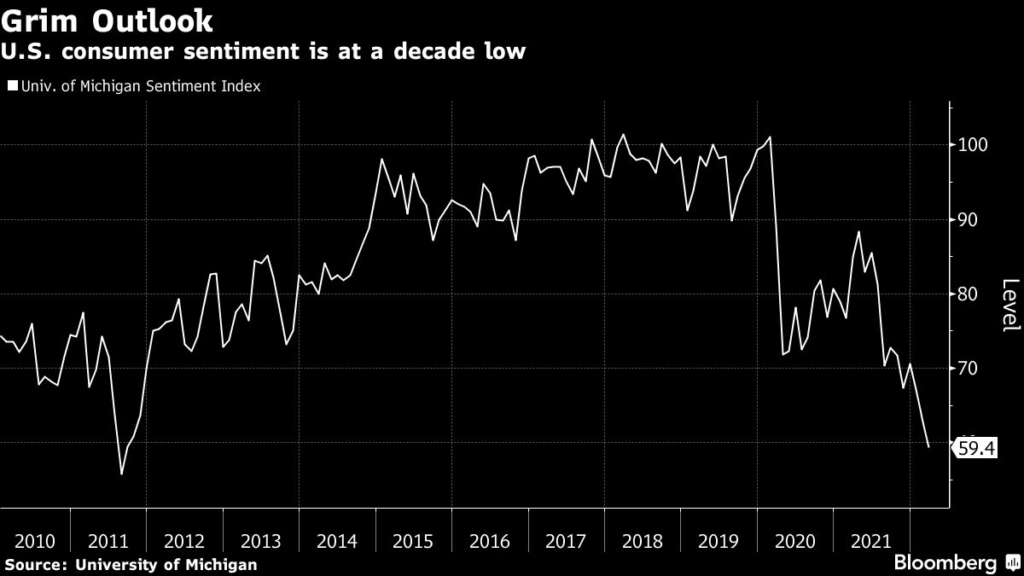
Surf-and-Turf Specials Cut From U.S. Menus in Sign of Price Pain

(Bloomberg) — For years, Fridays at Beef ‘O’ Brady’s, a sprawling restaurant chain in the Southeast, meant one thing: the steak-and-shrimp special.

But in January, Chief Executive Officer Chris Elliott saw signs that consumers were feeling the squeeze of soaring inflation. So he took the $12.99 surf-and-turf dish off the specials list, replaced it with a fish-and-chips platter and slapped a $9.99 price tag on it. Even with the change, though, customer traffic has been flagging in recent weeks.

“People are looking for deals; they’re getting hammered everywhere — at the gas station, at the grocery store,” said Elliott, who acknowledges that restaurants, including his own, have also been raising prices.

One year into the inflation spiral that has rocked the U.S. economy, lower-income consumers are starting to shift spending patterns. They’re cutting back on more expensive items, ramping up on cheaper ones and forcing restaurants, grocery stores and retailers to rejigger their sales strategies. This marks a major break from 2021, when consumers, still flush with pandemic stimulus and newly won pay raises, kept spending at a frenetic pace even as annual inflation surged to a four-decade high.

“Consumers are becoming more sensitive to price,” said Krishnakumar Davey, president of strategic analytics at IRI Worldwide, a provider of market research and data. “March is the turning point.”

The dropoff in spending, executives and analysts say, is most pronounced in lower-income families as inflation overtakes those wage gains. Food prices rose 7.9% in February from a year earlier, the largest gain since July 1981. Updated U.S. inflation figures for March will be released on Tuesday. While job gains and a jump in savings mean the pandemic-era shopping boom may not be completely over, it’s clearly slowing.

Bank of America data show that households making less than $50,000 annually increased card spending by only 4% in March — about a third of the rise for those who earn more than $125,000 a year. 

More than a third of U.S. households brought in less than $50,000 in 2020, excluding government stimulus payments, according to a Census Bureau report in September. That would total about 49 million households. Those in the lowest-income quintile spend 18% of their income on food and energy, compared with 11% in the highest one-fifth group, according to Bloomberg Economics.

This underscores the urgency of the Federal Reserve’s mission to restore price stability. Governor Lael Brainard highlighted the dynamic last week, noting that some families feeling crunched can shift to buying private-label goods. But for those already purchasing cheaper options, it won’t be as simple. Those shoppers “would have to either absorb the increase in cost or consume less,” she said.

Those in the food business are trying to adjust. Denny’s Corp. is promoting a $6.99 all-you-can eat breakfast of pancakes, eggs and hash browns to entice customers who are “feeling the pinch at the gas pump,” Chief Brand Officer John Dillon said. But that same endless breakfast meal costs $8.99 in states where wages and commodity costs are running higher. And bacon? That’ll be an extra 99 cents.

Soaring prices at restaurants and retailers are a big reason why the average U.S. household will have to spend an extra $5,200 this year, or about $433 a month, for the same consumption basket, according to Bloomberg economists Andrew Husby and Anna Wong.

That doesn’t necessarily mean total consumer spending is poised to fall. In fact, economists are predicting an inflation-adjusted 3.1% gain after last year’s 7.9% jump, according to the median estimate compiled by Bloomberg. That’s still strong, and ahead of the average annual growth of 2.5% the U.S. posted from 2016 to 2019. 

Indeed, there’s still plenty of cash to be spent. U.S. households are flush with an extra $2.5 trillion in savings built up over the pandemic, and inflation pressures will absorb only about a quarter of it, Husby and Wong said.

Even at the lower end, “consumers in the bottom 50% of incomes and wealth have never had more excess net worth or liquid assets,” Tavis McCourt and other analysts at Raymond James Financial Inc. said in a report. And with the job market booming, “we suspect it will take longer for consumers to show significant stress/slowing demand than one would normally expect,” they said.

Even so, shoppers are now looking harder for ways to save on groceries. Foot traffic at dollar stores, especially those of Dollar General Corp., has generally held up better than at traditional retailers, according to data compiled by Placer.ai, which uses mobile-phone data to determine traffic.

Big-Box Shift

Momentum is also shifting among big-box retailers. Target Corp. trounced Walmart Inc. in sales growth during the pandemic, and the company’s more upscale clientele positions it well for the future. But sales gains at Walmart have been stronger in recent months, according to Bloomberg Second Measure, which analyzes U.S. consumer transactions to measure revenue. That suggests shoppers are increasingly drawn to Walmart’s mantra of everyday low prices.

As recently as the fall, IRI, the market researcher, was predicting food inflation of 6% this year, with most of the increases coming in the first half. Now, it’s predicting a jump of between 8% and 11%. The sharp increase appears to be spurring a sales turnaround for private-label brands. Spending on generic-brand food recently ticked up after slipping during the pandemic, IRI’s Davey said. 

With many unable to pay more, companies’ profits are likely to fall. Friendly’s Restaurants is giving away more discounts than in the past, and is also advertising big portions. CEO Craig Erlich said he hopes Friendly’s won’t have to raise prices this year. He’s simply not sure customers can keep up.

“That’s why we’re being mindful about not increasing prices significantly like we’ve seen out there,” he said. “It’s really a tough balance we face.”

More stories like this are available on bloomberg.com

©2022 Bloomberg L.P.

SoftBank Leads $185 Million Round in Pax8 at $1.7 Billion Value

(Bloomberg) — SoftBank Vision Fund has led a $185 million investment in Pax8 Inc. that values the company at $1.7 billion.  

Existing investors Liberty Global Ventures, Catalyst Investors, Sageview Capital and Blue Cloud Ventures participated in the round, according to a statement Monday. 

The Denver, Colorado-based startup works with small businesses to help them manage an array of cloud technology services. Pax8 customers range from dentists to plumbers, who outsource their information technology needs to help run their business. 

SoftBank Managing Partner Nagraj Kashyap said that the firm invested in Pax8 because it can be difficult to know what technology is needed to run a small business. Pax8 has developed an edge and will continue to grow, after scaling for ten years, he added.

“We know the pain firsthand of what SMBs go through,” Kashyap said of his experience working with smaller startups. “It’s not easy to understand what to buy, how to buy it.” 

Pax8 Chief Executive Officer John Street said that some of the newly raised capital could be used to make acquisitions that complement the startup’s business, adding that the company could eventually hold an initial public offering. 

“We are scaling the company to potentially go public,” Street said.

The business is growing in Europe, as well as expanding offices in emerging startup scenes around the U.S., such as in San Antonio, Texas, and Atlanta. Pax8 intends to “spread the wealth around,” Street said.

More stories like this are available on bloomberg.com

©2022 Bloomberg L.P.

Close Bitnami banner
Bitnami