Bloomberg

Mideast Asset Manager Investcorp Seeks Cash for Blockchain Fund

(Bloomberg) — Investcorp Holdings, the biggest alternative asset manager in the Middle East, started raising money for a new fund aimed at taking stakes in startups developing blockchain technology.

The eLydian Lion fund will be based in Abu Dhabi and plans to invest in firms operating blockchain infrastructure, platforms and exchanges, decentralized finance and data analytics, according to a statement. Investcorp didn’t comment on how much it planned to raise for the fund.

“We believe that blockchain technology and the ecosystem around it will transform every facet of our economy much like the Internet did in the 2000s,” said Gilbert Kamieniecky, head of Investcorp’s technology private equity business.

A blockchain is a digital database, or ledger, used to record information and transactions in a collaborative manner. It’s the technological backbone of digital currencies like Bitcoin. 

Bahrain-based Investcorp, backed by Abu Dhabi’s Mubadala Investment Co., is also currently raising money for several other funds. It currently manges over $40 billion of assets and recently started expanding in Asia as part of the plan to more than double the size.

Investcorp delisted from the Bahrain stock exchange last year after almost four decades, in a move it said would give it the agility to expand faster. Mubadala in 2017 acquired a 20% stake in Investcorp, which previously backed companies including Tiffany & Co. and Gucci Ltd.

More stories like this are available on bloomberg.com

©2022 Bloomberg L.P.

Ukraine Update: Austria Chancellor to Meet Putin; New War Front

(Bloomberg) —

Austria’s chancellor said he’ll meet President Vladimir Putin in Moscow on Monday, as Ukraine reported Russian missile attacks destroyed the airport at Dnipro, the country’s fourth-largest city. 

Ukraine expects Russia to widen its offensive in the east this week, President Volodymyr Zelenskiy said, while a new commander for the Russian troops on the ground is raising alarm among U.S. officials.

Putin’s invasion will likely cause Ukraine’s economy to shrink by almost half this year, the World Bank said, while it expects Russia’s to contract by about 11%. The Kremlin said it’s boosting a national economic stability fund, using oil and gas revenue that continues to flow. 

(See RSAN on the Bloomberg Terminal for the Russian Sanctions Dashboard.) 

Key Developments

  • Russia’s War in Ukraine: Key Events and How It’s Unfolding
  • Why Japan Will Struggle to Do Without Russian Energy: QuickTake
  • Half of Harvests in Crop Giant Ukraine Could Be Wiped Out by War
  • General Who Ran Syria Operation to Lead Russia Troops in Ukraine
  • Singapore’s Lee Warns U.S. Against Isolating China Over Ukraine

All times CET: 

German Air Force to Evacuate Injured Ukrainians (7:00 a.m.)

Germany’s air force is preparing a flight to evacuate Ukrainians injured during the war from southeast Poland to Cologne for treatment, news agency DPA reported, without identifying the source of its information.

Germany has already taken in injured Ukrainian soldiers but this would be the first flight of its kind transporting adults and children, DPA said. 

New Zealand Deploys C-130 Aircraft (6:16 a.m.)

New Zealand will send a C-130 Hercules aircraft and a 50-strong team to Europe on Wednesday to support Ukraine, Prime Minister Jacinda Ardern said at a news conference.

Wheat Hits Two-Week High (5:10 a.m.)

Wheat extended a surge to a two-week high, propelled by deepening fears about dwindling global stockpiles as the war in Ukraine continues to cloud the outlook for Black Sea exports. 

Russia’s war in Ukraine is upending trade flows out of the critical Black Sea breadbasket region, fueling panic about shortages of key staples such as wheat, corn and cooking oils. Global food prices, which were already surging before the conflict, rose at the fastest pace ever in March, piling more inflationary pain on consumers and worsening a global hunger crisis.

Singapore’s Lee Warns U.S. on Isolating China (4:37 a.m.)

Prime Minister Lee Hsien Loong warned the U.S. against isolating China over the war in Ukraine by framing it as a battle between democracies and autocracies, which would complicate an already fraught relationship between the two powers.

“You have to be very careful not to define the problem with Ukraine in such a way that automatically, China is already on the wrong side,” Lee said in comments published by his office Sunday. 

Read the Story: Singapore’s Lee Warns U.S. Against Isolating China Over Ukraine

Russia Won’t Default, Deputy Minister Says (1:56 a.m.)

Russia won’t default on its debt obligations and the economy is expected to recover to its 2021 level in a year, Izvestia reported, citing an interview with Deputy Economy Minister Ilya Torosov. Russia has enough resources to serve its debt, Torosov told the newspaper.

Russia Plans to Stop Bond Auctions (11:55 p.m.)

“We do not plan to go to the local market or foreign markets this year,” Finance Minister Anton Siluanov told Izvestia. “It makes no sense because the borrowing cost would be cosmic.”

Ukraine Poised for Military Action in East (11:00 p.m.)

Zelenskiy said he expects Russia to “turn to even more large-scale actions in the east of our country” this week, including intensified air strikes.  The week “will be no less tense and even more weighty with responsibility,” he said in a video message. 

The Ukrainian president has been warning for days of a new Russian offensive. “We don’t know how much Russian weaponry there will be, but we understand there will be many times more than there is now,” he said in a pre-recorded CBS News interview to air Sunday.

Russian Economy to Shrink by 11%, World Bank Says (10 p.m.)

Russia’s sanctions-hit economy is projected to shrink by 11.2% this year, the World Bank said in an outlook published Sunday. Ukraine’s economy will contract by an estimated 45.1%, or almost half, with the outcome depending on the duration and intensity of the war, according to the Washington-based development bank. 

Read the story: Ukraine Economy to Fall 45% in 2022, Russia 11%, World Bank Says

Russia Destroys Key Airport at Dnipro (7:30 p.m.)

Renewed missile attacks by Russian forces have demolished the airport at Dnipro in central Ukraine, according to the regional governor. Dnipro is the fourth-largest city in the country.

The airport came under shelling in the morning and then again several hours later, with the subsequent attack injuring rescue workers on the scene, Valentyn Reznichenko said on his Telegram channel.

Russian troops separately hit infrastructure sites in Zvonetske, also in the Dnipropetrovsk region, he said.

Austrian Leader to Meet Putin After Kyiv Trip (6:18 p.m.)

Austria’s Chancellor Karl Nehammer said on Twitter he’ll meet Vladimir Putin in Moscow on Monday in an attempt to build dialog with the Russian president. 

Plans for the meeting were coordinated with European Commission President Ursula von der Leyen, German Chancellor Olaf Scholz, Turkish President Recep Tayyip Erdogan and Ukrainian President Volodymyr Zelenskiy, Nehammer said. 

The move is unusual for Nehammer, a novice in diplomatic circles who took office in December. He’ll look to build on militarily-neutral Austria’s perceived role as a bridge between Europe’s east and west. 

U.S. Officials Wary of Putin’s New Commander (5:37 p.m.)

Russia’s new military commander in Ukraine will probably mean “a continuation of what we have already seen on the ground,” said White House press secretary Jen Psaki.

Psaki was asked on Fox News about General Alexander Dvornikov, leader of the Russia’s Southern Military District, who’s been tapped to run the overall war effort in Ukraine. He notably oversaw Russian forces in Syria in 2015 and 2016. 

“This particular general has a resume that includes a brutality against civilians in other theaters, in Syria. And we can expect more of the same,” U.S. National Security Adviser Jake Sullivan said on CNN. “This general will just be another author of crimes and brutality against Ukrainian civilians.” 

U.S. in ‘Game Plan’ for More Weapons for Ukraine (3:00 p.m.)

Efforts to supply arms to Ukraine as Russian forces regroup in the east include “looking at systems that would require some training” for Ukrainian troops outside the country, National Security Adviser Jake Sullivan told CBS on Sunday. 

Nations Eye Modern Arms for Ukraine as Soviet-Era Stocks Dwindle

Sullivan said he and Mark Milley, chairman of the Joint Chiefs of Staff, “worked through a game plan” for delivering more weapons from the U.S. or its allies during a call last week with President Volodymyr Zelenskiy. “Some of that’s been delivered, some of it’s on the way and some of it we’re still working to source,” Sullivan said.

Putin, Belarus’s Lukashenko to Meet Tuesday (2:08 p.m.)

Vladimir Putin and Belarus leader Alexander Lukashenko will meet Tuesday at the Vostochny Cosmodrome in eastern Russia, Interfax reported. They’re expected to discuss Lukashenko’s hopes of being part of negotiations with Ukraine. 

It’s a rare foray out of the Moscow region for Putin since Russia’s invasion of Ukraine on Feb. 24. 

Zelenskiy, Germany’s Scholz Don’t Mention Energy in Readouts (1:47 p.m.)

Volodymyr Zelenskiy spoke by phone with German Chancellor Olaf Scholz on Sunday, with the talks said to focus on prosecution of Russian war crimes and financial support for Kyiv. 

A readout from the German government and a Twitter post from Zelenskiy make no reference to any discussion about Germany’s energy purchases from Russia. 

Kyiv has accused Germany of financing Moscow’s war machine with its long-standing reluctance to stop buying Russian natural gas and coal. Berlin is looking to wean itself off Russian gas over time. 

Germany Says VTB No Longer Controls European Unit (12:50 p.m.)

VTB Bank PJSC, Russia’s second-largest lender, no longer controls its Frankfurt-based subsidiary VTB Bank Europe SE after the European Union’s latest round of sanctions. 

Germany’s Federal Financial Supervisory Authority BaFin has prohibited VTB Bank Europe’s management from following instructions from its parent, the regulator said in a statement Sunday. 

Bloomberg News reported last month that VTB Bank Europe has been put up for sale, with German regulators backing the plan as they seek to avoid a messy unraveling. 

Anti-Ship Missiles Will Help Defend Odesa, Zelenskiy Aide Says (1:34 p.m.)

The missiles, part of the latest U.K. military aid, will be crucial as Russia presses its assault on southern coastal cities, including Odesa, said Ihor Zhovkva, an adviser to Ukraine’s president.  

“Russia is now trying to capture some major cities from the sea, such as Odesa,” Zhovkva said Sunday on the BBC. “They are now firing and shelling the infrastructure over there, from the sea.” Odesa, a key naval base on the Black Sea, has come under fire from missile strikes launched from the Crimean peninsula, Ukraine’s military has said. 

More foreign leaders are expected to come to Ukraine soon, Zhovkva said, without offering details.  

EU Holds Emergency Meeting of Top Military Body (11:53 a.m.)

EU foreign policy chief Josep Borrell held an extraordinary meeting of the bloc’s military committee Sunday to discuss expected Russian attacks in the east and south of Ukraine, as well as Kyiv’s request for additional weapons, according to an EU official who declined to be named. 

EU foreign ministers are expected to discuss further sanctions on Russia on Monday, including on the oil sector. The EU plans to approve an additional 500 million euros in arms in the coming days to support Ukraine, in addition to 1 billion euros already allocated.

More stories like this are available on bloomberg.com

©2022 Bloomberg L.P.

Tech Rout Could Drag Bitcoin to $30,000, BitMEX Co-Founder Says

(Bloomberg) — Bitcoin’s tendency to move in tandem with technology stocks means the biggest cryptocurrency may slump to $30,000 by June, according to Arthur Hayes, the co-founder of crypto trading platform BitMEX. 

Hayes, in a blog post on Monday, also said the same dynamic could drive Ether to $2,500. The tokens traded at around $42,300 and $3,180, respectively, at 12:43 p.m. in Hong Kong. Hayes said he’s buying “crash” puts expiring in June on both coins, while pointing out that’s he’s overall in a “long crypto position.” 

Expectations for a series of interest rate increases by the Federal Reserve in coming months have weighed on crypto and tech stocks recently, with the Nasdaq 100 Index losing 3.6% last week and Bitcoin briefly dipping below $42,000 on Monday. The Fed may need to hike interest rates above 4%, Goldman Sachs Group Inc. Chief Economist Jan Hatzius said Friday. 

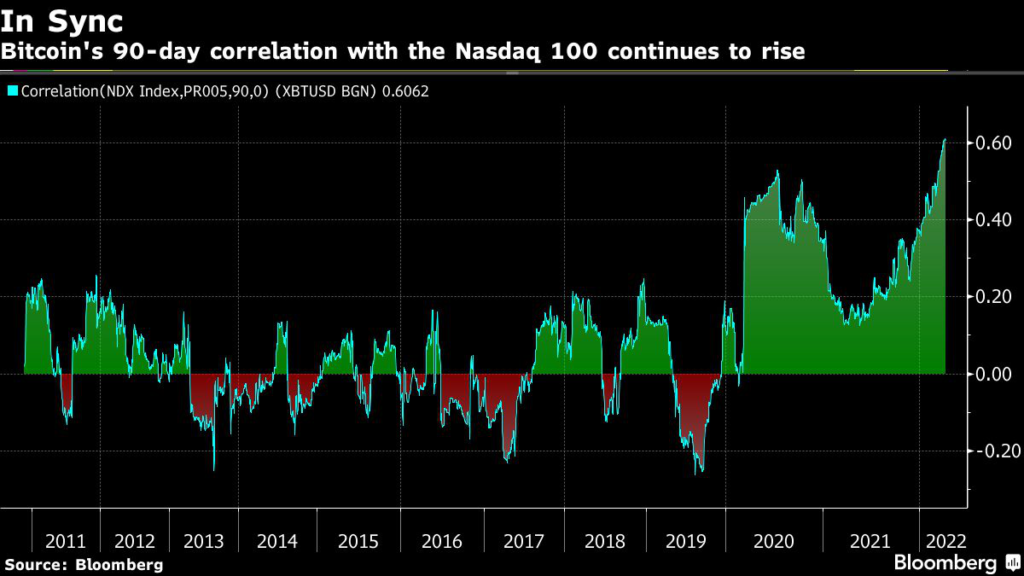
Bitcoin’s 90-day correlation with the Nasdaq 100 is at a record, undermining the token’s appeal as an instrument for diversification. The combination of weakening global growth and less accommodative central banks will weigh on tech stocks, and by extension, crypto, Hayes said. He acknowledged that his predictions for Bitcoin and Ether are mainly based on a “gut feeling.”

Crypto markets “will lead equities lower as we head into the downturn, and lead equities higher as we work our way out of it,” he wrote. “Bitcoin and Ether will bottom well before the Fed acts and U-turns its policy from tight to loose.”

Hayes, who is awaiting sentencing after he and fellow BitMEX co-founder Benjamin Delo admitted in February they failed to establish an anti-money-laundering program at the cryptocurrency exchange, has been sounding a cautious note on digital assets of late. 

“As we move into year end and 1Q 2022, I don’t see how we can take out Bitcoin at $69,000 or Ether at $5,000,” he wrote Dec. 10, following a sharp drop in both tokens over the previous month. “I can imagine, though, a muddle-through, sideways, boring market with small bouts of downside volatility followed by a tepid recovery.”

That prediction proved prescient, with Bitcoin spending most of this year mired in its tightest trading range since mid-2020. While crypto moved mostly sideways, bulls have pointed to accumulation by longer-term holders as a sign that digital assets were poised to break out of the rut. 

Bitcoin Breakout Is Making Proponents Wary of Another Fakeout

“There are many crypto market pundits who believe the worst is over,” Hayes wrote in his latest post. “I believe they ignore the inconvenient truth” that crypto prices are currently an indicator for the S&P 500 and Nasdaq 100, “and do not trade on the fundamentals of being peer-to-peer, decentralized, censorship-resistant digital networks designed for the transfer of money.”


More stories like this are available on bloomberg.com

©2022 Bloomberg L.P.
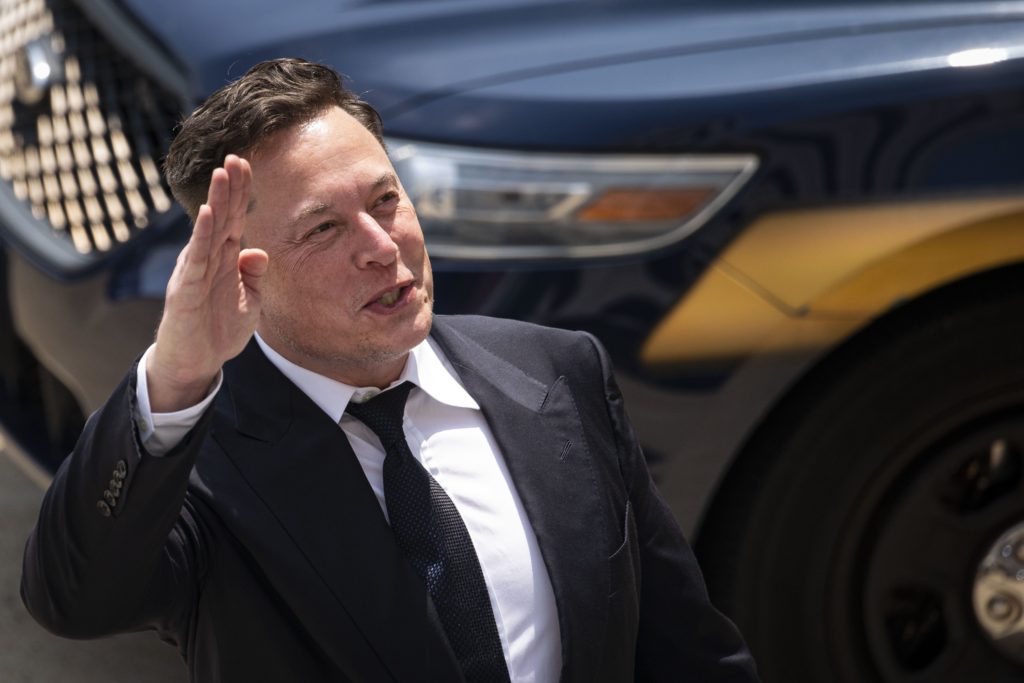
Musk Turns Down Twitter’s Offer to Join Its Board

(Bloomberg) — Twitter Inc. said Elon Musk has decided not to join its board, a stunning twist to a week-long saga that’s captivated the tech community and touched off renewed speculation about the company’s future.

Musk held “many discussions” with Twitter’s directors but the entrepreneur ultimately declined their offer to take a board seat, Chief Executive Officer Parag Agrawal tweeted. According to the CEO, Musk informed Twitter of his decision April 9, the same day he was slated to formally join the board.

“I believe this is for the best,” the Twitter CEO said in an internal memo shared late Sunday. “There will be distractions ahead, but our goals and priorities remain unchanged.”

The abrupt reversal ignites renewed speculation about Musk’s intentions for Twitter since disclosing he had taken a stake of just over 9% — becoming the social media giant’s largest individual shareholder. If he doesn’t join the board, Musk would not be subject to an agreement to keep his stake at no more than 14.9%.

The billionaire behind Tesla Inc. and SpaceX has been vocal about changes he’d consider at the social media platform. Musk wasted no time in appealing to users about prospective moves from turning Twitter’s San Francisco headquarters into a homeless shelter and adding an edit button for tweets, to granting automatic verification marks to premium users. Those open musings drew in even Amazon.com Inc. founder and space-faring rival Jeff Bezos, among other high-profile personalities.

Read more: Musk’s Idea for Twitter Homeless Shelter Wins Bezos Support

Musk posted a single emoji after the Twitter CEO’s explanation, a smiling face with a hand over its mouth.

Musk and Twitter executives had been expected to host a town-hall for employees this week, though it’s uncertain if that will proceed. Representatives for Musk and Twitter declined to comment.

Musk’s tweets have enthralled the social media sphere since the revelation of his stake. Twitter announced shortly after that the entrepreneur would be joining its board, spurring widespread debate. Several market-watchers tweeted that Musk may be staying off the board to avoid potential conflicts of interest in future — were he to consider increasing his stake of Twitter or acquiring it outright. 

Musk, CEO of automaker Tesla, is the world’s richest man, according to the Bloomberg Billionaires Index. He’s also one of the biggest personalities on Twitter and has regularly stirred controversy on the platform. 

The billionaire could face scrutiny from U.S. regulators by disclosing his massive stake days later than regulations allow, and because he revealed it in a filing typically reserved for passive investments. Ascending to Twitter’s board so swiftly after the disclosure could have complicated that process.

Musk is already seeking to exit a 2018 deal with the SEC that put controls in place related to his previous tweeting about Tesla.

Citing internal company messages, the Washington Post on Thursday reported that some workers in recent days have expressed concern on Twitter’s employee Slack channels that Musk could inflict damage to the company’s culture, as well as make it harder for people to do their jobs.

“Let’s tune out the noise, and stay focused on the work and what we’re building,” Agrawal said in his Sunday memo to employees.

(Updates with CEO’s comments from the fifth paragraph)

More stories like this are available on bloomberg.com

©2022 Bloomberg L.P.

Twitter Says Elon Musk Turned Down Offer to Join Its Board

(Bloomberg) — Twitter Inc. said Elon Musk has decided not to join its board, a stunning twist to a week-long saga that’s captivated the tech community and touched off renewed speculation about the company’s future.

Musk held “many discussions” with Twitter’s directors but the entrepreneur ultimately declined their offer to take a board seat, Chief Executive Officer Parag Agrawal tweeted. According to the CEO, Musk informed Twitter of his decision April 9, the same day he was slated to formally join the board.

“I believe this is for the best,” the Twitter CEO said in an internal memo shared late Sunday. “There will be distractions ahead, but our goals and priorities remain unchanged.”

The abrupt reversal ignites renewed speculation about Musk’s intentions for Twitter since disclosing he had taken a stake of just over 9% — becoming the social media giant’s largest individual shareholder. If he doesn’t join the board, Musk would not be subject to an agreement to keep his stake at no more than 14.9%.

The billionaire behind Tesla Inc. and SpaceX has been vocal about changes he’d consider at the social media platform. Musk wasted no time in appealing to users about prospective moves from turning Twitter’s San Francisco headquarters into a homeless shelter and adding an edit button for tweets, to granting automatic verification marks to premium users. Those open musings drew in even Amazon.com Inc. founder and space-faring rival Jeff Bezos, among other high-profile personalities.

Read more: Musk’s Idea for Twitter Homeless Shelter Wins Bezos Support

Musk posted a single emoji after the Twitter CEO’s explanation, a smiling face with a hand over its mouth.

Musk and Twitter executives had been expected to host a town-hall for employees this week, though it’s uncertain if that will proceed. Representatives for Musk and Twitter declined to comment.

Musk’s tweets have enthralled the social media sphere since the revelation of his stake. Twitter announced shortly after that the entrepreneur would be joining its board, spurring widespread debate. Several market-watchers tweeted that Musk may be staying off the board to avoid potential conflicts of interest in future — were he to consider increasing his stake of Twitter or acquiring it outright. 

Musk, CEO of automaker Tesla, is the world’s richest man, according to the Bloomberg Billionaires Index. He’s also one of the biggest personalities on Twitter and has regularly stirred controversy on the platform. 

The billionaire could face scrutiny from U.S. regulators by disclosing his massive stake days later than regulations allow, and because he revealed it in a filing typically reserved for passive investments. Ascending to Twitter’s board so swiftly after the disclosure could have complicated that process.

Musk is already seeking to exit a 2018 deal with the SEC that put controls in place related to his previous tweeting about Tesla.

Citing internal company messages, the Washington Post on Thursday reported that some workers in recent days have expressed concern on Twitter’s employee Slack channels that Musk could inflict damage to the company’s culture, as well as make it harder for people to do their jobs.

“Let’s tune out the noise, and stay focused on the work and what we’re building,” Agrawal said in his Sunday memo to employees.

(Updates with CEO’s comments from the fifth paragraph)

More stories like this are available on bloomberg.com

©2022 Bloomberg L.P.
Twitter CEO Says Elon Musk Decided Not to Join Board

(Bloomberg) — Tesla Inc. Chief Executive Officer Elon Musk’s board appointment to Twitter Inc. was to become officially effective April 9, but he “shared that same morning that he will no longer be joining the board,” Twitter CEO Parag Agrawal says in statement.

  • “I believe this is for the best”
  • “Elon is our biggest shareholder and we will remain open to his input”

Read more: Musk Gets Twitter Board Seat After Stake-Purchase Surprise

More stories like this are available on bloomberg.com

©2022 Bloomberg L.P.
China’s Covid Outbreak Worsens as New Shanghai Cases Top 26,000

(Bloomberg) — China’s largest documented outbreak continues to spread despite an extended lockdown of Shanghai’s 25 million people, weighing on a fragile economy and straining global supply chains.

There were 26,087 new daily infections reported in the Chinese financial hub on Sunday, an all-time high. Residents have been locked down for weeks now, with frustration building among the population as they struggle to get access to food and medical care. 

Elsewhere, the southern metropolis of Guangzhou is implementing a series of restrictions after local authorities warned the 20 cases they found in the latter part of last week could be the tip of the iceberg.


Infections and containment measures across China are causing an increasing drag on the world’s second-largest economy, with consequences for global growth, supply chains and inflation. 

Shanghai’s struggle with the virus means other local governments may become more sensitive to flare-ups and step up mobility controls even when cases are low, according to Tommy Xie, head of greater China research at Oversea-Chinese Banking Corp.

“The Chinese economy may have to brace for more short-term disruptions in the coming months,” Xie said in a note Monday. 

Economists now predict the economy will expand 5% this year, below the official target of around 5.5%. Analysts at Morgan Stanley have cut their growth forecasts this year on the lockdown impact, while Citigroup Inc. has warned of risks to growth in the second quarter.

China’s slowdown is already having a ripple effect across the region. Activity among Hong Kong’s private businesses slumped further into contraction in March, as lockdowns in mainland China weighed on new orders, according to the S&P Global purchasing managers’ index. Taiwan’s exports to China also decelerated in March from February. 

Containers are piling up at Shanghai, China’s biggest port, as the lockdown in the city has led to a shortage of trucks to clear imports.  It’s also disrupted business operations in the city, with companies like chip giant Semiconductor Manufacturing International Corp. struggling to secure trucks to ship out finished goods.

“China’s worst Covid outbreak may lead to delays and higher prices, which could stall recovery and further add to global inflation,” said Bruce Pang, head of macro and strategy research at China Renaissance Securities Hong Kong Ltd. 

The Shanghai Shipping Exchange Shanghai (Export) Containerized Freight Index, a measure of freight rates, has declined to 4,349 on April 1 from a peak of 5,110 in early January. The drop indicates an easing in exports, according to Pang.

In Shanghai, about 95% of the virus cases were among people already under isolation, data from the municipal government shows. The tally has climbed from 9,006 cases on April 3. 

The figures have surged despite the city’s move to lock down its population to curb transmission, starting with the eastern part — home to the financial district and numerous industrial parks —  on March 28. They were joined by residents in the west on April 1.

Guangzhou has shut schools until April 17 and will conduct mass-testing, while two districts have closed indoor entertainment venues. The city is also requiring people leaving to have a negative nucleic acid test result within 48 hours of departure.

Business disruptions are showing up in various indicators. Factory activity in China fell to its worst level since the pandemic’s onset two years ago in March, according to the Caixin Manufacturing Purchasing Managers’ Index, a private survey focusing on smaller export-oriented businesses. The official PMI also indicated a contraction in both manufacturing and services sectors in March.

Consumption is taking a toll as more residents stay home. Tourism revenue over the Qingming festival, the three-day national holiday last week, declined by 31% from last year to 18.8 billion yuan ($3 billion), according to official data. That’s equivalent to 39% of the pre-pandemic level in 2019, the Ministry of Culture and Tourism said. 

Data Monday showed a 10.9% plunge in vehicle sales in March from a year earlier, after a gain of 4.7% in February. The lockdowns have also pushed up vegetable prices, which surged 17.2% on year in March, compared to a drop of 0.1% in February. 

(Updates with details on economy starting from first paragraph.)

More stories like this are available on bloomberg.com

©2022 Bloomberg L.P.
Singapore’s Lee Warns U.S. Against Isolating China Over Ukraine

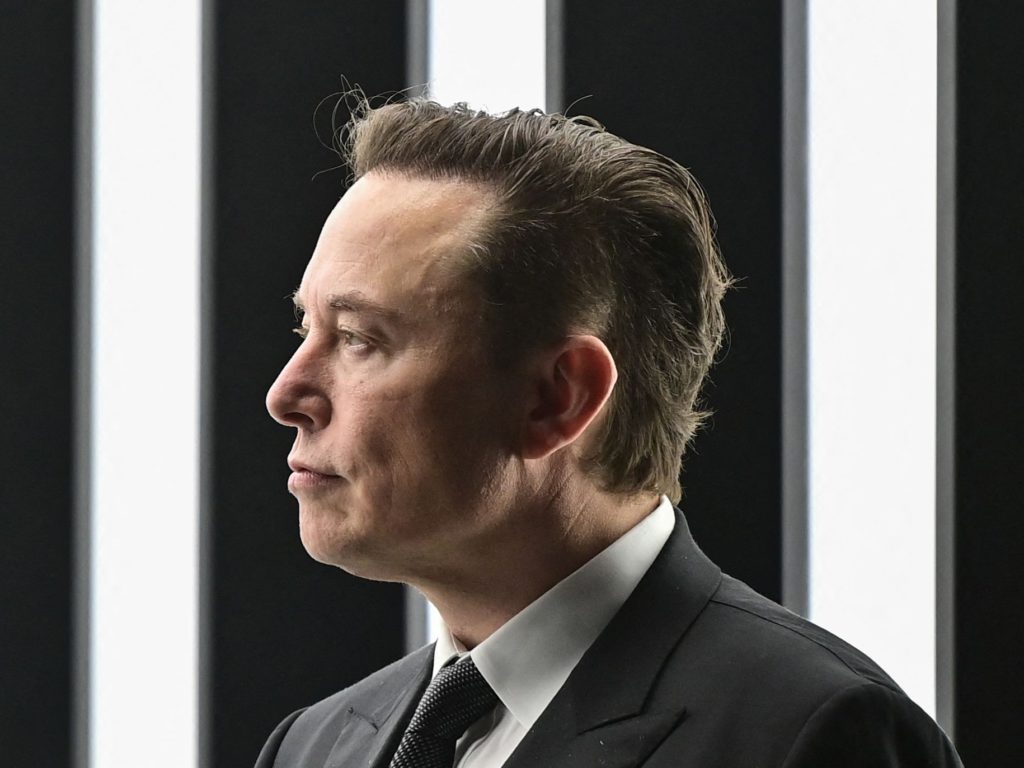
(Bloomberg) — Singapore Prime Minister Lee Hsien Loong warned the U.S. against isolating China over the war in Ukraine by framing it as a battle between democracies and autocracies, which would complicate an already fraught relationship between the two powers.

“You have to be very careful not to define the problem with Ukraine in such a way that automatically, China is already on the wrong side,” Lee said in comments published by his office on Sunday. 

“We all have a problem in Ukraine,” he continued. “I think if we talk about sovereignty, independence and territorial integrity, a lot of countries can come along. Even China would not object to that, and would actually privately strongly support that.”

Vladimir Putin’s war in Ukraine has tested ties between the U.S. and China already strained by a host of security and economic issues from Taiwan, to the South China Sea, telecommunications technology and trade. Asian nations like Singapore have long sought closer ties between the two in order to cooperate on other global issues like climate change and a response to the pandemic.

Still, China’s muted response to Russia’s invasion of Ukraine has hardened views within President Joe Biden’s administration that President Xi Jinping may be moving closer to supporting Moscow as the conflict continues. Lee previously said Russia’s invasion of Ukraine raises “awkward questions” for China because it violates Beijing’s closely-held principles of territorial integrity, sovereignty and non-interference.

“Already, things are difficult enough,” he said in the remarks published on Sunday. “There is very little trust on both sides. It is not so easy to find the right level empowered to engage so that you can tee up to reach rapprochement to reduce the tensions, gradually to build up trust, and to work toward accommodations which are necessary, if you are going to coexist with them.”

More stories like this are available on bloomberg.com

©2022 Bloomberg L.P.

Musk’s Idea for Twitter Homeless Shelter Wins Bezos Support

(Bloomberg) — Elon Musk floated the idea of turning Twitter Inc.’s headquarters into a homeless shelter, prompting a tweet of support from Amazon.com Inc. founder Jeff Bezos.  

The new Twitter board member on Saturday posted a poll on the idea, saying that “no one shows up anyway” — an apparent reference to the company’s policy to allow employees the option of working remotely — adding “I’m serious about this one.” The tweets come just days before he’s set to join Twitter Chief Executive Officer Parag Agrawal at a company meeting to address staff questions. 

Bezos, a fellow billionaire, responded Sunday with a link to a report about a homeless shelter attached to an Amazon office building, noting that a portion of Twitter’s space could be converted, making it easier for employees who want to volunteer. Musk called the suggestion a “great idea.”

People on Twitter weren’t sure whether to take Musk seriously. “Amazingly ridiculous idea,” one wrote.

The poll closed with 91% of people voting in favor of the shelter.

Homelessness is a particularly visible problem at Twitter’s headquarters, located in a part of San Francisco where residents have grappled with urban decay and drug addiction.

Over the weekend, Musk fired off a series of tweets suggesting that Twitter offer authentication checkmarks and zero ads for users that pay for premium features. 

After investor Michael Burry complained about losing his account’s authentication checkmark, the billionaire and new Twitter board member told Burry he’ll get it back and also suggested that the company give authentication checkmarks to all Twitter Blue users. 

Twitter’s monthly subscription service offers premium features such as some ad-free articles and the ability to retract a tweet before it’s visible to others and is available to users in the U.S., Canada, Australia and New Zealand. He ruminated on various ways to structure payments for the premium service, including perhaps with the cryptocurrency Dogecoin.

Read this next: Amazon’s Drone Delivery Program Is Hit by Crashes and Safety Concerns

Musk has already weighed in on the lack of an edit button as well as how little celebrities like Justin Bieber and Taylor Swift post on the social media network.  

Read more on how Twitter’s board will have to contend with Musk

(Updates with poll results in fifth paragraph)

More stories like this are available on bloomberg.com

©2022 Bloomberg L.P.

Bitcoin’s Correlation With Big Tech Increases to Record

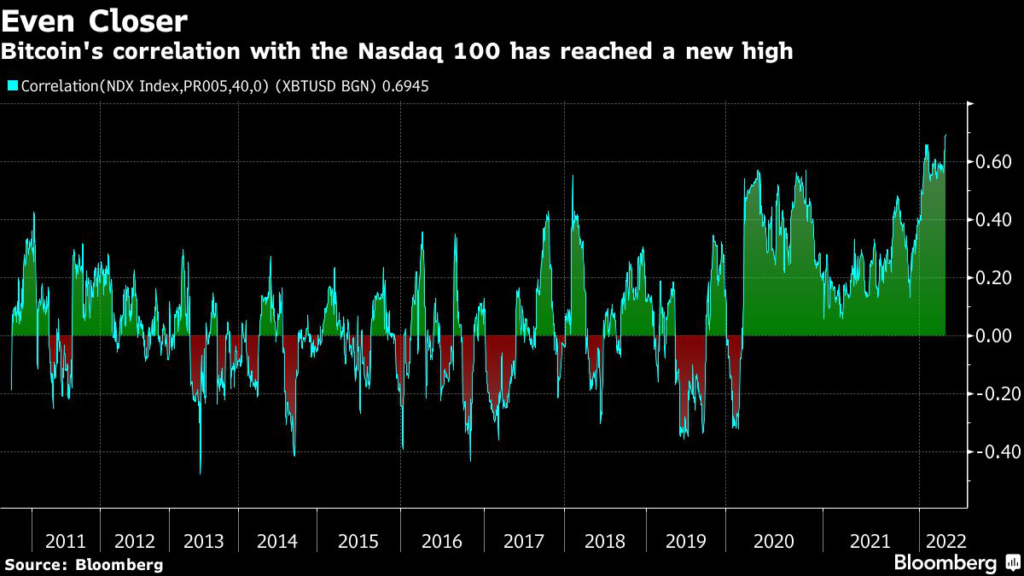
(Bloomberg) — Since the start of the pandemic, Bitcoin has tended to move in the same direction as the Nasdaq 100 index — and they’re now in unison more than ever. The 40-day correlation between the two reached a record of 0.6945 on Friday, Bloomberg data show. The increase further erodes the argument that Bitcoin works well as a diversifier, one that’s been help up by proponents as key to its appeal.

More stories like this are available on bloomberg.com

©2022 Bloomberg L.P.
Close Bitnami banner
Bitnami