
Bloomberg

Axie Owner Says Recovering Stolen Crypto Could Take Two Years

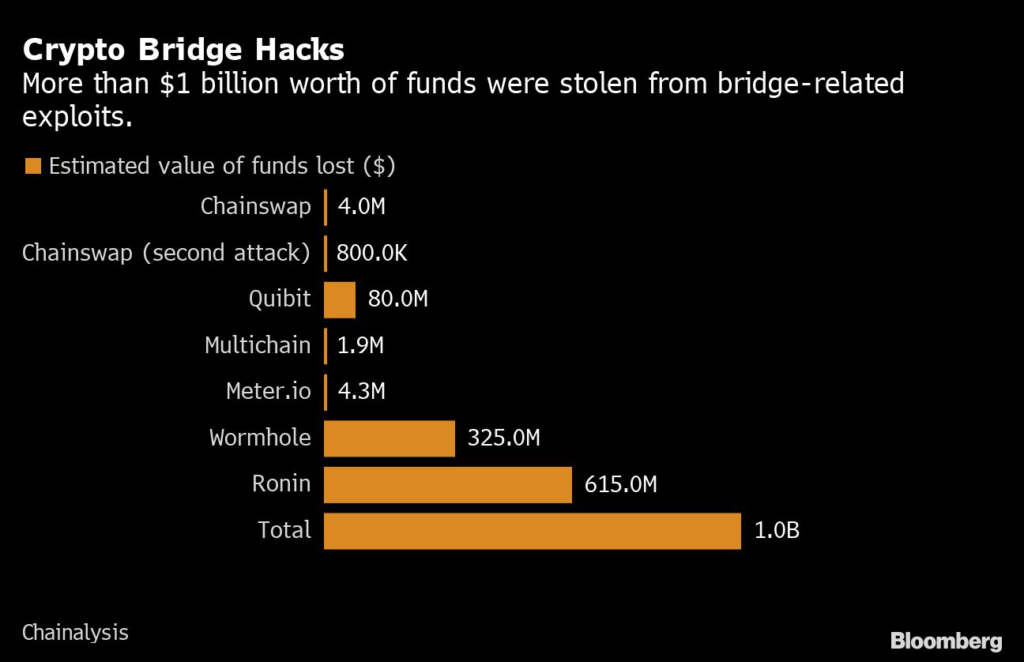
(Bloomberg) — The creator of the popular play-to-earn Axie Infinity crypto game said it expects to recover at least a portion of the roughly $600 million of cryptocurrencies hackers looted from a software system linked to the game, while acknowledging that it may be a lengthy process. 

“What we are assuming over the next two years is that some funds will be recovered,” Aleksander Leonard Larsen, chief operating officer of Ho Chi Minh-based Sky Mavis, said in an interview on Thursday. “Two years for Axie is a good time for us to get more information. We’re here to play the long game.” 

Sky Mavis is working with various law enforcement agencies to locate and recover the tokens — mostly Ether — that were siphoned off by hackers in late March from a blockchain “bridge” that allowed players to move crypto into and out of the virtual world, Larsen said. He declined to provide details on the investigation. 

Besides raising money from investors to make players who lost funds whole, Sky Mavis will also take a $450 million balance sheet hit to ensure all the stolen crypto is replenished. 

Blockchain data shows that the stolen Ether tokens were deposited into Ethereum wallets, and some of the haul was then moved to Tornado Cash, a service that helps users mask transactions. Tornado’s technology breaks the link between the sender and receiver’s addresses on transactions sent to the Ethereum blockchain. 

It’s “very rare” that funds stolen in large crypto hacks are fully recovered, according to Rishav Rai, lead investigator at Merkle Science, which specializes in crypto crime. At the same time, once a major hack has been discovered, it’s difficult for the perpetrators to liquidate their loot. 

Crypto mixers like Tornado aren’t typically built to built to handle volumes of this magnitude, and moving the tokens through various exchanges and wallets “is not only expensive but time-consuming, not to mention extremely conspicuous,” Rai said March 30. 

The hackers gained access to five computers known as validator “nodes,” which allowed them to drain software known as the Ronin Bridge of 173,600 Ether and 25.5 million USDC tokens — worth about a combined $600 million at currentg prices. To do so, they initially targeted a Sky Mavis employee in a so-called social engineering attack, Larsen said. 

“That person got access to our nodes through attacking one person on the team,” he said, without giving details. “The underlying technology for the Ronin network is still safe.” 

The company has said it doesn’t suspect any insider involvement in the hack. 

Users Flee

Sky Mavis has already moved to fully compensate gamers who lost money in the attack. It raised $150 million this week in a funding round led by Binance Holding Ltd. to finance reimbursing users. That deal was wrapped up within 48 hours, Larsen said, declining to comment on the valuation. 

To make up the difference and fully replenish the crypto drained in the hack, Sky Mavis is also using $450 million of its own money, Larsen said. The company remains in solid financial condition, he added. It has about $1.5 billion of cryptocurrencies in Axie Infinity’s treasury, where it parks fees paid by players for buying and minting the game’s blob-like NFT characters. It won’t tap the treasury funds to reimburse players. 

Sky Mavis also struck an agreement with Binance which allows gamers to deposit and withdraw crypto even as the Ronin Bridge remains suspended. To bolster defenses against future attacks, the number of validators required to sign off on withdrawals from the bridge has been raised to 21. 

Axie Infinity was losing users even before the hack. Data for the week ended March 28, a day before the theft was discovered, showed that the number had tumbled about 45% from a peak in November, to 1.48 million. Larsen attributed that largely to a steep drop in the value of the game’s rewards, which he said turned off players who participated purely to make money.

“This incident will plague us for a long time in the future, no doubt,” he said. “We feel like we failed to live up to the expectations of our users and we need to rebuild the trust. But I just think this is more as a lesson learned, and security needs will be a priority moving forward.”

More stories like this are available on bloomberg.com

©2022 Bloomberg L.P.
With WarnerMedia Merger Done, Discovery CEO Plots Changes

(Bloomberg) — Discovery Inc.’s merger with WarnerMedia was completed Friday, setting off a series of strategic moves that will reverberate through Hollywood in the form of job losses, marketing budgets and competitive threats.

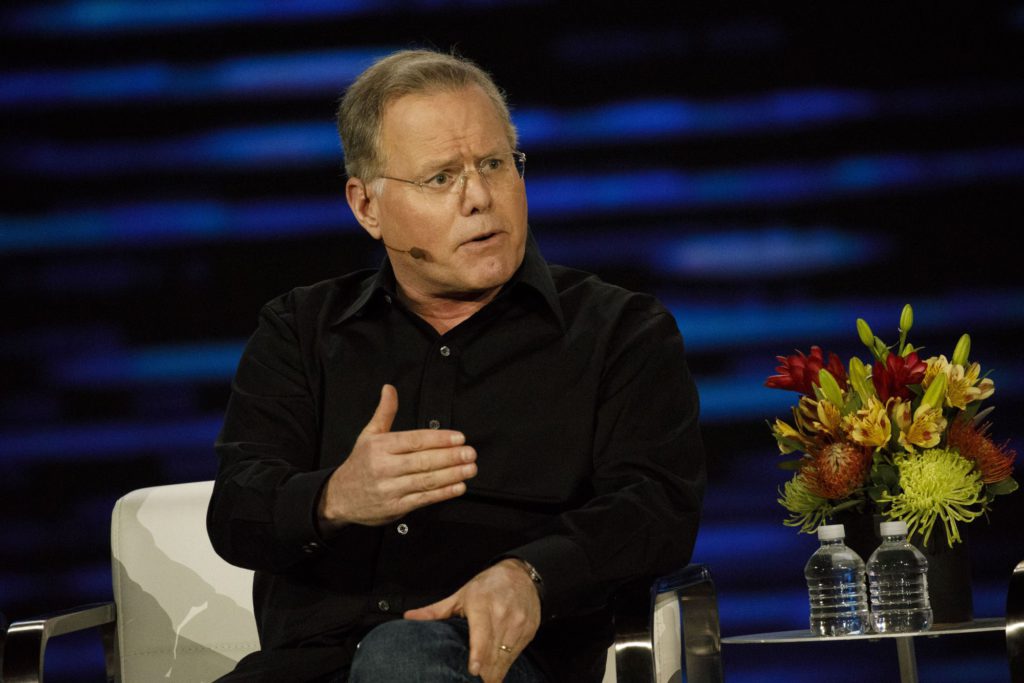
The merger with AT&T Inc.’s media division gives Discovery Chief Executive Officer David Zaslav control of a huge portfolio of assets, including the cable channels HBO, CNN and TBS, as well as the Warner Bros. film and TV studio. Combined, the new Warner Bros. Discovery Inc. will have projected revenue of $54 billion next year. Here are some of the decisions investors will likely hear about in coming weeks.

  • The company will hold its upfront presentation in May, revealing a combined brand strategy for advertisers. It will announce a new price for selling its two main streaming services, HBO Max and Discovery+, jointly as a bundle. Eventually the two will be combined, but that could be months away.
  • While the main leadership team was announced Thursday, one key role has not yet been filled. The company plans to announce a new head of its sports division, a role formerly held by Jeff Zucker, who resigned in February. The company will be a powerhouse in live sports, with broadcast rights to professional basketball, baseball and hockey in the U.S., the men’s college basketball tournament, and the Olympics in Europe, as well as cycling, tennis, motorsports and golf.
  • Discovery has promised $3 billion in cost synergies that will help reduce the company’s debt load. Much of those savings are expected to come through layoffs in areas like ad sales, engineering, corporate finance and legal. Employees at HBO and Warner Bros. are expected to mostly be spared.

Zaslav, 62, will embark on a listening tour next week that will have him meeting with employees in New York, Washington, D.C., Atlanta and Los Angeles.


For years the executive plotted and planned a major media deal. He kept a list of takeover targets and strategized with top lieutenants. Discovery, best-known for its nature shows and cable TV networks like Animal Planet, was going to have to get a whole lot bigger if it was going to compete with entertainment giants like Walt Disney Co., Comcast Corp., and Netflix Inc.

As part of the agreement, AT&T is distributing shares amounting to 71% of the new company to its shareholders. Zaslav, with input from Discovery investor and board member John Malone, will have a largely free rein to run the business the way he wants.


(Updates with closing of deal in first paragraph.)

More stories like this are available on bloomberg.com

©2022 Bloomberg L.P.
Amazon Appeals Union’s Historic New York Election Victory

(Bloomberg) — Amazon.com Inc. sought to overturn the results of an historic union election victory in New York, saying a labor board violated its rules in such a way that it implied a government endorsement of upstart labor group. 

In a filing to the National Labor Relations Board on Friday, the Seattle-based company said the agency repeatedly “failed to protect the integrity and neutrality of its procedures” by turning away voters and allowing media and union representatives to stay too close to the voting area, among other objections. The Amazon Labor Union likely didn’t meet the threshold of employee signatures to compel a vote in the first place, Amazon said in its filing, which outlined 25 objections to the election. 

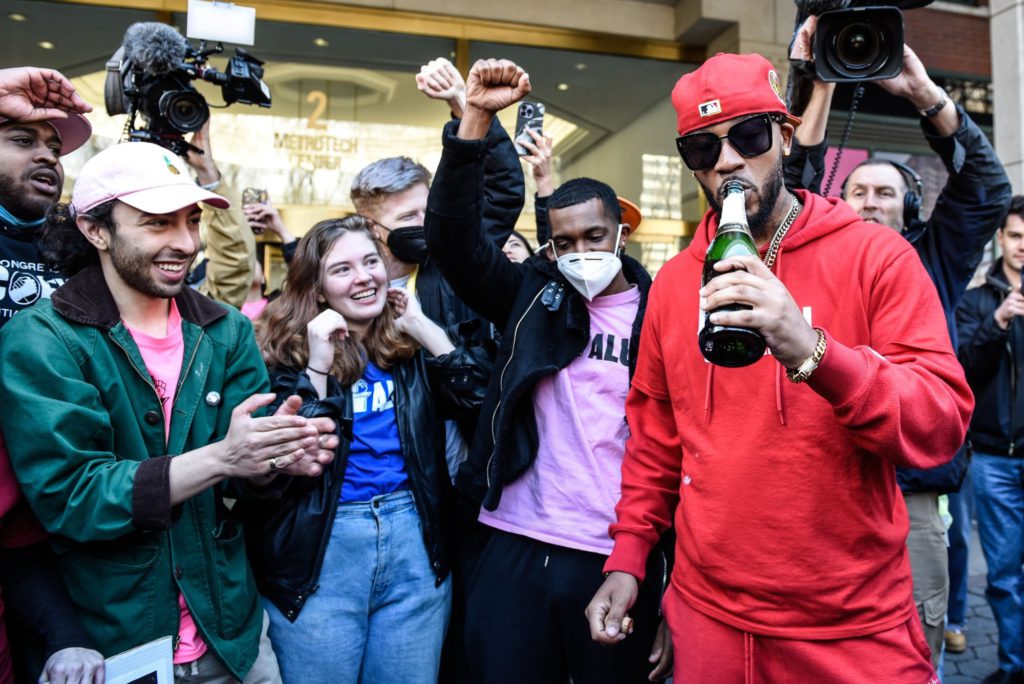
In a surprise result, workers at Amazon’s JFK8 fulfillment center in Staten Island last week voted to be represented by the ALU, a grassroots group founded by fired Amazon employee Christian Smalls. The ALU won a decisive victory, with 2,654 yes votes to 2,131 nos.

Unless the result is overturned, Amazon will be required to start contract negotiations that may hamper its ability to adjust work requirements and scheduling on the fly. 

The company’s appeal was widely expected. Amazon had previously telegraphed that Smalls and his allies could expect a lengthy legal battle and warned that it would target what the company called “inappropriate and undue influence by the NLRB.” 

Amazon cited accusations by business groups that the NLRB tried to influence the election’s outcome by filing a lawsuit seeking the reinstatement of an employee activist Amazon allegedly fired illegally. The company has denied wrongdoing. 

The labor board is unlikely to grant Amazon’s petition, labor experts said, but the company could keep fighting the issue in federal court and tie up the ALU in legal wrangling for months or years.

An ALU representative couldn’t be reached for comment.

Amazon earlier this week was granted an extension of its deadline to provide evidence to back the claims made in Friday’s filing. That document is due April 22, the labor board said this week. 

“We’ve always said that we want our employees to have their voices heard, and in this case, that didn’t happen — fewer than a third of the employees at the site voted for the union, and overall turnout was unusually low,” Amazon spokesperson Kelly Nantel said Friday in a statement. “Based on the evidence we’ve seen so far, as set out in our objections, we believe that the actions of the NLRB and the ALU improperly suppressed and influenced the vote, and we think the election should be conducted again so that a fair and broadly representative vote can be had.” 

More stories like this are available on bloomberg.com

©2022 Bloomberg L.P.
Tesla’s ‘Cyber Rodeo’ Was a Recruiting Event in a Party Hat

(Bloomberg) — Tesla Inc.’s Cyber Rodeo was a star-studded bash that was part marketing, part sales, and a whole lot of spectacle. But the party also had a more conventional, less glamorous purpose: showing off the company to the types of workers it’s desperate to hire.

Tesla has said it will need to find 20,000 workers for its factory outside of Austin, everything from manufacturing talent to mechanical and software engineers. That could be a daunting task in Central Texas, where a sub-3% unemployment rate amid a surge of corporate expansions and relocations in the area has driven up demand for skilled workers.

Yael Lawson, chief operations officer at Workforce Solutions Capital Area in Austin saw the event as “a useful recruiting tool.” She said that Tesla coming to town has garnered more attention for the manufacturing industry, helping her showcase her company’s scholarships and training.

Read more: Musk Says Tesla Cybertruck, Roadster and Semi Coming Next Year

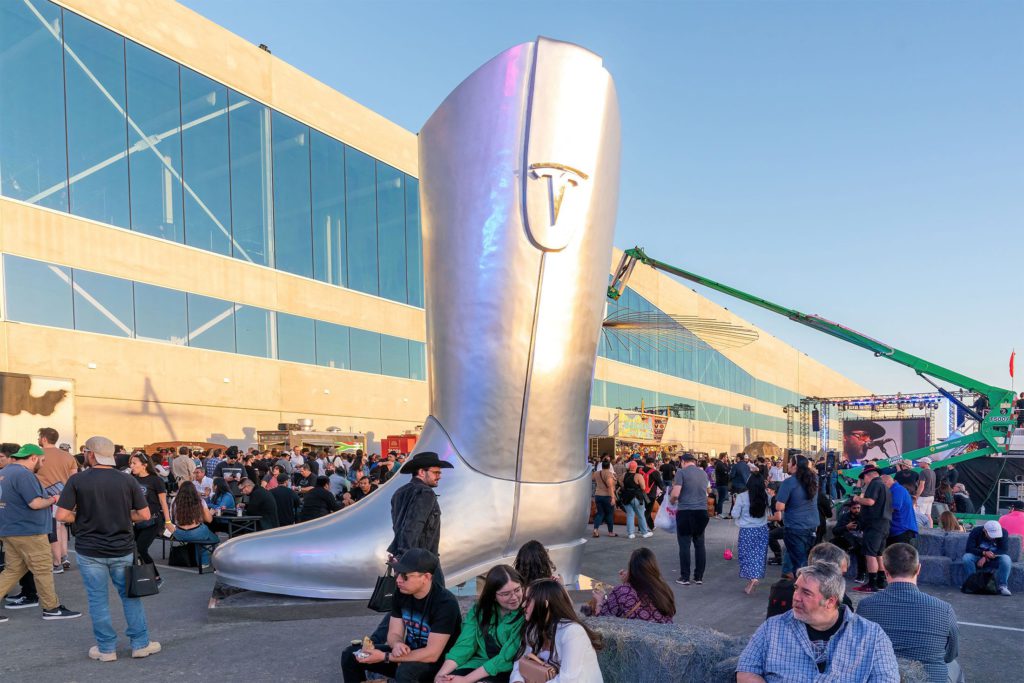
Of course, hiring wasn’t the focus of the party. There was also live music, a petting zoo and roller skaters in cowboy hats, turning the factory that’s three times the size of the Pentagon into something more like a carnival. Dust from a nearby construction site blew toward the factory, reminiscent of the fine white chalk of Nevada’s annual Burning Man festival.

A bulk of the party-goers were Tesla workers, many of whom brought along friends and family. Employees of SpaceX and The Boring Company, clad in branded hats and shirts, helped fill out the ranks. But throughout the event, it was clear that recruiting was also at the forefront.

At least nine representatives from Austin Community College, which has partnered with Tesla since 2020, were also in attendance. Tesla and ACC are developing “cutting-edge training programs that prepare students for careers in manufacturing — one of the region’s fastest-growing industries,” a spokesperson for the school said in an email. 

The local school district, Del Valle ISD, counted board members, its superintendent, and its workforce development team among the attendees.

“Students have many choices in a variety of industries at our schools, Tesla adds one more piece to this,” said communications director Christopher Weddle. “We continually work to build relationships with local businesses and industry areas for the benefit of our students.”

Weaving through the heavy machinery, art installations, and the beer and wine stands (where IDs were checked), local engineering students stared in awe at cutaways of the Model Y and stacks of the new 4680 battery cells. Most imposing was the company’s so-called “Giga Press,” the largest die-casting machine in the world, used to create an SUV frame out of just two solid pieces of metal.

There was no shortage of things to do and sights to see. The food truck choices ranged from South African, halal, and of course, tacos and BBQ. You could pet some baby goats, take in the art installations and the massive Tesla coils, or win some stuffed animals from various carnival games.

There was hard seltzer and cider on hand to help pass the time in the long lines at the merchandise tables, where swaths of people queued up for a chance to buy items like a Tesla hoodie ($90), Cyber Rodeo T-Shirt ($35) or trucker hat ($30), or a branding iron with a Tesla logo ($50).

Being a Cyber Rodeo, there were of course multiple mechanical bulls for riding, and — earlier in the day — a real one, too: Bevo, the live mascot for the University of Texas at Austin.

Music blared from multiple stages, including one above the factory’s main entrance where Austin’s own Gary Clark, Jr. performed a set. Below, the company’s assembly robots clicked and whirred along to their own beat under actual spotlights, miming the moves they’ll make when cars are built inside the factory. It was a dramatic flair, like something out of the Walt Disney playbook. 

As an ad for the business, there were unsurprisingly some details left out, like Tesla’s history of dealing with claims of harassment and racism at its factories. In October, the company was hit with a $137 million penalty as the result of a discrimination lawsuit brought by a former worker at Tesla’s Fremont, California factory. Tesla has asked for the penalty to be reduced, and a judge said in January it was “extremely high.”

CEO Elon Musk instead focused on the future. He said he believes the Austin factory could make 1 million cars per year (including the Cybertruck and other models), and guessed that Tesla could make up around 20% of the global automotive market some day. Musk also lavished  attention on the company’s as-yet-unrealized efforts to develop fully autonomous vehicles, as well as a humanoid robot that he’s said could be Tesla’s “most important product” one day.

These are all high bars, and he will need an army to reach them. But after the Cyber Rodeo, and Tesla’s overall charm offensive in Austin, Musk may have convinced more locals to join the ranks.

Ed Latson, executive director of the Austin Regional Manufacturers Association, said the event was “exemplary of the energy and excitement around the brand, locally and globally. They do a good job leveraging that enthusiasm in their marketing but also in their recruiting of talent which is so critical to their success.”

As Musk put it after walking the raucous crowd through a half-hour presentation about his company’s history, and its future goals: “Here at Tesla, we believe in throwing great parties.”

More stories like this are available on bloomberg.com

©2022 Bloomberg L.P.

Canada’s First Female Bank CEO Leads With Young Self in Mind

(Bloomberg) — In her 17 months as Laurentian Bank of Canada’s chief executive officer, Rania Llewellyn has seen about a third of the company’s 3,000-person workforce turn over.

She sees that upheaval not as a problem but a chance to rebuild the long-troubled bank anew. If she pulls off a turnaround at Laurentian — a minnow in an industry dominated by a six-firm oligopoly — that would mark just the latest noteworthy turn in a career that has defied much of the traditional Canadian banking blueprint.

Llewellyn is staking Laurentian’s comeback on a departure from the orthodoxies of larger rivals. She has committed to a work-from-home-first model in the Covid-19 era and cut the firm’s office space in half, has ruled out lending to oil and gas companies, and is focused on diversity and inclusion efforts so that talented women, minorities and immigrants face an easier climb than she did. 

That’s a responsibility that looms large in her thinking. Her appointment as the first female CEO of a publicly traded Canadian bank has prompted support from women and others who rarely see people like themselves in the industry’s top ranks.

“I’m building the bank that I’ve always wanted to work for,” Llewellyn said in an interview at Bloomberg’s Toronto offices Thursday. “I feel like my years of experience really prepared me for that opportunity in terms of the extra pressure.”

Llewellyn, 46, was born in Kuwait to an Egyptian father and Jordanian mother, and immigrated to Canada from Egypt in 1992. She got her start in banking as a part-time teller at Bank of Nova Scotia after graduating from college and finding herself unable to land a professional role — something she’s attributed partly to a lack of connections in Canada and foreign-sounding maiden name.

She landed her first management position at the company after meeting Scotiabank’s senior vice president for the Atlantic region at her citizenship ceremony and pressing him for a new job over the coming weeks. She ended up spending more than two decades at Scotiabank, holding roles as varied as head of global business payments, CEO of the Roynat Capital commercial-banking unit, head of multicultural banking and senior vice president for commercial banking and growth strategy.

Her projects along that path included developing the infrastructure and power-industry team in capital markets, and helping finance a nuclear-power plant in Ontario.

Now that she’s head of Laurentian, which has corporate offices in Montreal and Toronto, she wants to see her managers appointing women to lead large, complex books of business where they can demonstrate their ability to drive revenue for the bank and their bosses can “see them in action,” Llewellyn said. 

“Let’s give them the juicy projects,” she said.

Even before her appointment, Laurentian had already set itself apart by not requiring Canadian experience for new hires, giving immigrants an easier start in the industry. Llewellyn said she wants to build on that reputation, which could be a significant advantage in Canada, where there’s a broad political consensus that attracting skilled newcomers should be central to the country’s economic strategy.

Across Laurentian’s workforce, Llewellyn is also turning to some unconventional benefits. For Laurentian’s 175th anniversary last year, employees were allowed a day off on their birthday. On top of that, the bank gave staffers half a day off on four Fridays during Canada’s short summer season. The extra time off was so well-received that the bank is extending the program, Llewellyn said.

Board Presentations

Llewellyn tells even some of Laurentian’s more junior recruits that the firm’s relatively small size means they’ll have opportunities — like presenting projects directly to the board — that they wouldn’t have elsewhere. Such perks can help set cost-conscious Laurentian apart in instances where it can’t match the salaries larger rivals offer.

“You can leave your mark on this institution and be part of the success,” she said. “You can’t just boil it down to salary. People leave not because of salary. Salary has to obviously be competitive, but it is not the only deciding factor.”

Among the staff departures that have occurred since Llewellyn took the reins, “some were voluntary, and some were involuntary, because when new leadership comes in, a lot of them say, ‘You know what, I’m out.’ And that’s OK,” she said. The bank also cut some jobs, announcing in December that it had trimmed 64 positions and booked C$9 million in severance charges as part of its plan to simplify the organizational structure.

“I took the opportunity to flatten the organization,” Llewellyn said Thursday.

While her changes have helped Laurentian’s employee-engagement scores, which could pay off in the longer term, investors are beginning to look for more immediate progress on Laurentian’s income statement, starting with its personal-banking business.

Under Llewellyn, Laurentian introduced its first mobile-banking app after just seven months of development and is rolling out tap payments on debit cards, rectifying two major gaps in its offerings. The bank is working on cutting down the time it takes to approve customers’ mortgage applications and speeding up the process to sign up for new credit cards and deposit accounts.

Topping Estimates

The plan is gaining some traction. The bank has beaten analysts’ estimates in every quarter Llewellyn has been CEO after missing projections in eight of the 11 quarters before she took over. And the bank’s shares are up 57% since she took over, the fourth-best performance in the eight-company S&P/TSX Commercial Banks Index, an improvement from last place in the prior 12 months.

Beyond the concrete moves, Llewellyn points to culture as a driving force in the improvement so far. That has included a cost-conscious mindset, the breaking down of silos and implementing a more-casual atmosphere, with employees not expected to wear ties unless they’re meeting clients who will be similarly dressed, she said. Those moves would be harder to make at one of Laurentian’s larger Bay Street competitors.

“The culture was more that our size was a detractor versus my opinion where size is our advantage,” Llewellyn said. “At the end of the day, culture and the tone starts from the top.”

(Updates share move in 19th paragraph. A previous version of this story corrected the number of new summer holidays in paragraph 12.)

More stories like this are available on bloomberg.com

©2022 Bloomberg L.P.
Former Citigroup Executives Seek $100 Million for Crypto Hedge Funds

(Bloomberg) — A trio of former Citigroup Inc. executives who left the bank last month have formed Motus Capital Management, a firm that wants to make it easier for high-net-worth individuals to bet on cryptocurrencies.

Alex Kriete, Greg Girasole and Frank Cavallo are seeking to raise $100 million for a pair of actively managed hedge funds that will focus on digital assets, the three said in interviews. They are each founding partners of Motus, the Latin term that’s the origin of the word “motor.”

“Clients are hungry for returns,” Kriete said. “They’re wanting exposure, but they have a hard time telling what’s scammy and what are real investment opportunities.”

Kriete and Girasole made waves last month when they left Citigroup less than a year after being picked to oversee a new digital-assets group inside the Wall Street giant’s wealth-management division. Before that, Kriete managed $3 billion and Girasole $5 billion for Citigroup private-bank clients. Cavallo was most recently an investment counselor at Citigroup, where he oversaw $8 billion of assets and held roles inside the firm’s cross-asset sales and trading division. 

The three will invest their own wealth in the Motus funds, they said in the interviews. The funds will not self-custody — meaning they won’t hold control of the private keys for their digital assets — and will limit the assets they hold with exchanges as part of their efforts to satisfy due-diligence processes with sophisticated investors.

“We are working with best-in-class providers to meet the fiduciary standard our clients expect,” Girasole said. 

New York-based Motus intends to offer both growth and income funds. The growth fund will focus on investing in tokens with smaller market capitalizations that larger funds find it harder to invest in, Cavallo said. 

“We think we hit the sweet spot,” he said. “With assets like Bitcoin and ETH, clients can do that on their own. They don’t need to pay someone to buy Bitcoin.”

Nascent Sector

Crypto hedge funds are a nascent part of the broader asset-management industry. Globally, such funds have about $3.8 billion in assets under management, according to a report by PwC. Less than half of all crypto hedge funds have assets under management of more than $20 million, PwC found.

Cavallo, Girasole and Kriete are part of a growing exodus from New York-based Citigroup for the world of cryptocurrencies. 

Matt Zhang, who was co-head of Citigroup’s structured-products trading and solutions division, left in October to start a fund that trades digital assets and makes venture investments in crypto companies, while Christopher Perkins, the former co-head of Citigroup’s futures, clearing and foreign-exchange prime-brokerage businesses, was hired in August as a managing partner and president by CoinFund, a blockchain-focused investment firm. Sabrina Wilson, former co-head alongside Perkins, was named chief operating officer of Copper, which offers custody and prime-brokerage services for digital assets.

More stories like this are available on bloomberg.com

©2022 Bloomberg L.P.

Tesla May Start Mining Lithium as Musk Cites Battery Metal Cost

(Bloomberg) — Nearly two years after Tesla Inc. outlined a plan to start mining for lithium, its chief Elon Musk signaled the electric car giant might finally take the plunge due to the skyrocketing cost of the battery metal.

Lithium hasn’t been spared from the turmoil gripping commodities in the wake of Russia’s war on Ukraine. Even before the war, prices of raw materials rallied with demand surging and supplies choked up due to pandemic-triggered supply chain woes. An index of global lithium prices compiled by Benchmark Mineral Intelligence has surged almost 490% in the past year. China worries about the price of lithium so much that the government summoned a number of market participants for two days of talks in March that were focused on halting a breakneck run-up in prices.

Lithium is a key component in electric vehicle batteries and so automakers are racing to secure supplies, expecting surge in demand amid a global push for the electrification of transportation. Tesla has signed supply deals with producers of battery metals in the past couple of years, including one with mining giant Vale SA.

In the wake of the price rally in lithium, China is already telling its EV battery supply chain that it wants lithium prices to return to sustainable levels as soaring prices have increased cost inflation for manufacturers and threatened to eventually hurt consumer demand.

Read: Tesla Dodges Nickel Crisis With Secret Deal to Get Supplies

More stories like this are available on bloomberg.com

©2022 Bloomberg L.P.
Tech Rally Snuffed Out With Traders Gripped by Recession Angst

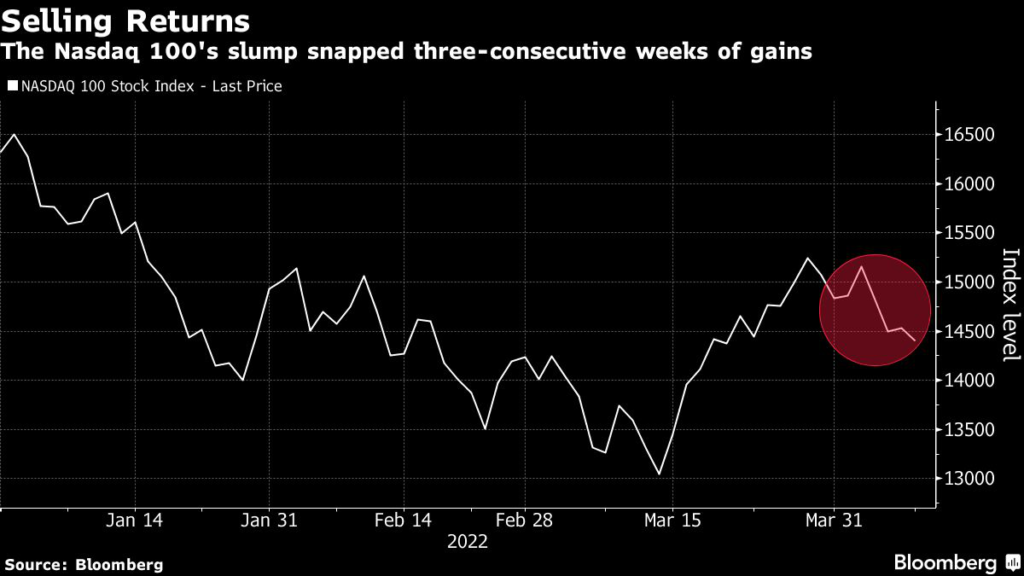
(Bloomberg) — A three-week rally for technology stocks came to a halt as investors retreated from the sector, spooked by hawkish commentary from the Federal Reserve that fanned fears of a recession.

The Nasdaq 100 Stock Index slid 3.6%, putting an end to the longest weekly winning streak since November. Chipmaker Nvidia Corp. and software company Datadog Inc. each dropped more than 10%, while megacaps like Amazon.com Inc. and Alphabet Inc. sank more than 4%.

“What we saw this week is people saying, ‘Well the probability of a recession is too high for me and I’m selling,’” said Bob Doll, chief investment officer at Crossmark Global Investments. 

The risk-off mood took hold on Tuesday when Federal Reserve Governor Lael Brainard suggested the central bank will rapidly reduce its bond holdings, which sent the 10-year Treasury yield up more than 30 basis points this week. Coupled with high energy prices, Covid-19 lockdowns in China and the war in Ukraine, investors sought cover in defensive sectors such as utilities and consumer staples at the expense of growth stocks.  

Up until this week, investors had been piling back into technology stocks as they viewed equities as an inflation hedge amid a bond rout. At the end of last week, the Nasdaq 100 had rallied 16% from a March 14 low.

READ: Tech Goes From Haven to Hazard as Investors Fear Recession

Chip stocks, seen as a barometer of economic growth since their products are critical in a broad range of industries, were among the hardest hit this week. The Philadelphia semiconductor index sank 7.3% in its worst week since January. 

In the coming days investors will be looking to inflation data, remarks by Fed officials and the start of the first-quarter earnings season that JPMorgan Chase & Co. will kick off on Wednesday.

Crossmark’s Doll views the odds of a recession as low with consumers flush with cash and a large amount of stimulus still in the economy. However, he is cautious about this reporting season.

“We need decent earnings to keep this market from going down,” he said in an interview. “We’re unlikely to get the kind of beats we got used to and spoiled with in 2021.”

More stories like this are available on bloomberg.com

©2022 Bloomberg L.P.

Block Nears Launch of New iPad System With Tap-to-Pay Reader

(Bloomberg) — Block Inc., the payments company formerly known as Square, is nearing the launch of a new iPad-based stand, refining a piece of equipment that’s become a common sight at coffee shops and retail stores.

A color image of a third-generation Square Stand, which lets merchants accept payments, was found this week hidden inside of the company’s point-of-sale app by developer Steve Moser and shared with Bloomberg. The stand, first reported by Bloomberg last year, is a major upgrade to the current model as it integrates both the physical credit-card reader and a tap-to-pay reader into the device for the first time.

By integrating the credit-card readers into the stand itself, the technology will simplify the process for merchants because they won’t be required to attach an external credit-card reader. 

A release date for the new stand couldn’t be learned, but the presence of an actual image of the device implies that a launch may be nearing. A Block spokeswoman didn’t respond to requests for comment. 

Square’s stand currently costs $169 and is one of the company’s highest-profile products. Whenever consumers swipe, dip or tap their cards at checkout, Square gets a commission representing 2.6% of a transaction’s price, plus 10 cents.

More stories like this are available on bloomberg.com

©2022 Bloomberg L.P.

Tesla to Partner With Block to Mine Bitcoin at Texas Site

(Bloomberg) — Jack Dorsey’s Block Inc. and crypto firm Blockstream Corp. are working together to build a Bitcoin mining farm with Tesla Inc.’s solar-powered battery in Texas. 

The mining farm will tap into Tesla’s energy storage technology with rechargeable large-scale batteries at the site, Adam Back, chief executive of Blockstream, said at the Bitcoin Conference 2022 in Miami. Back didn’t specify the location.

The venture is the latest manifestation of the aligning interests of Tesla Chief Executive Elon Musk and Twitter co-founder Dorsey, including over the energy usage of Bitcoin. Earlier this week, Dorsey said he was happy that Musk joined the board of directors of Twitter after Musk revealed his sizable stake in the social media giant. 

Musk expressed his interest in Bitcoin and Dogecoin early last year and allowed Tesla customers to buy the electric cars with Bitcoin, helping to send the crypto market to record highs. However, the carmaker later suspended the Bitcoin payment opening citing environmental concerns over Bitcoin mining. 

Shares of Tesla fell 2.1%, while dropped 1.4%. Blockstream is a private company.

The latest move comes after Block, which is formerly known as digital payment company Square, secured a purchase from Intel Corp.’s Bitcoin mining chip. Buyers of the chip can potentially either make their own mining rigs or receive an assembled machine from the chipmaker. 

Dorsey revealed the plan to decentralize Bitcoin mining and make the token’s network more secure with Block earlier this year. 

In the meanwhile, Dorsey has fully embraced the largest cryptocurrency by including Bitcoin micropayment Lightening Network in Twitter’s tipping function and launching the NFT profile function. He has funded Bitcoin developers and planned to decentralize Bitcoin mining.

Tesla’s first-quarter filing disclosed the company held $2.48 billion in Bitcoin as of March 31. Bitcoin revenue contributed to over half of the total net revenue of Block’s Cash App, a separate filing showed. 

The central and western parts of Texas are among the regions with rich wind and solar power resources. Bitcoin miners have flocked to the region, set up mines or expand transmission capacity in the past year.  

A Tesla subsidiary registered as Gambit Energy Storage LLC is building a more than 100 megawatt energy storage project in Angleton, Texas, a town roughly 40 miles (64 kilometers) south of Houston.

(Adds shares prices. An earlier version was corrected to clarify that the site isn’t a Tesla facility.)

More stories like this are available on bloomberg.com

©2022 Bloomberg L.P.

Close Bitnami banner
Bitnami