Bloomberg

Block, Blockstream Join Tesla to Mine Bitcoin in Texas

(Bloomberg) — Jack Dorsey’s Block Inc. and crypto firm Blockstream Corp. are working together to build a Bitcoin mining farm with Tesla Inc.’s solar-powered battery in Texas. 

The mining farm will tap into Tesla’s energy storage technology with rechargeable large-scale batteries at the site, Adam Back, chief executive of Blockstream, said at the Bitcoin Conference 2022 in Miami. Back didn’t specify the location.

The venture is the latest manifestation of the aligning interests of Tesla Chief Executive Elon Musk and Twitter co-founder Dorsey, including over the energy usage of Bitcoin. Earlier this week, Dorsey said he was happy that Musk joined the board of directors of Twitter after Musk revealed his sizable stake in the social media giant. 

Musk expressed his interest in Bitcoin and Dogecoin early last year and allowed Tesla customers to buy the electric cars with Bitcoin, helping to send the crypto market to record highs. However, the carmaker later suspended the Bitcoin payment opening citing environmental concerns over Bitcoin mining. 

Shares of Tesla fell 2.1%, while dropped 1.4%. Blockstream is a private company.

The latest move comes after Block, which is formerly known as digital payment company Square, secured a purchase from Intel Corp.’s Bitcoin mining chip. Buyers of the chip can potentially either make their own mining rigs or receive an assembled machine from the chipmaker. 

Dorsey revealed the plan to decentralize Bitcoin mining and make the token’s network more secure with Block earlier this year. 

In the meanwhile, Dorsey has fully embraced the largest cryptocurrency by including Bitcoin micropayment Lightening Network in Twitter’s tipping function and launching the NFT profile function. He has funded Bitcoin developers and planned to decentralize Bitcoin mining.

Tesla’s first-quarter filing disclosed the company held $2.48 billion in Bitcoin as of March 31. Bitcoin revenue contributed to over half of the total net revenue of Block’s Cash App, a separate filing showed. 

The central and western parts of Texas are among the regions with rich wind and solar power resources. Bitcoin miners have flocked to the region, set up mines or expand transmission capacity in the past year.  

A Tesla subsidiary registered as Gambit Energy Storage LLC is building a more than 100 megawatt energy storage project in Angleton, Texas, a town roughly 40 miles (64 kilometers) south of Houston.

(Adds shares prices. An earlier version was corrected to clarify that the site isn’t a Tesla facility.)

More stories like this are available on bloomberg.com

©2022 Bloomberg L.P.

Elon Musk Promises to Bring Even More Drama to Twitter Board

(Bloomberg) — In Silicon Valley, where board seats at public companies rarely trade hands, Twitter Inc. is the unruly exception. The social network has rotated through waves of directors in recent years as it dealt with slowing growth, executive turnover, contentious activist investors and unending political strife.

Now the board has Elon Musk. 

Over the last few months, the world’s wealthiest person went from being one of the loudest voices on Twitter to the company’s largest shareholder and board member. That transition has left employees and analysts guessing about Musk’s plans for the $37 billion company. It also puts a spotlight on Twitter’s mostly quiet board, which will now have to contend with the mercurial celebrity businessman. 

“He’s launched rockets into space. And helped solve the world’s energy crisis,” said Matt Navarra, social media consultant and industry analyst. “He’s about to discover tackling content moderation on social media platforms is harder than both those things.” 

Musk will be an unusual addition to the Twitter board. He isn’t an expert in advertising, which is how Twitter makes money, and he has a habit of tangling with regulators, who are a constant concern for any large social media platform. Jack Dorsey, Twitter’s former chief executive, is set to depart the board later this year when his term expires. Unlike Dorsey and Musk, the remaining 10 board members keep relatively low profiles. They don’t tweet nearly as often, and one hasn’t tweeted at all.

Shares of Twitter have jumped more than 17% since Musk disclosed his holdings, a sign that investors believe that he will have both the inclination and the influence to help the company hit its ambitious growth targets. Last year, under pressure from activist investor Elliott Management Corp., Twitter set a goal of reaching 315 million daily active users and doubling its revenue by the end of 2023.

But some analysts doubt that the kind of publicity that follows Musk will be good for Twitter. “This acquisition doesn’t change what Twitter needs,” said Tom Forte, senior research analyst at D.A. Davidson. “It increases its stature and profile, but that hasn’t been where Twitter has come up short.”

The story of Twitter’s leadership up until this point is an eventful one. Dorsey, a Twitter co-founder, started his second stint as its CEO in 2015, when the board consisted of mostly Silicon Valley insiders, and only one woman. He pushed to diversify Twitter’s directors, and the following year the company replaced two early investors on its board with PepsiCo Inc. executive Hugh Johnston and Martha Lane Fox, a British internet entrepreneur. In a statement, a Twitter spokesperson said, “We’ve been open about the need to diversify our board, and that commitment still stands today.” The company has added two female members in the last two years.

In 2020, as Twitter’s stock price languished, activist investor Elliott Management targeted the company—and Dorsey in particular. Elliott pushed for Dorsey’s ouster, complaining that he was also running Square, another public company. In March of 2020, Elliott took a board seat at Twitter, as did private equity firm Silver Lake. Elliott was represented by Jesse Cohn (who left last year), and Silver Lake by Egon Durban. Dorsey appeared to have won a reprieve, but in 2021, he stepped down as CEO, handing the reins to Parag Agarwal, Twitter’s chief technologist. At the same time, Salesforce.com Inc. executive Bret Taylor became the board chairman.

Despite all that upheaval, the board’s most chaotic era may be yet to come. Musk’s “appointment to Twitter’s board is very likely to bring controversy and theatrics,” Navarra said.

Musk, 50, has dropped some hints about his plans at Twitter. Since Jan. 31, when he quietly began acquiring Twitter shares, Musk criticized the company for “failing to adhere to free speech principles.” More recently, he promised that Twitter’s next board meeting “is gonna be lit.” He added an image showing him smoking marijuana on Joe Rogan’s podcast, an incident that prompted a Pentagon review. (Musk also runs Space Exploration Technologies Corp., a government contractor.)

Some analysts expect that Musk will play an active role in Twitter’s product development and policy moves—including, potentially, its decision to remove Donald Trump from the platform permanently in 2021. (Facebook and YouTube temporarily froze the former president’s account.) Musk “could try to convince the company to take it a little easier on content moderation,” said Ali Mogharabi, senior equity analyst at Morningstar Investment Service, who predicted that the billionaire would push to reactivate Trump’s account. However, it’s unclear how much power Musk could exert over that decision as a lone board member controlling about a 10th of the company. 

Several Twitter employees said they were concerned about Musk’s positions on content moderation, as well as allegations of racism at a Tesla factory. The employees asked not to be identified discussing private company information. Another Twitter staffer called those upset about Musk’s appointment a “loud minority.” Most people at Twitter learned that Musk would get a board seat only minutes before the move was announced publicly, according to multiple people at the company. Musk will field questions directly from employees when he joins Agrawal at a company all-hands meeting next week.

From now on, staffers may get a more detailed look at decision-making at Twitter via Musk’s own feed. Boards frequently limit how much their members can speak about the company, and often “have codes of conduct and confidentially agreements,” said Karen Brenner, executive director of law and business initiatives at New York University’s business school. But those constraints likely won’t work for Musk, Brenner said. “He has shown that he believes he can speak as freely as he wants and flout whatever rules are in place.”

Whatever mysteries surround Musk’s plans for Twitter, they probably won’t stay mysterious for long.

More stories like this are available on bloomberg.com

©2022 Bloomberg L.P.

Puerto Rico’s Massive Power Outage Drags On Into Third Day

(Bloomberg) — Hundreds of thousands of Puerto Ricans remained without electricity for a third day Friday, shuttering schools and government offices, as questions swirled about what caused the island-wide blackout.

At a press conference, grid operator Luma Energy said power had been restored to more than 600,000 of the island’s 1.4 million clients and that at least 1 million would be online by the end of the night Friday. But company officials refused to estimate when power would be fully restored to the U.S. commonwealth, saying it depends on a series of interlocking repairs and power-plant restarts that were difficult to predict. 

The length of the outage is also affecting other utilities. The island’s aqueduct authority said some 160,000 households were without water and Puerto Rico’s Telecommunication’s Bureau said island-wide connectivity was at about 73% of normal levels, citing network tracking site NetBlocker.

What remains unclear is what happened Wednesday night to trigger the massive blackout. While Luma officials say the incident began when a circuit-breaker attached to the Costa Sur power plant caught fire, they are still investigating how that incident triggered the shutdown all of the island’s power plants.

“This type of breakdown in our system is unacceptable and I will not rest until we achieve the goal of modernizing and replacing our old and outdated electrical system,” Governor Pedro Pierluisi wrote on Twitter.

Shay Bahramirad, the senior vice president for engineering at Luma, said the system overall is “fragile” and “obsolete,” includes the emergency shutdown infrastructure. 

“We have been changing the protection philosophy — and how all this equipment has to react at the time of an event — to make sure that events like this are isolated and do not cascade across the entire island,” she said at a press conference.  

Read More: Puerto Rico Power Slowly Being Restored After Massive Outage (2)

Luma — a consortium of Atco Ltd. and Quanta Services Inc. working with Innovative Emergency Management Inc — took over grid management from the bankrupt Puerto Rico Electric Power Authority in June. At the time, Luma and government officials said the company was well positioned to tap some $9.5 billion in federal money to repair the notoriously aging and ailing system. 

On Thursday, the Federal Emergency Management Agency, or FEMA, said that it had not received any requests to evaluate transmission and distribution projects that Luma would be responsible for.

Bahramirad disputed that claim, saying Luma had presented 180 preliminary projects to FEMA and that construction on the first fully funded one — while not fully approved — “will begin in a few months.”

A FEMA spokesperson said they couldn’t immediately explain the discrepancy. 

But the issue is giving longtime Luma critics additional ammunition. 

“We must find out why they have not moved forward on rebuilding projects when the money is available,” said Luis Raul Torres, a member of Puerto Rico’s legislature who has been campaigning to cancel Luma’s 15-year contract. “This seems to me like gross negligence.”

(Includes comments from Luma press conference starting in 2nd paragraph)

More stories like this are available on bloomberg.com

©2022 Bloomberg L.P.

With WarnerMedia Merger at Hand, Discovery CEO Plots Changes

(Bloomberg) — Discovery Inc.’s acquisition of WarnerMedia is expected to close Friday, setting off a series of strategic moves that will reverberate through Hollywood in the form of job losses, marketing budgets and competitive threats.

The merger with AT&T Inc.’s media division gives Discovery Chief Executive Officer David Zaslav control of a huge portfolio of assets, including the cable channels HBO, CNN and TBS, as well as the Warner Bros. film and TV studio. Combined, the new Warner Bros. Discovery Inc. will have projected revenue of $54 billion next year. Here are some of the decisions investors will likely hear about in coming weeks.

  • The company will hold its upfront presentation in May, revealing a combined brand strategy for advertisers. It will announce a new price for selling its two main streaming services, HBO Max and Discovery+, jointly as a bundle. Eventually the two will be combined, but that could be months away.
  • While the main leadership team was announced Thursday, one key role has not yet been filled. The company plans to announce a new head of its sports division, a role formerly held by Jeff Zucker, who resigned in February. The company will be a powerhouse in live sports, with broadcast rights to professional basketball, baseball and hockey in the U.S., the men’s college basketball tournament, and the Olympics in Europe, as well as cycling, tennis, motorsports and golf.
  • Discovery has promised $3 billion in cost synergies that will help reduce the company’s debt load. Much of those savings are expected to come through layoffs in areas like ad sales, engineering, corporate finance and legal. Employees at HBO and Warner Bros. are expected to mostly be spared.

Zaslav, 62, will embark on a listening tour next week that will have him meeting with employees in New York, Washington, D.C., Atlanta and Los Angeles. 

For years the executive plotted and planned a major media deal. He kept a list of takeover targets and strategized with top lieutenants. Discovery, best-known for its nature shows and cable TV networks like Animal Planet, was going to have to get a whole lot bigger if it was going to compete with entertainment giants like Walt Disney Co., Comcast Corp., and Netflix Inc.

As part of the agreement, AT&T is distributing shares amounting to 71% of the new company to its shareholders. Zaslav, with input from Discovery investor and board member John Malone, will have a largely free rein to run the business the way he wants.


More stories like this are available on bloomberg.com

©2022 Bloomberg L.P.

Stablecoin Issuer Circle Leads U.K. Charm Offensive Ahead of New Rules

(Bloomberg) — Circle Internet Financial Ltd. has conducted a number of “state visits” to the U.K. in the last year, flying over its most senior executives to engage with government, regulators and industry bodies with a view to expanding its business in the region.

The Boston-based payments and financial infrastructure company behind the USDC stablecoin has held both virtual and in-person meetings with a range of U.K. officials and crypto industry executives, some of which included a delegation of the company’s top brass. The latest trip to London was as recent as last month, while another occurred during the relaxed travel period between the Delta and Omicron Covid-19 variants last year.

Dante Disparte, closely-held Circle’s chief strategy officer, said in an interview that the firm had sought to take advantage of a shift in attitudes toward cryptoassets and payments innovation provided by stablecoins, where Circle’s work had been “well-received”. A stablecoin is a type of cryptocurrency whose value is tied to an outside asset, such as the dollar, to stabilize the price. They’re used to facilitate trading in the often volatile crypto market, but are also useful as a digital payment mechanism.

The trips were undertaken at a key turning point for U.K. regulation of the sector, which had been increasingly risk-averse toward cryptocurrency companies seeking to operate in the country. Circle’s most recent delegation was completed weeks before the U.K. announced it intends to bring forward new legislation for stablecoins, which would see the digital tokens and their issuers brought under existing payments rules. 

Crypto is ‘Double-Edged Sword’ Amid War, Circle’s Allaire Says

Disparte, who was one of the founding executives involved in Meta Inc.’s now-defunct Diem stablecoin project, said there had been “a general sea change” in the U.K. and other countries in their approach to crypto regulation in recent months.

“What we’ve been really working toward is where the U.K. is now, toward a world in which the political and regulatory environment is much more amenable and forward-leaning on innovation in the digital assets market,” he added.

The company has been looking broadly at the possibility of creating new stablecoins pegged to other currencies, such as the euro and sterling, and submitted written evidence on the topic of a central bank digital currency to the U.K. Parliament in October. Disparte said that developing a stablecoin is “an area of further opportunity for the U.K.,” where Circle is already authorized by the Financial Conduct Authority as an e-money institution.

“Clearly the operation we have in the U.K. is conducive toward this being an opportune time,” Disparte said. However the firm does not immediately plan to issue a new token, he added, given U.K. policymakers and regulators only recently began to sound “much more permissive” to the concept.

Circle’s USD Coin has a market value of about $51 billion, second only to market leader Tether with an estimated $82 billion value, according to data from CoinMarketCap. 

More stories like this are available on bloomberg.com

©2022 Bloomberg L.P.

London & Country, Habito Explore Mortgage Broker Tie-Up

(Bloomberg) —

London & Country Mortgages Ltd. is in talks with Habito about a possible combination to create one of the U.K.’s largest mortgage brokers, according to people familiar with the matter.

Both firms are working with advisers on a deal that could be announced in the coming months, the people said, asking not to be identified because the talks are private. They’re keen to combine London & Country’s army of over-the-phone advisers with Habito’s online technology platforms, the people said. 

Discussions between the two companies are ongoing and could still be delayed or fall apart, according to the people.

“We look forward to sharing more about our growth plans for 2022 and beyond in due course,” a spokesperson for Habito said, declining to comment further.

A representative for London & Country declined to comment.

Britain’s top mortgage lenders, Halifax and Nationwide Building Society, said earlier this year that they expect the housing market to slow in 2022 as rising taxes, interest rates and utility bills strain consumers.

Habito was founded in 2016 by Daniel Hegarty, following his difficult experience of buying a house. Backed by venture capital, it aims to simplify the administration of home buying, from finding mortgages to handling property surveys and legal work. Habito’s last funding round valued it at about $180 million, the people said.

London & Country was established in the 1980s. The company collects fees from lenders when a mortgage agreement completes and doesn’t seek an additional charge from its customers, according to its website.  

Incumbents across the financial services sector have been looking to tie-up with tech-savvy digital startups in a bid to stay relevant and competitive. Last year, JPMorgan Chase & Co. agreed to buy U.K. digital wealth manager Nutmeg Saving and Investment to expand its mobile banking service for retail investors in the country.

To be sure, technology valuations are facing headwinds after a year of record fundraising and investment, exacerbated by the volatility caused by Russia’s invasion of Ukraine and rising inflation and interest rates.

(Updates with London & Country response in fifth paragraph.)

More stories like this are available on bloomberg.com

©2022 Bloomberg L.P.

Crypto Use Is More Prevalent in Corrupt Countries, IMF Study Finds

(Bloomberg) — Cryptocurrencies are more popular in countries perceived as corrupt or with strict capital controls, boosting the case for greater regulation of the industry, the International Monetary Fund said in a recent report.

The report shows why countries might want to require intermediaries, such as digital currency exchanges, to implement know-your-customer procedures — ID verification standards that are designed to prevent fraud, money laundering and terrorism financing, the organization said. Some countries, like the U.S., have already instituted those kinds of controls. 

Nations around the world are struggling over the best way to regulate the $2 trillion crypto market, with the level of oversight varying greatly from one country to another. 

The findings suggest that crypto assets “may be used to transfer corruption proceeds or circumvent capital controls,” the organization said, without singling out individual countries. 

The IMF said it drew its baseline data on cryptocurrency usage from information collected in a survey conducted by the German company Statista. The survey covered 55 countries, with 2,000 to 12,000 respondents from each. Participants were asked whether they owned or used digital assets in 2020. 

The organization said its results are worth paying attention to, but also said they should be interpreted with caution, given the small sample size and uncertain quality of the data. 

More stories like this are available on bloomberg.com

©2022 Bloomberg L.P.

Nigeria’s Consumer-Goods Giants Tap Startup to Boost Sales

(Bloomberg) — Nigeria’s biggest consumer-goods companies have signed an agreement with e-commerce platform Omnibiz to boost sales and curb costs after Covid-19 lockdowns and smartphone use triggered a boom in online trade.

Omnibiz, a Lagos-based fintech company, has signed up more than 12 firms operating in the country — including Coca-Cola Co., Nestle SA, Kellogg Co., Unilever Plc and Procter & Gamble Co. They will use the startup’s platform that helps firms track sales from distributors to retailers. 

Transactions on the firm’s Mplify product have hit $360 million, Omnibiz Chief Executive Officer Deepankar Rustagi said in an interview in Lagos. “The target is to grow it to $600 million by next year,” he said.

The opportunity for Omnibiz is to digitize the $1.2 billion annual local revenue of its new clients, which makes up about 3% of Nigeria’s total fresh produce and packaged foods market, according to data from KPMG. 

Last year, Omnibiz raised $3 million in seed funding. The company plans to raise about $12 million more this year to further develop its software and expand into about five countries in sub-Saharan Africa, according to the CEO.

In Nigeria, Africa’s largest economy and most populous nation, most products are distributed physically, passing through informal or traditional channels like warehouses, markets, malls and kiosks. The coronavirus pandemic and lockdowns caused a shift, not only in distribution, but how people worked, learned and more importantly shopped: going online. 

E-commerce platform Jumia Technologies AG, which has Nigeria as its biggest market, reported a 40% increase in total orders and 29% jump in active users in the 12 months to December across Africa. The pandemic also opened an opportunity for new digital payment apps like Kippa to enter the consumer digital payment space.

“The manufacturers are making more revenue because they are able to see the movement of their goods and can increase the supply at a lower cost,” said Rustagi. “We are in the business of making retail simple.” 

More stories like this are available on bloomberg.com

©2022 Bloomberg L.P.

Corporate America Is Nowhere Near Supporting Yellen’s Global Tax Deal

(Bloomberg) — Treasury Secretary Janet Yellen is counting on the support of corporate America for a recently agreed global tax deal to help win passage in the U.S. Congress — a crucial step for its worldwide success.

The problem with that plan: Big business is nowhere near backing the plan. Executives at eight major U.S.-based multinational corporations interviewed by Bloomberg said that far too much remains unknown about the deal, whose fine print is still being negotiated.

Corporate leaders agree that international tax rules need reform and that the groundbreaking global deal Yellen secured last year could deliver important benefits to them by helping to reduce disputes and prevent trade wars. But they also called the plan overly complex and expressed little confidence it would be implemented fairly and uniformly around the world.

The executives represent firms across more than eight industries with a combined $600 billion of annual revenue — each likely exceeding the thresholds for the proposed new global tax rules. They spoke on condition of anonymity to offer candid comments on the accord.

Most of the executives said some version of deal can eventually be finalized, but not on its current, ambitious timeline, which aims for implementation by the end of 2023. Some say it may never fly at all.

Not Guaranteed

Many Republicans are opposed to the accord, and the November midterm elections could give them control of one or both chambers of Congress, adding urgency for Yellen. In a February interview, she stuck to her view that enough Republicans will eventually support the deal because U.S. companies will ask them to.

But the interviews with U.S. company executives indicate such support is far from assured.

“I think there’s a willingness to make it to that finish line,” said Alexandra Minkovich, a partner in the North American tax practice at law firm Baker McKenzie, whose comments echoed those from many executives. “But the mere fact that it’s a political process means the ultimate outcome can’t be guaranteed.”

Two senior administration officials, also speaking on condition of anonymity, said they are acutely aware that companies still lack the information necessary to make a final judgment on whether to support the accord. Still, they remain confident that once the deal’s details are ironed out and made public, corporations will prefer that outcome to a world without the agreement and a continued deterioration of the global tax landscape.

In the meantime, the Treasury is continuing to solicit feedback from businesses and lawmakers and incorporating that feedback as it works to resolve all the deal’s open issues, the officials said.

Long Slog

Negotiators already have made remarkable progress toward a transformational agreement in a very short period.

The Organization for Economic Cooperation and Development had tried for eight years to find a plan that would address rampant cross-border profit shifting that was costing governments an estimated $100 billion to $240 billion in tax revenue each year. But talks at the OECD had stalled, until Yellen and a team at the Treasury revived them in early 2021.

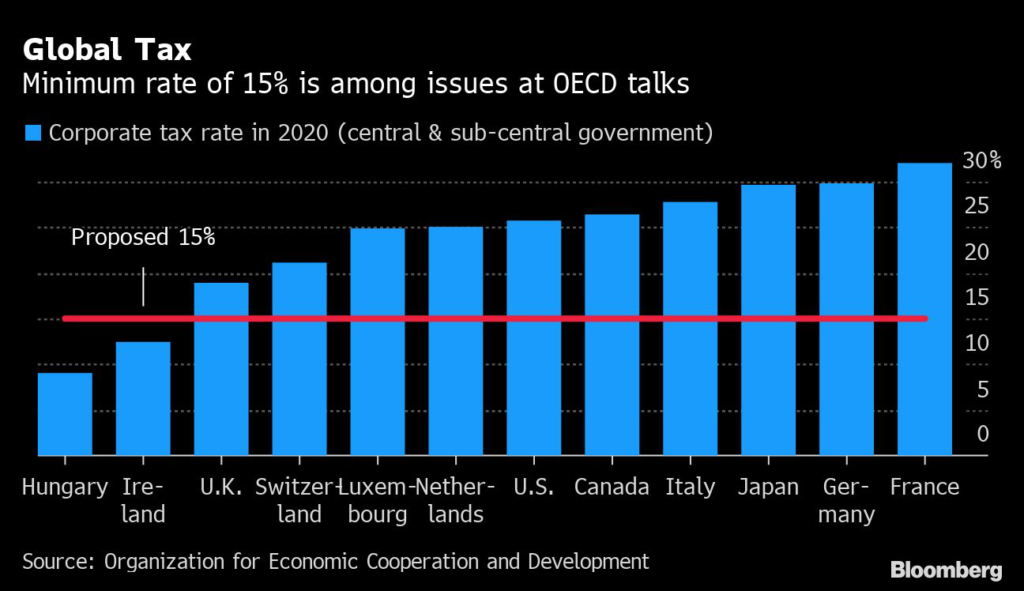
What emerged by mid-year was a two-part deal that would introduce a 15% global minimum tax and reallocate some taxing rights from nations where profits are booked to those where revenue is generated — giving so-called market countries a fairer slice of the taxes imposed on the largest multinational corporations.

Importantly, the deal would also ban so-called digital services taxes that target cross-border electronic commerce.

For multinational companies, it promised a trade-off: higher taxes in exchange for a more predictable tax landscape, with relief from the rapidly rising number of tax disputes and potential trade wars. Several executives recognized the attraction — certainty, they said, is invaluable to a business leader.

Last October, government heads from about 135 countries endorsed the agreement. It was a stunning achievement, but the new plan was nowhere near complete. “Technical” talks, the OECD said, would continue.

The executives who spoke with Bloomberg made clear they see these unresolved details as important enough to make or break the overall deal.

One company engaged in substantial digital commerce — and thus hit harder by digital services taxes — was generally enthusiastic for the deal. Trade groups including the Information Technology Industry Council and the Computer and Communications Industry Association, praised the agreement and Amazon.com Inc. issued a statement welcoming the “consensus-based solution for international tax harmonization.”

But for the rest, not enough is known yet about the formula for reallocating taxing rights. Without that, they said, the firms can’t begin to estimate how their overall tax exposure will change.

Many are also deeply worried about the complexity of the reallocation, as it will require them to report on the ultimate destination of their products. A plan intended to offer certainty, they said, may simply deliver a compliance nightmare.

Executives whose companies aren’t engaged in significant digital commerce expressed resentment about being dragged into a framework where taxes are reallocated in exchange for giving big tech companies relief from digital services taxes — something which wouldn’t benefit them.

The full reallocation plan won’t be available until at least June, leaving firms in the dark for now. That will also leave Congress — where legislating will grind to a halt in August through the midterm elections — little time to consider how and whether to write the plan into U.S. law before a potential change in partisan control.

Forgone Benefits

Meanwhile, new details on the minimum-tax rules released by the OECD in December have alarmed many U.S. firms and lawmakers. They worry the new system will prevent companies from benefiting from some tax incentives the U.S. offers, like credits for research and development.

The Treasury is working with Congress to adjust its proposal for bringing U.S. tax law into line with the global minimum rules in a way that offers U.S. firms more protection, but the process appears bogged down. Legislation incorporating the global corporate minimum tax was originally embedded in President Joe Biden’s longer-term economic agenda package, currently stalled in the Senate.

At the same time, European Union officials are having more trouble than expected adopting a directive for the minimum tax inside the 27-member trading bloc.

These hiccups introduce a troubling scenario, since all the big partners to the deal need to remain confident in the schedule for implementation. No one wants their own companies exposed to a new set of rules well ahead of others, so one set of delays can cascade across the globe. 

Enforcement Worries

U.S. executives also repeatedly expressed a lack of confidence over whether the minimum tax would be codified and enforced in a uniform way, when and whether digital services taxes would be eliminated, and whether the deal would come with a credible and robust dispute resolution mechanism — a feature many executives said was critical.

Most of the executives believe some version of the plan will eventually be implemented, maybe years from now. But that didn’t mean they would urge Congress to adopt it — making Yellen’s prediction look shaky.

Peter Barnes, a tax specialist at the law firm Caplin & Drysdale, said he expects the lobbying picture to remain mixed as the agreement’s details are ironed out.

“I don’t think it will be uniform, and when the business community cannot say with one voice, ‘We want this,’ then it’s very hard for Congress to act.”

(Updates with context on legislation in second paragraph after ‘Forgone Benefits’ subheadline.)

More stories like this are available on bloomberg.com

©2022 Bloomberg L.P.

First Female Bank CEO in Canada Leads With Younger Self in Mind

(Bloomberg) — In her 17 months as Laurentian Bank of Canada’s chief executive officer, Rania Llewellyn has seen about a third of the company’s 3,000-person workforce turn over.

She sees that upheaval not as a problem but a chance to rebuild the long-troubled bank anew. If she pulls off a turnaround at Laurentian — a minnow in an industry dominated by a six-firm oligopoly — that would mark just the latest noteworthy turn in a career that has defied much of the traditional Canadian banking blueprint.

Llewellyn is staking Laurentian’s comeback on a departure from the orthodoxies of larger rivals. She has committed to a work-from-home-first model in the Covid-19 era and cut the firm’s office space in half, has ruled out lending to oil and gas companies, and is focused on diversity and inclusion efforts so that talented women, minorities and immigrants face an easier climb than she did. 

That’s a responsibility that looms large in her thinking. Her appointment as the first female CEO of a publicly traded Canadian bank has prompted support from women and others who rarely see people like themselves in the industry’s top ranks.

“I’m building the bank that I’ve always wanted to work for,” Llewellyn said in an interview at Bloomberg’s Toronto offices Thursday. “I feel like my years of experience really prepared me for that opportunity in terms of the extra pressure.”

Llewellyn, 46, was born in Kuwait to an Egyptian father and Jordanian mother, and immigrated to Canada from Egypt in 1992. She got her start in banking as a part-time teller at Bank of Nova Scotia after graduating from college and finding herself unable to land a professional role — something she’s attributed partly to a lack of connections in Canada and foreign-sounding maiden name.

She landed her first executive position at the company after meeting Scotiabank’s senior vice president for the Atlantic region at her citizenship ceremony and pressing him for a new job over the coming weeks. She ended up spending more than two decades at Scotiabank, holding roles as varied as head of global business payments, CEO of the Roynat Capital commercial-banking unit, head of multicultural banking and senior vice president for commercial banking and growth strategy.

Her projects along that path included developing the infrastructure and power-industry team in capital markets, and helping finance a nuclear-power plant in Ontario.

Now that she’s head of Laurentian, which has corporate offices in Montreal and Toronto, she wants to see her managers appointing women to lead large, complex books of business where they can demonstrate their ability to drive revenue for the bank and their bosses can “see them in action,” Llewellyn said. 

“Let’s give them the juicy projects,” she said.

Even before her appointment, Laurentian had already set itself apart by not requiring Canadian experience for new hires, giving immigrants an easier start in the industry. Llewellyn said she wants to build on that reputation, which could be a significant advantage in Canada, where there’s a broad political consensus that attracting skilled newcomers should be central to the country’s economic strategy.

Across Laurentian’s workforce, Llewellyn is also turning to some unconventional benefits. For Laurentian’s 175th anniversary last year, employees were allowed a day off on their birthday. On top of that, the bank gave staffers half a day off on three Fridays during Canada’s short summer season. The extra time off was so well-received that the bank is extending the program, Llewellyn said.

Board Presentations

Llewellyn tells even some of Laurentian’s more junior recruits that the firm’s relatively small size means they’ll have opportunities — like presenting projects directly to the board — that they wouldn’t have elsewhere. Such perks can help set cost-conscious Laurentian apart in instances where it can’t match the salaries larger rivals offer.

“You can leave your mark on this institution and be part of the success,” she said. “You can’t just boil it down to salary. People leave not because of salary. Salary has to obviously be competitive, but it is not the only deciding factor.”

Among the staff departures that have occurred since Llewellyn took the reins, “some were voluntary, and some were involuntary, because when new leadership comes in, a lot of them say, ‘You know what, I’m out.’ And that’s OK,” she said. The bank also cut some jobs, announcing in December that it had trimmed 64 positions and booked C$9 million in severance charges as part of its plan to simplify the organizational structure.

“I took the opportunity to flatten the organization,” Llewellyn said Thursday.

While her changes have helped Laurentian’s employee-engagement scores, which could pay off in the longer term, investors are beginning to look for more immediate progress on Laurentian’s income statement, starting with its personal-banking business.

Under Llewellyn, Laurentian introduced its first mobile-banking app after just seven months of development and is rolling out tap payments on debit cards, rectifying two major gaps in its offerings. The bank is working on cutting down the time it takes to approve customers’ mortgage applications and speeding up the process to sign up for new credit cards and deposit accounts.

Topping Estimates

The plan is gaining some traction. The bank has beaten analysts’ estimates in every quarter Llewellyn has been CEO after missing projections in eight of the 11 quarters before she took over. And the bank’s shares are up 56% since she took over, the fourth-best performance in the eight-company S&P/TSX Commercial Banks Index, an improvement from last place in the prior 12 months.

Beyond the concrete moves, Llewellyn points to culture as a driving force in the improvement so far. That has included a cost-conscious mindset, the breaking down of silos and implementing a more-casual atmosphere, with employees not expected to wear ties unless they’re meeting clients who will be similarly dressed, she said. Those moves would be harder to make at one of Laurentian’s larger Bay Street competitors.

“The culture was more that our size was a detractor versus my opinion where size is our advantage,” Llewellyn said. “At the end of the day, culture and the tone starts from the top.”

More stories like this are available on bloomberg.com

©2022 Bloomberg L.P.

Close Bitnami banner
Bitnami