
Bloomberg

Taiwan Cuts 2022 GDP Forecast Again as Global Economy Slows

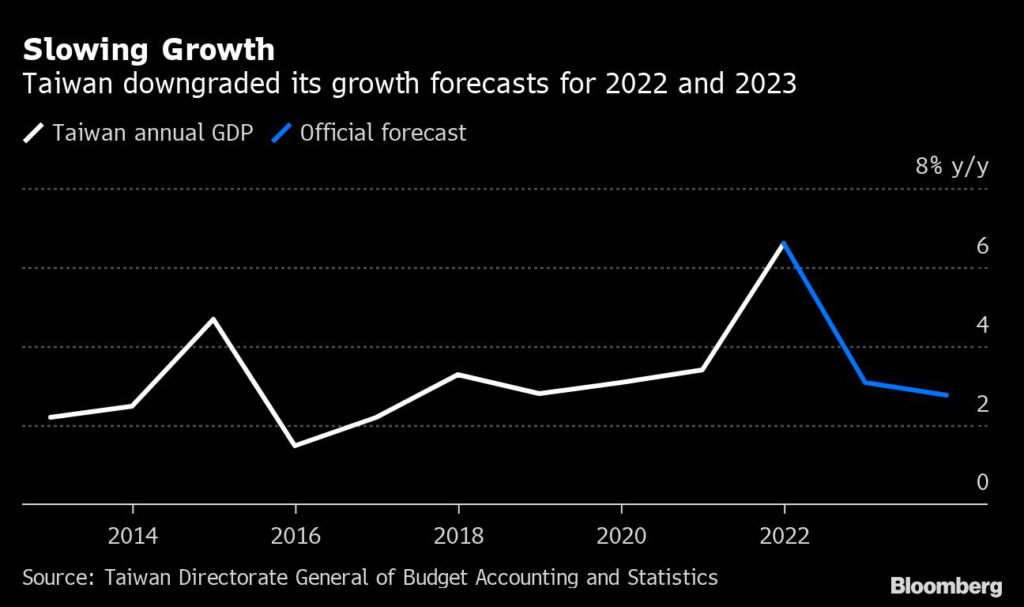
(Bloomberg) — Taiwan cut its 2022 growth forecast for the third time this year as the global demand slowdown and rising geopolitical tensions with China prove tough to navigate.

Gross domestic product is likely to grow 3.06% for the year, the Cabinet’s statistics department said in a statement Tuesday. That’s lower than the last formal estimate of 3.76% given in August. The official 2023 GDP forecast was downgraded to 2.75% from 3.05%.

Authorities cited a downturn in exports through the rest of this year and next as contributing factors. 

“Economic growth is expected to be relatively low in the first half of 2023,” said Tsai Yu-tai, the department’s head of statistics.

Chu Tzer-ming, the Cabinet’s chief statistician, added that growth would “gradually pick up” after the second quarter.

Export growth for 2022 is projected at around 8.7%, lower than an earlier forecast of about 13.5% as global inflation, interest rates and China’s Covid Zero policy curb demand. The government said 2023 exports are expected to contract slightly.

Officials left their full-year forecast for inflation little changed at 2.94%. It’s still the highest projection since the global financial crisis in 2008, when inflation surpassed 3.5%.

The government also revised GDP growth for the third quarter of 2022 to 4.01% from an earlier estimate of 4.1%. 

Taiwan’s growth has been challenging this year. The economy is expected to expand at roughly half the rate it did last year, when booming demand for electronics and semiconductors boosted GDP. 

Trade has fallen off in recent months, with exports contracting for the second consecutive month in October as the global slowdown intensifies — a trend seen elsewhere in the region, including in South Korea’s dismal trade figures. 

Taiwan weathered the downturn relatively well for much of the year. Last month’s fall in overseas shipments wasn’t as bad as economists expected, with exports to the US, Japan and elsewhere offset waning demand from China. 

The economy has also managed to confront other headwinds including inflation, which central bank Governor Yang Chin-long said Tuesday was effectively contained through interest rate hikes and other measures. 

Even so, Taiwan likely won’t be able to avoid more substantial economic pain forever. Chinese demand is still under pressure as Covid Zero continues to dominate policy there. Taiwanese officials have warned that November is likely to record a drop in exports of between 5% and 8%.

–With assistance from Cindy Wang.

(Updates with additional remarks from government officials.)

More stories like this are available on bloomberg.com

©2022 Bloomberg L.P.
Chinese Stocks Surge in US as Vaccine Drive Fuels Reopening Bets

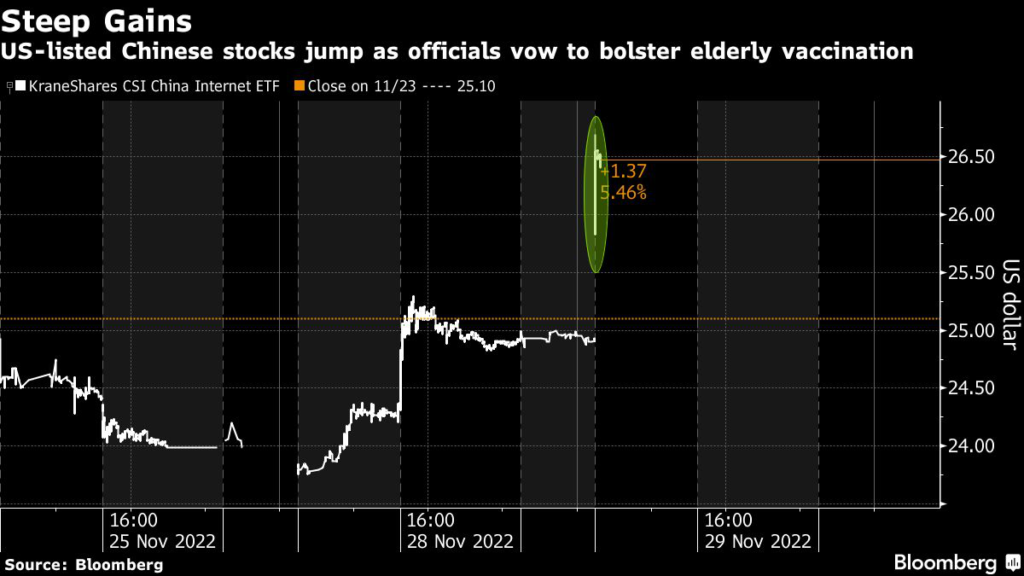
(Bloomberg) — Chinese stocks listed in the US extended gains in premarket trading as officials vowed to speed up Covid shots for the elderly and to avoid excessive restrictions, fueling a new round of bets that Beijing is bending to pressure for an economic reopening.

The exchange-traded KraneShares CSI China Internet Fund, which holds more than 40 Chinese stocks, advanced 6.5%. E-commerce giants Alibaba Group Holding Ltd. and JD.com Inc. each rose at least 5.5%. Stocks that are set to gain strongly from reopening, such as online travel agency Trip.com Group Ltd. and Yum China Holdings Inc., also rallied.

China said it will bolster vaccinations among senior citizens, a move seen by health experts as crucial to reopening, even though the government stopped short of issuing mandates to help raise inoculation rates. The country’s top health officials also warned against any excessive control measures during a briefing, while saying China is constantly adjusting its Covid policies.

READ: China Pushes Elderly Vaccination as Reopening Pressure Grows

The statements came after protesters took to the streets across China over the weekend in a rare act of defiance against the government and its Covid Zero strategy. The demonstrations were muted on Monday after authorities deployed a heavy police presence in major cities and localities pared back some Covid restrictions, soothing concerns that a long-lasting protest may prompt a crackdown.

Tuesday’s gains in US-listed Chinese stocks are set to add to a 2.8% advance in the Nasdaq Golden Dragon China Index on Monday. The benchmark is up 23% in November, heading for its biggest monthly gain on record.

More stories like this are available on bloomberg.com

©2022 Bloomberg L.P.
Stocks Climb as China Turmoil Eases; Dollar Slips: Markets Wrap

(Bloomberg) — European stocks opened higher and US index futures rose, as nationwide unrest in China over Covid curbs eased, boosting sentiment for riskier assets. 

Shares rallied in Hong Kong and on the Chinese mainland as some investors speculated that the protests may hasten a shift away from Covid-Zero policies. The dollar slipped after two days of gains, while the offshore-traded Chinese yuan rallied about 1% against the greenback. Europe’s Stoxx 600 equity gauge rose 0.4%, while a rebound in energy prices lifted oil companies’ shares.

China said it would bolster vaccination among its senior citizens, a move regarded by health experts as crucial to reopening an economy stuck in an endless loop of harsh Covid Zero curbs. But it stopped short of announcing mandates that helped raise inoculation rates in other countries. 

“We do not expect China policy to publicly shift away from the Zero Covid stance, however, we could see some easing of the policy privately and in localized areas,” Jefferies analyst Mohit Kumar wrote in a note. Depite Monday’s China-related setbacks, he said “markets are in a happy state and are comforted by the expected reduction in the pace of rate hikes from central banks.”

Many economists expect that Federal Reserve Chair Jerome Powell’s speech on Wednesday will cement bets that the central bank will slow its pace of rate increases next month — while reminding Americans that its fight against inflation will run into 2023. 

Still, Fed officials have signaled rate hikes have further to run. St. Louis President James Bullard, for instance, warned that investors may be underestimating the chances of higher rates. His New York counterpart John Williams noted policymakers have more work to do to curb inflation, and Fed Vice Chair Lael Brainard said the string of supply shocks is keeping inflation risks elevated. 

The dollar retreated against a basket of peers, while Treasury yields were little changed. Global bonds, meanwhile, joined US peers in signaling a recession, with a gauge measuring the worldwide yield curve inverting for the first time in at least two decades. 


Stagflation is the key risk for the global economy in 2023, according to investors who said hopes of a rally in markets are premature following this year’s brutal selloff. Almost half of the 388 respondents to the latest MLIV Pulse survey said a scenario where growth continues to slow while inflation remains elevated will dominate globally next year.

“I think the big risk for 2023 will be economic growth, because we have had this very very rapid move up in interest rates that tends to have a lag in terms of the impact on the economy,” Charlotte Ryan, co-head of investments at CCLA, told Bloomberg Television. “I don’t think we have seen the impact of that already.”

Elsewhere in markets, oil extended a rebound from the lowest level in almost a year on speculation that the Organization of Petroleum Exporting Countries and its allies will deepen supply cuts to respond to weakening global demand.

Key events this week:

  • Euro area economic confidence, consumer confidence, Tuesday
  • US Conference Board consumer confidence, Tuesday
  • EIA crude oil inventory report, Wednesday
  • China PMI, Wednesday
  • Fed Chair Jerome Powell speech, Wednesday
  • Fed releases its Beige Book, Wednesday
  • US wholesale inventories, GDP, Wednesday
  • S&P Global PMIs, Thursday
  • US construction spending, consumer income, initial jobless claims, ISM Manufacturing, Thursday
  • BOJ’s Haruhiko Kuroda speaks, Thursday
  • US unemployment, nonfarm payrolls, Friday
  • ECB’s Christine Lagarde speaks, Friday

Some of the main moves in markets:

Stocks

  • The Stoxx Europe 600 rose 0.4% as of 8:29 a.m. London time
  • Futures on the S&P 500 rose 0.4%
  • Futures on the Nasdaq 100 rose 0.6%
  • Futures on the Dow Jones Industrial Average rose 0.3%
  • The MSCI Asia Pacific Index rose 1.5%
  • The MSCI Emerging Markets Index rose 2.2%

Currencies

  • The Bloomberg Dollar Spot Index fell 0.5%
  • The euro rose 0.3% to $1.0366
  • The Japanese yen rose 0.4% to 138.37 per dollar
  • The offshore yuan rose 1.1% to 7.1713 per dollar
  • The British pound rose 0.6% to $1.2035

Cryptocurrencies

  • Bitcoin rose 1.7% to $16,466.06
  • Ether rose 3.2% to $1,209.74

Bonds

  • The yield on 10-year Treasuries declined one basis point to 3.67%
  • Germany’s 10-year yield declined eight basis points to 1.91%
  • Britain’s 10-year yield declined four basis points to 3.09%

Commodities

  • Brent crude rose 2.6% to $85.33 a barrel
  • Spot gold rose 0.8% to $1,755.21 an ounce

This story was produced with the assistance of Bloomberg Automation.

–With assistance from Richard Henderson.

More stories like this are available on bloomberg.com

©2022 Bloomberg L.P.

Norway to Improve Security Around Submarine Fiber Cables

(Bloomberg) — Norway will beef up security around the digital infrastructure that is essential for the Nordic country’s oil and gas production, following the recent sabotage on the Nord Stream pipelines.

Norway will spend an additional 43 million kroner ($4.3 million) to purchase new technology that enables threats to submarine fiber cables to be identified and to investigate important stretches of cable, the government said on Tuesday. That will also cover the purchase of equipment that can detect disturbances to satellite-based services, such as GPS, on the Norwegian continental shelf.

Norway has raised preparedness levels since Russia’s invasion of Ukraine in February and improved security around its North Sea oil and gas infrastructure after the September blasts on the Nord Stream pipeline system in the Baltic Sea. Curbs on Russian fossil-fuel exports have made Norway the biggest supplier of natural gas to Europe.

Sea fiber cables form an important part of the digital infrastructure for offshore oil and gas installations, and the new measures will improve telecom services and help prevent and handle possible threats, the government said.

More stories like this are available on bloomberg.com

©2022 Bloomberg L.P.

EasyJet Eyes Return to Full Capacity by Summer: The London Rush

(Bloomberg) — EasyJet is banking on the trade-down effect, where customers continue to choose cheaper brands to cut costs, to return it to pre-pandemic capacity next year. It comes after what can only be described as a torrid three years for the airline industry, where they first had to deal with aviation grinding to a halt, a stop-start recovery, then the fallout from the war in Ukraine, and now their customer’s wallets are under immense pressure. 

Here’s the key business news from London-listed companies this morning:

In The City

EasyJet Plc: The low-cost airline expects to do well out of the tougher economic environment, returning to pre-pandemic levels of capacity by next summer, as it expects customers to still go on holiday but start to look for value.

  • The carrier expects further market-wide inflationary pressure next year, with fuel costs in the first half increasing more than 50% year on year

AstraZeneca Plc: The pharmaceutical company will buy Neogene Therapeutics, a company that develops therapies for targeting cancer, for up to $320 million.

Wise Plc: The cross-border payments company experienced rising costs from “unusually high” levels of volatility in global currencies, with the prices it charged customers rising slightly in the second quarter. 

In Westminster

Rishi Sunak said the UK cannot rely on “simplistic” Cold War rhetoric against China, even after the BBC said one of its journalists was arrested and alleged he had been beaten and kicked by police while covering anti-government protests in Shanghai. 

Meanwhile, the government scrapped plans to define and regulate “legal but harmful speech” from the Online Safety Bill as it prepares to bring the long-awaited and controversial legislation back to Parliament next week. 

In Case You Missed It 

Later today, the Bank of England will start to sell the government bonds bought as part of its emergency action to halt recent chaos in UK markets. The sales are likely to prove a fresh test of confidence, given investors are already facing a deluge of supply from increased government borrowing and the BOE unwinding its pandemic-era debt holdings.

While luxury home prices are expected to drop in London next year, they look set to surge in another global business hub. 

Elsewhere, Ireland is said to be planning to allow banks that were bailed out during the financial crisis to pay bonuses to staff, ending a long-standing ban.

Looking Ahead

The BOE is due to release statistics on mortgage approvals, a reliable guide to housing activity in the months ahead, at 9:30 a.m. this morning. Approvals are likely to drop again in October, Bloomberg Intelligence estimates, as the UK housing market shows signs of cracking.

Tomorrow, publisher Future Plc and water and wastewater company Pennon Group Plc are among the companies expected to report results. 

For a news fix when the day is done, sign up to The Readout with Allegra Stratton, to make sense of the day’s events.

–With assistance from Kwaku Gyasi.

(Corrects EasyJet’s bullet point to reflect fuel costs will rise by more than 50%.)

More stories like this are available on bloomberg.com

©2022 Bloomberg L.P.
UK Rewrites Online Safety Bill After Free Speech Backlash

(Bloomberg) — The UK government scrapped plans to define and regulate “legal but harmful speech” from the Online Safety Bill as it prepares to bring the long-awaited and controversial legislation back to Parliament next week. 

Ministers axed a planned “harmful communications” offense that would have applied to social media posts sent with the intention of causing harm, resulting in “serious distress,” the Department for Digital, Culture, Media and Sport said late on Monday in a statement.

By making the changes, the government said it hopes to allay the concerns of free speech campaigners that the bill risked causing unintended consequences such as criminalizing “legal and legitimate speech.” At the same time, ministers are seeking to ease passage of the contentious bill through Parliament so that it can achieve its primary goal of protecting young people online. 

“Today’s announcement refocuses the Online Safety Bill on its original aims: the pressing need to protect children and tackle criminal activity online while preserving free speech,” the DCMS said.

The proposals have been in development for more than five years under seven Conservative Party culture secretaries, though the legislation itself was only introduced to Parliament in March.

‘Triple Shield’

Under the revised plans, instead of creating categories of legal content for companies and regulators to oversee, the bill now establishes a “triple shield” of protections:

  • Companies must remove content already ruled illegal, such as hate crime, fraud, and death threats
  • They must remove posts breaching their own terms of service
  • Adults must be given more control and filters over the content they are served

The bill creates duties for companies that host user-generated content and also for search engines to demonstrate how they will protect users. Failure to follow the rules will leave them facing fines and sanctions from media watchdog Ofcom. Although it’s a particular focus for so-called Big Tech businesses such as Meta Platforms Inc. and Twitter Inc., when passed, the law will affect more than 20,000 enterprises, according to a previous government impact assessment. 

Tech companies will be banned from removing or restricting user-generated content, or suspending or banning users, if they haven’t breached terms of service or the law. Twitter, now owned by Elon Musk, has reversed bans on prominent users including former US President Donald Trump. The UK’s regulatory engagement with Twitter was disrupted by Musk’s dramatic takeover.

Meanwhile, other criminal offenses will be created, including the posting and proliferation of online material that encourages self-harm, an issue which was brought into sharp focus after a judge ruled in September that the death of British teenager Molly Russell was related to her social media use.

The opposition Labour Party disagreed with the changes.

“Removing ‘legal but harmful’ gives a free pass to abusers and takes the public for a ride,” said culture spokeswoman Lucy Powell. “After the Molly Russell inquest, Russian disinformation campaigns, racist abuse against England footballers, incel gangs, eating disorder content, it’s pretty remarkable that the government has watered down this long-awaited bill quite so much.”

(Updates with Labour quote in eleventh paragraph)

More stories like this are available on bloomberg.com

©2022 Bloomberg L.P.
Global Stocks Rise as China Rebounds; Dollar Falls: Markets Wrap

(Bloomberg) — A gauge of global equities advanced, led by a rebound in Chinese stocks as nationwide unrest over Covid curbs eased. The dollar and Treasuries fell amid improved sentiment for risk taking.

Shares rallied in Hong Kong and on the mainland as some investors speculated that the protests may hasten a shift away from Covid-Zero policies. Chinese government health officials were due to hold a briefing at 3 p.m. on the implementation of virus prevention and control measures.

“There is growing speculation there will be an imminent announcement of the end of Covid-Zero policy and that’s driving the positive sentiment,” said Kiyong Seong, lead Asia macro strategist at Societe Generale SA in Hong Kong. “Markets will remain volatile as investors assess any policy shift.”

Traders also took heart from the lifting of China’s multi-year ban on share sales by builders. US futures advanced after the S&P 500 pared its monthly gain during the Wall Street session.

Investors continue to parse comments from Federal Reserve officials, with Fed Bank of St. Louis President James Bullard warning that markets may be underestimating the chances of higher rates. His New York counterpart John Williams noted policymakers have more work to do to curb inflation and Fed Vice Chair Lael Brainard said the string of supply shocks is keeping inflation risks elevated. 

A gauge of the dollar fell following two days of gains. The Japanese yen rose, as did an index of emerging-markets currencies.

Global bonds joined US peers in signaling a recession, with a gauge measuring the worldwide yield curve inverting for the first time in at least two decades. Treasury yields saw modest increases across the curve while yields on government bonds also rose in Australia and New Zealand.

Elsewhere in markets, oil extended a rebound from the lowest level in almost a year on speculation that the Organization of Petroleum Exporting Countries and its allies will deepen supply cuts to respond to weakening global demand.

Investors remained focused on developments in China Tuesday, and further ahead to Fed Chair Jerome Powell’s speech Wednesday. Many economists expect he’ll cement bets that the Fed will slow its pace of rate increases next month — while reminding Americans that its fight against inflation will run into 2023.

Stagflation is the key risk for the global economy in 2023, according to investors who said hopes of a rally in markets are premature following this year’s brutal selloff. Almost half of the 388 respondents to the latest MLIV Pulse survey said a scenario where growth continues to slow while inflation remains elevated will dominate globally next year.

Key events this week:

  • Euro area economic confidence, consumer confidence, Tuesday
  • US Conference Board consumer confidence, Tuesday
  • EIA crude oil inventory report, Wednesday
  • China PMI, Wednesday
  • Fed Chair Jerome Powell speech, Wednesday
  • Fed releases its Beige Book, Wednesday
  • US wholesale inventories, GDP, Wednesday
  • S&P Global PMIs, Thursday
  • US construction spending, consumer income, initial jobless claims, ISM Manufacturing, Thursday
  • BOJ’s Haruhiko Kuroda speaks, Thursday
  • US unemployment, nonfarm payrolls, Friday
  • ECB’s Christine Lagarde speaks, Friday

Some of the main moves in markets:

Stocks

  • S&P 500 futures rose 0.3% as of 3:11 p.m. Tokyo time. The S&P 500 fell 1.5%
  • Nasdaq 100 futures rose 0.5%. The Nasdaq 100 fell 1.4%
  • Euro Stoxx 50 futures rose 0.1%
  • Japan’s Topix fell 0.6%
  • Australia’s S&P/ASX 200 rose 0.3%
  • The Hang Seng Index rose 3.9%
  • The Shanghai Composite rose 2.1%

Currencies

  • The Bloomberg Dollar Spot Index fell 0.5%
  • The euro rose 0.5% to $1.0388
  • The Japanese yen rose 0.3% to 138.52 per dollar
  • The offshore yuan rose 1.1% to 7.1677 per dollar

Cryptocurrencies

  • Bitcoin rose 1.8% to $16,482.93
  • Ether rose 3.1% to $1,208.35

Bonds

  • The yield on 10-year Treasuries advanced two basis points to 3.71%
  • Japan’s 10-year yield was at 0.25%
  • Australia’s 10-year yield advanced nine basis points to 3.60%

Commodities

  • West Texas Intermediate crude rose 1.7% to $78.54 a barrel
  • Spot gold rose 0.7% to $1,754.12 an ounce

This story was produced with the assistance of Bloomberg Automation.

–With assistance from Rita Nazareth, Richard Henderson and Rik Stevens.

More stories like this are available on bloomberg.com

©2022 Bloomberg L.P.
UN Sees Friend-Shoring Risks in a Fragile Global Trading System

(Bloomberg) —

The UN said efforts to “friend-shore” manufacturing could weigh on a global trading system that a new report warns still faces transport headwinds and inflationary pressures tied to Russia’s war and the pandemic. 

“The trade system is a very complex system,” said Rebeca Grynspan, secretary-general of the United Nations Conference on Trade and Development, in a briefing with reporters. “If you try to get away from one part of the world, you create a huge disruption to the system. Everything changes.”

While Unctad said it sees “no evidence of a mass exodus” away from offshoring trends, US and European friend-shoring plans have the potential to further fragment international commerce, according to a report published Tuesday. 

Disruptions from the fighting in Ukraine have already led to higher grain prices and dry-bulk freight rates, which contributed to a 1.2% increase in consumer food prices, according to the Geneva-based agency.

In that environment, labor strikes pose risks to the logistics industries tied to ocean shipping. “Faced with rising inflation and increased cost of living and the introduction of automation, there is the potential for widespread unrest,” the report stated.

No Exodus Yet

Over the past year, policymakers in Washington and European capitals have sought to reduce their dependence on authoritarian nations like China and Russia for critical goods like food, energy and semiconductors.

The trend was spurred, in part, by pandemic-related supply snarls, which encouraged many companies to shift production closer to their consumer markets and away from a lean-inventory supply chains.

“The real question is whether we have open or closed regionalization,” Grynspan told reporters during the press conference in Geneva. If trade flows shift to a pattern of closed regionalization it will result in more fragmentation, she said.

But if supply lines operate along patterns of open regionalization, that could actually improve value chains and lead to more sustainable growth in the developing world. “That’s a win-win situation,” Grynspan said.

Gloomy Trade Outlook

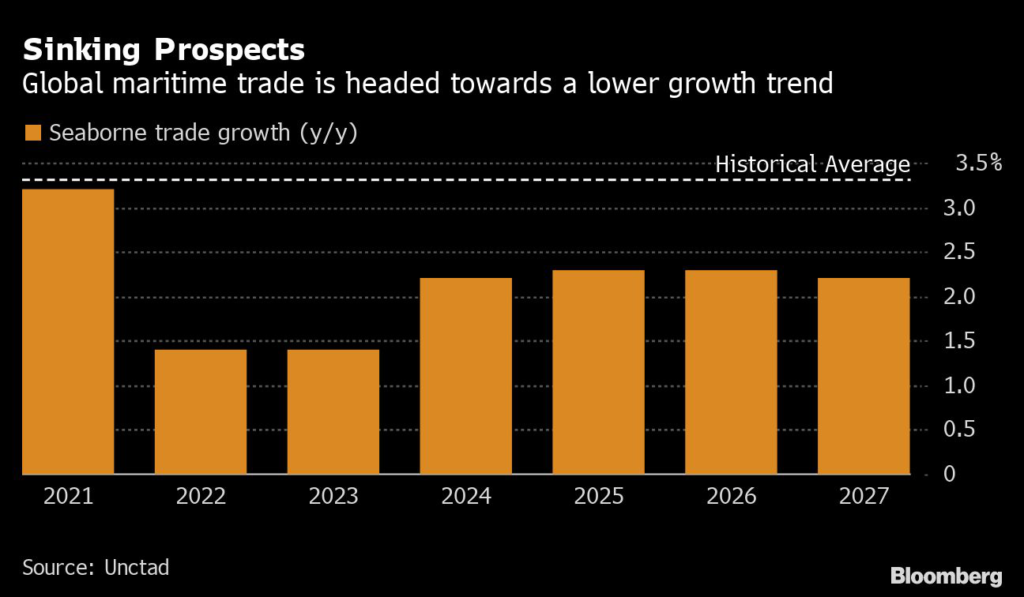
Unctad projects that growth in total seaborne trade will be 1.4% in 2023, unchanged from this year’s level, before averaging just above 2% in each year after that through 2027. That’s below the historical average in recent decades of about 3.3% annual growth. 

The slowdown is due to “strong macroeconomic headwinds combined with a weakening in China’s economy,” according to the report. China’s zero-Covid policy continues to weigh on the outlook as health-related shutdowns have disrupted manufacturing, logistics, and supply chains. 

In addition, the war in Ukraine, labor strikes and adverse weather events “spell further trouble for global supply chains and logistics — and for maritime trade.”

“Things are not looking up,” said Shamika Sirimanne, the director of Unctad’s division on technology and logistics. “The era of cheap, reliable and connected maritime trade may be coming to an end.”

Lower Growth Trends

The report found that port congestion was broadly easing and container shipping rates had fallen from their pandemic heights, though they’re still above pre-pandemic levels. Unctad said container rates will likely decline further as trade flows normalize and new vessels enter the market.

The UN urged nations to bolster their port infrastructure and adapt to automation trends as a means to reverse the decline of maritime shipping connectivity. 

US port performance was dragged down due to “long-term underinvestment” in America’s West Coast port infrastructure, the agency said. In addition, most ports in Africa, Latin America and the Caribbean “suffered significant reductions” in direct connections, it said. 

Recent trade-facilitation efforts — like digital customs declarations, electronic payments and other expedited customs procedures — helped soften the blow of the pandemic-driven supply crunch. 

More stories like this are available on bloomberg.com

©2022 Bloomberg L.P.
Toyota Global Output Slows From Record as Challenges Persist

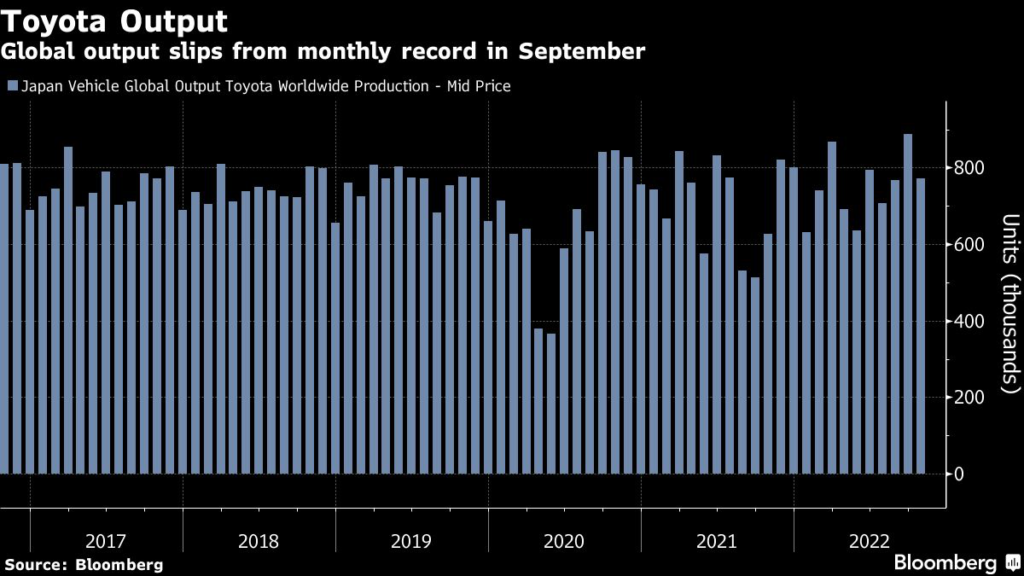
(Bloomberg) — Toyota Motor Corp. produced 771,382 vehicles in October, down from a record of 887,733 the previous month, and warned of an uncertain outlook due to Covid and semiconductor shortages. 

Output was up 23% from October 2021, when supply chains were disrupted by the spread of Covid in Southeast Asia, Toyota said in a statement Tuesday. The world’s biggest automaker is now adjusting some production in China, which is still gripped by the virus and related restrictions. 

Toyota’s global sales also rose 23% from a year earlier in October, reaching a total of 832,373 vehicles. 

Including subsidiaries Daihatsu Motor Co. and Hino Motors Ltd., output and sales totaled 924,132 and 918,756 vehicles, respectively, Toyota said.  

In early November, the company cut its global target for the fiscal year through March and stuck with a conservative profit outlook. 

Toyota shares slipped 1.2% Tuesday in Tokyo. They’re down 4.6% this year. 

Separately, Nissan Motor Co. said its global output fell 2.4% from a year earlier to 297,801 units in October, the first decline in four months, while sales dropped 13%. Honda Motor Co.’s global output increased 1.1% to 330,002 units last month versus a year earlier. 

(Updates with Honda, Nissan output in last paragraph.)

More stories like this are available on bloomberg.com

©2022 Bloomberg L.P.

SoftBank Analyst Rating Drops to Six-Year Low as Buybacks Dry Up

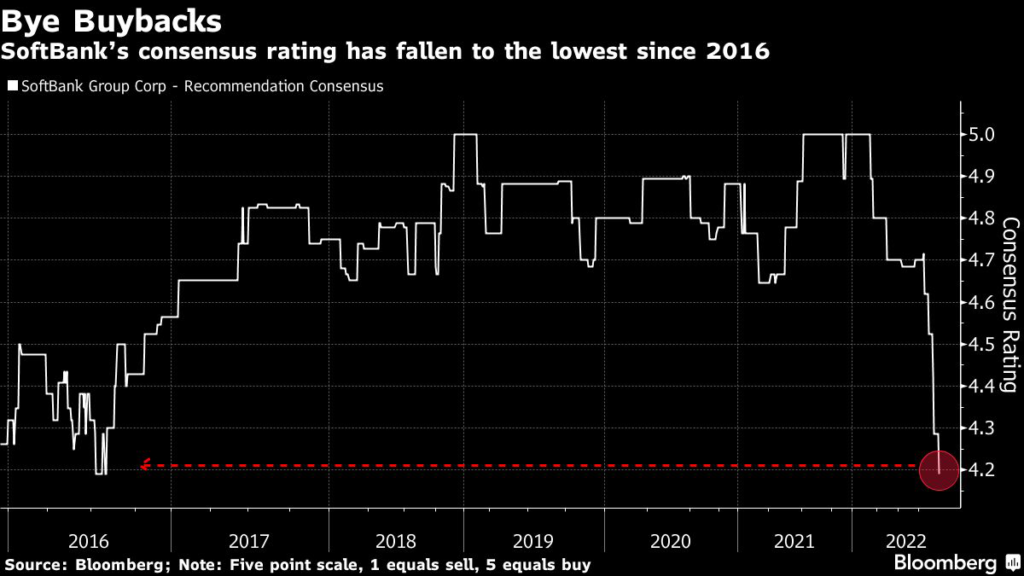
(Bloomberg) — Sell-side analyst opinion on SoftBank Group Corp. has tumbled to a six-year low as the Japanese technology giant refrains from new stock buybacks amid continued investment losses.

The shares fell as much as 2.6% Tuesday after Citigroup cut its rating to neutral from buy. That dragged the consensus recommendation to a 2016 low, following recent downgrades at Deutsche Bank, CLSA and Jefferies.

“The share buyback hiatus and the business execution issues behind it” lead Citi’s reasons for its rating cut, followed by risks from higher interest rates, and weaker investor communication with Masayoshi Son no longer attending quarterly results briefings, analyst Mitsunobu Tsuruo wrote in a note.

The company’s shares have slumped more than 15% from a high earlier this month after it posted another quarterly loss in its core Vision Fund segment and declined to announce further equity repurchases. 

More stories like this are available on bloomberg.com

©2022 Bloomberg L.P.

Close Bitnami banner
Bitnami