Bloomberg

Goldman Says Sell Robinhood After 84% Rout From Record Peak

(Bloomberg) — Goldman Sachs Group Inc. analysts cut Robinhood Markets Inc. to sell, less than a year after the bank led its popular initial public offering.

It joined JPMorgan Chase & Co., the other lead IPO bookrunner, in turning bearish on the free-trading app that rose to prominence during the peak of the pandemic as homebound people turned to online trading to pass the time and make money. Goldman’s William Nance cited continued weakness in account growth and path to profitability getting pushed further out as headwinds for Robinhood.

“We see an acceleration in user growth as a key requirement for shares to re-rate higher,” wrote Nance in a note. Beyond stocks, Nance said their cryptocurrency trading has “much better” economics, but the recent decline in volumes is offsetting the tailwind.

Goldman didn’t comment beyond the note.

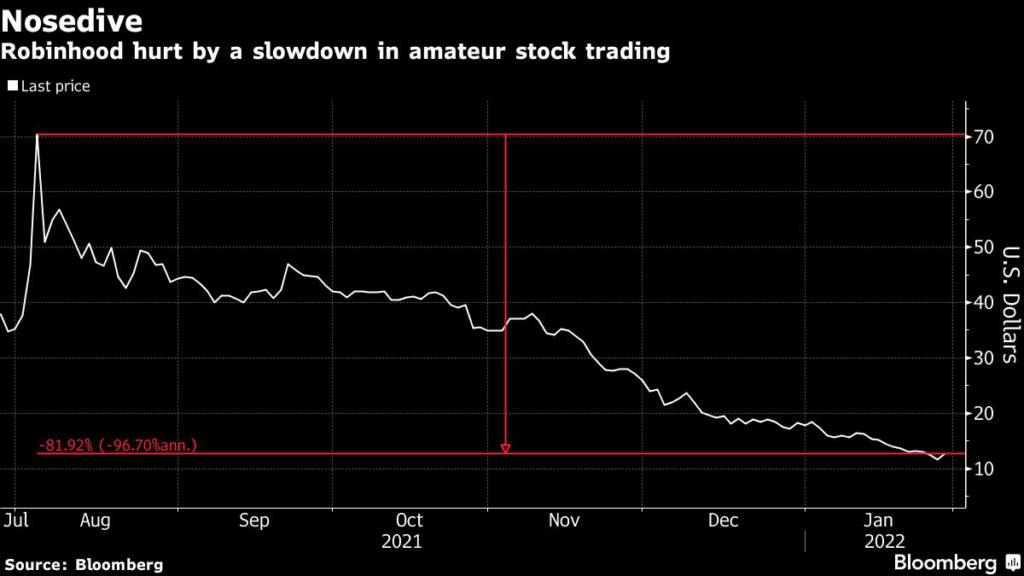
It’s a perfect storm for Robinhood shares: losses are mounting and monthly active users and average revenue per user are falling. Shares were down as much as 6%, a whopping 70% below their IPO price and 84% below the record highs in August.

Nance said Robinhood is unlikely to reach profitability in 2023 given its recent growth trends. “We believe this lack of clarity around the path to profitability will prevent the stock from re-rating higher.”

Indeed, analysts on average expect the company to report $658 million loss for next year, according to Bloomberg data.

What’s more, Robinhood is also among the worst high-profile global stock market debuts since the onset of the pandemic, joining the likes of China’s Didi Global Inc. and London’s THG Plc.

(Updates prices in fifth paragraph)

More stories like this are available on bloomberg.com

©2022 Bloomberg L.P.

Goldman Says Sell Robinhood After 84% Plunge From Record

(Bloomberg) — Goldman Sachs Group Inc. analysts cut Robinhood Markets Inc. to sell, less than a year after the bank led its popular initial public offering.

It joined JPMorgan Chase & Co., the other lead IPO bookrunner, in turning bearish on the free-trading app that rose to prominence during the peak of the pandemic as homebound people turned to online trading to pass the time and make money. Goldman’s William Nance cited continued weakness in account growth and path to profitability getting pushed further out as headwinds for Robinhood.

“We see an acceleration in user growth as a key requirement for shares to re-rate higher,” wrote Nance in a note. Beyond stocks, Nance said their cryptocurrency trading has “much better” economics, but the recent decline in volumes is offsetting the tailwind.

Goldman didn’t comment beyond the note.

It’s a perfect storm for Robinhood shares: losses are mounting and monthly active users and average revenue per user are falling. Shares were down as much as 6%, a whopping 70% below their IPO price and 84% below the record highs in August.

Nance said Robinhood is unlikely to reach profitability in 2023 given its recent growth trends. “We believe this lack of clarity around the path to profitability will prevent the stock from re-rating higher.”

Indeed, analysts on average expect the company to report $658 million loss for next year, according to Bloomberg data.

What’s more, Robinhood is also among the worst high-profile global stock market debuts since the onset of the pandemic, joining the likes of China’s Didi Global Inc. and London’s THG Plc.

(Updates prices in fifth paragraph)

More stories like this are available on bloomberg.com

©2022 Bloomberg L.P.

Finland Hit by Cyber Attack, Airspace Breach as NATO Bid Weighed

(Bloomberg) — Finland reported an attack on government websites and a suspected airspace violation by Russian aircraft just as speculation mounts that the Nordic nation will opt to apply for membership in the NATO alliance. 

Finland said on Friday a Russian state aircraft is suspected of having violated its airspace, followed by a cyber attack on the websites of Finland’s Foreign Ministry and Defense Ministry, as well as some other government services. The events coincided with a webcast speech to Finnish lawmakers by Ukraine’s President Volodymyr Zelenskiy.

The 5.5-million-nation, which has the European Union’s longest border with Russia and fought two wars with the Soviet Union, underwent a historic shift in public backing for joining the North Atlantic Treaty Organization in a matter of days following its neighbor’s full-scale invasion of Ukraine. While opinion polls in neighboring Sweden reflect a similar change, its ruling Social Democrats have so far remained opposed to such a move. 

The Finnish government is due to send a white paper to parliament on its changed security environment next week, launching a formal process that would be finalized by the end of June, according to Prime Minister Sanna Marin. While Marin and President Sauli Niinisto have steered clear of giving a clear endorsement to the NATO entry, speculation is growing among pundits and media that other options are less likely by now. Almost half of all lawmakers openly support an application.

Read More: Swedes, Finns Worry About Security Risk on the Path to NATO (1)

While the security-policy white paper won’t contain a proposal for joining, the government and president are prepared to submit an addendum on that “when the time is right” after they are satisfied lawmakers back the bid, Foreign Minister Pekka Haavisto said on Thursday.

Russia has repeatedly warned both Finland and Sweden against joining NATO, making both Nordic countries concerned about potential aggression from Moscow if they formally signal their alignment with the western bloc. NATO’s Article 5 mutual defense clause only applies to members.

The denial of service attack on websites was over at 1 p.m. in Helsinki, the government said in a tweet, adding most sites operated normally during the attack due to countermeasures. In a joint decision with Niinisto, the cabinet also expelled two Russian diplomats, with a Russian embassy employee also denied a visa extension.

Finland’s security service last month warned Russia would increase its spying and influence operations against the Nordic country. Authorities said earlier this week they are investigating a series of airspace violations by Russian civil aircraft that took place in March. 

Read More: How Russia Pushed Finland and Sweden Toward NATO: QuickTake

(Updates with end of cyber attacks, Russian diplomats expelled)

More stories like this are available on bloomberg.com

©2022 Bloomberg L.P.

The World’s Electric Vehicle Fleet Will Soon Surpass 20 Million

(Bloomberg) —

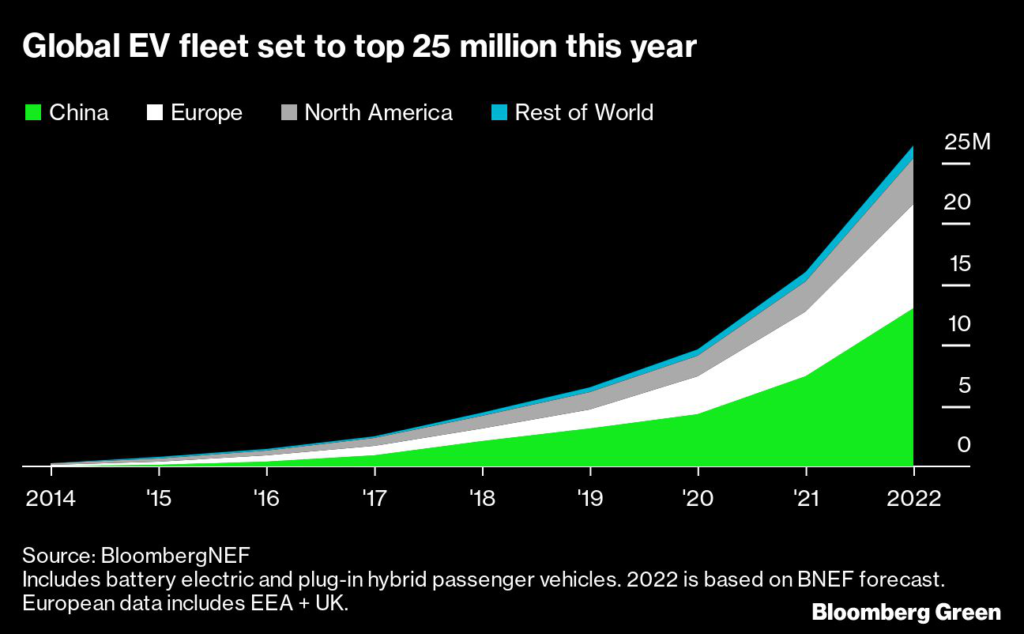
The world is about to pass another important milestone in electric vehicle adoption: 20 million plug-in vehicles on the road globally, come June, according to BNEF estimates. That’s remarkable growth from only 1 million EVs on roads in 2016. 

In the second half of 2022, almost a million EVs a month will be added to the global fleet, according to BNEF estimates. That’s about one every 3 seconds. Vehicles eventually get retired from the fleet due to age, wear-and-tear, crashes and battery degradation. But that’s not a big part of the EV story so far, mostly because the majority of EVs in the global fleet were sold in the past 18 months. By the end of 2022, BNEF is expecting over 26 million plug-in vehicles on the road.

The speed of growth is much faster than many incumbents in the automotive and oil industries were expecting just a few years ago. In BP’s 2016 outlook for example, the company expected a fleet of 71 million plug-in vehicles on the road by 2035. Based on the latest sales data, BNEF now expects that to be achieved by 2025, a full 10 years ahead of schedule.

Taking a look at the geographic breakdown of the vehicles underscores how just a few regions are driving most of the adoption. China accounts for 46% of the total sales to date, followed by Europe at 34%. North America is a distant third at 15%, but fresh policy support should get that EV market moving this year and next. All the remaining countries combined account for just 5% of the global EV fleet.

Most of the world’s plug-in vehicles are fully electric, but there are also 5.3 million plug-in hybrids. Europe accounts for most of them. The plug-in hybrids have helped automakers meet Europe’s increasingly stringent targets for reducing carbon emissions from vehicles. At BNEF, we’re expecting the market to shift away from plug-in hybrids in the coming years, as governments cut subsidies for them, and as automakers roll out their latest fully electric models.

EV adoption in Japan — the largest auto market after China, the U.S. and Europe — has been very slow. That should start to change soon as Japanese automakers launch new battery electric models in the popular mini “kei car” segment. Kei is short for keijidōsha, meaning light automobile, and they account for a third of all sales in the country. Nissan and Mitsubishi plan to bring electric kei models to market this year, followed by Honda in 2024, and Toyota subsidiary Daihatsu in 2025. Electric vehicle adoption in neighboring South Korea has been brisk, with EVs hitting nearly 15% of sales there at the end of 2021, driven by strong model offerings from domestic champions Hyundia and Kia.

Attention will eventually shift to the big emerging auto markets in the world, like India, Brazil, Mexico and Southeast Asia. EV adoption has barely started in these countries and regions, yet they are key for the growth in global EV adoption to continue once the larger markets start to saturate. There are several encouraging signs. In India’s three-wheeler market, over 50% of sales are already electric. Southeast Asia markets like Vietnam already have relatively high adoption of electric two-wheelers. And parts of Latin America are leading the way on electric buses and are starting to focus on electrifying taxis.

Perhaps most importantly, the models available in China’s EV market show how electric mobility can be very compelling for lower-middle class consumers in emerging markets. The best-selling EV in China so far this year is the Hongguang Mini, which retails for just $4,700.

Models like that, combined with a big push on electric kei cars from Japanese automakers, and more electric motorcycles and scooters, will help the rest of the world make the jump to electric mobility. There are other benefits, too. The Hongguang Mini weighs just 560 kilograms (1,235 pounds), compared to more than 4,000 kg for the recently launched electric GMC Hummer, which has a battery pack almost 20 times the size. With battery raw material costs soaring, scaled-down EVs look much more like the sustainable mobility solution the world needs.

The next few years will bring remarkable progress on EV adoption, but it’s worth keeping in mind just what a huge task it is to convert the world’s vehicle fleet. BNEF estimates that there are 1.2 billion light-duty passenger vehicles on the road globally. At the end of 2022, just over 2% of them will be electric. There’s still a long way to go. But the momentum is building.

(Updates 8th paragraph to reflect newly released March data — the Hongguang Mini is the best-selling EV in China.)

More stories like this are available on bloomberg.com

©2022 Bloomberg L.P.

Amazon Union Vote in Alabama Challenged Again by Labor Group

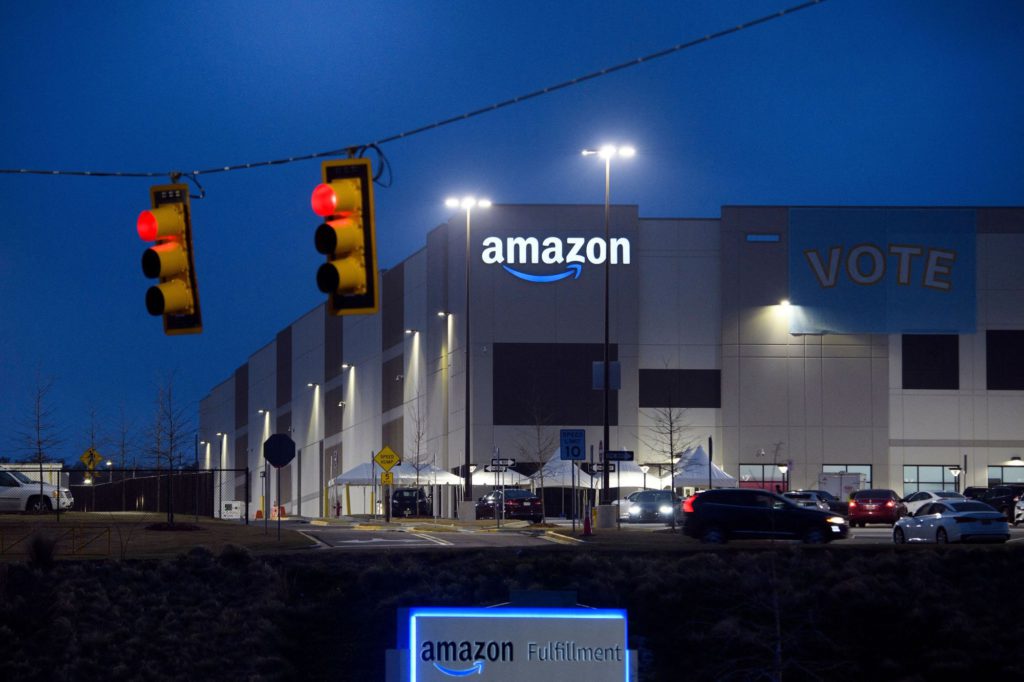
(Bloomberg) — Amazon.com Inc. interfered in a union election at an Alabama warehouse by prohibiting employees from discussing the union during work hours or posting literature about the effort, according to objections filed Thursday by the Retail, Wholesale and Department Store Union seeking to void the election results.

Amazon employees in Bessemer, Alabama, voted 993 to 875 against forming a union in a mail-in election that ended in March. More than 400 contested ballots haven’t been counted and could influence the final result. The union still filed its objections, saying Amazon allowed anti-union materials to be displayed in work areas, but prohibited pro-union displays. The objections also accuse Amazon of engaging in surveillance of employees during the election period.

“We are filing objections on Amazon’s behavior during this election, which include countless attempts to intimidate workers, even going so far as to terminate and suspend workers who supported the union,” union president Stuart Applebaum said. “Amazon’s behavior must not go unchallenged, and workers in Bessemer, Alabama, must have their rights protected under the law.”

Amazon employees at the warehouse voted last year against forming a union. The National Labor Relations Board ordered that the election be held again after determining that Amazon unlawfully interfered in the process.

Amazon filed its own objections to the conduct of the vote late Thursday, arguing that a mail-ballot election was inappropriate and that union representatives surveilled workers and offered to take their ballots, among other claims. 

“We’ve said from the beginning that we want our employees’ voices to be heard and we hope the NLRB counts every valid vote,” Amazon spokesperson Kelly Nantel said in an emailed statement.

Amazon warehouse workers in Staten Island voted in March to join the fledgling Amazon Labor Union, a major defeat for the Seattle-based company. Amazon has until April 22 to challenge the results of that election. Another union election for a different Staten Island facility is scheduled to begin later this month.

(Updated with Amazon comment.)

More stories like this are available on bloomberg.com

©2022 Bloomberg L.P.
Big Tech to Congress: Forget About Antitrust, Pass a Privacy Law

(Bloomberg) — Tech giants have a message for Congress: Stop pushing for antitrust laws, and pass privacy rules instead.

Lobbying to stop a package of bills designed to curb internet giants’ power reached a frenzy this week, as the window for major legislation before the midterms closes. Two industry groups representing companies such as Meta Platforms Inc. and Alphabet Inc. held separate lobbying days to oppose the bills and promote a federal privacy law, among other industry goals. 

TechNet, one of the oldest tech interest groups, met virtually with 41 lawmakers, including Senate Majority Leader Chuck Schumer and House Speaker Nancy Pelosi. The group’s president, Linda Moore, said TechNet argued that voters care more about addressing privacy issues than antitrust issues.

“A lot of the interest around the competition bills is based on the collection and the use of data,” Moore said. “Let’s focus on that part.”

A federal privacy standard was proposed years ago, but has not been a focus for this Congress as lawmakers turned their attention to competition and content moderation issues. But as many states have passed their own privacy bills, companies and lawmakers have looked to codify a federal standard. A meeting of members on the House and Senate committees that deal with the topic last week shows that momentum is building, TechNet’s Carl Holshouser said. 

TechNet also argued that American internet companies give the country a geopolitical advantage which could be muted if the companies are regulated, Moore said. Myriad other tech industry priorities were also promoted, such as funding for manufacturing semiconductors and increasing high-skill visas. The top lawyer for Alphabet’s Google unit, Kent Walker, joined some of the sessions. Moderate Democrats who have publicly opposed antitrust bills, including California Representative Zoe Lofgren and Washington Representative Suzan DelBene, also attended.

NetChoice, which represents a similar roster of the largest tech firms, led an in-person coalition of conservative groups in a lobbying day Monday. They met with over a dozen Republican lawmakers to critique the competition bills and advocate for privacy legislation, said Carl Szabo, the group’s vice president.

The group focused its critiques on two pieces of legislation which enjoy strong support in Congress — the Open App Markets Act and the American Innovation and Choice Online Act. The first would open up app stores operated by Apple Inc. and Alphabet Inc.’s Google, while the second is designed to prevent large internet platforms like Amazon.com Inc. from giving priority to their own products and services.

A coalition of left-leaning groups dueled for lawmaker attention on Monday, staging an “Antitrust Day,” in support of these same bills. Rather than meeting with lawmakers, coalition members like Yelp Inc., Match Group Inc., and Spotify Technology SA, encouraged users to write their representatives. About 60,000 messages were sent to lawmakers, said Evan Greer of Fight For the Future, which helped organize the action.

Greer said that tech giants are pushing for privacy legislation to distract from momentum on antitrust. “We need legislation that cracks down on anti-competitive business practices. We also need legislation that takes aim at surveillance capitalism,” she said. “It’s not one or the other.”

More stories like this are available on bloomberg.com

©2022 Bloomberg L.P.

Bitcoin Lingers Near Two-Week Low as Miami Fest Draws to Close

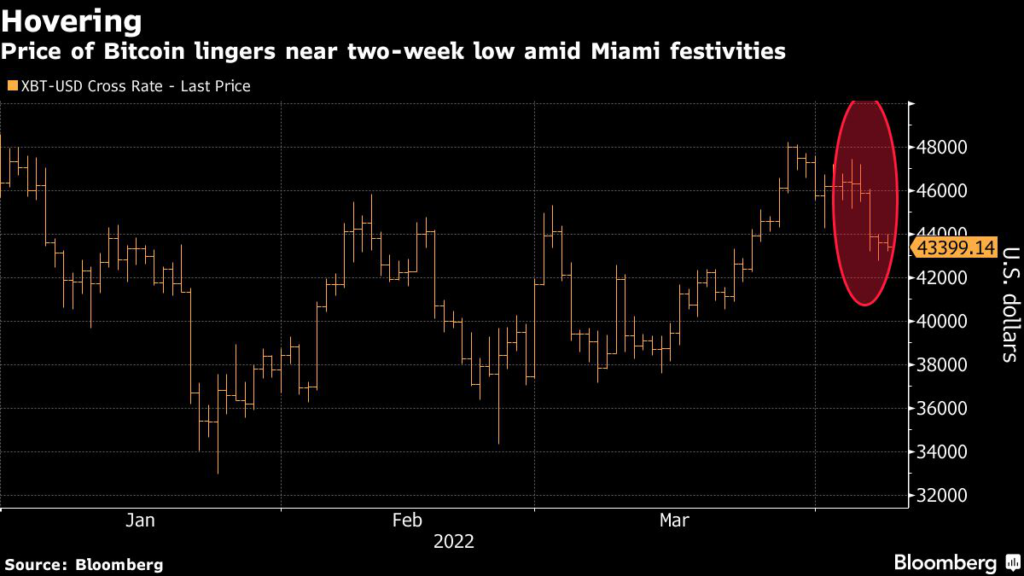
(Bloomberg) — Bitcoin appears to be ending the week on a down note, trading lower for a fifth consecutive session, while one of the crypto industry’s biggest conferences draws to a close in Miami. 

The largest cryptocurrency by market value fell to as low as $43,220, the least in about two weeks. Ether, the next largest digital token by market value, edged higher. Popular DeFi tokens Solana and Cardano were also negative. 

“It’s been a rough week for Bitcoin, which has been hammered by deteriorating risk appetite just after it broke through a major resistance level,” Craig Erlam, senior market analyst at Oanda, said in a note Friday. “It has found some support around $43,000, which is the 50% retracement of the March lows to highs and also coincides with the pre-breakout resistance.” 

Bitcoin 2022 in Miami has featured Bitcoin advocates including billionaire entrepreneur Peter Thiel, Ark Investment Management CEO Cathie Wood and MicroStrategy Inc. head Michael Saylor. Thiel, like Saylor, sees Bitcoin as the inflation-proof reserve currency of the future and warned central bankers that ignoring the digital currency will have serious consequences. 

Saylor and Wood in a fireside chat discussed the outlook for Bitcoin on Thursday, with both highlighting a shift in stance from politicians, regulators and capital markets toward the world’s largest digital asset. 

More stories like this are available on bloomberg.com

©2022 Bloomberg L.P.
“Sonic the Hedgehog 2” Vies to Be the Pandemic Era’s Top-Grossing Kids Film

(Bloomberg) — “Sonic the Hedgehog 2,” a sequel to the 2020 hit from Paramount Pictures, could be the pandemic era’s top-grossing kids film, if parents get more comfortable bringing little ones back to theaters.

The PG-rated picture is projected to generate $65 million in U.S. and Canadian ticket sales this weekend, according to Boxoffice Pro. Paramount is forecasting over $50 million. It’s already taken in $26.1 million in international ticket sales after opening in 31 markets last week.

The film, about a superfast blue mammal, has a number of things going for it. It’s based on a popular Sega Co. video-game franchise. Its predecessor was one of the last big hits before the pandemic struck. And it’s getting decent reviews, with 66% critical approval, according to RottenTomatoes.com. 

The picture is also coming out during spring break, meaning more parents will be looking for things to do with their kids as coronavirus case counts lessen and mask rules are lifted. All that is good news for theater owners, who have relied heavily on older kids and young adults to fill their seats the past few years. 

“‘Sonic 2’ is the greatest litmus test yet during the pandemic of how comfortable parents are feeling taking their kids back to public venues like the theater,” said Shawn Robbins, chief analyst at Boxoffice Pro. “The results of this film at the box office will tell us a great deal about what to expect from other family movies coming up during the summer and beyond.”

Kids are an important demographic for movie studios. Children age 2 to 17 accounted for 28% of domestic movie ticket sales in 2021, while only making up 21% of the population, according to research from the Motion Picture Association. But they’re also more likely to be enticed by smaller-screen options. About 85% of kids in the U.S. watched full-length movies on their mobile devices last year, compared with 60% of adults.

Ticket sales are recovering this year. The numbers are largely due to two big superhero films, Sony’s “Spider-Man: No Way Home,” released in mid-December, and Warner Bros.’ “The Batman.” Both appealed to adults as well as kids. 

Some theater operators also say they’ve waited to add more family-friendly events to their lineups. Mark Anastasio, director of special programming at Coolidge Corner Theatre in Brookline, Massachusetts, said his cinema will soon roll out more child-friendly activities.

“We held off from bringing back our weekend kids programming,” he said. “Not all children are eligible for vaccines and we weren’t sure if families were ready to bring back their kids.”

Before “Sonic,” the biggest opening weekend for a PG-rated film since the pandemic took hold was “Space Jam: A New Legacy,” from Warner Bros., which generated $31.1 million last July, according to Comscore data. After “Encanto” took in a relatively disappointing $27.2 million in November, Walt Disney Co. put its next animated film, “Turning Red,” directly on its Disney+ streaming service instead of showing it in theaters. 

“Sonic 2,” a combination live action and animated film, tells the story of the hedgehog as he tries “to prove he has what it takes to be a true hero,” according to a description from Paramount. Along with a friend, Knuckles, he goes in search of an emerald before it can fall into the hands of the evil villain, Dr. Robotnik, played by Jim Carrey.

The original “Sonic” generated $58 million in domestic ticket sales on its opening weekend and remained No. 1 for two weeks in February 2020. It’s now the top-grossing film based on a video-game franchise domestically, according to BoxOfficeMojo.com


More stories like this are available on bloomberg.com

©2022 Bloomberg L.P.
U.K. Labour Peer’s Data Firm Drops 89% on Shareholder Wipeout

(Bloomberg) — Sensyne Health Plc shares plummeted as investors in the company founded by a former U.K. government minister were set to be wiped out by a deal with lenders aimed at preventing its collapse.

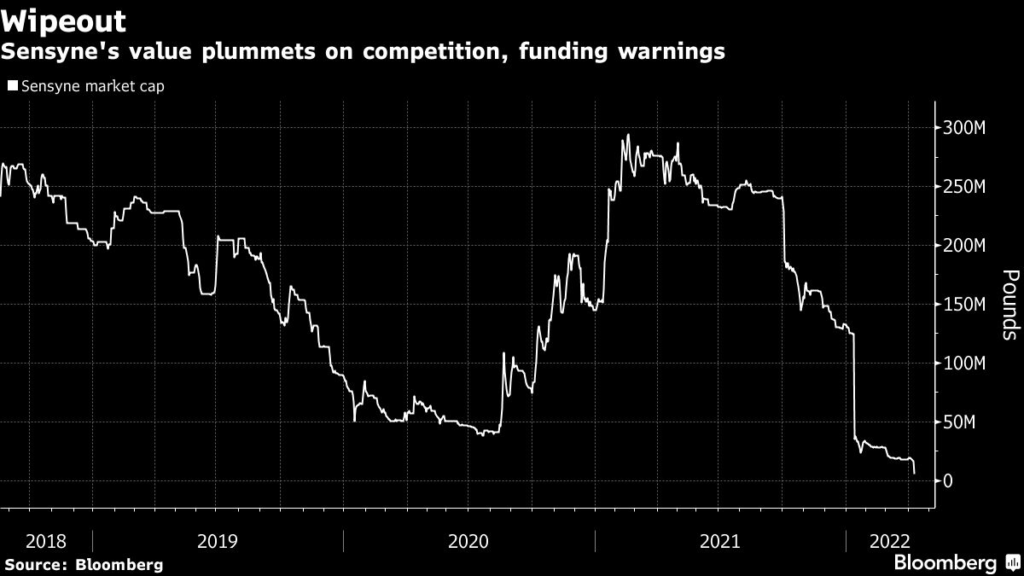
Shares of the Oxford, England-based artificial intelligence firm dropped as much as 89% after it announced a “highly dilutive” convertible note pact that secures it 15 million pounds ($19.6 million). The stock will be delisted from London’s AIM market as a result, the company said, adding that without the fresh funds it would be unlikely to continue trading beyond this month.

Founder and Chief Executive Officer Paul Drayson, a member of the U.K. House of Lords and former Minister of Science under the last Labour government, has resigned, the company said. Drayson and his wife Elspeth together own about 24% of the company, according to data compiled by Bloomberg.

Worth more than 285 million pounds a year ago, Sensyne’s plunge on Friday saw its market capitalization drop to just 5 million pounds. The loss-making firm, which says its Sensight product offers access to real-world data on millions of patients, has warned investors of increased competition.

Lord Drayson will be replaced as CEO by Alex Snow, former chairman at U.S.-listed Exscientia Plc, Sensyne said. The shares were down 69% to 3.05 pence as of 12:15 p.m. in London. 

More stories like this are available on bloomberg.com

©2022 Bloomberg L.P.

TalkTalk Owners Explore Options Amid Telecoms Consolidation Push

(Bloomberg) — The owners of TalkTalk Telecom Group Ltd are exploring strategic options, including a potential sale of the business, according to people familiar with the matter.

While the company has held talks with potential buyers, no formal offers have been lodged for TalkTalk, one of the people said. Lazard Ltd., the long-time adviser to TalkTalk, is working with the company, the people said, asking not to be identified because the talks are private. 

Salford, England-based TalkTalk is a low-cost internet service provider with over 4 million customers, according to its last annual report. It was taken private by investment fund Toscafund Asset Management LLP in 2020 for about 2 billion pounds ($2.6 billion), including debt. 

U.S. telecom giant Comcast Corp, which owns pay-TV and broadband company Sky Ltd., and London-based phone group Vodafone Group Plc, are mulling approaches, Sky News reported Friday. TalkTalk founder and co-owner Charles Dunstone believes the business is now worth at least 3 billion pounds, the report said.

Representatives for TalkTalk, Vodafone and Toscafund declined to comment, while representatives for Lazard and Comcast didn’t immediately respond to requests for comment.

Vodafone has been talking to parties to consolidate its presence in key European markets. In February, Vodafone Chief Executive Officer Nick Read said he was on the lookout for deals in the U.K., as well as Spain, Italy and Portugal. Since then he’s missed out on a deal in Spain and rejected an approach in Italy.

More stories like this are available on bloomberg.com

©2022 Bloomberg L.P.
Close Bitnami banner
Bitnami