Bloomberg

Sanctioned Russian Billionaires Looking to Sell Fintech Bets

(Bloomberg) —

Two U.K. fintech companies are exploring sale options after sanctions on their Russian billionaire backers have left them struggling to find funding.  

FIBR Tech Ltd., an online lender to businesses, and ANNA Money, which offers business accounts and administrative services, began searches for buyers in recent weeks after indirect shareholders including Mikhail Fridman and Petr Aven were hit by sanctions. 

The move to sell the two firms is part of an effort to find new sources of capital for the lenders. The action mirrors other deals rippling through the financial world as a number of Russians, either already hit by sanctions or at risk of getting drawn into the net, look to sell some assets. 

“We as a company – FIBR Tech Ltd. – can confirm that we have engaged FRP Advisory to advise in relation to strategic and restructuring options for FIBR,” Chief Executive Officer Bivu Das said in a statement.

“The founders of ANNA are currently in the process of negotiating a buy-out,” a spokesperson for ANNA said in a statement. “One of the conditions precedent for such a transaction is that it should be compliant with U.K. and EU sanctions law. We cannot comment further until it is completed.”

ABH Holdings

The two businesses are owned by ABH Holdings, a Luxembourg-based company whose owners have included Fridman, Aven and also German Khan and Alexey Kuzmichev. All four have been sanctioned. They have a combined fortune of about $29 billion, according to the Bloomberg Billionaires Index.

ABH, which hasn’t been sanctioned, also owns Alfa-Bank, the Moscow-based lender that Fridman founded more two decades ago and helped to turn into one of Russia’s biggest with assets totaling more than $60 billion. Alfa has been sanctioned in multiple jurisdictions. 

Advisers to ANNA Money are seeking at least 30 million pounds ($39 million) for the business which was set up 2017, according to a person familiar with the process. The asking price for FIBR’s U.K. unit isn’t known.

FIBR also has a separate European arm, which has its headquarters and a banking license in Holland. The business overall lent over 20 million euros ($22 million) to over 175 small- and medium-sized businesses in the U.K. and Netherlands, according to an October AltFi article.

(Adds Bloomberg Billionaires Index data in the sixth paragraph.)

More stories like this are available on bloomberg.com

©2022 Bloomberg L.P.

Musk Says Tesla Cybertruck, Roadster and Semi Coming Next Year

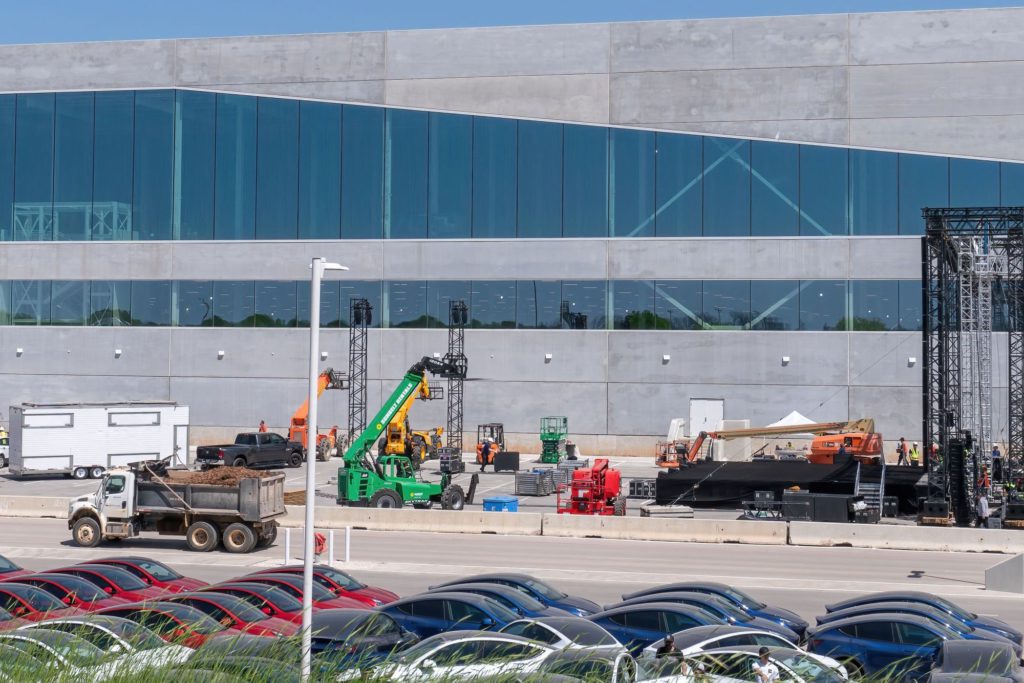
(Bloomberg) — Tesla Inc. will start production next year of three products that have fallen well behind Elon Musk’s original schedule, the chief executive officer said at the opening of the carmaker’s newest factory.

“We’ll be in production with Cybertruck next year, we’ll be in production with the Roadster, and with Semi,” the billionaire said on stage at the company’s “Cyber Rodeo” late Thursday in Austin, Texas. “This year is all about scaling up, and then next year, there’s gonna be a massive wave of new products.”

When Musk, 50, first unveiled Tesla’s angular pickup in November 2019, he said production would start in late 2021. The electric-vehicle maker announced in January it was delaying introductions of new models to next year, citing challenges scaling up existing products in the midst of supply-chain issues.

Musk showed prototypes of the Semi and next-generation Roadster in November 2017, and they’re much tardier than the Cybertruck. At the time of their unveiling, initial production was planned for 2019 and 2020, respectively.

For all the timelines Tesla hasn’t met, the carmaker has been on a roll since it introduced the Model Y, the first Texas-made units of which were delivered during the event. 

With additional capacity coming online at factories in Austin and near Berlin, BloombergNEF analysts expect Model Y to be the world’s best-selling EV this year, and to potentially crack the top five among all vehicles — electric or otherwise.

Drones and Doge

Tesla obtained a permit to host 15,000 people at its grand opening in Austin, which was replete with art installations and a bevy of Model Ys arranged to look like the Texas state flag. The event kicked off with hundreds of drones flying in the night sky to form the state of Texas, a Cybertruck and a Shiba Inu dog.

Musk drove on stage in a first-generation Roadster and cracked jokes with Franz von Holzhausen, Tesla’s chief designer, about smashing the windows of an updated version of the Cybertruck.

“I can’t wait to have this baby in production,” Musk said. “It’s gonna be epic.”

Musk delivered his usual series of superlatives, calling the Austin facility “the most advanced car factory that Earth has ever seen.” Tesla shared footage of larger 4680 battery cells the CEO said were being manufactured on site.

“We think, over time, this will probably be the biggest cell factory in the world,” he said. Musk made a similar prediction in November 2020 that Tesla’s then-under-construction plant near Berlin would be the biggest globally.

Cranking Out Cars

Of course, Tesla has followed through on some of its CEO’s pronouncements with respect to scale. The company made more cars at its Fremont, California, factory last year than any other assembly plant in North America. Musk said Austin will become America’s highest-volume auto factory, without giving a timeline.

After Musk’s remarks, fireworks lit up the night sky to the tune of Beethoven’s Symphony No. 5. 

The party drew scores of fans, including actor Harrison Ford. He was spotted in the VIP lounge along with Musk’s mother, Maye, and brother, Kimbal, a director on Tesla’s board.

Some fans who showed up at the strobe-lit factory in hopes of getting in without tickets were turned away by Tesla security.

(Updates with Musk’s comment in the second paragraph.)

More stories like this are available on bloomberg.com

©2022 Bloomberg L.P.

Bearish Signals Flash at China Giants After Recovery 

(Bloomberg) — The recent recovery of Chinese technology stocks hasn’t just lured bargain hunters. Short sellers are piling in, too. 

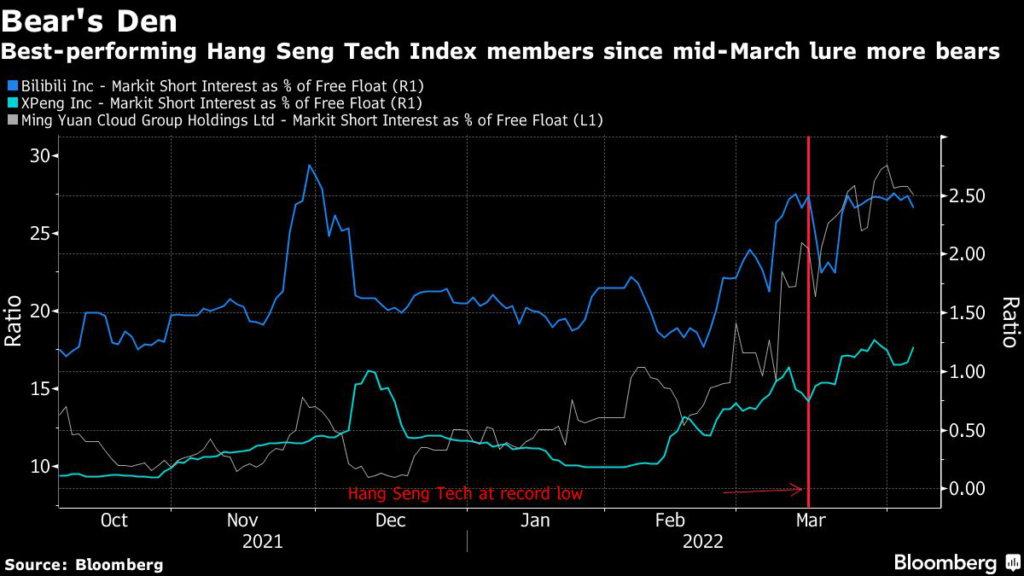
Bearish bets have risen on six out of the 10 best performers in the Hang Seng Tech Index since the benchmark’s record low in March, according to data from IHS Markit Ltd. And four of Hong Kong’s 10 most-shorted stocks are in the tech sector, include online-game company XD Inc. Video streamer Bilibili Inc. has seen short interest jump to near a record high.

Short interest accounts for a tiny portion of most tech companies’ free-floating shares in Hong Kong. Still, the increasing demand for downside protection when stocks rebound reflects how cautious investors are because of Beijing’s new regulations, worsening Covid lockdowns in China and U.S. interest rate increases. It’s already paying off, with the tech index dropping Friday for a third day. 

“The tech rally should be short-lived,” said Paul Pong, managing director at Pegasus Fund Managers Ltd., who has been cutting his holdings during the rebound. “We may see recent gains wiped out quickly. U.S. rates could be lifted at a faster-than-expected pace, which is big trouble. Also, China’s regulation keeps coming.” 

In the latest example of the regulatory crackdown, China on Friday kicked off a campaign to rein in the potential abuse of algorithms by internet giants, taking aim at the way they serve up ads and content to hook users. 

Tencent Holdings Ltd. also said it will shut its game streaming service, more than a year after Beijing blocked its effort to create a competitor to Amazon.com Inc.’s Twitch through a merger.

Although the sector is still up almost 30% from the bottom, market sentiment is fragile. The Hang Seng Tech Index dropped 1.2% Friday and registered its sixth weekly decline in the past eight weeks.

To be sure, short-term volatility of the tech index has fallen to levels prior to the epic rout in early March, when the index plunged 21% in three days. But coping with a new normal of a slowing Chinese economy and tightened regulation looks challenging. 

Technology giants including Alibaba Group Holding Ltd. and JD.com Inc. have announced big layoffs in the past three months as they seek to cut cost and stabilize margins. But it may be just a beginning. 

“From a company perspective, we believe cost savings will not only be through headcount reduction, but also lower sales and marketing expenses,” said John Choi, an analyst at Daiwa Capital Markets Hong Kong Ltd. “The easy growth phase is over in the China Internet sector and prudent resource management will likely be the new trend.” 


Tech Chart of the Day

Top Tech Stories

  • Taiwan Semiconductor Manufacturing Co. revenue rose to a record in the first quarter on demand for chips used in smartphones, computers and cars, while a prolonged shortage helped to boost prices.
  • Elon Musk, who was added to Twitter Inc.’s board after accumulating a stake in the social network, will join CEO Parag Agrawal at an all-hands company meeting next week to address employee questions.
  • The U.S. SEC rejected a request by Meta Platforms Inc. to quash a proposal from Arjuna Capital LLC asking for a third-party evaluation of the potential psychological, civil and human rights harms of the metaverse.
  • Atlassian Corp. announced a goal of $10 billion in annual revenue as the provider of productivity and collaboration tools continues its pivot to the cloud and expands its product line to reach a wider swath of corporate business.
  • Venture capitalists poured $9.7 billion into rapid-delivery companies globally in 2021, according to PitchBook. A few months into 2022, that optimism seems like a distant memory.

More stories like this are available on bloomberg.com

©2022 Bloomberg L.P.

Ukraine Grid Warns Russia Moves Could Affect Europe Gas Flow

(Bloomberg) —

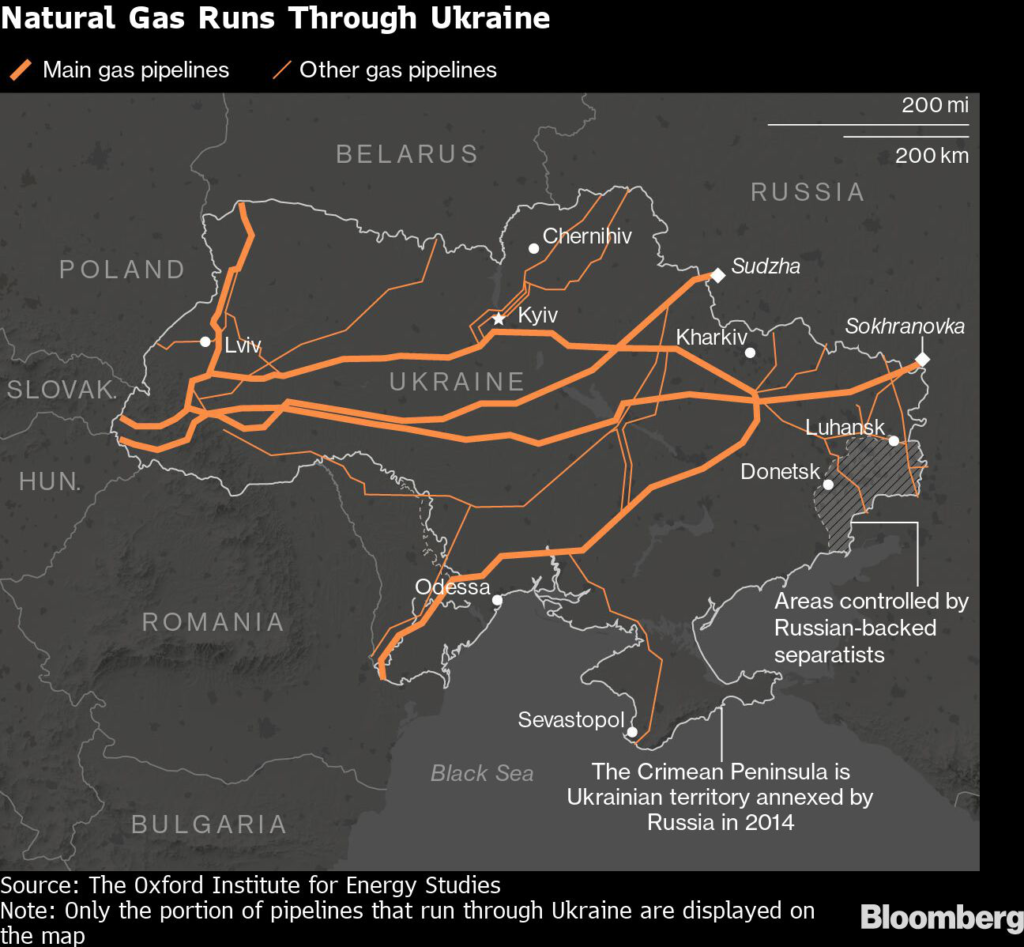
Ukraine’s natural gas grid warned that transit flows to Europe could be affected as Russia and illegal armed groups are disrupting operations at a key compressor station.

Occupiers are interfering with operations at the Novopskov gas compressor station in the Luhansk region, Gas Transmission System Operator of Ukraine said in a statement. The infrastructure is key for about a third of Russian gas that Ukraine transits to Europe.

The grid warned it will be forced to stop operations at the facility in case it loses control of operations. Disconnecting the compressor station will mean no transit through Sokhranivka, a key entry point for Russian gas, it said. 

“Responsibility for the consequences falls on the Russian Federation,” the grid manager said. Occupiers have taken actions including changing the operation of communication equipment and technological modes at the Novopskov station, it said. Russia’s exporter Gazprom PJSC didn’t immediately respond to a request for comment. 

Earlier on Friday, Gazprom said it’s sending gas to Ukraine for further transit to Europe as normal. Gas-shipping orders declined from a day before. But flows are in line with client requests, the company said. 

Russia supplies about 40% of the European Union’s gas demand and about a third of that is transited via Ukraine, making it a linchpin in the continent’s energy security. While gas prices have eased recently, as the weather gets milder and Europe is getting near-record volumes of liquefied natural gas, traders in Europe remain on edge. 

Any potential damage to Ukraine’s gas network or any decision by Russia to curb flows in response to international sanctions could trigger a supply crunch. Russian troops are preparing for redeployment to eastern Ukraine ahead of what’s expected to be a major offensive there. 

(Updates with Russian gas flows via Ukraine in 5th paragraph)

More stories like this are available on bloomberg.com

©2022 Bloomberg L.P.

Grocers Lift Staff Pay as U.K. Cost-of-Living Crisis Deepens

(Bloomberg) —

Britain’s biggest grocers are increasing pay to retain workers as rising inflation causes the worst cost-of-living crisis in decades.

Tesco Plc, the country’s largest grocer, said Thursday that it’s lifting wages by almost 6%. Smaller rival J Sainsbury Plc told staff Friday that from May all workers will receive the so-called real living wage — currently 11.05 pounds ($14.43) in London and slightly lower outside the U.K. capital. 

The moves show how British companies are being forced to respond to the cost-of-living crisis, which is pinching consumer budgets as the prices of fuel, energy and food soar. U.K. supermarket employees are among those worst-affected, with an increasing number using food banks, according to the Independent Food Aid Network. 

Sainsbury said this is the second time it is amending its pay for staff since January as it seeks to help shop workers deal with the increasing cost of living. 

“We know times are tough for everyone,” said Simon Roberts, chief executive officer.  

Other companies across Britain are also facing demands for higher pay. Telecommunications company BT Group Plc on Thursday announced a 1,500-pound increase for its workers, calling it the biggest award in two decades. However, the Communications Workers Union, which represents nearly half of its staff, said the offer was “insulting” at a time when inflation is surging.  

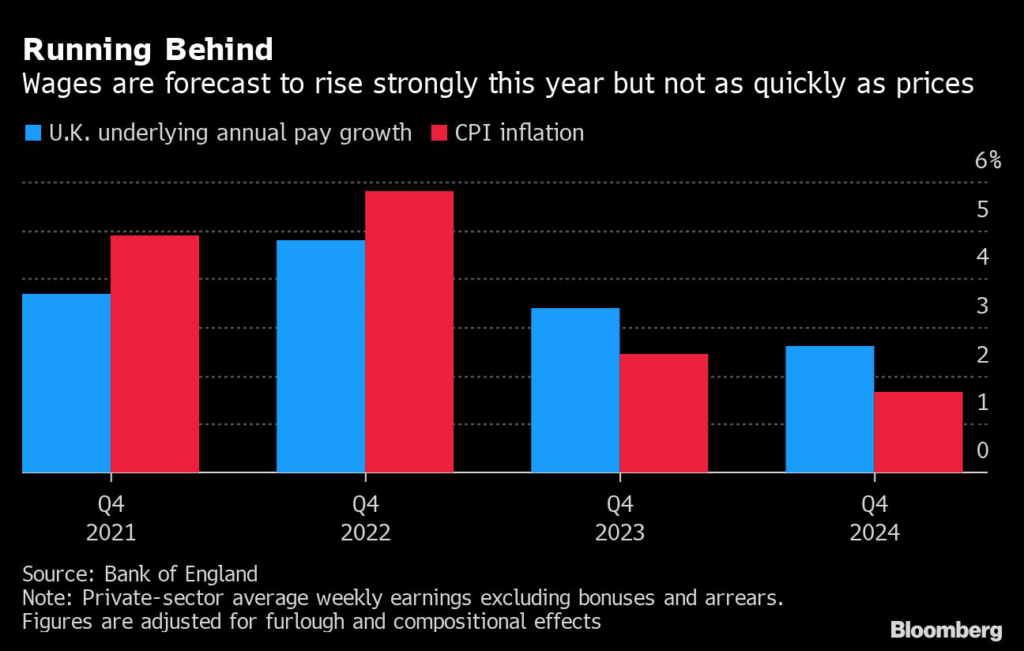
The Bank of England says higher wages threaten to cause an upward spiral in prices. Policy makers have boosted interest rates three times since December and are expected to act again as early as next month to clamp down on inflationary forces.

Consumer prices rose 6.2% in February, and the central bank has warned inflation could hit double digits by the end of the year, fueled by a surge in energy, food and clothing prices. Pay growth eased during the coronavirus lockdowns in 2020 and then surged as much as 8.8% in the middle of last year as the economy reopened and companies struggled to find workers.

Wage increases since then have settled down to a more moderate pace of under 5%, though Britain’s low productivity levels mean even that level may be more inflationary than in years past. The BOE’s target is to keep inflation to 2%.

British businesses facing pay rise requests have to balance those with the need to invest in the business at a time when costs are soaring and supply-chain problems and geopolitical concerns are weighing on sentiment. This is particularly difficult for supermarkets, which collectively employ hundreds of thousands of people and operate in a highly competitive industry that’s being disrupted by the growth of discounters and online shopping. 

Tesco is increasing the hourly rate for shop and warehouse workers to 10.10 pounds from July 24, with staff in London receiving 10.78 an hour. Truck drivers, who are in strong demand as online grocer ordering takes off, will receive 11 pounds hourly. The company said that while it normally agrees to two-year deals with union workers, it will review wages again next year because of the uncertainty in the economy.

Sainsbury’s enhanced pay will make it the highest payer in the U.K. industry and the first grocer to provide the real living wage to supermarket employees, who were designated as key workers by the U.K. government during the pandemic.   

The real living wage is the minimum hourly rate necessary for workers to afford housing, food and other basic needs, according to the Living Wage Foundation. Sainsbury workers in central London were already receiving the 11.05-pound hourly rate; those in outer parts of the capital will now get it as well, while those in other regions of the U.K. will receive 10 pounds an hour — 10 pence above the real living wage for those regions.

Sainsbury was already facing a demand from more than 100 shareholders including HSBC Holdings Plc to pay the higher living wage to all its employees. The resolution was to be voted on at the annual meeting later this year. 

Even before the cost-of-living crisis, supermarkets, which for many years were among the lowest-paying sectors in Britain, felt pressure to increase wages as competition for staff became more intense. Britain’s exit from the European Union — for years a ready source of labor — has worsened labor shortages.  

Tesco said its latest increase means that its hourly rate of pay has increased by more than 40% in the past decade. Sainsbury’s hourly level has increased by about 25% over the past five years. Since the grocer acquired electronics retailer Argos in 2016 it has increased staff wages there by about 39%.

BOE Governor Andrew Bailey in February urged workers to hold off on inflation-busting pay demands, saying policy makers would have to respond with higher borrowing costs. That drew jeers from union and research groups concerned that wages are failing to keep up with rising prices, delivering the biggest squeeze on living standards since the 1970s.


(Updates with Sainsbury confirmation in fourth paragraph and additional details on grocer pay from 10th paragraph)

More stories like this are available on bloomberg.com

©2022 Bloomberg L.P.

Indonesia’s Tiket Weighs Blibli Merger Before $1 Billion IPO

(Bloomberg) — Tiket.com, an Indonesian online travel booking company, is considering a merger with e-commerce platform Blibli after talks with a blank-check company fell through, according to people familiar with the matter.

The travel firm could join with PT Global Digital Niaga, as Blibli is formally known, ahead of a planned initial public offering in Jakarta, the people said. A first-time share sale for the combined firm could raise about $1 billion, they said, asking not to be identified as the information is private. Both companies count Indonesian conglomerate Djarum Group as a backer.

Tiket was considering going public through a merger with a special purpose acquisition company. The startup’s discussions with COVA Acquisition Corp. have ended, the people said.

Deliberations are ongoing and no final decisions have been made, the people said. Representatives for COVA and Tiket declined to comment, while representatives for Blibli didn’t immediately respond to requests.

The potential tie-up comes as Indonesian startups turn to the country’s IPO market despite malaise in the rest of the world. Blibli would join GoTo Group, the country’s largest tech company, which raised $1.1 billion in an IPO last month and is set to start trading on Monday.

Along with the option of a potential SPAC merger, Tiket was also exploring a traditional IPO as well as possibly combining with one of the Southeast Asian super apps, Chief Executive Officer George Hendrata told Bloomberg TV last May.

Tiket was founded in 2011, and was acquired in 2017 by Djarum Group. Tiket’s platform lets consumers buy tickets for flights and trains as well as hotel rooms and events such as concerts. It has a network of more than 90 airlines, 2.8 million hotels and other lodgings.

Blibli is working with Credit Suisse Group AG and Morgan Stanley on its planned IPO, Bloomberg News has reported. Founded in 2011, Blibli is an online mall for goods including electronics and lifestyle products, and collaborates with more than 100,000 business partners, according to its website. 

More stories like this are available on bloomberg.com

©2022 Bloomberg L.P.

EU Sees Window in Biden’s First Term to Lock In Trade Gains

(Bloomberg) — The European Union is aiming to lock in progress on trade and technology disputes with the U.S. during President Joe Biden’s first term amid concerns that any gains could otherwise be easily reversed.

The EU’s executive arm sees a window of opportunity in the next two-and-a-half years to cement the bilateral ties and progress made in trade disputes and regulatory cooperation, people familiar with the discussion said.

France, which is currently helming the EU presidency and is a strong advocate of strengthening Europe’s strategic autonomy, warned that the bloc should be prepared for a change of course in Washington and needs to preserve its regulatory freedom, the people said.

The EU’s deliberations show the scars of former President Donald Trump’s more confrontational approach to the bloc, as well as an awareness of Biden’s own political vulnerabilities. The U.S. president’s polls are sagging, Democrats may lose control of at least one chamber of Congress in November, and the 2024 presidential election is wide open.

Both sides are planning to agree on a series of measures on economic cooperation during the next meeting of the U.S.-EU Trade and Technology Council on May 15-16 in France.

This forum has gained new relevance following Russian President Vladimir Putin’s invasion of Ukraine as the two sides are exploring how to strengthen their alliance amid the war. 

May Meeting

The EU’s aims for the May TTC meeting include bolstering bilateral consultation on export controls, investment screening and non-tariff barriers.

The TTC played a role over the past weeks in preparing the sanction packages on Russia, including export controls.

Member states including Germany, Poland, Latvia and Belgium are urging the bloc to deepen further the bilateral cooperation on sanctions and exports control, particularly after Russia’s attack on Ukraine. 

The European Commission is also seeking an agreement on an early-warning mechanism to ensure that regulatory standards are in line with common interests, and a commitment to jointly mitigate vulnerabilities in supply chains.

In spite of the positive momentum and shared transatlantic values, the bloc remains cautious about the possibility of progress on some regulatory matters and trade priorities, including the overhaul of the World Trade Organization.

Brussels wants to bring Washington on board to avoid new trade barriers, combat distortive practices from non-market economies and promote using the WTO multilateral track. The U.S., however, is focusing more on its rivalry with China, and work on other areas including forced labor still lacks details, people familiar with the discussion said.

Both sides had warned China of consequences in case it supports Putin in its war efforts against Ukraine. The U.S. is sticking to a more assertive stance toward China’s unfair trade and economic practices, but the EU sees Beijing not only as a systemic rival, but also as a partner on global challenges including climate change.

Some countries including France, Germany and Belgium have rejected echoing the anti-China rhetoric emerging from Washington and don’t want to turn the TTC in a platform aimed against Beijing, the people said.

More stories like this are available on bloomberg.com

©2022 Bloomberg L.P.
One Creditor Is Delaying Zambia’s Debt Revamp, U.K. Says

(Bloomberg) — Zambia’s reorganization of as much as $17.3 billion of external debt is being delayed by a single foreign creditor, according to U.K. Minister for Africa Vicky Ford.

“We’ve got one creditor that seems to be — one international creditor — that seems to be taking a bit more time to make a decision,” Ford, who is visiting Zambia, said in comments broadcast on Hot FM radio Thursday in the capital, Lusaka. “I discussed that with the foreign minister as well last night, and I know that he has been working incredibly hard to try and speed up that process.”

Zambia, which became Africa’s first pandemic-era sovereign defaulter in 2020, has been seeking to restructure its dollar obligations under the Group of 20’s Common Framework, a set of guidelines that the most powerful countries drafted to mitigate debt crises in poorer states. Under those rules, Zambia first needed to reach a preliminary bailout deal with the International Monetary Fund, which it did in December.

Disagreements among official creditors or prolonged negotiations with private lenders could delay an eventual restructuring deal and IMF approval into the second half of this year or even into 2023, Fitch Ratings said this week. A “sizable” treatment will be required to return the nation to debt sustainability, the company said.

Zambia’s $1 billion in Eurobonds due April 2024 have fallen 6% this year to trade at 74 cents on the dollar by 9:33 a.m. in London.

Zambian Finance Minister Situmbeko Musokotwane on Dec. 15 asked bilateral lenders to form an official creditors committee as soon as possible. That’s yet to happen, even as the IMF and World Bank have since completed a debt sustainability analysis that sets the economic criteria used in negotiations for debt treatment.

Ford didn’t identify the creditor that she said has been delaying the process, and Musokotwane declined to name it when asked at a briefing on Thursday. 

“I am afraid I can not release that because there are diplomatic issues that we are following,” he said in Lusaka. “Mentioning the name obviously does not help.”

Puzzling Plans

The creditor slowing the process is China, as it has remained reluctant to support Zambia’s IMF program, Lusaka-based News Diggers! newspaper reported Friday, citing government officials it didn’t name. The Chinese Embassy in Lusaka didn’t immediately respond to emails seeking comment. Chinese creditors were “puzzled” about Zambia’s restructuring plans, the nation’s then ambassador to Zambia, Li Jie, said in November.

Out of Zambia’s total $17.3 billion of external public-sector debt, commercial and state-owned Chinese lenders account for $5.5 billion, making the nation by far the biggest source of Zambia’s loans, according to Finance Ministry data. Zambia owes $3.3 billion in Eurobonds and interest arrears since it defaulted at the end of 2020 and stopped servicing almost all other international loans. It also has a $147 million debt to Russia’s export-import bank.

Zambia had been targeting a deal with creditors in the first half of this year, in order to have its $1.4 billion deal with the IMF concluded by June. There has been behind-the-scenes work to establish an official creditors committee co-chaired by China and South Africa, Eurasia Group said in a note to clients last week.

South Africa is still finalizing its delegation for the creditor committee for Zambia, the National Treasury said in reply to emailed questions on April 4. 

The Paris Club, a group of wealthy nations, is spearheading the creditor committee’s formation, Musokotwane said, adding that he was optimistic on securing an IMF program by mid-year. China isn’t a permanent member of the club, but an ad-hoc participant, which gives the nation less decision-making power in a debt workout under Paris Club guidelines. 

Ford said she’d discuss with the IMF and World Bank how to expedite Zambia’s debt treatment at their spring meetings in Washington from April 18 to 23.

“I’m really encouraging them to say: How can we get this process going faster?” said Ford. “Because the longer it’s going, the more that overhang of uncertainty is going to impact on people here.”

(Updates with newspaper identifying the creditor as China in first paragraph below Puzzling Plans suheadline)

More stories like this are available on bloomberg.com

©2022 Bloomberg L.P.
Chinese Tech Stocks Fall as Tencent Shuts Game Streaming Site

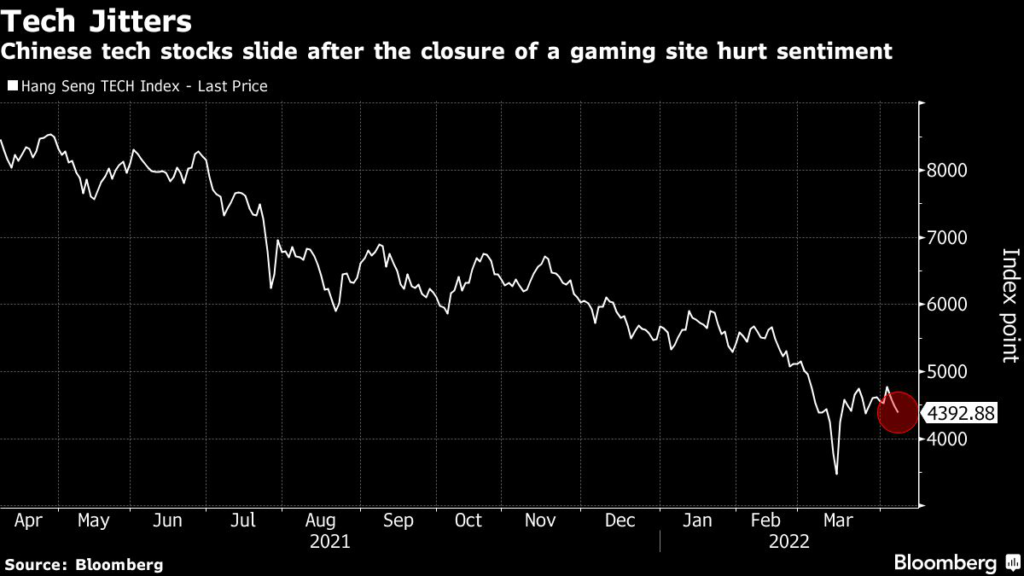
(Bloomberg) — Chinese tech stocks slid for a third day as Tencent Holdings Ltd.’s decision to shut its game streaming service further hurt sentiment in a sector already bogged down by regulatory risks. 

The Hang Seng Tech Index closed down 1.2% on Friday, having earlier shed as much as 3%. Video streaming firm Bilibili Inc. and Tencent supplier GDS Holdings Ltd. were among the worst performers. Meituan also weighed on the gauge, following news that Sequoia Capital reduced stakes.  

Read: Tencent Closes Game Streaming Site After Beijing Blocks Merger

Tencent’s decision comes more than a year after Beijing blocked a merger between its investees, an entity which the soon-to-be closed platform Penguin Esports would have been folded into. China tech stocks have come off a record low in mid-March, but yet to stage a sustainable rally amid regulatory risks.

“Shutting down Penguin Esports or any other service will weigh on cloud, data services demand by Tencent, affecting suppliers like GDS,” said Ivan Chow, president of Imperial Financial Group.

Shares of live-streaming platforms led a decline in U.S.-listed Chinese stocks on Thursday, with the Nasdaq Golden Dragon China Index closing 4.5% lower.   

Fragile 

Investors remain wary about the fragile tech sector following the yearlong rout, with shares hit recently after Beijing’s crackdown on the live-streaming sector’s tax evasion. Even as Chinese authorities have repeatedly vowed to add policy stimulus and stabilize markets, it’s done little to ease concerns about the spillover from higher U.S. interest rates, among other risks.

On Friday, China’s regulator said it will start a campaign until early December to curb violations in internet companies’ algorithm, warning that websites and platforms with big influence will be targeted.

Read More: China Targets Big Tech’s Algorithms as Crackdown Persists (1)

The announcement appeared to ensure that tech companies are transparent with consumers on the data they are collecting to protect privacy, said Wai Ho Leong, strategist at Modular Asset Management. 

But with some apps already giving users an option to turn-off personalized push services, “the spirit of these regulations and the inevitable inspections and audits may have been expected since earlier this year,” he said. 

Meanwhile, the broader Hang Seng Index reversed losses to gain 0.3%, led by a rally in property and financial shares. China’s benchmark CSI 300 Index ended 0.5% higher. 

More stories like this are available on bloomberg.com

©2022 Bloomberg L.P.
Trucking Startup G7 Weighs $500 Million Hong Kong IPO

(Bloomberg) — G7, a fleet management company backed by Tencent Holdings Ltd., is weighing an initial public offering in Hong Kong that could raise about $500 million as soon as this year, people with knowledge of the matter said. 

The Chinese firm is working with China International Capital Corp., Citigroup Inc. and Morgan Stanley on the proposed share sale, said the people, who asked not to be identified as the information is private. 

Deliberations are ongoing and details of the fundraising such as size and timing could change, the people said. Representatives for CICC, Citigroup and G7 declined to comment, while a representative for Morgan Stanley didn’t immediately respond to requests for comment. 

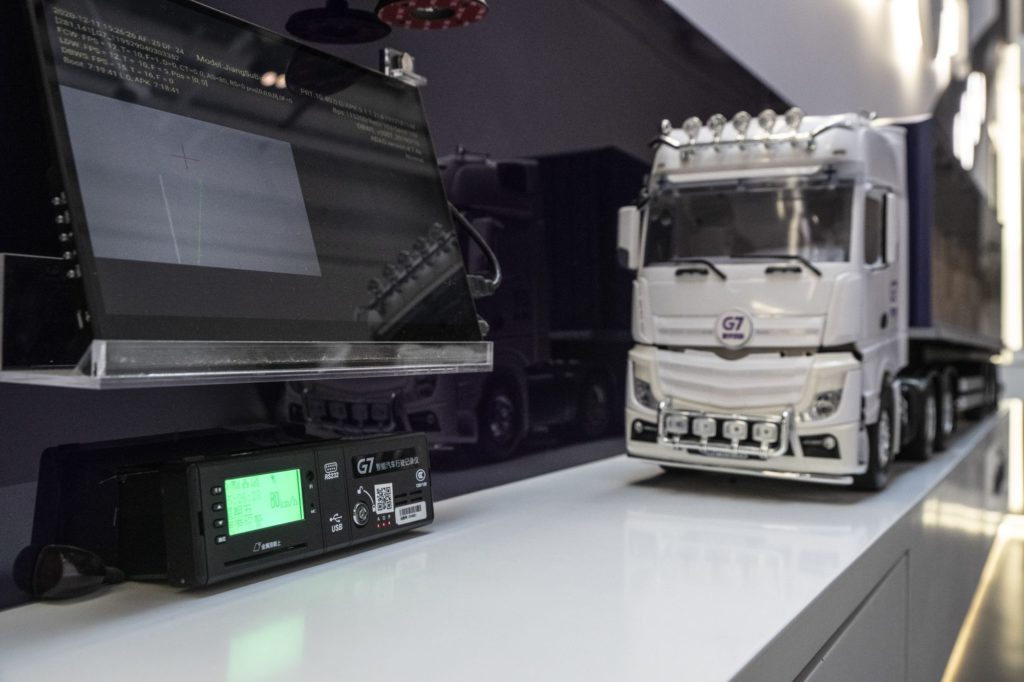
G7 uses artificial intelligence and Internet of Things technology to manage road freight and logistics services. It employs anti-fatigue cameras to call out bad driving, built-in advanced driver-assistance systems to send warnings about insufficient space between vehicles on highways, and real-time cargo weighing to prevent stealing.

Read More: Trucks in China Are Watching If Drivers Doze, Speed or Slack Off

The company was founded in 2010 and takes its name from the G7 Beijing–Urumqi Expressway, the world’s longest desert highway. It raised $200 million in a round led by Trustbridge Partners and CS Capital in February, according to a press release. 

G7 formed a joint venture in 2018 with Singapore-based investor GLP Pte and Nio Capital, a unit of electric vehicle maker Nio Inc., to focus on areas such as developing smart heavy-duty trucks powered by autonomous driving and logistics big data, a separate press release shows. 

The startup counts GLP, Bank of China and Temasek Holdings Pte among its backers, according to the same release.

(Updates with CICC response in third paragraph.)

More stories like this are available on bloomberg.com

©2022 Bloomberg L.P.
Close Bitnami banner
Bitnami