Bloomberg

Elon Musk to Join Twitter CEO Agrawal for Staff Q&A Next Week

(Bloomberg) — Elon Musk, who was added to Twitter Inc.’s board after accumulating a stake in the social network, will join Chief Executive Officer Parag Agrawal at a company all-hands meeting next week to address employee questions.

Agrawal will host Musk at the Q&A session to help ease internal concerns about the impact the billionaire will have on the company’s internal culture and policies, according to the Washington Post, which earlier reported the meeting. A Twitter spokesman confirmed the company’s plans.

On April 4, Musk, 50, disclosed that he’d taken a more than 9% stake in Twitter. The following day, Twitter said Musk was joining its board, and Musk filed a new form with the U.S. Securities and Exchange Commission classifying himself as an active investor. He had earlier submitted the form reserved for passive shareholders.

Musk, CEO of automaker Tesla Inc., is the world’s richest man, according to the Bloomberg Billionaires Index. He’s also one of the biggest personalities on Twitter and has regularly stirred controversy on the platform. He is currently seeking to exit a 2018 deal with the SEC that put controls in place related to his tweeting about Tesla.

Citing internal company messages, the Washington Post on Thursday reported that some workers in recent days have expressed concern on Twitter’s employee Slack channels that Musk could inflict damage to the company’s culture, as well as make it harder for people to do their jobs.

More stories like this are available on bloomberg.com

©2022 Bloomberg L.P.

Thiel Blasts Dimon, Buffett and Fink as ‘Finance Gerontocracy’ at Bitcoin 2022

(Bloomberg) — Billionaire entrepreneur Peter Thiel called Warren Buffett, Jamie Dimon and Larry Fink members of a “finance gerontocracy” opposed to a “revolutionary youth movement” that embraces Bitcoin.

In his keynote speech at the Bitcoin 2022 conference in Miami Thursday, Thiel blamed the finance titans for the digital currency’s failure to reach $100,000, a benchmark popular among the asset’s die-hard supporters.

“What is it going to take for this to happen?” he asked, before pinning blame on Buffett, 91, whom he called a “sociopathic grandpa,” as well as Dimon, the 66-year-old chief executive officer of JPMorgan Chase & Co., and Fink, 69, who runs BlackRock Inc. All three have said they’re skeptical of Bitcoin or digital currencies in general. 

A spokesman for BlackRock said the company declined to comment on Thiel’s remarks. But he pointed to Fink’s letter to shareholders last month in which the CEO said a thoughtfully designed digital-payment system “can enhance the settlement of international transactions while reducing the risk of money laundering and corruption.” Digital currencies can also help bring down costs of cross-border payments, Fink wrote.

JPMorgan declined to comment, and a representative of Buffett’s Berkshire Hathaway Inc. didn’t respond to a request for comment.

Bitcoin was little changed at $43,470 as of 8:22 p.m. in New York.

Thiel accused the trio of using investing practices focused on environmental, social and governance goals as a “hate factory” to undermine Bitcoin and other businesses.

Thiel, 54, also attacked central bankers including Federal Reserve Chairman Jerome Powell.

“Mr. Powell — people like that — should be extremely grateful to Bitcoin because it’s the last warning they are going to get,” Thiel said. “They’ve chosen to ignore it, and they will have to pay the consequences for that in the years ahead.”

(Updates with Bitcoin value in sixth paragraph. A previous version of this story was corrected to fix the spelling of “Thiel.”)

More stories like this are available on bloomberg.com

©2022 Bloomberg L.P.

Australia to Send Combat Vehicles to Ukraine After Leader’s Plea

(Bloomberg) — Australia will donate 20 Bushmaster armored combat vehicles to Ukraine following a direct request from President Volodymyr Zelenskiy for the locally-made equipment to help repel the Russian invasion.

The first four vehicles, which have been refitted and repainted with the Ukrainian flag, will be dispatched from the state of Queensland to Europe on Friday, according to a statement. Australian Defense Minister Peter Dutton said that his country would “answer the call” of the embattled leader.

“The idea will be to provide that support to keep people safe and to repel the Russians as quickly as possible from the Ukrainian territory,” he said in an Australian Broadcasting Corp. radio interview Friday.

The Bushmaster is well suited to provide protection to the Ukrainian armed forces soldiers and civilians against mines and improvised explosive devices, shrapnel from artillery and small arms fire, according to the statement. The blast-resistant vehicles are built to carry 10 people and can sustain themselves for up to three days.

Australia has been very vocal in its support of Ukraine since Russia’s invasion in late February, and has already sent more than A$116 million ($86.8 million) in military aid to the country. 

President Zelenskiy directly requested the Bushmaster vehicles in an address to the Australian parliament on March 31, during which he said his country needed urgent support in its war against Russia.

More stories like this are available on bloomberg.com

©2022 Bloomberg L.P.

Atlassian Sets Long-Term Sales Goal of $10 Billion a Year

(Bloomberg) — Atlassian Corp. announced a goal of $10 billion in annual revenue as the provider of productivity and collaboration tools continues its pivot to the cloud and expands its product line to reach a wider swath of corporate business.

“We have a clear and direct path toward it,” co-Chief Executive Officer Scott Farquhar said Thursday in an interview. “We set these goals to give investors comfort around the near-term opportunities.” 

Executives declined to put a specific time frame for hitting that metric during an investor presentation on Thursday. Analysts project Atlassian will generate $2.69 billion in annual sales in the fiscal year ending in June, according to data compiled by Bloomberg. The momentum is a result of a move away from products that run on data centers owned by Atlassian or its clients. The Sydney-based company now expects cloud revenue to jump 50% in each of the next two fiscal years. 

Like most growing software vendors, Atlassian is banking on existing customers increasingly purchasing more services to reach those new revenue targets. To do that, Atlassian and others are trying to become platform providers, effectively offering a suite of applications that can run on one central system. Among other benefits, it’s often easier to get customers to more quickly increase their annual contract sizes because the underlying system has already earned the support of key technology leaders.

“If you trust the Atlassian platform, you inherently trust all the products you use,” said Chief Revenue Officer Cameron Deatsch. “That gives a lot more ability for our customers to use more and more innovation from Atlassian as quickly as possible.”

To achieve its growth targets, Atlassian said it will hire more workers, with plans to eventually employ 25,000 people, up from roughly 7,000 now. As a result, margins are expected to drop to the mid-teens in fiscal year 2023. Investors may sour at that, given broad concerns over growth in the software industry and a potential pullback in spending in some global markets.

Atlassian is protected from such headwinds because its core market of developers and other information technology professionals are increasingly vital to its customers’ own growth ambitions, Farquhar said. 

“When downturns happen, people want to be more efficient,” he said. Companies “might trim their marketing spend or their sales team, but they want to keep their engineers and keep their R&D capabilities.” 

Atlassian plans to grow through sales and product development efforts instead of pursuing large mergers that would boost overall revenue or add new tools to its application suite. The company has acquired about a dozen companies, including a $425 million deal in 2019 to buy project management software provider Trello.

“There are a lot of strategic opportunities out there. At the same time, we set a path to $10 billion without that,” Farquhar said.

Atlassian shares, which jumped 63% in 2021, have dropped 23% this year to $292.97 through Thursday’s close amid a widespread decline in software company stocks.  

On Wednesday, Atlassian announced a slew of new products, including Atlas, a tool designed to solve a pressing problem for businesses: tracking work across an expanding suite of collaboration and productivity applications. It serves as a central hub that business leaders can scan to get short, Tweet-like updates of what everyone in their organization is working on.

Atlassian also released its version of an increasingly popular corporate information repository known as a data lake. Vendors such as Amazon.com Inc.’s cloud division sell such systems to enable companies to compile information from many different applications in one central location. But having one archive for information solely from Atlassian’s systems — as well as the ability to pull in other third-party data, like customer feedback surveys — will enable users to deploy predictive analytics to uncover business improvements, according to Deatsch. 

“Most vendors make that pretty hard when you have multiple applications to get that single view of all of your data,” Deatsch said. But by having such a repository, “you start getting real insights into overall team productivity,” he added.

In a spate of bad timing, many of Atlassian’s signature products continue to suffer from an incident that has kept the systems offline for several days. The company said the incident is “our biggest priority and we have mobilized hundreds of engineers who are working 24-7 to resolve this outage.”

More stories like this are available on bloomberg.com

©2022 Bloomberg L.P.

Meta Loses Bid to Quash Vote on the Future of Metaverse

(Bloomberg) — Meta Platforms Inc. will face a shareholder mandate on whether its planned metaverse virtual world is good for society.

The U.S. Securities and Exchange Commission rejected a request by Meta to quash a proposal from Arjuna Capital LLC asking for a third-party evaluation of the potential psychological, civil and human rights harms of the metaverse. Arjuna wants the company to demonstrate whether any harms could be mitigated or avoided or whether they are simply inherent to the technology. The proposal will now be included in the upcoming list of issues shareholders will vote on at the annual general meeting.

While Meta acknowledges there are risks from the creation of virtual worlds, it argued that the proposal shouldn’t go for a vote because it involved matters related to the company’s “ordinary business operations” which are excluded from shareholder votes. The SEC ruled that the proposal “transcends ordinary business matters.” The proposal, which is unlikely to pass because Chief Executive Officer Mark Zuckerberg controls the voting shares, will come to shareholders later this year.

“Yes, Zuckerberg is emperor at Facebook, but they are facing a lot of headwinds, so it’s not written in stone that Meta will continue in this form forever,” Natasha Lamb, a managing partner at Arjuna Capital, said in an interview. “They are pumping $10 billion a year into a new project when it’s quite obvious they can’t handle their current platform.”

Over the past year, the metaverse — a plan for interconnected virtual worlds — has become an increasing focus for the social media giant. The company, previously known as Facebook Inc., changed its name to Meta in October to underscore the shift. At the same time, concern has grown that the risks already inherent in social media may be amplified in a virtual space.

Meta is still reeling from fallout related to the trove of internal documents that whistleblower Frances Haugen shared with journalists and authorities that suggested Facebook prioritizes profit over content moderation. Facebook’s own research about the harms of Instagram use among young people was one of the most explosive aspects of Haugen’s revelations. Congress and federal enforcement agencies have spent the last several years formulating their own plans to hold Facebook to account, with nothing much to show for it.

Meta declined to comment on the SEC ruling. The company has said it doesn’t plan to develop the metaverse on its own, and will collaborate with policymakers, experts and industry partners. As part of the initiative, Meta said it will invest $50 million to help ensure the space is developed responsibly, including a focus on privacy, safety, equity and inclusion. 


“We’re not saying that nobody should be developing a metaverse,” Lamb said. “What we’re saying is, is Meta the right company to do this when they are so poorly governed and clearly can’t handle what they have in front of them already? Do they have the social license to do this or do they not?”

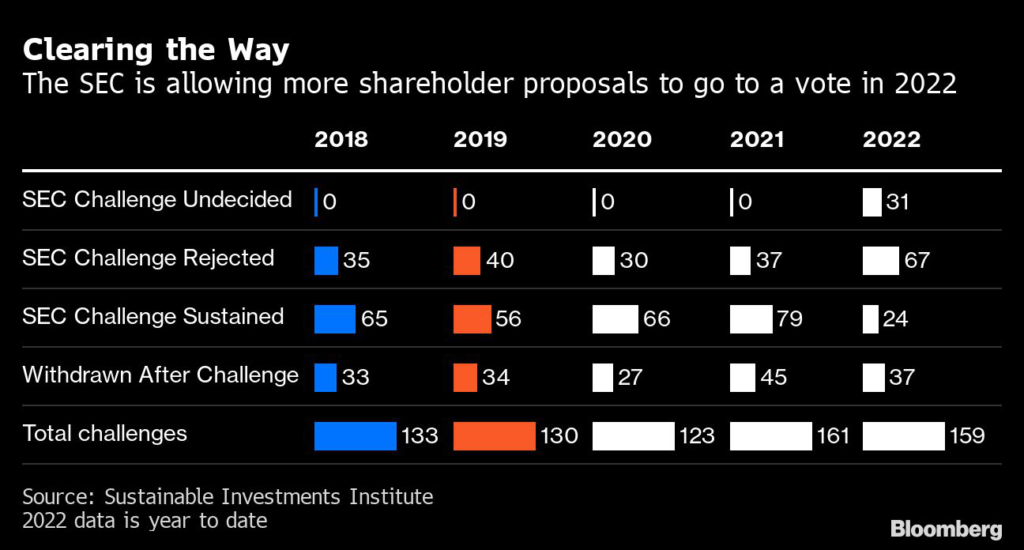
Meta isn’t alone in losing an appeal to the SEC. The agency is rejecting more requests from companies to exclude resolutions related to environmental and social issues from the ballot after a rule change last November that overturned guidance under President Donald Trump that made it easier for companies to block them. The agency said that it would start to include broader social policy considerations when reviewing requests from corporations to exclude proposals that they deemed to be interfering with regular business operations.

Meta is among the companies including Amazon.com Inc., McDonalds Corp., Chevron Corp. and JPMorgan Chase & Co. that failed to convince the SEC to block shareholder proposals for the upcoming proxy season. The regulator has so far blocked 15% of shareholder resolutions for the season compared with 49% last year and 54% in 2020, according to Sustainable Investments Institute, a research firm that tracks shareholder proposals. 


More stories like this are available on bloomberg.com

©2022 Bloomberg L.P.

Murata to Run More Plants Entirely on Renewable Energy by March 2023

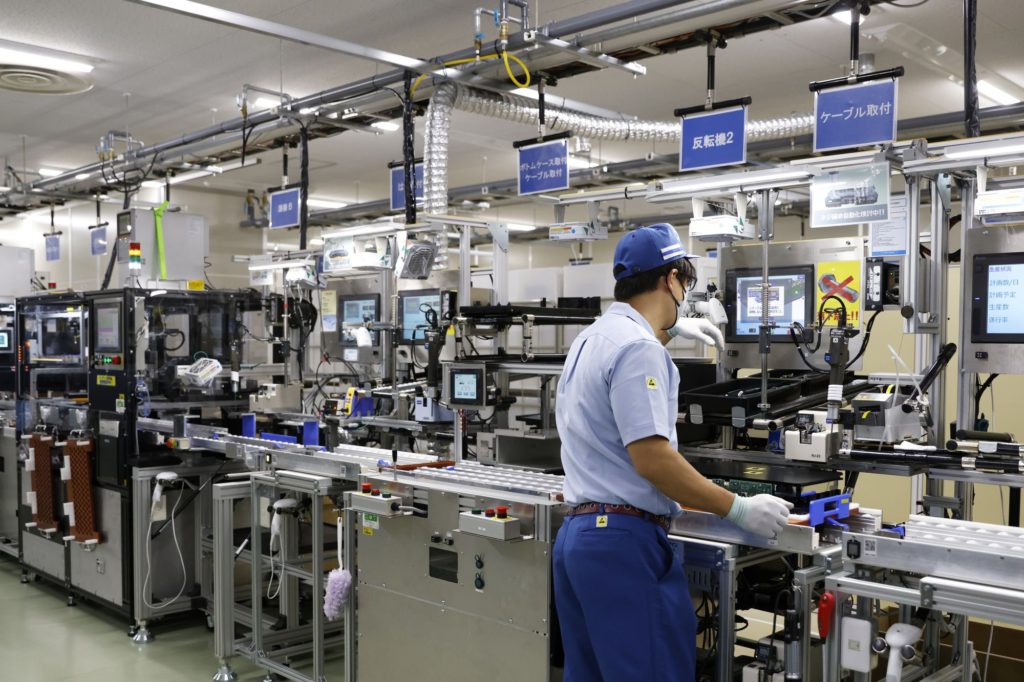
(Bloomberg) — Murata Manufacturing Co. plans to make three more factories in Japan 100% reliant on renewable power by March next year, in a bid to outshine rival iPhone suppliers racing to lower emissions.

The move is in part driven by Apple Inc.’s aggressive initiative to build a carbon-neutral supply chain, but other companies are increasingly making similar requests, Murata President Norio Nakajima told Bloomberg News in an interview.

“Stakeholders and society’s demands have changed, and we must move fast because we can’t do this overnight,” he said. “If we act first, these changes will bring us huge business opportunities.”

A third of Murata’s 230 billion yen ($1.9 billion) capital expenditure budget over the next three years will be dedicated to environment-related projects, he said.

The Kyoto-based firm is the premier supplier of ceramic capacitors — tiny, inexpensive products essential in most integrated circuits — and one of the leaders in corporate Japan’s move toward more environmentally-conscious operations. Two domestic Murata factories and one Philippines site already run fully on renewable power, accounting for 15% of the company’s total energy consumption. The component maker plans to raise that share to 25% by fiscal 2024 and 100% by fiscal 2050.

“I can’t think of any other Japanese firm whose management-level commitment is as strong and as clear as Murata’s,” said Atsushi Osanai, a professor at Waseda Business School in Tokyo. An increasing number of companies in the world’s third-largest economy are stepping up their ESG efforts, but their goals and objectives are often vague, he said.

The aggressive targets could attract more investors to Murata as ESG efforts grow increasingly important. Murata’s move, however, would further strain Japan’s electricity grid, with manufacturers already competing to secure power from clean sources. 

Only 18% of energy consumed in Japan is from renewable sources, far lower than the 30% or higher among European nations, government statistics show. Competition to secure clean power is severe in Japan, forcing Murata to accelerate negotiations with suppliers for long-term contracts, Nakajima said. 

The company expects growth opportunities ahead for its own energy-storage systems. Murata mainly keeps such large-scale batteries for its own factories, but it may sell more to clients in the future, Nakajima said. Demand is on the rise from enterprise clients, amid rising awareness about climate change and the frailty of Japan’s energy security, highlighted by the Ukraine-Russia war.

Nuclear Power’s Growing Fan Base in Japan Faces a Reality Check

“It may take some time when compared to traditional investment on output capacity, but I have no doubt that we can recoup our investment in the environment,” Nakajima said.

More stories like this are available on bloomberg.com

©2022 Bloomberg L.P.

WideOpenWest Explores Options, Including a Sale

(Bloomberg) — WideOpenWest Inc., a provider of broadband and other cable services, is exploring options including a sale, according to people with knowledge of the matter. The shares jumped as much as 13% on the news.

The Englewood, Colorado-based company is working with an adviser to solicit interest from potential suitors, said the people, who requested anonymity discussing confidential information. 

WideOpenWest, which does business as Wow!, is led by Chief Executive Officer Teresa Elder. It counts Crestview Partners as its largest shareholder, according to data compiled by Bloomberg. 

A representative for WideOpenWest declined to comment. A Crestview spokesperson didn’t immediately respond to a request for comment. 

The shares gained 12% to $20 in regular New York trading, their highest close in almost three months. Its market capitalization advanced to $1.76 billion.

The company says its network spans states including Georgia, Alabama, Michigan, Florida, Tennessee and South Carolina. It had 532,900 subscribers as of Dec. 31. Crestview has been an investor since 2015, when it acquired a stake from Avista Capital Partners and others.

Cable operators have drawn interest from private equity and infrastructure investors in the past. Last year, Stonepeak completed its $8.1 billion acquisition of Astound Broadband.

(Updates with stock-market reaction starting in first paragraph.)

More stories like this are available on bloomberg.com

©2022 Bloomberg L.P.

Better CTO Yu Leaves Role After Company Offers Separation Plan

(Bloomberg) — Financial-technology firm Better said Chief Technology Officer Diane Yu is leaving her role, a day after the company offered a voluntary separation plan to employees who belong to a division she helped grow.

Yu will become an adviser to the online mortgage lender, according to an internal memo from Chief Executive Officer Vishal Garg seen by Bloomberg. The announcement follows a round of job cuts in March and a mass firing in December.

Garg wrote that Yu has done “remarkable work” with Better’s engineering, and her focus has long been on growing teams. Better is moving away from “rapid scaling” to focus on “streamlining operations” and building longer-term research and development products. The transition will also give her more time with her family, Garg wrote.

Yu didn’t immediately reply to a request for comment.

More stories like this are available on bloomberg.com

©2022 Bloomberg L.P.
Activision Makes 1,100 Game Testers Full-Time Employees

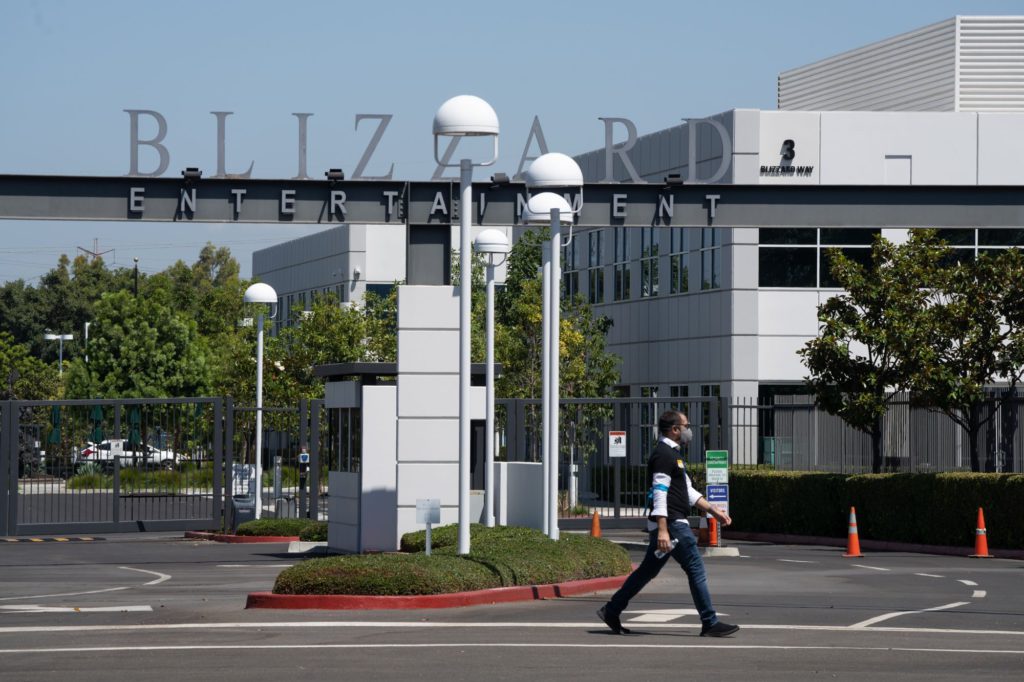
(Bloomberg) — Activision Blizzard Inc. said it will convert about 1,100 U.S.-based temporary or contract quality assurance workers to full-time staffers. The move comes after years of criticism over the video game publisher’s reliance on part-time employees and their tenuous working conditions.

The change will increase headcount at Activision’s publishing arm by 25% and boost the minimum salary for those workers to $20 an hour, according to a statement from the company. The workers will also be eligible for full company benefits.

In December, Activision converted 500 temporary roles to full-time positions while also ending 20 contracts. Outrage ensued over the job cuts, spurring a union push from a contingent of quality assurance testers at Raven Software, the Activision-owned studio that works on Call of Duty games. After Activision refused to recognize a union at Raven, the National Labor Relations Board in February heard arguments from both sides but hasn’t issued a ruling yet. 

“This change follows a process that began last year” across Activision Publishing and Blizzard, a spokesperson said in a statement. 

An Activision Blizzard spokesperson said Raven workers won’t receive the new pay initiatives “due to legal obligations under the National Labor Relations Act.” The spokesperson added that “Whether Raven workers choose to unionize has nothing to do with the salary increases elsewhere for Activision’s QA workers.”

Sara Steffens, secretary-treasurer of the Communications Workers of America, which is representing Raven in its union push, called Activision’s exclusion of Raven workers “especially galling,” considering those quality assurance professionals have been “at the forefront of this effort.” She said Activision is trying to “divide workers and undermine their effort to form a union.” Activision’s “disingenuous announcement is further evidence of the need for workers to have a protected voice on the job,” she said.

In an email to staff on Thursday, Activision Chief Operating Officer Josh Taub acknowledged that Call of Duty’s format has changed from an annual release schedule to an “always on” model. Along with that change, the company has “grown our workforce and support across our studios,” he said. The move to better integrate quality assurance workers will buoy Activision Blizzard’s service-game model, where a title is supported indefinitely with regular updates rather than a one-time purchase.

Activision Blizzard will bring on additional quality assurance support from “external partners,” the memo said, as part of a “long-standing studio and industry practice.”

For those hoping to work their way up in the video game world, quality assurance jobs are considered entry-level positions. However, across the industry, those workers have complained of low pay, overwork and uncertainty over how long their contracts will last. 

(Updates with comment from Communications Workers of America.)

More stories like this are available on bloomberg.com

©2022 Bloomberg L.P.
Canada Offers Carbon Capture Tax Credit to Help Cut Emissions

(Bloomberg) — Prime Minister Justin Trudeau is rolling out one of Canada’s largest single industrial tax incentives to fund carbon capture projects as his government tries to deliver on ambitious climate goals by offsetting emissions from the country’s energy sector.

In a federal budget unveiled on Thursday, Trudeau proposed a refundable investment tax credit to encourage the country’s oil and gas companies to move more quickly to lower emissions.

From 2022 through 2030, the investment tax credit rates would be set at 60% for investment in equipment for direct air capture projects, 50% for equipment in all other carbon capture projects, and 37.5% for transportation, storage and use. To encourage companies to invest more quickly, these rates will be halved for the period from 2031 through 2040. 

The tax credit is expected to cost C$2.6 billion ($2.1 billion) during the first five years, and about C$1.5 billion annually until 2030.

Carbon capture projects permanently store carbon dioxide emissions before they are released into the atmosphere. In Canada, the government is relying on this technology to allow an oil and gas sector that accounts for about 10% of the country’s economy to continue production while still meeting the government’s 2030 emissions-reduction goal.

“In the largest economic transformation since the Industrial Revolution, the world economy is going green,” Deputy Prime Minister and Finance Minister Chrystia Freeland said in a statement. “Canada can be in the vanguard, or we can be left behind.”

Tax credits for carbon capture, utilization, and storage technologies are a contentious part of the climate change debate: environmental groups view them as a fossil fuel subsidy that will delay a transition to clean energy, while advocates see them as a way to ensure energy security while more renewable and clean energy sources are built. 

With carbon-intensive businesses facing growing scrutiny from climate-conscious investors, Canada’s oil sands companies announced a goal to achieve net zero carbon emissions from operations by 2050, mostly through carbon capture projects with government support. 

The country’s largest producers have formed a group called the Oil Sands Pathways to Net Zero, and estimate carbon capture projects will cost about C$75 billion over three decades. The group is pushing for policies similar to those in Norway and the Netherlands, where roughly 75% of the cost of such projects was covered by public funds. 

Canada has a significant opportunity to establish itself as a leader in this area, according to a report led by Toronto-Dominion Bank Chief Economist Beata Caranci. The country is one of the few that have made inroads in developing and deploying this technology, she wrote, and has a strong dependence on emissions-intensive sectors planning to use it. 

Critical Minerals 

Apart from energy, resource-rich Canada is also abundant in critical minerals that are essential for industries like electric vehicles, clean technology and computing. The 2022 budget proposes to provide up to C$3.8 billion over eight years to implement Canada’s first Critical Minerals Strategy. 

The investment in critical mineral mining and processing is among the flagship initiatives in this year’s budget that would help ensure medium-term growth for the country, according to a senior government official.

Specific measures to support critical mineral projects include the introduction of a new 30% tax credit for mineral exploration expenses and up to C$1.5 billion in infrastructure investments. The tax credit would apply to exploration expenditures on minerals such as nickel, lithium, cobalt, graphite and copper.

More stories like this are available on bloomberg.com

©2022 Bloomberg L.P.
Close Bitnami banner
Bitnami