Bloomberg

Yellen to Lay Out Broad Principles for Regulation of Digital Assets

(Bloomberg) — Treasury Secretary Janet Yellen said a digital dollar would take years to develop if the U.S. decides to proceed with one, underscoring a deliberate approach by American policy makers as they flesh out their regulatory plans to address the rapid spread of digital assets.

U.S. regulators are now engaged in a six-month review aimed at coming up with recommendations on a raft of issues linked to digital assets, including a digital version of the U.S. sovereign currency. The initiative was launched through an executive order by President Joe Biden.

“I don’t yet know the conclusions we will reach, but we must be clear that issuing a CBDC would likely present a major design and engineering challenge that would require years of development, not months,” Yellen said in prepared remarks to an event Thursday in Washington. CBDC refers to a central bank digital currency — for the U.S., a digital dollar.

Yellen in her speech outlined a set of broad principles that she believes should guide the creation of a new framework for regulating digital assets, seeking to encourage innovation while protecting consumers, investors and financial stability.

“Our regulatory frameworks should be designed to support responsible innovation while managing risks — especially those that could disrupt the financial system and economy,” Yellen said.

‘Tech Neutral’

She stressed that as regulators strive to keep up with innovation, the rules they create should be “tech neutral.”

“That process should be guided by the risks associated with the services provided to households and businesses, not the underlying technology,” she said.

Issuers of digital assets and service providers in the sector should protect consumers and investors from fraud and misleading information, insure proper custody of assets and provide adequate tax reporting information, she said. 

The speech follows a March executive order directing a number of federal agencies, including the Treasury, to devote more attention to the study and prospective regulation of digital assets, which can include a range of crypto coins, like Bitcoin, fixed-value stablecoins and digital money issued by central banks.

Policymakers, Yellen added, should be prepared for possible changes to the structure of financial markets, citing potential changes driven by distributed ledger technology.

“While this could make markets less vulnerable to the failure of any particular firm, it is critical to ensure we maintain visibility into potential build-ups of systemic risk and continue to have effective tools for tamping down excesses where they arise,” she said.

(Updates with comments in first, third paragraphs)

More stories like this are available on bloomberg.com

©2022 Bloomberg L.P.

Roblox Analysts, Cathie Wood Defy Pessimism on Stock

(Bloomberg) — Analysts are standing pat with their bullish views on Roblox Corp. even after investors fled, erasing almost $51 billion in market value for the company that’s become a great hope of believers in the potential of the metaverse. 

Citigroup Inc. joined the ranks of the bulls Wednesday, starting coverage of the video-game platform with a buy rating. Of the 23 brokerages that follow Roblox, all but one recommend investors hang on to the stock or buy more, with an average expected return of 54% over the next year, according to Bloomberg data. The stock, though, has dropped 66% from its November high. 

That divergence reflects the push and pull in the market between optimists who see boundless profits from the as-yet-unproven virtual reality world, and skeptics who are recoiling from risk as central banks start to withdraw the flood of liquidity that’s lifted all assets. Facebook got a stock-price bump when it jumped on the metaverse trend in October, changing its name to Meta Platforms Inc., only to see the shares subsequently collapse. 

Roblox is a key player in the effort to build an immersive version of the internet — where people will be able to interact, play games or work using a digital avatar — because its users are already able to make their own games and worlds using its technology. Yet the company reported disappointing growth in the fourth quarter as the end of pandemic restrictions sent users back out into the real world, and the full promise of the metaverse is still years away.

“That’s a difficult proposition for a growth stock to be faced with,” said Danni Hewson, an analyst at AJ Bell, a U.K. investment firm that doesn’t have a rating on Roblox. 

Wood’s Bet

At least one big investor is siding with the analysts: Cathie Wood’s Ark Investment Management, which invests in “disruptive innovation.” The firm bought more stock last month, bringing its stake to about 5.48 million shares — more than double the 2 million it held at the end of last year. In February, Wood said Roblox is one of the best ways to play the metaverse. The firm didn’t respond to a request for comment.

Analysts are still seeing a 29% rise in its first-quarter user base and a moderate growth of 3.5% in bookings, according to data compiled by Bloomberg.

“If they put two more quarters together and beat expectations on key metrics, I think investors will probably climb back in,” said John Freeman, an analyst at CFRA Research, which has a strong buy on the stock and a price target of $107.

Shares of many other firms linked to the metaverse have struggled this year as investors grappled with an unclear path ahead for companies wanting to monetize the platform. 

Only four out of the 44 components in the Roundhill Ball Metaverse ETF are up for the year, with Roblox, Meta and Matterport Inc., a maker of software for virtual walkthroughs, weighing heavily on the group. Roblox, which listed on the stock market in March last year, has yet to make a profit.

“There’s plenty to trouble the metaverse, from tightening fiscal policy to the cost-of-living crisis which will impact the amount of disposable income consumers have to spend,” Hewson said. 

And in another knock to its investment thesis, Roblox is still expensive at 8.8 times estimated sales for the next year. That compares with established gaming companies Electronic Arts Inc., Take-Two Interactive Software Inc. and Activision Blizzard Inc., which trade from 4.2 times to 6.9 times sales.

“While the firm’s valuation is above many peers, we believe this is justified given firm’s strategic position, rapid growth and healthy pipeline of product enhancements,” Citi analysts including Jason Bazinet wrote in their report initiating coverage on Roblox.

The stock rose 0.3% to $46.02 at 10:07 a.m. in New York. 


Tech Chart of The Day

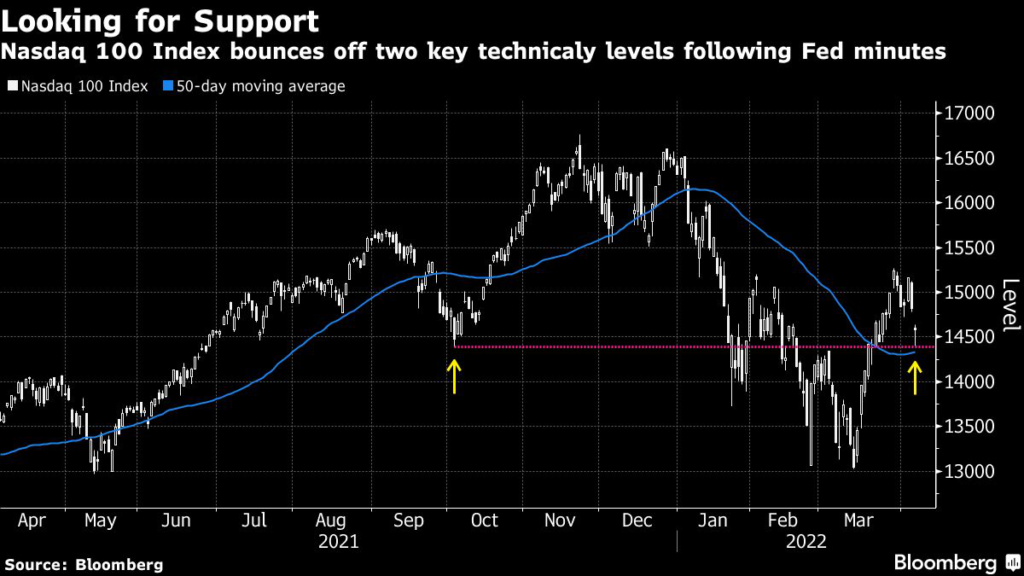
U.S. tech stocks tested a pair of key technicals on Wednesday as shares whipsawed in afternoon trading following the release of the Federal Reserve’s meeting minutes. The Nasdaq 100 Index closed lower by 2.2% on the day after briefly sinking below the 14,400 level, which sits just above the gauge’s 50-day moving average and its intraday low from early October. A break below both levels could put the tech-heavy benchmark on a path back toward the lows seen in March when it entered a bear market.

Top Tech Stories

  • Warren Buffett’s Berkshire Hathaway Inc. bought a stake in the laptop maker HP Inc. valued at more than $4.2 billion
  • Elon Musk on Wednesday refuted reports that he had reduced his stake in Twitter, saying that an initial regulatory filing on his holdings in the social media platform contained the wrong number of shares
  • Samsung Electronics Co. reported preliminary earnings for the first quarter that beat analysts’ estimates on strong demand for new smartphone models and memory chips that go into servers
  • JD.com Inc.’s billionaire founder, Richard Liu, has stepped down as chief executive officer of China’s No. 2 online retailer, joining tech tycoons that exited top management roles after Beijing’s sweeping internet-sector crackdown
  • Meituan shares rallied early Thursday after a senior executive’s rare appearance at Shanghai’s official Covid briefing raised hopes that the delivery giant will benefit from its role in the city’s pandemic fight
  • Uber Technologies Inc.’s customers will soon be able to book long-distance travel on planes, trains and buses, reflecting the company’s ambitions to become a travel “super app”

(Updates to add shares in last paragraph)

More stories like this are available on bloomberg.com

©2022 Bloomberg L.P.

Hellman-Backed NPD to Merge With IRI to Form $8 Billion Company

(Bloomberg) — Private equity firm Hellman & Friedman has agreed to buy a majority stake in Information Resources Inc., a market-analytics business backed by Vestar Capital Partners and New Mountain Capital, with plans to merge it with portfolio company NPD Group. 

The deal values the combined entity at more than $8 billion, including debt, according to a person familiar with the matter, who asked to not be identified because the terms are private. Bloomberg News reported in March that NPD was in talks to buy IRI for more than $5 billion, including debt. Vestar and New Mountain will remain investors, according to a statement Thursday. 

“As the global retail landscape continues to evolve, IRI and NPD will have innovative technology, analytics, data resources, talent and geographic reach to best support the growth of the world’s leading brands and retailers,” IRI Chief Executive Officer Kirk Perry said in a statement. 

Perry is set to run the combined organization as CEO as part of the deal, and will join the company’s board alongside NPD’s Executive Chairman Tod Johnson and CEO Karyn Schoenbart.

“Both NPD and IRI share similar client-focused, innovative and collaborative cultures, making this combination a natural fit,” Schoenbart said in a statement. 

Hellman & Friedman agreed to acquire NPD last year. NPD is the eighth-largest research company in the world, covering more than 20 industries, according to a statement at the time of the deal.

More stories like this are available on bloomberg.com

©2022 Bloomberg L.P.

Biden’s EU Data Pact Will Need a Close Look, Watchdogs Warn

(Bloomberg) — Europe’s privacy chiefs said it’s too soon to declare victory after U.S. President Joe Biden and European Commission President Ursula von der Leyen reached the outlines of a deal to keep data flowing across the Atlantic.

The two sides broke the deadlock last month on a new pact, potentially avoiding a doomsday scenario for tech giants such as Meta Platforms Inc. and thousands of other firms that rely on free flows of information. 

But a panel of EU regulators said Thursday the deal can only survive if it ends in concrete measures following “unprecedented” measures the U.S. committed to take to protect EU citizens’ data.

The EU’s top court in a 2020 ruling toppled the previous pact over concerns that EU user data wasn’t safe from the prying eyes of U.S. spies once it’s been shipped across the Atlantic. The ruling meant thousands of businesses that ship commercial data to the U.S. had to figure out alternative ways to keep their data flowing and EU-U.S. negotiators were forced back to the drawing table.

The European Data Protection Board said Thursday it will “analyze whether the collection of personal data for national security purposes is limited to what is strictly necessary and proportionate” and “how the announced independent redress mechanism” will respect European citizens’ right to a fair trial. 

Big Tech Blackout Set to Be Averted With EU-U.S. Data Pact 

The guarded welcome by regulators comes after Didier Reynders, the EU’s justice commissioner, said late last month he was confident the new accord would be a “robust solution” compared to its predecessor. 

He said the U.S. will present a number of texts, including an executive order by President Biden, with final adoption “maybe by the end of the year.”

The political agreement and the “significant improvements” touted by the commission already got the initial backing of EU member states at a meeting earlier this month, according to officials.

More stories like this are available on bloomberg.com

©2022 Bloomberg L.P.

Boeing Sued by Archer Over Alleged Smears in Air Taxi Wars

(Bloomberg) — Archer Aviation Inc. sued Boeing Co., in an escalation of a feud over technology in the race to develop flying taxis.

Archer claims that it has been the victim of a smear campaign by Boeing, via its joint venture with Google co-founder Larry Page. 

Wisk Aero LLC, Boeing’s joint venture with Page’s Kitty Hawk Corp., sought “to halt the forward progress of Archer’s business with flagrantly defamatory public statements intended to destroy Archer’s reputation — including a highly publicized, intentional lie that Archer was under criminal investigation for theft of intellectual property,” the company said in the lawsuit, filed Wednesday in state court in San Jose, California. 

Boeing declined to comment on pending litigation but said it “remains committed to Wisk’s mission of driving innovation and sustainability through the future of electric air travel.”

The lawsuit is the latest round in a battle between Wisk and Archer, who have been fighting over the development of so-called eVTOL — electric vertical takeoff and landing aircraft that will allow consumers to hop over traffic using battery-powered transportation. The global eVTOL market last year was valued at $8.5 billion and will climb to more than $30 billion by 2030, according to Archer. Wisk sued Archer last April, claiming the upstart had stolen its intellectual property. 

Read More: No, Really, Flying Taxis Are Getting Closer to Giving You Rides

The same day the suit was filed, Wisk “launched a vicious media smear campaign aimed at mortally wounding Archer,” according to Archer’s new complaint. The attack was timed before Archer’s listing on the New York Stock Exchange and cost the company up to $1 billion, according to the suit. 

As a partner with Kitty Hawk, Boeing is liable, Archer says, and the lawsuit seeks to “hold it accountable for those wrongs.”

Archer, which originated at the University of Florida and moved to Palo Alto, California, was taken public last year through a merger with a blank-check company led by Ken Moelis. 

Read More: Boeing Invests $450 Million in Wisk’s Self-Flying Air Taxis

The case is Archer Aviation Inc. v. The Boeing Co., 22CV396479, California Superior Court, Santa Clara County (San Jose).

(Updates with Boeing response in fourth paragraph.)

More stories like this are available on bloomberg.com

©2022 Bloomberg L.P.

Software Stocks Are Considered Merger Darlings as Deals Heat Up

(Bloomberg) — Merger investors expect healthy deal flow to extend into the second quarter, especially in software, as buyers remain hungry and valuations are attractive.

It’s already playing out. CDK Global Inc., which was named among potential takeover targets in a Bloomberg News survey of 20 event-driven trading desks, fund managers and analysts, was acquired Thursday morning. Zendesk Inc. also was popular software name on the list. 

Kohl’s Corp. was named by survey participants as the most likely company to complete a deal over the next three months. The retailer is already working with potential bidders amid a push by activist investors to explore strategic options.

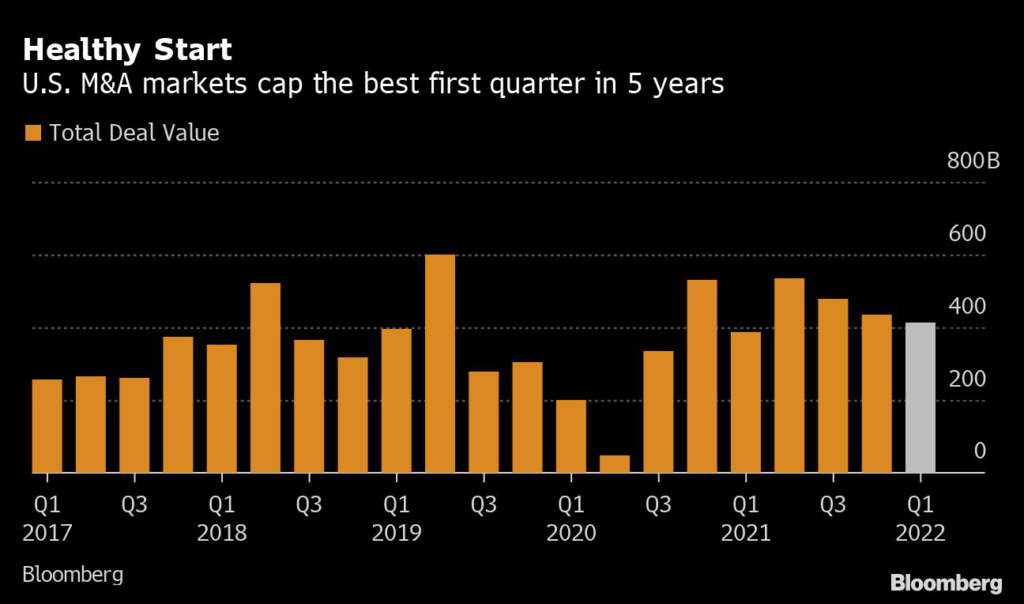
The mergers and acquisition market in the U.S. is off to a decent start this year against the uncertain backdrop of rising rates, soaring inflation and the war in Ukraine. The total value of pending and completed deals announced in the first three months of 2022 reached $414 billion, according to Bloomberg data. That’s the best first quarter performance in the past five years, though the pace will have to quicken considerably for the rest of the year to approach 2021’s record run. 

“There are many opportunistic dealmakers and activists pushing companies to explore a sale or bidding for the companies themselves,” said Tyler Silver, a partner at New York-based investment firm Apex Capital. “Acquisitive big tech and private equity firms with loads of cash will help. Some PEs just have an unlimited appetite for deals.”

Software Sweet Spot 

Small to mid-sized software companies are in the sweet spot for consolidation, according to the survey respondents. Merger investors are optimistic that cash-rich strategic and financial buyers will want to take advantage of cheaper valuations caused by the recent tech selloff. The S&P 500 Software Industry index is down more than 10% this year compared with a 5% decline in the S&P 500 Index and a 9% drop in the Nasdaq 100 Index.

Seven out of 20 survey respondents saw a takeover of Zendesk as likely after the company scrapped its acquisition of Momentive Global Inc. and a group of private equity firms was said to line up loan for a refreshed buyout offer. The issue will be price since Zendesk already rejected a bid between $127 and $132 because it was too low. Zendesk closed at $122.58 on Wednesday, down from its February 2021 record high of $158. In addition, two people surveyed said they expect Momentive to also return to the M&A spotlight.

CDK Global was the third most mentioned company in the poll, which was conducted from March 28 to April 1. On Thursday, Brookfield Business Partners announced a $6.4 billion all-cash deal to acquire the auto dealer software provider. Five9 Inc., which in September scrapped its planned sale to Zoom Video Communications Inc., also appeared on the list.

Representatives for Kohl’s, Zendesk, CDX Global and Momentive did not respond to requests for comment.

In addition, Wall street analysts flagged a list of software names to watch after PE firm Thoma Bravo in March announced plans to buy cloud-based software maker Anaplan Inc. for $10.7 billion. Mizuho analyst Jordan Klein touted battered stocks like Datto Holding Corp. and Appian Corp., while Bloomberg intelligence’s Anurag Rana pointed to C3.ai Inc. and Elastic NV among the potential targets with cratering valuations.

“The tech, and software in particular, space should continue to be a favorite given the need for increased productivity and cost cutting in the context of supply chain issues, among other things,” said Frederic Boucher, a risk-arbitrage analyst at Susquehanna International Group. He added that private equity firms still have plenty of dry powder at their disposal.

To be sure, whether financial buyers pick up the dealmaking pace also depends on the debt markets. Their choppy performance this year has stirred fears about potentially cooling private equity buyouts.

Meanwhile, big tech players with strong balance sheets remain another source of transactions. However, they might grow cautious with any deals that could get caught in the crosshairs of antitrust regulators, survey respondents said. 

Related: Megacaps With $600 Billion of Cash Have Fuel for M&A: Tech Watch

M&A desks in U.S. are closely watching the evolving regulatory environment, which has been a constant concern. At the moment, their eyes are on UnitedHealth Group Inc.’s pending acquisition of Change Healthcare Inc. The pair just extended their agreement as they wait to litigate the Department of Justice’s suit to block their merger plan. 

Related: Deal Market’s Regulatory Worries Deepen Amid Boom: M&A Survey

To Aaron Glick, a merger-arb specialist at Cowen & Co., this is an important demonstration of how willing some buyers are to defend their acquisitions in court.

“Companies that entered into deals this year went in eyes-wide-open knowing that the odds of litigation were higher than they had been in prior administrations,” said “Still, each situation is unique.”

More stories like this are available on bloomberg.com

©2022 Bloomberg L.P.

Buffett’s Berkshire Builds Up New $4.2 Billion Stake in HP

(Bloomberg) — Warren Buffett’s Berkshire Hathaway Inc. has found another way to put even more of its money to work, purchasing a stake in HP Inc. valued at more than $4.2 billion. 

The disclosure that the billionaire investor’s company holds about 121 million shares in the computer company sent HP’s stock surging, with shares climbing 15% to $40.08 at 9:37 a.m. in New York. Berkshire bought some of the stock earlier this week in multiple transactions, according to a regulatory filing late Wednesday.

“Berkshire Hathaway is one of the world’s most respected investors and we welcome them as an investor in HP,” an HP spokesperson said.

Berkshire’s HP bet is just the latest way the billionaire investor’s firm has found a way to deploy some of its near-record cash pile, after years of being stifled by high valuations and a competitive dealmaking landscape. In recent months, Berkshire has expanded its $350 billion equity portfolio, helped in part by volatility that dragged the S&P 500 Index down almost 6% this year through Wednesday’s close.

In March, Buffett’s company disclosed that it had been buying up shares in Occidental Petroleum Corp., building a stake that now ranks among Berkshire’s 10 largest common-stock bets. 

What Bloomberg Intelligence Says:

“Berkshire Hathaway’s $4.2 billion investment in HP Inc. reinforces the computer maker’s long-term capital-returns value proposition. HP Inc. has become a capital-returns story, given its low-single-digit growth profile.”

— Woo Jin Ho, BI senior industry analyst

Click here to read the research.

Berkshire has also found more luck on the acquisition front, announcing in March a $11.6 billion deal to purchase insurer Alleghany Corp. in the conglomerate’s largest deal since its 2016 acquisition of Precision Castparts Corp. Still, the purchase price represents just 7.9% of Berkshire’s cash pile of $146.7 billion at the end of 2021. 

Helped by strong performances from businesses such as the BNSF railroad and Berkshire’s sprawling energy empire, Buffett’s conglomerate has been pulling in more cash that he can quickly deploy into higher-returning assets, a skill that had drawn the investor acclaim for years. A shortage of appealing investment opportunities has led the billionaire to increasingly turn to share buybacks, with repurchases totaling a record $27.1 billion last year.

Now, some stock valuations have become even more attractive. HP stock rallied last year, gaining 53% in 2021, but had fallen 7.3% this year through Wednesday’s close. Berkshire, which had historically shied away from some technology investments, has leaned further into that sector in recent years and built up a stake in Apple Inc. that was valued at more than $161 billion at the end of 2021.

HP, a maker of printers and computers, surged as high as $40.85 in premarket trading in New York Thursday morning.

As one of the older, more traditional tech stocks, HP could benefit from a shift into so-called value tech shares, with the prospect for rising interest rates blunting gains for more highly valued Big Tech stocks. 

HP has also benefited from sustained increased demand for PCs, a market that HP now expects to be worth as much as $560 billion by 2024, amid a shift to hybrid work. It’s also seeing continued success in segments such as gaming and 3D printing. Last month, HP agreed to buy Plantronics Inc., also known as Poly, which sells phone headsets and audio and video accessories, in a $3.3 billion deal to help it capitalize on the remote-work culture.

Berkshire didn’t immediately respond to a request for comment sent outside regular business hours about whether the purchase was made by Buffett himself or one of his two investing deputies.

(Updates with HP shares in second paragraph.)

More stories like this are available on bloomberg.com

©2022 Bloomberg L.P.

Ukraine Update: Kuleba Says Kyiv Needs NATO Military Aid Now

(Bloomberg) — Ukraine’s foreign minister pleaded for urgent military assistance before it’s too late to make a difference in its fight against Russian forces.

The United Nations moved toward a vote Thursday on whether to suspend Russia from the Human Rights Council. The U.S. announced a fresh set of sanctions as President Joe Biden accused Russian leader Vladimir Putin’s forces of committing “major war crimes” in Ukraine. The European Union, assembling its fifth package of sanctions, hit a snag as some member states said it was being excessively diluted. 

On the ground, the Ukrainian military said Russian troops are preparing for a new offensive in the country’s east. Elsewhere, German intelligence picked up radio intercepts that reinforced indications that Russian troops carried out atrocities against civilians near Kyiv. Russia has denied the accusations. 

(See RSAN on the Bloomberg Terminal for the Russian Sanctions Dashboard.) 

Key Developments

  • Russian Coal and Oil Paid for in Yuan to Start Flowing to China
  • Shell to Write Down as Much as $5 Billion on Russia Exit 
  • Mocked as ‘Rubble’ by Biden, Russia’s Ruble Comes Roaring Back
  • Sanctions Hobble the Airline Built by ‘Russia’s Elon Musk’
  • Russia Piles Pressure on Companies as Unemployment Crisis Looms
  • U.S. Satellites Spying on Russia’s War Tap Commercial Technology

All times CET: 

Kuleba Says Ukraine Needs NATO’s Help Now (3:21 p.m.)

Ukrainian Foreign Minister Dmytro Kuleba said his nation needs urgent military assistance before it’s too late to make a difference in its fight against Russian forces.

“Either you help us now — and I’m speaking about days not weeks — or your help will come too late,” he said after meeting with NATO foreign ministers in Brussels. He said he will be following up on specific timelines for his country’s request for more weapons to fight Russian forces. “I have no doubts that Ukraine will have weapons necessary to fight. The question is the timeline.”

“You provide us with everything that we need and we will fight for our security, but also for your security so that President Putin will have no chance to test Article 5,” he added, referring to a provision of the NATO treaty where countries pledge to defend all alliance members from attack.

EU Sanctions Debate Hits a Few Snags (12:15 p.m.)

Several European Union countries say the fifth package of sanctions against Russia is being watered down too much, according to people familiar with the matter.

EU ambassadors are meeting Thursday with the aim of approving the package, which contains a coal embargo. But Poland is resisting a change in the draft sanctions plan, sought by Germany, that extends the phase-in period for the ban by a month to four months. Poland also wants to remove all remaining exemptions to the already existing ban on the sale of weapons, as well as military-related technologies and components, to Russia, the people said.

Estonia, Finland to Rent Joint LNG Terminal Vessel (11:14 a.m.)

Estonia and Finland plan to jointly rent a liquefied natural gas terminal vessel as part of an effort to lower dependence on Russian gas. 

The floating storage and regasification unit would have possible berths on both sides of the Gulf of Finland, according to statements from the countries, which are connected by the Balticconnector gas pipeline. The project’s timetable is “extremely urgent,” Finland’s economy ministry said.

Russia Coal, Oil Paid for in Yuan Heads to China (11:00 a.m.)

Several Chinese firms used local currency to buy Russian coal in March, and the first cargoes will arrive this month, Chinese consultancy Fenwei Energy Information Service Co. said. 

These will be the first commodity shipments paid for in yuan since the U.S. and Europe penalized Russia and cut several of its banks off from the international financial system. 

Hungary Still Opposes Sanctions on Russian Gas (10:56 a.m.) 

Hungary reiterated that it can’t back sanctions against Russia that would threaten its natural gas supplies. Despite efforts at diversification Hungary “is still heavily dependent on Russian gas,” Dora Zombori, ambassador-at-large for energy and climate, said at an industry conference in Budapest. “We cannot change this situation overnight.” 

Russian Railways Didn’t Repay $605M Bond (10:56 a.m.)

Russian Railways informed the issuer, RZD Capital Plc, that it’s applied for a license from the Office of Financial Sanctions Implementation in the U.K. for the purposes of facilitating payments on outstanding debt obligations issued before March 24, which “may require a number of weeks processing time,” according to a statement. 

Russian Railways Coupon Miss Raises Debt Swaps Trigger Question

Commodity Markets Remain Volatile (10:20 a.m.)

Commodity markets continue to be whipsawed by disruptions sparked by Russia’s war in Ukraine and efforts to curb raw-material costs. 

Russia slipped closer to a technical default after foreign banks declined to process about $650 million of dollar payments on its bonds, forcing it to offer rubles instead.

Equities markets are showing signs of stability after a selloff sparked by hawkish minutes from the Federal Reserve, with European markets mostly up and U.S. futures mixed. 

EU Russian Coal Ban May be Pushed to Mid-August: Reuters (10:16 a.m.) 

Envoys are poised to approve a ban on Russian coal that would become fully effective from mid-August, a month later than initially proposed, Reuters reported, citing a person in the EU familiar with the matter who it didn’t identify. 

Shell Exit From Russia May Trigger $5 Billion Writedown (9:52 a.m.)

Shell Plc said its withdrawal from Russia will result in $4 billion to $5 billion of impairments, and warned investors that extreme energy price volatility in the first quarter could hit cash flow. 

While western energy companies leaving Russia are likely to take massive financial hits, they are attempting to minimize the reputational damage of investing in Moscow-backed projects following the war on Ukraine.  

Germany Overhears Russian Soldiers Discussing Bucha: Spiegel (9:52 a.m.) 

Germany’s foreign intelligence service intercepted communications between Russian soldiers discussing the killing of civilians in the town of Bucha, Der Spiegel reported, without saying how it obtained the information. 

The radio communications, which appear to place Russian soldiers at locations where bodies were found, contradict Moscow’s denial that its troops were involved. In one of the messages, a soldier can be heard describing how he shot a person on a bicycle. Another appears to provide evidence of a strategy to stop and question civilians before shooting them, according to the report. 

The material also shows that mercenaries, including the Kremlin-backed Wagner Group, appeared to have played a major role in the killings, according to Der Spiegel. 

Finland’s NATO-Backing Party Rises in Poll (9:19 a.m.) 

Finland’s National Coalition, the only large party in the Nordic country to openly support joining NATO, soared 3.5 percentage points in the latest poll. The party’s benefiting from a historic shift in Finnish attitudes to potential membership in the North Atlantic Treaty Organization. The gain, almost twice the margin of error, gives it 26.1% backing, its highest in polls by YLE.

Finland’s government is slated to send a white paper to parliament next week on its changed security environment. 

Australia Imposes New Sanctions on Russia Over Bucha (9:15 a.m.) 

Australia placed new sanctions on 67 Russian individuals, including military figures accused of human rights abuses, bringing the total number of people sanctioned by Canberra since the beginning of the Ukraine war to almost 600.

Foreign Minister Marise Payne said in a statement that the move was in response to “the emergence of evidence of war crimes committed by Russia in Bucha and other towns around Kyiv.” 

Russian Unemployment Crisis Looms (9:09 a.m.)

The next economic jolt to Russia will likely arrive by way of the labor market, building in intensity over the coming months and bringing new hardships for a nation already waylaid by a series of shocks.

Joblessness this year is set to more than double from the first quarter and exceed 9% for the first time in more than a decade, according to a Bloomberg survey of analysts in March. 

German Minister Says Open to Coal Embargo (8:33 a.m.) 

Economy Minister Robert Habeck said Germany has already cut its reliance on Russian coal by at least half in the past month and won’t stand in the way if the European Union decides to ban on imports of the fuel from Moscow. 

Habeck said it would be “foolish” to name an exact date for when purchases of Russian coal could end. The sanctions being considered would allow some deliveries to be completed, he added.

Austria Expels Four Russian Diplomats (8:24 a.m.)

Austria expelled four Russian diplomats for illegal activities, the Foreign Ministry in Vienna said in a statement.  

While several other nations who have announced similar measures in recent days, it’s a rare step for Austria, which houses several international organizations and has sought a diplomatic role in bridging Europe’s east and west. Russia has almost 300 diplomats stationed in Austria.  

Ukraine Says Russian Troops Readying for Eastern Offensive (8:02 a.m) 

Russian troops are focusing on preparations for their next offensive in Ukraine’s east, the General Staff of the Ukrainian armed forces said on its Facebook page. Shelling of towns in the Luhansk region started on Wednesday night and continued through morning, with significant damage to residential buildings and infrastructure.

The entire Kharkiv and Donetsk regions were under artillery fire overnight  and so was the occupied Kherson region in Ukraine’s south. Civilians are attempting to evacuate from occupied areas of Kherson region.

Ukraine’s government has urged people living in the regions of Kharkiv, Donetsk and Luhansk to leave the areas “while the opportunity still exists” in advance of Russia’s expected new assault. 

EU Ministers Set To Discuss Oil Embargo, Borrell Says (8:11 a.m.) 

European Union foreign affairs ministers are likely to discuss imposing an oil embargo on Russia when they meet early next week, said Josep Borrell, the EU’s foreign policy chief. 

Borrell told reporters in Brussels that an oil embargo is not in a fifth sanctions package on the agenda for Thursday, but that he expects the ministers will tackle it on Monday “and sooner or later, I hope sooner, it will happen.” 

He said he hopes the fifth package, which would ban coal imports among other steps, “will be finally approved by the ambassadors” later Thursday. 

Germany Too Slow To Move on Weapons, Kuleba Says (7:47 a.m.)

Germany is taking too long to decide on supplying more weapons to Kyiv, Ukraine Foreign Minister Dmytro Kuleba said. “While Berlin has time, Kyiv doesn’t,” Kuleba said of Germany’s “length of procedures and decision-making” as he arrived for a meeting of NATO foreign ministers in Brussels. 

Kuleba said Germany had made “a revolutionary step” in agreeing several weeks ago to supply weapons to Ukraine. “However, it is clear that Germany can do more given its reserves and capacity.” 

In a tweet describing his talks with NATO chief Jens Stoltenberg, Kuleba said he had come to Brussels to “discuss three most important things: weapons, weapons, and weapons.” 


U.S. Shares Intelligence With Foreign Banks, FT Says (6:02 a.m.)

U.S. federal agencies are sharing intelligence with foreign banks to bolster defenses against potential cyberattacks in retaliation for the economic sanctions imposed on Russia, the Financial Times reported, citing unidentified people familiar with the briefings. 

(An earlier version corrected the 8:02 subhead to show Russia preparing for eastern offensive.)

More stories like this are available on bloomberg.com

©2022 Bloomberg L.P.

CME Offers Reference Rates on Additional Cryptocurrencies

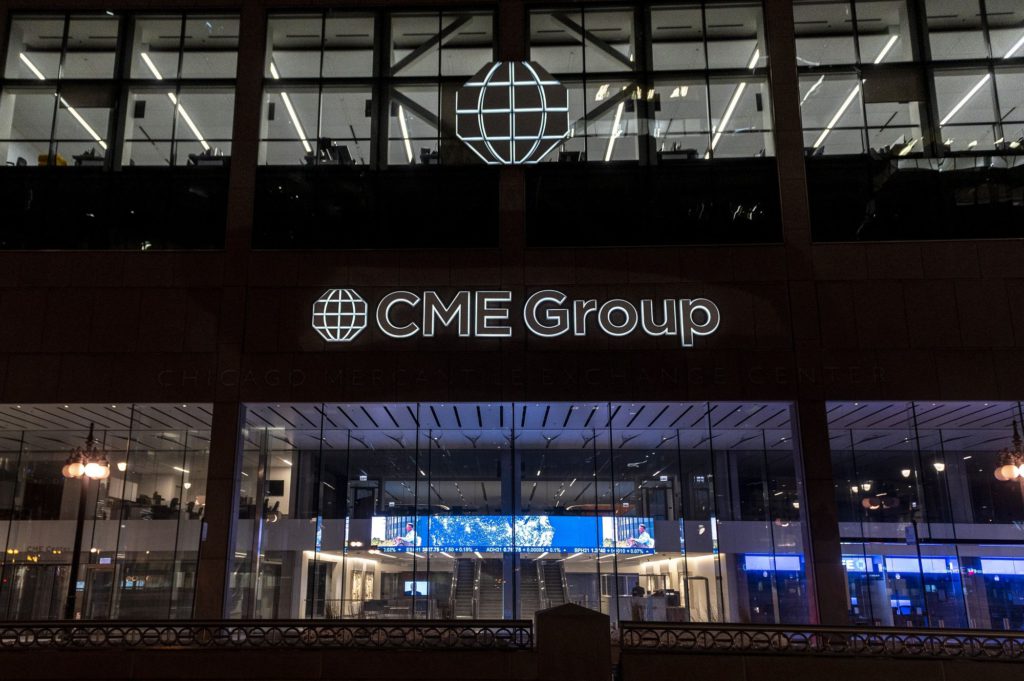
(Bloomberg) — CME Group Inc. is set to offer investors broadened access to a greater range of cryptocurrencies on traditional markets, launching 11 new reference rates and real-time indices.

Alongside its existing Bitcoin and Ether rates, the derivatives marketplace said its partnership with CF Benchmarks will expand to include reference rates and indices for Algorand, Bitcoin Cash, Cardano, Chainlink, Cosmos, Litecoin, Polkadot, Polygon, Solana, Stellar and Uniswap. Reference rates are usually used as a benchmark for other financial products.  

The additions mean more availability for traders and fund managers to evaluate portfolio risk and create structured products like exchange-traded products based on cryptocurrencies. Such products have been available for many years in regions like Europe and Canada, but only recently gained approval in the U.S., which approved its first ETF linked to Bitcoin futures in October last year.

The new benchmarks for alternative tokens, also known as altcoins, capture over 90% of the crypto sector’s total investible market capitalization, said Tim McCourt, CME’s global head of equity and FX products. The overall market value for digital assets was more than $2 trillion on Thursday, according to data from CoinMarketCap.

“As the digital asset market continues to expand, there is an increasing demand for reliable, standardized cryptocurrency pricing information based on robust, regulated reference rates,” said McCourt in a statement on Thursday. 

Banks Are ‘Very Far Away’ From Trading Crypto, Genesis CEO Says

Crypto ETPs could swell to over $120 billion in assets under management by 2028, according to analysis by Bloomberg Intelligence this month. Analysts expect flows into cryptocurrency funds will likely accelerate if a U.S.-listed spot Bitcoin ETF is approved soon, which could come by the end of 2023. 

Data for the new benchmarks will be calculated and published daily by CF Benchmarks starting April 25, using pricing information from crypto exchanges Bitstamp, Coinbase, Gemini, itBit and Kraken. London-based exchange LMAX Digital will also contribute data from May onwards.   

More stories like this are available on bloomberg.com

©2022 Bloomberg L.P.
Surge in Car-Crash Deaths Could Be Magnified by New Breed of EVs

(Bloomberg) — All things being equal, choosing an electric vehicle over one with an internal combustion engine is likely to be a better move for the planet, thanks to motors that don’t spew greenhouse gases while underway.

But all things aren’t always equal: Battery-powered cars and trucks tend to be far heavier than their gas-burning counterparts. That extra bulk translates into a mixed bag of benefits and concerns, especially when it comes to safety. The occupants of heavy vehicles tend to fare better in an accident, explained Michael Anderson, the University of California professor who co-wrote the study “Pounds That Kill: The External Costs of Vehicle Weight.”

“Really what it’s doing is essentially pushing the other vehicle that you crash into out of the way and subjecting you to gentler deceleration forces,” he said.

At the time of his study, 2011, Anderson was concerned about what a tide of SUVs and super-sized trucks would mean for road fatalities. And he was prescient; in the years since, U.S. road deaths have surged in step with the average weight of the American vehicle. Anderson was less concerned with electric vehicles, because he figured the batteries would show up first in hatchbacks and sedans like the Nissan Leaf and the Tesla Model S, another thesis that panned out. In the next few months, however, the safety landscape will change drastically, as several huge and heavy electric vehicles hit the streets. By the end of the year, about 18 new battery-powered SUVs and pickup trucks will be available for U.S. buyers to choose from.

“What matters is less the average weight than the heterogeneity,” Anderson says. “There could be a window where it’s pretty unsafe to be driving (small, gas-powered vehicles) and getting into multi-vehicle accidents.”


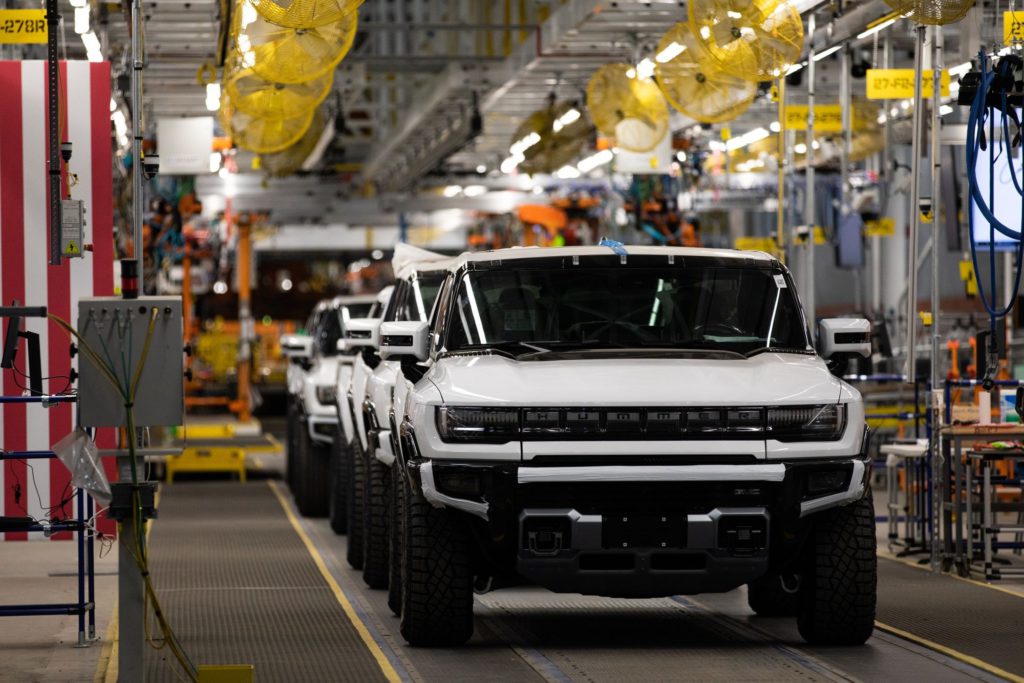
Consider the GMC Hummer EV, which tips the scales at almost 9,100 pounds, roughly the equivalent of two Chevrolet Silverado pickup trucks. It’s hard to imagine any collision it might be involved in as minor. Ironically, as more drivers choose massive trucks over family cars, some consumers who prefer smaller cars are turning to trucks as a form of defense. 

Despite the extra pounds, most of the current crop of electric vehicles decelerate at distances in line with — and sometimes better than — similarly sized gas vehicles, according to data compiled by Consumer Reports. There are a few reasons for this. Carmakers are fitting many of these vehicles with larger brakes, for one. Secondly, electric vehicles have regenerative braking systems in which the electric motors slow the machine slightly while generating power. Brembo, which supplies many of the brakes to carmakers, says the regenerative systems often entirely compensate for the additional weight, which is typically at least 10% more than that of a similar combustion vehicle.

Finally, electric cars tend to have better weight distribution and lower centers of gravity than gas-powered cars, thanks to the ponderous battery sealed under the floor of the machine, so braking power is spread more evenly among the four wheels and the tires have more friction with the road. “It all counteracts the additional momentum,” says Jake Fisher, an engineer who leads auto testing at Consumer Reports. “In a physics equation, it cancels out.”

On Polestar vehicles, regenerative braking via the motor handles much of the deceleration, including in relatively sudden stopping situations, Christian Samson, head of product attributes, said in an e-mail. Even so, its engineers did not factor that into their equations when deciding how big the brake pads should be.

“Friction brakes are dimensioned and capable of handling all of the vehicle’s braking despite having the regen system, which, in reality, handles the bulk of the deceleration,” Samson explained. 

Audi engineers say the regenerative systems on its current electric vehicles handle up to 95% of slowing and stopping, including about 30% of the deceleration in an emergency situation. The Audi e-tron, for example, stops more quickly than the company’s Q7 SUV, according to Consumer Reports, despite being 14% heavier. In fact, the e-tron brakes are used so little that Audi had to design a special protocol to keep the pads from getting corroded. 

Of course, stopping distance is only pertinent when brakes are engaged. If the pilot of a mammoth EV accidentally steps on the accelerator, isn’t paying attention or can’t see the vehicle’s path very well, its full mass will come to bear, situations that may be exacerbated by the violently quick acceleration most electric motors are capable of. There are about four pedestrians killed by pickup trucks making a left turn for every fatality caused by a conventional car in the same situation. The Insurance Institute for Highway Safety blames poor visibility and links the decade-long surge in pedestrian fatalities to steadily bulked-up vehicles.

The problem has caught the attention of federal regulators. In March, the National Highway Traffic Safety Administration proposed updating its five-star safety ratings program for new cars. If the change is made, automakers, for the first time, would have to build with pedestrians in mind to get high marks.

What’s more, researchers have found a direct correlation between pedestrian fatalities and the weight of the offending vehicle. Equally troubling, the blind spot in front of hulking pickup truck hoods can be up to 11 feet longer than that of sedans, according to a recent Consumer Reports study.

The insurance industry, however, is sanguine about the mass market transition to EVs. Janet Ruiz, director of strategic communications for the Insurance Information Institute, said EV pilots tend to have cleaner driving records than their petrol-powered peers; specifically they speed less and log fewer miles. A 2020 study from the Highway Loss Data Institute found that electric vehicles were tied to roughly 20% fewer claims than similar vehicles running on gas, although the severity of their claims were slightly higher. 

As for the Hummer, its stopping hardware was considered just as carefully as its 0-60 acceleration. General Motors Co. spokesman Chris Bonelli said the truck has an “upsized, robust” brake system, a full suite of active safety features like reverse automatic emergency braking and torque vectoring, a technology developed in sports cars that, at least in some cases. could help the 1,000-horsepower truck steer around potential collisions.

More stories like this are available on bloomberg.com

©2022 Bloomberg L.P.
Close Bitnami banner
Bitnami