Bloomberg

Crypto Exchange Backed by Social Media Titan Line Shuts Down

(Bloomberg) — Bitfront, a crypto exchange backed by Japan’s social media giant Line Corp., said it’s shutting down amid challenges in a “rapidly evolving” industry.

The company has “regretfully determined that we need to shut down Bitfront in order to continue growing the LINE blockchain ecosystem and LINK token economy,” it said in a statement on its website. 

The US-based firm signaled the step isn’t connected to the collapse of Sam Bankman-Fried’s FTX exchange by saying the closure is unrelated to “certain exchanges that have been accused of misconduct.”

Bitfront had six coins and 13 trading pairs and a 24-hour volume of nearly $94 million, according to CoinGecko. That’s a small fraction of total trading volumes in the crypto sector of almost $57 billion over the same period.

Bitfront said it stopped new sign-ups and credit card payments as of Nov. 28. It will suspend all withdrawals on March 31, 2023 and asked customers to withdraw all their assets by then.

Line opened Bitfront in 2020 under the goal of bringing the cryptocurrency industry into the mainstream. 


(Updates from the fourth paragraph with details on volumes.)

More stories like this are available on bloomberg.com

©2022 Bloomberg L.P.

Asian Stocks Rise on China Rebound; Dollar Falls: Markets Wrap

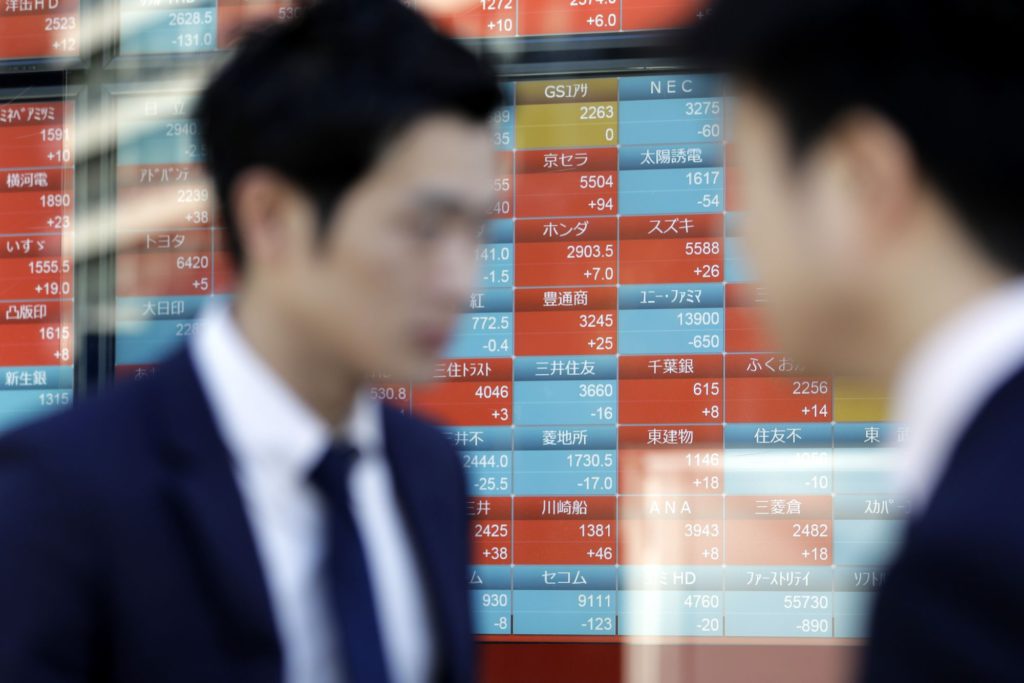
(Bloomberg) — A gauge of Asian stocks climbed as Chinese shares rebounded from the selloff sparked by nationwide unrest over Covid curbs. The dollar weakened against most major currencies as demand for haven assets eased.

Hong Kong’s benchmark share index rose more than 3% and its mainland counterpart advanced about 2% after a heavy police presence in major cities deterred a repeat of the weekend’s demonstrations. Some investors speculated that the protests may hasten a shift away from Covid-Zero policies while others took heart from the lifting of a multi-year ban on share sales by builders. 

Chinese government health officials were due to hold a briefing at 3 p.m. on the implementation of Covid prevention and control measures.

Stocks remained lower in Japan while those in Australia eked out small gains. US futures rose slightly after after the S&P 500 pared its monthly gain during the Wall Street session.

Fed Bank of St. Louis President James Bullard said markets may be underestimating the chances of higher rates. His New York counterpart John Williams noted policymakers have more work to do to curb inflation. Fed Vice Chair Lael Brainard said the string of supply shocks is keeping inflation risks elevated. 

A gauge of the dollar fell following two days of gains. The Japanese yen rose, as did an index of emerging-markets currencies.

Treasuries were little changed. Benchmark government yields made small gains in Australia and New Zealand.

Elsewhere in markets, oil and gold both steadied. 

Investors remained focused on developments in China Tuesday, and further ahead to Fed chief Jerome Powell’s speech Wednesday. Many economists expect he’ll cement bets that the Fed will slow its pace of rate increases next month — while reminding Americans that its fight against inflation will run into 2023.

“It’s a decent time to start considering sharpening your pencil and think about what is a good buy right now,” Terri Spath, founder and chief investment officer of Zuma Wealth Management, said on Bloomberg Television. She said that the coming slowdown in the US economy would be mild and that if there’s a shallow recession “we can actually see some bottoms in stocks.”

Stagflation is the key risk for the global economy in 2023, according to investors who said hopes of a rally in markets are premature following this year’s brutal selloff. Almost half of the 388 respondents to the latest MLIV Pulse survey said a scenario where growth continues to slow while inflation remains elevated will dominate globally next year.

Key events this week:

  • Euro area economic confidence, consumer confidence, Tuesday
  • US Conference Board consumer confidence, Tuesday
  • EIA crude oil inventory report, Wednesday
  • China PMI, Wednesday
  • Fed Chair Jerome Powell speech, Wednesday
  • Fed releases its Beige Book, Wednesday
  • US wholesale inventories, GDP, Wednesday
  • S&P Global PMIs, Thursday
  • US construction spending, consumer income, initial jobless claims, ISM Manufacturing, Thursday
  • BOJ’s Haruhiko Kuroda speaks, Thursday
  • US unemployment, nonfarm payrolls, Friday
  • ECB’s Christine Lagarde speaks, Friday

Some of the main moves in markets:

Stocks

  • S&P 500 futures rose 0.2% as of 12:11 p.m. Tokyo time. The S&P 500 fell 1.5%
  • Nasdaq 100 futures rose 0.2%. The Nasdaq 100 fell 1.4%
  • Japan’s Topix fell 0.6%
  • Australia’s S&P/ASX 200 rose 0.1%
  • The Hang Seng Index rose 3.5%
  • The Shanghai Composite rose 1.9%

Currencies

  • The Bloomberg Dollar Spot Index fell 0.3%
  • The euro rose 0.2% to $1.0358
  • The Japanese yen rose 0.2% to 138.72 per dollar
  • The offshore yuan rose 0.6% to 7.2069 per dollar
  • The Australian dollar rose 0.4% to $0.6676

Cryptocurrencies

  • Bitcoin rose 0.4% to $16,266.03
  • Ether rose 1% to $1,183.48

Bonds

  • The yield on 10-year Treasuries advanced one basis point to 3.69%
  • Australia’s 10-year yield advanced seven basis points to 3.58%

Commodities

  • West Texas Intermediate crude rose 0.5% to $77.61 a barrel
  • Spot gold rose 0.3% to $1,746.06 an ounce

This story was produced with the assistance of Bloomberg Automation.

–With assistance from Rita Nazareth, Richard Henderson and Rik Stevens.

More stories like this are available on bloomberg.com

©2022 Bloomberg L.P.

Sony’s New Metaverse Bet: $360 Wearable That Captures Your Moves

(Bloomberg) — Sony Group Corp.’s latest gadget is a set of wearable motion trackers designed to bring users into the metaverse on their phones.

The new Mocopi system consists of six pucks worn around the user’s wrists, ankles, head and hips, used to animate avatars inside various metaverse apps on Sony Android phones or Apple Inc. iPhones. Priced at 49,500 yen ($360) and launching in Japan in January, the Mocopi kit adds to the company’s ventures into virtual and augmented reality.

Tokyo-based Sony has made a big push to expand its gaming empire beyond its traditional strength of console games with more peripherals for PC and mobile gaming. The company also has the PlayStation VR headset and a successor in the offing, both designed to develop an ecosystem of VR experiences along the lines envisioned by Mark Zuckerberg’s Meta Platforms Inc., which he renamed the company after.

Metaverse and VR applications have failed to break through to mainstream audiences so far, occupying only a niche of the global gaming and peripherals market. Sony’s betting on being able to drive this segment with its PlayStation brand and software development talent.

More stories like this are available on bloomberg.com

©2022 Bloomberg L.P.

NBC Must Face Suit by Devin Nunes Alleging Maddow Smeared Him

(Bloomberg) — Former congressman and Donald Trump ally Devin Nunes cleared an early hurdle in a lawsuit accusing MSNBC host Rachel Maddow of smearing him on her show.

A federal judge in Manhattan on Monday rejected NBCUniversal Media’s request to dismiss Nunes’s lawsuit, saying he’d “plausibly’ alleged that Maddow had made a statement with malice or reckless disregard for the truth.

Nunes claims that in March 2021, Maddow falsely accused him of wrongdoing by stating that he refused to give the FBI a package he’d received from a suspected Russian agent. At the time, Nunes, a Republican, was ranking member of the House Intelligence Committee.

He says one of his aides turned over the package, unopened, to the FBI on the day it arrived. The lawsuit asserts that Maddow cited no source for her information about the package “because, in truth, Maddow fabricated the statements.”

NBC said the case should be dismissed because Maddow’s statements were either true or simple opinions, protected by the Constitution’s First Amendment.

Read More: Congressman Nunes Sues NBC Claiming Rachel Maddow Smeared Him

US District Judge P. Kevin Castel rejected that argument in his ruling. He said that when Maddow said Nunes had refused to give the package to the FBI, she was asserting a fact, not an opinion. 

“The statement in this respect was false, not just technically but also in substance and meaning, and capable of injuring Nunes in his profession,” the judge wrote. Castel dismissed Nunes’s claims that two other statements were defamatory.

NBCUniversal didn’t immediately respond to a request for comment.

Nunes left Congress at the end of 2021 to become chief executive officer of the Trump Media & Technology Group.

The case is Nunes v. NBCUniversal Media LLC, 1:22-cv-01633, US District Court, Southern District of New York (Manhattan).

More stories like this are available on bloomberg.com

©2022 Bloomberg L.P.

Foxconn Offers More Bonuses to Win Back iPhone City Staff

(Bloomberg) — Apple Inc.’s manufacturing partner is trying yet another special payout to workers in China to soothe unrest and restore production at the world’s biggest iPhone factory, a flashpoint in Beijing’s efforts to sustain its economy while fighting Covid infections.

Foxconn Technology Group is offering workers who left the Zhengzhou complex between Oct. 1 and Nov. 10 an extra 30 yuan ($4.20) an hour on top of their regular wages through December and January, as well as a returnee bonus of 500 yuan. They can get a 3,000 yuan bonus after staying 30 days, plus another 6,000 yuan in January if they work 23 days or more, according to a notice posted on social media service WeChat.

Foxconn and Apple rolled out a series of extra payments and incentives after violent protests broke out against lockdowns imposed at the factory to address a rise in Covid infections. The companies said over the weekend they would pay as much as 13,000 yuan a month in December and January to full-time workers who had joined at the start of November or earlier.

Apple is facing a shortfall of iPhone 14 Pros during the critical holiday shopping season because of production problems in China. The companies estimate the troubles in Zhengzhou will cut output by close to 6 million units of the Pro devices, its most in-demand models. The phones start at about $1,000, suggesting that could represent at least $6 billion in lost revenue.

The situation at the complex known as iPhone City remains fluid and the amount of lost production could change depending on conditions. Much will depend on how quickly Foxconn can get people back to assembly lines after the protests.

The enormous complex hosts upwards of 200,000 workers during peak iPhone production season. However, thousands left after Foxconn offered recent employees $1,400 apiece as severance, aiming to usher out disgruntled staff.

More stories like this are available on bloomberg.com

©2022 Bloomberg L.P.

iPhone Pro Wait Times Hit New Peak After Factory Disruptions

(Bloomberg) — Apple Inc.’s iPhone 14 Pro models are taking longer to deliver than ever as the company’s key assembly plant in China’s Zhengzhou weathers Covid lockdowns and worker unrest.

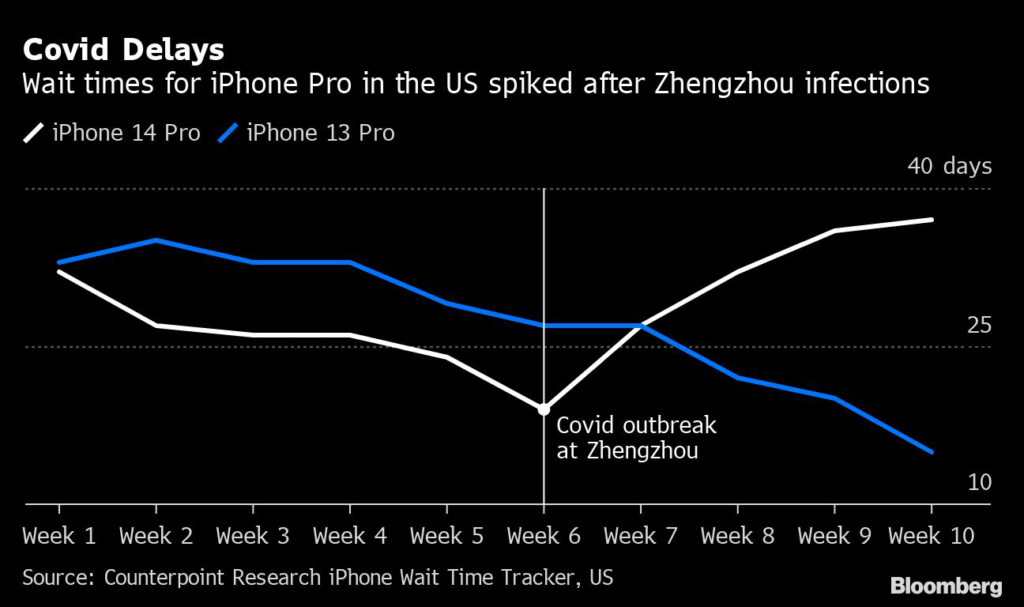
Customers buying Apple’s most premium devices in the US this year can now expect to wait as long as 37 days, according to Counterpoint Research, which monitors delivery times every year. That’s far higher than the predecessor iPhone 13 Pro family and longer than the initial launch of the current generation. Delivery days are “increasing significantly” for iPhone 14 Pro and Pro Max models across all markets, Counterpoint analysts said.

The Zhengzhou facility, operated by Foxconn Technology Group, accounts for most of the world’s iPhone Pro supply and houses as many as 200,000 workers during the peak holiday season. It’s been through a series of disruptions after a Covid outbreak in October, including an abrupt government-imposed lockdown and violent worker protests against restrictions and living conditions.

“The zero China Covid policy has been an absolute gut punch to Apple’s supply chain with the Foxconn protests in Zhengzhou a black eye for both Apple and Foxconn,” said Dan Ives of Wedbush Securities. “We estimate that Apple now has significant iPhone shortages that could take off roughly at least 5% of units in the quarter and potentially up to 10% depending on the next few weeks in China.”

Apple’s Reliance on China Grows Perilous With iPhone City Chaos

Apple is now expected to face a shortfall of 6 million iPhone Pro units this year as a result of those disruptions, Bloomberg News has reported, and the company has said it anticipates longer delivery times this year. Apple and Foxconn, also known as Hon Hai Precision Industry Co., anticipate making up for orders lost this quarter by catching up on production in 2023, though it’s not certain that customers will still want to buy at that time.

Counterpoint’s research is based on averaged data the firm collects three to four times per week. The current wait time in certain locations, including California, is 30 days.

Apple Faces Deficit of 6 Million IPhone Pros on China Tumult

“It’s unfortunate for Apple to be short of its flagship Pro series going into the holiday season, especially if buyers end up pivoting to a competing product,” IDC’s Bryan Ma said. “The good thing for Apple is that it has plenty of ecosystem stickiness to contain most of the leakage and satiate this demand in the following quarters.”

Apple Falls With Shortages at ‘Worst Possible Time’: Street Wrap

This year’s iPhone Pro models are more critical to Apple than ever, as they have been making up for sluggish demand for its regular iPhone 14 series. Counterpoint’s trackers found wait times for iPhone 14 handsets low, remaining at less than three days since launch. The company cut back its production plans for the lower-end devices earlier this month because of that disappointing demand.

More stories like this are available on bloomberg.com

©2022 Bloomberg L.P.

Google Play Fee Suit by Consumers Grows to 21 Million Users

(Bloomberg) — Google now faces more than 21 million customers, instead of just a handful, in a lawsuit alleging its app store collects exorbitant fees.

A federal judge exponentially increased the Alphabet Inc. unit’s damages exposure by granting class-action status Monday in a suit alleging that Google Play has abused its power over the sale and distribution of Android mobile applications.

The consumer dispute is part of a sprawling antitrust fight that also includes complaints filed by attorneys general of almost three dozen states, Epic Games Inc., Match Group Inc. and a group of small app developers. 

The actions threaten the billions of dollars in revenue generated by Google Play, according to Bloomberg Intelligence analyst Jennifer Rie.

“We’re evaluating the ruling and, after that, we’ll assess our options,” a Google spokesperson said. 

The class approved by the judge includes Google Play users since August 2016 in 17 U.S. states and territories not represented in the suit filed in July 2021 by state attorneys general, Karma Giulianelli, an attorney representing consumers, told Donato at an August hearing. Almost 70 million consumers are covered by the states’ suit, she said. 

The consumers claim Google inflates Android app prices by taking, with some exceptions, a 30% cut of sales on Google Play. But for Google’s anti-competitive conduct, the company would “offer discounts, more subsidies in the form of rewards” to bring users to its marketplace, Giulianelli said at the hearing. 

Google’s attorney, Justin Raphael, argued against letting the case proceed as a class action, saying there are too many differences among app transactions to group users together. Apps have a varied price and cost structure, Raphael said at the hearing. 

The case is In Re Google Play Store Antitrust Litigation, 21-md-02981, US District Court, Northern District of California (San Francisco).

–With assistance from Julia Love.

(Updates with Google spokesperson’s comment.)

More stories like this are available on bloomberg.com

©2022 Bloomberg L.P.

Startup CEO Fired for LSD Use Claims Discrimination in Lawsuit

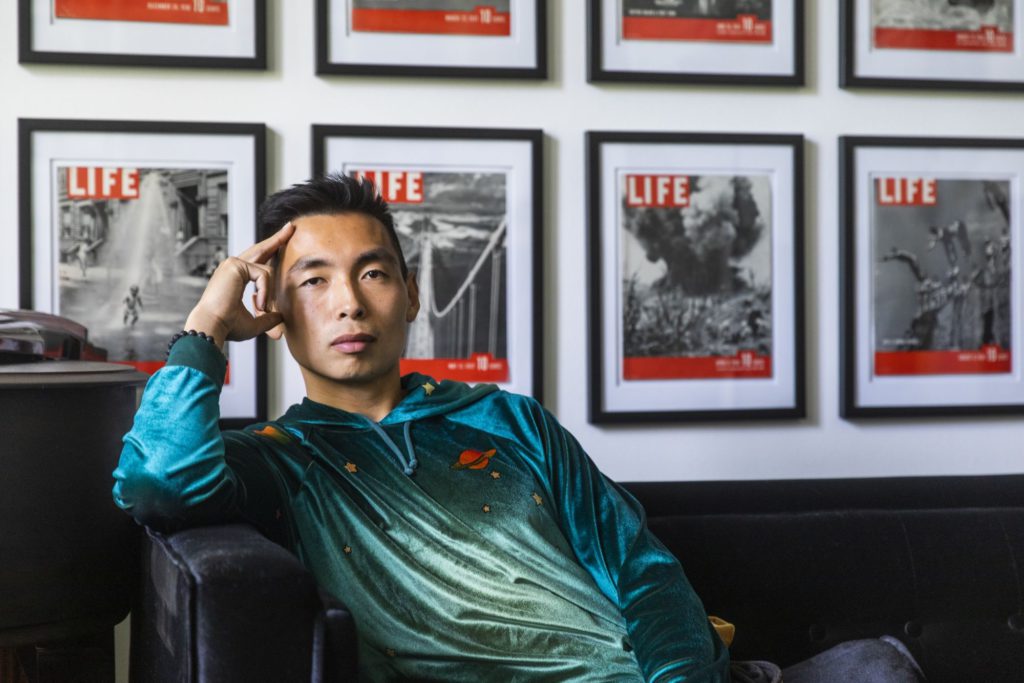
(Bloomberg) — The former chief executive of a high-flying technology startup who was fired for using LSD sued the company and some of its venture backers, claiming the real reason for his termination was his East Asian background.

Justin Zhu, who was fired from Iterable Inc. last year after disagreements with his investors, claims in a complaint filed in state court in San Francisco that the company’s stated reason for firing him, that he violated company policy by using an illegal drug, was “pretextual and a subterfuge.”

His firing came after the issue of discrimination against Asian Americans became a national conversation following the 2021 killings of eight people in Atlanta, most of them women of Asian descent. That spring, Zhu helped organize Stand with Asian Americans, a coalition of executives who condemned violence and pledged donations to help victims. The issue came up during a meeting with Iterable investors Murat Bicer and Shardul Shah, according to the complaint.

“They stated that if he cared about Asian causes, he could invest in them, not serve the goal by being a role model as CEO,’’ Zhu said in the complaint.  “Shardul pointed to the statement by a potential investor who said that Justin did not look like an enterprise CEO. The potential investor stated that the company’s Caucasian COO looked more like a CEO than Justin did.’’

Bicer, a partner at Charles River Ventures was also named as defendants in the suit. Zhu’s lawyer said he filed an amended complaint on Monday in which Shah, a partner at Index Ventures SA, was removed from the list of defendants.Iterable didn’t have an immediate comment on the lawsuit. Charles  River Ventures and Index Ventures didn’t immediately respond to requests for comment.

Zhu said in the lawsuit that he took a small amount of LSD before a 2019 investor meeting and his body “was more sensitive to the dose than he expected,” affecting his vision. He said the experience brought a positive change to his work life, helping to alleviate his depression and anxiety during a difficult fundraising process. He later raised more money for Iterable, bringing it to a unicorn valuation.

In the lawsuit he noted that several studies suggest psychedelic drugs may have benefits for people with depression and other psychological problems.

When his investors, already pushing for him to step down as CEO , learned of the incident around May 2021, they cited it as a reason to remove him from the top job, according to the lawsuit. In a surprise meeting with board members Bicer of Charles River Ventures and Lee Wittlinger of Silver Lake, he was fired. Wittlinger is also named as a defendant.

Silver Lake didn’t immediately respond to a request for comment.

Stand with Asian Americans has since created a forum for Asian Americans to report workplace discrimination and seek support. While Asian Americans often account for a significant portion of the workforce within big technology companies, they are less likely to break into leadership ranks.

The case is Zhu v. Bicer, Case No. CGC-22-602938, Superior Court of the state of California (San Francisco). Read more: CEO of $2 Billion Startup Ousted for Taking LSD at Work

(Updates with lawyer’s comment)

More stories like this are available on bloomberg.com

©2022 Bloomberg L.P.

Crypto Lender BlockFi Goes Bankrupt in Wake of FTX’s Fall

(Bloomberg) — Crypto lender BlockFi Inc. filed for bankruptcy, becoming the latest digital-asset firm to collapse in the wake of the rapid downfall of the FTX exchange and stoking worries that more corporate failures lie ahead.

BlockFi said in a statement Monday that it will use the Chapter 11 process to “focus on recovering all obligations owed to BlockFi by its counterparties, including FTX and associated corporate entities,” adding that recoveries are likely to be delayed by FTX’s own bankruptcy. Chapter 11 bankruptcy allows a company to continue operating while working out a plan to repay creditors. 

The petition, filed in New Jersey, lists BlockFi’s assets and liabilities at between $1 billion and $10 billion each. The company said in the statement that it had around $257 million of cash on hand, and is starting an “internal plan to considerably reduce expenses, including labor costs.”

Citing “a lack of clarity” over the status of bankrupt FTX and Alameda Research, the Jersey City, New Jersey-based company earlier halted withdrawals and said it was exploring “all options” with outside advisers.

Following investigations into FTX by the US Securities Exchange Commission and Commodity Futures Trading Commission over potential misuse of customer funds, it became unclear to BlockFi where funding for a credit line from FTX US and collateral on loans to Alameda, which included Robinhood Markets Inc. stock, came from, Bloomberg News reported earlier this month. BlockFi had also been in the process of shifting over its assets over to FTX for custody, but the majority of the assets had not been moved prior to FTX’s collapse. 

FTX US is listed in the company’s petition as one of its top unsecured creditors, with a $275 million loan.


The company’s largest unsecured creditor, Ankura Trust Company, is owed about $729 million, according to the petition. Ankura acts as a trustee for BlockFi’s interest-bearing crypto accounts, according to its website.

“BlockFi’s Chapter 11 restructuring underscores significant asset contagion risks associated with the crypto ecosystem, and, potentially, deficient risk management processes,” said Monsur Hussain, senior director of Financial Institutions at Fitch Ratings. He said that that these restructuring processes can be “notoriously lengthy” and noted that creditors owed money by Mt. Gox are only getting closer to be paid eight years after the Bitcoin exchange failed. 

BlockFi’s bankruptcy shares similarities with that of FTX, according to Eric Snyder, partner and chairman of the bankruptcy department at law firm Wilk Auslander. He said in an interview that in both filings, the names of many of the key creditors have not been disclosed, which is unusual in a bankruptcy filing. Snyder also said that it will take a while to determine the total amount of money owed to creditors in both cases.  

BlockFi was founded in 2017 by Zac Prince and Flori Marquez and in its early days had backing from influential Wall Street investors like Mike Novogratz and, later on, Valar Ventures, a Peter Thiel-backed venture fund as well as Winklevoss Capital, among others. Valar was one of BlockFi’s largest shareholders with a 19% stake, the bankruptcy filings show. BlockFi made waves in 2019 when it began providing interest-bearing accounts with returns paid in Bitcoin and Ether, with its program attracting millions of dollars in deposits right away. 

The company grew during the pandemic years and had offices in New York, New Jersey, Singapore, Poland and Argentina, according to its website. Co-founder Prince in a March 2021 interview with Bloomberg said BlockFi was using proceeds from a $350-million funding round to expand into new markets and fund new products. Bain Capital Ventures and Tiger Global were among the investors in the that round.

Originally valued at $3 billion in March 2021, BlockFi looked to raise money at a reduced valuation of about $1 billion in June. The firm also faced scrutiny from financial regulators over its interest-bearing accounts and agreed to pay $100 million in penalties to the SEC and several US states in February. The SEC is listed on the bankruptcy filing as BlockFi’s fourth-largest creditor, with $30 million owed to the agency.

BlockFi worked with FTX US after it took an $80 million hit from the bad debt of crypto hedge fund Three Arrows Capital, which imploded after the TerraUSD stablecoin wipeout in May.

The company had significant exposure to the empire of companies founded by former FTX Chief Executive Officer Sam Bankman-Fried. The company received a $400 million credit line from FTX US in an agreement that also gave the company the option to acquire BlockFi through a bailout orchestrated by Bankman-Fried over the summer. BlockFi also had collateralized loans to Alameda Research, the trading firm co-founded by Bankman-Fried.

The company is the latest crypto firm to seek bankruptcy amid a prolonged slump in digital asset prices. Lenders Celsius Network LLC and Voyager Digital Holdings Inc. also filed for court protection this year. Crypto brokerage Genesis is struggling to raise at least $1 billion in fresh capital and has warned potential investors that it may need to file for bankruptcy if its efforts fall short, Bloomberg reported last week.

BlockFi sold about $239 million of its own cryptocurrency and warned almost 250 workers that they would lose their jobs in the run-up to its bankruptcy filing, court papers show. 

The case is BlockFi Inc., 22-19361, U.S. Bankruptcy Court for the District of New Jersey (Trenton).

–With assistance from Jeremy Hill, Vildana Hajric and Emily Nicolle.

(Updates with Genesis’s travails in the 15th paragraph.)

More stories like this are available on bloomberg.com

©2022 Bloomberg L.P.

Taiwan Dollar’s Best Rally in Decades May Stumble

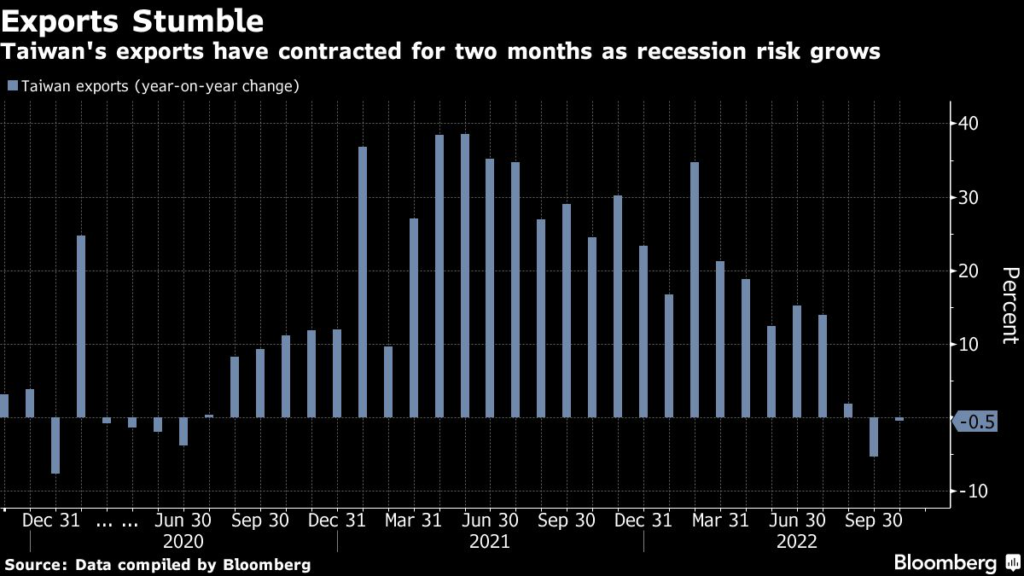
(Bloomberg) — Taiwan dollar’s biggest rally in almost a quarter of a century is set to unwind as a looming global recession cuts into the island’s technology exports.

The currency, which has risen more than 4% this month to 30.90 per US dollar, will probably weaken to about 33 by the end of the first quarter, Mizuho Bank Ltd. and RBC Capital Markets forecast, as overseas shipments shrink for a second straight month. The outlook isn’t bright with a global recession looming and big tech shedding jobs, while Covid-19 infections rise in China — the biggest trading partner of the export-reliant economy. 

“The recent rally has helped TWD recover some lost ground but with the semiconductor cycle turning lower and the purchasing managers indexes wallowing at very low levels, the growth argument to hold TWD looks handicapped,” said Philip McNicholas, Asia sovereign strategist at Robeco Group in Singapore.

Global tech companies, including HP Inc., are laying off people as they navigate a sustained downturn in personal computer demand while phone-makers have also warned of slowing sales. A slowdown in China is adding to the risk given Taiwan’s economic dependence on the nation. That will threaten the island’s exports, which make up a large source of its foreign exchange and surged to a record $446.5 billion last year.

Although the profits of Taiwan’s top three tech firms — Taiwan Semiconductor Manufacturing Co., MediaTek Inc. and Hon Hai Precision Industry Co. — may remain strong in the near term, the sector may see slowing growth or even contract next year, according to Bloomberg Intelligence Strategist Marvin Chen.

Underweight 

Despite its recent rebound, the Taiwan dollar is still down more than 10% this year — set for its steepest slide since 1997 — given a widening rate differential with the US. Its central bank delivered only a total of 50-basis-point rate hike this year, among the smallest in Asia, even as the Federal Reserve raised rates by 375 basis points. Taiwanese policymakers will next decide on rates on Dec. 15.

Goldman Sachs Group Inc. also said this month it’s underweight on the Taiwan dollar as geopolitical risks could lead to foreign selling of the island’s stocks. Having said that, local elections over the weekend indicate that the opposition Kuomintang — which favors closer ties with China — won in more cities and counties than the ruling party. 

The rise in power of the ruling Democratic Progressive Party had led to tension with China.

“We expect the Taiwan dollar to revert to 32-33 level in the medium term as the recession will dampen demand for Taiwan’s electronic exports,” said Ken Cheung, chief Asian FX strategist at Mizuho in Hong Kong. “The central bank’s rate-hike pace will also lag the Federal Reserve’s rate-hike cycle, and the currency will stay soft compared to its peers.”

Here are the key Asian economic data due this week:

  • Monday, Nov 28: South Korea retail Sales, Australia retail sales
  • Tuesday, Nov 29: Taiwan 3Q GDP, Japan jobless and retail sales
  • Wednesday, Nov 30: Bank of Thailand policy decision, Thailand trade data and balance of payments, South Korea industrial production, Australia CPI, China manufacturing PMI
  • Thursday, Dec 1: South Korea 3Q GDP and trade data, PMI for most countries in the region, Indonesia CPI
  • Friday, Dec 2: South Korea CPI

–With assistance from Cindy Wang.

(Corrects the fourth paragraph to remove inaccurate reference of other layoffs.)

More stories like this are available on bloomberg.com

©2022 Bloomberg L.P.
Close Bitnami banner
Bitnami