Bloomberg

The Netflix Effect on Asian Snacks, Noodles Is Real, CEO Says

(Bloomberg) — Like many founders, Alex Zhou started a business out of frustration.

When he moved to the U.S. from China, Zhou quickly realized that finding his favorite chili sauce and tea would be hard. He eventually discovered an Asian market that was a two-hour drive from Kansas State University, where he studied industrial engineering. But he wasn’t satisfied and in 2013 founded Yami, an online retailer that offers imported Asian goods.

The company now sells more than 250,000 products, spanning flavored bread to acne cream. And Zhou, 35, thinks Yami can cater to a wider swath of U.S. consumers because of the rising popularity of Asian goods, as the region’s cultural influence grows thanks to K-pop music, which has loyal fans the world over, and shows like “Squid Game,” Netflix’s most popular series ever.

Zhou expects Yami to increase sales 50% this year to $300 million. The company recently raised $50 million in a series B round to expand its product lineup and supply chain, including a warehouse on the East Coast. It declined to provide a valuation. In a sign of the market’s potential, competitor Weee! — an online retailer that sells Asian and Hispanic goods in the U.S. — has taken in more than $800 million in funding and is valued at $4.1 billion, according to researcher PitchBook.

Bloomberg recently spoke with Zhou about what’s next for Yami and the Asian goods market.

Let’s start with the basics. What’s driving demand for Asian goods in the U.S.?

The overall Asian population is growing in North America, as well as the number of non-Asians who have an interest in Asian products — some are pop culture fans. And there’s been the rise of Asian food culture. So, when they get used to this Asian taste, they’re going to start looking for seasonings, chili sauce, Japanese ramen.

We carry products that you can’t easily find.

You mention pop culture boosting interest in Asian goods. Is the Netflix effect real?

We know based on our internal data that there are more and more non-Asian customers. They really love Asian pop culture — K-pop, K-drama, Japanese mangas.

Your customer base now spans Asian communities to White Americans and Latinos. How are you trying to cater to all of them?

We categorize our customers based on their behavior — what do they want? Are they deal driven? That’s one of the main areas we’re going to work on for our tech. When our consumers come to our website, they’ll be shown products they’re actually interested in.

Our Asian customers normally come to the site and know what they want. They know the brands. But many times, our non-Asian shoppers don’t. So, we also offer bundles, such as limited-edition Japan or China snack boxes.

Delivery times continue to shrink across e-commerce. How are you planning to keep up?

We have a warehouse in Los Angeles, so for L.A. and Orange counties we can deliver the same or next day. For San Diego and North California, next day. After this round, we can duplicate the delivery model to the East Coast. After we open the second warehouse, over 80% of our clients will receive packages in two days at most.

Since most of your products are imported, how are you dealing with supply chain snags?

Frankly speaking, this is all very ongoing. The price of international freight is so high. We have direct relationships with vendors in Japan, China, Korea and Southeast Asia. So that’s helped. We have our own warehouse as well as third-party partners, so we can use their inventory to fulfill orders when we experience our own shortage.

Editor’s note: This interview has been edited and condensed.


More stories like this are available on bloomberg.com

©2022 Bloomberg L.P.

Carrefour Seen as Europe’s Top M&A Target in Bloomberg Poll

(Bloomberg) — Carrefour SA beat out telecom and media companies to top the list of mergers and acquisitions targets in Europe, as dealmaking starts to recover from its worst quarter since summer 2020.

The French grocer was a clear M&A favorite in a Bloomberg News survey of 20 traders, fund managers and analysts in Europe at the end of March. While approaches by Canada’s Alimentation Couche-Tard Inc. and domestic rival Auchan fell apart early last year, the latter is said to weigh another takeover attempt. Any deal in France will look to avoid the presidential elections this month.

Worries about the war in Ukraine and soaring inflation dented confidence this year, with European M&A volume down 41% compared to a blockbuster first quarter in 2021. Yet, dealmaking is still happening at a historically elevated pace in Europe, as cheaper valuations and a rotation away from frothy growth assets provide an array of buying opportunities. 

“The M&A market has remained active even after the invasion of Ukraine and there is no shortage of potential buyers screening businesses,” said Stuart Ord, head of M&A at Numis Plc. He expects interest in financial services, technology, media and telecom and health-care sectors to continue.

Carrefour shares were trading 1.9% higher at 19.76 euros as of 12:20 p.m. in Paris on Thursday. That’s not far from the initial 20 euros per share bid that had been submitted by Couche-Tard in January 2021. 

The stock remains a top pick for Bryan Garnier analyst Clement Genelot, who predicts continuing M&A speculation about Carrefour until Auchan launches an all-cash 23.5 euros per share bid for the French grocer. 

“I’m sure Auchan will place a bid soon after French presidential elections,” Genelot said in a phone interview on Thursday. “The war in Ukraine and Auchan’s presence in Russia means the company has an even bigger need to refocus on France now.”

Satellite company Eutelsat Communications SA, which topped the poll in January, came in second place this time. The firm rejected the advances of billionaire and media tycoon Patrick Drahi last year, but survey participants see potential for more interest in the French business. Telecom carrier Royal KPN NV, a frequent flyer in Bloomberg M&A surveys, also ended up high in the rankings.

Europe’s media sector is in focus as former Italian Prime Minister Silvio Berlusconi’s broadcaster, MFE-MediaForEurope NV, moved to take full control of a Spanish unit, likely the first step in its plan to create a pan-European television group. ProSiebenSat.1 Media SE is seen as next on the shopping list.

Bargain Hunters

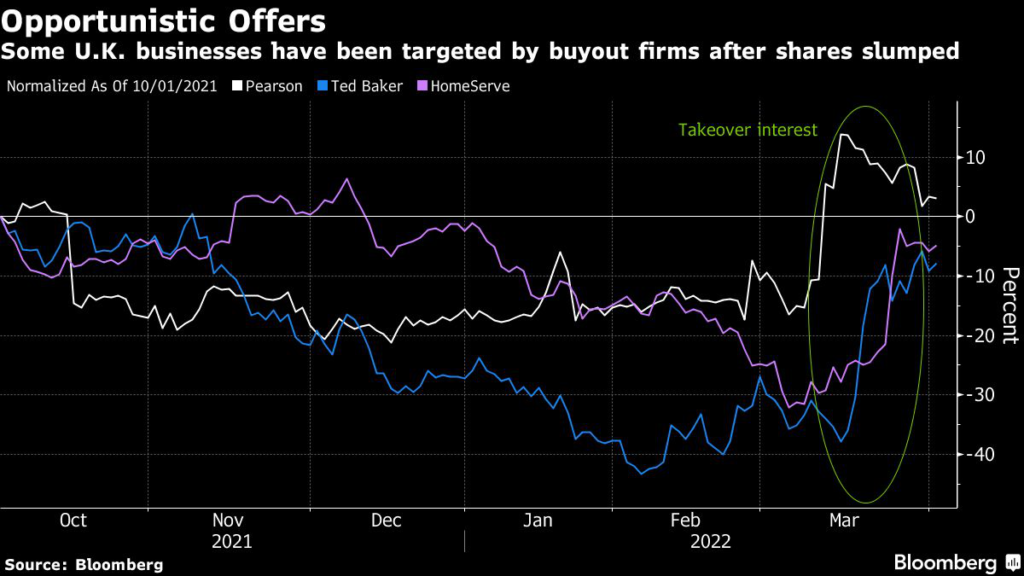
Another area where dealmaking is picking up is private equity. Over the past two weeks, Pearson Plc, Ted Baker Plc and HomeServe Plc have all been targeted by financial sponsors after a slump in their share prices.

So far, the overtures haven’t met with much success, with both Pearson and Ted Baker saying the proposed offers were too low. The interest prompted Ted Baker to kickstart a formal sale process in search of higher bids this week. Private equity firms are likely to ramp up their buying spree to put cash piles to work before they are eroded by inflation.

“We are already seeing evidence of private equity firms re-entering the M&A market after a very quiet first quarter,” said Graham Simpson, analyst at Canaccord Genuity’s research division Quest. “This tells us they have their confidence back and the current valuations are too good to pass up.”

The focus in 2022 has shifted from mega-mergers to cost-cutting and unlocking value for shareholders as activist investors boost their presence in European companies. Several large U.K. conglomerates in particular have been caught in their crosshairs.

GlaxoSmithKline Plc is preparing to split out its consumer health business this summer, as Elliott Investment Management dials up the heat on management to improve returns. Activist investor Nelson Peltz is putting pressure on ailing consumer goods giant Unilever Plc, after abandoning its pursuit of Glaxo’s unit.

“The U.K. market is cheap relative to most other equity markets across sectors and on almost every metric, so activists are seeing there’s significant money to be made,” said Andrew Millington, head of U.K. equities at abrdn. The FTSE 100 Index trades at 11 times estimated earnings, compared with 13 times for the Euro Stoxx 50.

(Updates with comments on Carrefour from fifth paragraph)

More stories like this are available on bloomberg.com

©2022 Bloomberg L.P.

Shanghai Lockdown Risks Becoming Biggest Crisis of Xi’s Tenure

(Bloomberg) — Pets beaten to death. Parents forced to separate from their children. Elderly folks unable to access medical care. Locked-up residents chanting “we want to eat” and “we want freedom.”

As much of the world moves on from the pandemic, the desperate scenes seeping out of China’s most global city have shocked even citizens who were once staunch supporters of President Xi Jinping’s Covid Zero strategy to eliminate the virus. The struggle to obtain daily necessities like food and medical care has triggered rare pushback from residents, with some saying the Communist Party’s cure is worse than the disease.

“In this country it’s not the virus that scares us, but the chaotic anti-Covid measures that have caused risks to the well-being of the elderly, the children and companion animals,” said Lily Chen, who lives in Shanghai with her three cats. “I now realize we can only rely on ourselves — not the government — to protect our own families.”

Another Shanghai resident, Regina Li, said she had long supported the government and even defended the strict measures at the start of the lockdown, which began in parts of the city on March 28 before spreading to cover nearly everywhere. But the widespread difficulties of vulnerable people started to change her mind, and she broke down in tears after seeing social-media posts of a virus-control worker beating a dog to death.

“I feel I no longer know the city,” Li said. “The only thing in my mind is to protect my dogs. Anyone who wants to kill them, come kill me first.”

The growing angst risks becoming one of the biggest challenges to Xi perhaps since he took power in 2012, and comes just months before he’s expected to secure a precedent-breaking third term at a twice-a-decade party congress later this year. The outbreak has virtually paralyzed one of China’s most sophisticated and recognizable cities, with businesses shuttered and factories of companies like Tesla Inc. halting production. 

Although the Communist Party remains firmly in control, the rare grassroots criticism undercuts Xi’s ability to trumpet his Covid-19 strategy as evidence of China’s superior model of governance — a key justification for him to stay in power. China’s Foreign Ministry has regularly blasted the U.S. and Europe for allowing so many deaths, while saying Xi’s policy was “beyond reproach.”

Tesla Halted, Chips Pile Up as Shanghai Lockdown Upends Business

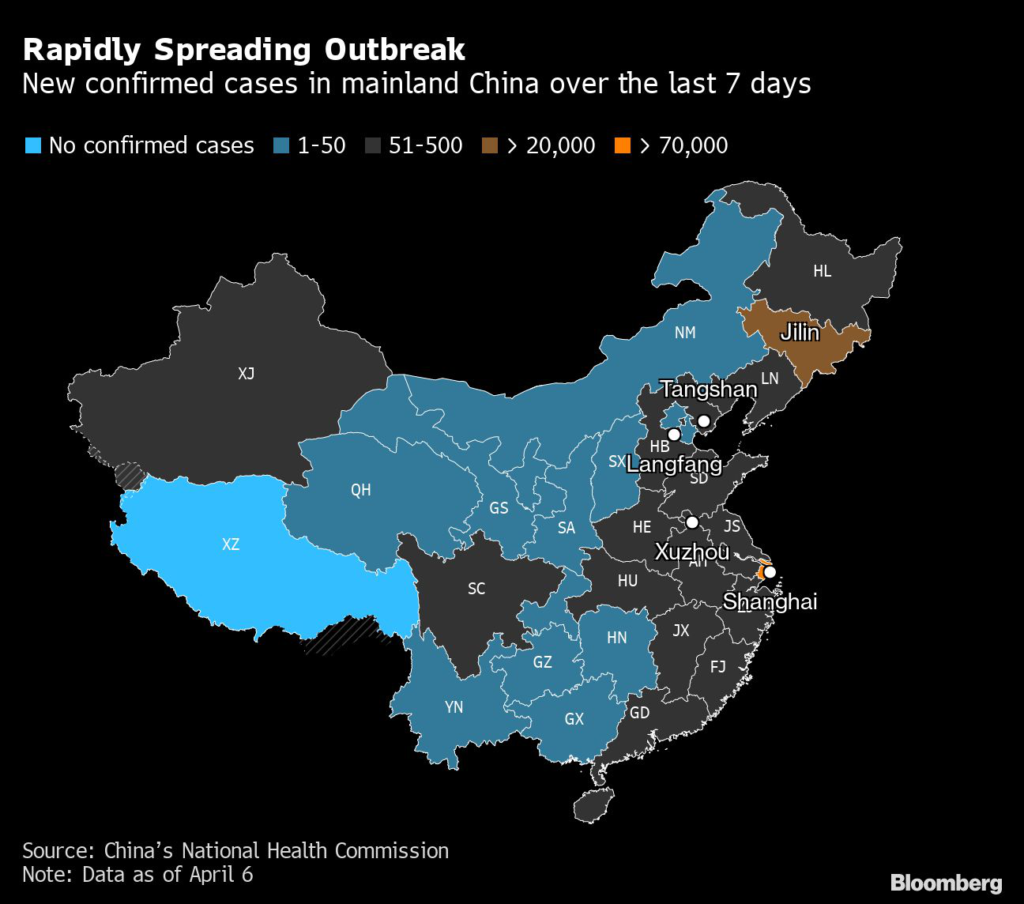
Greater pushback by residents in Shanghai could also inspire other cities to resist lockdowns and other stringent measures used by China to fight the virus. The northeastern province of Jilin, an automaking and farming hub, has also been locked down for nearly a month, prompting residents to complain on social media about running out of food, cancer medication and baby formula.

The situation could still get worse in other parts of the country. China’s outbreak is surpassing a level not seen since February 2020, when a one-day correction in the way it tracked cases pushed daily infections past 15,000, largely in Wuhan. 

“There is the risk of a slow-burn discontent if lockdown measures spread across China,” said Chen Shih-Min, an associate political science professor at National Taiwan University. “And if its virus strategy goes out of control and heavily affects its economy, this will not look good as Xi attempts a third term. At that point, Xi will have no choice but to ramp up his nationalism agenda.”

The Communist Party is feeling the heat. On Wednesday it issued a rare call imploring rank-and-file members to help contain the coronavirus in Shanghai, where daily cases rose to more than 19,900.

“We must dare to draw our swords and fight against all kinds of behaviors that interfere with and undermine the overall situation of the fight against the epidemic,” the party’s top branch in Shanghai wrote to members in an open letter. It urged them to “take the initiative to speak out against all kinds of noises, especially rumors, to clarify right and wrong, and to unite a strong force to overcome the difficulties together.”

Shanghai officials are also racing to reassure residents they can access essential supplies in a city home to top banks and the biggest stock exchange in the world’s No. 2 economy. The lockdowns and virus-containment measures threaten to slow China’s growth this year to below the government’s 5.5% target, according to Bloomberg Economics. 

Deputy Mayor Chen Tong on Thursday pledged to “unlock” wholesale markets, fulfillment centers, e-commerce warehouses and central kitchens to ease the supply crunch for goods like infant formula. At the same briefing, Meituan Vice President Mao Fang said the food delivery company would bring in 1,000 sorting workers from outside the city to speed up deliveries.

‘Shanghai, Keep Fighting’

officials have ramped up assistance in recent days. Some residents have begun receiving food packs from the government that include eggs, milk, vegetables and luncheon meat. In certain places, those locked in have joined together to sing patriotic songs like “Me and My Motherland” from their balconies and chant “Shanghai, Keep Fighting.”

The letter from the Communist Party committee in Shanghai on Wednesday appealed to patriotism. “Today, we communists in Shanghai must carry forward the founding spirit of the party, and let the party flag stand high on the front line of the fight against the epidemic,” it said.

Still, even that was met with scorn from some internet users.

“Where’s the party flag? Where’s your fortress and vanguard?” Weibo user Ah Dai Is Speechless wrote. “We don’t see anything but chaos, disorder and discrimination.”

‘No Humanity Left’

The government has tried to censor the unrest, with Bloomberg reporting last week that videos of a rare protest in a locked-down housing compound were deleted from a social media platform by tech giant Tencent Holdings Ltd. Other incidents that have gone viral on Chinese social media platforms are still accessible on places like Twitter and YouTube. 

One in particular captured an older man who said that Shanghainse people are practically being put in prison. “Really shame on you. Treat us like animals,” the man said in the clip. “In other countries, you can’t even treat a cat or a dog like this. There is no humanity left.”

More stories like this are available on bloomberg.com

©2022 Bloomberg L.P.

Ukraine Update: Kuleba Weapons Plea; Russian Joblessness Rising

(Bloomberg) — Ukraine’s foreign minister pleaded for more weapons at a NATO meeting in Brussels, and called out Germany for being too slow to help. The United Nations General Assembly is set to vote Thursday on whether to suspend Russia from the Human Rights Council, as U.S. President Joe Biden accused the Kremlin’s forces of committing “major war crimes” in Ukraine.

The U.S. announced new sanctions that target two of Russia’s biggest banks and President Vladimir Putin’s adult daughters after saying Moscow’s forces carried out atrocities in towns near Kyiv that included the murder of civilians. Russia has repeatedly denied the allegations. 

European foreign ministers are likely to discuss an oil embargo on Russia when they meet early next week. Italy said it would support a European Union ban on Russian gas if the bloc is united behind the idea — which it currently isn’t. Russia’s ruble has recovered to its pre-invasion level.

(See RSAN on the Bloomberg Terminal for the Russian Sanctions Dashboard.) 

Key Developments

  • Russian Coal and Oil Paid for in Yuan to Start Flowing to China
  • Shell to Write Down as Much as $5 Billion on Russia Exit 
  • Mocked as ‘Rubble’ by Biden, Russia’s Ruble Comes Roaring Back
  • Sanctions Hobble the Airline Built by ‘Russia’s Elon Musk’
  • Russia Piles Pressure on Companies as Unemployment Crisis Looms
  • U.S. Satellites Spying on Russia’s War Tap Commercial Technology

All times CET: 

Estonia, Finland to Rent Joint LNG Terminal Vessel (11:14 a.m.)

Estonia and Finland plan to jointly rent a liquefied natural gas terminal vessel as part of an effort to lower dependence on Russian gas. 

The floating storage and regasification unit would have possible berths on both sides of the Gulf of Finland, according to statements from the countries, which are connected by the Balticconnector gas pipeline. The project’s timetable is “extremely urgent,” Finland’s economy ministry said.

Russia Coal, Oil Paid for in Yuan Heads to China (11:00 a.m.)

Several Chinese firms used local currency to buy Russian coal in March, and the first cargoes will arrive this month, Chinese consultancy Fenwei Energy Information Service Co. said. 

These will be the first commodity shipments paid for in yuan since the U.S. and Europe penalized Russia and cut several of its banks off from the international financial system. 

Hungary Still Opposes Sanctions on Russian Gas (10:56 a.m.) 

Hungary reiterated that it can’t back sanctions against Russia that would threaten its natural gas supplies. Despite efforts at diversification Hungary “is still heavily dependent on Russian gas,” Dora Zombori, ambassador-at-large for energy and climate, said at an industry conference in Budapest. “We cannot change this situation overnight.” 

Russian Railways Didn’t Repay $605M Bond (10:56 a.m.)

Russian Railways informed the issuer, RZD Capital Plc, that it’s applied for a license from the Office of Financial Sanctions Implementation in the U.K. for the purposes of facilitating payments on outstanding debt obligations issued before March 24, which “may require a number of weeks processing time,” according to a statement. 

Russian Railways Coupon Miss Raises Debt Swaps Trigger Question

Commodity Markets Remain Volatile (10:20 a.m.)

Commodity markets continue to be whipsawed by disruptions sparked by Russia’s war in Ukraine and efforts to curb raw-material costs. 

Russia slipped closer to a technical default after foreign banks declined to process about $650 million of dollar payments on its bonds, forcing it to offer rubles instead.

Equities markets are showing signs of stability after a selloff sparked by hawkish minutes from the Federal Reserve, with European markets mostly up and U.S. futures mixed. 

EU Russian Coal Ban May be Pushed to Mid-August: Reuters (10:16 a.m.) 

Envoys are poised to approve a ban on Russian coal that would become fully effective from mid-August, a month later than initially proposed, Reuters reported, citing a person in the EU familiar with the matter who it didn’t identify. 

Shell Exit From Russia May Trigger $5 Billion Writedown (9:52 a.m.)

Shell Plc said its withdrawal from Russia will result in $4 billion to $5 billion of impairments, and warned investors that extreme energy price volatility in the first quarter could hit cash flow. 

While western energy companies leaving Russia are likely to take massive financial hits, they are attempting to minimize the reputational damage of investing in Moscow-backed projects following the war on Ukraine.  

Germany Overhears Russian Soldiers Discussing Bucha: Spiegel (9:52 a.m.) 

Germany’s foreign intelligence service intercepted communications between Russian soldiers discussing the killing of civilians in the town of Bucha, Der Spiegel reported, without saying how it obtained the information. 

The radio communications, which appear to place Russian soldiers at locations where bodies were found, contradict Moscow’s denial that its troops were involved. In one of the messages, a soldier can be heard describing how he shot a person on a bicycle. Another appears to provide evidence of a strategy to stop and question civilians before shooting them, according to the report. 

The material also shows that mercenaries, including the Kremlin-backed Wagner Group, appeared to have played a major role in the killings, according to Der Spiegel. 

Finland’s NATO-Backing Party Rises in Poll (9:19 a.m.) 

Finland’s National Coalition, the only large party in the Nordic country to openly support joining NATO, soared 3.5 percentage points in the latest poll. The party’s benefiting from a historic shift in Finnish attitudes to potential membership in the North Atlantic Treaty Organization. The gain, almost twice the margin of error, gives it 26.1% backing, its highest in polls by YLE.

Finland’s government is slated to send a white paper to parliament next week on its changed security environment. 

Australia Imposes New Sanctions on Russia Over Bucha (9:15 a.m.) 

Australia placed new sanctions on 67 Russian individuals, including military figures accused of human rights abuses, bringing the total number of people sanctioned by Canberra since the beginning of the Ukraine war to almost 600.

Foreign Minister Marise Payne said in a statement that the move was in response to “the emergence of evidence of war crimes committed by Russia in Bucha and other towns around Kyiv.” 

Russian Unemployment Crisis Looms (9:09 a.m.)

The next economic jolt to Russia will likely arrive by way of the labor market, building in intensity over the coming months and bringing new hardships for a nation already waylaid by a series of shocks.

Joblessness this year is set to more than double from the first quarter and exceed 9% for the first time in more than a decade, according to a Bloomberg survey of analysts in March. 

German Minister Says Open to Coal Embargo (8:33 a.m.) 

Economy Minister Robert Habeck said Germany has already cut its reliance on Russian coal by at least half in the past month and won’t stand in the way if the European Union decides to ban on imports of the fuel from Moscow. 

Habeck said it would be “foolish” to name an exact date for when purchases of Russian coal could end. The sanctions being considered would allow some deliveries to be completed, he added.

Austria Expels Four Russian Diplomats (8:24 a.m.)

Austria expelled four Russian diplomats for illegal activities, the Foreign Ministry in Vienna said in a statement on Thursday.  

While several other nations who have announced similar measures in recent days, it’s a rare step for Austria, which houses several international organizations and has sought a diplomatic role in bridging Europe’s east and west. Russia has almost 300 diplomats stationed in Austria.  

Ukraine Says Russian Troops Readying for Eastern Offensive (8:02 a.m) 

Russian troops are focusing on preparations for their next offensive in Ukraine’s east, the General Staff of the Ukrainian armed forces said on its Facebook page. Shelling of towns in the Luhansk region started on Wednesday night and continued through morning, with significant damage to residential buildings and infrastructure.

The entire Kharkiv and Donetsk regions were under artillery fire overnight  and so was the occupied Kherson region in Ukraine’s south. Civilians are attempting to evacuate from occupied areas of Kherson region.

Ukraine’s government has urged people living in the regions of Kharkiv, Donetsk and Luhansk to leave the areas “while the opportunity still exists” in advance of Russia’s expected new assault. 

EU Ministers Set To Discuss Oil Embargo, Borrell Says (8:11 a.m.) 

European Union foreign affairs ministers are likely to discuss imposing an oil embargo on Russia when they meet early next week, said Josep Borrell, the EU’s foreign policy chief. 

Borrell told reporters in Brussels that an oil embargo is not in a fifth sanctions package on the agenda for Thursday, but that he expects the ministers will tackle it on Monday “and sooner or later, I hope sooner, it will happen.” 

He said he hopes the fifth package, which would ban coal imports among other steps, “will be finally approved by the ambassadors” later Thursday. 

Germany Too Slow To Move on Weapons, Kuleba Says (7:47 a.m.)

Germany is taking too long to decide on supplying more weapons to Kyiv, Ukraine Foreign Minister Dmytro Kuleba said. “While Berlin has time, Kyiv doesn’t,” Kuleba said of Germany’s “length of procedures and decision-making” as he arrived for a meeting of NATO foreign ministers in Brussels. 

Kuleba said Germany had made “a revolutionary step” in agreeing several weeks ago to supply weapons to Ukraine. “However, it is clear that Germany can do more given its reserves and capacity.” 

In a tweet describing his talks with NATO chief Jens Stoltenberg, Kuleba said he had come to Brussels to “discuss three most important things: weapons, weapons, and weapons.” 


U.S. Shares Intelligence With Foreign Banks, FT Says (6:02 a.m.)

U.S. federal agencies are sharing intelligence with foreign banks to bolster defenses against potential cyberattacks in retaliation for the economic sanctions imposed on Russia, the Financial Times reported, citing unidentified people familiar with the briefings.

U.K. May Send Armored Vehicles to Ukraine, Times Says (11:45 p.m.)

The U.K. is drawing up plans to send armored vehicles to Ukraine, with options including the Mastiff or Jaguar patrol vehicles, The Times of London reported, citing official sources.

Additional support including anti-tank and anti-aircraft missiles is set to be announced within days, The Times said. 

Biden Says ‘Major War Crimes’ Were Committed (7:14 p.m.)

Biden said that Russia has committed “major war crimes” in Ukraine and that U.S. sanctions are crushing its economy.

“There’s nothing less happening than major war crimes. Responsible nations have to come together to hold these perpetrators responsible,” Biden said in a speech to a convention of construction unions in Washington on Wednesday.

He said that sanctions already imposed by the U.S. and allies are predicted to shrink the Russian economy by “double digits this year alone” and added that “we’re going to stifle Russia’s ability to grow its economy for years to come.” 

(An earlier version corrected the 8:02 subhead to show Russia preparing for eastern offensive.)

More stories like this are available on bloomberg.com

©2022 Bloomberg L.P.

Tesla’s Long, Winding Road to Getting Europe’s Approval for FSD

(Bloomberg) —

Road trips are fun — especially when someone else handles the driving.

I just returned from a 12-day visit to the U.S. Much of that time, I was chauffeured by two longtime friends, Joe and Wes, around the American Southwest in their Tesla Model 3.

In my first battery-powered road trip, we drove from Arizona to Los Angeles. Then, after a brief respite following our return to Phoenix, we headed to the Grand Canyon and back. The ride was very smooth and the planned Supercharger stops proved to be fun intermissions rather than the nuisances I expected. I also got to experience Tesla technology that hasn’t made it to Europe yet: Full Self-Driving, or FSD, the controversial pay-to-unlock features that drivers have been beta testing on public roads.

We tried out FSD in downtown Phoenix. While the car self-parked fine and did well going straight, the driver-assistance system is still rough around the edges. It often brakes a bit too late and accelerates too abruptly for my tastes. When the car was about to make a left turn at a busy intersection, Wes quickly took over the wheel because it appeared the Tesla was about to veer into oncoming traffic.

Elon Musk says he’s confident Tesla can introduce FSD in Europe this summer, but I’m not so sure. The region is known to err on the safe side, and adapting the software so it can detect the different languages, traffic rules and road designs isn’t easy. Regulators are going to expect that developers of these systems have engineered them to be able to handle drivers taking trips, for example, from Denmark, down through Germany and the Czech Republic, and on to Hungary. That’s a lot of complexity.

Musk admitted last month Tesla still has “a lot of work” to do on special-case traffic situations before the carmaker will be ready to show FSD to European regulators. And even then, he expects them to be less permissive than their American counterparts.

“In the U.S., things are legal by default, and in Europe, they are illegal by default,” Musk said last month during the opening of Tesla’s factory near Berlin. “We have to get approval beforehand, whereas in the U.S., you can kind of do it on your own cognizance, more or less.”

Yeah, more or less. The U.S. National Highway Traffic Safety Administration has opened two defect investigations into Tesla’s standard Autopilot driver-assistance system. The agency opened the first probe after a dozen incidents in the last four years in which Teslas collided with first-responder vehicles. The moves suggest regulators in Washington may be losing patience with the carmaker. Any clampdown on Autopilot in the U.S. by what Musk has referred to as “the fun police” won’t help Tesla’s cause getting the green light for FSD in Europe.

Granted, European politicians are eager to ensure they don’t fall behind the U.S. and China when it comes to automated driving. German lawmakers agreed last year to allow some driverless vehicle trials on public roads. Mercedes-Benz late last year won regulatory approval to deploy a hands-free driving system in Germany, ahead of Tesla. Still, the system was approved only for use on stretches of the country’s Autobahn highway network at a speed of up to 60 kilometers (37 miles) per hour. That means it’s basically reserved for traffic jams and slow-moving traffic.

Autopilot has had a rough go in Europe. In 2019, Tesla pushed a software update to walk back some features because of a new driver-assistance system regulation. A Munich court ruled in 2020 that the company misled consumers about what Autopilot can do. German magazine Der Spiegel reported last month that a court in Darmstadt, Germany, had ordered Tesla to refund a Model 3 owner some 69,000 euros ($75,300) because the car’s automated-driving features didn’t work as advertised.

I’m all in favor of driver-assistance tech in cars — as long as it’s foolproof in what it’s designed to do, and buyers are made well aware its limitations and their duty to keep their eyes on the road. Tesla is far ahead of the pack when it comes to its in-car operating system, and some of its driver-assistance features work really well. Still, during our trip, I felt safest when one of my friends did the driving.

More stories like this are available on bloomberg.com

©2022 Bloomberg L.P.

Hundreds of Facebook Pages Removed as Philippines Vote Nears

(Bloomberg) — Meta Platforms Inc. said it removed a network of 400 Facebook accounts and pages in the Philippines as it guards against misinformation ahead of the May 9 elections.

The people behind this activity claimed to be hacktivists who used duplicate accounts to deface news websites in the Philippines, Facebook’s parent company said in an April 6 statement. A separate network of Facebook pages maintained by communist armed group New People’s Army was also removed for violating policies against violence, it said.

“As with any major civic event, we’ve also seen Inauthentic Behaviour operators from various countries become active on the margins of the upcoming Philippines elections,” Meta said. 

Also removed were pages and groups that switched their focus to elections to increase their following. It cited as an example a page that previously shared dance videos which was renamed to “Bongbong Marcos news.” The late dictator’s son, former Senator Ferdinand “Bongbong” Marcos Jr. is running for the presidency.

Facebook Users Rewrite Marcos History in Race to Succeed Duterte

In January, Twitter Inc. said it suspended more than 300 accounts reportedly promoting Marcos for violating its policies against spam. The presidential candidate has denied employing online trolls to boost his social media pages. 

Spammers

Meta also said it took down a dozen clusters of Facebook activity focused on fake engagement. It said it identified efforts to push out content at spam-like rates to drive people to particular pages or websites, including by an unnamed social media management agency that used hundreds of accounts for political and entertainment posts. 

Activity clusters from Vietnam, Thailand and the U.S. were also removed for posing to be members of communities in the Philippines “to monetize people’s attention on the election,” Meta said. These include pages, operated by spammers in Vietnam, posing as supporters of Philippine politicians to attract clicks to websites filled with ads. 

Facebook also has third-party fact-checking partners in the Philippines. “When a fact-checker rates a piece of content as false, we reduce its distribution, notify people who share the content — or who have previously shared it — that the information is false or misleading, and we add a warning label that links to the fact-checker’s article disproving the claim,” Meta said. 

(Adds more details from Meta statement from 6th paragraph.)

More stories like this are available on bloomberg.com

©2022 Bloomberg L.P.
Containers Stack Up at China’s Ports as Lockdown Blocks Trucks

(Bloomberg) — Containers full of frozen food and chemicals are piling up at China’s biggest port in Shanghai as the lock down of the city and virus testing means truckers can’t get to the docks to pick up boxes.

A shortage of trucks to haul containers from the port is impeding the clearance of imports, Ocean Network Express said in a customer advisory Wednesday. While the port is operating normally, the “critically high” numbers of refrigerated containers and items classified as dangerous goods piled up at two storage yards means some ships carrying those types of cargo may not be able to unload any more boxes at the port, it said.

Shanghai is now the epicenter of China’s worst Covid outbreak in two years, with almost 20,000 new cases reported just on Wednesday. The shortage of trucks is also hitting companies in the city which have been able to continue working through the lockdown, with chip giant Semiconductor Manufacturing International Corp. struggling to secure trucks to ship out finished goods. 

Truckers form a crucial component of supply chains in China, moving raw materials from coastal ports to factories further inland. The backlog is likely contributing to growing ship queues off China, threatening even more delays and higher freight rates in coming months. 

Tightened restrictions on truckers in other parts of China are also delaying the delivery and return of containers to ports, according to freight forwarders. There is a possibility that containers of frozen food or hazardous items like lithium batteries or chemicals won’t be able to land at Shanghai and will need to be re-routed to other ports, ONE said. 

Yantian terminal at Shenzhen port in southern China will halt the collection and delivery of containers at all berths for about two hours Thursday evening to smooth out port operations, according to an advisory sent to customers. Truckers were advised not to arrive earlier to pick up boxes as they could get held up. 

More stories like this are available on bloomberg.com

©2022 Bloomberg L.P.

One Creditor Is Delaying Zambia’s Debt Restructuring, U.K. Says

(Bloomberg) — Zambia’s reorganization of as much as $17.3 billion of external debt is being delayed by a single foreign creditor, according to U.K. Minister for Africa Vicky Ford.

“We’ve got one creditor that seems to be — one international creditor — that seems to be taking a bit more time to make a decision,” Ford, who is visiting Zambia, said in comments broadcast on Hot FM radio Thursday in the capital, Lusaka. “I discussed that with the foreign minister as well last night, and I know that he has been working incredibly hard to try and speed up that process.”

Zambia, which became Africa’s first pandemic-era sovereign defaulter in 2020, has been seeking to restructure its dollar obligations under the Group of 20’s Common Framework, a set of guidelines that the most powerful countries drafted to mitigate debt crises in poorer states. Under those rules, Zambia first needed to reach a preliminary bailout deal with the International Monetary Fund, which it did in December.

Disagreements among official creditors or prolonged negotiations with private lenders could delay an eventual restructuring deal and IMF approval into the second half of this year or even into 2023, Fitch Ratings said this week.

Zambia’s $1 billion in Eurobonds due April 2024 have fallen 6% this year to trade at 74 cents on the dollar by 10:23 a.m. in London.

Zambian Finance Minister Situmbeko Musokotwane on Dec. 15 asked bilateral lenders to form an official creditors committee as soon as possible. That’s yet to happen, even as the IMF and World Bank have since completed a debt sustainability analysis that sets the economic criteria used in negotiations for debt treatment.

Ford didn’t identify the creditor that she said has been delaying the process.

Out of Zambia’s total $17.3 billion of external public-sector debt, commercial and state-owned Chinese lenders account for $5.5 billion, making the nation by far the biggest source of Zambia’s loans, according to Finance Ministry data. Zambia owes $3.3 billion in Eurobonds and interest arrears since it defaulted at the end of 2020 and stopped servicing almost all other international loans. It also has a $147 million debt to Russia’s export-import bank.

Puzzling Plans

The Chinese Embassy in Lusaka and the Finance Ministry didn’t immediately respond to emails seeking comment. Chinese creditors were “puzzled” about Zambia’s restructuring plans, the nation’s ambassador to Zambia, Li Jie, said in November.

Zambia had been targeting a deal with creditors in the first half of this year, in order to have its $1.4 billion deal with the IMF concluded by June. There has been behind-the-scenes work to establish an official creditors committee co-chaired by China and South Africa, Eurasia Group said in a note to clients last week.

South Africa is still finalizing its delegation for the creditor committee for Zambia, the National Treasury said in reply to emailed questions on April 4. 

Ford said she’d be discussing with the IMF and World Bank how to expedite Zambia’s debt treatment at their spring meetings in Washington from April 18 to 23.

“I’m really encouraging them to say: How can we get this process going faster?” said Ford. “Because the longer it’s going, the more that overhang of uncertainty is going to impact on people here.”

More stories like this are available on bloomberg.com

©2022 Bloomberg L.P.
Musk Embraces Blunt-Smoking Meme in Quip About Twitter Board

(Bloomberg) — Elon Musk is already having a little fun joking about Twitter Inc.’s next board meeting.

The billionaire embraced one of his meme-iest moments on Thursday, sharing someone’s post quipping about the time he puffed on a blunt containing tobacco and marijuana on Joe Rogan’s podcast.

Not everyone was laughing when the episode happened back in September 2018. At the time, the U.S. Securities and Exchange Commission was investigating Musk’s live-tweeted attempt to take Tesla Inc. private at $420 a share. That price was a marijuana joke to impress Musk’s then-girlfriend, the SEC later said when charging him with securities fraud.

The Pentagon also reviewed the security clearance Musk had as chief executive officer of Space Exploration Technologies Corp., a U.S. Defense Department contractor.

Twitter named Musk, 50, to its board this week after he disclosed a more than 9% stake in the social media company, making him the largest shareholder.

More stories like this are available on bloomberg.com

©2022 Bloomberg L.P.

FCA Outlines Three-Year Strategy for U.K. Finance Regulation

(Bloomberg) —

The Financial Conduct Authority set out a three-year strategy Thursday that will see it move faster to protect consumers from financial harm and create targets to oversee the U.K.’s financial markets more assertively and efficiently.

The plan sets out 13 commitments over three areas: to reduce and prevent serious harm to consumers, set higher standards and promote more competition in the industry. For the first time, the watchdog will publish measures that it can be judged against.

The FCA also said it is recruiting more staff to help police the markets, hiring 80 employees who will focus on shutting down problem firms that do not meet basic regulatory standards. 

Chief Executive Officer Nikhil Rathi told Bloomberg TV the changes will mean faster decisions against misbehaving firms, and in turn cheaper regulatory costs for those that stick to the rules. 

The watchdog needs to be efficient at approving new companies, as well as on social media platforms that host financial advertising, he said.


“We’ve pressed Meta and Twitter also to give us clear timetables for action,” following a pledge by Alphabet Inc.’s Google to crack down on scam ads, Rathi said. “We’re particularly concerned that vulnerable consumers can go online and really quickly get duped out of very substantial portions of their life savings.”

Meanwhile, the watchdog is pulling together new teams to monitor compliance with sanctions against Russia following the invasion of Ukraine, Rathi said. The regulator is “watching very closely” any use of cryptocurrency and e-money companies to skirt the restrictions, he added. 

Last July, Rathi said the regulator would be bolder in protecting consumers, with plans to strengthen rules on financial promotions, crack down on scams and high-risk investments and improve the standard of pension advice. The past few months have also been marked by a prolonged dispute between the regulator and staff over compensation, part of Rathi’s attempts to revamp the regulator since his appointment in 2020.

The focus on consumers comes with the FCA, which was established in the aftermath of the financial crisis, under pressure to act more forcefully. It has faced criticism after a mini-bond scandal in 2019 exposed retail investors to losses on more than $300 million in investments. 

The FCA made its first criminal prosecution last year under 2007 money laundering rules, as part of its more proactive stance.

(Adds CEO interview quotes from fourth paragraph.)

More stories like this are available on bloomberg.com

©2022 Bloomberg L.P.

Close Bitnami banner
Bitnami