

Bloomberg

Globetrotting Executive’s Startup Matches Blockchain With Mangos

(Bloomberg Markets) — Geneviève Léveillé was born in Haiti and has spent more than 45 years living in the U.S. and U.K., advising on projects around the world for Royal Bank of Scotland (RBS), Hewlett-Packard, General Electric, and other companies. She was working for IdenTrust, which provides digital certificates, when she discovered blockchain and embarked on a new entrepreneurial path.

Cryptocurrencies make headlines, yet it’s the underlying technology that really intrigues banks, companies, and institutional investors. So-called blockchain networks provide a source of truth, ensuring every phase of a process can be verified on an accessible ledger.

In 2016, Léveillé’s passion for food led her to start AgriLedger, a business that uses the blockchain to give farmers more direct control of logistics and finances. Working in partnership with the World Bank and the government of Haiti, an AgriLedger pilot project helped mango farmers retain more profit by cutting out inter­mediaries. Now she says AgriLedger is embarking on new projects in Haiti and Tanzania.

It hasn’t been an easy journey, and Léveillé, 58, says she’s seeking funding to expand beyond the pilot software. She spoke with Bloomberg Markets in late February about her career and her insights into startup life and crypto culture. The interview has been condensed and edited for clarity.

EMILY NICOLLE: Tell me about your career journey into blockchain.

GENEVIEVE LEVEILLE: I have always been tasked with trying to find: How do we change the status quo? How do we make it better?

[IdenTrust] asked me if I could go to South Africa and look at this thing called blockchain that Barclays was looking at in 2015, at the beginning of the craziness.

The one thing I wish I had done is actually bought Bitcoin. Somebody told me about it, and I was confused and couldn’t be bothered. It was less than maybe $100, and you could actually mine it yourself very easily. But I started looking at technology as a mechanism for getting things done, removing intermediaries to check what was going on. I decided, hell, why don’t I start my own thing?

Whatever I did, it had to be something I was passionate about. There had always been two passions in my life—food and travel—and while travel is not an inherent human need, food is basic to survival.

The AgriLedger concept was born out of a hackathon. Usually things coming out of hackathons don’t have a long life. But I had too many people telling me this couldn’t be done. I felt I had to prove it could be, that it wasn’t just a technical breakthrough.

EN: How does AgriLedger help farmers?

GL: A streamlined value chain, powered by blockchain, is value-­accretive for all the stakeholders. This cuts out noncontributing players and ensures that the essential service providers work collaboratively with producers as partners and provides them a more direct access to markets.

By tracking information, recording financial transactions in an immutable ledger, and implementing smart contracts, we can work with banks to put in place a security structure that then allows them to provide these communities with working capital facilities. Currently, smallholders rely on other intermediaries, such as the agents and brokers, for their financing needs, which is extremely inefficient. Providing a direct interface between the farmers and the financial institutions is a paradigm shift and has the potential of unlocking significant value and efficiencies.

EN: How does startup life compare with working for a big company?

GL: I can change something on the fly. The risk is greatly minimized when you’re in a startup vs. in a big bank.

I used to love working for Hewlett-Packard because I could have this crazy idea of a technology and then search within the organization to find out who had knowledge about it and could help implement it. Now you may only have very few people on your team. That doesn’t mean they’re not brilliant, but you can’t overwork them in the same way.

At AgriLedger, the cash is not flowing in. I’ve been told it’s because I’m not bothering to market it in the right way. But then a lack of funding means you don’t have the right people, and yet we expect in the startup world to pay people less. That’s not sustainable, because if you don’t raise your staff to the market value very soon, they will walk away.

We cannot afford from a moral standpoint to fail to deliver, not only to our partners but to those communities they seek to uplift by collaborating with us in delivering this technology.

EN: How do your challenges compare with traditional finance?

GL: I ran a project at RBS where we ended up with over 400 people working on it. There, you are using a prevetting process, either hiring through an agency or another company. In the blockchain space, there are a lot of people who, I hate to say, are just very good talkers and not really good at action.

It’s a gold rush, and the challenge I find is that a lot of the good people don’t need to come to a startup anymore. Now the game is on with corporates trying to get in the space. A lot of people are going into roles as consultants. India has been going crazy with the startup world. So the salary expectations have now tripled. We lost a major developer because he got offered a job we couldn’t even match.

EN: Is innovation getting priced out of the market?

GL: Innovation used to be done at the corporate level. Now [research and development] is mostly done by acquiring because it’s cheaper. But I’m finding that in this space, corporates are realizing you can’t just acquire, because you may acquire a shell of nothing. There’s now a bit of going back to actually having a team internally.

It’s not just crypto. Even with central bank digital currencies, you need to be aware of this new way of doing business, these new data sources you’re going to need to consume or data you’re going to need to provide. It’s like those companies that decided they didn’t want to get on the internet: They faded away very fast.

EN: What’s your opinion of cryptocurrencies?

GL: I don’t use crypto or tokenization in my solutions, because crypto is still in the process of creating a new economy and will go head-to-head with regulators and financial services. But if I work with someone and they cannot send me fiat money, I will take Bitcoin now. What people have to realize is that what you receive is the value at the time of the settlement, but within 10 minutes it can either go up or down.

In 2020, I needed some cash, and I had a friend I could exchange my Bitcoin with. What I gave him was [worth] about £500 ($659), but a few months later, the damn thing tripled. But that’s the risk you take.

I find the concept of decentralized finance—or DeFi—very interesting. For example, yield farming, where you use part of your crypto holdings to lend to others and receive interest back, is a very interesting concept on a peer-to-peer level. There’s no KYC [know-your-customer checks]. You’re just staking your coins and then getting them back at some point. I can see those ideas becoming mainstream, but they’re going to have to have KYC at some point if they’re going to continue and start being regulated.

Now that China has launched a digital currency, let’s say you are a company in the U.K. but you have individuals working for you or clients in China. You become exposed to this new way of transacting. Financial departments are going to need to understand how to retrieve that transaction information.

EN: How will the industry mature over the next decade?

GL: I think we have a couple more years of mayhem before crypto settles down, but settling down means it will likely be taken over by established brands and organizations. There is a trust mechanism that has come into play. I liken it to the evolution of cellphones. In the ’80s, they were just for people in emerging markets who traveled. Large organizations are now going to start understanding what it is they need to do to be able to reach customers faster.

I’m also not sure how long governments are going to allow this to continue. You can already see some regulations coming in and others trying to sort of keep tabs on what’s going on through various exchanges. The purpose of crypto is getting lost because those exchanges are really becoming like the banks.

Blockchain still has a certain level of digitalization that means some individuals may not have the comprehension or the ability to use it. Unlike many of the digital transformations we’re looking at, there’s no thought of really how to be inclusive.

At ETHDenver [a major crypto gathering in February], I heard only 3% to 5% of the crowd were women. There are a lot of organizations across the world looking at creating more inclusiveness of women, either in trading or through being part of technology solutions. But when you then go to these conferences, it’s still a big bro party. An even bigger challenge is inclusion for anyone who is physically impaired. Current solutions do not allow them to use that technology, and there isn’t any thought of how they can be included.

Nicolle covers cryptocurrencies for Bloomberg News in London.

More stories like this are available on bloomberg.com

©2022 Bloomberg L.P.

Russian Tycoon Malofeev Indicted by U.S. for Sanctions Violations Over Ukraine

(Bloomberg) — The Justice Department unsealed an indictment against Konstantin Malofeev for sanctions violations, the first U.S. charges against a Russian tycoon since the invasion of Ukraine.

The announcement came in a news conference Wednesday by Attorney General Merrick Garland, in which he said the U.S. had seized millions of dollars from an account traced to Malofeev. Garland also said the department is collecting evidence of war crimes.

Read More: Russian Oligarch’s Yacht Seized in Spain at Request of U.S.

Russia faced new sanctions after launching its war on Ukraine in February. Garland in March announced the launch of a team to enforce sanctions, export restrictions and economic measures imposed in response to the invasion.

“When we announced the launch of the KleptoCapture Taskforce last month, I said we would leave no stone unturned in our efforts to investigate, arrest, and prosecute those whose criminal acts enable Russia to continue its unjust war in Ukraine,” Garland said Wednesday. “That is a promise we are keeping.”

Sources of Financing 

In targeting Malofeev for sanctions in 2014, the Treasury Department’s Office of Foreign Assets Control said he was “one of the main sources of financing for Russians promoting separatism in Crimea.”

The U.S. “will continue to work alongside our international partners to hold accountable those who break our laws, threaten our national security, and harm our allies,” Garland said at the conference. 

Turning to war crimes reported in Ukraine, he said “we are assisting international efforts to identify and hold accountable those responsible for atrocities in Ukraine” and are “in the collection-of-evidence stage.”

The indictment against Malofeev comes a month after the U.S. said it had charged former Fox News producer Jack Hanick with violating sanctions for allegedly working for Malofeev from 2013 to 2017, helping him set up a Russian cable network.

Malofeev owns Tsargrad TV, a conservative, pro-Orthodox-Christian channel that has supported Russian President Vladimir Putin. Hanick also worked for Malofeev on projects to set up a Greek television network and to buy a Bulgarian network, according to prosecutors. Hanick, a U.S. citizen, was arrested in London on Feb 3.

Read More: Ex-Fox News Producer Charged With Violating Russia Sanctions 

(Adds details and context in second and third sections.)

More stories like this are available on bloomberg.com

©2022 Bloomberg L.P.
Bitcoin Will Go to the ‘Moon’ Once Fed Pauses, Crypto Billionaire Novogratz Says

(Bloomberg) — Billionaire crypto investor Michael Novogratz says that once the Federal Reserve takes a pause, Bitcoin could start to take off again.

Novogratz, who leads Galaxy Digital Holdings, predicted the central bank under the helm of Jerome Powell will remain “very hawkish for a while” due to high inflation, and will likely raise interest rates by 50 basis points soon. But as the economy slows down and the Fed steps back, “Bitcoin goes to the moon,” he said, repeating a popular crypto catchphrase. 

Novogratz was speaking at the “Bitcoin 2022” conference in Miami, which kicked off on Wednesday with the unveiling of a bull statue that commemorates the city’s partiality toward cryptocurrencies and the digital-assets industry. The event has attracted more than 25,000 attendees. 

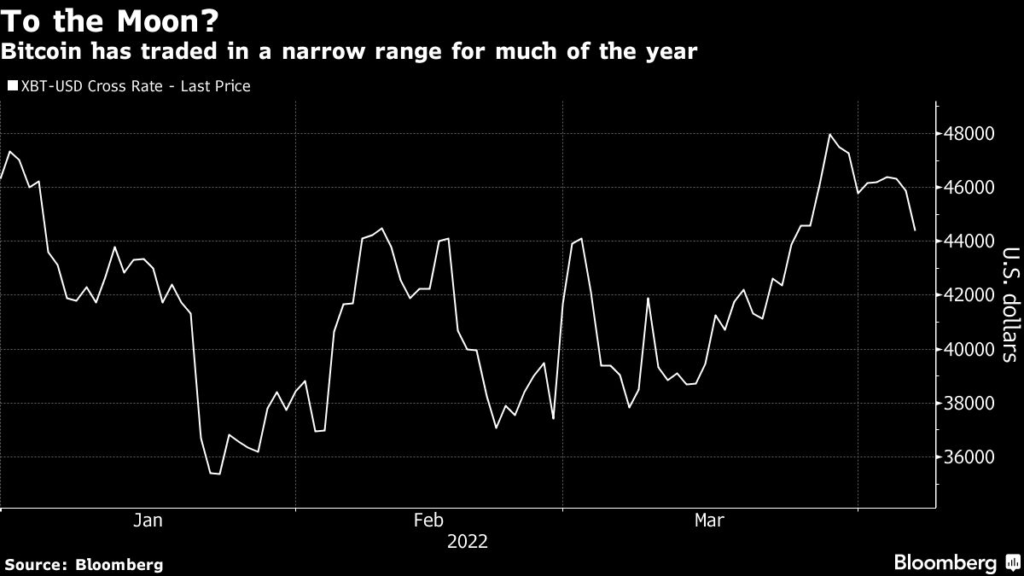
Novogratz also reiterated a call that Bitcoin will eventually reach a price of $500,000 and eventually $1 million. The largest digital currency fell about 3.3% to $44,366 as of 10:34 a.m. Eastern time.  

“I go to bed and I pray that the stewards of the U.S. economy don’t screw it up,” he said, adding that he has Russian friends who have gone “bankrupt” recently. “And so I really do pray that the dollar is going to be strong and it doesn’t go to infinity because Bitcoin going to infinity means the rest of the Western world has really fallen apart,” he said, though Bitcoin can reach his price targets “with stability in the West.”

Bitcoin has recently traded in a narrow range — it hasn’t been able to meaningfully break out above $48,000 and is down so far this year. Proponents have been debating which of its narratives — including whether it’s an inflation hedge or not — is most prevalent at the moment and which story could likely end up sticking for the long run. 

Novogratz said that though Bitcoin has largely traded in tandem with the tech-heavy Nasdaq 100, it could be in the process of disabusing itself from that relationship. Bitcoin’s purpose, he says, won’t be for purchasing everyday items, like shoes. But, “it’s that I’m going to take some of my wealth and preserve and store it there.” The coin, he added, is becoming a part of institutional portfolios.

More stories like this are available on bloomberg.com

©2022 Bloomberg L.P.
Biden’s Commerce Chief Tests Positive for Covid, Has Mild Symptoms

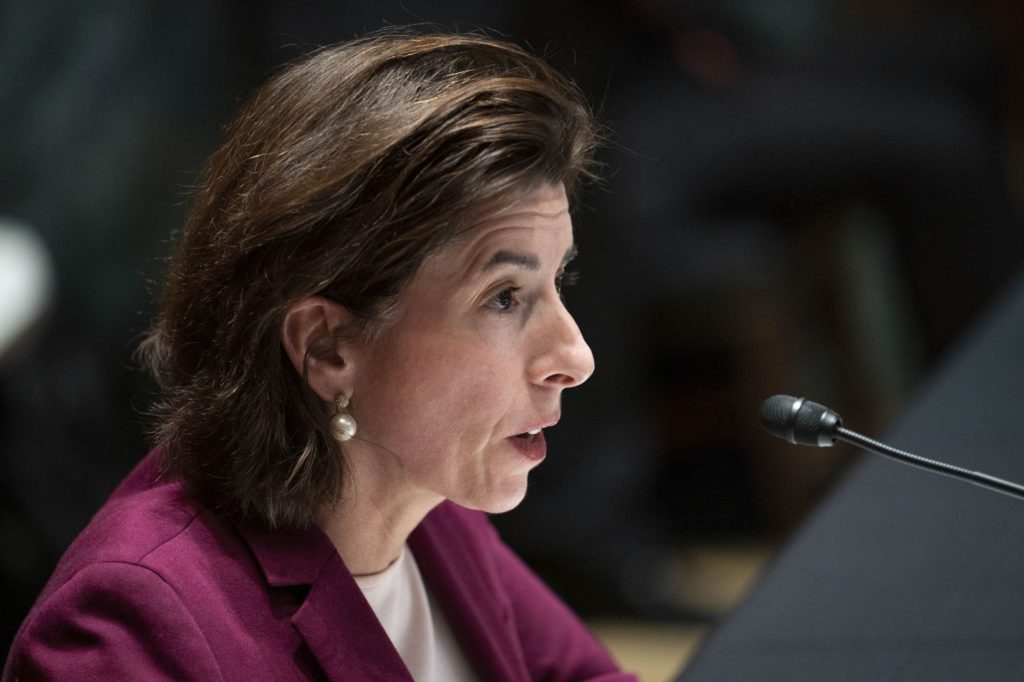
(Bloomberg) — President Joe Biden’s commerce chief tested positive for Covid-19 on Wednesday after experiencing mild symptoms and is isolating at home.

Commerce Secretary Gina Raimondo — who is fully vaccinated and boosted — got the diagnosis through an at-home antigen test, her office said in a statement Wednesday. Raimondo is confident that the vaccine prevented her from experiencing more significant symptoms and is sharing the news of her positive test out of an abundance of transparency, her department said.

Raimondo, 50, will isolate at home for five days and return to the office after she has tested negative for the virus, Commerce said. During that time, she will continue to work from home. She’s in the process of notifying people with whom she may have been in close contact as defined by the Centers for Disease Control and Prevention, and hasn’t had close contact with Biden, according to a Commerce spokesperson.

The former Rhode Island governor is at the center of many of the Biden administration’s biggest economic initiatives, including its push to get Congress to approve $52 billion for the American semiconductor industry to counter China and its campaign to cut off Russia’s access to cutting-edge technology over President Vladimir Putin’s invasion of Ukraine. 

Read more: Raimondo Pledges Chips Money for Training That Boosts Diversity

The secretary spoke at the North America’s Building Trades Union’s legislative conference in Washington on Tuesday, a gathering of hundreds of construction professionals, where she promoted the chips agenda and infrastructure plans such as investing $50 billion to expand broadband in rural areas and boosting job opportunities for women and minorities. 


More stories like this are available on bloomberg.com

©2022 Bloomberg L.P.
U.K. Shoppers to Get Buy Now, Pay Later Option at Westfield Malls

(Bloomberg) — ClearPay Finance Ltd. is partnering with mall landlord Unibail-Rodamco-Westfield in the U.K., continuing the buy-now-pay-later provider’s expansion into brick and mortar retail globally. 

Customers at 13 stores in Westfield’s pair of giant London shopping centers will be given the option to pay in installments through ClearPay, which is known as Afterpay outside Europe. 

It adds to ClearPay’s U.K. partnerships with National Express and London Fashion Week, as well as an existing tie-up with Westfield in the U.S. 

ClearPay, whose Australian parent firm was acquired by Block Inc. for $29 billion in January, is working with Westfield to give customers more options in-store as the retail industry recovers from the pandemic, co-founder Anthony Eisen said in an interview with Bloomberg.

“We are fully committed to the U.K market and looking to grow the team,” Eisen said. ClearPay already has 2.5 million active customers in the country and Eisen said buy-now-pay-later could soon account for 10% of e-commerce spending. 

The firm has responded to a U.K. consultation on regulating buy-now-pay-later loans, with the results expected this spring. New spending platforms including Klarna and Affirm have grown rapidly, fueled by younger customers who are spreading the cost of purchases while spurning credit cards. They aren’t covered by existing rules governing other short-term debt such as payday loans.

The co-founder welcomed regulation and said the process had been one of “engagement and learning,” but appealed to lawmakers “not to stymie competition.”

“The discussions in the U.K. are very similar to the conversations in Australia a few years earlier. Now 15-20% of all Australians use it,” Eisen said at the Innovate Finance Global Summit in London. 

Buy-now-pay-later differs from credit cards by covering typically smaller purchases and quicker repayments, Eisen said. “We recognize millennials and Gen Z don’t want to sit in a world of revolving debt,” he said.

More stories like this are available on bloomberg.com

©2022 Bloomberg L.P.

Dell, HP Shares Hit by Growth Worry as Fed Tightening Looms

(Bloomberg) — These are tough times for hardware stocks.

Investors are souring on Dell Technologies, HP Inc., and Hewlett Packard Enterprise Co. on concern that surging inflation will curb consumer spending. At the same time, the Federal Reserve’s effort to damp those price increases is likely to crimp the economy in coming months, further denting sales. 

In that environment, investors are turning their backs on computer makers despite their having some of the cheapest valuations in the tech sector. Instead, they’re looking to companies that are less dependent on the economic cycle to boost their sales, such as Apple Inc. and Amazon.com Inc.  

“Investors are moving to growth — that’s where the backdrop is more defensible,” said Ted Mortonson, a technology strategist at Robert W. Baird & Co.

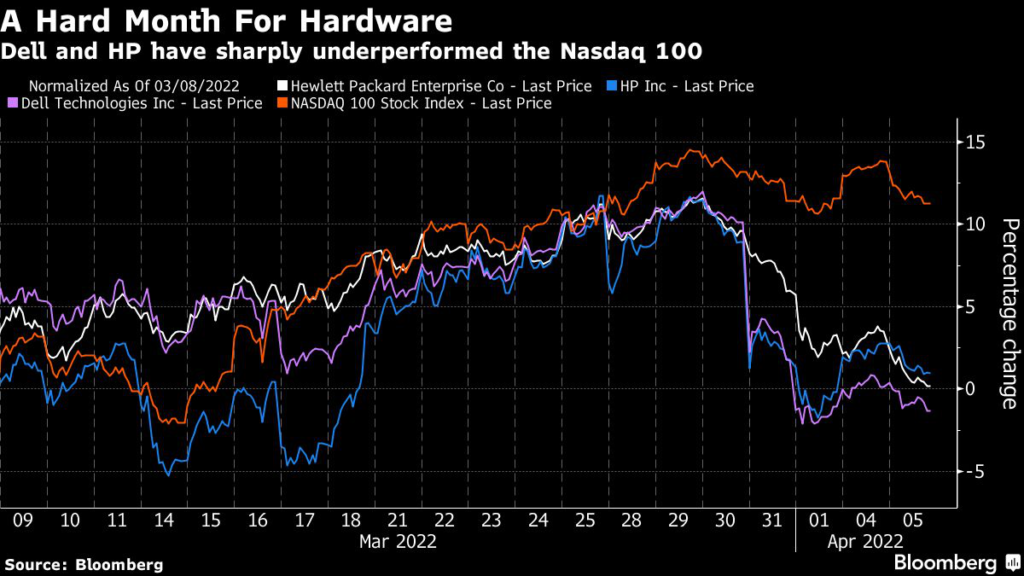
Dell fell 11% last week in its biggest decline since February, while HP posted its biggest slump since May 2020. Morgan Stanley downgraded both stocks on a weaker outlook for computer and hardware spending due to rising costs. Dell was also cut at Goldman, which wrote that moderating demand among low-end consumers was enough to offset its attractive valuation.

Hardware companies have been outperforming this year as the prospect of higher interest rates sparked a flight out of growth stocks with high valuations and into the cheaper, older group of legacy tech firms. Looking at just the past few weeks, though, investors have been selling out of these firms on economic growth concerns.

The cautious view toward so-called value stocks stands in contrast to the recent rebound in megacaps like Apple, Amazon and Alphabet Inc., which are seen as reliable investments for long-term growth. Growth tech stocks have risen 7% since March 14, when the Nasdaq 100 Index bottomed, while value tech has dropped 14% over the same period.

The recent selloff has made hardware stocks cheaper than they already were. Dell now sells for 7.2 times estimated earnings, its lowest level since November, while HP trades at about 8.3 times. Both are a fraction of the Nasdaq 100’s multiple near 25, or of Apple’s 27.5 figure. But that hasn’t drawn dip buyers.

“Megacaps throw off a tremendous amount of free cash flow and have defensible tailwinds in a dicey and uncertain economic environment,” Mortonson said.

Earnings projections paint a similar picture. Analysts predict that profits for tech hardware and equipment companies will increase by 8.8% in 2022, lower than the 13% expected for the tech sector overall and the S&P 500’s 10%, according to data compiled by Bloomberg Intelligence. Counterpoint Research predicts that global PC shipments will fall for the first time in four years as the pandemic-fueled demand for computers cools. 

Tech Chart of the Day

Tech investors are being treated to a wild ride in 2022. The Nasdaq 100 Index fell as much as 2.5% in early trading on Wednesday, and if losses hold it would be the 14th time it has fallen by at least 2% this year. To put that in perspective, that means the tech-heavy gauge has averaged a drop of 2% or more once every five trading days. That would be the highest percentage since the global financial crisis when the benchmark fell by a record 42%.  

Top Tech Stories

  • Elon Musk refiled the disclosure of his stake in Twitter Inc. to classify himself as an active investor, making the change after taking a seat on the social media company’s board.
  • Twitter said it’s starting internal testing of an edit button, and that work on the feature began last year — before new top shareholder and board member Musk polled users on the topic.
  • Apple Inc. will hold its annual Worldwide Developers Conference virtually for the third year in a row, the event will take place from June 6 to June 10
  • Paytm, the Indian digital-payments pioneer grappling with a regulatory audit of its data-management systems, expects to break even on an operating basis over the next year and a half
  • Samsung Electronics Co. is expected to report roughly 40% growth in its first-quarter profit thanks to strong Galaxy smartphone sales before the breakout of war in Ukraine
  • Analog Devices Inc. said revenue in the current period may exceed its previous forecast range, indicating that demand remains strong and downplaying concerns that customers are stockpiling inventory
  • The wait times for semiconductor deliveries rose slightly in March, reaching a new high, after lockdowns in China and an earthquake in Japan further hampered supply

(updates Nasdaq 100 Index move)

More stories like this are available on bloomberg.com

©2022 Bloomberg L.P.

ESPN to Launch Its First NFT, Featuring Tom Brady’s Documentary

(Bloomberg) — ESPN is wading into the world of non-fungible tokens.

The Walt Disney Co.-owned sports outlet is collaborating with Autograph, a Web3 brand co-founded by Tom Brady, and will feature the seven-time Super Bowl champion in its first NFT, based on the quarterback’s “Man in the Arena” series on ESPN+.

The NFT is set to drop Wednesday and will be for sale on DraftKings Marketplace, according to a statement.

The 44-year-old Tampa Bay Buccaneers quarterback had announced his retirement in February before reversing course, declaring he would return for a 23rd NFL season. Brady has been active off the field in recent years, launching diets and clothing lines, among other ventures.

Read more: Tom Brady files for dozens of trademarks from food to furniture

More stories like this are available on bloomberg.com

©2022 Bloomberg L.P.
ESPN Is Launching Its First NFT, Featuring Tom Brady

(Bloomberg) — ESPN is wading into the world of non-fungible tokens.

The Walt Disney Co.-owned sports outlet is collaborating with Autograph, a Web3 brand co-founded by Tom Brady, and will feature the seven-time Super Bowl champion in its first NFT, based on the quarterback’s “Man in the Arena” series on ESPN+.

The NFT is set to drop Wednesday and will be for sale on DraftKings Marketplace, according to a statement.

The 44-year-old Tampa Bay Buccaneers quarterback had announced his retirement in February before reversing course, declaring he would return for a 23rd NFL season. Brady has been active off the field in recent years, launching diets and clothing lines, among other ventures.

Read more: Tom Brady files for dozens of trademarks from food to furniture

More stories like this are available on bloomberg.com

©2022 Bloomberg L.P.

Biden Aide Deese Says Semiconductor Shortage Cost 1% of U.S. GDP

(Bloomberg) — President Joe Biden’s top economic adviser said that a shortage of semiconductors last year probably shaved a full percentage point off U.S. economic output in 2021, and that administration officials will brief Congress on the crisis Wednesday.

“We are 100% vulnerable to foreign supply chains on those advanced semiconductors,” the director of Biden’s National Economic Council, Brian Deese, told reporters at a breakfast hosted by the Christian Science Monitor on Wednesday. “The best estimates are that the lack of available semiconductors probably took a full percentage point off of GDP in 2021.”

Commerce Secretary Gina Raimondo, White House National Security Adviser Jake Sullivan and Deputy Defense Secretary Kathleen Hicks will hold a classified briefing on Wednesday for lawmakers on the chip shortage, Deese said.

Supply-chain bottlenecks quickly emerged in the vital semiconductor industry when pandemic-related lockdowns took effect in locations spanning the globe. Combined with a surge in demand for goods — spurred by consumers shifting their spending away from services — that caused a dire shortage of chips, affecting the automobile along with many other industries.

Auto-industry sales fell about 20% in the fourth quarter of 2021 and suffered the worst second half since the Great Recession more than a decade ago. The mis-match between supply and demand has propelled prices not only of new vehicles, but used ones as well — contributing to inflationary pressures that are undermining American households’ finances.

Legislation Pending

The White House is calling on Congress to enact a bill that includes nearly $52 billion for the semiconductor industry, to stoke domestic production and ease supply-chain strains over time. It’s part of broader legislation aimed at strengthening U.S. competitiveness against China.

The Biden administration has also been seeking to coordinate with allies such as South Korea on building supply chains of nations friendly to Washington.

Deese said Wednesday that more than a dozen members of Congress will participate in the classified briefing. Among them: GOP Senators John Cornyn, Todd Young and Rob Portman, he said.

More stories like this are available on bloomberg.com

©2022 Bloomberg L.P.

Bankman-Fried’s Crypto Exchange FTX to Launch in West Africa

(Bloomberg) — FTX, a cryptocurrency exchange that’s been valued at $32 billion, will begin rolling out its platform in Africa in the next few weeks.

The platform will be launched first in West Africa, Elizabeth Rossiello, the founder of AZA Finance, a Kenyan company that started in 2013 and is partnering FTX on the continent, said in an interview on Tuesday. She declined to be more specific. 

FTX currently only has “piecemeal competitors” in Africa and plans to offer its products to a continent with a rapidly growing population and some of the world’s fastest expanding economies, Sam Bankman-Fried, chief executive officer of FTX, said in the same interview. 

The companies seek to capitalize on Africa’s population which is expected to double by 2050, as well as the already rapid adoption of digital technologies by Africans who often have little access to traditional banking services. 

The platform will be rolled out in three African countries in coming months and within two years the two companies hope to operate in all major and secondary markets on the continent, Rossiello said. 


More stories like this are available on bloomberg.com

©2022 Bloomberg L.P.

Close Bitnami banner
Bitnami