Bloomberg

Twitter Tests Edit Button, Says Work Began Before Musk Poll

(Bloomberg) — Twitter Inc. said it’s starting internal testing of an edit button, and that work on the feature began last year — before new top shareholder and board member Elon Musk polled users on the topic.

The ability to edit tweets after posting them has been the most-requested feature for many years, Jay Sullivan, Twitter’s head of consumer product, wrote in a thread elaborating on the company’s announcement. Roughly 74% of the more than 4.4 million votes cast in Musk’s poll this week were in favor of adding the functionality.

Musk, 50, started the poll after disclosing Monday that he’d taken a more than 9% stake in Twitter. He filed a new form with the Securities and Exchange Commission on Tuesday classifying himself as an active investor, a day after he was late submitting a form for passive shareholders. Twitter agreed on Monday to add Musk to its board.

Twitter posted a GIF on Tuesday hinting at how the edit feature would work. Sullivan, the consumer product chief, said the company would seek “input and adversarial thinking” before launching the functionality.

“Without things like time limits, controls, and transparency about what has been edited, Edit could be misused to alter the record of the public conversation,” he wrote. “Protecting the integrity of that public conversation is our top priority when we approach this work.”

Twitter shares fell 2.1% to $49.87 as the market opened in New York on Wednesday. The stock had gained 30% after Musk disclosed his investment, notching the biggest two-day gain since the company’s 2013 initial public offering.

(Updates with shares in final paragraph)

More stories like this are available on bloomberg.com

©2022 Bloomberg L.P.

Axie Developer Raises $150 Million as Gamers Flee After Hacking

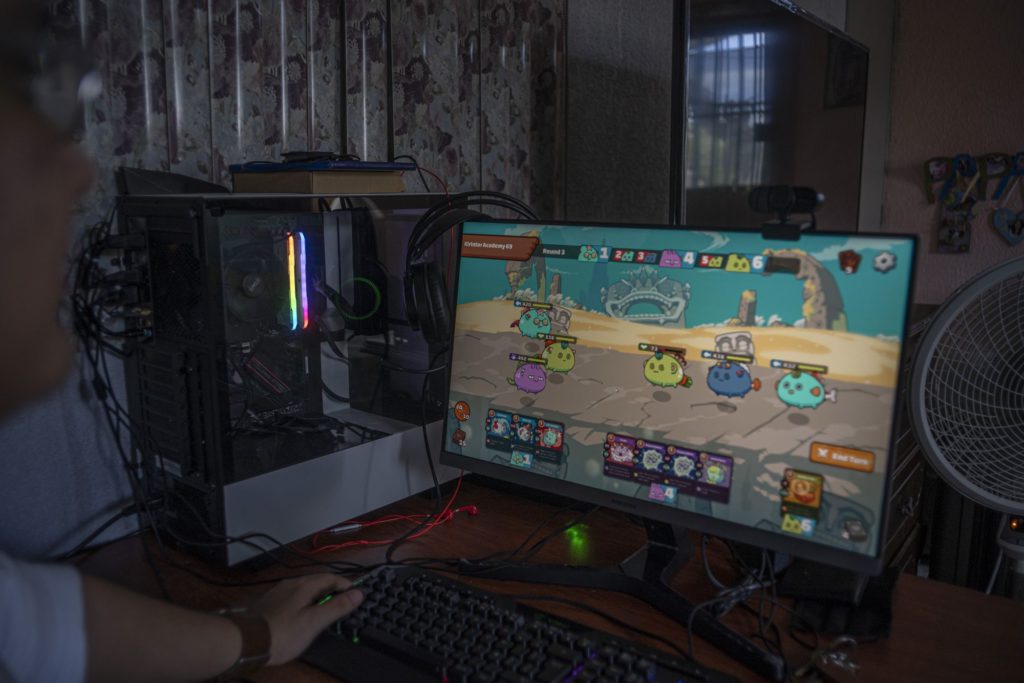
(Bloomberg) — Sky Mavis, the developer of the popular play-to-earn Axie Infinity video game that lost about $625 million in a hack last month, raised $150 million to help stem an exodus of players after they were unable to access gaming proceeds. 

The money will be used to partially reimburse participants and enhance security measures. Binance, the world’s largest cryptocurrency exchange and one of the primary trading platforms for the digital tokens used in conjunction with the game, led the funding round, the companies said in a statement Wednesday. Other participating investors include the gaming and blockchain company Animoca Brands, the venture capital firm Andreessen Horowitz, Dialectic and Paradigm. 

The capital will be combined with funds from balance sheets of Vietnam-based Sky Mavis and Axie Infinity, and used to make sure the users affected by the hack of a software bridge known as Ronin that allowed participants to use tokens from different blockchains. The funding raised is only a third of the capital lost during the hack. 

“Sky Mavis is committed to reimbursing all of our users’ lost funds and implementing rigorous internal security measures to prevent future attacks,” Trung Nguyen, chief executive of Sky Mavis said in a emailed statement. 

The Ronin Network is increasing the number of validators that handle transactions to 21 from 5 to bolster security.

Binance is supporting the Ronin Network by providing Ether withdrawals and deposits for Axie Infinity users. It is expected the Ronin bridge will open once it has undergone a security upgrade and several audits, which can take several weeks.  

Since disclosing the hack, Axie Infinity had to restrict the ability of players to move digital money out of the virtual world and has seen the number of daily active users decline. Sky Mavis has stressed it remains committed to reimbursing players as soon as possible.

The 56,000 Ether taken from the Axie DAO treasury will remain undercollateralized as Sky Mavis works with law enforcement to recover the funds. If the stolen funds are not fully recovered within two years, the Axie DAO will vote on next steps for the treasury.

In the meantime the hacker behind the Ronin attack moved 1,400 Ether to Tornado Cash on Monday, a crypto asset mixing services as reported by CoinDesk. 

More stories like this are available on bloomberg.com

©2022 Bloomberg L.P.

Tesla’s ‘Cyber Rodeo’ and SpaceX’s Launch Up Next in Elon Musk’s Wild Week

(Bloomberg) —

Elon Musk is having quite the week.

On Monday, we learned Tesla’s CEO had taken up a more than 9% stake in Twitter, making him the social networking company’s largest shareholder. The service the world’s richest person uses to ask for input and promise product improvements then announced Tuesday that Musk will join its board of directors.

We’ll see what fresh surprises Musk has next for Twitter after these disclosures drove its shares up 30% in the course of just a couple sessions — the biggest two-day jump for the stock since the company’s initial public offering. This much we do know: on Thursday, attention will turn back to Tesla. And on Friday, the focus will be on SpaceX, the rocket company Musk runs.

Musk will first host a massive party at Tesla’s new factory in Austin, Texas. The company has a permit to host 15,000 people for what it’s calling a “Cyber Rodeo,” nodding to the Cybertruck the CEO unveiled to enormous fanfare in November 2019 but hasn’t put into production yet. Fans are clamoring for tickets — including on Twitter — and heading to the Lone Star State’s capital in hopes of being someone’s plus-one.

Tesla has put off rolling out the Cybertruck, Semi or Roadster until no sooner than next year, because the company is parts-constrained and would produce fewer vehicles if it tried to add more models to the lineup, Musk said in January. This dragged on Tesla shares early this year, but the opening of the company’s other new factory, near Berlin, and last week’s signal another stock split is coming have done wonders for the stock.

The Rodeo promises to be a late night: doors open at 4 p.m. and remarks begin at sunset, according to Tesla’s event page. The next morning, SpaceX has scheduled another major milestone launch.

The mission for a Dragon capsule aboard a Falcon 9 rocket will be to pull off the first all-private human spaceflight mission to the International Space Station.

SpaceX already has ferried NASA astronauts to and from the ISS and recently sent its Starlink gear to Ukraine to support the government with its satellite broadband service.

Tesla doesn’t spend money on traditional advertising, and this manic schedule shows it doesn’t need to. There’s no escaping Musk’s command of the news cycle.

I’d imagine Musk will be in an expansive and jolly mood Thursday evening. The Cyber Rodeo is a big event, marking Tesla’s next phase of growth and further establishing Texas as Musk’s new center of gravity.

One of the big questions I have: who will be at Elon’s big party? Three names I’d be on the lookout for: Texas Governor Greg Abbott, Joe Rogan and maybe even Jack Dorsey.

If you’ll be at the Rodeo, do let me know: dhull12@bloomberg.net.

More stories like this are available on bloomberg.com

©2022 Bloomberg L.P.

Social Media Influencers Are Sharing Their Tricks — for a Fee

(Bloomberg) — As a travel vlogger and social media influencer, Christina Galbato got a lot of messages from her online followers. They requested tips for hotels and restaurants, but many sought another kind of advice. 

“A lot of what they were asking was: How can I do what you do?” the 29-year-old recalls. 

That’s why Galbato launched “The Influencer Bootcamp,” 20 hours of prerecorded lessons in how others can monetize their social media presence. She charges $700 for a package that includes that course as well as other tools, such as sample email pitches and access to a members-only Facebook support group. Galbato says she’s on track to take in $4 million in revenue this year.

The influencer marketing business is already a $20 billion industry and one that’s projected to grow as social media users increase and brands seek out online talent to pitch their products on YouTube, Instagram and other sites. It’s such a big business, influencers are now selling courses to each other on a variety of topics. Chefs with big followings give online cooking lessons. Financial strategists peddle money planning tips. And others, like Galbato, teach about the art of viral marketing itself. 

Courses vary in length and focus. Darius Moravcik, a 32-year-old technology entrepreneur who writes about online marketing under the name Darius Mora, documents his own journey as a TikTok personality and shows users how he boosted his follower count from zero to more than 35,000 in three months. Simple tricks — like posting often and consistently — can help users increase their followings, according to Moravcik.

“If you study the formula, anyone can do it,” he said. 

Kristen Bousquet, a 28-year-old “influencer mentor” who created a course in January 2021, sells weekly live lessons as well as access to planning materials like organizational calendars and templates outlining how best to negotiate with potential sponsors. Like Moravcik, many of the lessons are easy to implement. Bousquet advises her students to limit TikTok videos to 10 seconds to increase the chance viewers will watch them multiple times, for example.

Prices for the courses also vary. Moravcik sells his prerecorded class, including roughly eight hours of content, for under $40. Bousquet markets her ten-week course for just under $400. Galbato charges as much as $9,000 for six months of live coaching. Her premium offering comes with one-on-one support, as well as a two-day retreat with other students in the program. Her sales overall doubled last year, she said. 

Successful online courses can diversify influencers’ incomes. “If you want to be a creator, you need to be doing multiple things,” says Mae Karwowski, chief executive officer of influencer marketing agency Obviously. 

For TikTokers, multiple revenue streams can be especially important. Creators like science commentator Hank Green and technology reviewer Safwan AhmedMia have publicly complained that TikTok underpays its influencers, especially relative to other sites such as YouTube. They allege that TikTok’s “Creator Fund” doesn’t offer enough resources to pay all of its successful content posters, especially as more people go viral on the platform. TikTok said its fund is just one way creators get compensated, and the social media app’s tools allow the creators to be compensated directly by their fans.

Not all influencers have found online courses worthwhile, however. A year and a half ago, social media strategist Caitlin Jenco paid $200 to take an Instagram management course. 

“The information was generic and lacked value beyond what I could find on Google for free,” she said. Jenco, who has over 110,000 followers on TikTok, describes herself as “anti-course.”

Instead of teaching online classes, she charges a monthly rate to consult with companies and individuals one-on-one. The fees range from $500 to $4,500, based on the clients’ needs. Sometimes she can answer questions in an email or text message. Other students require a more substantial review of things like the scripts for videos. 

“It’s very much tailored to where the creator is,” Jenco said. 

While students risk wasting money, the social media teachers are ultimately increasing their own competition. Bousquet, the influencer mentor, sees that as a benefit, with more people negotiating higher fees from sponsors.

“I won’t have to fight with brands that don’t want to meet me at my rates because another influencer is OK doing it for free,’” she said.

More stories like this are available on bloomberg.com

©2022 Bloomberg L.P.

Fake Bank Records Are Readily Available as U.S. Hunts for Fraud

(Bloomberg) — For anyone who wants a phony pay stub or doctored tax return, an easy source is just a click away.

A website called banknovelties.com claims it can provide “fake bank statements” as well as “fake pay stubs,” “fake utility bills” and “fake US tax returns (1040).” They’re readily available for as low as $50 each. 

It may seem like a joke. But as the U.S. government pursues billions of dollars in fraud tied to Congress’s pandemic-relief measures, a common thread has emerged: The people who stole taxpayer money did it using bogus documents. And those are easily obtained on websites that are fully functional across the internet. 

“Sites like this are designed to create documents that evade automated fraud detection tools, and even human underwriters,” said Jesse Carlson, general counsel of commercial-finance lender Kapitus, and a former counsel in the professional liability and financial crimes section of the Federal Deposit Insurance Corp.

When Congress authorized as much as $669 billion in forgivable pandemic loans from the Small Business Administration two years ago, a large chunk of that money disappeared into the hands of bad actors who claimed to run businesses in need of funds. The U.S. Justice Department is throwing more resources into identifying and prosecuting these fraudsters, with the Secret Service estimating that more than $100 billion has been stolen from a range of programs under the Coronavirus Aid Relief and Economic Security Act.

The SBA’s Paycheck Protection Program was particularly susceptible to fraud because banks were urged to quickly get money out to prevent the pandemic from causing an economic crisis. Under the administration’s rules, lenders were “held harmless for borrowers’ failure to comply with program criteria” as part of its goal of acting expeditiously. 

Banks could thus suspend their normal due diligence, setting up “one of the top frauds of all time,” said BJ Moravek, a former Secret Service agent and bank examiner. 

“I haven’t seen anything that overshadows this,” Moravek, who started his career in the 1990s tracking down “prime bank guarantee” bonds, fictitious instruments peddled by con artists to gullible investors, said of CARES Act scams. 

Few of the CARES Act court filings identify how the defendants secured their doctored paperwork. But Moravek, now a director at the Kaufman Rossin accounting firm, pointed to websites such as banknovelties.com as examples of just how easily these frauds are perpetrated.

The site promotes a range of paperwork, some touted merely as “educational financial novelties.” It offers authentic-looking documents from scores of lenders to create bank statements that look like they originated from giants like Bank of America Corp. and Wells Fargo & Co., as well as smaller institutions like Nevada State Bank and Bethpage Federal Credit Union. 

Buyers can also get utility bills, frequently used for address verification, that look like they are from the likes of Florida Power & Light, Pacific Gas & Electric Co. and London-based National Grid. (For U.K. customers, the website has a separate list of British, European and Australasian banks.)

The website, which claims to have been in business since 2006, currently operates as Bankus in the U.S. and Banksy in the U.K. Its roots are murky: The company claims to have offices in New York and London, but it doesn’t provide a physical address or phone number. Bankus doesn’t appear to be registered in New York state as a business. 

All correspondence is via email, and payment is accepted in Bitcoin only. Banknovelties.com’s IP address is listed as the Netherlands, and the sometimes stilted wording on the website suggests the people behind the business might not be native English speakers.

The company didn’t respond to email requests for comment and for further information about its business practices. Banksy offers a “get in touch” button on its site for prospective partners next to a signature with a familiar name: Richard Nixon. And yes, the signature looks remarkably similar to that of former U.S. President Richard Nixon, who died in 1994.

Quick Response

As a test last year, Moravek sent an inquiry to the site asking whether it could provide a handful “novelties” in the forms of fake IRS documents. The response came back within hours:

“Dear Customer: We can do all those 5 novelties at a total of $500 USD as a standard order (3 business days completion) or as $650 USD for 24 hours delivery. If you agree to proceed then send us all exact data to insert and we will send you payment instructions to proceed. Please advise.”

While similar products might proliferate on the dark web, the banknovelties site is accessible to anyone. And it has competition. A quick Google search reveals multiple sites that create fake documents. Most state that their products are for educational or entertainment purposes, rather than any unauthorized use.  

Banknovelties.com uses the disclaimer “Your use of any information or materials on this website is entirely at your own risk, for which we shall not be liable.”

Buying or selling fake bank documents may not be illegal outright, though using the name of a real bank likely would be, said Jacob Frenkel, a former state and federal prosecutor now at law firm Dickinson-Wright. The real liability centers on the paperwork’s use.

“Where the clear intended purpose or logical use is to enable fraudulent activity, then the person and company selling the fake documents could be charged criminally,” Frenkel said, adding that the chances of prosecution go way down if the site is operated outside of the country.

The last significant enforcement action against purveyors of phony documents in the U.S. took place in 2018, when the Federal Trade Commission shut down three homegrown sites that trafficked in fake financial documents: Fakepaystubonline.com, noveltyexcuses.com and PaycheckStubOnline.com. The FTC charged each of the three owners with unfair trade practices.  

The FTC didn’t respond to a request for comment about banknovelties.com.

Moravek shared his discovery of the website last year at a forensic accounting conference sponsored by the U.S. Treasury Department and Florida Atlantic University. 

“The law-enforcement people at the conference were astonished,” he said. “They didn’t realize it existed.” And yet, one year later, it’s still in operation.

More stories like this are available on bloomberg.com

©2022 Bloomberg L.P.

Binance.US Raises About $200 Million at $4.5 Billion Valuation

(Bloomberg) — Binance.US, the American affiliate of the largest global cryptocurrency exchange, has raised more than $200 million at a valuation of $4.5 billion, the first external funding since its inception about two years ago. 

Investors include Circle Ventures, VanEck and Foundation Capital, Binance.US said Wednesday in a statement. Gold House, which focuses on combating anti-Asian hate, and Gaingels, which supports LGBTQ causes, also joined the round. 

The fundraising comes as its bigger competitors, such as Coinbase Global Inc and FTX, have ramped up advertising to gain U.S. market share. Binance.US plans to use the funding for its first marketing push, while expanding products and services, potentially through M&As. It plans to emphasize low-cost crypto trades. 

“When you look at Coinbase retail users, on average, they are being charged 1.5%, sometimes up to 3%. For the same users transacting and trading on Binance.US, we are charging 0.1%,” Binance.US Chief Executive Officer Brian Shroder said in an interview. “We are going to educate people on these price differences.” 

Shroder, a former executive at Ant Group Co., met Changpeng Zhao, the founder and CEO of Binance Holdings Ltd., when the two explored an unrealized partnership between their companies. 

He was promoted to the CEO of Binance.US last October, after Brian Brooks, a U.S. comptroller of the currency during the Trump administration, abruptly resigned from the job months into his tenure. 

Shroder said in September that he foresees an IPO in the next two to three years. Binance.US, which is available in 45 states, gets about 70% of trading volume from institutions. Retail investors, who pay higher fees, contribute the majority of revenue.  

Binance.US is operated separately from Binance.com, licensing trading technology from the global arm. The U.S. entity has been on a hiring spree, especially for risk and compliance staff. 

“Regulation is an opportunity for us,” Shroder said. “This is the first time we are going out and speaking to regulators with our own voice” separate from Binance. 

He declined to comment on a February Wall Street Journal report of a probe by the Securities and Exchange Commission of the exchange and two trading firms with ties to Binance’s founder. 

“We are very focused on establishing and building on regulatory discussions, whether at state, federal, or local levels,” Shroder said. 

More stories like this are available on bloomberg.com

©2022 Bloomberg L.P.
Betting Against Bitcoin May Get Easier With Futures ETF Filing

(Bloomberg) — The firm behind the first U.S. Bitcoin futures ETF wants to launch a product that will bet against the world’s largest cryptocurrency.

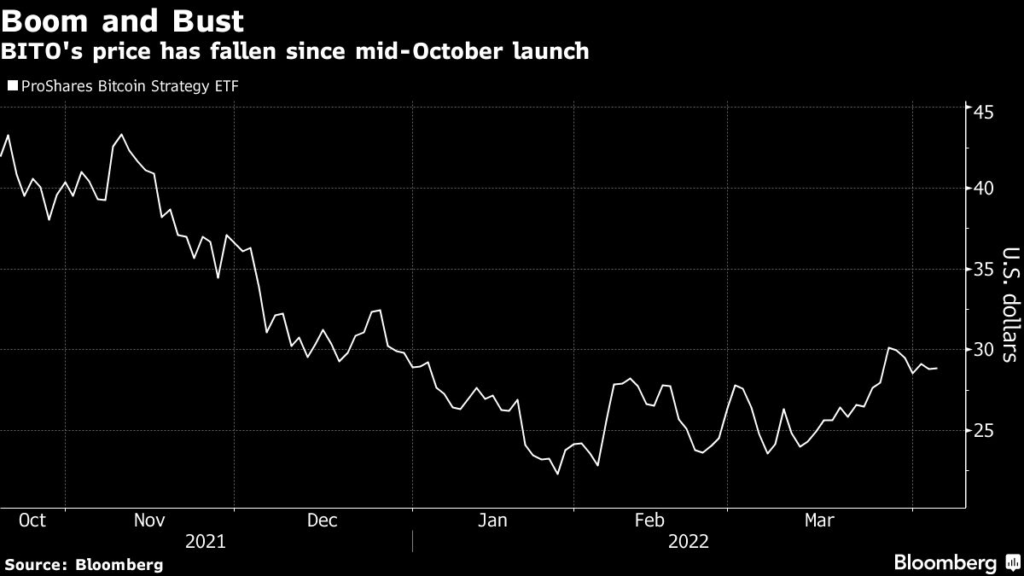
The ProShares Short Bitcoin Strategy exchange-traded fund would track the inverse performance of an index of Bitcoin futures, according to Tuesday filing with the U.S. Securities and Exchange Commission. ProShares introduced the Bitcoin Strategy ETF (ticker BITO) in October, which ranked among the most popular ETF debuts on record.

If approved by regulators, the proposed fund would be the first U.S. ETF betting against the performance of Bitcoin futures. Rival issuer Direxion filed for a similar strategy in October following BITO’s launch, but pulled the application at the request of the SEC. 

This time around it’s likely that the SEC is more comfortable with the possibility of an inverse futures ETF, according to Bloomberg Intelligence.

“ProShares nailed the SEC’s openness for a futures ETF and so there’s no reason to doubt them here, especially because BITO trading has been fine, it clearly works,” said Eric Balchunas, ETF analyst at BI. “This could mean the SEC is ready to take the next baby step.”

The filing lands with Bitcoin stuck in a rut. The coin is currently trading near $45,000, up from January’s lows near $33,000 but down significantly from November’s highs of almost $69,000. Short interest as a percentage of shares outstanding on BITO currently stands near 5.5%, down from a record 8% last month, data from IHS Markit Ltd. show.

Fees and a ticker for the proposed offering have yet to be disclosed. 

More stories like this are available on bloomberg.com

©2022 Bloomberg L.P.
South Africa Central Bank Urges Engagement on Blockchain

(Bloomberg) — South African policymakers, legislators and regulators need more engagement with the fintech industry before distributed-ledger technology can be incorporated into the nation’s financial markets, according to a new report by the central bank and the Intergovernmental Fintech Working Group.  

A distributed ledger is a digital record of transactions and contracts maintained in a decentralized form across different locations. The technology underpins cryptocurrencies such as Bitcoin and is being experimented with in large parts of the global financial system. 

With legislative reforms in the payment system underway in South Africa, it’s an opportune time to consider how to treat distributed ledger-based platforms and the use of tokenization in financial markets, though efforts should be made to ensure rules are technology-neutral, principle-based and borne out of collaboration, the Reserve Bank and the working group said in a statement Wednesday. The two bodies have completed a joint proof-of-concept project exploring the policy and regulatory implications of distributed-ledger-driven innovation in financial markets. 

“The insights gained through practical exploration should lead to greater regulatory clarity — both for innovators and for regulators — and should be in the broader interest of ensuring a level playing field for all market participants,” Governor Lesetja Kganyago said in an online speech. Regulators should move with caution when considering developments before amending rules and should be “fully appreciative” that regulated entities need clarity to committing to distributed-ledger markets, he said.

Under the experiment dubbed Project Khoka 2, the central bank and working group issued, cleared and settled debentures using distributed-ledger technology and tokenized money to inform policy and regulatory reflections. The working group included the Johannesburg Stock Exchange. and South Africa’s top four banks — Absa Group Ltd., FirstRand Bank Ltd., Nedbank Group Ltd. and Standard Bank Group Ltd. 

To operate a distributed-ledger technology-based financial system, new capabilities are needed across all role players and new platforms will need to be integrated with legacy systems, the central bank and working group said said. The costs of such a move — that ought to be borne by all market players — will have to be offset against potential benefits, new standards, best practices and a supporting ecosystem will also have to be put in place. 

“A transition to a DLT-based system requires careful planning and execution and may involve running a DLT-based system in parallel to the existing system for a while, perhaps indefinitely,” they said.

(Updates with central bank governor’s comments in fourth paragraph)

More stories like this are available on bloomberg.com

©2022 Bloomberg L.P.

Nigeria Penalizes Lenders for Shielding Crypto Transactions

(Bloomberg) — Nigeria’s central bank fined several lenders for failing to comply with regulations that bar customers from transacting in cryptocurrencies.

The penalties are part of efforts by the central bank to ensure commercial lenders implement a February 2021 order to block trading in cryptocurrencies because of the threat that it says they pose to Nigeria’s financial system. In November, it ordered lenders to close the accounts of two individuals and a company for allegedly trading cryptocurrencies.

The West African nation accounts for the largest volume of cryptocurrency transactions outside the U.S., according to Paxful, a Bitcoin marketplace. Africa’s most populous country also has the largest proportion of retail users conducting transactions under $10,000, according to Chainalysis.

The Central Bank of Nigeria fined Stanbic IBTC Bank, the domestic unit of Standard Bank Group Ltd., 200 million naira ($478,595) for two accounts alleged to have been used for crypto transactions, Chief Executive Officer Wole Adeniyi said Tuesday during an investor conference call in Lagos. 

Access Bank Plc, the country’s biggest lender by assets, was fined 500 million naira for failure to close customers’ crypto accounts, according to a filing with the Nigerian Exchange Ltd. United Bank for Africa Plc incurred a 100 million naira penalty for digital-currency transactions by a customer, it said.   

While Stanbic IBTC followed the central bank directive, the transactions it was sanctioned for may have passed through its system undetected, Adeniyi said. The central bank was able to detect the relevant transactions using an “advanced capability” that Nigerian lenders don’t have access to, and they’ve asked the central bank to share the technology, he said.

“It doesn’t seem that they are going to entertain a refund, but they are now sharing intelligence with us to be able to kind of deter clients.”


More stories like this are available on bloomberg.com

©2022 Bloomberg L.P.

Pentagon’s Outgoing Data Boss Warns of Quantum Cyber Threats

(Bloomberg) — The U.S. Department of Defense’s outgoing chief data officer called for the Pentagon to make urgent investments to defend against potential espionage from quantum computers — nascent technology that could one day break the encryption that protects American secrets.   

In his first interview since leaving his post last month, David Spirk, who spent two years in his role, told Bloomberg News that the Pentagon needs to speed up efforts to counter adversaries who are developing military tools supported by advanced technologies such as artificial intelligence, machine learning and eventually quantum science. 

Quantum computing may prove far more able than existing technology to solve mathematical problems at exponentially faster speeds. That could enable operators to unscramble the algorithms that underpin encryption protocols, unlocking an array of sensitive data. 

“I don’t think that there’s enough senior leaders getting their heads around the implications of quantum,” Spirk said. “Like AI, I think that’s a new wave of compute that when it arrives is going to be a pretty shocking moment to industry and government alike.”

“We have to pick up pace because we have competitors who are also attempting to accelerate,” he added.

Spirk’s comments come amid warnings that U.S. adversaries, particularly China, are aggressively pursuing advanced technologies that could radically accelerate the pace of modern warfare. China is investing in AI and quantum sciences as part of its plan to become an innovation superpower, according to the Pentagon’s latest annual report to Congress on China’s military power. China is “at or near the lead on numerous science fields,” including AI and quantum, it said.

The National Security Agency, meanwhile, said last year that the adversarial use of a quantum computer “could be devastating” to the U.S. and its national security systems. The NSA said it could take 20 years or more to roll out new post-quantum cryptography that would resist such code-cracking.

Tim Gorman, a spokesperson at the Pentagon, said the Department of Defense was taking post-quantum cryptography seriously and coordinating with Congress and across government agencies. He added there was “a significant effort” underway.

A January presidential memo further charged agencies with establishing a timeline for transitioning to quantum resistant cryptography. 

Among the efforts underway to bolster defenses against quantum-based attacks, the National Institute of Standards and Technology, known as NIST, is seeking to select new quantum-proof encryption algorithms from seven finalists shortly as part of a global competition.

Jonathan Katz, computer science professor at the University of Maryland who submitted a “post-quantum algorithm” to the NIST competition, said the stakes in the NIST competition were high: an algorithm that later proved vulnerable would be “a disaster.” Once a choice is made, the U.S. Department of Defense faces a huge task in upgrading all its software and hardware that features algorithms, he said, adding that included not only servers and laptops but also parts of submarines, tanks, helicopters and weapons systems.

Experts generally assess large-scale quantum computing may be 15 to 20 years away if it is ever even developed, but the Pentagon’s Defense Advanced Research Agency, or DARPA, launched a project this February to explore the possibility that a breakthrough could be developed “much sooner.”

Joe Altepeter, who manages DARPA’s new quantum project, told Bloomberg there was a lot of “hype” over industry claims about the arrival of quantum computing, with several “hardware miracles” still standing in the way. Some of the smartest physicists he knew were divided over whether useful quantum computing would ever exist, Altepeter said, adding that the risk was such that it was important to develop resilient systems.

Spirk said the Pentagon needs to start preparing “now,” arguing military applications for quantum computing could be only five to 10 years away. The Pentagon needed to work at the same speed as commercial vendors that are already exploring ways to use quantum-resistant cryptography to safeguard financial and health-care sectors, he said.

If the U.S. doesn’t make the right investments in defensive quantum today, “then our concepts around encryption, data security and cybersecurity will be obsolete because the computers will break our cryptography,” Spirk said. He added that all the encrypted data that adversaries have already gathered would also risk exposure.

Spirk, a former U.S. Marine, became the first chief data officer at Special Operations Command before he joined the Pentagon. He said he left the chief data officer post after a two-year commitment to rejoin his family in Florida. The departure follows last year’s resignation of the U.S. Air Force’s first chief software officer, Nicolas Chaillan, who previously told the Financial Times that the U.S. was losing the AI race to China. 


More stories like this are available on bloomberg.com

©2022 Bloomberg L.P.
Close Bitnami banner
Bitnami